Research Methodology
3. FORMULATION OF RESEARCH
OBJECTIVES
"Objectives summarize what is to
be achieved by the study"
Why?
 To focus the study:
 narrowing it down to essentials
 To avoid collection of data that are not
strictly related to the objectives
 To organize the study in clearly defined
parts or phases
Why?
 Properly formulated objectives will:
 facilitate the development of your
research methodology
 will help to guide the:
collection,
analysis,
interpretation and
utilisation of data
Objectives and problem statement
 Objectives should be closely related to
the statement of the problem and
research question
 If the problem is “low utilization of
immunization services”:
 the objective of the study could be
“to identify the reasons for low
utilization, in order to find solutions”.
Types of Objectives
 General (ultimate) objective
 Specific (immediate) objectives
General objective
 What is expected to achieved by the
study, e.g.:
To identify the reasons for low vaccination
coverage in district "A" and to find solutions
Specific objectives
 Break down the general objective and
specify what you will do in your study,
where, and why e.g.:
 Quantifying the problem
 Distribution of the problem
 The reasons behind the problem
 How the results will be used:
 especially for HSR
Specific objectives
 Quantifying the problem: e.g.
To determine the level of vaccination
coverage in district "A" over the year
2017 as compared to the target
 Distribution of the problem: e.g.
Identify whether there are variations
in vaccination coverage related to rural
vs. urban, type of clinic etc.
Specific objectives
 The reasons behind the problem: e.g.
- To establish the reasons for low coverage as
seen by the clients, Health Worker, and
Community leaders e.g.
- distance between the home and clinic, availability
of refrigerator, acceptability of the service etc.
- the socioeconomic and cultural factors that may
influence the utilization of the service
Specific objectives
 How the results will be used: e.g.
- Make recommendation to all parties
concerned ( EPI' DG, Area DG, health staff and
mothers) concerning what the changes should
be made to improve coverage
- Work with all parties concerned to develop a
plan for implementing the recommendations
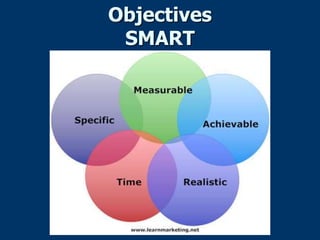
Objectives
SMART
Specific
 What exactly are we going to do and
for whom?
 Clear about:
what,
where,
When
Measurable
 Is it quantifiable?
 Can we measure it?
 How will we know we’ve achieved it?
Achievable
 Can we get it done in:
the proposed time frame
with the resources and support
available
Realistic/Relevant
 Why are we doing this?
 Is it really what we want?
 Able to obtain the level of change
reflected in the objective
Time bound
 Stating the time period in which the
objectives will be accomplished.
How should you state your objectives?
 Cover the different aspects of the
problem and its contributing factors in:
 a coherent way
 in a logical sequence
How should you state your objectives?
 Are clearly phrased in operational terms:
 specifying exactly:
what you are going to do
where
for what purpose
How should you state your objectives?
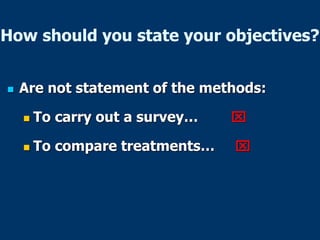
 Are not statement of the methods:
 To carry out a survey… 
 To compare treatments… 
How should you state your objectives?
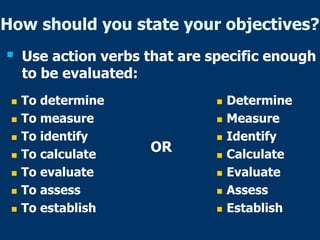
 To determine
 To measure
 To identify
 To calculate
 To evaluate
 To assess
 To establish
 Determine
 Measure
 Identify
 Calculate
 Evaluate
 Assess
 Establish
 Use action verbs that are specific enough
to be evaluated:
OR
How should you state your objectives?
 Avoid the use of vague non-action verbs
e.g. to understand, to study, to know
 The research objectives should not be too
many or too ambitious
 When the study is evaluated, the results
will be compared to the objectives
 If the objectives have not been spelled
out clearly, the study cannot be evaluated
HYPOTHESES
 It might be possible, in addition to objectives, to
develop explanation (hypothesis) for the
problem that can be tested
 Hypothesis is a prediction of a relationship
between one or more factors and the problem
under study that can be tested e.g.
 Vaccination coverage is lowest among non
educated mothers who does not know its
importance
 Vaccination coverage is lowest in the clinics
which has irregular supply with vaccine
Research question
 A hypothesis can be stated as a research
question e.g.:
“Is the vaccination coverage differ
according to educational status?”
“Is the vaccination coverage differ from
urban to rural areas?”
TITLE OF THE STUDY
 The title should be in line with your
general objective
 Make sure that it is specific enough to
tell the reader what your study is about
and where it will be calculated
 Not “Study of vaccination coverage”
 But “A study of the reasons for low
vaccination coverage in Area "A" , 2014”
TITLE OF THE STUDY
 You might also consider fancier titles:
 ‘Why children are not immunized ? A study
of the reasons for low vaccination coverage
in governorate “A”, 2014”
 ‘Do We Care? A study on cost and quality of
counselling for HIV/AIDS patients in Yemen’
 ‘WORKSHOPS: Blessings or Burdens? A
study of the workshops held in 1999 in
Province Y - Their utility and consequences
for daily working activities of health staff’
 According to what you have learnt
about formulation of objectives:
1. Write for your study:
a. general and
b. specific objectives
1. Think about:
Hypothesis/Research question
3. Write a title for your proposed study
Now it is your turn!
for your study
Good luck

03. Formulation of objectives.ppt

  • 1.
  • 3.
    "Objectives summarize whatis to be achieved by the study"
  • 4.
    Why?  To focusthe study:  narrowing it down to essentials  To avoid collection of data that are not strictly related to the objectives  To organize the study in clearly defined parts or phases
  • 5.
    Why?  Properly formulatedobjectives will:  facilitate the development of your research methodology  will help to guide the: collection, analysis, interpretation and utilisation of data
  • 6.
    Objectives and problemstatement  Objectives should be closely related to the statement of the problem and research question  If the problem is “low utilization of immunization services”:  the objective of the study could be “to identify the reasons for low utilization, in order to find solutions”.
  • 7.
    Types of Objectives General (ultimate) objective  Specific (immediate) objectives
  • 8.
    General objective  Whatis expected to achieved by the study, e.g.: To identify the reasons for low vaccination coverage in district "A" and to find solutions
  • 9.
    Specific objectives  Breakdown the general objective and specify what you will do in your study, where, and why e.g.:  Quantifying the problem  Distribution of the problem  The reasons behind the problem  How the results will be used:  especially for HSR
  • 10.
    Specific objectives  Quantifyingthe problem: e.g. To determine the level of vaccination coverage in district "A" over the year 2017 as compared to the target  Distribution of the problem: e.g. Identify whether there are variations in vaccination coverage related to rural vs. urban, type of clinic etc.
  • 11.
    Specific objectives  Thereasons behind the problem: e.g. - To establish the reasons for low coverage as seen by the clients, Health Worker, and Community leaders e.g. - distance between the home and clinic, availability of refrigerator, acceptability of the service etc. - the socioeconomic and cultural factors that may influence the utilization of the service
  • 12.
    Specific objectives  Howthe results will be used: e.g. - Make recommendation to all parties concerned ( EPI' DG, Area DG, health staff and mothers) concerning what the changes should be made to improve coverage - Work with all parties concerned to develop a plan for implementing the recommendations
  • 13.
  • 14.
    Specific  What exactlyare we going to do and for whom?  Clear about: what, where, When
  • 15.
    Measurable  Is itquantifiable?  Can we measure it?  How will we know we’ve achieved it?
  • 16.
    Achievable  Can weget it done in: the proposed time frame with the resources and support available
  • 17.
    Realistic/Relevant  Why arewe doing this?  Is it really what we want?  Able to obtain the level of change reflected in the objective
  • 18.
    Time bound  Statingthe time period in which the objectives will be accomplished.
  • 19.
    How should youstate your objectives?  Cover the different aspects of the problem and its contributing factors in:  a coherent way  in a logical sequence
  • 20.
    How should youstate your objectives?  Are clearly phrased in operational terms:  specifying exactly: what you are going to do where for what purpose
  • 21.
    How should youstate your objectives?  Are not statement of the methods:  To carry out a survey…   To compare treatments… 
  • 22.
    How should youstate your objectives?  To determine  To measure  To identify  To calculate  To evaluate  To assess  To establish  Determine  Measure  Identify  Calculate  Evaluate  Assess  Establish  Use action verbs that are specific enough to be evaluated: OR
  • 23.
    How should youstate your objectives?  Avoid the use of vague non-action verbs e.g. to understand, to study, to know  The research objectives should not be too many or too ambitious  When the study is evaluated, the results will be compared to the objectives  If the objectives have not been spelled out clearly, the study cannot be evaluated
  • 24.
    HYPOTHESES  It mightbe possible, in addition to objectives, to develop explanation (hypothesis) for the problem that can be tested  Hypothesis is a prediction of a relationship between one or more factors and the problem under study that can be tested e.g.  Vaccination coverage is lowest among non educated mothers who does not know its importance  Vaccination coverage is lowest in the clinics which has irregular supply with vaccine
  • 25.
    Research question  Ahypothesis can be stated as a research question e.g.: “Is the vaccination coverage differ according to educational status?” “Is the vaccination coverage differ from urban to rural areas?”
  • 26.
    TITLE OF THESTUDY  The title should be in line with your general objective  Make sure that it is specific enough to tell the reader what your study is about and where it will be calculated  Not “Study of vaccination coverage”  But “A study of the reasons for low vaccination coverage in Area "A" , 2014”
  • 27.
    TITLE OF THESTUDY  You might also consider fancier titles:  ‘Why children are not immunized ? A study of the reasons for low vaccination coverage in governorate “A”, 2014”  ‘Do We Care? A study on cost and quality of counselling for HIV/AIDS patients in Yemen’  ‘WORKSHOPS: Blessings or Burdens? A study of the workshops held in 1999 in Province Y - Their utility and consequences for daily working activities of health staff’
  • 28.
     According towhat you have learnt about formulation of objectives: 1. Write for your study: a. general and b. specific objectives 1. Think about: Hypothesis/Research question 3. Write a title for your proposed study Now it is your turn! for your study
  • 29.