Introduction to Nursing
Research
Shakir Rahman
BScN, MScN, MSc Applied Psychology, PhD Nursing (Candidate)
University of Minnesota USA
Principal & Assistant Professor
Ayub International College of Nursing & AHS Peshawar
Visiting Faculty
Swabi College of Nursing & Health Sciences Swabi
Nowshera College of Nursing & Health Sciences Nowshera
Lecture Outcomes:
At the completion of this unit learners will be to;
Define nursing research
Describe ways of knowing in nursing (tradition, authority, borrowing,
trial and error, intuition, and research )
Identify role of a nurse in research as ADN, BS, MS, PhD, and DNP
Explain Evidence Based Practice through research.
Definitions
 Research: It is a systematic, formal, rigorous, and precise process used
to gain solutions to problems or discover and interpret new facts and
relationships.
 Nursing Research: is systemic inquiry designed to develop knowledge
about issues of importance to nurses, including nursing practice,
nursing education, and nursing administration.
 Research-based Practice: using research findings to inform the
decisions, actions, and interaction of nurses with clients.
Importance of research in nursing:
1. Emphasizing on the development and utilization of nursing
knowledge, which is essential for continued improvement in
patient care.
2. Nurses' need to document the effectiveness of their practices not
only to the profession, but also to the clients, administrators, and
other professionals. - (Thus research findings help them to
eliminate nursing actions that do not achieve desired outcomes
or to identify the practices that alter health care outcomes and
contain costs).
3. Nurses' need for understanding the varied dimensions of their
profession, (theoretical, ethical, practical dimensions, etc.)
Continue: Importance of research in nursing:
4. Research enables nurses to describe:
a) The characteristics of a particular nursing situation about which
little is known.
b) Explain phenomena that must be considered in planning nursing
care.
c) Predict the probable outcomes of certain nursing decisions.
d) Control the occurrence of undesired outcomes.
e) Initiate activities to promote desired client behavior.
Roles of nurses in nursing research:
It is every nurse's responsibility to engage in one or more roles
along the research participation:
1. Indirect participation:
This is a minimum nurse involvement in a research responsibility. It
is done when a nurse read a research report to keep up-to-date on
relevant findings that may affect their practice. This level is called
"research utilization".
Research Utilization: "Is the use of the research findings in a
practice setting"
Continue: Roles of nurses in nursing research:
2. Direct participation: in which nurses are nursing research producers.
They are actively participating in designing and implementing research studies.
3. Between these two dimensions of research participation, there are a variety of
roles for nurses to play, from these roles:
a) Attending research presentations at professional conferences.
b) Evaluating completed research for its possible use in practice.
c) Discussing the implications and relevance of research findings with clients.
d) Giving clients information and advice about participation in studies.
e) Assisting in the collection of research information (e.g., distributing
questionnaires to clients).
f) Reviewing a proposed research plan for its applicability in clinical settings.
g) Assisting with the development of an idea for a clinical research project.
Continue: Roles of nurses in nursing research:
 Baccalaureate Nurses
 Be able to evaluate research in terms of its applicability to nursing practice-
research utilization
 Be able to identify problems for future investigation
 Offer clinical expertise to improve a proposed research plan
 Data collection
 Inform/assist with informed consent/answer questions
 To incorporate research findings into practice
 Share research findings with colleagues
 Participate in a journal club
 Attend research presentations
Continue: Roles of nurses in nursing research:
 Masters Prepared Nurses
Conduct investigations
Assist others with their research
Help others apply research to practice
Work toward developing a climate conducive to research
Continue: Roles of nurses in nursing research:
 Doctoral Prepared Nurses
Direct research projects
Provide leadership in conducting research and disseminating
research findings
Sources of knowledge
1. Tradition:
Within nursing profession, certain beliefs are accepted as truths (and
certain practices are accepted as effective) simply based on
customs,
(for example, one of the tasks traditionally performed by nurses is
the change-of- shift report for each and every patient, whether or not
the patient's condition has changed, without proving its productivity
and/or effectiveness under certain circumstances). But traditions may
undermine effective problem solving.
Continue: Sources of knowledge:
2. Authorities:
An authority is a person with specialized expertise and recognition for
that expertise.
Dependency on nursing authorities (such as nursing faculty)
is inevitable.
Authorities as a source of information have limitations as:
• May depend on their personal experiences.
• Their knowledge often goes unchallenged.
Continue: Sources of knowledge:
3. Personal experience:
We all solve problems based on observations and experiences.
 Personal experiences are based on recognition, generalization, and
predictions based on observations.
 Personal experience has limitations as:
o Each person's experience may be too restricted to be useful. –
o Personal experiences are often biased.
Continue: Sources of knowledge:
4. Trial and error:
• The trial and error approach to nursing knowledge usually involves
multiple attempts to solve a particular problem until a satisfactory
solution is found.
 For example, a pediatric nurse who is caring for immobilized child
in the hospital may try a number of different play techniques based
on the child's developmental stage until finding one that is effective.
Continue: Sources of knowledge:
5. Intuition:
Intuitive knowing is "the ability to understand a situation or
phenomena as a whole without reasoning or previous study".
 It causes a nurse to respond appropriately in unfamiliar situations
(as a personal experience).
 However, controversy exists regarding its validity because it does
not conform to the recent requirements for evidence-based practice
in health care (that is, intuitive knowing is not predictable,
measurable, and generalizable).
Continue: Sources of knowledge:
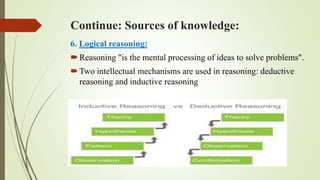
6. Logical reasoning:
Reasoning "is the mental processing of ideas to solve problems".
Two intellectual mechanisms are used in reasoning: deductive
reasoning and inductive reasoning
Continue: Sources of knowledge:
7. Disciplined research (Scientific research):
Research conducted within a disciplined format is the most
sophisticated method of acquiring knowledge.
 Nursing research creates systems of problem solving that tend to
be more reliable than other sources of knowledge.
Evidence Based Practice
EBP is the conscientious, explicit, and judicious use of theory
derived research based information in making decisions about care
delivery of individual or group of patients and in the consideration of
individual needs and preferences.
(Ingersoll, 2000)
Evidence-based practice (EBP) is an approach to healthcare that
utilizes the most current research available in order to improve the
health and safety of patients while reducing overall costs and
variation in health outcomes.
(Journal of Nursing Administration)
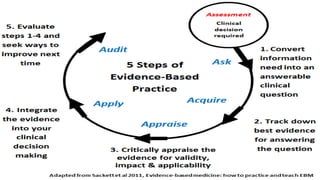
Evidence Based Practice Steps
Step 1:
Assess your patient and determine the pertinent issues. You may be looking for
evidence about therapy options, prognosis or diagnostic techniques.
Step 2:
Ask a clinical question. Use the PICO model to formulate a clear and concise
clinical question.
Step 3:
Acquire the best evidence. Search the appropriate databases and resources to find
the best evidence.
Step 4:
Appraise the evidence. Determine whether the information you found is relevant,
valid and applicable to your patient.
Step 5:
Apply the evidence to your patient. Ensure that the evidence and recommendations
meet your patient's values and expectations.
EBP Importance
EBP is important because it aims to provide the most effective care
that is available, with the aim of improving patient outcomes.
Patients expect to receive the most effective care based on the best
available evidence.
EBP promotes an attitude of inquiry in health professionals and starts
us thinking about: Why am I doing this in this way? Is there
evidence that can guide me to do this in a more effective way? As
health professionals, part of providing a professional service is
ensuring that our practice is informed by the best available evidence.
EBP also plays a role in ensuring that finite health resources are used
wisely and that relevant evidence is considered when decisions are
made about funding health services.
References
 1. Guyatt, G.H., Haynes, R.B., Jaeschke, R.Z., & Cook, D.J. (2000). Users' guides to the
medical literature: XXV. evidence-based medicine: principles for applying the users' guides
to patient care. JAMA, 284, 1290-1296. doi: http://dx.doi.org/10.1001/jama.284.10.1290
 2. Sackett, D., Rosenberg, W., Gray, J., et al. (1996). Evidence based medicine: what it is and
what it isn't: it's about integrating individual clinical expertise and the best external
evidence. BMJ, 312, 71-72. doi: http://dx.doi.org/10.1136/bmj.312.7023.71
 3. Mayer, D. (2010). Essential evidence-based medicine (2nd ed.). Cambridge: Cambridge
University Press.
 4. Hoffman, T., Bennett, S., & Del Mar, C. (2013). Evidence-based practice: across the health
professions (2nd ed.). Chatswood, NSW: Elsevier.
 5. Straus, S., Glasziou, P., Richardson, W., & Haynes, R. (2011). Evidence-based medicine:
how to practice and teach it (4th ed.). Edinburgh: Churchill Livingstone Elsevier
 6. Bushell, M. (2019). Supporting your practice: Evidence-based medicine. Australian
Pharmacist, 38, 3, 46-55.
Unit I. Introduction to Nursing Research.pptx

Unit I. Introduction to Nursing Research.pptx

  • 2.
    Introduction to Nursing Research ShakirRahman BScN, MScN, MSc Applied Psychology, PhD Nursing (Candidate) University of Minnesota USA Principal & Assistant Professor Ayub International College of Nursing & AHS Peshawar Visiting Faculty Swabi College of Nursing & Health Sciences Swabi Nowshera College of Nursing & Health Sciences Nowshera
  • 3.
    Lecture Outcomes: At thecompletion of this unit learners will be to; Define nursing research Describe ways of knowing in nursing (tradition, authority, borrowing, trial and error, intuition, and research ) Identify role of a nurse in research as ADN, BS, MS, PhD, and DNP Explain Evidence Based Practice through research.
  • 4.
    Definitions  Research: Itis a systematic, formal, rigorous, and precise process used to gain solutions to problems or discover and interpret new facts and relationships.  Nursing Research: is systemic inquiry designed to develop knowledge about issues of importance to nurses, including nursing practice, nursing education, and nursing administration.  Research-based Practice: using research findings to inform the decisions, actions, and interaction of nurses with clients.
  • 5.
    Importance of researchin nursing: 1. Emphasizing on the development and utilization of nursing knowledge, which is essential for continued improvement in patient care. 2. Nurses' need to document the effectiveness of their practices not only to the profession, but also to the clients, administrators, and other professionals. - (Thus research findings help them to eliminate nursing actions that do not achieve desired outcomes or to identify the practices that alter health care outcomes and contain costs). 3. Nurses' need for understanding the varied dimensions of their profession, (theoretical, ethical, practical dimensions, etc.)
  • 6.
    Continue: Importance ofresearch in nursing: 4. Research enables nurses to describe: a) The characteristics of a particular nursing situation about which little is known. b) Explain phenomena that must be considered in planning nursing care. c) Predict the probable outcomes of certain nursing decisions. d) Control the occurrence of undesired outcomes. e) Initiate activities to promote desired client behavior.
  • 7.
    Roles of nursesin nursing research: It is every nurse's responsibility to engage in one or more roles along the research participation: 1. Indirect participation: This is a minimum nurse involvement in a research responsibility. It is done when a nurse read a research report to keep up-to-date on relevant findings that may affect their practice. This level is called "research utilization". Research Utilization: "Is the use of the research findings in a practice setting"
  • 8.
    Continue: Roles ofnurses in nursing research: 2. Direct participation: in which nurses are nursing research producers. They are actively participating in designing and implementing research studies. 3. Between these two dimensions of research participation, there are a variety of roles for nurses to play, from these roles: a) Attending research presentations at professional conferences. b) Evaluating completed research for its possible use in practice. c) Discussing the implications and relevance of research findings with clients. d) Giving clients information and advice about participation in studies. e) Assisting in the collection of research information (e.g., distributing questionnaires to clients). f) Reviewing a proposed research plan for its applicability in clinical settings. g) Assisting with the development of an idea for a clinical research project.
  • 9.
    Continue: Roles ofnurses in nursing research:  Baccalaureate Nurses  Be able to evaluate research in terms of its applicability to nursing practice- research utilization  Be able to identify problems for future investigation  Offer clinical expertise to improve a proposed research plan  Data collection  Inform/assist with informed consent/answer questions  To incorporate research findings into practice  Share research findings with colleagues  Participate in a journal club  Attend research presentations
  • 10.
    Continue: Roles ofnurses in nursing research:  Masters Prepared Nurses Conduct investigations Assist others with their research Help others apply research to practice Work toward developing a climate conducive to research
  • 11.
    Continue: Roles ofnurses in nursing research:  Doctoral Prepared Nurses Direct research projects Provide leadership in conducting research and disseminating research findings
  • 12.
    Sources of knowledge 1.Tradition: Within nursing profession, certain beliefs are accepted as truths (and certain practices are accepted as effective) simply based on customs, (for example, one of the tasks traditionally performed by nurses is the change-of- shift report for each and every patient, whether or not the patient's condition has changed, without proving its productivity and/or effectiveness under certain circumstances). But traditions may undermine effective problem solving.
  • 13.
    Continue: Sources ofknowledge: 2. Authorities: An authority is a person with specialized expertise and recognition for that expertise. Dependency on nursing authorities (such as nursing faculty) is inevitable. Authorities as a source of information have limitations as: • May depend on their personal experiences. • Their knowledge often goes unchallenged.
  • 14.
    Continue: Sources ofknowledge: 3. Personal experience: We all solve problems based on observations and experiences.  Personal experiences are based on recognition, generalization, and predictions based on observations.  Personal experience has limitations as: o Each person's experience may be too restricted to be useful. – o Personal experiences are often biased.
  • 15.
    Continue: Sources ofknowledge: 4. Trial and error: • The trial and error approach to nursing knowledge usually involves multiple attempts to solve a particular problem until a satisfactory solution is found.  For example, a pediatric nurse who is caring for immobilized child in the hospital may try a number of different play techniques based on the child's developmental stage until finding one that is effective.
  • 16.
    Continue: Sources ofknowledge: 5. Intuition: Intuitive knowing is "the ability to understand a situation or phenomena as a whole without reasoning or previous study".  It causes a nurse to respond appropriately in unfamiliar situations (as a personal experience).  However, controversy exists regarding its validity because it does not conform to the recent requirements for evidence-based practice in health care (that is, intuitive knowing is not predictable, measurable, and generalizable).
  • 17.
    Continue: Sources ofknowledge: 6. Logical reasoning: Reasoning "is the mental processing of ideas to solve problems". Two intellectual mechanisms are used in reasoning: deductive reasoning and inductive reasoning
  • 18.
    Continue: Sources ofknowledge: 7. Disciplined research (Scientific research): Research conducted within a disciplined format is the most sophisticated method of acquiring knowledge.  Nursing research creates systems of problem solving that tend to be more reliable than other sources of knowledge.
  • 19.
    Evidence Based Practice EBPis the conscientious, explicit, and judicious use of theory derived research based information in making decisions about care delivery of individual or group of patients and in the consideration of individual needs and preferences. (Ingersoll, 2000) Evidence-based practice (EBP) is an approach to healthcare that utilizes the most current research available in order to improve the health and safety of patients while reducing overall costs and variation in health outcomes. (Journal of Nursing Administration)
  • 20.
    Evidence Based PracticeSteps Step 1: Assess your patient and determine the pertinent issues. You may be looking for evidence about therapy options, prognosis or diagnostic techniques. Step 2: Ask a clinical question. Use the PICO model to formulate a clear and concise clinical question. Step 3: Acquire the best evidence. Search the appropriate databases and resources to find the best evidence. Step 4: Appraise the evidence. Determine whether the information you found is relevant, valid and applicable to your patient. Step 5: Apply the evidence to your patient. Ensure that the evidence and recommendations meet your patient's values and expectations.
  • 22.
    EBP Importance EBP isimportant because it aims to provide the most effective care that is available, with the aim of improving patient outcomes. Patients expect to receive the most effective care based on the best available evidence. EBP promotes an attitude of inquiry in health professionals and starts us thinking about: Why am I doing this in this way? Is there evidence that can guide me to do this in a more effective way? As health professionals, part of providing a professional service is ensuring that our practice is informed by the best available evidence. EBP also plays a role in ensuring that finite health resources are used wisely and that relevant evidence is considered when decisions are made about funding health services.
  • 23.
    References  1. Guyatt,G.H., Haynes, R.B., Jaeschke, R.Z., & Cook, D.J. (2000). Users' guides to the medical literature: XXV. evidence-based medicine: principles for applying the users' guides to patient care. JAMA, 284, 1290-1296. doi: http://dx.doi.org/10.1001/jama.284.10.1290  2. Sackett, D., Rosenberg, W., Gray, J., et al. (1996). Evidence based medicine: what it is and what it isn't: it's about integrating individual clinical expertise and the best external evidence. BMJ, 312, 71-72. doi: http://dx.doi.org/10.1136/bmj.312.7023.71  3. Mayer, D. (2010). Essential evidence-based medicine (2nd ed.). Cambridge: Cambridge University Press.  4. Hoffman, T., Bennett, S., & Del Mar, C. (2013). Evidence-based practice: across the health professions (2nd ed.). Chatswood, NSW: Elsevier.  5. Straus, S., Glasziou, P., Richardson, W., & Haynes, R. (2011). Evidence-based medicine: how to practice and teach it (4th ed.). Edinburgh: Churchill Livingstone Elsevier  6. Bushell, M. (2019). Supporting your practice: Evidence-based medicine. Australian Pharmacist, 38, 3, 46-55.