Task 1In media
, why might
we group or
classify
audiences
in this
manner?
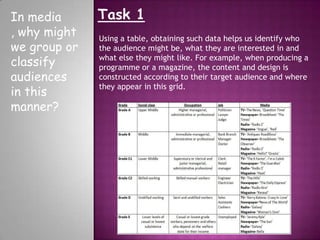
Using a table, obtaining such data helps us identify who
the audience might be, what they are interested in and
what else they might like. For example, when producing a
programme or a magazine, the content and design is
constructed according to their target audience and where
they appear in this grid.
How is
audience
research
used in
relation to
new media
products?
(e.g.
rating, BAR
B, focus
groups, ques
tionnaires)
When launching a new product audience research
is key to the product’s success. Conducting
audience research using a site such as BARB for a
programme or film, would inform us what time a
similar product is on and what type of channel it
is shown on. This would enable us to identify the
best way to capture the correct target audience.
Focus groups and questionnaires help us to tweak
and adapted a specific area of the programme
before it is officially aired.
Task 2Using the
classifications
table and the
BARB
website, what
can you tell
us about your
chosen
industry and
your product
from Unit 21?
(who would
like your
target
audience be?)
For my unit 21 production, my original target
audience was a large audience with the age range
between 16 – 40. However, looking in more detail, I
would like and would hope to aim my ‘SoccerAM’
programme at the ‘Lower middle’ social class
(Grade C1). My product would suit this audience as
research shows they are most likely to watch
popular shows on popular channels and are
attracted to the ‘Gossip’ radio and magazine. Of
course this is all irrelevant unless they are into sport
and specifically football, but if all of the above
apply as well as the sporting interest, this is the
perfect target audience.
What
constraints,
codes of
practice, and
or regulations
does your
chosen
industry/must
your product
follow?

Unit 4 presentation

  • 2.
    Task 1In media ,why might we group or classify audiences in this manner? Using a table, obtaining such data helps us identify who the audience might be, what they are interested in and what else they might like. For example, when producing a programme or a magazine, the content and design is constructed according to their target audience and where they appear in this grid.
  • 3.
    How is audience research used in relationto new media products? (e.g. rating, BAR B, focus groups, ques tionnaires) When launching a new product audience research is key to the product’s success. Conducting audience research using a site such as BARB for a programme or film, would inform us what time a similar product is on and what type of channel it is shown on. This would enable us to identify the best way to capture the correct target audience. Focus groups and questionnaires help us to tweak and adapted a specific area of the programme before it is officially aired.
  • 4.
    Task 2Using the classifications tableand the BARB website, what can you tell us about your chosen industry and your product from Unit 21? (who would like your target audience be?) For my unit 21 production, my original target audience was a large audience with the age range between 16 – 40. However, looking in more detail, I would like and would hope to aim my ‘SoccerAM’ programme at the ‘Lower middle’ social class (Grade C1). My product would suit this audience as research shows they are most likely to watch popular shows on popular channels and are attracted to the ‘Gossip’ radio and magazine. Of course this is all irrelevant unless they are into sport and specifically football, but if all of the above apply as well as the sporting interest, this is the perfect target audience.
  • 5.
    What constraints, codes of practice, and orregulations does your chosen industry/must your product follow?