Soviet Union: Communism Under Khrushchev and Brezhnev
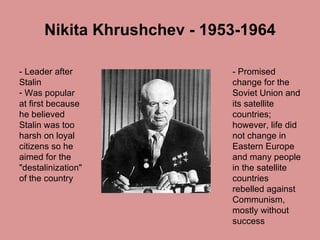
Nikita Khrushchev - 1953-1964 - Leader after Stalin  Was popular at first because he believed Stalin was too harsh on loyal citizens so he aimed for the "destalinization" of the country  - Promised change for the Soviet Union and its satellite countries; however, life did not change in Eastern Europe and many people in the satellite countries rebelled against Communism, mostly without success
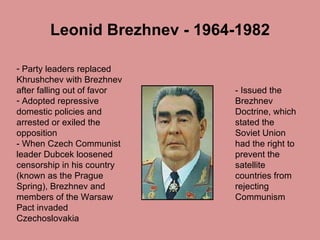
Leonid Brezhnev - 1964-1982 Party leaders replaced Khrushchev with Brezhnev after falling out of favor  Adopted repressive domestic policies and arrested or exiled the opposition - When Czech Communist leader Dubcek loosened censorship in his country (known as the Prague Spring), Brezhnev and members of the Warsaw Pact invaded Czechoslovakia - Issued the Brezhnev Doctrine, which stated the Soviet Union had the right to prevent the satellite countries from rejecting Communism
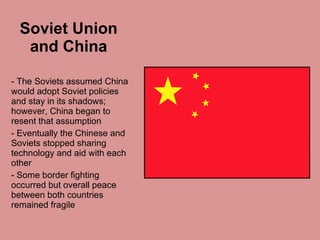
Soviet Union and China The Soviets assumed China would adopt Soviet policies and stay in its shadows; however, China began to resent that assumption Eventually the Chinese and Soviets stopped sharing technology and aid with each other  Some border fighting occurred but overall peace between both countries remained fragile
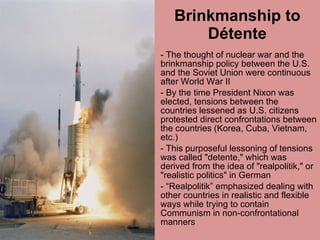
Brinkmanship to Détente - The thought of nuclear war and the brinkmanship policy between the U.S. and the Soviet Union were continuous after World War II By the time President Nixon was elected, tensions between the countries lessened as U.S. citizens protested direct confrontations between the countries (Korea, Cuba, Vietnam, etc.)  - This purposeful lessoning of tensions was called "detente," which was derived from the idea of "realpolitik," or "realistic politics" in German  - “Realpolitik” emphasized dealing with other countries in realistic and flexible ways while trying to contain Communism in non-confrontational manners
SALT I Talks In 1971, Nixon visited China to make them an ally when Nixon would meet with Brezhnev  - The next year, Nixon met with the Soviets and signed the SALT I, which stood for Strategic Arms Limitation Treaty This five-year agreement limited the number of intercontinental and submarine-launched missiles each country could have  By 1975, 33 additional countries signed the Helsinki Accords, which symbolized a commitment to détente policies
SALT II Talks While Nixon and Ford were in office, they continued détente policies  When Carter became president, issues such as how protesters in the Soviet Union were treated and the Soviet invasion of Afghanistan delayed and almost ended the possibility of a second round of SALT negotiations After the talks took place, the Soviet issues prevented the SALT II from being ratified by the U.S. Congress
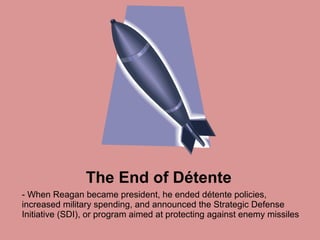
The End of Détente - When Reagan became president, he ended détente policies, increased military spending, and announced the Strategic Defense Initiative (SDI), or program aimed at protecting against enemy missiles
The End Works Cited All pictures came from Microsoft Office Clip Art except: http://fisher.osu.edu/~kinard_1/MBA808W08/images/NikitaKhrushchev.jpg http://www.spartacus.schoolnet.co.uk/COLDbreznev.JPG

Unit 14 lesson 3

  • 1.
    Soviet Union: CommunismUnder Khrushchev and Brezhnev
  • 2.
    Nikita Khrushchev -1953-1964 - Leader after Stalin Was popular at first because he believed Stalin was too harsh on loyal citizens so he aimed for the "destalinization" of the country - Promised change for the Soviet Union and its satellite countries; however, life did not change in Eastern Europe and many people in the satellite countries rebelled against Communism, mostly without success
  • 3.
    Leonid Brezhnev -1964-1982 Party leaders replaced Khrushchev with Brezhnev after falling out of favor Adopted repressive domestic policies and arrested or exiled the opposition - When Czech Communist leader Dubcek loosened censorship in his country (known as the Prague Spring), Brezhnev and members of the Warsaw Pact invaded Czechoslovakia - Issued the Brezhnev Doctrine, which stated the Soviet Union had the right to prevent the satellite countries from rejecting Communism
  • 4.
    Soviet Union andChina The Soviets assumed China would adopt Soviet policies and stay in its shadows; however, China began to resent that assumption Eventually the Chinese and Soviets stopped sharing technology and aid with each other Some border fighting occurred but overall peace between both countries remained fragile
  • 5.
    Brinkmanship to Détente- The thought of nuclear war and the brinkmanship policy between the U.S. and the Soviet Union were continuous after World War II By the time President Nixon was elected, tensions between the countries lessened as U.S. citizens protested direct confrontations between the countries (Korea, Cuba, Vietnam, etc.) - This purposeful lessoning of tensions was called "detente," which was derived from the idea of "realpolitik," or "realistic politics" in German - “Realpolitik” emphasized dealing with other countries in realistic and flexible ways while trying to contain Communism in non-confrontational manners
  • 6.
    SALT I TalksIn 1971, Nixon visited China to make them an ally when Nixon would meet with Brezhnev - The next year, Nixon met with the Soviets and signed the SALT I, which stood for Strategic Arms Limitation Treaty This five-year agreement limited the number of intercontinental and submarine-launched missiles each country could have By 1975, 33 additional countries signed the Helsinki Accords, which symbolized a commitment to détente policies
  • 7.
    SALT II TalksWhile Nixon and Ford were in office, they continued détente policies When Carter became president, issues such as how protesters in the Soviet Union were treated and the Soviet invasion of Afghanistan delayed and almost ended the possibility of a second round of SALT negotiations After the talks took place, the Soviet issues prevented the SALT II from being ratified by the U.S. Congress
  • 8.
    The End ofDétente - When Reagan became president, he ended détente policies, increased military spending, and announced the Strategic Defense Initiative (SDI), or program aimed at protecting against enemy missiles
  • 9.
    The End WorksCited All pictures came from Microsoft Office Clip Art except: http://fisher.osu.edu/~kinard_1/MBA808W08/images/NikitaKhrushchev.jpg http://www.spartacus.schoolnet.co.uk/COLDbreznev.JPG