MATERIALS AND INVENTORY
MANAGEMENT
UNIT 2: INVENTORY FUNCTIONALITY AND
PRINCIPLES
Prepared and presented by,
Ganesha Pandian . N,
Assistant Professor.
1
RLIMS-MBA2018
CONTENT
 Inventory types and characteristics
 Reasons for holding inventories
 Inventory functionality
 Inventory related definitions
 Costs relevant for inventory decision making
 Special focus on cost of carrying inventory 2
RLIMS-MBA2018
INTRODUCTION
 Inventories – vital part in business
 Not only essential for operations – but also
contributes to the customer satisfaction
 Inventories substantial part of total assets
 Related to ROI (return on investment)
 Goal of inventory management – reduce the cost,
maximize the profitability and utilization of
resources 3
RLIMS-MBA2018
TERMS AND DEFINITIONS IN INVENTORY
1. Inventory : can be defined as those stocks or items
used to support production, supporting activities and
customer services.
2. Inventory refers to equipment, building, fixtures and
also include the raw materials, work- in- progress and
finished goods.
3. Inventory functions – anticipation, hedge, cycle,
fluctuation, transportations and service parts.
4
RLIMS-MBA2018
TERMS AND DEFINITIONS IN INVENTORY
 Inventory management – management concerned
with the planning and controlling of inventories
 Inventory policy – statement of goals or approach
towards the management of inventory
 Inventory costs – carrying cost and holding cost
 Inventory cycle – the length of time between the
replenishment
5
RLIMS-MBA2018
TERMS AND DEFINITIONS IN INVENTORY
 Inventory planning: refers to the activities and
techniques to determine the desired level of items.
 Order point: point where the action to be taken to
replenish the stock.
 Lot size: how much amount of items to be ordered
each time economically
6
RLIMS-MBA2018
INVENTORY TYPES AND CLASSIFICATIONS
 According to Arnold – Inventories are classified into
generally as raw materials, work-in-progress and
finished products
 Classification of items particularly depends on the
production environment
 According to association for operation management,
inventories are classified into
1. Categories
2. Functions 7
RLIMS-MBA2018
CATEGORY WISE CLASSIFICATION
1. Raw materials
2. Work-in-progress
3. Semi-finished products or assemblies
4. Finished goods
5. Maintenance, repair and operating supplies
(MRO)
8
RLIMS-MBA2018
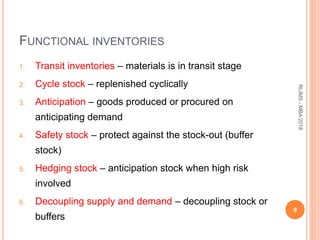
FUNCTIONAL INVENTORIES
1. Transit inventories – materials is in transit stage
2. Cycle stock – replenished cyclically
3. Anticipation – goods produced or procured on
anticipating demand
4. Safety stock – protect against the stock-out (buffer
stock)
5. Hedging stock – anticipation stock when high risk
involved
6. Decoupling supply and demand – decoupling stock or
buffers
9
RLIMS-MBA2018
CHARACTERISTICS OF INVENTORY
 Nature of inventory differs from one organization to
another
 Managing a service supply chain is different from
manufacturing or distribution supply chain
 There is a greater variation of nature of inventories
between the manufacturing and services inventory
10
RLIMS-MBA2018
REASONS FOR HOLDING INVENTORIES
 To facilitate and stabilize production
 To eliminate disruption
 To meet customer demand whenever arises
 To carry safety stocks in order to prevent stock-outs
 To deal with variations in supply and demand
 To hedge against the price escalations
 To take advantage of price discounts
11
RLIMS-MBA2018
MOTIVES BEHIND CARRYING INVENTORY
Transaction motive
Precautionary motive
Speculative motive
12
RLIMS-MBA2018
INVENTORY COST AND ITS RELEVANCE FOR
DECISION MAKING
 The costs associated with the inventory are:
1. Item costs or materials costs – Direct cost for getting
an item
2. Holding costs or carrying costs – costs associated with
carrying materials in inventory
3. Ordering costs – Fixed costs associated with placing
an order
4. Shortage costs or stock-out costs – cost associated
with not having enough materials to meet demand 13
RLIMS-MBA2018
 Inventory cost reduction is the important cost
decision in any business
 Time and lean manufacturing principles can be
used to manage inventory levels more efficiently.
 Technology plays an important role in cost
reduction.
 Many experts were finding ways and means of
reducing the size of holding the inventory
14
RLIMS-MBA2018
CARRYING COST – SPECIAL FOCUS
 Two important costs associated with the inventory
holding are carrying cost and purchasing cost
 Both are opposite in nature. If one increases, then
another decreases
 Right order quantity is the balance between both the
ordering cost and carrying cost
 The cost incurred over the period of time for holding the
inventory – “Carrying cost”
15
RLIMS-MBA2018
 Cost of carrying or holding inventory may be:
1. Opportunity cost
2. Physical space occupied by the inventory such
as rent, depreciation, utility cost, insurance,
taxes and etc.,
3. Cost of materials handling and cost of wastage
and obsolescence
16
RLIMS-MBA2018
17
RLIMS-MBA2018

Unit 2 inventory functionality and principles

  • 1.
    MATERIALS AND INVENTORY MANAGEMENT UNIT2: INVENTORY FUNCTIONALITY AND PRINCIPLES Prepared and presented by, Ganesha Pandian . N, Assistant Professor. 1 RLIMS-MBA2018
  • 2.
    CONTENT  Inventory typesand characteristics  Reasons for holding inventories  Inventory functionality  Inventory related definitions  Costs relevant for inventory decision making  Special focus on cost of carrying inventory 2 RLIMS-MBA2018
  • 3.
    INTRODUCTION  Inventories –vital part in business  Not only essential for operations – but also contributes to the customer satisfaction  Inventories substantial part of total assets  Related to ROI (return on investment)  Goal of inventory management – reduce the cost, maximize the profitability and utilization of resources 3 RLIMS-MBA2018
  • 4.
    TERMS AND DEFINITIONSIN INVENTORY 1. Inventory : can be defined as those stocks or items used to support production, supporting activities and customer services. 2. Inventory refers to equipment, building, fixtures and also include the raw materials, work- in- progress and finished goods. 3. Inventory functions – anticipation, hedge, cycle, fluctuation, transportations and service parts. 4 RLIMS-MBA2018
  • 5.
    TERMS AND DEFINITIONSIN INVENTORY  Inventory management – management concerned with the planning and controlling of inventories  Inventory policy – statement of goals or approach towards the management of inventory  Inventory costs – carrying cost and holding cost  Inventory cycle – the length of time between the replenishment 5 RLIMS-MBA2018
  • 6.
    TERMS AND DEFINITIONSIN INVENTORY  Inventory planning: refers to the activities and techniques to determine the desired level of items.  Order point: point where the action to be taken to replenish the stock.  Lot size: how much amount of items to be ordered each time economically 6 RLIMS-MBA2018
  • 7.
    INVENTORY TYPES ANDCLASSIFICATIONS  According to Arnold – Inventories are classified into generally as raw materials, work-in-progress and finished products  Classification of items particularly depends on the production environment  According to association for operation management, inventories are classified into 1. Categories 2. Functions 7 RLIMS-MBA2018
  • 8.
    CATEGORY WISE CLASSIFICATION 1.Raw materials 2. Work-in-progress 3. Semi-finished products or assemblies 4. Finished goods 5. Maintenance, repair and operating supplies (MRO) 8 RLIMS-MBA2018
  • 9.
    FUNCTIONAL INVENTORIES 1. Transitinventories – materials is in transit stage 2. Cycle stock – replenished cyclically 3. Anticipation – goods produced or procured on anticipating demand 4. Safety stock – protect against the stock-out (buffer stock) 5. Hedging stock – anticipation stock when high risk involved 6. Decoupling supply and demand – decoupling stock or buffers 9 RLIMS-MBA2018
  • 10.
    CHARACTERISTICS OF INVENTORY Nature of inventory differs from one organization to another  Managing a service supply chain is different from manufacturing or distribution supply chain  There is a greater variation of nature of inventories between the manufacturing and services inventory 10 RLIMS-MBA2018
  • 11.
    REASONS FOR HOLDINGINVENTORIES  To facilitate and stabilize production  To eliminate disruption  To meet customer demand whenever arises  To carry safety stocks in order to prevent stock-outs  To deal with variations in supply and demand  To hedge against the price escalations  To take advantage of price discounts 11 RLIMS-MBA2018
  • 12.
    MOTIVES BEHIND CARRYINGINVENTORY Transaction motive Precautionary motive Speculative motive 12 RLIMS-MBA2018
  • 13.
    INVENTORY COST ANDITS RELEVANCE FOR DECISION MAKING  The costs associated with the inventory are: 1. Item costs or materials costs – Direct cost for getting an item 2. Holding costs or carrying costs – costs associated with carrying materials in inventory 3. Ordering costs – Fixed costs associated with placing an order 4. Shortage costs or stock-out costs – cost associated with not having enough materials to meet demand 13 RLIMS-MBA2018
  • 14.
     Inventory costreduction is the important cost decision in any business  Time and lean manufacturing principles can be used to manage inventory levels more efficiently.  Technology plays an important role in cost reduction.  Many experts were finding ways and means of reducing the size of holding the inventory 14 RLIMS-MBA2018
  • 15.
    CARRYING COST –SPECIAL FOCUS  Two important costs associated with the inventory holding are carrying cost and purchasing cost  Both are opposite in nature. If one increases, then another decreases  Right order quantity is the balance between both the ordering cost and carrying cost  The cost incurred over the period of time for holding the inventory – “Carrying cost” 15 RLIMS-MBA2018
  • 16.
     Cost ofcarrying or holding inventory may be: 1. Opportunity cost 2. Physical space occupied by the inventory such as rent, depreciation, utility cost, insurance, taxes and etc., 3. Cost of materials handling and cost of wastage and obsolescence 16 RLIMS-MBA2018
  • 17.