
INTRODUCTION
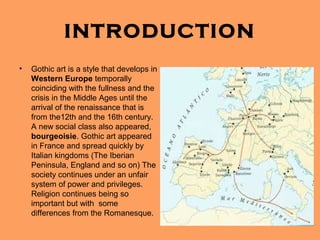
•   Gothic art is a style that develops in
    Western Europe temporally
    coinciding with the fullness and the
    crisis in the Middle Ages until the
    arrival of the renaissance that is
    from the12th and the 16th century.
    A new social class also appeared,
    bourgeoisie. Gothic art appeared
    in France and spread quickly by
    Italian kingdoms (The Iberian
    Peninsula, England and so on) The
    society continues under an unfair
    system of power and privileges.
    Religion continues being so
    important but with some
    differences from the Romanesque.
THREE IMPORTANT
            CONCEPTS
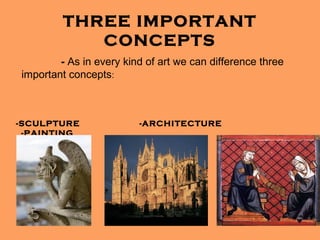
        - As in every kind of art we can difference three
important concepts:


-SCULPTURE               -ARCHITECTURE
 -PAINTING
ARCHITECTURE
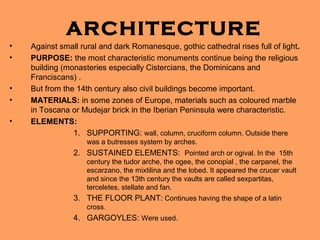
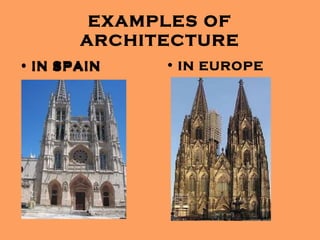
•   Against small rural and dark Romanesque, gothic cathedral rises full of light.
•   PURPOSE: the most characteristic monuments continue being the religious
    building (monasteries especially Cistercians, the Dominicans and
    Franciscans) .
•   But from the 14th century also civil buildings become important.
•   MATERIALS: in some zones of Europe, materials such as coloured marble
    in Toscana or Mudejar brick in the Iberian Peninsula were characteristic.
•   ELEMENTS:
                1. SUPPORTING: wall, column, cruciform column. Outside there
                    was a butresses system by arches.
                2. SUSTAINED ELEMENTS: Pointed arch or ogival. In the 15th
                    century the tudor arche, the ogee, the conopial , the carpanel, the
                    escarzano, the mixtilina and the lobed. It appeared the crucer vault
                    and since the 13th century the vaults are called sexpartitas,
                    terceletes, stellate and fan.
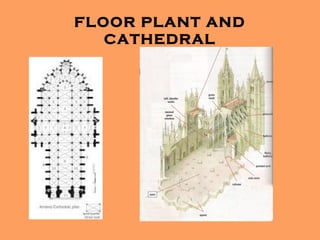
                3. THE FLOOR PLANT: Continues having the shape of a latin
                    cross.
                4. GARGOYLES: Were used.
EXAMPLES OF
       ARCHITECTURE
• IN SPAIN   • IN EUROPE
FLOOR PLANT AND
   CATHEDRAL
SCULPTURE
• Appeared in France(XII-XVI)
• Characteristics: naturalism humanization of divinity
  exhibition organized and clear in the compositions.
• Favourite materials: Marble in Italy, stone,
  wood(wooden panels and images) and ivory.
• Topics are basically religious(the life of Jesus the virgin
  and the saints)
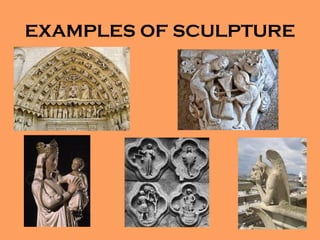
• The decorative elements are inspired in the local nature:
  animals and plants.
• It also appeared in facades cathedrals, the cloisters,the
  chapels,the choir stalls, the graves and the wooden
  panels. In the capitels the decoration represents plants.
EXAMPLES OF SCULPTURE
PAINTING
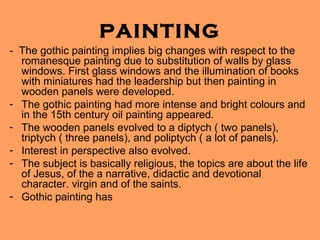
- The gothic painting implies big changes with respect to the
  romanesque painting due to substitution of walls by glass
  windows. First glass windows and the illumination of books
  with miniatures had the leadership but then painting in
  wooden panels were developed.
- The gothic painting had more intense and bright colours and
  in the 15th century oil painting appeared.
- The wooden panels evolved to a diptych ( two panels),
  triptych ( three panels), and poliptych ( a lot of panels).
- Interest in perspective also evolved.
- The subject is basically religious, the topics are about the life
  of Jesus, of the a narrative, didactic and devotional
  character. virgin and of the saints.
- Gothic painting has
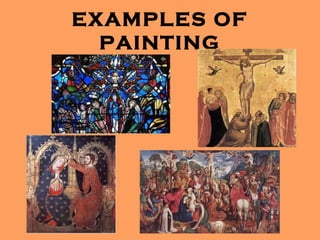
EXAMPLES OF
  PAINTING
CONCLUSION
Gothic art beginning in the 14th century in Western
Europe, there were three important concepts: Sculpture,
Painting and Architecture.
Sculpture was more realist than the Romanesque.
Painting was very religious, they used the perspective
and the people showed emotion.
Achitecture began to be more popular like palaces,
bridges and cathedrals.
Gothic art was more brigth, recharged and popular than
Romanesque art.
BY :
   Sara Alonso
 Amaya Aparicio
Cristina Fernández
 Daniela Martínez
    Jara Muñoz

     2º ESO

Gothic Art

  • 2.
    INTRODUCTION • Gothic art is a style that develops in Western Europe temporally coinciding with the fullness and the crisis in the Middle Ages until the arrival of the renaissance that is from the12th and the 16th century. A new social class also appeared, bourgeoisie. Gothic art appeared in France and spread quickly by Italian kingdoms (The Iberian Peninsula, England and so on) The society continues under an unfair system of power and privileges. Religion continues being so important but with some differences from the Romanesque.
  • 3.
    THREE IMPORTANT CONCEPTS - As in every kind of art we can difference three important concepts: -SCULPTURE -ARCHITECTURE -PAINTING
  • 4.
    ARCHITECTURE • Against small rural and dark Romanesque, gothic cathedral rises full of light. • PURPOSE: the most characteristic monuments continue being the religious building (monasteries especially Cistercians, the Dominicans and Franciscans) . • But from the 14th century also civil buildings become important. • MATERIALS: in some zones of Europe, materials such as coloured marble in Toscana or Mudejar brick in the Iberian Peninsula were characteristic. • ELEMENTS: 1. SUPPORTING: wall, column, cruciform column. Outside there was a butresses system by arches. 2. SUSTAINED ELEMENTS: Pointed arch or ogival. In the 15th century the tudor arche, the ogee, the conopial , the carpanel, the escarzano, the mixtilina and the lobed. It appeared the crucer vault and since the 13th century the vaults are called sexpartitas, terceletes, stellate and fan. 3. THE FLOOR PLANT: Continues having the shape of a latin cross. 4. GARGOYLES: Were used.
  • 5.
    EXAMPLES OF ARCHITECTURE • IN SPAIN • IN EUROPE
  • 6.
  • 7.
    SCULPTURE • Appeared inFrance(XII-XVI) • Characteristics: naturalism humanization of divinity exhibition organized and clear in the compositions. • Favourite materials: Marble in Italy, stone, wood(wooden panels and images) and ivory. • Topics are basically religious(the life of Jesus the virgin and the saints) • The decorative elements are inspired in the local nature: animals and plants. • It also appeared in facades cathedrals, the cloisters,the chapels,the choir stalls, the graves and the wooden panels. In the capitels the decoration represents plants.
  • 8.
  • 9.
    PAINTING - The gothicpainting implies big changes with respect to the romanesque painting due to substitution of walls by glass windows. First glass windows and the illumination of books with miniatures had the leadership but then painting in wooden panels were developed. - The gothic painting had more intense and bright colours and in the 15th century oil painting appeared. - The wooden panels evolved to a diptych ( two panels), triptych ( three panels), and poliptych ( a lot of panels). - Interest in perspective also evolved. - The subject is basically religious, the topics are about the life of Jesus, of the a narrative, didactic and devotional character. virgin and of the saints. - Gothic painting has
  • 10.
    EXAMPLES OF PAINTING
  • 11.
    CONCLUSION Gothic art beginningin the 14th century in Western Europe, there were three important concepts: Sculpture, Painting and Architecture. Sculpture was more realist than the Romanesque. Painting was very religious, they used the perspective and the people showed emotion. Achitecture began to be more popular like palaces, bridges and cathedrals. Gothic art was more brigth, recharged and popular than Romanesque art.
  • 12.
    BY : Sara Alonso Amaya Aparicio Cristina Fernández Daniela Martínez Jara Muñoz 2º ESO