UNIT -IV
FILTRATION
1
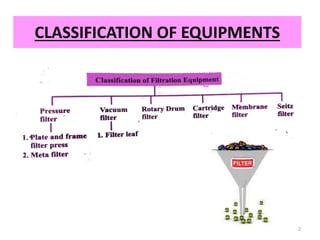
CLASSIFICATION OF EQUIPMENTS
2
Principle: This is the simplest type of pressure filter. The slurry enters the frame by
pressure and flows through the filter medium. The filtrate is collected on the plates and
sent to the outlet. A number of frames and plates are used so that the surface area
increases and therefore, large volumes of slurry can be treated simultaneously with or
without washing.
Figure: Construction
It consists of plates and frames arranged alternatively
and supported on a pair of rails. The plate is a solid
piece having a ribbed surface. The plate consist of an
outlet. The frame is hollow and provides space for the
filter cake. Frame of varying thickness are also
available. The frame consists of an open space inside
where the slurry reservoir is held for filtration and an
inlet for receiving the slurry. The cloth as filter
medium is placed between plate and frame. The filter
cloth have holes and act as gasket.. The plate and
frame are square or rectangular and made of cast
iron, stainless steel, nickel, aluminum,, wood, hard
rubber or plastic (polypropylene).
3
Plate & Frame Filter Press
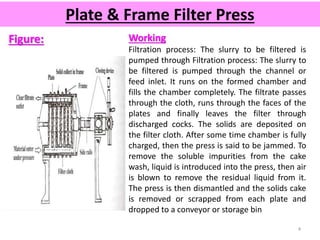
Figure: Working
Filtration process: The slurry to be filtered is
pumped through Filtration process: The slurry to
be filtered is pumped through the channel or
feed inlet. It runs on the formed chamber and
fills the chamber completely. The filtrate passes
through the cloth, runs through the faces of the
plates and finally leaves the filter through
discharged cocks. The solids are deposited on
the filter cloth. After some time chamber is fully
charged, then the press is said to be jammed. To
remove the soluble impurities from the cake
wash, liquid is introduced into the press, then air
is blown to remove the residual liquid from it.
The press is then dismantled and the solids cake
is removed or scrapped from each plate and
dropped to a conveyor or storage bin
4
Plate & Frame Filter Press
5
Plate & Frame Filter Press
ADVANTAGES: a.Simple in construction.
b. Plate and frame filter presses provide the lowest cost of filtration per
unit of fluid processed
C. Maintenance cost is low.
d.It provides large filtering area per unit for floor space occupied.
It is possible to alter the capacity.
DISADVANTAGES: a. Labour requirement is very high
b. Life of Filter cloth is relatively short.
c. Not suitable to get high output. It is suitable for slurries containing less
than 5% solids.
d. Problem of leakage of equipment
USES: 1.Widely used in food industry, mining industry, pharmaceutical industry,
Chemical industry, waste water treatment.
2.In pharmaceutical industry. Enzymes, amino acids, antibiotics,
pharmaceutical intermediates, bulk drugs. medicine, blood products,
antibioties.
3.The filter sheets made of asbestos and cellulose are capable of retaining
bacteria
4.Filter presses are used in a huge variety of different applications, from
dewatering of mineral slurries to blood plasma purification.
Principle: It is a type of pressure filter. Pressure filters feed the product to the filter at a
higher pressure than would bederived from gravity alone. This is the most common type of
filter used in the processing of pharmaceutical products. The metafilter works as a strainer or
filter for the separation of particles. The metal rings with number of semicircular projections
are arranged as a nest. Therefore channels are formed at the edges. This channel offers
resistance to the flow of solids (forced particles). The clear liquid is collected into a receiver
from the top
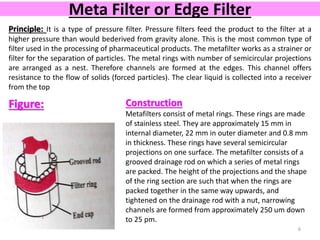
Figure: Construction
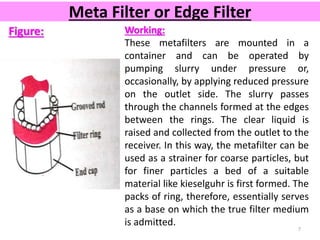
Metafilters consist of metal rings. These rings are made
of stainless steel. They are approximately 15 mm in
internal diameter, 22 mm in outer diameter and 0.8 mm
in thickness. These rings have several semicircular
projections on one surface. The metafilter consists of a
grooved drainage rod on which a series of metal rings
are packed. The height of the projections and the shape
of the ring section are such that when the rings are
packed together in the same way upwards, and
tightened on the drainage rod with a nut, narrowing
channels are formed from approximately 250 um down
to 25 pm.
6
Meta Filter or Edge Filter
Figure: Working:
These metafilters are mounted in a
container and can be operated by
pumping slurry under pressure or,
occasionally, by applying reduced pressure
on the outlet side. The slurry passes
through the channels formed at the edges
between the rings. The clear liquid is
raised and collected from the outlet to the
receiver. In this way, the metafilter can be
used as a strainer for coarse particles, but
for finer particles a bed of a suitable
material like kieselguhr is first formed. The
packs of ring, therefore, essentially serves
as a base on which the true filter medium
is admitted.
7
Meta Filter or Edge Filter
8
Meta Filter or Edge Filter
ADVANTAGES:
a. It can be used at high strength and pressure with no danger of
bursting the filter medium.
b. It is economical filter. As there is no filter medium as such, the
running cost is low.
It can be made non corrosive material and avoid contamination with
most sensitive product.
d. By selecting the appropriate material to form the filter bed, it is
possible to filter very fine particles.
Removal of the cake is effected effectively by back flushing with water,
further cleaning is
necessary.
Uses: a.These filters are used for clarification and polishing of beverages and
pharmaceutical suspension having low solid content.
b. Suitable for viscous liquids.
c.Suitable for corrosive substance.
d.It is used in clarification of syrups, and products such as insulin
liquors.
Principle: The mechanism is surface filtration and acts as a strainer.
Vacuum can be applied to increase the filtration rate
Figure: Construction
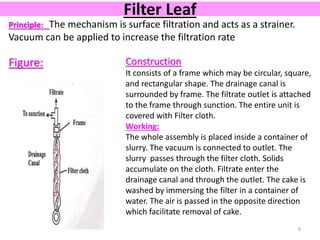
It consists of a frame which may be circular, square,
and rectangular shape. The drainage canal is
surrounded by frame. The filtrate outlet is attached
to the frame through sunction. The entire unit is
covered with Filter cloth.
Working:
The whole assembly is placed inside a container of
slurry. The vacuum is connected to outlet. The
slurry passes through the filter cloth. Solids
accumulate on the cloth. Filtrate enter the
drainage canal and through the outlet. The cake is
washed by immersing the filter in a container of
water. The air is passed in the opposite direction
which facilitate removal of cake.
9
Filter Leaf
10
Filter Leaf
ADVANTAGES: 1. It require minimum floor space.
2.Labor cost is also not so much high.
3. High Washing efficiency
4. Filtration area can be enhanced by attaching number of leaves in
parallel.
5. It provide high filtrate clarity.
6. Cake can be easily dislodged and washed.
DISADVANTAGES: The maximum concentration of slurry that can be filtered is only 5%w/v.
USES: a. Leaf filters are suitable for handling flammable, toxic and corrosive
materials as they are autoclaved and designed for hazardous
environments when high pressure and safe operation are required.
b. The leaf filters satisfactory if the solids content of the slurry is not too
high, i.e., about 5% of the slurry
THANK YOU
11

UNIT 4 - FILTRATION

  • 1.
  • 2.
  • 3.
    Principle: This isthe simplest type of pressure filter. The slurry enters the frame by pressure and flows through the filter medium. The filtrate is collected on the plates and sent to the outlet. A number of frames and plates are used so that the surface area increases and therefore, large volumes of slurry can be treated simultaneously with or without washing. Figure: Construction It consists of plates and frames arranged alternatively and supported on a pair of rails. The plate is a solid piece having a ribbed surface. The plate consist of an outlet. The frame is hollow and provides space for the filter cake. Frame of varying thickness are also available. The frame consists of an open space inside where the slurry reservoir is held for filtration and an inlet for receiving the slurry. The cloth as filter medium is placed between plate and frame. The filter cloth have holes and act as gasket.. The plate and frame are square or rectangular and made of cast iron, stainless steel, nickel, aluminum,, wood, hard rubber or plastic (polypropylene). 3 Plate & Frame Filter Press
  • 4.
    Figure: Working Filtration process:The slurry to be filtered is pumped through Filtration process: The slurry to be filtered is pumped through the channel or feed inlet. It runs on the formed chamber and fills the chamber completely. The filtrate passes through the cloth, runs through the faces of the plates and finally leaves the filter through discharged cocks. The solids are deposited on the filter cloth. After some time chamber is fully charged, then the press is said to be jammed. To remove the soluble impurities from the cake wash, liquid is introduced into the press, then air is blown to remove the residual liquid from it. The press is then dismantled and the solids cake is removed or scrapped from each plate and dropped to a conveyor or storage bin 4 Plate & Frame Filter Press
  • 5.
    5 Plate & FrameFilter Press ADVANTAGES: a.Simple in construction. b. Plate and frame filter presses provide the lowest cost of filtration per unit of fluid processed C. Maintenance cost is low. d.It provides large filtering area per unit for floor space occupied. It is possible to alter the capacity. DISADVANTAGES: a. Labour requirement is very high b. Life of Filter cloth is relatively short. c. Not suitable to get high output. It is suitable for slurries containing less than 5% solids. d. Problem of leakage of equipment USES: 1.Widely used in food industry, mining industry, pharmaceutical industry, Chemical industry, waste water treatment. 2.In pharmaceutical industry. Enzymes, amino acids, antibiotics, pharmaceutical intermediates, bulk drugs. medicine, blood products, antibioties. 3.The filter sheets made of asbestos and cellulose are capable of retaining bacteria 4.Filter presses are used in a huge variety of different applications, from dewatering of mineral slurries to blood plasma purification.
  • 6.
    Principle: It isa type of pressure filter. Pressure filters feed the product to the filter at a higher pressure than would bederived from gravity alone. This is the most common type of filter used in the processing of pharmaceutical products. The metafilter works as a strainer or filter for the separation of particles. The metal rings with number of semicircular projections are arranged as a nest. Therefore channels are formed at the edges. This channel offers resistance to the flow of solids (forced particles). The clear liquid is collected into a receiver from the top Figure: Construction Metafilters consist of metal rings. These rings are made of stainless steel. They are approximately 15 mm in internal diameter, 22 mm in outer diameter and 0.8 mm in thickness. These rings have several semicircular projections on one surface. The metafilter consists of a grooved drainage rod on which a series of metal rings are packed. The height of the projections and the shape of the ring section are such that when the rings are packed together in the same way upwards, and tightened on the drainage rod with a nut, narrowing channels are formed from approximately 250 um down to 25 pm. 6 Meta Filter or Edge Filter
  • 7.
    Figure: Working: These metafiltersare mounted in a container and can be operated by pumping slurry under pressure or, occasionally, by applying reduced pressure on the outlet side. The slurry passes through the channels formed at the edges between the rings. The clear liquid is raised and collected from the outlet to the receiver. In this way, the metafilter can be used as a strainer for coarse particles, but for finer particles a bed of a suitable material like kieselguhr is first formed. The packs of ring, therefore, essentially serves as a base on which the true filter medium is admitted. 7 Meta Filter or Edge Filter
  • 8.
    8 Meta Filter orEdge Filter ADVANTAGES: a. It can be used at high strength and pressure with no danger of bursting the filter medium. b. It is economical filter. As there is no filter medium as such, the running cost is low. It can be made non corrosive material and avoid contamination with most sensitive product. d. By selecting the appropriate material to form the filter bed, it is possible to filter very fine particles. Removal of the cake is effected effectively by back flushing with water, further cleaning is necessary. Uses: a.These filters are used for clarification and polishing of beverages and pharmaceutical suspension having low solid content. b. Suitable for viscous liquids. c.Suitable for corrosive substance. d.It is used in clarification of syrups, and products such as insulin liquors.
  • 9.
    Principle: The mechanismis surface filtration and acts as a strainer. Vacuum can be applied to increase the filtration rate Figure: Construction It consists of a frame which may be circular, square, and rectangular shape. The drainage canal is surrounded by frame. The filtrate outlet is attached to the frame through sunction. The entire unit is covered with Filter cloth. Working: The whole assembly is placed inside a container of slurry. The vacuum is connected to outlet. The slurry passes through the filter cloth. Solids accumulate on the cloth. Filtrate enter the drainage canal and through the outlet. The cake is washed by immersing the filter in a container of water. The air is passed in the opposite direction which facilitate removal of cake. 9 Filter Leaf
  • 10.
    10 Filter Leaf ADVANTAGES: 1.It require minimum floor space. 2.Labor cost is also not so much high. 3. High Washing efficiency 4. Filtration area can be enhanced by attaching number of leaves in parallel. 5. It provide high filtrate clarity. 6. Cake can be easily dislodged and washed. DISADVANTAGES: The maximum concentration of slurry that can be filtered is only 5%w/v. USES: a. Leaf filters are suitable for handling flammable, toxic and corrosive materials as they are autoclaved and designed for hazardous environments when high pressure and safe operation are required. b. The leaf filters satisfactory if the solids content of the slurry is not too high, i.e., about 5% of the slurry
  • 11.