Plate and frame filter press
presented by
pharmaceutics Dept
working Principle:
• Mechanism is surface filtration.
• The slurry enters the frame by pressure and flows
through filter medium.
• The filtrate is collected on the plates and send to outlet.
A number of frames and plates are used so that surface
area increases and consequently large volumes of slurry
can be processed simultaneously with or without washing.
• D
• D
Construction :
• .The Filter press is made of two types of units, plate and
frames.
• Usually made of aluminium alloy. Sometimes, these are
also lacquered for protection against corrosive chemicals
and made suitable for steam sterilization. Frame
• It contains a open space inside wherein the slurry
reservoir is maintained for filtration and an inlet to receive
the slurry.
• It is indicated by two dots in description. 32 Slurry inlet
Handle to rest on rod
• .Frames of different thickness are available.
• It is selected based on the thickness of cake formed
during filtration.
• Optimum thickness of frame should be chosen.
• Plate
• The plate has a studded or grooved surface to support the
filter cloth and an outlet.
• It is indicated by one dot in description. 33 Through
channel Filtrate outlet
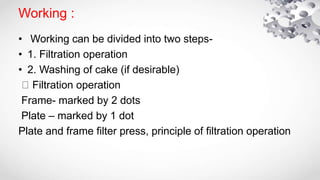
• Plate supports the filter medium, receiving the filtrate and outlet.
The filter medium usually cloth is interposed between plate and
frame.
Plate, filter medium, frame, filter medium and plate are arranged
in sequence and clamed to a supporting structure.
It is normally described by dots as 1.2.1.2.1 so on.
A number of plates and frames are employed so that the filtration
area is as large as necessary.
Number of filtration units are operated in parallel.
Channels for slurry inlet and filtrate outlet can be arranged by
fitting eyes to the plates and frames, these join together to form a
channel.
In some types only one inlet channel is formed, while each plate
is having individual outlets controlled by valves.
Working :
• Working can be divided into two steps-
• 1. Filtration operation
• 2. Washing of cake (if desirable)
Filtration operation
Frame- marked by 2 dots
Plate – marked by 1 dot
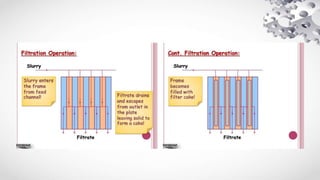
Plate and frame filter press, principle of filtration operation
• Slurry enters the frame from the feed channel and passes
through the filter medium on the surface of the plate
• The solid forms a filter cake and remain in the frame
• The thickness of the cake is half of the frame thickness,
because on each side of frame filtration occurs
• Thus two filter cakes are formed , which meet eventually in
the centre of the frame
• The filtrate drains between the projections of the surface of
the plate and escape from the outlet
• As filtration proceeds, the resistance of the cake increases
and filtration rate decrease. At a certain point process is
stopped and press is emptied and cycle is restarted
Slurry enters the frame from the feed channel and passes through the filter medium on the surface of the plate
The solid forms a filter cake and remain in the frame
The thickness of the cake is half of the frame thickness, because on each side of frame filtration occurs
Thus two filter cakes are formed , which meet eventually in the centre of the frame
As filtration proceeds, the resistance of the cake increases and filtration rate decrease
The filtrate drains between the projections of the surface of the plate and escape from the outlet
At a certain point process is stopped and press is emptied and cycle is restarted
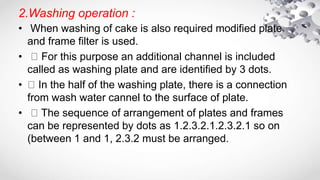
2.Washing operation :
• When washing of cake is also required modified plate
and frame filter is used.
• For this purpose an additional channel is included
called as washing plate and are identified by 3 dots.
• In the half of the washing plate, there is a connection
from wash water cannel to the surface of plate.
• The sequence of arrangement of plates and frames
can be represented by dots as 1.2.3.2.1.2.3.2.1 so on
(between 1 and 1, 2.3.2 must be arranged.
Procedure for washing the press
• Step 1 • Filtration proceeds in the ordinary way until the frames
are filled with cake.
• Step 2 • To wash the filter cake, the outlets of washing plates are
closed.
• Step 3 • Wash water is pumped in the washing channel. • The
water enters through the inlets on the surface of washing plate.
• Step 4 • Water passes through the filter cloth and enters frame
which contains the cake. • Then water washes the cake, passes
through the filter cloth and enters the plate down the surface.
• Step 5 • Finally washed water escapes through the outlet of that
plate
Things to be noted
• Water – wash is efficient only if the frames are full with
filter cake.
• If the solid do not fill the frame completely, the wash
water causes the cake to break (on the washing plate side
of the frame), then washing will be less effective.
• Hence it is essential to allow the frames become
completely filled with washing cake.
• This helps not only in emptying the frames but also helps
in washing the cake correctly
Special provisions and Uses
• .Special provisions:
• 1. Any possible contamination can be observed by passing the filtrate
through a glass tube or sight glass from the outlet on each plate.
• This permits the inspection of quality of filtrate. The filtrate goes through
the control valves to an outlet channel.
• 2. The filtration process from each plate can be seen.
• In the event of broken cloth, the faulty plate can be isolated and filtration
can be continued with one plate less.
• Uses: Sterile filtrate can by obtain by using asbestos and cellulose filter
sheet (for this, whole filter press and filter medium have been sterilized
previously).
• Filtration of viscous liquid can also be done by incorporating
heating/cooling coils in the press.
Advantages :
• . Construction of filter press is very simple and a variety of materials can be
used.
• I. Cast iron – for handling common substances.
• II. Bronze - for smaller units.
• III. Stainless steel – contamination can be avoided.
• IV. Hard rubber and plastic- used where metals must be avoided.
• V. Wood- for lightness though it must be kept wet.
• Provide large filtration area in relatively small floor space. The capacity
being variable according to thickness of frames and number used.
• Sturdy construction permits the use of considerable pressure difference.
(2000 Kilopascals normally used)
• Efficient washing of cake is possible.
• Operation and maintenance is easy. It produce dry cake in form of slab.
Disadvantages :
• . It is a batch filter, so it is a time consuming.
• The filter press is an expensive filter, the emptying time, the labour
involved, and the wear and tear on the cloths resulting in high costs.
• Operation is critical, as the frames should be full, otherwise washing is
inefficient and the cake is difficult to remove.
• The filter press is used for slurries containing less about 5 % solids
• In view of the high labour costs , it is most suitable for expensive materials
e.g. the removal of precipitated proteins from insulin liquors.
Plate &fram press

Plate &fram press

  • 1.
    Plate and framefilter press presented by pharmaceutics Dept
  • 2.
    working Principle: • Mechanismis surface filtration. • The slurry enters the frame by pressure and flows through filter medium. • The filtrate is collected on the plates and send to outlet. A number of frames and plates are used so that surface area increases and consequently large volumes of slurry can be processed simultaneously with or without washing.
  • 3.
  • 4.
  • 5.
    Construction : • .TheFilter press is made of two types of units, plate and frames. • Usually made of aluminium alloy. Sometimes, these are also lacquered for protection against corrosive chemicals and made suitable for steam sterilization. Frame • It contains a open space inside wherein the slurry reservoir is maintained for filtration and an inlet to receive the slurry. • It is indicated by two dots in description. 32 Slurry inlet Handle to rest on rod
  • 6.
    • .Frames ofdifferent thickness are available. • It is selected based on the thickness of cake formed during filtration. • Optimum thickness of frame should be chosen. • Plate • The plate has a studded or grooved surface to support the filter cloth and an outlet. • It is indicated by one dot in description. 33 Through channel Filtrate outlet
  • 7.
    • Plate supportsthe filter medium, receiving the filtrate and outlet. The filter medium usually cloth is interposed between plate and frame. Plate, filter medium, frame, filter medium and plate are arranged in sequence and clamed to a supporting structure. It is normally described by dots as 1.2.1.2.1 so on. A number of plates and frames are employed so that the filtration area is as large as necessary. Number of filtration units are operated in parallel. Channels for slurry inlet and filtrate outlet can be arranged by fitting eyes to the plates and frames, these join together to form a channel. In some types only one inlet channel is formed, while each plate is having individual outlets controlled by valves.
  • 8.
    Working : • Workingcan be divided into two steps- • 1. Filtration operation • 2. Washing of cake (if desirable) Filtration operation Frame- marked by 2 dots Plate – marked by 1 dot Plate and frame filter press, principle of filtration operation
  • 12.
    • Slurry entersthe frame from the feed channel and passes through the filter medium on the surface of the plate • The solid forms a filter cake and remain in the frame • The thickness of the cake is half of the frame thickness, because on each side of frame filtration occurs • Thus two filter cakes are formed , which meet eventually in the centre of the frame • The filtrate drains between the projections of the surface of the plate and escape from the outlet • As filtration proceeds, the resistance of the cake increases and filtration rate decrease. At a certain point process is stopped and press is emptied and cycle is restarted
  • 13.
    Slurry enters theframe from the feed channel and passes through the filter medium on the surface of the plate The solid forms a filter cake and remain in the frame The thickness of the cake is half of the frame thickness, because on each side of frame filtration occurs Thus two filter cakes are formed , which meet eventually in the centre of the frame As filtration proceeds, the resistance of the cake increases and filtration rate decrease The filtrate drains between the projections of the surface of the plate and escape from the outlet At a certain point process is stopped and press is emptied and cycle is restarted
  • 14.
    2.Washing operation : •When washing of cake is also required modified plate and frame filter is used. • For this purpose an additional channel is included called as washing plate and are identified by 3 dots. • In the half of the washing plate, there is a connection from wash water cannel to the surface of plate. • The sequence of arrangement of plates and frames can be represented by dots as 1.2.3.2.1.2.3.2.1 so on (between 1 and 1, 2.3.2 must be arranged.
  • 15.
    Procedure for washingthe press • Step 1 • Filtration proceeds in the ordinary way until the frames are filled with cake. • Step 2 • To wash the filter cake, the outlets of washing plates are closed. • Step 3 • Wash water is pumped in the washing channel. • The water enters through the inlets on the surface of washing plate. • Step 4 • Water passes through the filter cloth and enters frame which contains the cake. • Then water washes the cake, passes through the filter cloth and enters the plate down the surface. • Step 5 • Finally washed water escapes through the outlet of that plate
  • 16.
    Things to benoted • Water – wash is efficient only if the frames are full with filter cake. • If the solid do not fill the frame completely, the wash water causes the cake to break (on the washing plate side of the frame), then washing will be less effective. • Hence it is essential to allow the frames become completely filled with washing cake. • This helps not only in emptying the frames but also helps in washing the cake correctly
  • 17.
    Special provisions andUses • .Special provisions: • 1. Any possible contamination can be observed by passing the filtrate through a glass tube or sight glass from the outlet on each plate. • This permits the inspection of quality of filtrate. The filtrate goes through the control valves to an outlet channel. • 2. The filtration process from each plate can be seen. • In the event of broken cloth, the faulty plate can be isolated and filtration can be continued with one plate less. • Uses: Sterile filtrate can by obtain by using asbestos and cellulose filter sheet (for this, whole filter press and filter medium have been sterilized previously). • Filtration of viscous liquid can also be done by incorporating heating/cooling coils in the press.
  • 18.
    Advantages : • .Construction of filter press is very simple and a variety of materials can be used. • I. Cast iron – for handling common substances. • II. Bronze - for smaller units. • III. Stainless steel – contamination can be avoided. • IV. Hard rubber and plastic- used where metals must be avoided. • V. Wood- for lightness though it must be kept wet. • Provide large filtration area in relatively small floor space. The capacity being variable according to thickness of frames and number used. • Sturdy construction permits the use of considerable pressure difference. (2000 Kilopascals normally used) • Efficient washing of cake is possible. • Operation and maintenance is easy. It produce dry cake in form of slab.
  • 19.
    Disadvantages : • .It is a batch filter, so it is a time consuming. • The filter press is an expensive filter, the emptying time, the labour involved, and the wear and tear on the cloths resulting in high costs. • Operation is critical, as the frames should be full, otherwise washing is inefficient and the cake is difficult to remove. • The filter press is used for slurries containing less about 5 % solids • In view of the high labour costs , it is most suitable for expensive materials e.g. the removal of precipitated proteins from insulin liquors.