Course Title: Poetry
   Course Code & NO.: LANE 447
   Course Credit Hrs.: 3 weekly
   Level: 7th Level Students


                The Transitional Period
                  The Pre-Romantics
                                William Collins
                                William Blake
                                Robert Burns
Instructor: Dr. Noora Al-Malki
Credits of images and online content are to their original owners.
Pre-Romanticism
           The Transitional Era

The term Pre-romantic “defines the sensibilities and spiritual
states, trends, ideas and forms that developed at the end of the
Neoclassical Period.”

The Pre romantics did not constitute a school of thought. They
were a group of writers that were influenced by the new trends,
feelings, of the end of the century.


                        Dr. Noora Al-Malki 2012
                                                                   2
                        eaglenoora@yahoo.com
William Collins
                      1721-59


William Collins was a pre-Romantic English poet
whose lyrical odes adhered to Neoclassical forms
but were Romantic in theme and feeling. Though
his literary career was brief and his output slender,
he is considered one of the finest English lyric
poets of the 18th century.


                   Dr. Noora Al-Malki 2012
                                                        3
                   eaglenoora@yahoo.com
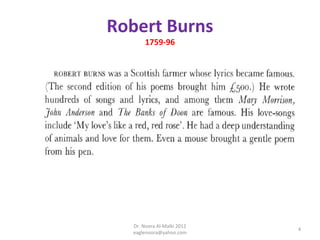
Robert Burns
        1759-96


   Dr. Noora Al-Malki 2012
                             4
   eaglenoora@yahoo.com
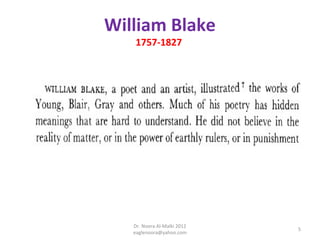
William Blake
    1757-1827


   Dr. Noora Al-Malki 2012
                             5
   eaglenoora@yahoo.com
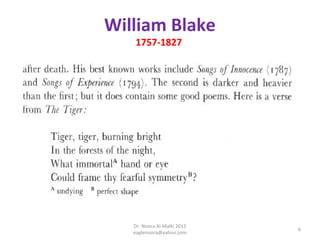
William Blake
    1757-1827


   Dr. Noora Al-Malki 2012
                             6
   eaglenoora@yahoo.com
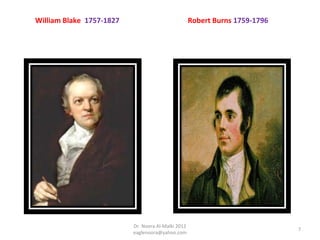
William Blake 1757-1827                             Robert Burns 1759-1796


                          Dr. Noora Al-Malki 2012
                                                                             7
                          eaglenoora@yahoo.com
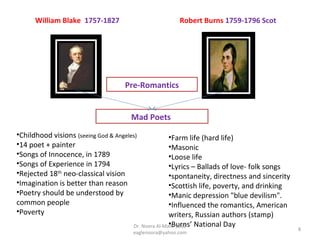
William Blake 1757-1827                           Robert Burns 1759-1796 Scot


                                    Pre-Romantics


                                       Mad Poets
•Childhood visions (seeing God & Angeles)             •Farm life (hard life)
•14 poet + painter                                    •Masonic
•Songs of Innocence, in 1789                          •Loose life
•Songs of Experience in 1794                          •Lyrics – Ballads of love- folk songs
•Rejected 18th neo-classical vision                   •spontaneity, directness and sincerity
•Imagination is better than reason                    •Scottish life, poverty, and drinking
•Poetry should be understood by                       •Manic depression "blue devilism".
common people                                         •Influenced the romantics, American
•Poverty                                              writers, Russian authors (stamp)
                                                      •Burns’
                                       Dr. Noora Al-Malki 2012 National Day
                                                                                               8
                                       eaglenoora@yahoo.com
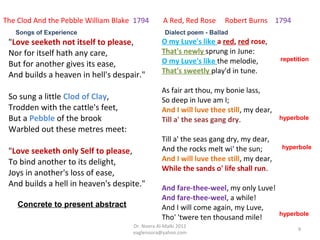
The Clod And the Pebble William Blake 1794       A Red, Red Rose     Robert Burns 1794
   Songs of Experience                            Dialect poem - Ballad
 "Love seeketh not itself to please,             O my Luve's like a red, red rose,
 Nor for itself hath any care,                   That's newly sprung in June:
                                                 O my Luve's like the melodie,          repetition
 But for another gives its ease,
                                                 That's sweetly play'd in tune.
 And builds a heaven in hell's despair."
                                                 As fair art thou, my bonie lass,
 So sung a little Clod of Clay,                  So deep in luve am I;
 Trodden with the cattle's feet,                 And I will luve thee still, my dear,
 But a Pebble of the brook                       Till a' the seas gang dry.             hyperbole
 Warbled out these metres meet:
                                                 Till a' the seas gang dry, my dear,
                                                 And the rocks melt wi' the sun;        hyperbole
 "Love seeketh only Self to please,
 To bind another to its delight,                 And I will luve thee still, my dear,
                                                 While the sands o' life shall run.
 Joys in another's loss of ease,
 And builds a hell in heaven's despite."         And fare-thee-weel, my only Luve!
                                                 And fare-thee-weel, a while!
    Concrete to present abstract                 And I will come again, my Luve,
                                                                                        hyperbole
                                                 Tho' 'twere ten thousand mile!
                                     Dr. Noora Al-Malki 2012
                                                                                              9
                                     eaglenoora@yahoo.com

Unit 4

  • 1.
    Course Title: Poetry Course Code & NO.: LANE 447 Course Credit Hrs.: 3 weekly Level: 7th Level Students The Transitional Period The Pre-Romantics William Collins William Blake Robert Burns Instructor: Dr. Noora Al-Malki Credits of images and online content are to their original owners.
  • 2.
    Pre-Romanticism The Transitional Era The term Pre-romantic “defines the sensibilities and spiritual states, trends, ideas and forms that developed at the end of the Neoclassical Period.” The Pre romantics did not constitute a school of thought. They were a group of writers that were influenced by the new trends, feelings, of the end of the century. Dr. Noora Al-Malki 2012 2 eaglenoora@yahoo.com
  • 3.
    William Collins 1721-59 William Collins was a pre-Romantic English poet whose lyrical odes adhered to Neoclassical forms but were Romantic in theme and feeling. Though his literary career was brief and his output slender, he is considered one of the finest English lyric poets of the 18th century. Dr. Noora Al-Malki 2012 3 eaglenoora@yahoo.com
  • 4.
    Robert Burns 1759-96 Dr. Noora Al-Malki 2012 4 eaglenoora@yahoo.com
  • 5.
    William Blake 1757-1827 Dr. Noora Al-Malki 2012 5 eaglenoora@yahoo.com
  • 6.
    William Blake 1757-1827 Dr. Noora Al-Malki 2012 6 eaglenoora@yahoo.com
  • 7.
    William Blake 1757-1827 Robert Burns 1759-1796 Dr. Noora Al-Malki 2012 7 eaglenoora@yahoo.com
  • 8.
    William Blake 1757-1827 Robert Burns 1759-1796 Scot Pre-Romantics Mad Poets •Childhood visions (seeing God & Angeles) •Farm life (hard life) •14 poet + painter •Masonic •Songs of Innocence, in 1789 •Loose life •Songs of Experience in 1794 •Lyrics – Ballads of love- folk songs •Rejected 18th neo-classical vision •spontaneity, directness and sincerity •Imagination is better than reason •Scottish life, poverty, and drinking •Poetry should be understood by •Manic depression "blue devilism". common people •Influenced the romantics, American •Poverty writers, Russian authors (stamp) •Burns’ Dr. Noora Al-Malki 2012 National Day 8 eaglenoora@yahoo.com
  • 9.
    The Clod Andthe Pebble William Blake 1794 A Red, Red Rose Robert Burns 1794 Songs of Experience Dialect poem - Ballad "Love seeketh not itself to please, O my Luve's like a red, red rose, Nor for itself hath any care, That's newly sprung in June: O my Luve's like the melodie, repetition But for another gives its ease, That's sweetly play'd in tune. And builds a heaven in hell's despair." As fair art thou, my bonie lass, So sung a little Clod of Clay, So deep in luve am I; Trodden with the cattle's feet, And I will luve thee still, my dear, But a Pebble of the brook Till a' the seas gang dry. hyperbole Warbled out these metres meet: Till a' the seas gang dry, my dear, And the rocks melt wi' the sun; hyperbole "Love seeketh only Self to please, To bind another to its delight, And I will luve thee still, my dear, While the sands o' life shall run. Joys in another's loss of ease, And builds a hell in heaven's despite." And fare-thee-weel, my only Luve! And fare-thee-weel, a while! Concrete to present abstract And I will come again, my Luve, hyperbole Tho' 'twere ten thousand mile! Dr. Noora Al-Malki 2012 9 eaglenoora@yahoo.com