ROBERT BURNS


The Great Scotsman
THE BEGINNING
   Born 25 January 1759

   Came from a poor family but was always inspired to
    succeed

   Was the oldest of seven children

   Worked on his father's farm in Mt. Oliphant.

   Became a Freemason in 1781 and was an active member
    during his life. He obtained the degree of Royal Arch in
    1787
•   He had fourteen children, nine out of wedlock, which led to
    public persecution

•   Robert Burns became intimate with Jean Armour.

•   To raise funds for his emigration he published Kilmarnock, in
    1786. These poems were surprisingly successful.

•   His poems were such a success he remained in Scotland and
    did not go to the West Indies.

•   In rapidly deteriorating health, Burns dies on 21 July 1796 in
    Dumfries, Scotland at the age of only 37
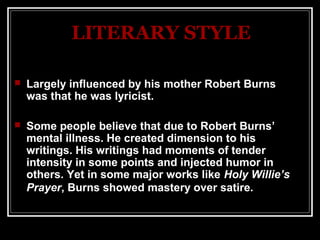
LITERARY STYLE

   Largely influenced by his mother Robert Burns
    was that he was lyricist.

   Some people believe that due to Robert Burns’
    mental illness. He created dimension to his
    writings. His writings had moments of tender
    intensity in some points and injected humor in
    others. Yet in some major works like Holy Willie’s 
    Prayer, Burns showed mastery over satire.
• Directed his poetry to the cultural identity of Scotland,
  sexuality, and poverty.

•    Some belief that Burns emotions were very ranged some
    suggest he suffered from Mental Illness.

• Had very satirical views which were evident in his writings.

• Brought a freshness to the original English romantic poetry

•   Had an influence on the American author John Steinbeck Of 
    Mice and Men.
PERSONAL OPINIONS
While writing and creating this slide show it
brought me back to my childhood days in
Scotland. I was born and brought up in
Ayrshire, Scotland. Also know as “Rabbie
Country”. Burns’ poetry was always taught in
school but like most elementary students I
read it and forgot it. Not realizing the meaning
or History. I remember having to remember
and recite “To a Mouse”. 30 years later, I
finally understand the passion that Burns
displayed.
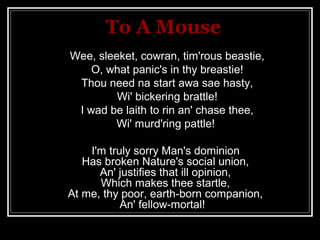
To A Mouse
Wee, sleeket, cowran, tim'rous beastie,
    O, what panic's in thy breastie!
 Thou need na start awa sae hasty,
         Wi' bickering brattle!
 I wad be laith to rin an' chase thee,
        Wi' murd'ring pattle!

    I'm truly sorry Man's dominion
   Has broken Nature's social union,
      An' justifies that ill opinion,
      Which makes thee startle,
At me, thy poor, earth-born companion,
           An' fellow-mortal!
I doubt na, whyles, but thou may thieve;
 What then? poor beastie, thou maun live!
A daimen-icker in a thrave 'S a sma' request:
        I'll get a blessin wi' the lave,
               An' never miss't!

       Thy wee-bit housie, too, in ruin!
     It's silly wa's the win's are strewin!
    An' naething, now, to big a new ane,
                O' foggage green!
    An' bleak December's winds ensuin,
               Baith snell an' keen!
Thou saw the fields laid bare an' wast,
    An' weary Winter comin fast,
  An' cozie here, beneath the blast,
         Thou thought to dwell,
   Till crash! the cruel coulter past
           Out thro' thy cell.

That wee-bit heap o' leaves an' stibble,
 Has cost thee monie a weary nibble!
Now thou's turn'd out, for a' thy trouble,
         But house or hald.
 To thole the Winter's sleety dribble,
        An' cranreuch cauld!
But Mousie, thou are no thy-lane,
   In proving foresight may be vain:
The best laid schemes o' Mice an' Men,
            Gang aft agley,
 An' lea'e us nought but grief an' pain,
            For promis'd joy!

 Still, thou art blest, compar'd wi' me!
   The present only toucheth thee:
  But Och! I backward cast my e'e,
           On prospects drear!
      An' forward, tho' I canna see,
             I guess an' fear!
          (Robert Burns- ElectricScotland.com)
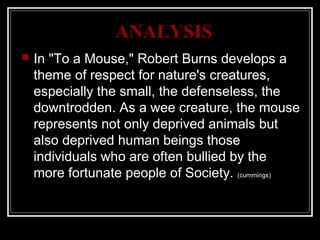
ANALYSIS
   In "To a Mouse," Robert Burns develops a
    theme of respect for nature's creatures,
    especially the small, the defenseless, the
    downtrodden. As a wee creature, the mouse
    represents not only deprived animals but
    also deprived human beings those
    individuals who are often bullied by the
    more fortunate people of Society. (cummings)
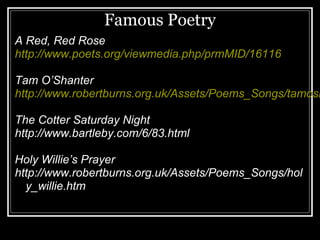
Famous Poetry
A Red, Red Rose
http://www.poets.org/viewmedia.php/prmMID/16116

Tam O’Shanter
http://www.robertburns.org.uk/Assets/Poems_Songs/tamosh

The Cotter Saturday Night
http://www.bartleby.com/6/83.html

Holy Willie’s Prayer
http://www.robertburns.org.uk/Assets/Poems_Songs/hol
  y_willie.htm
Work Cited
Lawrie,Alexander. “Robert Burns suffered from mental disorder.”
Deadlinenews. June 7, 2009. Web. September 6, 2012,

 “Tom O’Shanter.” Robert Burns Encyclopedia. 2012. Web.
September 6, 2012.
http://www.robertburns.org/encyclopedia/TamOShanter.23.shtml

 “To a mouse” Cumming’s study Guide.
http://cummingsstudyguides.net/Guides4/Mouse.html

David lafferty ppt

  • 1.
  • 2.
    THE BEGINNING  Born 25 January 1759  Came from a poor family but was always inspired to succeed  Was the oldest of seven children  Worked on his father's farm in Mt. Oliphant.  Became a Freemason in 1781 and was an active member during his life. He obtained the degree of Royal Arch in 1787
  • 3.
    He had fourteen children, nine out of wedlock, which led to public persecution • Robert Burns became intimate with Jean Armour. • To raise funds for his emigration he published Kilmarnock, in 1786. These poems were surprisingly successful. • His poems were such a success he remained in Scotland and did not go to the West Indies. • In rapidly deteriorating health, Burns dies on 21 July 1796 in Dumfries, Scotland at the age of only 37
  • 4.
    LITERARY STYLE  Largely influenced by his mother Robert Burns was that he was lyricist.  Some people believe that due to Robert Burns’ mental illness. He created dimension to his writings. His writings had moments of tender intensity in some points and injected humor in others. Yet in some major works like Holy Willie’s  Prayer, Burns showed mastery over satire.
  • 5.
    • Directed hispoetry to the cultural identity of Scotland, sexuality, and poverty. • Some belief that Burns emotions were very ranged some suggest he suffered from Mental Illness. • Had very satirical views which were evident in his writings. • Brought a freshness to the original English romantic poetry • Had an influence on the American author John Steinbeck Of  Mice and Men.
  • 6.
    PERSONAL OPINIONS While writingand creating this slide show it brought me back to my childhood days in Scotland. I was born and brought up in Ayrshire, Scotland. Also know as “Rabbie Country”. Burns’ poetry was always taught in school but like most elementary students I read it and forgot it. Not realizing the meaning or History. I remember having to remember and recite “To a Mouse”. 30 years later, I finally understand the passion that Burns displayed.
  • 7.
    To A Mouse Wee,sleeket, cowran, tim'rous beastie, O, what panic's in thy breastie! Thou need na start awa sae hasty, Wi' bickering brattle! I wad be laith to rin an' chase thee, Wi' murd'ring pattle! I'm truly sorry Man's dominion Has broken Nature's social union, An' justifies that ill opinion, Which makes thee startle, At me, thy poor, earth-born companion, An' fellow-mortal!
  • 8.
    I doubt na,whyles, but thou may thieve; What then? poor beastie, thou maun live! A daimen-icker in a thrave 'S a sma' request: I'll get a blessin wi' the lave, An' never miss't! Thy wee-bit housie, too, in ruin! It's silly wa's the win's are strewin! An' naething, now, to big a new ane, O' foggage green! An' bleak December's winds ensuin, Baith snell an' keen!
  • 9.
    Thou saw thefields laid bare an' wast, An' weary Winter comin fast, An' cozie here, beneath the blast, Thou thought to dwell, Till crash! the cruel coulter past Out thro' thy cell. That wee-bit heap o' leaves an' stibble, Has cost thee monie a weary nibble! Now thou's turn'd out, for a' thy trouble, But house or hald. To thole the Winter's sleety dribble, An' cranreuch cauld!
  • 10.
    But Mousie, thouare no thy-lane, In proving foresight may be vain: The best laid schemes o' Mice an' Men, Gang aft agley, An' lea'e us nought but grief an' pain, For promis'd joy! Still, thou art blest, compar'd wi' me! The present only toucheth thee: But Och! I backward cast my e'e, On prospects drear! An' forward, tho' I canna see, I guess an' fear! (Robert Burns- ElectricScotland.com)
  • 11.
    ANALYSIS  In "To a Mouse," Robert Burns develops a theme of respect for nature's creatures, especially the small, the defenseless, the downtrodden. As a wee creature, the mouse represents not only deprived animals but also deprived human beings those individuals who are often bullied by the more fortunate people of Society. (cummings)
  • 12.
    Famous Poetry A Red,Red Rose http://www.poets.org/viewmedia.php/prmMID/16116 Tam O’Shanter http://www.robertburns.org.uk/Assets/Poems_Songs/tamosh The Cotter Saturday Night http://www.bartleby.com/6/83.html Holy Willie’s Prayer http://www.robertburns.org.uk/Assets/Poems_Songs/hol y_willie.htm
  • 13.
    Work Cited Lawrie,Alexander. “RobertBurns suffered from mental disorder.” Deadlinenews. June 7, 2009. Web. September 6, 2012,  “Tom O’Shanter.” Robert Burns Encyclopedia. 2012. Web. September 6, 2012. http://www.robertburns.org/encyclopedia/TamOShanter.23.shtml  “To a mouse” Cumming’s study Guide. http://cummingsstudyguides.net/Guides4/Mouse.html