Celebration of Christmas
Live Arts Maryland
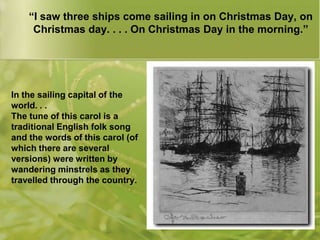
“I saw three ships come sailing in on Christmas Day, on
Christmas day. . . . On Christmas Day in the morning.”

In the sailing capital of the
world. . .
The tune of this carol is a
traditional English folk song
and the words of this carol (of
which there are several
versions) were written by
wandering minstrels as they
travelled through the country.
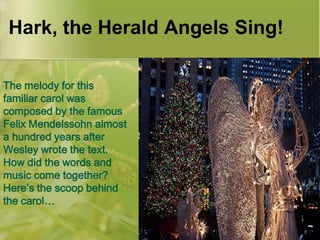
Hark, the Herald Angels Sing!
The melody for this
familiar carol was
composed by the famous
Felix Mendelssohn almost
a hundred years after
Wesley wrote the text.
How did the words and
music come together?
Here’s the scoop behind
the carol…
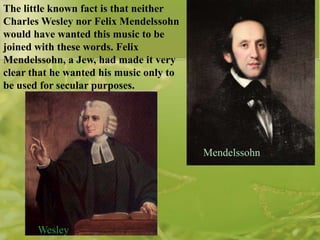
The little known fact is that neither
Charles Wesley nor Felix Mendelssohn
would have wanted this music to be
joined with these words. Felix
Mendelssohn, a Jew, had made it very
clear that he wanted his music only to
be used for secular purposes.

Mendelssohn

Wesley
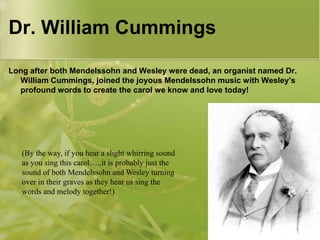
Dr. William Cummings
Long after both Mendelssohn and Wesley were dead, an organist named Dr.
William Cummings, joined the joyous Mendelssohn music with Wesley’s
profound words to create the carol we know and love today!

(By the way, if you hear a slight whirring sound
as you sing this carol…..it is probably just the
sound of both Mendelssohn and Wesley turning
over in their graves as they hear us sing the
words and melody together!)
Jingle Bells
Did you ever wonder
who wrote Jingle Bells?
It‟s one of the first
carols we learn as
children and is so much
a part of our lives that
most of us probably
never even have thought
about the fact that
somebody really did
write it!
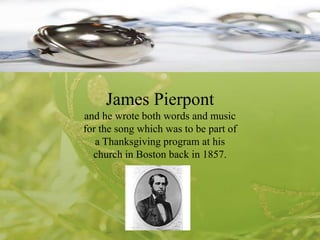
James Pierpont
and he wrote both words and music
for the song which was to be part of
a Thanksgiving program at his
church in Boston back in 1857.
The Christmas Song

One excessively hot
afternoon, I drove out to Bob's
house [Robert Wells] in Toluca
Lake for a work session. The
San Fernando Valley, always
at least ten degrees warmer
than the rest of the town,
blistered in the July sun.... I
opened the front door and
walked in.... I called for Bob.
No answer. I walked over to
the piano. A writing pad rested
on the music board. Written in
pencil on the open page were
four lines of verse:
Chestnuts roasting on an open
fire
Jack frost nipping at your nose
Yuletide carols being sung by
a choir
And folks dressed up like
Eskimos
When Bob finally appeared,
I asked him about the little
poem.
"I thought I'd write
something to cool myself off.
All I could think of was
Christmas and cold
weather."
I took another look at his
handiwork. "You know," I
said, "this just might make
a song."
We sat down together at the
piano, and, improbable
though it may sound, "The
Christmas Song" was
completed about forty-five
minutes later.
Does this look familiar?
Adeste Fideles
O Come, All Ye Faithful
So. . . Who gets credit? This is difficult to determine. . .
1. We have heard a faint echo in the Winchester Cathedral organ-loft,
thanks to Vincent Novello, who was convinced that the Adeste was
composed there by John Reading about the year 1680.
2. Then came a clear „evocation,‟ like that of a mocking bird, of the
same tune from a Paris theatre in 1744.
3. The next report comes from Dublin a few years later, about the year
1748. Here the Dominican nuns have preserved “a floating tradition”
that the Adeste was sung for the first time in the Channel Row
Dominican Priory, shortly after the 1745 rising in the British Isles in
favor of Bonnie Prince Charlie.
http://www.hymnsandcarolsofchristmas.com/Hymns_and_Carols/Images/Stephan/adeste_fideles_a_study_on_its_or.htm
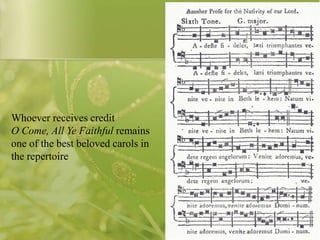
Whoever receives credit
O Come, All Ye Faithful remains
one of the best beloved carols in
the repertoire
What do the following have in
common?
1.

2.

3.

4.

Rudolph,the Red-Nosed Reindeer a hit
for Gene Autry and others
Rockin’ Around the Christmas Tree a hit
for Brenda Lee
A Holly Jolly Christmas recorded by Burl
Ives
Silver and Gold
Johnny Marks

The brother-in-law of Robert L. May, who wrote the original
story of "Rudolph, the Red-Nosed Reindeer," it was he who
set the story to music. After failing to sell the song to,
among others, Bing Crosby, Marks eventually found a
enthusiastic listener in the person of singing cowboy Gene
Autry. Autry's Columbia recording of the song, in 1947,
became the biggest hit of his career and made both men (and
May, who owned the rights to the original story) very
wealthy.
France bans “O Holy Night”

In 1847, Placide Cappeau de Roquemaure
was the commissionaire of wines in a small
French town. Known more for his poetry
than his church attendance, it probably
shocked Placide when his parish priest
asked the commissionaire to pen a poem for
Christmas mass. Nevertheless, the poet was
honored to share his talents with the church.
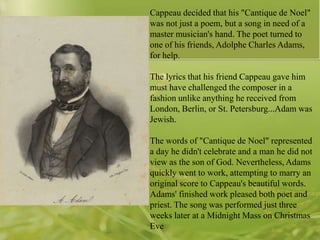
Cappeau decided that his "Cantique de Noel"
was not just a poem, but a song in need of a
master musician's hand. The poet turned to
one of his friends, Adolphe Charles Adams,
for help.
The lyrics that his friend Cappeau gave him
must have challenged the composer in a
fashion unlike anything he received from
London, Berlin, or St. Petersburg...Adam was
Jewish.
The words of "Cantique de Noel" represented
a day he didn't celebrate and a man he did not
view as the son of God. Nevertheless, Adams
quickly went to work, attempting to marry an
original score to Cappeau's beautiful words.
Adams' finished work pleased both poet and
priest. The song was performed just three
weeks later at a Midnight Mass on Christmas
Eve
So, why was it banned in France?
Initially, "Cantique de Noel" was wholeheartedly
accepted by the church in France and the song quickly
found its way into various Catholic Christmas services.
But when Placide Cappeau walked away from the
church and became a part of the socialist movement,
and church leaders discovered that Adolphe Adams was
a Jew, the song--which had quickly grown to be one of
the most beloved Christmas songs in France--was
suddenly and uniformly denounced by the church.
Enter . . John Sullivan Dwight, American

An ardent abolitionist, Dwight strongly identified with the lines of the
third verse:
"Truly he taught us to love one another; his law is love and
his gospel is peace. Chains shall he break, for the slave is our
brother; and in his name all oppression shall cease."
Published in his magazine, Dwight's English translation of "O Holy
Night" quickly found favor in America, especially in the North during
the Civil War.
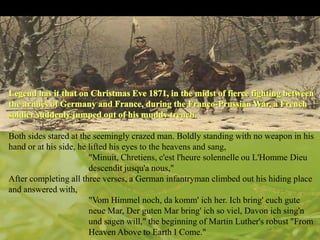
Both sides stared at the seemingly crazed man. Boldly standing with no weapon in his
hand or at his side, he lifted his eyes to the heavens and sang,
"Minuit, Chretiens, c'est l'heure solennelle ou L'Homme Dieu
descendit jusqu'a nous,"
After completing all three verses, a German infantryman climbed out his hiding place
and answered with,
"Vom Himmel noch, da komm' ich her. Ich bring' euch gute
neue Mar, Der guten Mar bring' ich so viel, Davon ich sing'n
und sagen will," the beginning of Martin Luther's robust "From
Heaven Above to Earth I Come."
The story goes that
the fighting stopped
for the next twentyfour hours while the
men on both sides
observed a temporary
peace in honor of
Christmas day.
Perhaps this story
had a part in the
French church once
again embracing
"Cantique de Noel"
in holiday services.
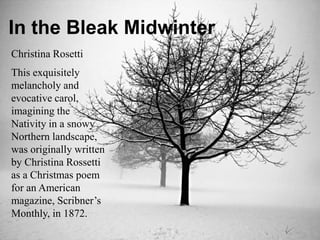
In the Bleak Midwinter
Christina Rosetti
This exquisitely
melancholy and
evocative carol,
imagining the
Nativity in a snowy
Northern landscape,
was originally written
by Christina Rossetti
as a Christmas poem
for an American
magazine, Scribner‟s
Monthly, in 1872.
Harold Darke
Harold Darke wrote sacred music, organ and piano pieces, and songs.
His setting of In the Bleak Midwinter is still often sung at the service of
Nine Lessons and Carols at King's College, Cambridge, and at similar
services around the world.
Do You Hear What I Hear?

Many people mistakenly assume this Christmas
classic has been around for years and that it is of
European origin. But it was written in 1962 during
the Cuban Missile Crisis as a powerful plea for peace
by a man who had experienced the horrors of war.
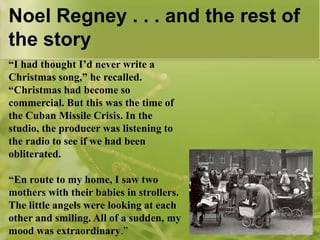
Noel Regney . . . and the rest of
the story
“I had thought I’d never write a
Christmas song,” he recalled.
“Christmas had become so
commercial. But this was the time of
the Cuban Missile Crisis. In the
studio, the producer was listening to
the radio to see if we had been
obliterated.
“En route to my home, I saw two
mothers with their babies in strollers.
The little angels were looking at each
other and smiling. All of a sudden, my
mood was extraordinary.”
…and his wife. . . Gloria Shayne
Noel wrote a beautiful song,” Gloria said later, “and I wrote the music.
We couldn‟t sing it, through; it broke us up. We cried. Our little song
broke us up. You must realize there was a threat of nuclear war at that
time.”
Pray for peace people
everywhere
“Pray for peace, people everywhere” – Do You Hear What I Hear?
Merry Christmas from Live Arts Maryland, the Annapolis Chorale, The
Annapolis Chamber Orchestra, the Annapolis Youth Chorus, and
Cantori.
Please, support the following
patrons of the arts!
Annapolis Chorale christmas card

Annapolis Chorale christmas card

  • 1.
  • 2.
    “I saw threeships come sailing in on Christmas Day, on Christmas day. . . . On Christmas Day in the morning.” In the sailing capital of the world. . . The tune of this carol is a traditional English folk song and the words of this carol (of which there are several versions) were written by wandering minstrels as they travelled through the country.
  • 3.
    Hark, the HeraldAngels Sing! The melody for this familiar carol was composed by the famous Felix Mendelssohn almost a hundred years after Wesley wrote the text. How did the words and music come together? Here’s the scoop behind the carol…
  • 4.
    The little knownfact is that neither Charles Wesley nor Felix Mendelssohn would have wanted this music to be joined with these words. Felix Mendelssohn, a Jew, had made it very clear that he wanted his music only to be used for secular purposes. Mendelssohn Wesley
  • 5.
    Dr. William Cummings Longafter both Mendelssohn and Wesley were dead, an organist named Dr. William Cummings, joined the joyous Mendelssohn music with Wesley’s profound words to create the carol we know and love today! (By the way, if you hear a slight whirring sound as you sing this carol…..it is probably just the sound of both Mendelssohn and Wesley turning over in their graves as they hear us sing the words and melody together!)
  • 6.
    Jingle Bells Did youever wonder who wrote Jingle Bells? It‟s one of the first carols we learn as children and is so much a part of our lives that most of us probably never even have thought about the fact that somebody really did write it!
  • 7.
    James Pierpont and hewrote both words and music for the song which was to be part of a Thanksgiving program at his church in Boston back in 1857.
  • 8.
    The Christmas Song Oneexcessively hot afternoon, I drove out to Bob's house [Robert Wells] in Toluca Lake for a work session. The San Fernando Valley, always at least ten degrees warmer than the rest of the town, blistered in the July sun.... I opened the front door and walked in.... I called for Bob. No answer. I walked over to the piano. A writing pad rested on the music board. Written in pencil on the open page were four lines of verse: Chestnuts roasting on an open fire Jack frost nipping at your nose Yuletide carols being sung by a choir And folks dressed up like Eskimos
  • 9.
    When Bob finallyappeared, I asked him about the little poem. "I thought I'd write something to cool myself off. All I could think of was Christmas and cold weather." I took another look at his handiwork. "You know," I said, "this just might make a song." We sat down together at the piano, and, improbable though it may sound, "The Christmas Song" was completed about forty-five minutes later.
  • 10.
    Does this lookfamiliar?
  • 11.
    Adeste Fideles O Come,All Ye Faithful So. . . Who gets credit? This is difficult to determine. . . 1. We have heard a faint echo in the Winchester Cathedral organ-loft, thanks to Vincent Novello, who was convinced that the Adeste was composed there by John Reading about the year 1680. 2. Then came a clear „evocation,‟ like that of a mocking bird, of the same tune from a Paris theatre in 1744. 3. The next report comes from Dublin a few years later, about the year 1748. Here the Dominican nuns have preserved “a floating tradition” that the Adeste was sung for the first time in the Channel Row Dominican Priory, shortly after the 1745 rising in the British Isles in favor of Bonnie Prince Charlie. http://www.hymnsandcarolsofchristmas.com/Hymns_and_Carols/Images/Stephan/adeste_fideles_a_study_on_its_or.htm
  • 12.
    Whoever receives credit OCome, All Ye Faithful remains one of the best beloved carols in the repertoire
  • 13.
    What do thefollowing have in common? 1. 2. 3. 4. Rudolph,the Red-Nosed Reindeer a hit for Gene Autry and others Rockin’ Around the Christmas Tree a hit for Brenda Lee A Holly Jolly Christmas recorded by Burl Ives Silver and Gold
  • 14.
    Johnny Marks The brother-in-lawof Robert L. May, who wrote the original story of "Rudolph, the Red-Nosed Reindeer," it was he who set the story to music. After failing to sell the song to, among others, Bing Crosby, Marks eventually found a enthusiastic listener in the person of singing cowboy Gene Autry. Autry's Columbia recording of the song, in 1947, became the biggest hit of his career and made both men (and May, who owned the rights to the original story) very wealthy.
  • 15.
    France bans “OHoly Night” In 1847, Placide Cappeau de Roquemaure was the commissionaire of wines in a small French town. Known more for his poetry than his church attendance, it probably shocked Placide when his parish priest asked the commissionaire to pen a poem for Christmas mass. Nevertheless, the poet was honored to share his talents with the church.
  • 16.
    Cappeau decided thathis "Cantique de Noel" was not just a poem, but a song in need of a master musician's hand. The poet turned to one of his friends, Adolphe Charles Adams, for help. The lyrics that his friend Cappeau gave him must have challenged the composer in a fashion unlike anything he received from London, Berlin, or St. Petersburg...Adam was Jewish. The words of "Cantique de Noel" represented a day he didn't celebrate and a man he did not view as the son of God. Nevertheless, Adams quickly went to work, attempting to marry an original score to Cappeau's beautiful words. Adams' finished work pleased both poet and priest. The song was performed just three weeks later at a Midnight Mass on Christmas Eve
  • 17.
    So, why wasit banned in France? Initially, "Cantique de Noel" was wholeheartedly accepted by the church in France and the song quickly found its way into various Catholic Christmas services. But when Placide Cappeau walked away from the church and became a part of the socialist movement, and church leaders discovered that Adolphe Adams was a Jew, the song--which had quickly grown to be one of the most beloved Christmas songs in France--was suddenly and uniformly denounced by the church.
  • 18.
    Enter . .John Sullivan Dwight, American An ardent abolitionist, Dwight strongly identified with the lines of the third verse: "Truly he taught us to love one another; his law is love and his gospel is peace. Chains shall he break, for the slave is our brother; and in his name all oppression shall cease." Published in his magazine, Dwight's English translation of "O Holy Night" quickly found favor in America, especially in the North during the Civil War.
  • 19.
    Both sides staredat the seemingly crazed man. Boldly standing with no weapon in his hand or at his side, he lifted his eyes to the heavens and sang, "Minuit, Chretiens, c'est l'heure solennelle ou L'Homme Dieu descendit jusqu'a nous," After completing all three verses, a German infantryman climbed out his hiding place and answered with, "Vom Himmel noch, da komm' ich her. Ich bring' euch gute neue Mar, Der guten Mar bring' ich so viel, Davon ich sing'n und sagen will," the beginning of Martin Luther's robust "From Heaven Above to Earth I Come."
  • 20.
    The story goesthat the fighting stopped for the next twentyfour hours while the men on both sides observed a temporary peace in honor of Christmas day. Perhaps this story had a part in the French church once again embracing "Cantique de Noel" in holiday services.
  • 21.
    In the BleakMidwinter Christina Rosetti This exquisitely melancholy and evocative carol, imagining the Nativity in a snowy Northern landscape, was originally written by Christina Rossetti as a Christmas poem for an American magazine, Scribner‟s Monthly, in 1872.
  • 22.
    Harold Darke Harold Darkewrote sacred music, organ and piano pieces, and songs. His setting of In the Bleak Midwinter is still often sung at the service of Nine Lessons and Carols at King's College, Cambridge, and at similar services around the world.
  • 23.
    Do You HearWhat I Hear? Many people mistakenly assume this Christmas classic has been around for years and that it is of European origin. But it was written in 1962 during the Cuban Missile Crisis as a powerful plea for peace by a man who had experienced the horrors of war.
  • 24.
    Noel Regney .. . and the rest of the story “I had thought I’d never write a Christmas song,” he recalled. “Christmas had become so commercial. But this was the time of the Cuban Missile Crisis. In the studio, the producer was listening to the radio to see if we had been obliterated. “En route to my home, I saw two mothers with their babies in strollers. The little angels were looking at each other and smiling. All of a sudden, my mood was extraordinary.”
  • 25.
    …and his wife.. . Gloria Shayne Noel wrote a beautiful song,” Gloria said later, “and I wrote the music. We couldn‟t sing it, through; it broke us up. We cried. Our little song broke us up. You must realize there was a threat of nuclear war at that time.”
  • 26.
    Pray for peacepeople everywhere “Pray for peace, people everywhere” – Do You Hear What I Hear? Merry Christmas from Live Arts Maryland, the Annapolis Chorale, The Annapolis Chamber Orchestra, the Annapolis Youth Chorus, and Cantori.
  • 27.
    Please, support thefollowing patrons of the arts!