The Renaissance elements in Macbeth
Course Code: Eng - 201
C ourse Tit le: Eliz abet han D rama
Presented By:
Kamrul Hasan Bappy
ID: M21513111100
Batch: 36th
Section: [B]
Prepared for:
Monir Hossen
Lecturer
Department of English
Uttara university
Contents
• About Macbeth
• Shakespeare
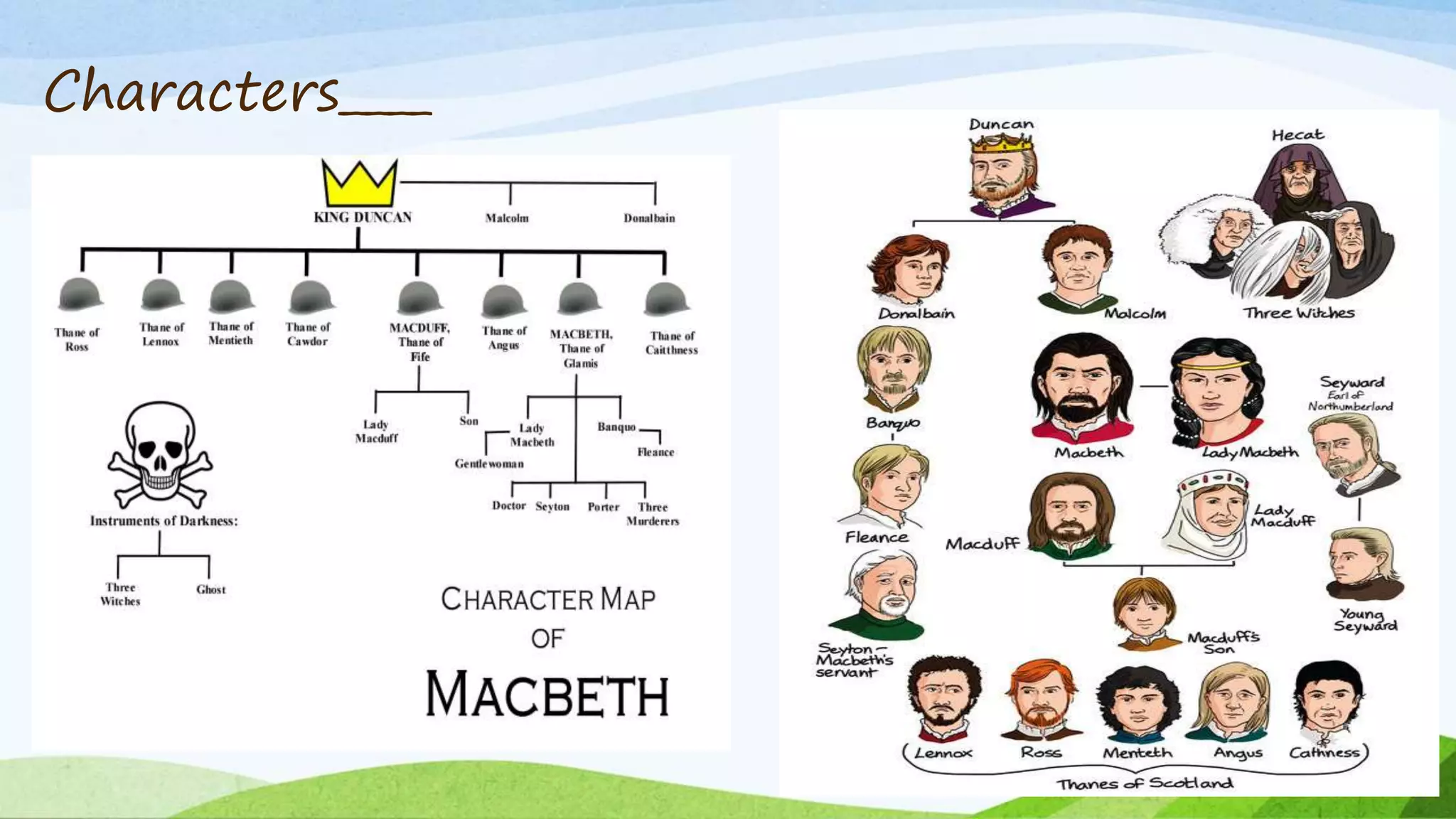
• Characters
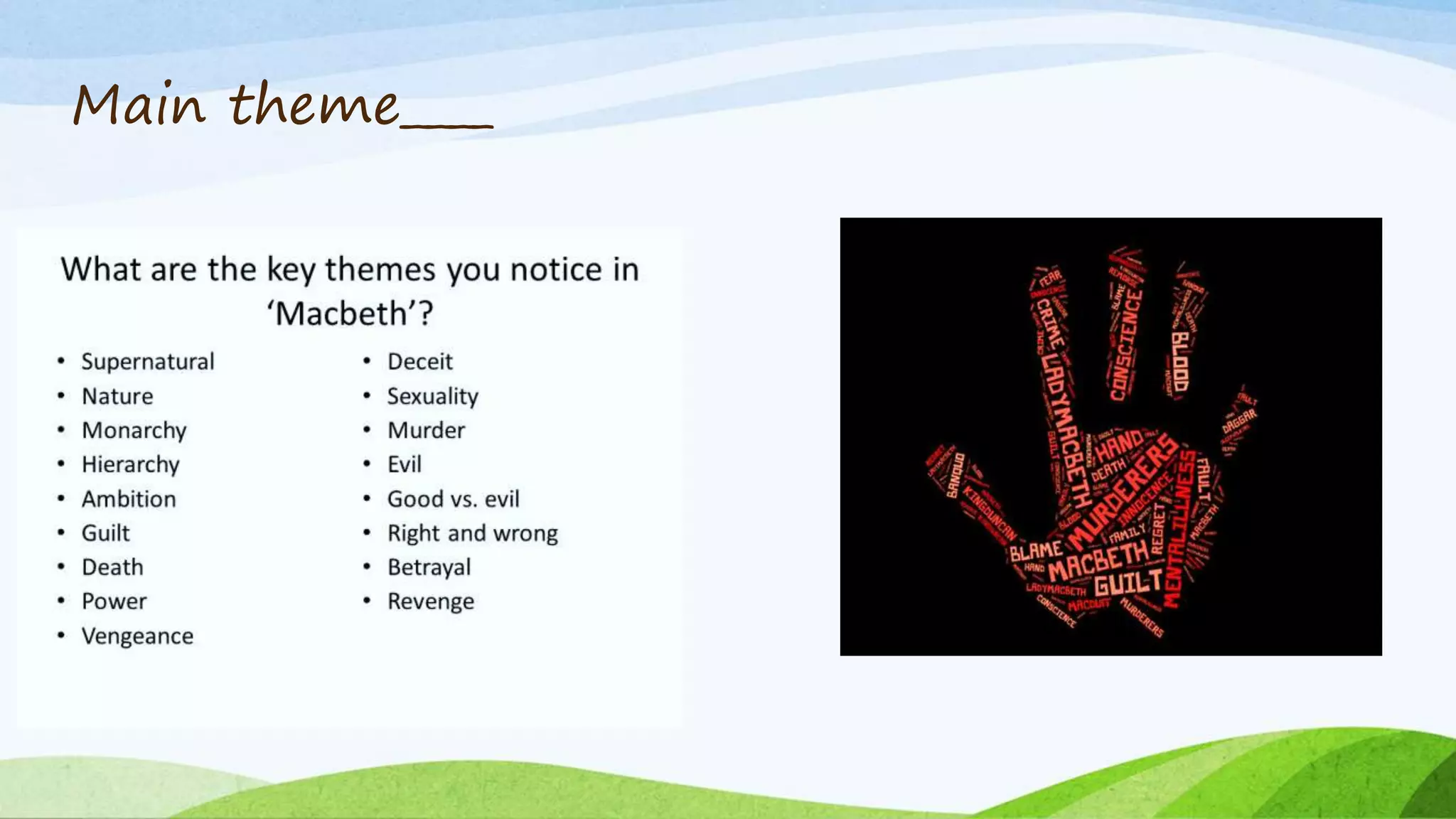
• Main Theme
• Story
• Plot Diagram
• Renaissance elements
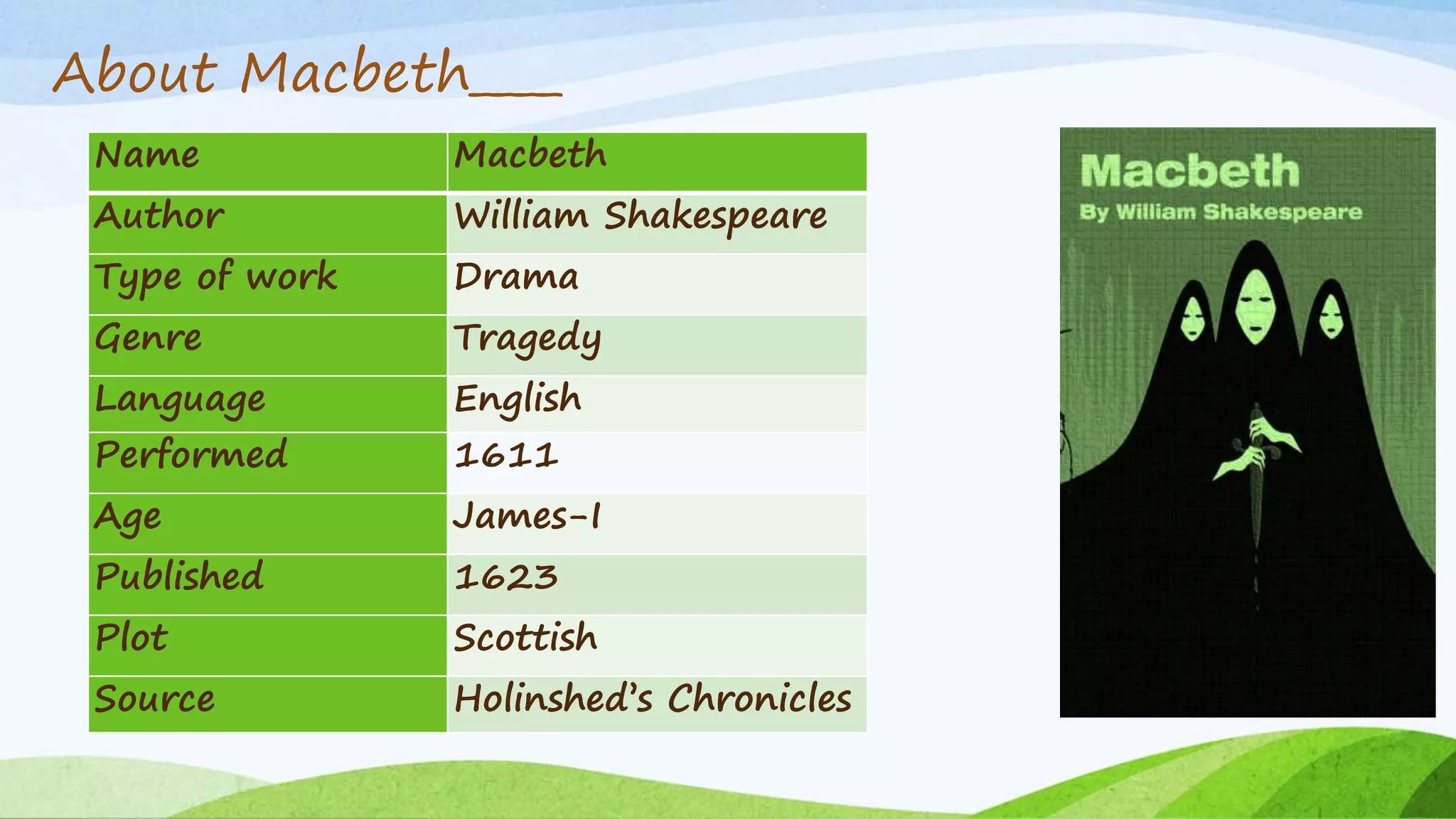
Name Macbeth
Author William Shakespeare
Type of work Drama
Genre Tragedy
Language English
Performed 1611
Age James-I
Published 1623
Plot Scottish
Source Holinshed’s Chronicles
About Macbeth____
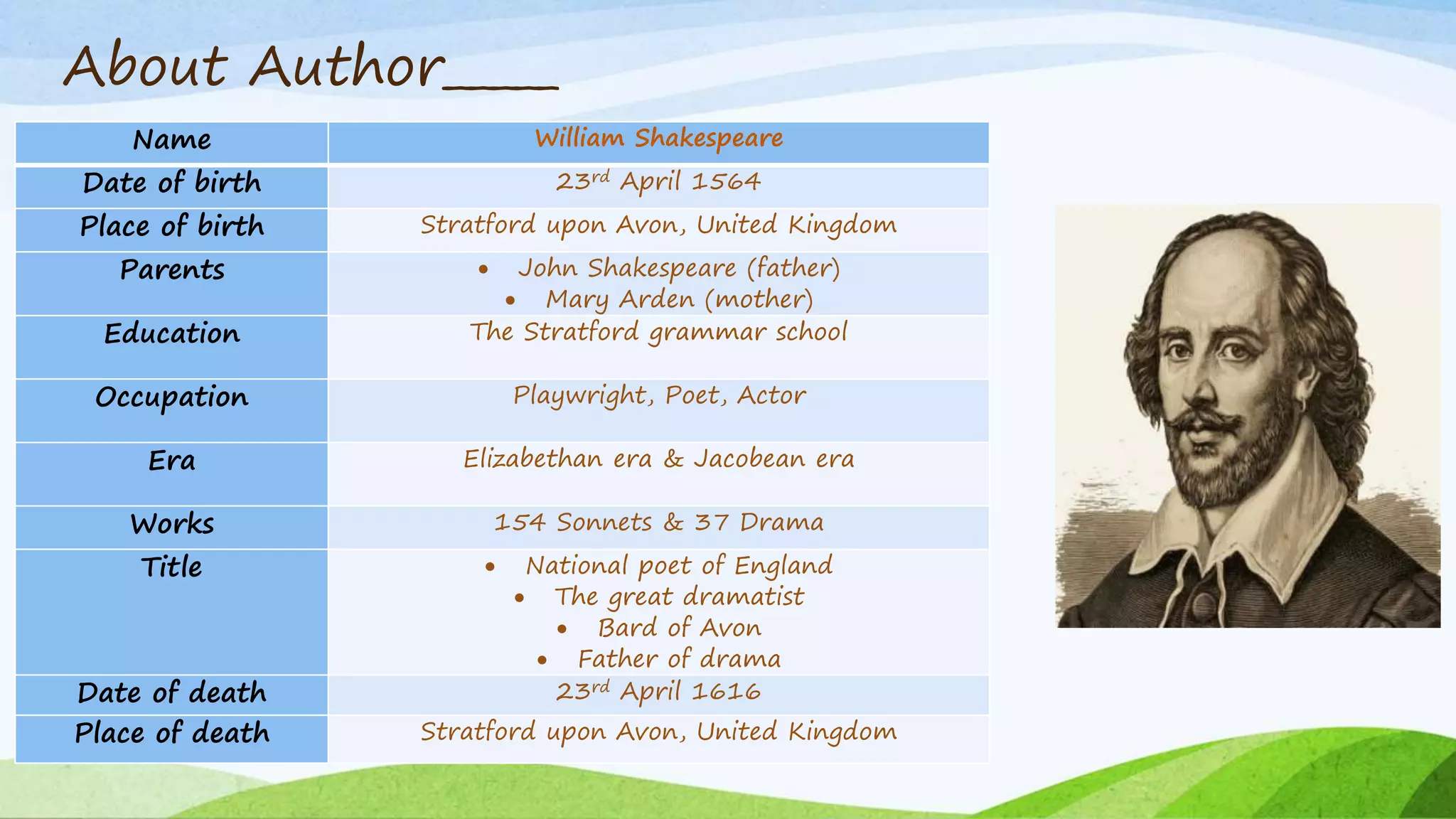
About Author_____
Name William Shakespeare
Date of birth 23rd April 1564
Place of birth Stratford upon Avon, United Kingdom
Parents  John Shakespeare (father)
 Mary Arden (mother)
Education The Stratford grammar school
Occupation Playwright, Poet, Actor
Era Elizabethan era & Jacobean era
Works 154 Sonnets & 37 Drama
Title  National poet of England
 The great dramatist
 Bard of Avon
 Father of drama
Date of death 23rd April 1616
Place of death Stratford upon Avon, United Kingdom
Characters____
Main theme____
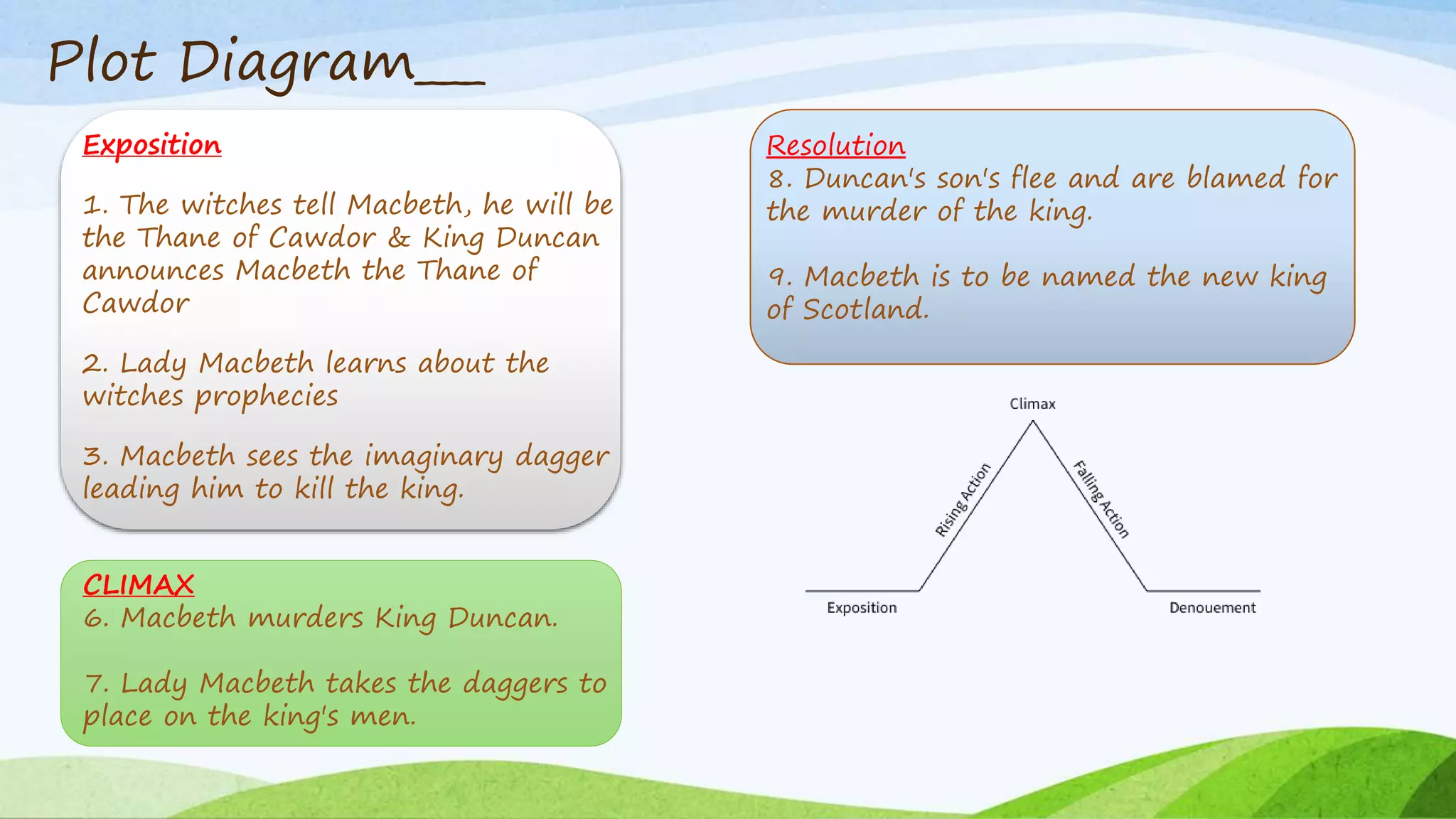
Plot Diagram___
Exposition
1. The witches tell Macbeth, he will be
the Thane of Cawdor & King Duncan
announces Macbeth the Thane of
Cawdor
2. Lady Macbeth learns about the
witches prophecies
3. Macbeth sees the imaginary dagger
leading him to kill the king.
CLIMAX
6. Macbeth murders King Duncan.
7. Lady Macbeth takes the daggers to
place on the king's men.
Resolution
8. Duncan's son's flee and are blamed for
the murder of the king.
9. Macbeth is to be named the new king
of Scotland.
The Story___
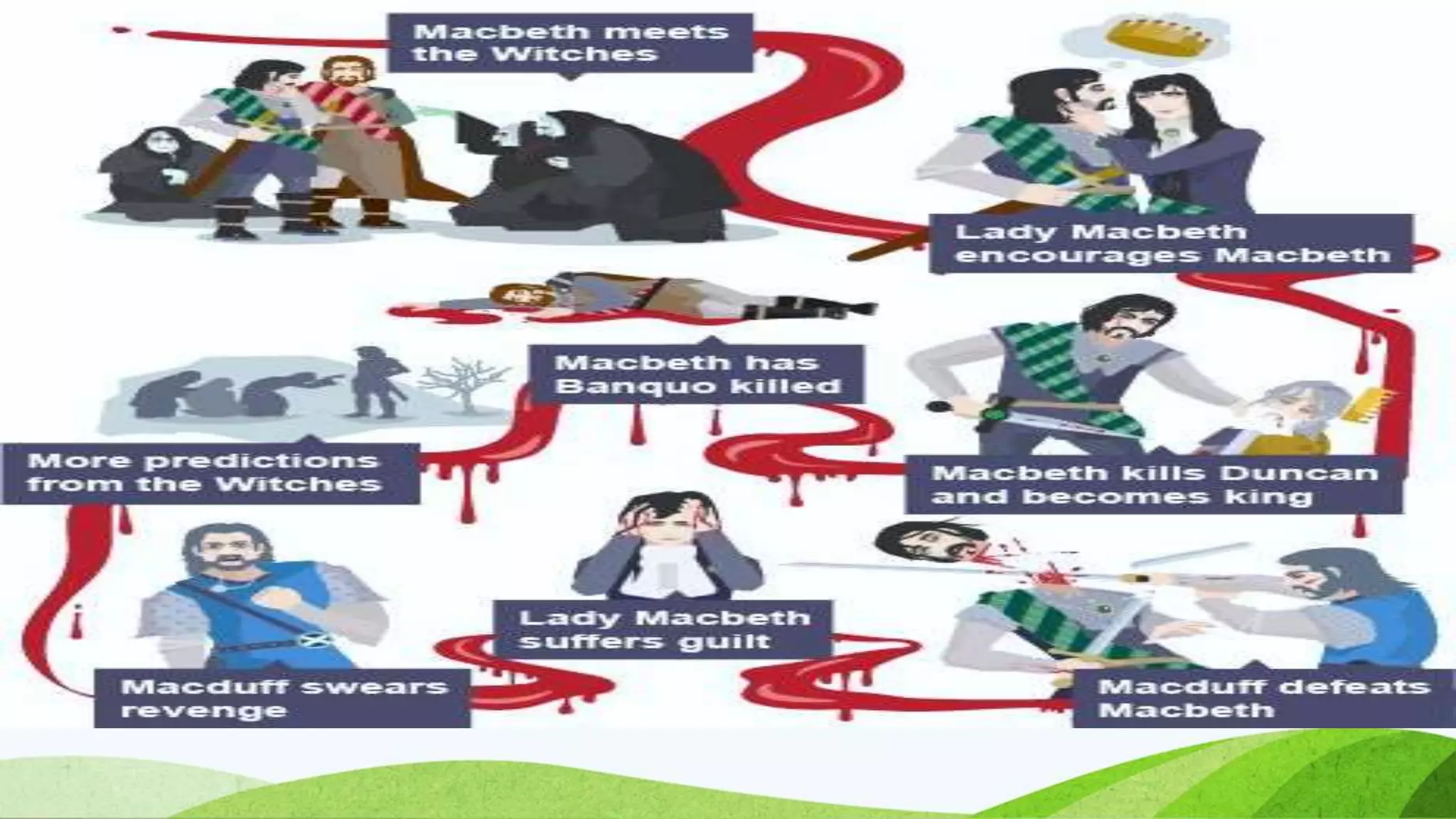
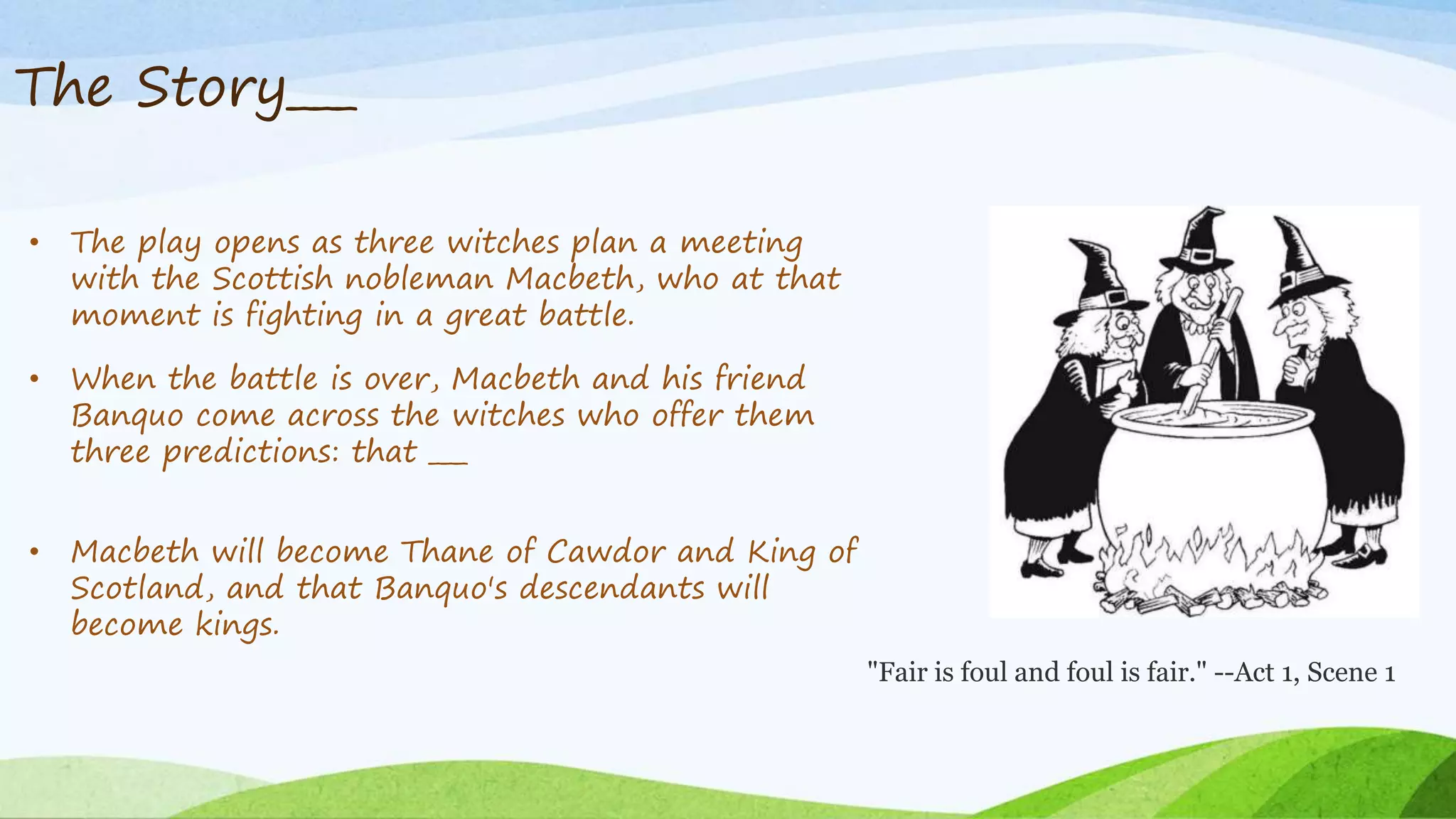
• The play opens as three witches plan a meeting
with the Scottish nobleman Macbeth, who at that
moment is fighting in a great battle.
• When the battle is over, Macbeth and his friend
Banquo come across the witches who offer them
three predictions: that ___
• Macbeth will become Thane of Cawdor and King of
Scotland, and that Banquo's descendants will
become kings.
"Fair is foul and foul is fair." --Act 1, Scene 1
The Story___
• Banquo laughs at the prophecies but Macbeth is
excited, especially as soon after their meeting
with the witches Macbeth is made Thane of
Cawdor by King Duncan, in return for his
bravery in the battle.
• He writes to his wife, Lady Macbeth, who is as
excited as he is.
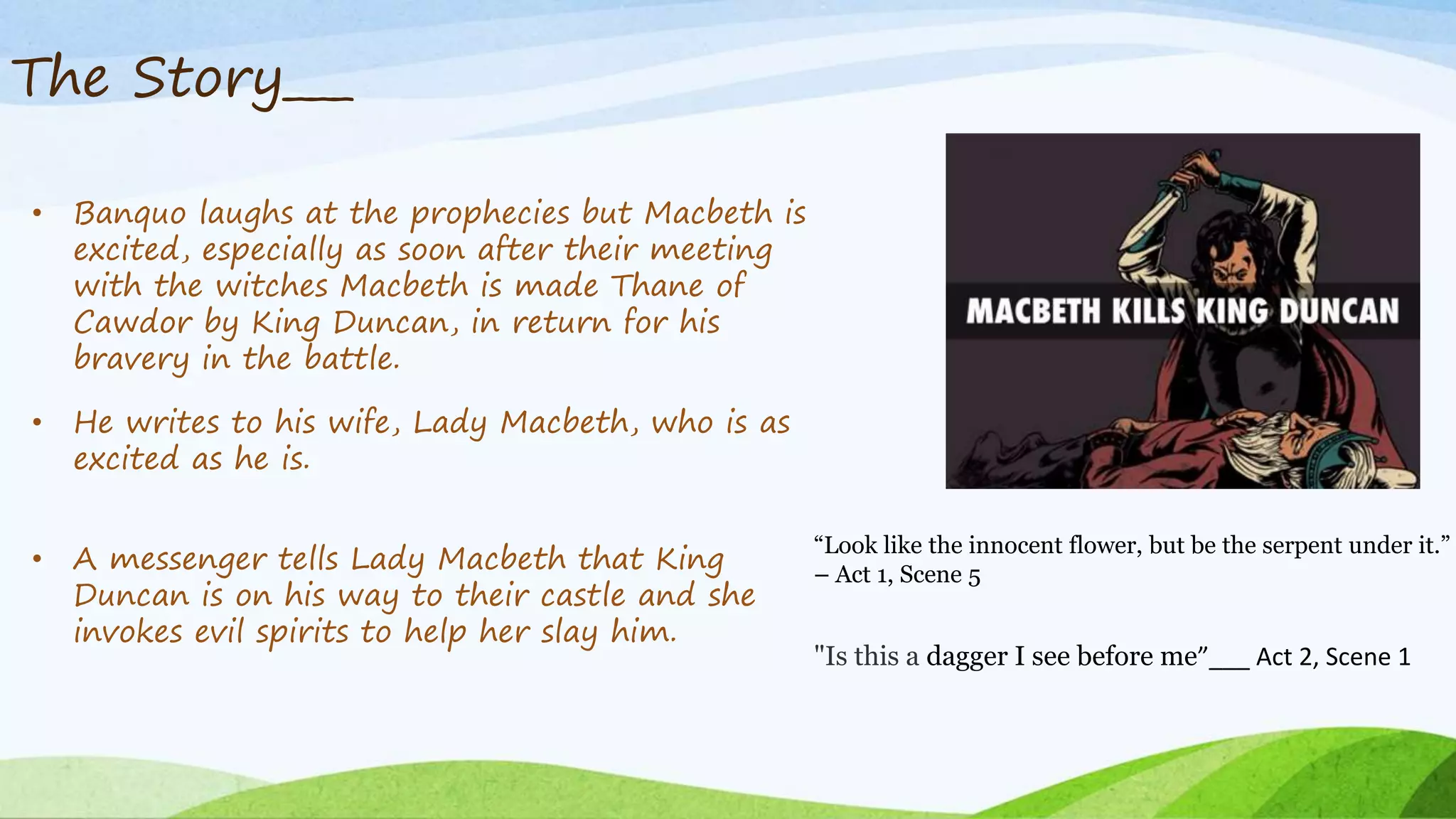
• A messenger tells Lady Macbeth that King
Duncan is on his way to their castle and she
invokes evil spirits to help her slay him.
"Is this a dagger I see before me”___ Act 2, Scene 1
“Look like the innocent flower, but be the serpent under it.”
– Act 1, Scene 5
The Story___
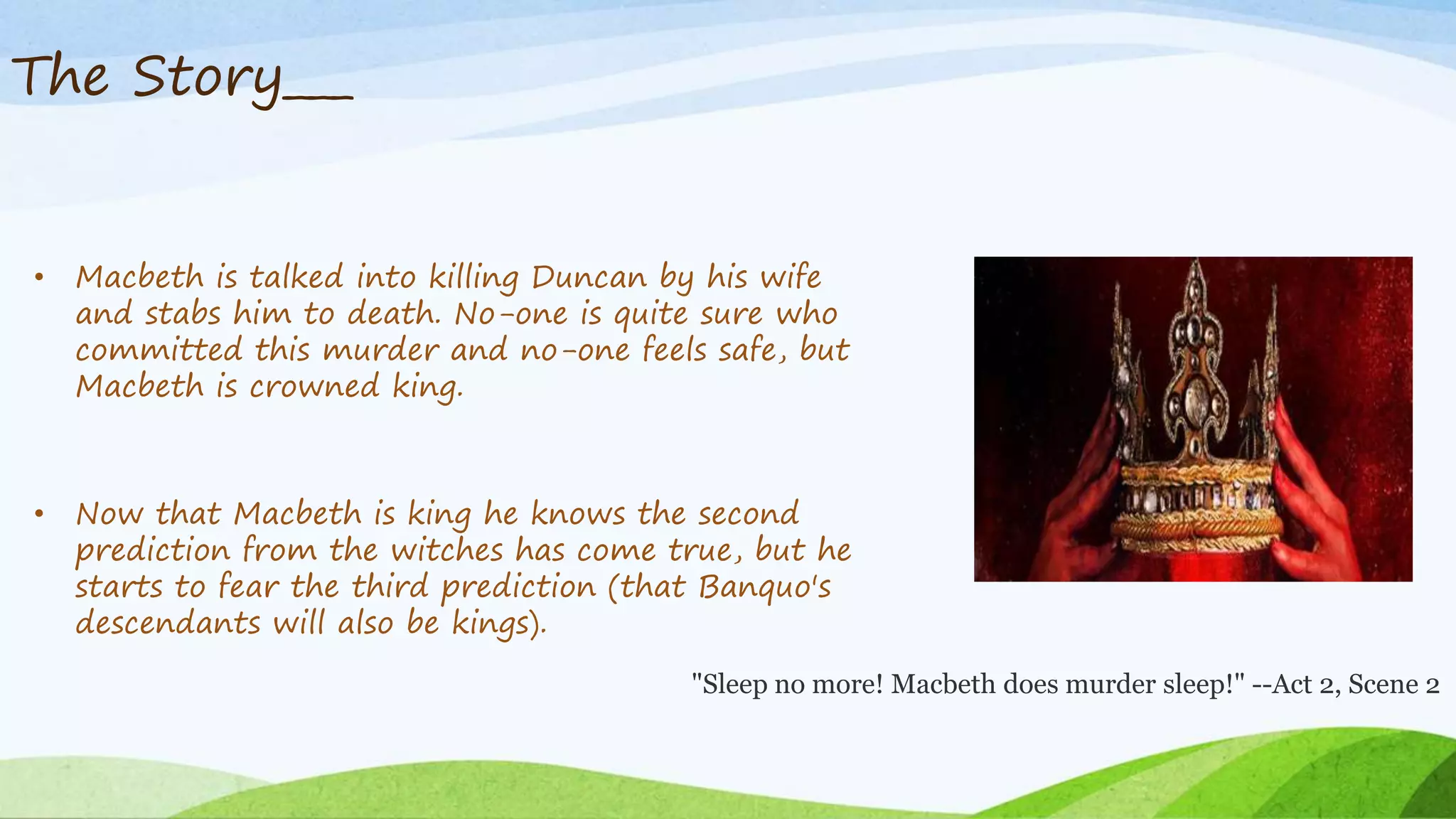
• Macbeth is talked into killing Duncan by his wife
and stabs him to death. No-one is quite sure who
committed this murder and no-one feels safe, but
Macbeth is crowned king.
• Now that Macbeth is king he knows the second
prediction from the witches has come true, but he
starts to fear the third prediction (that Banquo's
descendants will also be kings).
"Sleep no more! Macbeth does murder sleep!" --Act 2, Scene 2
The Story___
• Macbeth therefore decides to kill Banquo and his son,
but the plan goes wrong - Banquo is killed but his
son escapes.
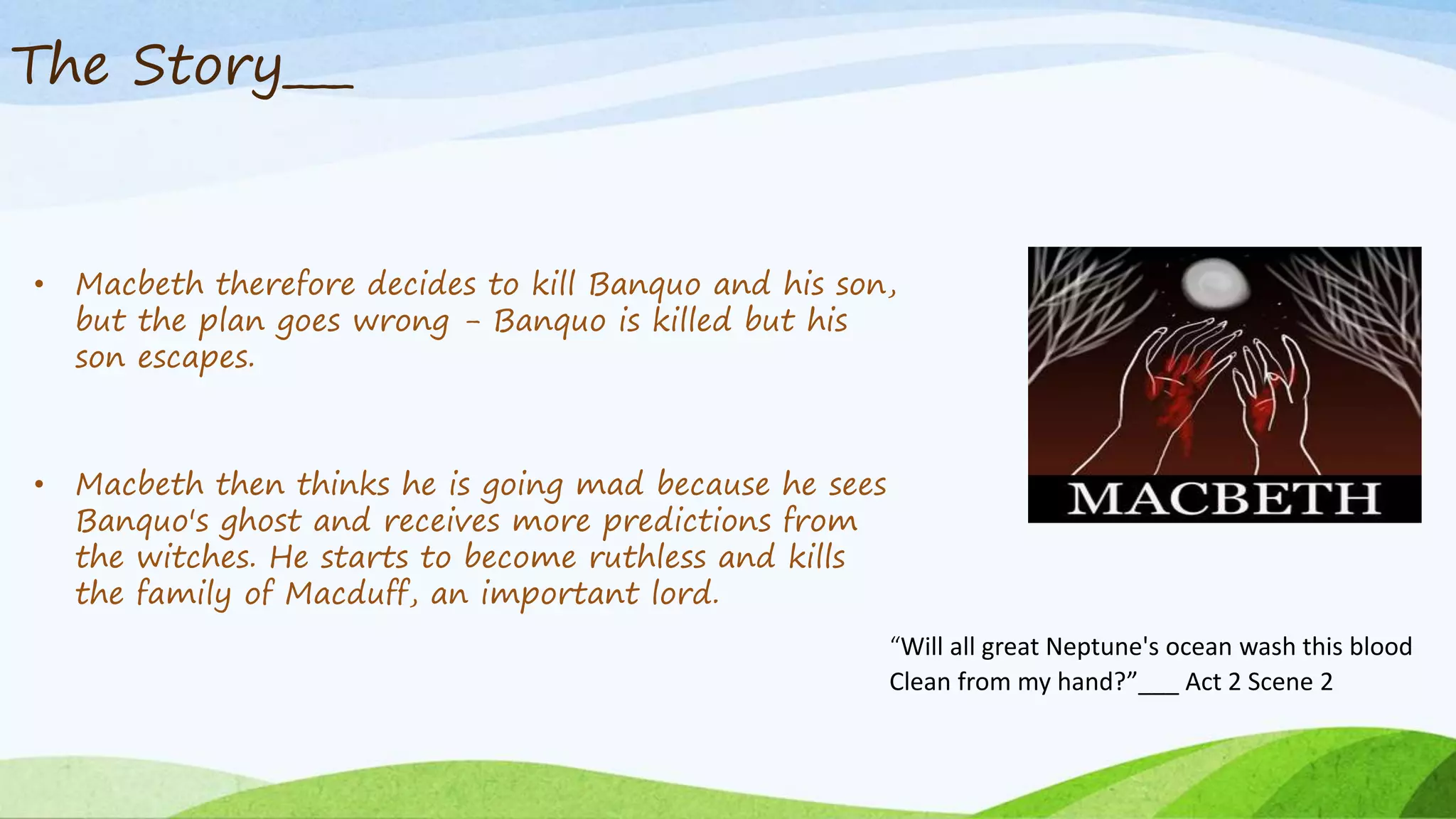
• Macbeth then thinks he is going mad because he sees
Banquo's ghost and receives more predictions from
the witches. He starts to become ruthless and kills
the family of Macduff, an important lord.
“Will all great Neptune's ocean wash this blood
Clean from my hand?”___ Act 2 Scene 2
The Story___
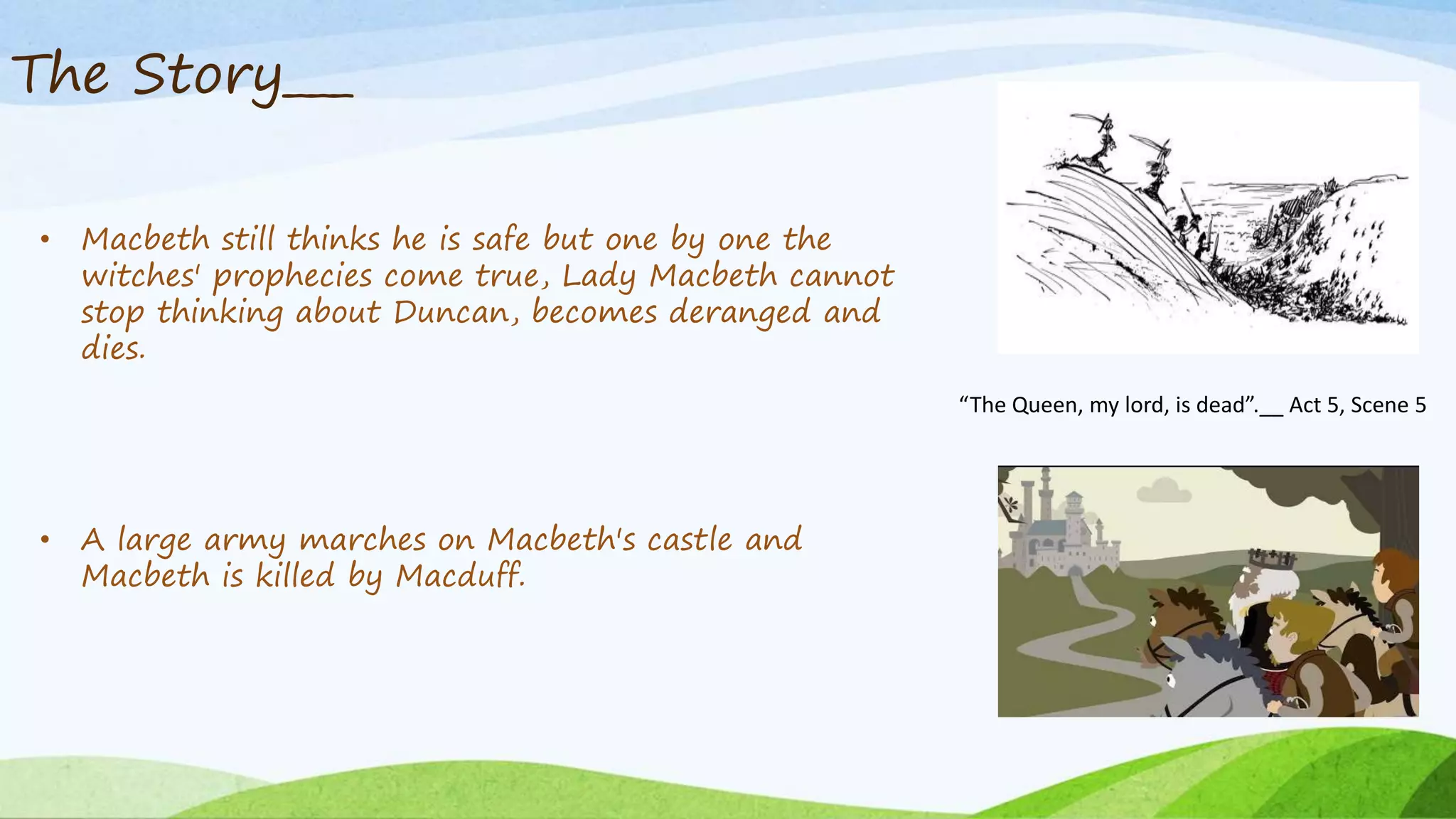
• Macbeth still thinks he is safe but one by one the
witches' prophecies come true, Lady Macbeth cannot
stop thinking about Duncan, becomes deranged and
dies.
• A large army marches on Macbeth's castle and
Macbeth is killed by Macduff.
“The Queen, my lord, is dead”.__ Act 5, Scene 5
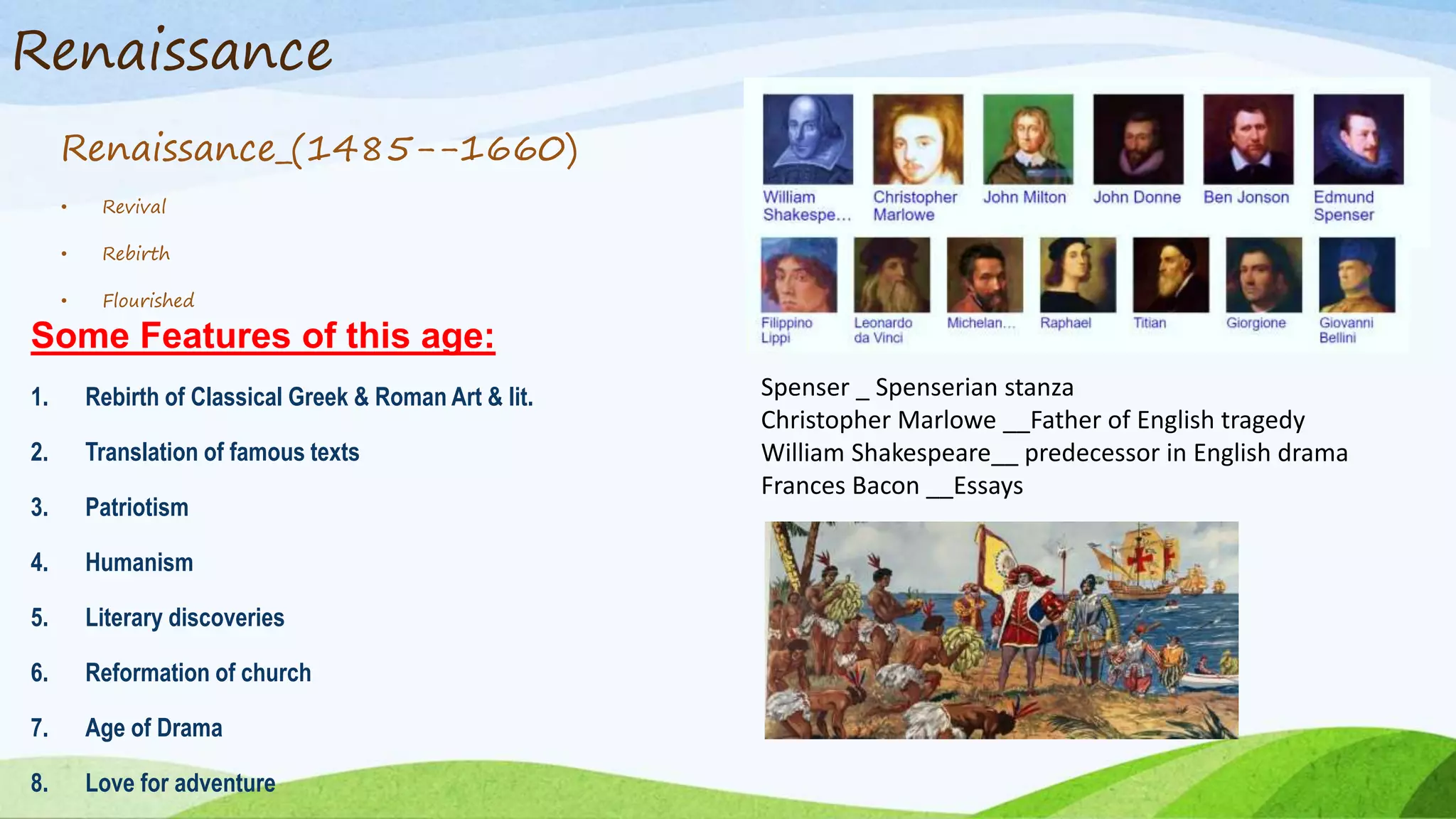
Renaissance
Renaissance_(1485--1660)
• Revival
• Rebirth
• Flourished
Some Features of this age:
1. Rebirth of Classical Greek & Roman Art & lit.
2. Translation of famous texts
3. Patriotism
4. Humanism
5. Literary discoveries
6. Reformation of church
7. Age of Drama
8. Love for adventure
Spenser _ Spenserian stanza
Christopher Marlowe __Father of English tragedy
William Shakespeare__ predecessor in English drama
Frances Bacon __Essays
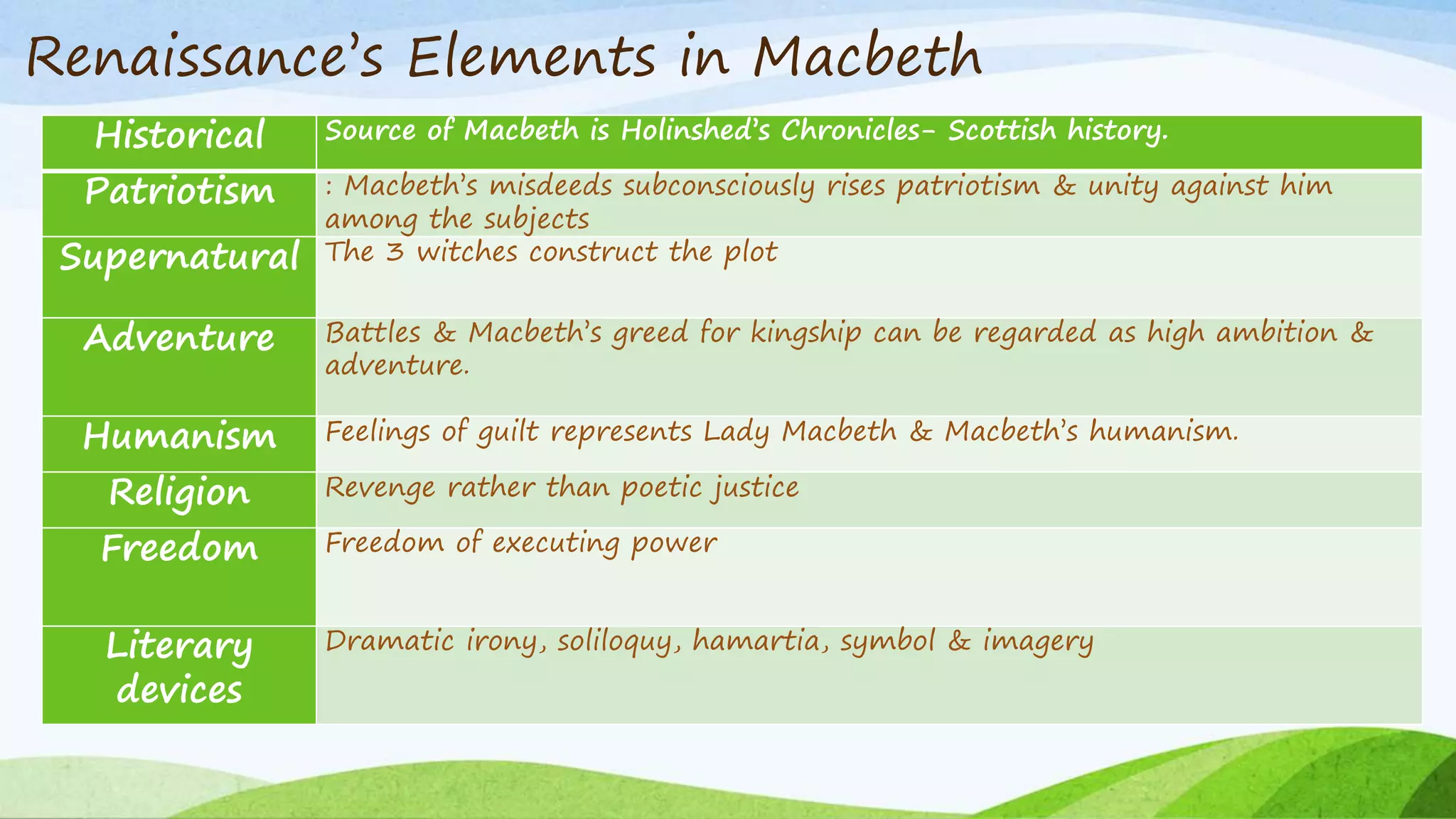
Renaissance’s Elements in Macbeth
Historical Source of Macbeth is Holinshed’s Chronicles- Scottish history.
Patriotism : Macbeth’s misdeeds subconsciously rises patriotism & unity against him
among the subjects
Supernatural The 3 witches construct the plot
Adventure Battles & Macbeth’s greed for kingship can be regarded as high ambition &
adventure.
Humanism Feelings of guilt represents Lady Macbeth & Macbeth’s humanism.
Religion Revenge rather than poetic justice
Freedom Freedom of executing power
Literary
devices
Dramatic irony, soliloquy, hamartia, symbol & imagery
Prepared by: Kamrul Hasan Bappy

Macbeth Presented by Kamrul Hasan Bappy

  • 2.
    The Renaissance elementsin Macbeth Course Code: Eng - 201 C ourse Tit le: Eliz abet han D rama
  • 3.
    Presented By: Kamrul HasanBappy ID: M21513111100 Batch: 36th Section: [B] Prepared for: Monir Hossen Lecturer Department of English Uttara university
  • 4.
    Contents • About Macbeth •Shakespeare • Characters • Main Theme • Story • Plot Diagram • Renaissance elements
  • 5.
    Name Macbeth Author WilliamShakespeare Type of work Drama Genre Tragedy Language English Performed 1611 Age James-I Published 1623 Plot Scottish Source Holinshed’s Chronicles About Macbeth____
  • 6.
    About Author_____ Name WilliamShakespeare Date of birth 23rd April 1564 Place of birth Stratford upon Avon, United Kingdom Parents  John Shakespeare (father)  Mary Arden (mother) Education The Stratford grammar school Occupation Playwright, Poet, Actor Era Elizabethan era & Jacobean era Works 154 Sonnets & 37 Drama Title  National poet of England  The great dramatist  Bard of Avon  Father of drama Date of death 23rd April 1616 Place of death Stratford upon Avon, United Kingdom
  • 7.
  • 8.
  • 10.
    Plot Diagram___ Exposition 1. Thewitches tell Macbeth, he will be the Thane of Cawdor & King Duncan announces Macbeth the Thane of Cawdor 2. Lady Macbeth learns about the witches prophecies 3. Macbeth sees the imaginary dagger leading him to kill the king. CLIMAX 6. Macbeth murders King Duncan. 7. Lady Macbeth takes the daggers to place on the king's men. Resolution 8. Duncan's son's flee and are blamed for the murder of the king. 9. Macbeth is to be named the new king of Scotland.
  • 11.
    The Story___ • Theplay opens as three witches plan a meeting with the Scottish nobleman Macbeth, who at that moment is fighting in a great battle. • When the battle is over, Macbeth and his friend Banquo come across the witches who offer them three predictions: that ___ • Macbeth will become Thane of Cawdor and King of Scotland, and that Banquo's descendants will become kings. "Fair is foul and foul is fair." --Act 1, Scene 1
  • 12.
    The Story___ • Banquolaughs at the prophecies but Macbeth is excited, especially as soon after their meeting with the witches Macbeth is made Thane of Cawdor by King Duncan, in return for his bravery in the battle. • He writes to his wife, Lady Macbeth, who is as excited as he is. • A messenger tells Lady Macbeth that King Duncan is on his way to their castle and she invokes evil spirits to help her slay him. "Is this a dagger I see before me”___ Act 2, Scene 1 “Look like the innocent flower, but be the serpent under it.” – Act 1, Scene 5
  • 13.
    The Story___ • Macbethis talked into killing Duncan by his wife and stabs him to death. No-one is quite sure who committed this murder and no-one feels safe, but Macbeth is crowned king. • Now that Macbeth is king he knows the second prediction from the witches has come true, but he starts to fear the third prediction (that Banquo's descendants will also be kings). "Sleep no more! Macbeth does murder sleep!" --Act 2, Scene 2
  • 14.
    The Story___ • Macbeththerefore decides to kill Banquo and his son, but the plan goes wrong - Banquo is killed but his son escapes. • Macbeth then thinks he is going mad because he sees Banquo's ghost and receives more predictions from the witches. He starts to become ruthless and kills the family of Macduff, an important lord. “Will all great Neptune's ocean wash this blood Clean from my hand?”___ Act 2 Scene 2
  • 15.
    The Story___ • Macbethstill thinks he is safe but one by one the witches' prophecies come true, Lady Macbeth cannot stop thinking about Duncan, becomes deranged and dies. • A large army marches on Macbeth's castle and Macbeth is killed by Macduff. “The Queen, my lord, is dead”.__ Act 5, Scene 5
  • 16.
    Renaissance Renaissance_(1485--1660) • Revival • Rebirth •Flourished Some Features of this age: 1. Rebirth of Classical Greek & Roman Art & lit. 2. Translation of famous texts 3. Patriotism 4. Humanism 5. Literary discoveries 6. Reformation of church 7. Age of Drama 8. Love for adventure Spenser _ Spenserian stanza Christopher Marlowe __Father of English tragedy William Shakespeare__ predecessor in English drama Frances Bacon __Essays
  • 17.
    Renaissance’s Elements inMacbeth Historical Source of Macbeth is Holinshed’s Chronicles- Scottish history. Patriotism : Macbeth’s misdeeds subconsciously rises patriotism & unity against him among the subjects Supernatural The 3 witches construct the plot Adventure Battles & Macbeth’s greed for kingship can be regarded as high ambition & adventure. Humanism Feelings of guilt represents Lady Macbeth & Macbeth’s humanism. Religion Revenge rather than poetic justice Freedom Freedom of executing power Literary devices Dramatic irony, soliloquy, hamartia, symbol & imagery
  • 19.