Learning Objectives:
After readingthis chapter, you should be able to:
• Define strategic management;
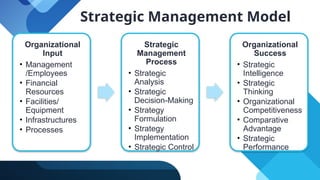
• identify the strategic management model;
• differentiate strategic analysis from strategic
decision-making, and strategic intelligence from
strategic thinking;
• explain the meaning of strategic planning;
• formulate a sample company vision, mission
statement, and company goals and objectives.
3.
Strategic Management
is acontinuous process of strategy
creation. It involves strategic
processes like strategic analysis and
decision-making, strategy
formulation and implementation,
and strategy control with the
primary objectives of achieving and
maintaining better alignment of
corporate policies, priorities, and
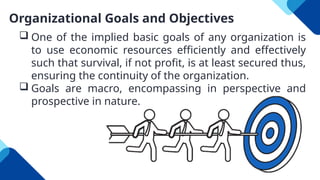
success.
4.
Strategic Management
Defined asthe science of
creating, executing, and
evaluating cross-functional
decisions to enable an
organization to achieve its
goals and objectives, the
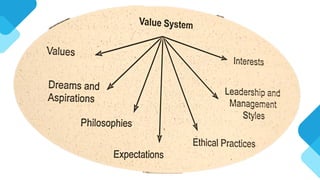
components of the strategic
management process have to
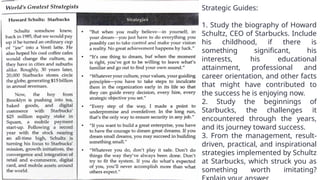
be effective.
5.
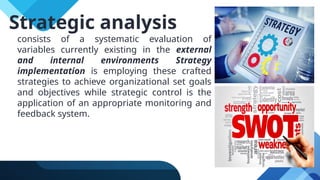
consists of asystematic evaluation of
variables currently existing in the external
and internal environments Strategy
implementation is employing these crafted
strategies to achieve organizational set goals
and objectives while strategic control is the
application of an appropriate monitoring and
feedback system.
Strategic analysis
Strategy
implementation
is employing thesecrafted strategies to
achieve organizational set goals and objectives
while strategic control is the application of an
appropriate monitoring and feedback system.
defined as acontinuous, repetitive,
and competitive process of setting the
goals and objectives that an
organization aims to attain, defining
the means to achieve them and
assessing the best way to realize them
in the context of the prevailing
environment while measuring
performance through set standards,
and periodically but continuously
conducting reassessments.
Strategic Planning
11.
Strategic planning exhibitsthe following
properties:
It generates the blueprint of what the organization intends to
accomplish.
The strategic plan presents the grand scheme of the
organization and outlines all the set activities, ranging from the
organizational to the departmental level. It formalizes all plans
with respect to type and extent.
It is the process of developing a strategic fit between the
organization's goals and capabilities in the context of changing
opportunities.
It is a process that involves carefully delineated steps. As stated
in the definition, strategic planning is structured, in that it
begins with reviewing the environment, setting goals, adopting
12.
Strategic planning exhibitsthe following
properties:
It is proactive, in that it is written in the context of anticipated
future realities. Strategic planning does not make future
decisions. Instead, plans are made in anticipation of future
changes and developments.
It is a philosophy because it evolves a dynamic way of
conducting and managing an organization. Strategic planning
involves a unique a way of thinking and doing things. It is an
intellectual exercise that embraces a belief that convinces
organizations of their worth and importance. In other words,
values are integrated within the philosophy of an evolving
organizational culture.
It links the organizational plan with functional and operational
plans. Strategic planning speaks of two types of planning: (a) the
13.
Strategic planning exhibitsthe following
properties:
It is intricately interwoven within the defined managerial
functions of organizing, directing, staffing, and controlling.
Although strategic planning is a strictly formal and separate
function of management, it is subtly intertwined in all the other
functions and responsibilities of a manager. In other words, no
manager can fully accomplish his/her responsibilities effectively if
strategic planning is disregarded or overlooked
It necessitates the leadership and support of top management
and, at the same time, employee participation and commitment.
Successful implementation of strategic planning is largely
dependent on responsibility, support, and sustained leadership
coupled with acceptance and involvement of employees. There
should be synergistic interrelationships between departments
14.
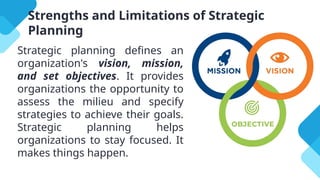
Strengths and Limitationsof Strategic
Planning
Strategic planning defines an
organization's vision, mission,
and set objectives. It provides
organizations the opportunity to
assess the milieu and specify
strategies to achieve their goals.
Strategic planning helps
organizations to stay focused. It
makes things happen.
15.
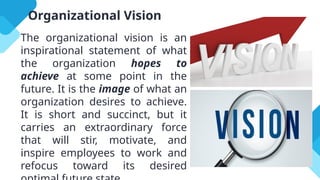
Organizational Vision
The organizationalvision is an
inspirational statement of what
the organization hopes to
achieve at some point in the
future. It is the image of what an
organization desires to achieve.
It is short and succinct, but it
carries an extraordinary force
that will stir, motivate, and
inspire employees to work and
refocus toward its desired
16.
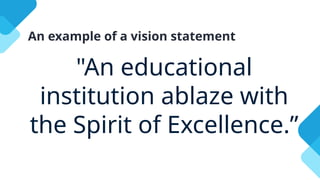
An example ofa vision statement
"An educational
institution ablaze with
the Spirit of Excellence.”
17.
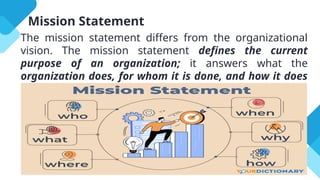
Mission Statement
The missionstatement differs from the organizational
vision. The mission statement defines the current
purpose of an organization; it answers what the
organization does, for whom it is done, and how it does
what it does.
18.
An example ofa mission statement
"We build, through Christian
and holistic formation, new
generations of responsible
citizens who are agents of
transformation.”
19.
Vision-Mission of theCollege of the Holy Spirit Manila
Vision: An educational institution ablaze with the Spirit of
Excellence
Mission: We build, through Christian and holistic formation,
new generations of responsible citizens who are agents of
transformation.
Strategic Goals
In living out the ideals of St. Arnold Janssen, CHSM aims at the
total formation of authentically Christian Filipinos who are:
• humane and committed to the care of creation;
• professionally competent and dedicated to service;
• socially and critically conscious of the realities of life;
• motivated to proactively respond to the call of the times;
20.
Organizational Goals andObjectives
To operationalize the mission
statement, organizational goals
and objectives are defined.
All organizations have set goals.
These are referred to as
organizational goals.
Organizational goals are pursued
to make the specified strategies
succeed. They vary and are
essentially dependent on their
respective purpose and direction.
21.
Organizational Goals andObjectives
One of the implied basic goals of any organization is
to use economic resources efficiently and effectively
such that survival, if not profit, is at least secured thus,
ensuring the continuity of the organization.
Goals are macro, encompassing in perspective and
prospective in nature.
22.
In fact, goalsrepresent the overall vision of an organization. By
their very nature, goals have the following properties:
1. Goals provide organizations focus and direction.
They neatly converge toward the purpose of any firm,
thus, streamlining all unnecessary and redundant
considerations.
2. Goals move organizations to action. Because goals
have to be attained, organizations are motivated to
function and perform toward their vision
3. Goals develop in organizations the trait of
persistence. Thus, organizations continue to persevere
until they achieve their desired success
24.
Objectives are differentfrom goals; in that they are micro and
specific in perspective. They should possess the following
characteristics:
1. Objectives need to be clearly defined and
formulated, carefully chosen, specific, and
definite.
2 Objectives may be immediate or short-term.
3. They need to be prioritized into a hierarchy
of objectives.
4. Objectives need to be realistic and
attainable. They need to be flexible, consistent,
and strategic.
25.
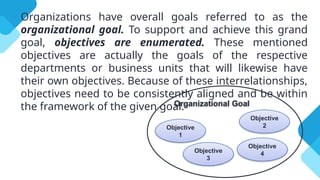
Organizations have overallgoals referred to as the
organizational goal. To support and achieve this grand
goal, objectives are enumerated. These mentioned
objectives are actually the goals of the respective
departments or business units that will likewise have
their own objectives. Because of these interrelationships,
objectives need to be consistently aligned and be within
the framework of the given goal.
Objective
1
Objective
2
Objective
4
Objective
3
Organizational Goal
26.
Strategic objectives are,in general, externally focused. According to
Peter Drucker (2008), objectives fall into eight major classifications:
1. Market standing (e.g., desired share of the current and new
markets);
2. Innovation (e.g., development of new goods, services, and of
skills and methods required to supply them);
3. Human resources (e.g., selection and development of
employees);
4. Financial resources (e.g., identification of sources of capital
and their uses);
5. Physical resources (e.g., equipment and facilities and their
uses);
6 Productivity (e.g., efficient use of the resources relative to
output);
27.
Values and ValueSystem
Organizations are guided by values,
which vary from one organization to
another. Values are inherent roots of
motivation within an individual, an
organization, a community, or a
nation. They are by nature, ingrained
and thus, are more stable and
enduring. They are both intellectual
and behavioral, serving as bases for
the organization's actions and way of
thinking.
28.
Values and ValueSystem
Values are generally exhibited in two different
ways, namely, beliefs and attitudes. More
particularly, beliefs are cognitive manifestations
while attitudes are characteristically behavioral.
They are fundamental and intricately integrated
in the organization's value system. Take note that
the values projected by organizations are largely
dependent on any or all the following: the
stockholders, the Board of Directors, and the top
30.
Values and ValueSystem
Strictly speaking, the values of an organization
are not synonymous to its value system. The
value system is characteristically broader in
scope; aside from values, it includes other
variables such as the organization's dreams,
aspirations, interests, expectations,
philosophies, as well as leadership and
management styles and ethical practices.
31.
Values and ValueSystem
Moreover, the value system indicates the
hierarchy of values ranked by organizations.
Because values are distinct, they differ from one
organization to another. This explains why one
organization may be perceived as socially and
community-active, while another is business-
oriented. Hence, the importance of these value
qualities and value systems for organizations
cannot be underestimated.
32.
Strategic Guides:
1. Studythe biography of Howard
Schultz, CEO of Starbucks. Include
his childhood, if there is
something significant, his
interests, his educational
attainment, professional and
career orientation, and other facts
that might have contributed to
the success he is enjoying now.
2. Study the beginnings of
Starbucks, the challenges it
encountered through the years,
and its journey toward success.
3. From the management, result-
driven, practical, and inspirational
strategies implemented by Schultz
at Starbucks, which struck you as
something worth imitating?
33.
ASSIGNMENT: GROUP WORK
LOOKFOR A COMPANY THAT IS RELATED TO THE HOSPITALITY
AND TOURISM INDUSTRY
1.Study the biography of the, CEO of the company. Include his
childhood, if there is something significant, his interests, his
educational attainment, professional and career orientation,
and other facts that might have contributed to the success he
is enjoying now.
2. Study the beginnings of the company , the challenges it
encountered through the years, and its journey toward success.
3. what is the company’s mission, vision and goals
4. what are the different strategies of the company why thy are
34.
CREDITS: This presentationtemplate was created by Slidesgo, and
includes icons by Flaticon, and infographics & images by Freepik
Thank
You!
Any questions?
Editor's Notes
#9 The strategic management model shows the relationships between and among the input, process, and output. The input in this model includes organizational variables like management and employees, financial resources, facilities and equipment, infrastructures, and processes. The strategic management process consists strategic analysis, strategic decision-making, strategy formulation, strategy implementation, and strategic control.
When these specific processes are executed and managed creatively, distinctly, and strategically, the organization can ultimately achieve organizational success. In particular, the output are exhibited in the strategic intelligence acquired, strategic thinking mode developed, organizational competitiveness, comparative advantage, and strategic performance attained by the organization.
#10 the word strategic planning is more popular than strategic management. Essentially, these two words are the same. In terms of purpose, both strategic management and strategic planning have the same goals and objectives, that is, to devise a strategic mode of preparing, addressing, and steering organizations to where they want to go. Particularly, both undertakings endeavor to understand the strategic position of organizations their set goals, preferred choices and deliberate and calculated strategies. Furthermore, both strategic management and strategie planning use the same processes to attain their goals
Strategic planning is the approach used in forming an organization's direction (e.g., its vision, mission and priorities). On the other hand, strategic management is the overall process of achieving that direction, from planning to executing.
#15 Having a strong sense of vision can move the organization to be what it wants to be. Like an unseen force, the organizational vision binds the company and its employees together
#16 This is the vision statement of the educational institution, College of the Holy Spirit Manila. The statement energizes the administrators, faculty, students, and staff. It brings singleness in their desire and coherence in their efforts. Although difficult and in fact, not measurable, the organizational vision is an effective mode of binding everyone to a company's ultimate goal.
#17 Having a strong sense of vision can move the organization to be what it wants to be. Like an unseen force, the organizational vision binds the company and its employees together
#18 Here, what the organization does is "to build"; it does this "for new generations of responsible citizens"; and how it does what it does is "through Christian and holistic formation."
Mission statements are likewise short and easy to remember. It gives employees a better perspective on how their tasks contribute to the attainment of organizational goals. Oftentimes, vision statements are more enduring compared to mission statements. Mission statements are expected to change in the context of shifting economic realities or unexpected circumstances like challenges, threats, and even opportunities.
#22 Nevertheless, for goals to be attained, they have to be supported by objectives.
#24 The relationship between goals and objectives can be concretely illustrated.