© 2005 Prentice Hall Inc.
All rights reserved.
PowerPoint Presentation by Charlie Cook
The University of West Alabama
t e n t h e d i t i o n
Gary Dessler
Gary Dessler
Part
Part 1
1 Introduction
Introduction
Chapter
Chapter 3
3
Strategic Human Resource
Management and the HR Scorecard
After studying this chapter,
you should be able to:
1. Outline the steps in the strategic management
process.
2. Explain and give examples of each type of
companywide and competitive strategy.
3. Explain what a high performance work system is
and why it is important.
4. Illustrate and explain each of the seven steps in
the HR Scorecard approach to creating HR
systems.
© 2005 Prentice Hall Inc. All rights reserved.
© 2005 Prentice Hall Inc. All rights reserved. 3–
3–2
2
© 2005 Prentice Hall Inc. All rights reserved. 3–3
HR’s Strategic Challenges
 Strategic plan
– A company’s plan for how it will match its
internal strengths and weaknesses with
external opportunities and threats in order to
maintain a competitive advantage.
 Three basic challenges
– The need to support corporate productivity and
performance improvement efforts.
– That employees play an expanded role in
employers’ performance improvement efforts.
– HR must be more involved in designing—not
just executing—the company’s strategic plan.
© 2005 Prentice Hall Inc. All rights reserved. 3–4
The Strategic Management Process
 Strategic management
– The process of identifying and executing the
organization’s mission by matching its
capabilities with the demands of its
environment.
 Strategy
– A strategy is a course of action.
– The company’s long-tem plan for how it will
balance its internal strengths and weaknesses
with its external opportunities and threats to
maintain a competitive advantage.
© 2005 Prentice Hall Inc. All rights reserved. 3–5
Business Mission and Its Vision
 Vision
– A general statement of its intended direction
that evokes emotional feelings in organization
members.
 Mission
– Spells out who the company is, what it does,
and where it’s headed.
© 2005 Prentice Hall Inc. All rights reserved. 3–6
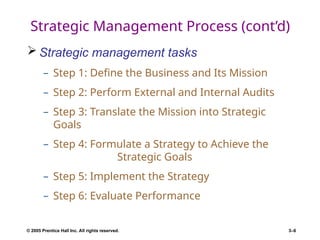
Strategic Management Process (cont’d)
 Strategic management tasks
– Step 1: Define the Business and Its Mission
– Step 2: Perform External and Internal Audits
– Step 3: Translate the Mission into Strategic
Goals
– Step 4: Formulate a Strategy to Achieve the
Strategic Goals
– Step 5: Implement the Strategy
– Step 6: Evaluate Performance
© 2005 Prentice Hall Inc. All rights reserved. 3–7
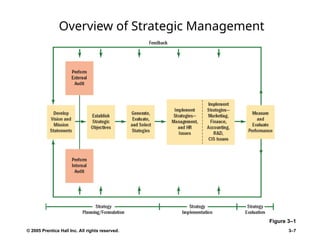
Overview of Strategic Management
Figure 3–1
© 2005 Prentice Hall Inc. All rights reserved. 3–8
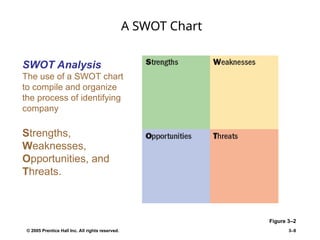
A SWOT Chart
Figure 3–2
SWOT Analysis
The use of a SWOT chart
to compile and organize
the process of identifying
company
Strengths,
Weaknesses,
Opportunities, and
Threats.
© 2005 Prentice Hall Inc. All rights reserved. 3–9
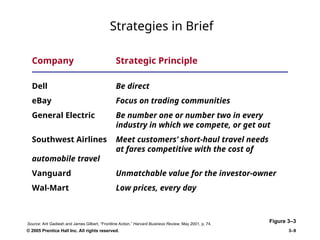
Strategies in Brief
Figure 3–3
Company Strategic Principle
Dell Be direct
eBay Focus on trading communities
General Electric Be number one or number two in every
industry in which we compete, or get out
Southwest Airlines Meet customers’ short-haul travel needs
at fares competitive with the cost of
automobile travel
Vanguard Unmatchable value for the investor-owner
Wal-Mart Low prices, every day
Source: Arit Gadiesh and James Gilbert, “Frontline Action,” Harvard Business Review, May 2001, p. 74.
© 2005 Prentice Hall Inc. All rights reserved. 3–10
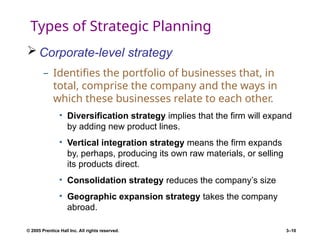
Types of Strategic Planning
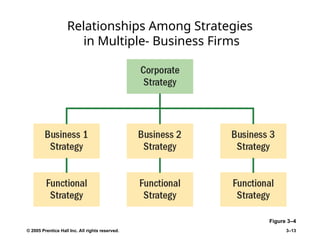
 Corporate-level strategy
– Identifies the portfolio of businesses that, in
total, comprise the company and the ways in
which these businesses relate to each other.
• Diversification strategy implies that the firm will expand
by adding new product lines.
• Vertical integration strategy means the firm expands
by, perhaps, producing its own raw materials, or selling
its products direct.
• Consolidation strategy reduces the company’s size
• Geographic expansion strategy takes the company
abroad.
© 2005 Prentice Hall Inc. All rights reserved. 3–11
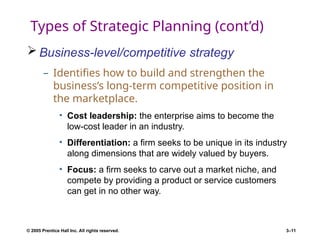
Types of Strategic Planning (cont’d)
 Business-level/competitive strategy
– Identifies how to build and strengthen the
business’s long-term competitive position in
the marketplace.
• Cost leadership: the enterprise aims to become the
low-cost leader in an industry.
• Differentiation: a firm seeks to be unique in its industry
along dimensions that are widely valued by buyers.
• Focus: a firm seeks to carve out a market niche, and
compete by providing a product or service customers
can get in no other way.
© 2005 Prentice Hall Inc. All rights reserved. 3–12
Types of Strategic Planning (cont’d)
 Functional strategies
– Identify the basic courses of action that each
department will pursue in order to help the
business attain its competitive goals.
© 2005 Prentice Hall Inc. All rights reserved. 3–13
Relationships Among Strategies
in Multiple- Business Firms
Figure 3–4
© 2005 Prentice Hall Inc. All rights reserved. 3–14
Achieving Strategic Fit
 Michael Porter
– Emphasizes the “fit” point of view that all of the
firm’s activities must be tailored to or fit its
strategy, by ensuring that the firm’s functional
strategies support its corporate and
competitive strategies.
 Gary Hamel and C. K. Prahalad
– Argue for “stretch” in leveraging resources—
supplementing what you have and doing more
with what you have—can be more important
than just fitting the strategic plan to current
resources.
© 2005 Prentice Hall Inc. All rights reserved. 3–15
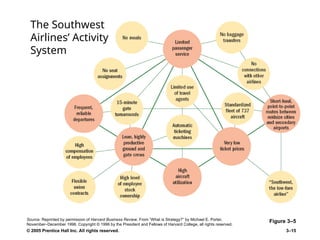
The Southwest
Airlines’ Activity
System
Figure 3–5
Source: Reprinted by permission of Harvard Business Review. From “What is Strategy?” by Michael E. Porter,
November–December 1996. Copyright © 1996 by the President and Fellows of Harvard College, all rights reserved.
© 2005 Prentice Hall Inc. All rights reserved. 3–16
HR and Competitive Advantage
 Competitive advantage
– Any factors that allow an organization to
differentiate its product or service from those
of its competitors to increase market share.
– Superior human resources are an important
source of competitive advantage
© 2005 Prentice Hall Inc. All rights reserved. 3–17
Strategic Human Resource
Management
 Strategic Human Resource Management
– The linking of HRM with strategic goals and
objectives in order to improve business
performance and develop organizational
cultures that foster innovation and flexibility.
– Formulating and executing HR systems—HR
policies and activities—that produce the
employee competencies and behaviors the
company needs to achieve its strategic aims.
© 2005 Prentice Hall Inc. All rights reserved. 3–18
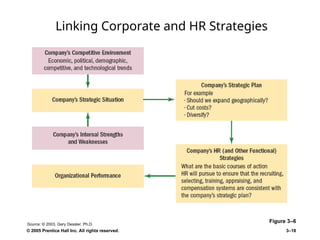
Linking Corporate and HR Strategies
Figure 3–6
Source: © 2003, Gary Dessler, Ph.D.
© 2005 Prentice Hall Inc. All rights reserved. 3–19
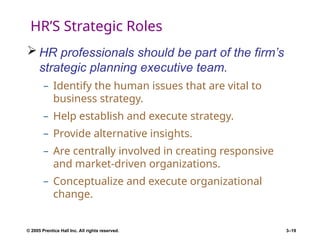
HR’S Strategic Roles
 HR professionals should be part of the firm’s
strategic planning executive team.
– Identify the human issues that are vital to
business strategy.
– Help establish and execute strategy.
– Provide alternative insights.
– Are centrally involved in creating responsive
and market-driven organizations.
– Conceptualize and execute organizational
change.
© 2005 Prentice Hall Inc. All rights reserved. 3–20
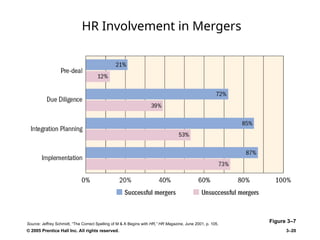
HR Involvement in Mergers
Figure 3–7
Source: Jeffrey Schmidt, “The Correct Spelling of M & A Begins with HR,” HR Magazine, June 2001, p. 105.
© 2005 Prentice Hall Inc. All rights reserved. 3–21
HR’s Strategy Execution Role
 The HR department’s strategies, policies, and
activities must make sense in terms of the
company’s corporate and competitive
strategies, and they must support those
strategies.
© 2005 Prentice Hall Inc. All rights reserved. 3–22
HR’s Strategy Formulation Role
 HR helps top management formulate strategy
in a variety of ways by.
– Supplying competitive intelligence that may be
useful in the strategic planning process.
– Supplying information regarding the
company’s internal human strengths and
weaknesses.
– Build a persuasive case that shows how—in
specific and measurable terms—the firm’s HR
activities can and do contribute to creating
value for the company.
© 2005 Prentice Hall Inc. All rights reserved. 3–23
Creating a Strategy-oriented HR
System
 Components of the HR process
– HR professionals who have strategic and other
skills
– HR policies and activities that comprise the HR
system itself
– Employee behaviors and competencies that the
company’s strategy requires.
© 2005 Prentice Hall Inc. All rights reserved. 3–24
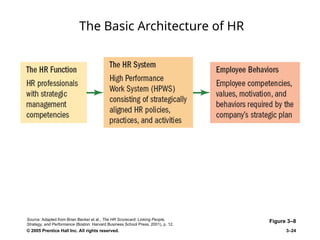
The Basic Architecture of HR
Figure 3–8
Source: Adapted from Brian Becker et al., The HR Scorecard: Linking People,
Strategy, and Performance (Boston: Harvard Business School Press, 2001), p. 12.
© 2005 Prentice Hall Inc. All rights reserved. 3–25
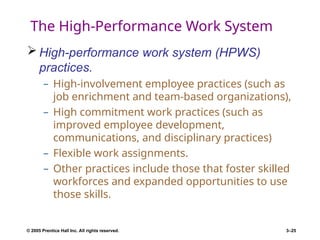
The High-Performance Work System
 High-performance work system (HPWS)
practices.
– High-involvement employee practices (such as
job enrichment and team-based organizations),
– High commitment work practices (such as
improved employee development,
communications, and disciplinary practices)
– Flexible work assignments.
– Other practices include those that foster skilled
workforces and expanded opportunities to use
those skills.
© 2005 Prentice Hall Inc. All rights reserved. 3–26
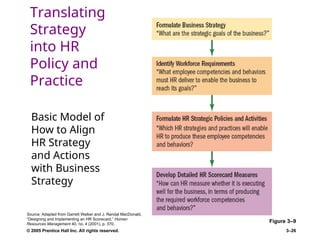
Basic Model of
How to Align
HR Strategy
and Actions
with Business
Strategy
Figure 3–9
Source: Adapted from Garrett Walker and J. Randal MacDonald,
“Designing and Implementing an HR Scorecard,” Human
Resources Management 40, no. 4 (2001), p. 370.
Translating
Strategy
into HR
Policy and
Practice
© 2005 Prentice Hall Inc. All rights reserved. 3–27
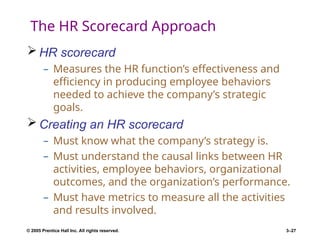
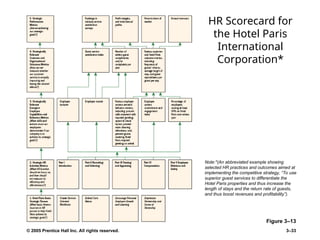
The HR Scorecard Approach
 HR scorecard
– Measures the HR function’s effectiveness and
efficiency in producing employee behaviors
needed to achieve the company’s strategic
goals.
 Creating an HR scorecard
– Must know what the company’s strategy is.
– Must understand the causal links between HR
activities, employee behaviors, organizational
outcomes, and the organization’s performance.
– Must have metrics to measure all the activities
and results involved.
© 2005 Prentice Hall Inc. All rights reserved. 3–28
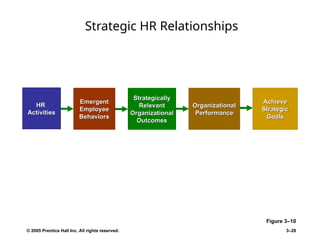
Strategic HR Relationships
Figure 3–10
HR
HR
Activities
Activities
Emergent
Emergent
Employee
Employee
Behaviors
Behaviors
Strategically
Strategically
Relevant
Relevant
Organizational
Organizational
Outcomes
Outcomes
Organizational
Organizational
Performance
Performance
Achieve
Achieve
Strategic
Strategic
Goals
Goals
© 2005 Prentice Hall Inc. All rights reserved. 3–29
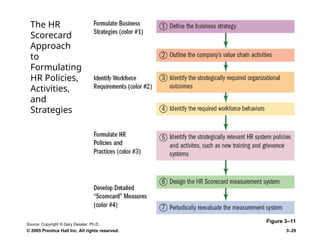
The HR
Scorecard
Approach
to
Formulating
HR Policies,
Activities,
and
Strategies
Figure 3–11
Source: Copyright © Gary Dessler, Ph.D.
© 2005 Prentice Hall Inc. All rights reserved. 3–30
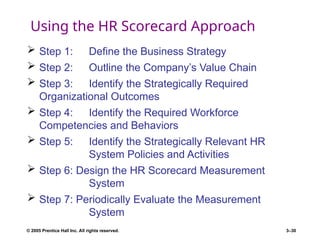
Using the HR Scorecard Approach
 Step 1: Define the Business Strategy
 Step 2: Outline the Company’s Value Chain
 Step 3: Identify the Strategically Required
Organizational Outcomes
 Step 4: Identify the Required Workforce
Competencies and Behaviors
 Step 5: Identify the Strategically Relevant HR
System Policies and Activities
 Step 6: Design the HR Scorecard Measurement
System
 Step 7: Periodically Evaluate the Measurement
System
© 2005 Prentice Hall Inc. All rights reserved. 3–31
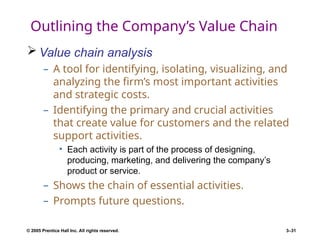
Outlining the Company’s Value Chain
 Value chain analysis
– A tool for identifying, isolating, visualizing, and
analyzing the firm’s most important activities
and strategic costs.
– Identifying the primary and crucial activities
that create value for customers and the related
support activities.
• Each activity is part of the process of designing,
producing, marketing, and delivering the company’s
product or service.
– Shows the chain of essential activities.
– Prompts future questions.
© 2005 Prentice Hall Inc. All rights reserved. 3–32
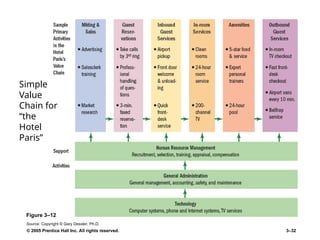
Figure 3–12
Source: Copyright © Gary Dessler, Ph.D.
Simple
Value
Chain for
“the
Hotel
Paris”
© 2005 Prentice Hall Inc. All rights reserved. 3–33
HR Scorecard for
the Hotel Paris
International
Corporation*
Figure 3–13
Note:*(An abbreviated example showing
selected HR practices and outcomes aimed at
implementing the competitive strategy, “To use
superior guest services to differentiate the
Hotel Paris properties and thus increase the
length of stays and the return rate of guests,
and thus boost revenues and profitability”).
© 2005 Prentice Hall Inc. All rights reserved. 3–34
Key Terms
competitive advantage
HR Scorecard
leveraging
metrics
mission strategic control
strategic human resource
manager
strategic management
strategic plan
strategy
SWOT analysis
value chain analysis
vision

2_strategic_Human Resources Management.ppt

  • 1.
    © 2005 PrenticeHall Inc. All rights reserved. PowerPoint Presentation by Charlie Cook The University of West Alabama t e n t h e d i t i o n Gary Dessler Gary Dessler Part Part 1 1 Introduction Introduction Chapter Chapter 3 3 Strategic Human Resource Strategic Human Resource Management and the HR Scorecard Management and the HR Scorecard
  • 2.
    After studying thischapter, After studying this chapter, you should be able to: you should be able to: 1. Outline the steps in the strategic management process. 2. Explain and give examples of each type of companywide and competitive strategy. 3. Explain what a high performance work system is and why it is important. 4. Illustrate and explain each of the seven steps in the HR Scorecard approach to creating HR systems. © 2005 Prentice Hall Inc. All rights reserved. © 2005 Prentice Hall Inc. All rights reserved. 3– 3–2 2
  • 3.
    © 2005 PrenticeHall Inc. All rights reserved. 3–3 HR’s Strategic Challenges  Strategic plan – A company’s plan for how it will match its internal strengths and weaknesses with external opportunities and threats in order to maintain a competitive advantage.  Three basic challenges – The need to support corporate productivity and performance improvement efforts. – That employees play an expanded role in employers’ performance improvement efforts. – HR must be more involved in designing—not just executing—the company’s strategic plan.
  • 4.
    © 2005 PrenticeHall Inc. All rights reserved. 3–4 The Strategic Management Process  Strategic management – The process of identifying and executing the organization’s mission by matching its capabilities with the demands of its environment.  Strategy – A strategy is a course of action. – The company’s long-tem plan for how it will balance its internal strengths and weaknesses with its external opportunities and threats to maintain a competitive advantage.
  • 5.
    © 2005 PrenticeHall Inc. All rights reserved. 3–5 Business Mission and Its Vision  Vision – A general statement of its intended direction that evokes emotional feelings in organization members.  Mission – Spells out who the company is, what it does, and where it’s headed.
  • 6.
    © 2005 PrenticeHall Inc. All rights reserved. 3–6 Strategic Management Process (cont’d)  Strategic management tasks – Step 1: Define the Business and Its Mission – Step 2: Perform External and Internal Audits – Step 3: Translate the Mission into Strategic Goals – Step 4: Formulate a Strategy to Achieve the Strategic Goals – Step 5: Implement the Strategy – Step 6: Evaluate Performance
  • 7.
    © 2005 PrenticeHall Inc. All rights reserved. 3–7 Overview of Strategic Management Figure 3–1
  • 8.
    © 2005 PrenticeHall Inc. All rights reserved. 3–8 A SWOT Chart Figure 3–2 SWOT Analysis The use of a SWOT chart to compile and organize the process of identifying company Strengths, Weaknesses, Opportunities, and Threats.
  • 9.
    © 2005 PrenticeHall Inc. All rights reserved. 3–9 Strategies in Brief Figure 3–3 Company Strategic Principle Dell Be direct eBay Focus on trading communities General Electric Be number one or number two in every industry in which we compete, or get out Southwest Airlines Meet customers’ short-haul travel needs at fares competitive with the cost of automobile travel Vanguard Unmatchable value for the investor-owner Wal-Mart Low prices, every day Source: Arit Gadiesh and James Gilbert, “Frontline Action,” Harvard Business Review, May 2001, p. 74.
  • 10.
    © 2005 PrenticeHall Inc. All rights reserved. 3–10 Types of Strategic Planning  Corporate-level strategy – Identifies the portfolio of businesses that, in total, comprise the company and the ways in which these businesses relate to each other. • Diversification strategy implies that the firm will expand by adding new product lines. • Vertical integration strategy means the firm expands by, perhaps, producing its own raw materials, or selling its products direct. • Consolidation strategy reduces the company’s size • Geographic expansion strategy takes the company abroad.
  • 11.
    © 2005 PrenticeHall Inc. All rights reserved. 3–11 Types of Strategic Planning (cont’d)  Business-level/competitive strategy – Identifies how to build and strengthen the business’s long-term competitive position in the marketplace. • Cost leadership: the enterprise aims to become the low-cost leader in an industry. • Differentiation: a firm seeks to be unique in its industry along dimensions that are widely valued by buyers. • Focus: a firm seeks to carve out a market niche, and compete by providing a product or service customers can get in no other way.
  • 12.
    © 2005 PrenticeHall Inc. All rights reserved. 3–12 Types of Strategic Planning (cont’d)  Functional strategies – Identify the basic courses of action that each department will pursue in order to help the business attain its competitive goals.
  • 13.
    © 2005 PrenticeHall Inc. All rights reserved. 3–13 Relationships Among Strategies in Multiple- Business Firms Figure 3–4
  • 14.
    © 2005 PrenticeHall Inc. All rights reserved. 3–14 Achieving Strategic Fit  Michael Porter – Emphasizes the “fit” point of view that all of the firm’s activities must be tailored to or fit its strategy, by ensuring that the firm’s functional strategies support its corporate and competitive strategies.  Gary Hamel and C. K. Prahalad – Argue for “stretch” in leveraging resources— supplementing what you have and doing more with what you have—can be more important than just fitting the strategic plan to current resources.
  • 15.
    © 2005 PrenticeHall Inc. All rights reserved. 3–15 The Southwest Airlines’ Activity System Figure 3–5 Source: Reprinted by permission of Harvard Business Review. From “What is Strategy?” by Michael E. Porter, November–December 1996. Copyright © 1996 by the President and Fellows of Harvard College, all rights reserved.
  • 16.
    © 2005 PrenticeHall Inc. All rights reserved. 3–16 HR and Competitive Advantage  Competitive advantage – Any factors that allow an organization to differentiate its product or service from those of its competitors to increase market share. – Superior human resources are an important source of competitive advantage
  • 17.
    © 2005 PrenticeHall Inc. All rights reserved. 3–17 Strategic Human Resource Management  Strategic Human Resource Management – The linking of HRM with strategic goals and objectives in order to improve business performance and develop organizational cultures that foster innovation and flexibility. – Formulating and executing HR systems—HR policies and activities—that produce the employee competencies and behaviors the company needs to achieve its strategic aims.
  • 18.
    © 2005 PrenticeHall Inc. All rights reserved. 3–18 Linking Corporate and HR Strategies Figure 3–6 Source: © 2003, Gary Dessler, Ph.D.
  • 19.
    © 2005 PrenticeHall Inc. All rights reserved. 3–19 HR’S Strategic Roles  HR professionals should be part of the firm’s strategic planning executive team. – Identify the human issues that are vital to business strategy. – Help establish and execute strategy. – Provide alternative insights. – Are centrally involved in creating responsive and market-driven organizations. – Conceptualize and execute organizational change.
  • 20.
    © 2005 PrenticeHall Inc. All rights reserved. 3–20 HR Involvement in Mergers Figure 3–7 Source: Jeffrey Schmidt, “The Correct Spelling of M & A Begins with HR,” HR Magazine, June 2001, p. 105.
  • 21.
    © 2005 PrenticeHall Inc. All rights reserved. 3–21 HR’s Strategy Execution Role  The HR department’s strategies, policies, and activities must make sense in terms of the company’s corporate and competitive strategies, and they must support those strategies.
  • 22.
    © 2005 PrenticeHall Inc. All rights reserved. 3–22 HR’s Strategy Formulation Role  HR helps top management formulate strategy in a variety of ways by. – Supplying competitive intelligence that may be useful in the strategic planning process. – Supplying information regarding the company’s internal human strengths and weaknesses. – Build a persuasive case that shows how—in specific and measurable terms—the firm’s HR activities can and do contribute to creating value for the company.
  • 23.
    © 2005 PrenticeHall Inc. All rights reserved. 3–23 Creating a Strategy-oriented HR System  Components of the HR process – HR professionals who have strategic and other skills – HR policies and activities that comprise the HR system itself – Employee behaviors and competencies that the company’s strategy requires.
  • 24.
    © 2005 PrenticeHall Inc. All rights reserved. 3–24 The Basic Architecture of HR Figure 3–8 Source: Adapted from Brian Becker et al., The HR Scorecard: Linking People, Strategy, and Performance (Boston: Harvard Business School Press, 2001), p. 12.
  • 25.
    © 2005 PrenticeHall Inc. All rights reserved. 3–25 The High-Performance Work System  High-performance work system (HPWS) practices. – High-involvement employee practices (such as job enrichment and team-based organizations), – High commitment work practices (such as improved employee development, communications, and disciplinary practices) – Flexible work assignments. – Other practices include those that foster skilled workforces and expanded opportunities to use those skills.
  • 26.
    © 2005 PrenticeHall Inc. All rights reserved. 3–26 Basic Model of How to Align HR Strategy and Actions with Business Strategy Figure 3–9 Source: Adapted from Garrett Walker and J. Randal MacDonald, “Designing and Implementing an HR Scorecard,” Human Resources Management 40, no. 4 (2001), p. 370. Translating Strategy into HR Policy and Practice
  • 27.
    © 2005 PrenticeHall Inc. All rights reserved. 3–27 The HR Scorecard Approach  HR scorecard – Measures the HR function’s effectiveness and efficiency in producing employee behaviors needed to achieve the company’s strategic goals.  Creating an HR scorecard – Must know what the company’s strategy is. – Must understand the causal links between HR activities, employee behaviors, organizational outcomes, and the organization’s performance. – Must have metrics to measure all the activities and results involved.
  • 28.
    © 2005 PrenticeHall Inc. All rights reserved. 3–28 Strategic HR Relationships Figure 3–10 HR HR Activities Activities Emergent Emergent Employee Employee Behaviors Behaviors Strategically Strategically Relevant Relevant Organizational Organizational Outcomes Outcomes Organizational Organizational Performance Performance Achieve Achieve Strategic Strategic Goals Goals
  • 29.
    © 2005 PrenticeHall Inc. All rights reserved. 3–29 The HR Scorecard Approach to Formulating HR Policies, Activities, and Strategies Figure 3–11 Source: Copyright © Gary Dessler, Ph.D.
  • 30.
    © 2005 PrenticeHall Inc. All rights reserved. 3–30 Using the HR Scorecard Approach  Step 1: Define the Business Strategy  Step 2: Outline the Company’s Value Chain  Step 3: Identify the Strategically Required Organizational Outcomes  Step 4: Identify the Required Workforce Competencies and Behaviors  Step 5: Identify the Strategically Relevant HR System Policies and Activities  Step 6: Design the HR Scorecard Measurement System  Step 7: Periodically Evaluate the Measurement System
  • 31.
    © 2005 PrenticeHall Inc. All rights reserved. 3–31 Outlining the Company’s Value Chain  Value chain analysis – A tool for identifying, isolating, visualizing, and analyzing the firm’s most important activities and strategic costs. – Identifying the primary and crucial activities that create value for customers and the related support activities. • Each activity is part of the process of designing, producing, marketing, and delivering the company’s product or service. – Shows the chain of essential activities. – Prompts future questions.
  • 32.
    © 2005 PrenticeHall Inc. All rights reserved. 3–32 Figure 3–12 Source: Copyright © Gary Dessler, Ph.D. Simple Value Chain for “the Hotel Paris”
  • 33.
    © 2005 PrenticeHall Inc. All rights reserved. 3–33 HR Scorecard for the Hotel Paris International Corporation* Figure 3–13 Note:*(An abbreviated example showing selected HR practices and outcomes aimed at implementing the competitive strategy, “To use superior guest services to differentiate the Hotel Paris properties and thus increase the length of stays and the return rate of guests, and thus boost revenues and profitability”).
  • 34.
    © 2005 PrenticeHall Inc. All rights reserved. 3–34 Key Terms competitive advantage HR Scorecard leveraging metrics mission strategic control strategic human resource manager strategic management strategic plan strategy SWOT analysis value chain analysis vision