Cryptography and CyberSecurity
[IT311]
Sanjivani Rural Education Society’s
Sanjivani College of Engineering, Kopargaon-423603
(An Autonomous Institute Affiliated to Savitribai Phule Pune University, Pune)
NAAC ‘A’ Grade Accredited, ISO 9001:2015 Certified
Department of Information Technology
(NBAAccredited)
Mrs. Kanchan D. Patil
Assistant Professor
2.
Unit 3: MessageDigest & Key Management
• Cryptographic Hash Functions, Applications of Cryptographic Hash
Functions- Message Authentication, Digital Signatures, Two Simple Hash
Functions, MD5 algorithm, SHA-1 algorithm, Key Management:
Introduction, Generations, Distribution, Updation, Digital Certificate,
Kerberos 5.0.
Cryptography & Cyber Security Mrs. Kanchan Patil Department of Information Technology
3.
Cryptographic Hash Function
•It is a fingerprint or summary of message
• A hash function is a mathematical function that converts a numerical input
value into another compressed numerical value.
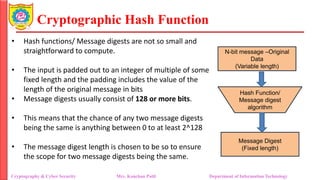
• The input to the hash function is of variable length but output is always of
fixed length.
• The value generated as a output is referred as hash value or message digest
• It is used to verify the integrity of data (i.e. to ensure that a message has not
been tampered with after it leaves the sender but before it reaches the
receiver)
• It has a property that the results of applying the function to a large set of
inputs will produce outputs that are evenly distributed and apparently random
Cryptography & Cyber Security Mrs. Kanchan Patil Department of Information Technology
4.
Cryptographic Hash Function
•A change to any bit or bits in M results, with high probability, in a change to
hash code
• The kind of hash function needed for security applications is referred to as
cryptographic hash function
• A Cryptographic hash function is an algorithm for which it is infeasible to
find
• Either a data object that maps to a pre-specified hash result (one-way
function)
• Or two data objects that map to same hash result (collision-free
property)
Cryptography & Cyber Security Mrs. Kanchan Patil Department of Information Technology
5.
Cryptographic Hash Function
•Hash functions/ Message digests are not so small and
straightforward to compute.
• The input is padded out to an integer of multiple of some
fixed length and the padding includes the value of the
length of the original message in bits
• Message digests usually consist of 128 or more bits.
• This means that the chance of any two message digests
being the same is anything between 0 to at least 2^128
• The message digest length is chosen to be so to ensure
the scope for two message digests being the same.
Cryptography & Cyber Security Mrs. Kanchan Patil Department of Information Technology
N-bit message –Original
Data
(Variable length)
Hash Function/
Message digest
algorithm
Message Digest
(Fixed length)
6.
Requirements of CryptographicHash
Function
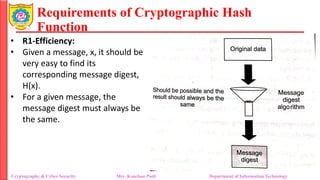
• R1-Efficiency:
• Given a message, x, it should be
very easy to find its
corresponding message digest,
H(x).
• For a given message, the
message digest must always be
the same.
Cryptography & Cyber Security Mrs. Kanchan Patil Department of Information Technology
7.
Requirements of CryptographicHash
Function
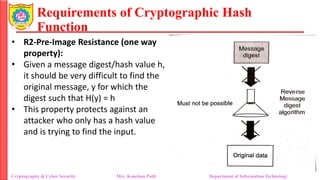
• R2-Pre-Image Resistance (one way
property):
• Given a message digest/hash value h,
it should be very difficult to find the
original message, y for which the
digest such that H(y) = h
• This property protects against an
attacker who only has a hash value
and is trying to find the input.
Cryptography & Cyber Security Mrs. Kanchan Patil Department of Information Technology
8.
Requirements of CryptographicHash
Function / Message Digests
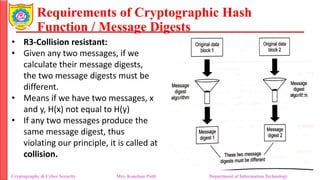
• R3-Collision resistant:
• Given any two messages, if we
calculate their message digests,
the two message digests must be
different.
• Means if we have two messages, x
and y, H(x) not equal to H(y)
• If any two messages produce the
same message digest, thus
violating our principle, it is called at
collision.
Cryptography & Cyber Security Mrs. Kanchan Patil Department of Information Technology
9.
Applications of CryptographicHash Function
• Message Authentication:
• It is a mechanism or service used to verify the integrity of a message.
• Message authentication assures that data received are exactly as sent
(i.e., contain no modification, insertion, deletion, or replay).
• In many cases, there is a requirement that the authentication mechanism
assures that purported identity of the sender is valid.
• When a hash function is used to provide message authentication, the
hash function value is often referred to as a message digest.
• A variety of ways in which a hash code can be used to provide message
authentication as follows:
Cryptography & Cyber Security Mrs. Kanchan Patil Department of Information Technology
10.
Applications of CryptographicHash Function
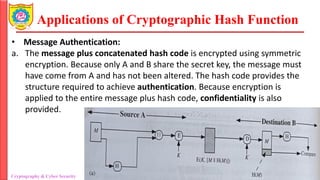
• Message Authentication:
a. The message plus concatenated hash code is encrypted using symmetric
encryption. Because only A and B share the secret key, the message must
have come from A and has not been altered. The hash code provides the
structure required to achieve authentication. Because encryption is
applied to the entire message plus hash code, confidentiality is also
provided.
Cryptography & Cyber Security Mrs. Kanchan Patil Department of Information Technology
11.
Applications of CryptographicHash Function
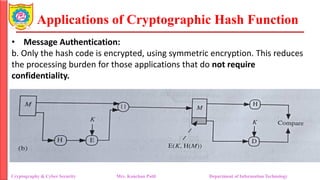
• Message Authentication:
b. Only the hash code is encrypted, using symmetric encryption. This reduces
the processing burden for those applications that do not require
confidentiality.
Cryptography & Cyber Security Mrs. Kanchan Patil Department of Information Technology
12.
Applications of CryptographicHash Function
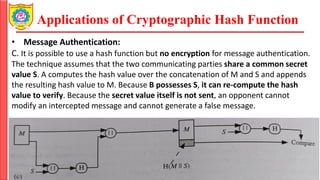
• Message Authentication:
C. It is possible to use a hash function but no encryption for message authentication.
The technique assumes that the two communicating parties share a common secret
value S. A computes the hash value over the concatenation of M and S and appends
the resulting hash value to M. Because B possesses S, it can re-compute the hash
value to verify. Because the secret value itself is not sent, an opponent cannot
modify an intercepted message and cannot generate a false message.
Cryptography & Cyber Security Mrs. Kanchan Patil Department of Information Technology
13.
Applications of CryptographicHash Function
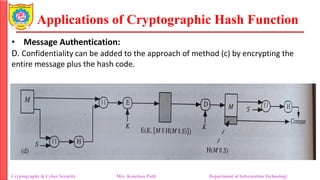
• Message Authentication:
D. Confidentiality can be added to the approach of method (c) by encrypting the
entire message plus the hash code.
Cryptography & Cyber Security Mrs. Kanchan Patil Department of Information Technology
14.
Applications of CryptographicHash Function
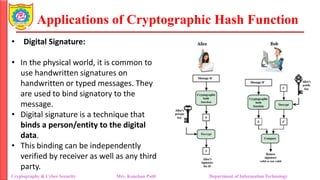
• Digital Signature:
• In the physical world, it is common to
use handwritten signatures on
handwritten or typed messages. They
are used to bind signatory to the
message.
• Digital signature is a technique that
binds a person/entity to the digital
data.
• This binding can be independently
verified by receiver as well as any third
party.
Cryptography & Cyber Security Mrs. Kanchan Patil Department of Information Technology
15.
Applications of CryptographicHash Function
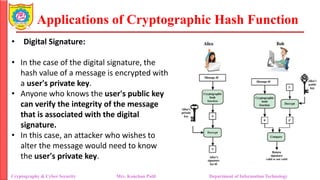
• Digital Signature:
• In the case of the digital signature, the
hash value of a message is encrypted with
a user's private key.
• Anyone who knows the user's public key
can verify the integrity of the message
that is associated with the digital
signature.
• In this case, an attacker who wishes to
alter the message would need to know
the user's private key.
Cryptography & Cyber Security Mrs. Kanchan Patil Department of Information Technology
16.
Applications of CryptographicHash Function
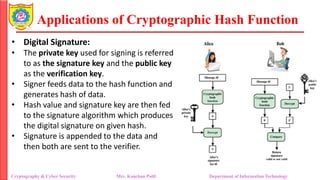
• Digital Signature:
• The private key used for signing is referred
to as the signature key and the public key
as the verification key.
• Signer feeds data to the hash function and
generates hash of data.
• Hash value and signature key are then fed
to the signature algorithm which produces
the digital signature on given hash.
• Signature is appended to the data and
then both are sent to the verifier.
Cryptography & Cyber Security Mrs. Kanchan Patil Department of Information Technology
17.
Applications of CryptographicHash Function
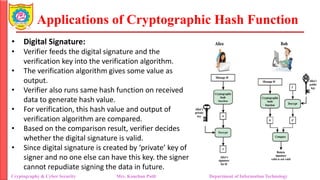
• Digital Signature:
• Verifier feeds the digital signature and the
verification key into the verification algorithm.
• The verification algorithm gives some value as
output.
• Verifier also runs same hash function on received
data to generate hash value.
• For verification, this hash value and output of
verification algorithm are compared.
• Based on the comparison result, verifier decides
whether the digital signature is valid.
• Since digital signature is created by ‘private’ key of
signer and no one else can have this key. the signer
cannot repudiate signing the data in future.
Cryptography & Cyber Security Mrs. Kanchan Patil Department of Information Technology
18.
Applications of CryptographicHash Function
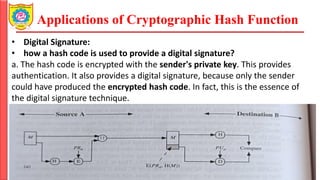
• Digital Signature:
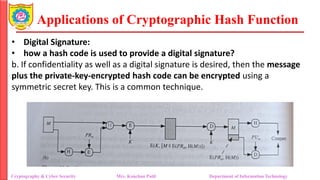
• how a hash code is used to provide a digital signature?
a. The hash code is encrypted with the sender's private key. This provides
authentication. It also provides a digital signature, because only the sender
could have produced the encrypted hash code. In fact, this is the essence of
the digital signature technique.
Cryptography & Cyber Security Mrs. Kanchan Patil Department of Information Technology
19.
Applications of CryptographicHash Function
• Digital Signature:
• how a hash code is used to provide a digital signature?
b. If confidentiality as well as a digital signature is desired, then the message
plus the private-key-encrypted hash code can be encrypted using a
symmetric secret key. This is a common technique.
Cryptography & Cyber Security Mrs. Kanchan Patil Department of Information Technology
20.
Two Simple HashFunctions
• To get some feel for the security considerations involved in cryptographic hash functions,
we present two simple, insecure hash functions.
• All hash functions operate using the following general principles.
• The input (message, file, etc.) is viewed as a sequence of n-bit blocks.
• The input is processed one block at a time in an iterative fashion to produce an n-
bit hash function.
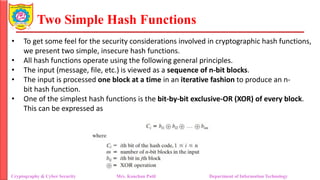
• One of the simplest hash functions is the bit-by-bit exclusive-OR (XOR) of every block.
This can be expressed as
Cryptography & Cyber Security Mrs. Kanchan Patil Department of Information Technology
21.
Two Simple HashFunctions
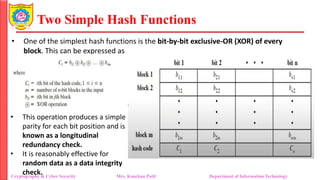
• One of the simplest hash functions is the bit-by-bit exclusive-OR (XOR) of every
block. This can be expressed as
Cryptography & Cyber Security Mrs. Kanchan Patil Department of Information Technology
• This operation produces a simple
parity for each bit position and is
known as a longitudinal
redundancy check.
• It is reasonably effective for
random data as a data integrity
check.
22.
Two Simple HashFunctions
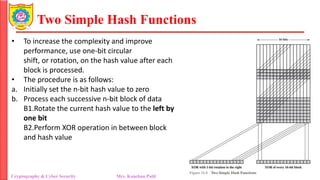
• To increase the complexity and improve
performance, use one-bit circular
shift, or rotation, on the hash value after each
block is processed.
• The procedure is as follows:
a. Initially set the n-bit hash value to zero
b. Process each successive n-bit block of data
B1.Rotate the current hash value to the left by
one bit
B2.Perform XOR operation in between block
and hash value
Cryptography & Cyber Security Mrs. Kanchan Patil Department of Information Technology
23.
Two Simple HashFunctions
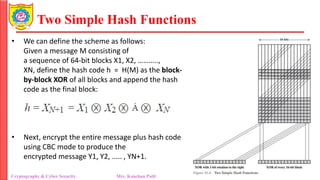
• We can define the scheme as follows:
Given a message M consisting of
a sequence of 64-bit blocks X1, X2, ………..,
XN, define the hash code h = H(M) as the block-
by-block XOR of all blocks and append the hash
code as the final block:
• Next, encrypt the entire message plus hash code
using CBC mode to produce the
encrypted message Y1, Y2, ..... , YN+1.
Cryptography & Cyber Security Mrs. Kanchan Patil Department of Information Technology
24.
Birthday Attack
• Aspecific type of security attack called as birthday attack is used to detect collisions
in the message digest algorithm such as MD5 and SHA1.
• It is based on principle of Birthday Paradox.
• It that if there are 23 people in a room, chances are more than 50% that any two of
the people will share the same birthday.
• For instance, suppose that we have Alice, Bob and Carol as three of the 23 people in
the room.
• Therefore, Alice has 22 possibilities to share a birthday with anyone else Alice will
leave if no birthday matching
• Bob has 21 possibilities to share a birthday with anyone else Bob will leave if no
birthday matching
• Carol has 20 possibilities to share a birthday with anyone else and so on
Cryptography & Cyber Security Mrs. Kanchan Patil Department of Information Technology
25.
Birthday Attack
• Ifa message digest uses 64-bit keys, then after trying 2^32 transactions,
an attacker can expect that for two different messages, we may get the
same message digests.
• for a given message, if we compute up to N different message digests,
then we can expect the first collision after the number of message
digests computed exceeds square-root of N.
• In other words, a collision is expected when the probability of collision
exceeds 50%.
• This can lead to birthday attacks.
Cryptography & Cyber Security Mrs. Kanchan Patil Department of Information Technology
26.
Message Digests –MD5
•Message digest algorithm developed by Ron Rivest
• Series of Message Digests algorithms
• Original was MD
• Then MD2 - weak one
• MD3 - failure
• MD4 – weak
• MD5 – fast and produces 128-bit message digests (four 32-bit blocks)
• Input 512-bit (sixteen 32-bit blocks)
Cryptography & Cyber Security Mrs. Kanchan Patil Department of Information Technology
27.
MD5 Working
• Step1: Padding
• The first step in MDS is to add padding bits to the original message.
• The aim of this step is to make the length of the original message
equal to a value, which is 64 bits less than an exact multiple of 512.
• Example
• if the length of the original message is 1000 bits, we add a padding of
472 bits to make the length of the message 1472 bits.
• This is because, if we add 64 to 1472, we get 1536, which is a multiple
of 512 (because 1536 = 512 ×3).
Cryptography & Cyber Security Mrs. Kanchan Patil Department of Information Technology
MD5 Working
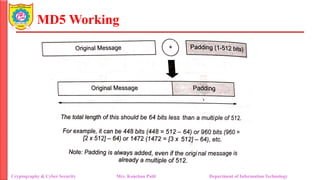
• Step1: Padding
• After padding, original message will have a length of 448 bits (64 bits
less than 512), 960 bits (64 bits less than 1024), 1472 bits (64 bits less
than 1536), etc.
• The padding consists of a single 1-bit, followed by as many 0-bits, as
required.
• Padding is always added, even if the message length is already 64 bits
less than a multiple of 512.
• Thus, if the message were already of length say 448 bits, we will add a
padding of 512 bits to make its length 960 bits. Thus, the padding
length is any value between 1 and 512.
Cryptography & Cyber Security Mrs. Kanchan Patil Department of Information Technology
30.
MD5 Working
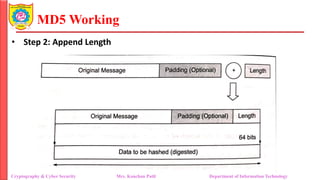
• Step2: Append Length
• Append length after padding bits are added
• Calculate the original length of the message and add it to the end of the message
• The length of the message is calculated, excluding the padding bits (i.e. it is the
length before the padding bits were added).
• Example
• if the original message consisted of 1000 bits and we added a padding of 472 bits
to make the length of the message 64 bits less than 1536 (a multiple of 512), the
length is considered as 1000 and not 1472
• This length of the original message is now expressed as a 64-bit value and these
64 bits are appended to the end of the original message + padding.
Cryptography & Cyber Security Mrs. Kanchan Patil Department of Information Technology
31.
MD5 Working
• Step2: Append Length
Cryptography & Cyber Security Mrs. Kanchan Patil Department of Information Technology
32.
MD5 Working
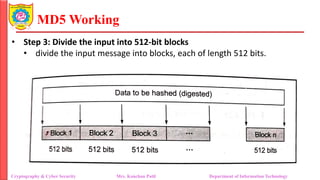
• Step3: Divide the input into 512-bit blocks
• divide the input message into blocks, each of length 512 bits.
Cryptography & Cyber Security Mrs. Kanchan Patil Department of Information Technology
33.
MD5 Working
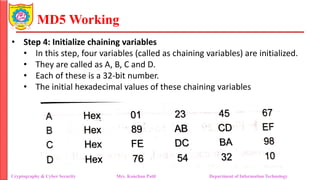
• Step4: Initialize chaining variables
• In this step, four variables (called as chaining variables) are initialized.
• They are called as A, B, C and D.
• Each of these is a 32-bit number.
• The initial hexadecimal values of these chaining variables
Cryptography & Cyber Security Mrs. Kanchan Patil Department of Information Technology
34.
MD5 Working
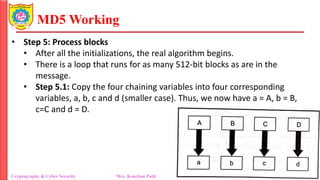
• Step5: Process blocks
• After all the initializations, the real algorithm begins.
• There is a loop that runs for as many 512-bit blocks as are in the
message.
• Step 5.1: Copy the four chaining variables into four corresponding
variables, a, b, c and d (smaller case). Thus, we now have a = A, b = B,
c=C and d = D.
Cryptography & Cyber Security Mrs. Kanchan Patil Department of Information Technology
35.
MD5 Working
• Step5: Process blocks
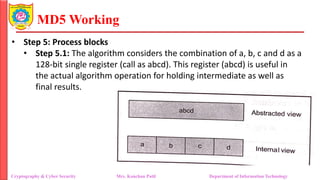
• Step 5.1: The algorithm considers the combination of a, b, c and d as a
128-bit single register (call as abcd). This register (abcd) is useful in
the actual algorithm operation for holding intermediate as well as
final results.
Cryptography & Cyber Security Mrs. Kanchan Patil Department of Information Technology
36.
MD5 Working
• Step5: Process blocks
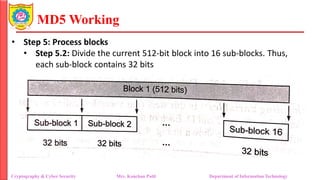
• Step 5.2: Divide the current 512-bit block into 16 sub-blocks. Thus,
each sub-block contains 32 bits
Cryptography & Cyber Security Mrs. Kanchan Patil Department of Information Technology
37.
MD5 Working
• Step5: Process blocks
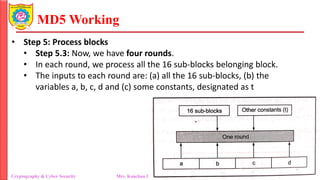
• Step 5.3: Now, we have four rounds.
• In each round, we process all the 16 sub-blocks belonging block.
• The inputs to each round are: (a) all the 16 sub-blocks, (b) the
variables a, b, c, d and (c) some constants, designated as t
Cryptography & Cyber Security Mrs. Kanchan Patil Department of Information Technology
38.
MD5 Working
• Step5: Process blocks
• Step 5.3:
• Step 1 of the four rounds has different processing.
• The other steps in all the four rounds are the same.
• In each round, we have 16 input sub-blocks, named M[0], M[1], ...,
M[15] or in general, M[i] where i varies from 0 to 15.
• We process all 16 blocks consists of 32-bits
• The inputs to each round are:
• all the 16 sub-blocks
• the variables a, b, c, d
• some constants, designated as t
Cryptography & Cyber Security Mrs. Kanchan Patil Department of Information Technology
39.
MD5 Working
• Step5: Process blocks
• Step 5.3:
• T is array of constants
• It contains 64 elements, with each element consists of 32 bits
• Lets say, array t as t[1],t[2] ..., t[64] or in general, t[k] where k varies
from 1 to 64.
• As there are 4 rounds, we use 16 out of 64 values of t in each round.
Cryptography & Cyber Security Mrs. Kanchan Patil Department of Information Technology
40.
MD5 Working
• Step5.3
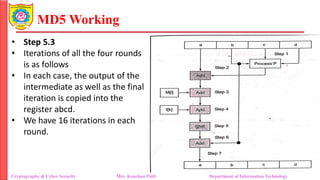
• Iterations of all the four rounds
is as follows
• In each case, the output of the
intermediate as well as the final
iteration is copied into the
register abcd.
• We have 16 iterations in each
round.
Cryptography & Cyber Security Mrs. Kanchan Patil Department of Information Technology
41.
MD5 Working
• Step5.3
• A process P is first performed on b, c and d.
• This process P is different in all the four rounds.
• The variable a is added to the output of the process P (i.e. to the register
abcd).
• The message sub-block M[i] is added to the output of Step 2 (i.e. to the
register abcd).
• The constant t[k] is added to the output of Step 3 (i.e. to the register
abcd).
• The output of Step 4 (i.e. the contents of register abcd) is circular-left
shifted by s bits. (The value of s keeps changing).
Cryptography & Cyber Security Mrs. Kanchan Patil Department of Information Technology
42.
MD5 Working
• Step5.3
• The variable b is added to the output of Step 5 (i.e. to the register abcd).
• The output of Step 6 becomes the new abcd for the next step.
• We can mathematically express a single MDS operation as follows:
a = b + ((a+ Process P (b. c. d) + M[i] + T[k]) <<< s)
Where,
a, b, c, d = Chaining variables
P = A non-linear operation
M[i] = M[q x 16+ i], which is the ith 32-bit word in the qth 512-bit block
of the message
t[k] = A constant
<<<s = Circular-left shift by s bits
Cryptography & Cyber Security Mrs. Kanchan Patil Department of Information Technology
43.
MD5 Strength
• Theattempt of Rivest was to add as much of complexity and randomness
as possible to the MD5 algorithm, so that no two message digests
produced by MDS on any two different messages are equal.
• MD5 has a property that every bit of the message digest is some function
of every bit in the input.
• The possibility that two messages produce the same message digest using
MDS is in the order of 2^64 operations.
• Given a message digest, working backwards to find the original message
can lead up to 2^128 operations.
Cryptography & Cyber Security Mrs. Kanchan Patil Department of Information Technology
44.
Attacks on MD5
•Tom Berson could find two messages that produce the same message digest
for each of the four individual rounds. However, he could not come up with
two messages that produce the same message digest for all the four rounds
taken together.
• Den Boer and Bosselaers showed that the execution of MD5 on a single
block of 512 bits will produce the same output for two different values in
the chaining variable register abcd. This is called as pseudocollision.
However, they could not extend this to a full MD5 consisting of four rounds,
each containing 16 steps.
• Dobbertin provided the most serious attack on MDS. Using his attack, the
operation of MD5 on two different 512-bit blocks produces the same 128-
bit output. However, this has not bees generalized to a full message block.
Cryptography & Cyber Security Mrs. Kanchan Patil Department of Information Technology
45.
MD5 Example
• Originalmessage: They are deterministic
• Step 1:
• Identify ASCII for each character (Hint: A-Z : 65-90 in decimal, a-z: 97-122 in
decimal, space: 20 in hex)
• ASCII for T is 84 in decimal, h is 104 in decimal and so on
• Step 2:
• Convert decimal values into the hex format and then into the binary format OR
directly convert ASCII into binary format
• “T” is written as “01010100” in binary
• A lowercase “h” is “01101000”
• A lowercase “e” is “01100101”
• A lowercase “y” is “01111001”
• The binary code for a space (SP) is “00100000” etc.
Cryptography & Cyber Security Mrs. Kanchan Patil Department of Information Technology
46.
MD5 Example
• Step3:
our input They are deterministic is written in binary as:
01010100 01101000 01100101 01111001 00100000 01100001
01110010 01100101 00100000 01100100 01100101 01110100
01100101 01110010 01101101 01101001 01101110 01101001
01110011 01110100 01101001 01100011
• Step 4: Padding
• Inputs in MD5 are broken up into 512-bit blocks, with padding added to
fill up the rest of the space in the block.
• Our input is 22 characters long including spaces, and each character is 8
bits long, so total bits = 22 * 8 = 176
Cryptography & Cyber Security Mrs. Kanchan Patil Department of Information Technology
47.
MD5 Example
• Step4: Padding
• With an input of only 176 bits and a 512-bit block that needs to be filled,
we need 336 bits of padding to complete the block.
• One block size = 512 bits, reserved length = 64 bits
• Total padding bits required = 512 – 64 – message size = 448 – 176 = 272
bits
• After laying out the initial 176 bits of binary that represent our input, the
rest of the block is padded with a single one, then enough zeros to bring
it up to a length of 448 bits. So: 448 – 1 – 176 = 271
• The padding for this block will include a one, then an extra 271
Cryptography & Cyber Security Mrs. Kanchan Patil Department of Information Technology
48.
MD5 Example
• Step5: Append Length
• The reason we only need to pad it up to 448 bits (instead of 512) is
because the final 64 bits (512 – 64 = 448) are reserved to display the
message’s length in binary.
• In our example, the number 176 is 10110000 in binary.
• This forms the very end of the padding scheme, while the preceding 56
bits (64 minus the 8 bits that make up 10110000) are all filled up with
zeros.
• 00000000 00000000 00000000 00000000 00000000 00000000
00000000 10110000
Cryptography & Cyber Security Mrs. Kanchan Patil Department of Information Technology
49.
MD5 Example
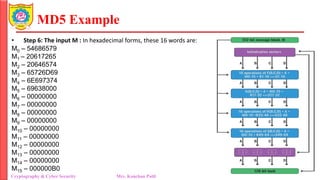
• Step6: The input M
• As we can see four “16 operations”
rectangles. Each of these four rectangles
are called rounds, and each of them are
composed of a series of sixteen operations
• This means that our input, M, is an input in
each of these four stages. However, before
it can be used as an input, our 512-bit M
needs to be split into sixteen 32-bit
“words”.
• Each of these words is assigned its own
number, ranging from M0 to M15.
Cryptography & Cyber Security Mrs. Kanchan Patil Department of Information Technology
MD5 Example
• Step6: The input M : In hexadecimal forms, these 16 words are:
M0 – 54686579
M1 – 20617265
M2 – 20646574
M3 – 65726D69
M4 – 6E697374
M5 – 69638000
M6 – 00000000
M7 – 00000000
M8 – 00000000
M9 – 00000000
M10 – 00000000
M11 – 00000000
M12 – 00000000
M13 – 00000000
M14 – 00000000
M15 – 000000B0
Cryptography & Cyber Security Mrs. Kanchan Patil Department of Information Technology
52.
MD5 Example
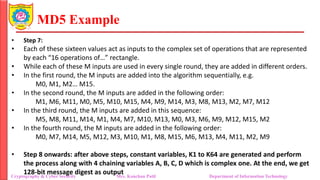
• Step7:
• Each of these sixteen values act as inputs to the complex set of operations that are represented
by each “16 operations of…” rectangle.
• While each of these M inputs are used in every single round, they are added in different orders.
• In the first round, the M inputs are added into the algorithm sequentially, e.g.
M0, M1, M2… M15.
• In the second round, the M inputs are added in the following order:
M1, M6, M11, M0, M5, M10, M15, M4, M9, M14, M3, M8, M13, M2, M7, M12
• In the third round, the M inputs are added in this sequence:
M5, M8, M11, M14, M1, M4, M7, M10, M13, M0, M3, M6, M9, M12, M15, M2
• In the fourth round, the M inputs are added in the following order:
M0, M7, M14, M5, M12, M3, M10, M1, M8, M15, M6, M13, M4, M11, M2, M9
• Step 8 onwards: after above steps, constant variables, K1 to K64 are generated and perform
the process along with 4 chaining variables A, B, C, D which is complex one. At the end, we get
128-bit message digest as output
Cryptography & Cyber Security Mrs. Kanchan Patil Department of Information Technology
53.
References:
Cryptography & CyberSecurity Mrs. Kanchan Patil Department of Information Technology
• Atul Kahate,”Cryptography and Network Security”, second edition, Tata
McGraw Hill
• William Stallings, “Cryptography and Network Security-Principles and
practice”
![Cryptography and Cyber Security
[IT311]
Sanjivani Rural Education Society’s
Sanjivani College of Engineering, Kopargaon-423603
(An Autonomous Institute Affiliated to Savitribai Phule Pune University, Pune)
NAAC ‘A’ Grade Accredited, ISO 9001:2015 Certified
Department of Information Technology
(NBAAccredited)
Mrs. Kanchan D. Patil
Assistant Professor](https://image.slidesharecdn.com/unit3hashfunctionandmd5-250312080231-01115a31/85/Unit-3_Hash-function-and-MD5-working-pdf-1-320.jpg)
![MD5 Working
• Step 5: Process blocks
• Step 5.3:
• Step 1 of the four rounds has different processing.
• The other steps in all the four rounds are the same.
• In each round, we have 16 input sub-blocks, named M[0], M[1], ...,
M[15] or in general, M[i] where i varies from 0 to 15.
• We process all 16 blocks consists of 32-bits
• The inputs to each round are:
• all the 16 sub-blocks
• the variables a, b, c, d
• some constants, designated as t
Cryptography & Cyber Security Mrs. Kanchan Patil Department of Information Technology](https://image.slidesharecdn.com/unit3hashfunctionandmd5-250312080231-01115a31/85/Unit-3_Hash-function-and-MD5-working-pdf-38-320.jpg)
![MD5 Working
• Step 5: Process blocks
• Step 5.3:
• T is array of constants
• It contains 64 elements, with each element consists of 32 bits
• Lets say, array t as t[1],t[2] ..., t[64] or in general, t[k] where k varies
from 1 to 64.
• As there are 4 rounds, we use 16 out of 64 values of t in each round.
Cryptography & Cyber Security Mrs. Kanchan Patil Department of Information Technology](https://image.slidesharecdn.com/unit3hashfunctionandmd5-250312080231-01115a31/85/Unit-3_Hash-function-and-MD5-working-pdf-39-320.jpg)
![MD5 Working
• Step 5.3
• A process P is first performed on b, c and d.
• This process P is different in all the four rounds.
• The variable a is added to the output of the process P (i.e. to the register
abcd).
• The message sub-block M[i] is added to the output of Step 2 (i.e. to the
register abcd).
• The constant t[k] is added to the output of Step 3 (i.e. to the register
abcd).
• The output of Step 4 (i.e. the contents of register abcd) is circular-left
shifted by s bits. (The value of s keeps changing).
Cryptography & Cyber Security Mrs. Kanchan Patil Department of Information Technology](https://image.slidesharecdn.com/unit3hashfunctionandmd5-250312080231-01115a31/85/Unit-3_Hash-function-and-MD5-working-pdf-41-320.jpg)
![MD5 Working
• Step 5.3
• The variable b is added to the output of Step 5 (i.e. to the register abcd).
• The output of Step 6 becomes the new abcd for the next step.
• We can mathematically express a single MDS operation as follows:
a = b + ((a+ Process P (b. c. d) + M[i] + T[k]) <<< s)
Where,
a, b, c, d = Chaining variables
P = A non-linear operation
M[i] = M[q x 16+ i], which is the ith 32-bit word in the qth 512-bit block
of the message
t[k] = A constant
<<<s = Circular-left shift by s bits
Cryptography & Cyber Security Mrs. Kanchan Patil Department of Information Technology](https://image.slidesharecdn.com/unit3hashfunctionandmd5-250312080231-01115a31/85/Unit-3_Hash-function-and-MD5-working-pdf-42-320.jpg)