DISTRIBUTED FILE
SYSTEM
1
BY
NANDAKUMAR P,
AP/CSE,
CAHCET
CONTENTS:
• Introduction
• File System : Features –File Model
• File Accessing Model
• File Sharing Semantics
INTRODUCTION
 A File is a named object that comes into existence by explicit
creation, is immune to temporary failures in the system, and
persists until explicitly destroyed.
 Two main purposes:
 Permanent storage of information
 Sharing of information
 A File system is a subsystem of an operating system that
performs file management activities such as organization,
storing, and protection of files.
 A distributed file system provides similar abstraction to the
users of a distributed system and makes it convenient for
them to use files in a distributed environment.
3
INTRODUCTION CONTINUES…
 Distributed system supports:
 Remote information sharing
 User mobility
 Availability
 Diskless workstations
 Three types of services:
 Storage service
 True file service
 Name service
4
Features of a good Distributed System
 Transparency
 Structure
 Access
 Naming
 Replication
 User mobility
 Performance
 Simplicity and ease of use
 Scalability
 High availability
 High reliability
 Data integrity
 Security
 Heterogeneity
5
File Models
 Two criteria for file modeling:
 Structure
 Modifiability
 Unstructured and Structured Files
 Unstructured sequence of data
 Ex: UNIX & MS-DOS
 Structured File – Two types:
 non-indexed records
 indexed records
 Mutable and Immutable Files
6
File–Accessing Model
 Mainly depend on two factors:
 The method used for accessing remote files
 The unit of data access
 Accessing Remote Files
 Remote service model
 Data-caching model
 Unit of Data Transfer
 File-level transfer model
 Block-level transfer model
 Byte-level transfer model
 Record-level transfer model
7
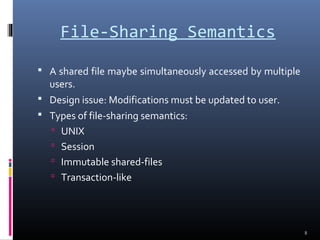
File-Sharing Semantics
 A shared file maybe simultaneously accessed by multiple
users.
 Design issue: Modifications must be updated to user.
 Types of file-sharing semantics:
 UNIX
 Session
 Immutable shared-files
 Transaction-like
8
Instructor’s Guide for Coulouris, Dollimore, Kindberg and Blair, Distributed Systems: Concepts and Design Edn. 5
© Pearson Education 2012
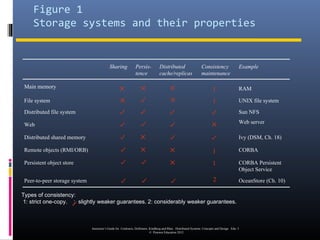
Figure 1
Storage systems and their properties
Sharing Persis-
tence
Distributed
cache/replicas
Consistency
maintenance
Example
Main memory RAM
File system UNIX file system
Distributed file system Sun NFS
Web Web server
Distributed shared memory Ivy (DSM, Ch. 18)
Remote objects (RMI/ORB) CORBA
Persistent object store 1 CORBA Persistent
Object Service
Peer-to-peer storage system OceanStore (Ch. 10)
1
1
1
2
Types of consistency:
1: strict one-copy. : slightly weaker guarantees. 2: considerably weaker guarantees.
Instructor’s Guide for Coulouris, Dollimore, Kindberg and Blair, Distributed Systems: Concepts and Design Edn. 5
© Pearson Education 2012
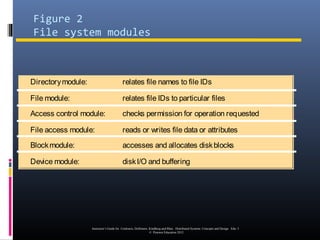
Figure 2
File system modules
Directorymodule: relates file names to file IDs
File module: relates file IDs to particular files
Access control module: checks permission for operation requested
File access module: reads or writes file data or attributes
Blockmodule: accesses and allocates diskblocks
Device module: diskI/O and buffering
Instructor’s Guide for Coulouris, Dollimore, Kindberg and Blair, Distributed Systems: Concepts and Design Edn. 5
© Pearson Education 2012
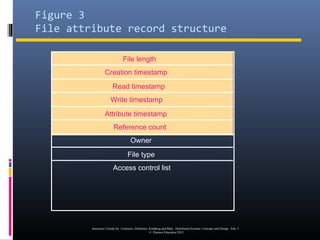
Figure 3
File attribute record structure
File length
Creation timestamp
Read timestamp
Write timestamp
Attribute timestamp
Reference count
Owner
File type
Access control list
Instructor’s Guide for Coulouris, Dollimore, Kindberg and Blair, Distributed Systems: Concepts and Design Edn. 5
© Pearson Education 2012
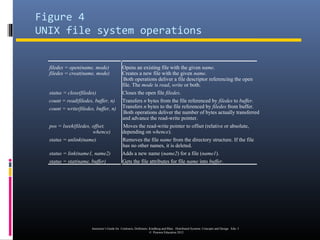
Figure 4
UNIX file system operations
filedes = open(name, mode)
filedes = creat(name, mode)
Opens an existing file with the given name.
Creates a new file with the given name.
Both operations deliver a file descriptor referencing the open
file. The mode is read, write or both.
status = close(filedes) Closes the open file filedes.
count = read(filedes, buffer, n)
count = write(filedes, buffer, n)
Transfers n bytes from the file referenced by filedes to buffer.
Transfers n bytes to the file referenced by filedes from buffer.
Both operations deliver the number of bytes actually transferred
and advance the read-write pointer.
pos = lseek(filedes, offset,
whence)
Moves the read-write pointer to offset (relative or absolute,
depending on whence).
status = unlink(name) Removes the file name from the directory structure. If the file
has no other names, it is deleted.
status = link(name1, name2) Adds a new name (name2) for a file (name1).
status = stat(name, buffer) Gets the file attributes for file name into buffer.
Instructor’s Guide for Coulouris, Dollimore, Kindberg and Blair, Distributed Systems: Concepts and Design Edn. 5
© Pearson Education 2012
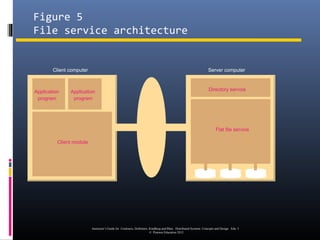
Figure 5
File service architecture
Client computer Server computer
Application
program
Application
program
Client module
Flat file service
Directory service
Instructor’s Guide for Coulouris, Dollimore, Kindberg and Blair, Distributed Systems: Concepts and Design Edn. 5
© Pearson Education 2012
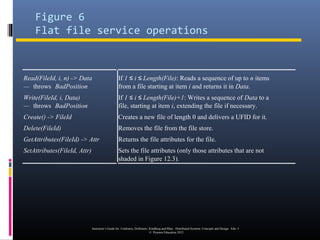
Figure 6
Flat file service operations
Read(FileId, i, n) -> Data
— throws BadPosition
If 1 i Length(File)≤ ≤ : Reads a sequence of up to n items
from a file starting at item i and returns it in Data.
Write(FileId, i, Data)
— throws BadPosition
If 1 i Length(File)+1≤ ≤ : Writes a sequence of Data to a
file, starting at item i, extending the file if necessary.
Create() -> FileId Creates a new file of length 0 and delivers a UFID for it.
Delete(FileId) Removes the file from the file store.
GetAttributes(FileId) -> Attr Returns the file attributes for the file.
SetAttributes(FileId, Attr) Sets the file attributes (only those attributes that are not
shaded in Figure 12.3).
Instructor’s Guide for Coulouris, Dollimore, Kindberg and Blair, Distributed Systems: Concepts and Design Edn. 5
© Pearson Education 2012
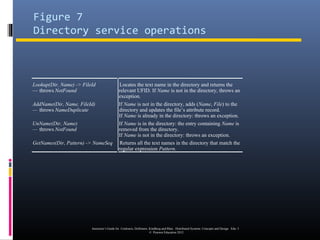
Figure 7
Directory service operations
Lookup(Dir, Name) -> FileId
— throws NotFound
Locates the text name in the directory and returns the
relevant UFID. If Name is not in the directory, throws an
exception.
AddName(Dir, Name, FileId)
— throws NameDuplicate
If Name is not in the directory, adds (Name, File) to the
directory and updates the file’s attribute record.
If Name is already in the directory: throws an exception.
UnName(Dir, Name)
— throws NotFound
If Name is in the directory: the entry containing Name is
removed from the directory.
If Name is not in the directory: throws an exception.
GetNames(Dir, Pattern) -> NameSeq Returns all the text names in the directory that match the
regular expression Pattern.
Instructor’s Guide for Coulouris, Dollimore, Kindberg and Blair, Distributed Systems: Concepts and Design Edn. 5
© Pearson Education 2012
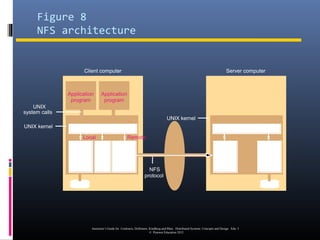
Figure 8
NFS architecture
UNIX kernel
protocol
Client computer Server computer
system calls
Local Remote
UNIX
file
system
NFS
client
NFS
server
UNIX
file
system
Application
program
Application
program
NFS
UNIX
UNIX kernel
Virtual file systemVirtual file system
Other
filesystem
Instructor’s Guide for Coulouris, Dollimore, Kindberg and Blair, Distributed Systems: Concepts and Design Edn. 5
© Pearson Education 2012
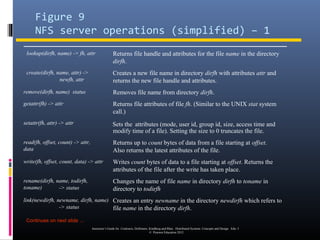
Figure 9
NFS server operations (simplified) – 1
lookup(dirfh, name) -> fh, attr Returns file handle and attributes for the file name in the directory
dirfh.
create(dirfh, name, attr) ->
newfh, attr
Creates a new file name in directory dirfh with attributes attr and
returns the new file handle and attributes.
remove(dirfh, name) status Removes file name from directory dirfh.
getattr(fh) -> attr Returns file attributes of file fh. (Similar to the UNIX stat system
call.)
setattr(fh, attr) -> attr Sets the attributes (mode, user id, group id, size, access time and
modify time of a file). Setting the size to 0 truncates the file.
read(fh, offset, count) -> attr,
data
Returns up to count bytes of data from a file starting at offset.
Also returns the latest attributes of the file.
write(fh, offset, count, data) -> attr Writes count bytes of data to a file starting at offset. Returns the
attributes of the file after the write has taken place.
rename(dirfh, name, todirfh,
toname) -> status
Changes the name of file name in directory dirfh to toname in
directory to todirfh.
link(newdirfh, newname, dirfh, name)
-> status
Creates an entry newname in the directory newdirfh which refers to
file name in the directory dirfh.
Continues on next slide ...
Instructor’s Guide for Coulouris, Dollimore, Kindberg and Blair, Distributed Systems: Concepts and Design Edn. 5
© Pearson Education 2012
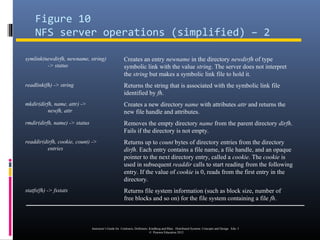
Figure 10
NFS server operations (simplified) – 2
symlink(newdirfh, newname, string)
-> status
Creates an entry newname in the directory newdirfh of type
symbolic link with the value string. The server does not interpret
the string but makes a symbolic link file to hold it.
readlink(fh) -> string Returns the string that is associated with the symbolic link file
identified by fh.
mkdir(dirfh, name, attr) ->
newfh, attr
Creates a new directory name with attributes attr and returns the
new file handle and attributes.
rmdir(dirfh, name) -> status Removes the empty directory name from the parent directory dirfh.
Fails if the directory is not empty.
readdir(dirfh, cookie, count) ->
entries
Returns up to count bytes of directory entries from the directory
dirfh. Each entry contains a file name, a file handle, and an opaque
pointer to the next directory entry, called a cookie. The cookie is
used in subsequent readdir calls to start reading from the following
entry. If the value of cookie is 0, reads from the first entry in the
directory.
statfs(fh) -> fsstats Returns file system information (such as block size, number of
free blocks and so on) for the file system containing a file fh.
Instructor’s Guide for Coulouris, Dollimore, Kindberg and Blair, Distributed Systems: Concepts and Design Edn. 5
© Pearson Education 2012
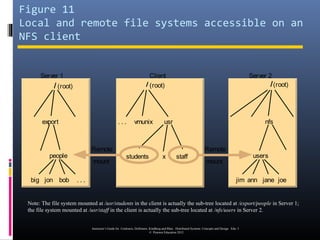
Figure 11
Local and remote file systems accessible on an
NFS client
jim jane joeann
usersstudents
usrvmunix
Client Server 2
. . . nfs
Remote
mount
staff
big bobjon
people
Server 1
export
(root)
Remote
mount
. . .
x
(root) (root)
Note: The file system mounted at /usr/students in the client is actually the sub-tree located at /export/people in Server 1;
the file system mounted at /usr/staff in the client is actually the sub-tree located at /nfs/users in Server 2.
Instructor’s Guide for Coulouris, Dollimore, Kindberg and Blair, Distributed Systems: Concepts and Design Edn. 5
© Pearson Education 2012
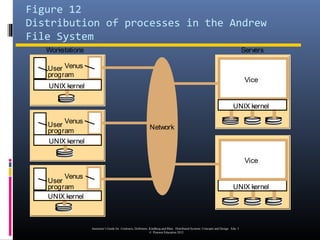
Figure 12
Distribution of processes in the Andrew
File System
Venus
Workstations Servers
Venus
VenusUser
program
Network
UNIX kernel
UNIX kernel
Vice
User
program
User
program
Vice
UNIX kernel
UNIX kernel
UNIX kernel
Instructor’s Guide for Coulouris, Dollimore, Kindberg and Blair, Distributed Systems: Concepts and Design Edn. 5
© Pearson Education 2012
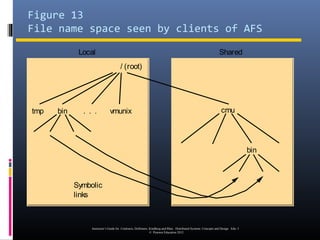
Figure 13
File name space seen by clients of AFS
/ (root)
tmp bin cmuvmunix. . .
bin
SharedLocal
Symbolic
links
Instructor’s Guide for Coulouris, Dollimore, Kindberg and Blair, Distributed Systems: Concepts and Design Edn. 5
© Pearson Education 2012
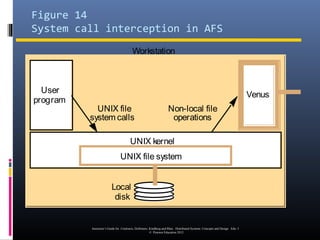
Figure 14
System call interception in AFS
UNIX file
system calls
Non-local file
operations
Workstation
Local
disk
User
program
UNIX kernel
Venus
UNIX file system
Venus
Instructor’s Guide for Coulouris, Dollimore, Kindberg and Blair, Distributed Systems: Concepts and Design Edn. 5
© Pearson Education 2012
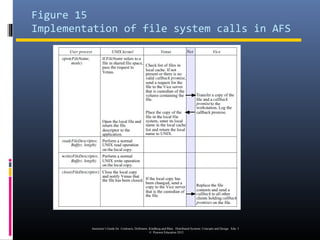
Figure 15
Implementation of file system calls in AFS
Instructor’s Guide for Coulouris, Dollimore, Kindberg and Blair, Distributed Systems: Concepts and Design Edn. 5
© Pearson Education 2012
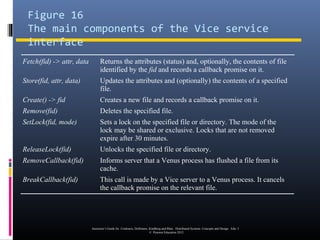
Figure 16
The main components of the Vice service
interface
Fetch(fid) -> attr, data Returns the attributes (status) and, optionally, the contents of file
identified by the fid and records a callback promise on it.
Store(fid, attr, data) Updates the attributes and (optionally) the contents of a specified
file.
Create() -> fid Creates a new file and records a callback promise on it.
Remove(fid) Deletes the specified file.
SetLock(fid, mode) Sets a lock on the specified file or directory. The mode of the
lock may be shared or exclusive. Locks that are not removed
expire after 30 minutes.
ReleaseLock(fid) Unlocks the specified file or directory.
RemoveCallback(fid) Informs server that a Venus process has flushed a file from its
cache.
BreakCallback(fid) This call is made by a Vice server to a Venus process. It cancels
the callback promise on the relevant file.
THANK YOU
25

Unit 3.1 cs6601 Distributed File System

  • 1.
  • 2.
    CONTENTS: • Introduction • FileSystem : Features –File Model • File Accessing Model • File Sharing Semantics
  • 3.
    INTRODUCTION  A Fileis a named object that comes into existence by explicit creation, is immune to temporary failures in the system, and persists until explicitly destroyed.  Two main purposes:  Permanent storage of information  Sharing of information  A File system is a subsystem of an operating system that performs file management activities such as organization, storing, and protection of files.  A distributed file system provides similar abstraction to the users of a distributed system and makes it convenient for them to use files in a distributed environment. 3
  • 4.
    INTRODUCTION CONTINUES…  Distributedsystem supports:  Remote information sharing  User mobility  Availability  Diskless workstations  Three types of services:  Storage service  True file service  Name service 4
  • 5.
    Features of agood Distributed System  Transparency  Structure  Access  Naming  Replication  User mobility  Performance  Simplicity and ease of use  Scalability  High availability  High reliability  Data integrity  Security  Heterogeneity 5
  • 6.
    File Models  Twocriteria for file modeling:  Structure  Modifiability  Unstructured and Structured Files  Unstructured sequence of data  Ex: UNIX & MS-DOS  Structured File – Two types:  non-indexed records  indexed records  Mutable and Immutable Files 6
  • 7.
    File–Accessing Model  Mainlydepend on two factors:  The method used for accessing remote files  The unit of data access  Accessing Remote Files  Remote service model  Data-caching model  Unit of Data Transfer  File-level transfer model  Block-level transfer model  Byte-level transfer model  Record-level transfer model 7
  • 8.
    File-Sharing Semantics  Ashared file maybe simultaneously accessed by multiple users.  Design issue: Modifications must be updated to user.  Types of file-sharing semantics:  UNIX  Session  Immutable shared-files  Transaction-like 8
  • 9.
    Instructor’s Guide forCoulouris, Dollimore, Kindberg and Blair, Distributed Systems: Concepts and Design Edn. 5 © Pearson Education 2012 Figure 1 Storage systems and their properties Sharing Persis- tence Distributed cache/replicas Consistency maintenance Example Main memory RAM File system UNIX file system Distributed file system Sun NFS Web Web server Distributed shared memory Ivy (DSM, Ch. 18) Remote objects (RMI/ORB) CORBA Persistent object store 1 CORBA Persistent Object Service Peer-to-peer storage system OceanStore (Ch. 10) 1 1 1 2 Types of consistency: 1: strict one-copy. : slightly weaker guarantees. 2: considerably weaker guarantees.
  • 10.
    Instructor’s Guide forCoulouris, Dollimore, Kindberg and Blair, Distributed Systems: Concepts and Design Edn. 5 © Pearson Education 2012 Figure 2 File system modules Directorymodule: relates file names to file IDs File module: relates file IDs to particular files Access control module: checks permission for operation requested File access module: reads or writes file data or attributes Blockmodule: accesses and allocates diskblocks Device module: diskI/O and buffering
  • 11.
    Instructor’s Guide forCoulouris, Dollimore, Kindberg and Blair, Distributed Systems: Concepts and Design Edn. 5 © Pearson Education 2012 Figure 3 File attribute record structure File length Creation timestamp Read timestamp Write timestamp Attribute timestamp Reference count Owner File type Access control list
  • 12.
    Instructor’s Guide forCoulouris, Dollimore, Kindberg and Blair, Distributed Systems: Concepts and Design Edn. 5 © Pearson Education 2012 Figure 4 UNIX file system operations filedes = open(name, mode) filedes = creat(name, mode) Opens an existing file with the given name. Creates a new file with the given name. Both operations deliver a file descriptor referencing the open file. The mode is read, write or both. status = close(filedes) Closes the open file filedes. count = read(filedes, buffer, n) count = write(filedes, buffer, n) Transfers n bytes from the file referenced by filedes to buffer. Transfers n bytes to the file referenced by filedes from buffer. Both operations deliver the number of bytes actually transferred and advance the read-write pointer. pos = lseek(filedes, offset, whence) Moves the read-write pointer to offset (relative or absolute, depending on whence). status = unlink(name) Removes the file name from the directory structure. If the file has no other names, it is deleted. status = link(name1, name2) Adds a new name (name2) for a file (name1). status = stat(name, buffer) Gets the file attributes for file name into buffer.
  • 13.
    Instructor’s Guide forCoulouris, Dollimore, Kindberg and Blair, Distributed Systems: Concepts and Design Edn. 5 © Pearson Education 2012 Figure 5 File service architecture Client computer Server computer Application program Application program Client module Flat file service Directory service
  • 14.
    Instructor’s Guide forCoulouris, Dollimore, Kindberg and Blair, Distributed Systems: Concepts and Design Edn. 5 © Pearson Education 2012 Figure 6 Flat file service operations Read(FileId, i, n) -> Data — throws BadPosition If 1 i Length(File)≤ ≤ : Reads a sequence of up to n items from a file starting at item i and returns it in Data. Write(FileId, i, Data) — throws BadPosition If 1 i Length(File)+1≤ ≤ : Writes a sequence of Data to a file, starting at item i, extending the file if necessary. Create() -> FileId Creates a new file of length 0 and delivers a UFID for it. Delete(FileId) Removes the file from the file store. GetAttributes(FileId) -> Attr Returns the file attributes for the file. SetAttributes(FileId, Attr) Sets the file attributes (only those attributes that are not shaded in Figure 12.3).
  • 15.
    Instructor’s Guide forCoulouris, Dollimore, Kindberg and Blair, Distributed Systems: Concepts and Design Edn. 5 © Pearson Education 2012 Figure 7 Directory service operations Lookup(Dir, Name) -> FileId — throws NotFound Locates the text name in the directory and returns the relevant UFID. If Name is not in the directory, throws an exception. AddName(Dir, Name, FileId) — throws NameDuplicate If Name is not in the directory, adds (Name, File) to the directory and updates the file’s attribute record. If Name is already in the directory: throws an exception. UnName(Dir, Name) — throws NotFound If Name is in the directory: the entry containing Name is removed from the directory. If Name is not in the directory: throws an exception. GetNames(Dir, Pattern) -> NameSeq Returns all the text names in the directory that match the regular expression Pattern.
  • 16.
    Instructor’s Guide forCoulouris, Dollimore, Kindberg and Blair, Distributed Systems: Concepts and Design Edn. 5 © Pearson Education 2012 Figure 8 NFS architecture UNIX kernel protocol Client computer Server computer system calls Local Remote UNIX file system NFS client NFS server UNIX file system Application program Application program NFS UNIX UNIX kernel Virtual file systemVirtual file system Other filesystem
  • 17.
    Instructor’s Guide forCoulouris, Dollimore, Kindberg and Blair, Distributed Systems: Concepts and Design Edn. 5 © Pearson Education 2012 Figure 9 NFS server operations (simplified) – 1 lookup(dirfh, name) -> fh, attr Returns file handle and attributes for the file name in the directory dirfh. create(dirfh, name, attr) -> newfh, attr Creates a new file name in directory dirfh with attributes attr and returns the new file handle and attributes. remove(dirfh, name) status Removes file name from directory dirfh. getattr(fh) -> attr Returns file attributes of file fh. (Similar to the UNIX stat system call.) setattr(fh, attr) -> attr Sets the attributes (mode, user id, group id, size, access time and modify time of a file). Setting the size to 0 truncates the file. read(fh, offset, count) -> attr, data Returns up to count bytes of data from a file starting at offset. Also returns the latest attributes of the file. write(fh, offset, count, data) -> attr Writes count bytes of data to a file starting at offset. Returns the attributes of the file after the write has taken place. rename(dirfh, name, todirfh, toname) -> status Changes the name of file name in directory dirfh to toname in directory to todirfh. link(newdirfh, newname, dirfh, name) -> status Creates an entry newname in the directory newdirfh which refers to file name in the directory dirfh. Continues on next slide ...
  • 18.
    Instructor’s Guide forCoulouris, Dollimore, Kindberg and Blair, Distributed Systems: Concepts and Design Edn. 5 © Pearson Education 2012 Figure 10 NFS server operations (simplified) – 2 symlink(newdirfh, newname, string) -> status Creates an entry newname in the directory newdirfh of type symbolic link with the value string. The server does not interpret the string but makes a symbolic link file to hold it. readlink(fh) -> string Returns the string that is associated with the symbolic link file identified by fh. mkdir(dirfh, name, attr) -> newfh, attr Creates a new directory name with attributes attr and returns the new file handle and attributes. rmdir(dirfh, name) -> status Removes the empty directory name from the parent directory dirfh. Fails if the directory is not empty. readdir(dirfh, cookie, count) -> entries Returns up to count bytes of directory entries from the directory dirfh. Each entry contains a file name, a file handle, and an opaque pointer to the next directory entry, called a cookie. The cookie is used in subsequent readdir calls to start reading from the following entry. If the value of cookie is 0, reads from the first entry in the directory. statfs(fh) -> fsstats Returns file system information (such as block size, number of free blocks and so on) for the file system containing a file fh.
  • 19.
    Instructor’s Guide forCoulouris, Dollimore, Kindberg and Blair, Distributed Systems: Concepts and Design Edn. 5 © Pearson Education 2012 Figure 11 Local and remote file systems accessible on an NFS client jim jane joeann usersstudents usrvmunix Client Server 2 . . . nfs Remote mount staff big bobjon people Server 1 export (root) Remote mount . . . x (root) (root) Note: The file system mounted at /usr/students in the client is actually the sub-tree located at /export/people in Server 1; the file system mounted at /usr/staff in the client is actually the sub-tree located at /nfs/users in Server 2.
  • 20.
    Instructor’s Guide forCoulouris, Dollimore, Kindberg and Blair, Distributed Systems: Concepts and Design Edn. 5 © Pearson Education 2012 Figure 12 Distribution of processes in the Andrew File System Venus Workstations Servers Venus VenusUser program Network UNIX kernel UNIX kernel Vice User program User program Vice UNIX kernel UNIX kernel UNIX kernel
  • 21.
    Instructor’s Guide forCoulouris, Dollimore, Kindberg and Blair, Distributed Systems: Concepts and Design Edn. 5 © Pearson Education 2012 Figure 13 File name space seen by clients of AFS / (root) tmp bin cmuvmunix. . . bin SharedLocal Symbolic links
  • 22.
    Instructor’s Guide forCoulouris, Dollimore, Kindberg and Blair, Distributed Systems: Concepts and Design Edn. 5 © Pearson Education 2012 Figure 14 System call interception in AFS UNIX file system calls Non-local file operations Workstation Local disk User program UNIX kernel Venus UNIX file system Venus
  • 23.
    Instructor’s Guide forCoulouris, Dollimore, Kindberg and Blair, Distributed Systems: Concepts and Design Edn. 5 © Pearson Education 2012 Figure 15 Implementation of file system calls in AFS
  • 24.
    Instructor’s Guide forCoulouris, Dollimore, Kindberg and Blair, Distributed Systems: Concepts and Design Edn. 5 © Pearson Education 2012 Figure 16 The main components of the Vice service interface Fetch(fid) -> attr, data Returns the attributes (status) and, optionally, the contents of file identified by the fid and records a callback promise on it. Store(fid, attr, data) Updates the attributes and (optionally) the contents of a specified file. Create() -> fid Creates a new file and records a callback promise on it. Remove(fid) Deletes the specified file. SetLock(fid, mode) Sets a lock on the specified file or directory. The mode of the lock may be shared or exclusive. Locks that are not removed expire after 30 minutes. ReleaseLock(fid) Unlocks the specified file or directory. RemoveCallback(fid) Informs server that a Venus process has flushed a file from its cache. BreakCallback(fid) This call is made by a Vice server to a Venus process. It cancels the callback promise on the relevant file.
  • 25.