1
PRESENTATION OF OPERATING SYSTEM
SUBMITTED TO: HUSNAINA AKHTAR
SUBMITTED BY: MUHAMMAD TAYYAB
ROLL
#
J1F18ASCS0008
ADP(CS)-IV
2
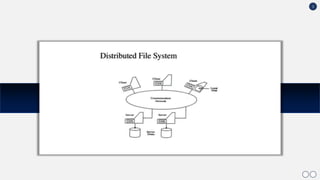
A Distributed File System ( DFS ) is simply a classical
model of a file system distributed across multiple
machines.
the purpose is to promote sharing of dispersed files.
 Goal-(Chow & Johnson)
Efficiency (work)
 Flexibility(design or system) Consistency
 Robustness
DISTRIBUTED FILE
SYSTEM
3
4
Naming and Transparency
5
 Naming is the mapping between logical and physical objects.
 In a conventional file system, it's understood where the file actually resides; the system
and disk are known. In a transparent DFS, the location of a file, somewhere in the
network, is hidden.
NAMING AND TRANSPARENCY
6
a. The name of a file does not reveal any hint of the file's physical
storage location.
b. File name still denotes a specific, although hidden, set of physical
disk blocks.
c. This is a convenient way to share data.
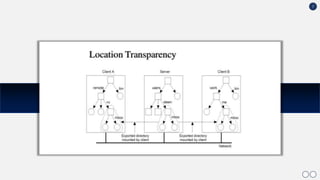
Location Independence-
a. The name of a file doesn't need to be changed when the file's
physical storage location changes. Dynamic, one-to-many mapping.
b. Better file abstraction.
c. Promotes sharing the storage space itself.
d. Separates the naming hierarchy from the storage devices hierarchy.
Location Transparency-
NAMING AND TRANSPARENCY(CONT…)
7
8
1. Files are named with a combination of host and local name.
 This guarantees a unique name. NOT location transparent NOR
location independent.
2. Remote directories are mounted to local directories.
 The files are location independent.
 SUN NFS is a good example of this technique.
3. A single global name structure spans all the files in the system.
 The DFS is built the same way as a local file system. Location
independent.
NAMING SCHEMES(CONT…)
9
REMOTE FILE ACCESS
10
Caching-
The idea is to retain recently accessed disk blocks
in cache so repeated accesses to the same
information can be handled locally, without
additional network traffic.
 Reduce network traffic by retaining recently
accessed disk blocks in a cache, so that repeated
accesses to the same information can be handled
locally.
If required data is not already cached, a copy of
data is brought from the server to the user.
REMOTE FILE ACCESSING
11
There is no direct correspondence between accesses and traffic to the server. Files are still identified,
with one master copy residing at the server machine, but copies of (parts of) the file are scattered in
different caches.
Cache Consistency Problem Keeping the cached copies consistent with the master file.
REMOTE FILE ACCESSING(CONT…)
12
Cache Location
 Caching is a mechanism for maintaining disk data on the
local machine. This data can be kept in the local memory or in
the local disk. Caching can be advantageous both for read
ahead and read again.
 The cost of getting data from a cache is a few HUNDRED
instructions; disk accesses cost THOUSANDS of instructions.
 The master copy of a file doesn't move, but caches contain
replicas of portions of the file.
 Caching behaves just like "networked virtual memory".
REMOTE FILE ACCESSING(CONT…)
13
A caching scheme in a DFS should
 Address the following design decisions[nelson et al.
19881:
 The location of the client’s cache (main memory or
local disk).
 How to propagate modifications of cached copies.
 How to determine if a client’s cached data are
consistent.
REMOTE FILE ACCESSING(CONT…)
14
FILE REPLICATION
15
Provide for increase reliability by having
independent backups of each file.
 Enable file access to continue even if one file
server is down.
FILE REPLICATION
16
Improver performance
Increase reliability
High availability.
ADVANTAGES OF REPLICATION
17
Three methods
a) Explicit file replication
b) Lazy file replication
c) File replication using
group
REPLICA CREATION METHODS
18
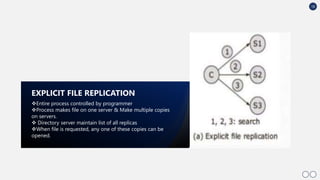
Entire process controlled by programmer
Process makes file on one server & Make multiple copies
on servers.
 Directory server maintain list of all replicas
When file is requested, any one of these copies can be
opened.
EXPLICIT FILE REPLICATION
19
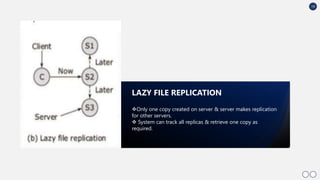
Only one copy created on server & server makes replication
for other servers.
 System can track all replicas & retrieve one copy as
required.
LAZY FILE REPLICATION
20
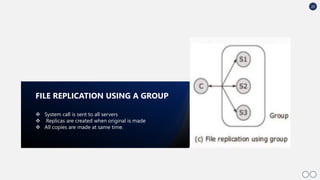
 System call is sent to all servers
 Replicas are created when original is made
 All copies are made at same time.
FILE REPLICATION USING A GROUP
21
Stateful
– Server maintains information about a file opened
by a client . (e.g…. file pointer, mode). –
Mechanism: on open, the server provides a
“handle” to the client to use on subsequent
operations.
Stateless – Server maintains no information about
client access to files – Mechanism: each client
operation must provide context information for
that operation.
STATEFUL VS STATELESS SERVICE
22
 Information about file operations are kept in
the server during all the file session.
 A communication channel is established
between the client and the server when a the
client explicitly open a file.
 A number(identifier) is used to define the
communication channel then this identifier will
be used to perform file operations.
 To attend its clients, the server copies data
from the storage devices to memory and let
them there till the file closing.
STATEFUL SERVICE
23
 The stateless service does not establish a
communication channel. there is no necessity
for explicit file opening and closing
 Before executing a file operation the server will
automatically open and close the file.
 Each request sent to the server must define the
desired file likewise, if a read or write
 Operation is requested, it must contain the
position in the file referring to the respective
operation.
STATELESS SERVICE
24
THANK YOU

best presentation ever by tayyab.pptx

  • 1.
    1 PRESENTATION OF OPERATINGSYSTEM SUBMITTED TO: HUSNAINA AKHTAR SUBMITTED BY: MUHAMMAD TAYYAB ROLL # J1F18ASCS0008 ADP(CS)-IV
  • 2.
    2 A Distributed FileSystem ( DFS ) is simply a classical model of a file system distributed across multiple machines. the purpose is to promote sharing of dispersed files.  Goal-(Chow & Johnson) Efficiency (work)  Flexibility(design or system) Consistency  Robustness DISTRIBUTED FILE SYSTEM
  • 3.
  • 4.
  • 5.
    5  Naming isthe mapping between logical and physical objects.  In a conventional file system, it's understood where the file actually resides; the system and disk are known. In a transparent DFS, the location of a file, somewhere in the network, is hidden. NAMING AND TRANSPARENCY
  • 6.
    6 a. The nameof a file does not reveal any hint of the file's physical storage location. b. File name still denotes a specific, although hidden, set of physical disk blocks. c. This is a convenient way to share data. Location Independence- a. The name of a file doesn't need to be changed when the file's physical storage location changes. Dynamic, one-to-many mapping. b. Better file abstraction. c. Promotes sharing the storage space itself. d. Separates the naming hierarchy from the storage devices hierarchy. Location Transparency- NAMING AND TRANSPARENCY(CONT…)
  • 7.
  • 8.
    8 1. Files arenamed with a combination of host and local name.  This guarantees a unique name. NOT location transparent NOR location independent. 2. Remote directories are mounted to local directories.  The files are location independent.  SUN NFS is a good example of this technique. 3. A single global name structure spans all the files in the system.  The DFS is built the same way as a local file system. Location independent. NAMING SCHEMES(CONT…)
  • 9.
  • 10.
    10 Caching- The idea isto retain recently accessed disk blocks in cache so repeated accesses to the same information can be handled locally, without additional network traffic.  Reduce network traffic by retaining recently accessed disk blocks in a cache, so that repeated accesses to the same information can be handled locally. If required data is not already cached, a copy of data is brought from the server to the user. REMOTE FILE ACCESSING
  • 11.
    11 There is nodirect correspondence between accesses and traffic to the server. Files are still identified, with one master copy residing at the server machine, but copies of (parts of) the file are scattered in different caches. Cache Consistency Problem Keeping the cached copies consistent with the master file. REMOTE FILE ACCESSING(CONT…)
  • 12.
    12 Cache Location  Cachingis a mechanism for maintaining disk data on the local machine. This data can be kept in the local memory or in the local disk. Caching can be advantageous both for read ahead and read again.  The cost of getting data from a cache is a few HUNDRED instructions; disk accesses cost THOUSANDS of instructions.  The master copy of a file doesn't move, but caches contain replicas of portions of the file.  Caching behaves just like "networked virtual memory". REMOTE FILE ACCESSING(CONT…)
  • 13.
    13 A caching schemein a DFS should  Address the following design decisions[nelson et al. 19881:  The location of the client’s cache (main memory or local disk).  How to propagate modifications of cached copies.  How to determine if a client’s cached data are consistent. REMOTE FILE ACCESSING(CONT…)
  • 14.
  • 15.
    15 Provide for increasereliability by having independent backups of each file.  Enable file access to continue even if one file server is down. FILE REPLICATION
  • 16.
    16 Improver performance Increase reliability Highavailability. ADVANTAGES OF REPLICATION
  • 17.
    17 Three methods a) Explicitfile replication b) Lazy file replication c) File replication using group REPLICA CREATION METHODS
  • 18.
    18 Entire process controlledby programmer Process makes file on one server & Make multiple copies on servers.  Directory server maintain list of all replicas When file is requested, any one of these copies can be opened. EXPLICIT FILE REPLICATION
  • 19.
    19 Only one copycreated on server & server makes replication for other servers.  System can track all replicas & retrieve one copy as required. LAZY FILE REPLICATION
  • 20.
    20  System callis sent to all servers  Replicas are created when original is made  All copies are made at same time. FILE REPLICATION USING A GROUP
  • 21.
    21 Stateful – Server maintainsinformation about a file opened by a client . (e.g…. file pointer, mode). – Mechanism: on open, the server provides a “handle” to the client to use on subsequent operations. Stateless – Server maintains no information about client access to files – Mechanism: each client operation must provide context information for that operation. STATEFUL VS STATELESS SERVICE
  • 22.
    22  Information aboutfile operations are kept in the server during all the file session.  A communication channel is established between the client and the server when a the client explicitly open a file.  A number(identifier) is used to define the communication channel then this identifier will be used to perform file operations.  To attend its clients, the server copies data from the storage devices to memory and let them there till the file closing. STATEFUL SERVICE
  • 23.
    23  The statelessservice does not establish a communication channel. there is no necessity for explicit file opening and closing  Before executing a file operation the server will automatically open and close the file.  Each request sent to the server must define the desired file likewise, if a read or write  Operation is requested, it must contain the position in the file referring to the respective operation. STATELESS SERVICE
  • 24.

Editor's Notes

  • #4 The space between the axon terminal ending and the dendrites of the post synaptic neuron is known as the synapse. Because information relayed in neurons occur in electrical format, these impulses need to be transformed into chemical molecules in the form of neurotransmitter to pass through the synapse. Neurotransmitters are made in the cell body of the neuron and then transported down the axon to the axon terminal. These neurotransmitters are stored in synaptic vesicles and released from the axon terminals into the synapse, where they are received by receptors on dendrites in the receiving neuron. In brief, neurotransmitters are chemical molecules that pass through synapses and communicate information between two neurons (Pinel & Barnes, 2018).
  • #8 The space between the axon terminal ending and the dendrites of the post synaptic neuron is known as the synapse. Because information relayed in neurons occur in electrical format, these impulses need to be transformed into chemical molecules in the form of neurotransmitter to pass through the synapse. Neurotransmitters are made in the cell body of the neuron and then transported down the axon to the axon terminal. These neurotransmitters are stored in synaptic vesicles and released from the axon terminals into the synapse, where they are received by receptors on dendrites in the receiving neuron. In brief, neurotransmitters are chemical molecules that pass through synapses and communicate information between two neurons (Pinel & Barnes, 2018).