UNIT-3
TRAINING AND DEVELOPMENT
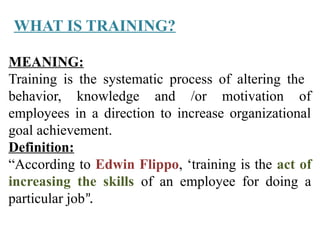
MEANING:
Training is the systematic process of altering the
behavior, knowledge and /or motivation of
employees in a direction to increase organizational
goal achievement.
Definition:
“According to Edwin Flippo, ‘training is the act of
increasing the skills of an employee for doing a
particular job”.
WHAT IS TRAINING?
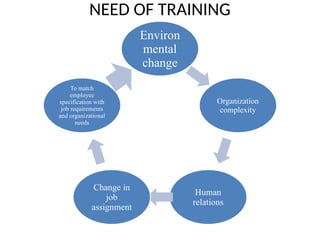
NEED OF TRAINING
Environ
mental
change
Organization
complexity
Human
relations
Change in
job
assignment
To match
employee
specification with
job requirements
and organizational
needs
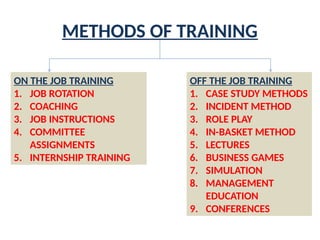
METHODS OF TRAINING
ON THE JOB TRAINING
1. JOB ROTATION
2. COACHING
3. JOB INSTRUCTIONS
4. COMMITTEE
ASSIGNMENTS
5. INTERNSHIP TRAINING
OFF THE JOB TRAINING
1. CASE STUDY METHODS
2. INCIDENT METHOD
3. ROLE PLAY
4. IN-BASKET METHOD
5. LECTURES
6. BUSINESS GAMES
7. SIMULATION
8. MANAGEMENT
EDUCATION
9. CONFERENCES
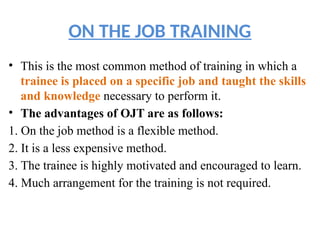
ON THE JOB TRAINING
• This is the most common method of training in which a
trainee is placed on a specific job and taught the skills
and knowledge necessary to perform it.
• The advantages of OJT are as follows:
1. On the job method is a flexible method.
2. It is a less expensive method.
3. The trainee is highly motivated and encouraged to learn.
4. Much arrangement for the training is not required.
JOB ROTATION
This training method involves movement of trainee from one job to
another to gain knowledge and experience from different job assignments.
This method helps the trainee under­
stand the problems of other employees.
ADVANTAGES
• Allow managers to see your hidden talents
• Helps in exploring interest & ideas
• Motivates all employees & help them to deal with new challenges
• Keeps away fraudent practices
• Boosts satisfaction.
DISADVANTAGES
• Wastage of time & efforts
• Employees take time
• Leads a whole lot of stress & anxiety
• It doesn’t check the time wasted
COACHING
Under this method, the trainee is placed under a particular
supervisor who functions as a coach in training and provides
feedback to the trainee. Sometimes the trainee may not get an
opportunity to express his ideas.
Advantages
• Proper guidance on how to conduct an activity
• Cost effective
• No loss of productivity
disadvantages
• Ideas given by trainee are not considered
• Trainee wouldn’t get a chance to explore more
JOB INSTRUCTION
Also known as step-by-step training in which the trainer explains
the way of doing the jobs to the trainee and in case of mistakes,
corrects the trainee.
Advantages
• Employee safety
• Increased productivity
• Cost effective
• Meeting standards
Disadvantages
• Trainee feels reserved about the work
• Restricted area of work
COMMITTEE ASSIGNMENTS
• A group of trainees are asked to solve a given
organizational problem by discussing the
problem. This helps to improve team work.
• Advantages
• Improves employees interrelationship.
• Builds team spirit
• Deals with real organization problem.
• Disadvantages
• Can’t always reach to a conclusion
• Creates hassle among employees.
INTERNSHIP TRAINING
Under this method, instructions through theoretical and
practical aspects are provided to the trainees. Usually,
students from the engineering and commerce colleges
receive this type of training for a small stipend.
Advantages
• Proper guidance
• Practical exposure
• Productivity of organization improves
Disadvantages
• Trainee’s work importance is ignored
• Work under stressed environment
OFF THE JOB TRAINING
• The methods of training which are adopted for the
development of employees away from the field of
the job are known as off-the-job methods.
Some advantages of off the job training methods are:-
1. Stress free environment to learn
2. Same as classroom learning
3.Full focus on teaching of employees
CASE STUDY METHOD
Usually case study deals with any problem confronted by a
business which can be solved by an employee. The trainee is
given an opportunity to analyze the case and come out
with all possible solutions. This method can enhance analytic
and critical thinking of an employee.
Advantages
• Good source of ideas about behavior
• Good opportunity for innovation
• Good method to study rare phenomena
• Good method to challenge theoretical assumptions
• Good alternative or complement to the group focus of
psychology
Disadvantages
• Hard to draw definite cause-effect conclusions
• Hard to generalize from a single case
• Possible biases in data collection and interpretation
INCIDENT METHOD
Incidents are prepared on the basis of actual
situations which happened in different
organizations and each employee in the training
group is asked to make decisions as if it is a real-
life situation. Later on, the entire group discusses the
incident and takes decisions related to the incident on
the basis of individual and group decisions.
Advantages
• Can be applied using questionnaires or interviews.
• Flexible method that can be used to improve multi-user systems.
• Identifies even rare events that might be missed by other methods
Useful when problems occur but the cause and severity are not
known.
Inexpensive and provides rich information
Disadvantages
• Since critical incidents often rely on memory, incidents may be
imprecise or may even go unreported.
• incidents that happened recently, since these are easier to recall.
It will emphasize only rare events; more common events will be
missed.
Respondents may not be accustomed to or willing to take the time
to tell (or write) a complete story when describing a critical incident
ROLE PLAY
In this case also a problem situation is simulated asking the employee to
assume the role of a particular person in the situation. The participant
interacts with other participants assuming different roles. The whole play
will be recorded and trainee gets an opportunity to examine their own
performance.
Advantages
• Indicates skill level
• Prepares for real life
• It’s social & communal
Disadvantages
• Time consuming
• May not be taken seriously
• Some feel uncomfortable
IN-BASKET METHOD
• The employees are given information about an imaginary
company, its activi­
ties and products, HR employed and all data
related to the firm. The trainee has to make notes, delegate tasks
and prepare schedules within a specified time. This can develop
situational judgments and quick decision making skills of employees.
Advantages
• Easy to conduct
• Flexible instrument
• Solution achieved can be applied later on
• Judges the skill set of a trainee
Disadvantages
• Time consuming
• Not effective for small organization
LECTURES
This will be a suitable method when the numbers of trainees are quite
large. Lectures can be very much helpful in explaining the concepts
and principles very clearly, and face to face interaction is very much
possible.
Advantages
• Covers large number of people simultaneously
• Face to face interaction with experts
• Queries can be asked
Disadvantages
• Lectures are not retained for longer time period
• Less attention level
• Same lecture is delivered to all person unknowingly their level of skill
set
• Every person is not familiar with language used in lectures
Business games
According to this method the trainees are divided into groups and each group
has to discuss about various activities and functions of an imaginary
organization. They will discuss and decide about various subjects like
production, promotion, pricing etc. This gives result in co-operative decision
making process.
ADVANTAGES
• Training the brain to act without to much consideration
• Team uniform approaches
• High knowledge retention
• Quick learning
• Fun & entertaining
• Builds teams cohesiveness
• Enhance creativity
DISADVANTAGES
• Can cause people not to assess risks thoroughly
• Time difference between how business games are delivered and how the
events unfold in the real world.
SIMULATION
Under this method an imaginary situation is created and trainees are
asked to act on it. For e.g., assuming the role of a marketing manager
solving the marketing problems or creating a new strategy etc.
Advantages
• Gain understanding about the consequences of their action and take
corrective action
• Feedback to learners can be given immediately
• don’t wait for real life situation to deal with
• Allows trainee to undertake high-risk involving decisions
Disadvantages
• Expensive
• Real life situation cant be completely re-created
• Not every situation can not be included
MANAGEMENT EDUCATION
At present universities and management institutes gives
great emphasis on management education. For e.g.,
Mumbai University has started bachelors and postgraduate
degree in Management. Many management Institutes provide
not only degrees but also hands on experience having
collaboration with business concerns.
Advantages
• Provide in-depth knowledge to a person
• Trains from scratch
• Theoretical as well as practical knowledge is being to a
person
Disadvantages
• Can’t be afforded by all people
• Providing theoretical knowledge is the main concern
CONFERENCE
Meeting of several people to discuss any subject is called conference.
Each par­
ticipant contributes by analyzing and discussing various issues
related to the topic. Everyone can express their own view point.
Advantages
• Chance to learn from other’s experience
• Worthy knowledge can be shared by a speaker
• Learn in stress free environment
Disadvantages
• Expensive
• Effects productivity for concern period
• Speaker does not have ample knowledge about the topic of
seminar/conference
BENEFITS AND PURPOSE OF THE TRAINING AND
DEVELOPMENT
1. Improves job knowledge and skills at all the levels of the
organisation.
2. Helps people identify with organisational goals
3. Improves the relationship between boss and subordinates.
4. Aids in organisational developments
5. Promotes more effective decision making and problem solving.
6. Aids in increasing productivity and quality of work
7. Create an appropriate climates for growth and communication.
8. Helps in handling stress , tension , frustration and conflict
9. Provides information for improving leadership knowledge ,
communication skills and attitudes
10. Increase job satisfaction and recognition.
11. Improves interpersonal skills.
12. Make organisational polices, rules, and regulations viable.
Causes of Resistance to Training
Employee-Related Reasons
• Fear of Change – Employees may be comfortable with their current skills
and fear that new training will make their jobs harder.
• Lack of Motivation – If employees don’t see personal or professional
benefits, they may not be interested in training.
• Workload Pressure – Employees may feel they are too busy with daily
tasks and can’t afford time for training.
• Past Negative Experiences – If previous training was ineffective or boring,
employees may resist future programs.
• Fear of Failure – Some employees worry they won’t perform well in
training and might be judged
Organizational-Related Reasons
• Lack of Support from Management – If managers don’t
encourage training, employees may not see it as important.
• Poor Training Methods – If the training is not engaging,
practical, or relevant, employees will resist it.
• Unclear Objectives – If employees don’t understand why the
training is necessary, they may not participate actively.
• Lack of Incentives – Without rewards or recognition,
employees may not be motivated to complete training
Solutions to Overcome Resistance
A. Employee Engagement Strategies
1. Communicate Benefits Clearly – Explain how training will improve job performance and
career growth.
2. Make Training Relevant – Customize training content to align with employees' roles and
challenges.
3. Create a Positive Learning Culture – Encourage lifelong learning by making training part
of company values.
4. Offer Flexible Learning Options – Provide online courses, workshops, and self-paced
training to suit different learning styles.
5. Provide Support & Encouragement – Offer mentorship, coaching, and a safe space for
learning without fear of failure.
B. Organizational Strategies
• Get Management Buy-in – Leaders should actively participate and promote training..
• Recognize and Reward Participation – Offer certificates, promotions, or small incentives
for completing training.
• Reduce Workload During Training – Allow dedicated time for learning without adding
extra pressure.
EXECUTIVE DEVELOPMENT PROGRAMME
• Executive development is popularly known as
management development.
• Executive management is a systematic process
of training and growth by which managerial
personnel gain and apply skills, knowledge,
attitudes and insights into managing the work in
their organisation effectively and efficiently.
OBJECTIVES OF EXECUTIVE DEVELOPMENT
1. To develop managers to perform better on their
present assignment
2. To prepare them for higher assignment
3. To provide a steady source of competent person at
all levels to meet future organisational goals
4. To help them grow fast
5. To prevent obsolescence of manager
6. To create conditions and climate which contribute
to the growth process.
BENEFITS OF EXECUTIVE DEVELOPMENT
• To increase quality, and productivity
• To improves the technical performance
• To improve the supervision and leadership at each level
• To improve the intra and inter departmental co-operation
• To address personal growth and prevent obsolescence
• To improve organisational climate
• To improve interpersonal communication and team work.
• To help company fulfil its future managerial personnel needs.
Common Practices in Executive Development
Programmes
• Leadership & Strategic Thinking
– Courses on transformational leadership, emotional intelligence, and decision-
making.
– Case studies on leadership challenges and organizational transformation.
• Customized Learning Modules
– Tailored content based on industry trends and company needs.
– Specialized tracks for different business functions like finance, marketing, or
operations.
• Experiential Learning
– Business simulations, role-playing, and real-world problem-solving exercises.
– Immersive projects with peer collaboration.
• Coaching & Mentoring
– One-on-one executive coaching with industry experts.
– Peer mentoring and leadership networking opportunities.
• Global & Industry Exposure
– International business modules and global best practices.
– Guest lectures by thought leaders and business icons.
• Technology & Digital Transformation
– Sessions on AI, data analytics, and digital disruption.
– Training on emerging business technologies.
• Sustainability & Corporate Social Responsibility (CSR)
– Modules on ethical leadership and sustainable business practices.
– Discussions on ESG (Environmental, Social, and Governance) compliance.
• Networking & Collaboration
– Executive peer groups and alumni networks.
– Collaborative projects with professionals from diverse industries.
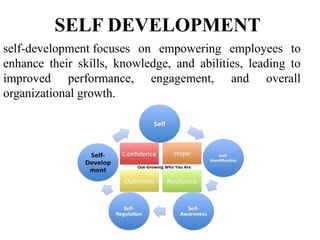
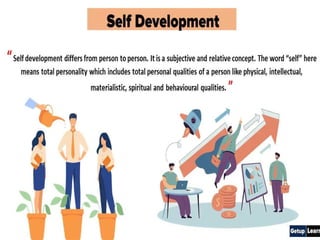
SELF DEVELOPMENT
self-development focuses on empowering employees to
enhance their skills, knowledge, and abilities, leading to
improved performance, engagement, and overall
organizational growth.
BENEFITS OF SELF DEVELOPMENT
1. SELF AWARNESS: Personal development begins with self awareness. It denotes
better understanding of ourselves and it enables us to experience ourselves as
unique and separate individuals.
2. A SENSE OF DIRECTION: Once you have raised you self awareness, you are
clearer on the things you wish to achieve from life. Decision making become a lot
easier.
3. IMPROVED FOCUS AND EFFECTIVENESS: As your personal development
improves, prioritization becomes much easier . You are clearer on your objectives
and you can quickly identify which task will give you best result with the resource
available to you at that moment.
4. MORE MOTIVATION: When you know what you want to achieve , it is easier for
you to see the benefits of taking action.
5. GREATER RESILIENCE: There will be tough times in life. When these tough
times occur , you need to have the skills and attributes to deal effectively with them.
6. MORE FULFILLING RELATIONSHIP: Relationship are a double edged
sword. They either lift you up or drag you down . When you improves your
personal development, you are better able to see which relationship are worth
investing in and which need to be cut loose.
STRESS MANAGEMENT
The ultimate goal is to strike a balance between home,
personal life, work, relationships, relaxation and fun.
Always follow ABC
• Aware: be aware of the advertises or stressful events, so
that you know what is causing stress.
• Beliefs: trust the way you handle and deal a situation.
• Consequences: know the outcomes of the vents and use
stress management tools to overcome or minimize them
FINDING STRENGTH
Following are the ways you can find your strengths:
• Think of anything that makes your successful most of the times.
• Think about what others like and appreciate in you.
• Take our time and analyze about what you do well
FINDING WEAKNESS
Figure out the areas where your struggle and the things you find difficult
to do
• Look at the feedback and accept your weaknesses. It will improve your
ability to work calmly.
• Identify how different and better we can be from others.
• Think where, how and why do others perform better than me?
KNOWLEDGE MANGEMENT
• Knowledge management is the systematic management of
an organisation’s knowledge assets for the purpose of
creating value and meeting tactical & strategic
requirements; it consists of the initiatives , process
strategies and systems that sustain and enhance the storage ,
assessment, sharing refinement and creation of knowledge.
• The process of creating, identifying, and managing
knowledge of an organization and structuring it for effective
and efficient usage by employees and teams.
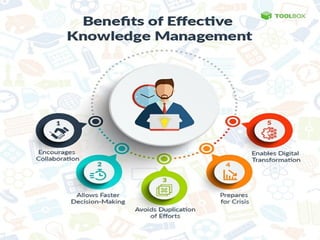
 Encourages collaboration :It enables collaboration and more
effective exchange of ideas, leading to improved decision-making.
Better and faster decision-making helps in enhancing customer
experience and improving business prospects for the company
 Allows faster decision-making When relevant information is
provided as and when required, it enables faster and more informed
decision-making.
 Avoids duplication of efforts: It helps firms to enhance operational
efficiency and save time and effort. A crucial benefit of knowledge
management is the elimination of replication of efforts.
 Leverages existing expertise :A well-defined knowledge
management process enables the organization to effectively take
advantage of its team members’ existing skills and expertise. Let’s say
a few colleagues are experts in a new and developing complementary
area. A formalized knowledge management program will help other
members leverage these members’ skills and expertise to build
competency in a new area.
Prepares for crisis Organizations with a structured and
formalized knowledge management program are better
prepared to face challenges as they benefit from the
learnings of dealing with a crisis.
Enables digital transformation As organizations quicken
the pace of digitalization, they have a plethora of structured
and unstructured data. A well-defined knowledge
management program allows them to use this information
for their growth and benefit.
Types of Knowledge Management
When we are dealing with knowledge within an
organization there are three different types that we need to
be aware of.
Explicit
• Explicit knowledge is information that can be codified
and communicated. It’s easy to share this type of
knowledge and it can be quickly understood by others.
Some types of explicit knowledge are standard operating
procedures, employee handbooks, and HR policies.
Tacit
• Tacit knowledge is much harder to capture than explicit
knowledge. It typically comprises the skills and experience
of your employee that is difficult to explain or share with
others. Tacit knowledge includes customer support know-
how, design skills, and so on.
Implicit
• Implicit knowledge is very similar to tacit knowledge
except that it can more easily be codified. It’s information
that is embedded in the organization’s processes and is
currently unarticulated. It’s tribal knowledge that can be
learned and communicated but hasn’t yet been formally
captured
THANK YOU

Unit -3 Training and Development.Self-development – Knowledge management

  • 1.
  • 2.
    MEANING: Training is thesystematic process of altering the behavior, knowledge and /or motivation of employees in a direction to increase organizational goal achievement. Definition: “According to Edwin Flippo, ‘training is the act of increasing the skills of an employee for doing a particular job”. WHAT IS TRAINING?
  • 3.
    NEED OF TRAINING Environ mental change Organization complexity Human relations Changein job assignment To match employee specification with job requirements and organizational needs
  • 4.
    METHODS OF TRAINING ONTHE JOB TRAINING 1. JOB ROTATION 2. COACHING 3. JOB INSTRUCTIONS 4. COMMITTEE ASSIGNMENTS 5. INTERNSHIP TRAINING OFF THE JOB TRAINING 1. CASE STUDY METHODS 2. INCIDENT METHOD 3. ROLE PLAY 4. IN-BASKET METHOD 5. LECTURES 6. BUSINESS GAMES 7. SIMULATION 8. MANAGEMENT EDUCATION 9. CONFERENCES
  • 5.
    ON THE JOBTRAINING • This is the most common method of training in which a trainee is placed on a specific job and taught the skills and knowledge necessary to perform it. • The advantages of OJT are as follows: 1. On the job method is a flexible method. 2. It is a less expensive method. 3. The trainee is highly motivated and encouraged to learn. 4. Much arrangement for the training is not required.
  • 6.
    JOB ROTATION This trainingmethod involves movement of trainee from one job to another to gain knowledge and experience from different job assignments. This method helps the trainee under­ stand the problems of other employees. ADVANTAGES • Allow managers to see your hidden talents • Helps in exploring interest & ideas • Motivates all employees & help them to deal with new challenges • Keeps away fraudent practices • Boosts satisfaction. DISADVANTAGES • Wastage of time & efforts • Employees take time • Leads a whole lot of stress & anxiety • It doesn’t check the time wasted
  • 7.
    COACHING Under this method,the trainee is placed under a particular supervisor who functions as a coach in training and provides feedback to the trainee. Sometimes the trainee may not get an opportunity to express his ideas. Advantages • Proper guidance on how to conduct an activity • Cost effective • No loss of productivity disadvantages • Ideas given by trainee are not considered • Trainee wouldn’t get a chance to explore more
  • 8.
    JOB INSTRUCTION Also knownas step-by-step training in which the trainer explains the way of doing the jobs to the trainee and in case of mistakes, corrects the trainee. Advantages • Employee safety • Increased productivity • Cost effective • Meeting standards Disadvantages • Trainee feels reserved about the work • Restricted area of work
  • 9.
    COMMITTEE ASSIGNMENTS • Agroup of trainees are asked to solve a given organizational problem by discussing the problem. This helps to improve team work. • Advantages • Improves employees interrelationship. • Builds team spirit • Deals with real organization problem. • Disadvantages • Can’t always reach to a conclusion • Creates hassle among employees.
  • 10.
    INTERNSHIP TRAINING Under thismethod, instructions through theoretical and practical aspects are provided to the trainees. Usually, students from the engineering and commerce colleges receive this type of training for a small stipend. Advantages • Proper guidance • Practical exposure • Productivity of organization improves Disadvantages • Trainee’s work importance is ignored • Work under stressed environment
  • 11.
    OFF THE JOBTRAINING • The methods of training which are adopted for the development of employees away from the field of the job are known as off-the-job methods. Some advantages of off the job training methods are:- 1. Stress free environment to learn 2. Same as classroom learning 3.Full focus on teaching of employees
  • 12.
    CASE STUDY METHOD Usuallycase study deals with any problem confronted by a business which can be solved by an employee. The trainee is given an opportunity to analyze the case and come out with all possible solutions. This method can enhance analytic and critical thinking of an employee. Advantages • Good source of ideas about behavior • Good opportunity for innovation • Good method to study rare phenomena • Good method to challenge theoretical assumptions • Good alternative or complement to the group focus of psychology
  • 13.
    Disadvantages • Hard todraw definite cause-effect conclusions • Hard to generalize from a single case • Possible biases in data collection and interpretation INCIDENT METHOD Incidents are prepared on the basis of actual situations which happened in different organizations and each employee in the training group is asked to make decisions as if it is a real- life situation. Later on, the entire group discusses the incident and takes decisions related to the incident on the basis of individual and group decisions.
  • 14.
    Advantages • Can beapplied using questionnaires or interviews. • Flexible method that can be used to improve multi-user systems. • Identifies even rare events that might be missed by other methods Useful when problems occur but the cause and severity are not known. Inexpensive and provides rich information Disadvantages • Since critical incidents often rely on memory, incidents may be imprecise or may even go unreported. • incidents that happened recently, since these are easier to recall. It will emphasize only rare events; more common events will be missed. Respondents may not be accustomed to or willing to take the time to tell (or write) a complete story when describing a critical incident
  • 15.
    ROLE PLAY In thiscase also a problem situation is simulated asking the employee to assume the role of a particular person in the situation. The participant interacts with other participants assuming different roles. The whole play will be recorded and trainee gets an opportunity to examine their own performance. Advantages • Indicates skill level • Prepares for real life • It’s social & communal Disadvantages • Time consuming • May not be taken seriously • Some feel uncomfortable
  • 16.
    IN-BASKET METHOD • Theemployees are given information about an imaginary company, its activi­ ties and products, HR employed and all data related to the firm. The trainee has to make notes, delegate tasks and prepare schedules within a specified time. This can develop situational judgments and quick decision making skills of employees. Advantages • Easy to conduct • Flexible instrument • Solution achieved can be applied later on • Judges the skill set of a trainee Disadvantages • Time consuming • Not effective for small organization
  • 17.
    LECTURES This will bea suitable method when the numbers of trainees are quite large. Lectures can be very much helpful in explaining the concepts and principles very clearly, and face to face interaction is very much possible. Advantages • Covers large number of people simultaneously • Face to face interaction with experts • Queries can be asked Disadvantages • Lectures are not retained for longer time period • Less attention level • Same lecture is delivered to all person unknowingly their level of skill set • Every person is not familiar with language used in lectures
  • 18.
    Business games According tothis method the trainees are divided into groups and each group has to discuss about various activities and functions of an imaginary organization. They will discuss and decide about various subjects like production, promotion, pricing etc. This gives result in co-operative decision making process. ADVANTAGES • Training the brain to act without to much consideration • Team uniform approaches • High knowledge retention • Quick learning • Fun & entertaining • Builds teams cohesiveness • Enhance creativity DISADVANTAGES • Can cause people not to assess risks thoroughly • Time difference between how business games are delivered and how the events unfold in the real world.
  • 19.
    SIMULATION Under this methodan imaginary situation is created and trainees are asked to act on it. For e.g., assuming the role of a marketing manager solving the marketing problems or creating a new strategy etc. Advantages • Gain understanding about the consequences of their action and take corrective action • Feedback to learners can be given immediately • don’t wait for real life situation to deal with • Allows trainee to undertake high-risk involving decisions Disadvantages • Expensive • Real life situation cant be completely re-created • Not every situation can not be included
  • 20.
    MANAGEMENT EDUCATION At presentuniversities and management institutes gives great emphasis on management education. For e.g., Mumbai University has started bachelors and postgraduate degree in Management. Many management Institutes provide not only degrees but also hands on experience having collaboration with business concerns. Advantages • Provide in-depth knowledge to a person • Trains from scratch • Theoretical as well as practical knowledge is being to a person
  • 21.
    Disadvantages • Can’t beafforded by all people • Providing theoretical knowledge is the main concern CONFERENCE Meeting of several people to discuss any subject is called conference. Each par­ ticipant contributes by analyzing and discussing various issues related to the topic. Everyone can express their own view point. Advantages • Chance to learn from other’s experience • Worthy knowledge can be shared by a speaker • Learn in stress free environment Disadvantages • Expensive • Effects productivity for concern period • Speaker does not have ample knowledge about the topic of seminar/conference
  • 22.
    BENEFITS AND PURPOSEOF THE TRAINING AND DEVELOPMENT 1. Improves job knowledge and skills at all the levels of the organisation. 2. Helps people identify with organisational goals 3. Improves the relationship between boss and subordinates. 4. Aids in organisational developments 5. Promotes more effective decision making and problem solving. 6. Aids in increasing productivity and quality of work 7. Create an appropriate climates for growth and communication. 8. Helps in handling stress , tension , frustration and conflict 9. Provides information for improving leadership knowledge , communication skills and attitudes 10. Increase job satisfaction and recognition. 11. Improves interpersonal skills. 12. Make organisational polices, rules, and regulations viable.
  • 23.
    Causes of Resistanceto Training Employee-Related Reasons • Fear of Change – Employees may be comfortable with their current skills and fear that new training will make their jobs harder. • Lack of Motivation – If employees don’t see personal or professional benefits, they may not be interested in training. • Workload Pressure – Employees may feel they are too busy with daily tasks and can’t afford time for training. • Past Negative Experiences – If previous training was ineffective or boring, employees may resist future programs. • Fear of Failure – Some employees worry they won’t perform well in training and might be judged
  • 24.
    Organizational-Related Reasons • Lackof Support from Management – If managers don’t encourage training, employees may not see it as important. • Poor Training Methods – If the training is not engaging, practical, or relevant, employees will resist it. • Unclear Objectives – If employees don’t understand why the training is necessary, they may not participate actively. • Lack of Incentives – Without rewards or recognition, employees may not be motivated to complete training
  • 25.
    Solutions to OvercomeResistance A. Employee Engagement Strategies 1. Communicate Benefits Clearly – Explain how training will improve job performance and career growth. 2. Make Training Relevant – Customize training content to align with employees' roles and challenges. 3. Create a Positive Learning Culture – Encourage lifelong learning by making training part of company values. 4. Offer Flexible Learning Options – Provide online courses, workshops, and self-paced training to suit different learning styles. 5. Provide Support & Encouragement – Offer mentorship, coaching, and a safe space for learning without fear of failure. B. Organizational Strategies • Get Management Buy-in – Leaders should actively participate and promote training.. • Recognize and Reward Participation – Offer certificates, promotions, or small incentives for completing training. • Reduce Workload During Training – Allow dedicated time for learning without adding extra pressure.
  • 26.
    EXECUTIVE DEVELOPMENT PROGRAMME •Executive development is popularly known as management development. • Executive management is a systematic process of training and growth by which managerial personnel gain and apply skills, knowledge, attitudes and insights into managing the work in their organisation effectively and efficiently.
  • 27.
    OBJECTIVES OF EXECUTIVEDEVELOPMENT 1. To develop managers to perform better on their present assignment 2. To prepare them for higher assignment 3. To provide a steady source of competent person at all levels to meet future organisational goals 4. To help them grow fast 5. To prevent obsolescence of manager 6. To create conditions and climate which contribute to the growth process.
  • 28.
    BENEFITS OF EXECUTIVEDEVELOPMENT • To increase quality, and productivity • To improves the technical performance • To improve the supervision and leadership at each level • To improve the intra and inter departmental co-operation • To address personal growth and prevent obsolescence • To improve organisational climate • To improve interpersonal communication and team work. • To help company fulfil its future managerial personnel needs.
  • 29.
    Common Practices inExecutive Development Programmes • Leadership & Strategic Thinking – Courses on transformational leadership, emotional intelligence, and decision- making. – Case studies on leadership challenges and organizational transformation. • Customized Learning Modules – Tailored content based on industry trends and company needs. – Specialized tracks for different business functions like finance, marketing, or operations. • Experiential Learning – Business simulations, role-playing, and real-world problem-solving exercises. – Immersive projects with peer collaboration. • Coaching & Mentoring – One-on-one executive coaching with industry experts. – Peer mentoring and leadership networking opportunities.
  • 30.
    • Global &Industry Exposure – International business modules and global best practices. – Guest lectures by thought leaders and business icons. • Technology & Digital Transformation – Sessions on AI, data analytics, and digital disruption. – Training on emerging business technologies. • Sustainability & Corporate Social Responsibility (CSR) – Modules on ethical leadership and sustainable business practices. – Discussions on ESG (Environmental, Social, and Governance) compliance. • Networking & Collaboration – Executive peer groups and alumni networks. – Collaborative projects with professionals from diverse industries.
  • 31.
    SELF DEVELOPMENT self-development focuseson empowering employees to enhance their skills, knowledge, and abilities, leading to improved performance, engagement, and overall organizational growth.
  • 33.
    BENEFITS OF SELFDEVELOPMENT 1. SELF AWARNESS: Personal development begins with self awareness. It denotes better understanding of ourselves and it enables us to experience ourselves as unique and separate individuals. 2. A SENSE OF DIRECTION: Once you have raised you self awareness, you are clearer on the things you wish to achieve from life. Decision making become a lot easier. 3. IMPROVED FOCUS AND EFFECTIVENESS: As your personal development improves, prioritization becomes much easier . You are clearer on your objectives and you can quickly identify which task will give you best result with the resource available to you at that moment. 4. MORE MOTIVATION: When you know what you want to achieve , it is easier for you to see the benefits of taking action. 5. GREATER RESILIENCE: There will be tough times in life. When these tough times occur , you need to have the skills and attributes to deal effectively with them. 6. MORE FULFILLING RELATIONSHIP: Relationship are a double edged sword. They either lift you up or drag you down . When you improves your personal development, you are better able to see which relationship are worth investing in and which need to be cut loose.
  • 36.
    STRESS MANAGEMENT The ultimategoal is to strike a balance between home, personal life, work, relationships, relaxation and fun. Always follow ABC • Aware: be aware of the advertises or stressful events, so that you know what is causing stress. • Beliefs: trust the way you handle and deal a situation. • Consequences: know the outcomes of the vents and use stress management tools to overcome or minimize them
  • 37.
    FINDING STRENGTH Following arethe ways you can find your strengths: • Think of anything that makes your successful most of the times. • Think about what others like and appreciate in you. • Take our time and analyze about what you do well
  • 38.
    FINDING WEAKNESS Figure outthe areas where your struggle and the things you find difficult to do • Look at the feedback and accept your weaknesses. It will improve your ability to work calmly. • Identify how different and better we can be from others. • Think where, how and why do others perform better than me?
  • 39.
    KNOWLEDGE MANGEMENT • Knowledgemanagement is the systematic management of an organisation’s knowledge assets for the purpose of creating value and meeting tactical & strategic requirements; it consists of the initiatives , process strategies and systems that sustain and enhance the storage , assessment, sharing refinement and creation of knowledge. • The process of creating, identifying, and managing knowledge of an organization and structuring it for effective and efficient usage by employees and teams.
  • 41.
     Encourages collaboration:It enables collaboration and more effective exchange of ideas, leading to improved decision-making. Better and faster decision-making helps in enhancing customer experience and improving business prospects for the company  Allows faster decision-making When relevant information is provided as and when required, it enables faster and more informed decision-making.  Avoids duplication of efforts: It helps firms to enhance operational efficiency and save time and effort. A crucial benefit of knowledge management is the elimination of replication of efforts.  Leverages existing expertise :A well-defined knowledge management process enables the organization to effectively take advantage of its team members’ existing skills and expertise. Let’s say a few colleagues are experts in a new and developing complementary area. A formalized knowledge management program will help other members leverage these members’ skills and expertise to build competency in a new area.
  • 42.
    Prepares for crisisOrganizations with a structured and formalized knowledge management program are better prepared to face challenges as they benefit from the learnings of dealing with a crisis. Enables digital transformation As organizations quicken the pace of digitalization, they have a plethora of structured and unstructured data. A well-defined knowledge management program allows them to use this information for their growth and benefit.
  • 43.
    Types of KnowledgeManagement When we are dealing with knowledge within an organization there are three different types that we need to be aware of. Explicit • Explicit knowledge is information that can be codified and communicated. It’s easy to share this type of knowledge and it can be quickly understood by others. Some types of explicit knowledge are standard operating procedures, employee handbooks, and HR policies.
  • 44.
    Tacit • Tacit knowledgeis much harder to capture than explicit knowledge. It typically comprises the skills and experience of your employee that is difficult to explain or share with others. Tacit knowledge includes customer support know- how, design skills, and so on. Implicit • Implicit knowledge is very similar to tacit knowledge except that it can more easily be codified. It’s information that is embedded in the organization’s processes and is currently unarticulated. It’s tribal knowledge that can be learned and communicated but hasn’t yet been formally captured
  • 45.