Training and Development
Meaning of Training and Development
• Training is concerned with increasing knowledge and skill in doing a
particular job and the major burden of training falls upon the business
organisation in which the job is located.
• Training is the act of increasing knowledge & skill of an employee for
doing a particular job. It is a short term educational process utilizing
systematic and organized procedure by which employees learn
technical knowledge skills for definite purpose.
• Development is an educational process which is concerned with the
overall growth of the employees.
Objectives of Training
1. To provide the basic knowledge & skill to the newly joined people to perform the tasks as
designed by the organisation.
2. To develop the existing employees by exposing them to latest concepts, information & techniques,
and thereby strengthen their skills.
3. To develop second & third line executive to strengthen the working links & levels, so that they can
occupy higher positions.
4. To improve the outlook of senior level managers & other policy-makers enabling them to look
into new horizons of the organisation.
5. To make employees more effective & productive which increase the image of employees’ earning
power & job security.
6. To would the employee attitude with the purpose of achieving a better cooperative with the
company & develop loyalty to the organisation.
Difference between training and development
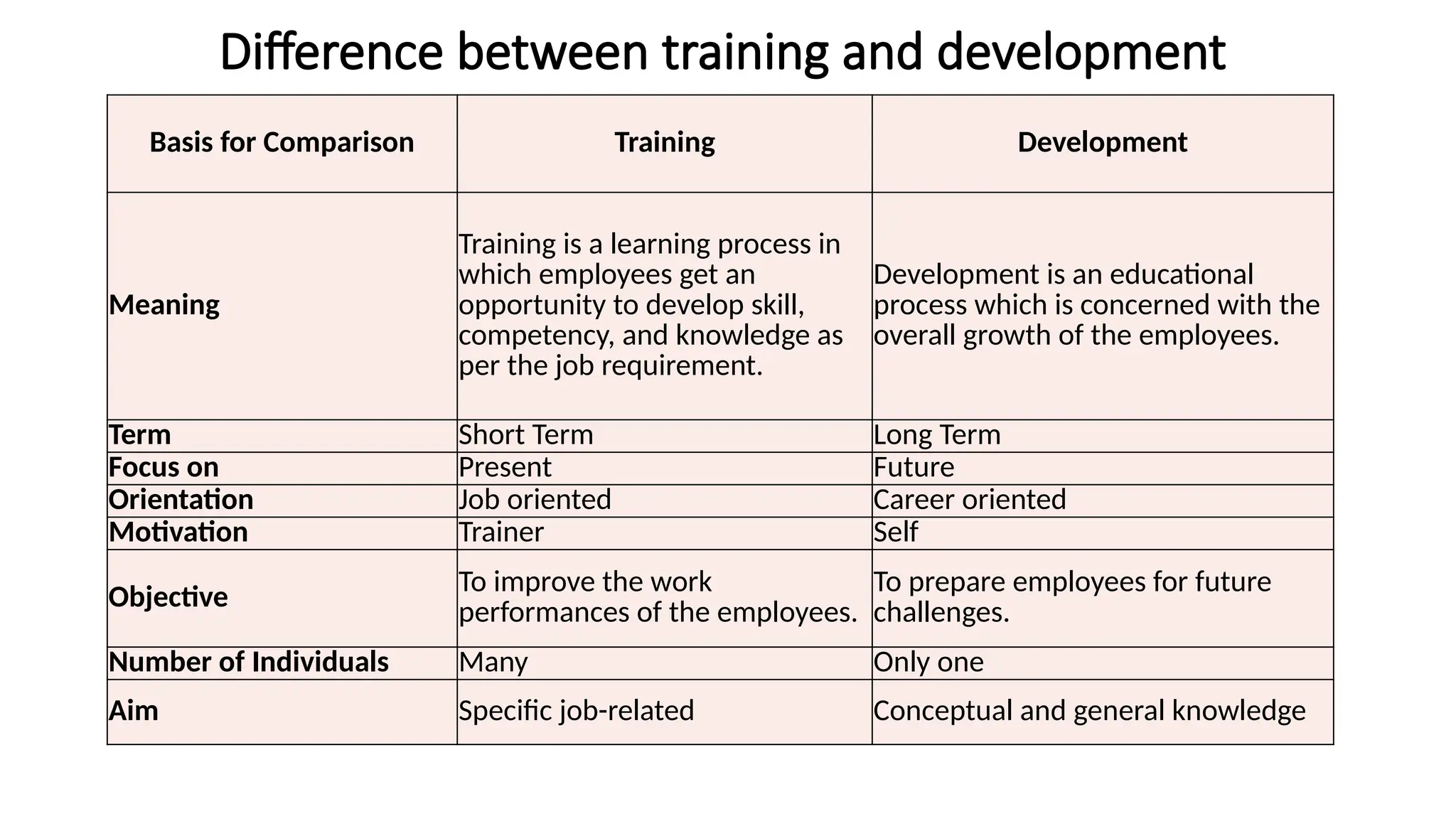
Basis for Comparison Training Development
Meaning
Training is a learning process in
which employees get an
opportunity to develop skill,
competency, and knowledge as
per the job requirement.
Development is an educational
process which is concerned with the
overall growth of the employees.
Term Short Term Long Term
Focus on Present Future
Orientation Job oriented Career oriented
Motivation Trainer Self
Objective
To improve the work
performances of the employees.
To prepare employees for future
challenges.
Number of Individuals Many Only one
Aim Specific job-related Conceptual and general knowledge
Training Methods
A. On the Job Training:
1. Job Instruction Training
2. Vestibule Training
3. Simulation
4. Job Rotation
5. Coaching
6. Apprenticeship
• B. Off the Job Training:
1. Lecture Methods
2. Conference or discussion
3. Case Discussion
4. Role Plays
5. Programmed Instruction
6. T-Group or Sensitivity Training
7. In Basket Training
A. On Job Training
• This type of Training, also known as job instruction training, is the most commonly used method.
Under this method, the individual is placed on a regular job & taught the skills necessary to
perform that job. The trainee learns under the supervision & guidance of a qualified worker or
instructor.
1. Job Instruction Training: This method is also known training step by step. Under this method, the
trainer explains to the trainee the way of doing the job, Job knowledge & skills & allows him to do
the job. The trainer appraises the performance of the trainee, provides feedback information &
corrects the trainee.
2. Vestibule Training: In this method, actual work conditions are simulated in a classroom. Material,
files & equipment which are used in actual job performance are also used in training. This type of
training is commonly used to training personnel for clerical & semi-skilled jobs. The Duration of this
training ranges from days to a few weeks. Theory can be related to practice in this method.
• 3. Simulation: The real situation of work environment in an organisation is presented in the training session. In
other words, in simulation, instead of taking participants into the field, the field is simulated in the training
session itself. The participants act out samples of real business behaviour in order to get practice in making
decisions. It covers situations of varying complexities & roles for the participants. Role Playing is one of the
common simulation methods of training.
• 4. Job Rotation: This type of training involves the movement of the trainee from one job to another. The trainee
receives job knowledge & gains experience from his supervisor or trainer in each of the different job
assignments. Though this method of training is common in training managers for general management
positions, trainees can also be rotated from job to job in workshop jobs.
• 5. Coaching: The trainee is placed under a particular supervisor who functions as a coach in training the
individual. The supervisor provides feedback to the trainee on his performance & offers him some suggestions
for improvements. Often the trainee shares some of the duties & responsibilities of the coach & relieves him of
his burden. A limitation of this method of training it shat the trainee may not have the freedom or opportunity to
express his own ideas.
• 6. Apprenticeship: It is a structured process by which people become skilled workers through a combination of
classroom instructions & on-the-job training. It is widely used to train individuals for many occupations. Many
organisations have apprenticeship laws with supervised plans for such training.
B. Off the Job Training
• Under this method of training the trainee is separated from the job situation & his attention is focused upon
learning the material related to his future job performance. Since the trainee is not distracted by job
requirements, he can place his entire concentration on learning the job rather than spending his time in
performing it. There is an opportunity for freedom of expression for the trainees.
1. Lecture Methods: The lecture is traditional & direct method of instruction. The instructor organises the
material & gives it to group of trainees in the form of a talk. To be effective, the lecture must motivate & create
interest among the trainees. Thus, costs & time involved are reduced. The major limitation of the lecture
method is that it does not provide for transfer of training effectively.
2. Conference or Discussion: It is a method in training the clerical, professional & supervision personnel. This
method involves a group of people who pose ideas, examine & share facts, ideas & data test assumptions &
draw conclusions, all of which contribute to the improvement of job performance. Discussion has the distinct
advantage over the lecture method, in that the discussion involves two-way communication & hence, feedback
is provided. The participants feel free to speak in small groups. The success of this method depends on the
person who leads the group.
• Case Discussion (Case studies):- The case study method , the instructor describes the actual situation or problem on a
specific concern of the problem. This method increases the trainee’s power of observation & also his analytical ability.
• 4. Role Play:- It is defined as a method of human interaction that involves realistic behaviour in imaginary situations. This
method of training involves action, doing & practice. The participants play the role of certain characters such as the
production manager, mechanical engineer, superintendents, maintenance engineers, quality control inspectors, foreman,
workers & the like. This method is mostly used for developing interpersonal interactions & relations.
• Programmed Instruction: In recent years, this method has become popular. The subject matter to be earned is presented in
a series of carefully planned sequential units. These units are arranged from simple to more complex levels of instruction.
The trainees go through these units by answering question or filling the blanks. This method is expensive & time consuming.
• 6. T- Group or Sensitivity Training:- This method aims to influence an individual’s behaviour through group discussion. In
group discussion, the trainees freely express their ideas, beliefs & attitudes. In this method the trainees are enabled to see
themselves as others see them & develop an understanding of others’ views & behaviour. Further, any. In addition the
trainees by interaction in a group become sensitive to one another’s feelings & also develop increased tolerance for
individual’s differences.
• In basket Training:- In this method to acquaint employees about their job where a number of problems are kept in the in
basket ( usually kept on the desk of the employee). The worker has to look at the problems which could also the complaints
from different employees & simultaneously deal with those problems.
Executive Development
• Executive Development is a way to help develop performance and
skills in executive employees.
• Executive development is a whole of activities aimed at developing
the skills and competencies of those that have executive positions in
the organisations.
• It helps employees to be better leaders and improve their
performances.
Meaning of HRD
• Human Resource Development (HRD) refers to the organisation’s plan
to help employees develop their abilities, skills and knowledge. In
return enhances organisation’s efficiency.
Roles and Importance of training in HRD
• To Match the employee specifications with the job requirements & organisational needs:-
managements find deviations between employee’s present specification & the job requirements &
organisational needs. Training is needed to fill these gaps by developing & moulding the employee’s skill,
knowledge, attitude, behaviour etc., to the tune of the job requirements & organisational needs.
• Organisational Viability and the Transformation process:- the primary goals of most of the
organisations is that their viability is continuously influenced by environmental pressure. If the
organisation does not adapt itself to the changing factors in the environment, it will lose its market share. If
the organisation desires to adapt these changes, first it has to train the employees to impart specific skills &
knowledge in order to enable them to contribute to organisational efficiency & to cope with the changing
environment.
• Technical Advances:- Every organisation in order to survive & to be effective should adopt the latest
technology i.e., mechanisation, computerisation & automation. Adoption of latest technological means &
methods will not be complete until they are manned by employees possessing skills to operate them. So,
the organisation should train the employees to enrich them in the areas of changing technical skills &
knowledge from time to time.
• Organisational Complexity:- with the emergence of increased mechanization & automation, manufacturing of
multiple products & by-products or dealing in services of diversified lines, extension of operations to various regions
of the country or in overseas countries, organisation of most of the companies has become complex,. This creates the
complex problems of coordination & integration of activities adaptable for adaptable to the expanding &
diversifying.
• Human Relation :- Trends in approach towards personnel management has changed from the commodity approach
to partnership approach, crossing the human relations approach. So today, management of most of the organization
has to maintain human relations besides maintaining sound industrial relations although the managers are not
equipped accordingly.
• Change in the Job Assignment:- training is also necessary when the existing employee in promoted to the higher
level in the organisation & when there is some new job or occupation due to transfer. Training is also necessary to
equip old employees with the advanced disciplines, techniques or technology.
• The training also need for
• Increase productivity
• Improve quality of the products/service.
• Help a company to fulfil its future personnel needs.
• Improve organisational climate.
• Improve health & safety
• Prevent health & safety
• Prevent obsolescence.
• Effect personal growth
• Minimise the resistance to change.

Unit 3 - Training and Development in Human Resources

  • 1.
  • 2.
    Meaning of Trainingand Development • Training is concerned with increasing knowledge and skill in doing a particular job and the major burden of training falls upon the business organisation in which the job is located. • Training is the act of increasing knowledge & skill of an employee for doing a particular job. It is a short term educational process utilizing systematic and organized procedure by which employees learn technical knowledge skills for definite purpose. • Development is an educational process which is concerned with the overall growth of the employees.
  • 3.
    Objectives of Training 1.To provide the basic knowledge & skill to the newly joined people to perform the tasks as designed by the organisation. 2. To develop the existing employees by exposing them to latest concepts, information & techniques, and thereby strengthen their skills. 3. To develop second & third line executive to strengthen the working links & levels, so that they can occupy higher positions. 4. To improve the outlook of senior level managers & other policy-makers enabling them to look into new horizons of the organisation. 5. To make employees more effective & productive which increase the image of employees’ earning power & job security. 6. To would the employee attitude with the purpose of achieving a better cooperative with the company & develop loyalty to the organisation.
  • 4.
    Difference between trainingand development Basis for Comparison Training Development Meaning Training is a learning process in which employees get an opportunity to develop skill, competency, and knowledge as per the job requirement. Development is an educational process which is concerned with the overall growth of the employees. Term Short Term Long Term Focus on Present Future Orientation Job oriented Career oriented Motivation Trainer Self Objective To improve the work performances of the employees. To prepare employees for future challenges. Number of Individuals Many Only one Aim Specific job-related Conceptual and general knowledge
  • 5.
    Training Methods A. Onthe Job Training: 1. Job Instruction Training 2. Vestibule Training 3. Simulation 4. Job Rotation 5. Coaching 6. Apprenticeship
  • 6.
    • B. Offthe Job Training: 1. Lecture Methods 2. Conference or discussion 3. Case Discussion 4. Role Plays 5. Programmed Instruction 6. T-Group or Sensitivity Training 7. In Basket Training
  • 7.
    A. On JobTraining • This type of Training, also known as job instruction training, is the most commonly used method. Under this method, the individual is placed on a regular job & taught the skills necessary to perform that job. The trainee learns under the supervision & guidance of a qualified worker or instructor. 1. Job Instruction Training: This method is also known training step by step. Under this method, the trainer explains to the trainee the way of doing the job, Job knowledge & skills & allows him to do the job. The trainer appraises the performance of the trainee, provides feedback information & corrects the trainee. 2. Vestibule Training: In this method, actual work conditions are simulated in a classroom. Material, files & equipment which are used in actual job performance are also used in training. This type of training is commonly used to training personnel for clerical & semi-skilled jobs. The Duration of this training ranges from days to a few weeks. Theory can be related to practice in this method.
  • 8.
    • 3. Simulation:The real situation of work environment in an organisation is presented in the training session. In other words, in simulation, instead of taking participants into the field, the field is simulated in the training session itself. The participants act out samples of real business behaviour in order to get practice in making decisions. It covers situations of varying complexities & roles for the participants. Role Playing is one of the common simulation methods of training. • 4. Job Rotation: This type of training involves the movement of the trainee from one job to another. The trainee receives job knowledge & gains experience from his supervisor or trainer in each of the different job assignments. Though this method of training is common in training managers for general management positions, trainees can also be rotated from job to job in workshop jobs. • 5. Coaching: The trainee is placed under a particular supervisor who functions as a coach in training the individual. The supervisor provides feedback to the trainee on his performance & offers him some suggestions for improvements. Often the trainee shares some of the duties & responsibilities of the coach & relieves him of his burden. A limitation of this method of training it shat the trainee may not have the freedom or opportunity to express his own ideas. • 6. Apprenticeship: It is a structured process by which people become skilled workers through a combination of classroom instructions & on-the-job training. It is widely used to train individuals for many occupations. Many organisations have apprenticeship laws with supervised plans for such training.
  • 9.
    B. Off theJob Training • Under this method of training the trainee is separated from the job situation & his attention is focused upon learning the material related to his future job performance. Since the trainee is not distracted by job requirements, he can place his entire concentration on learning the job rather than spending his time in performing it. There is an opportunity for freedom of expression for the trainees. 1. Lecture Methods: The lecture is traditional & direct method of instruction. The instructor organises the material & gives it to group of trainees in the form of a talk. To be effective, the lecture must motivate & create interest among the trainees. Thus, costs & time involved are reduced. The major limitation of the lecture method is that it does not provide for transfer of training effectively. 2. Conference or Discussion: It is a method in training the clerical, professional & supervision personnel. This method involves a group of people who pose ideas, examine & share facts, ideas & data test assumptions & draw conclusions, all of which contribute to the improvement of job performance. Discussion has the distinct advantage over the lecture method, in that the discussion involves two-way communication & hence, feedback is provided. The participants feel free to speak in small groups. The success of this method depends on the person who leads the group.
  • 10.
    • Case Discussion(Case studies):- The case study method , the instructor describes the actual situation or problem on a specific concern of the problem. This method increases the trainee’s power of observation & also his analytical ability. • 4. Role Play:- It is defined as a method of human interaction that involves realistic behaviour in imaginary situations. This method of training involves action, doing & practice. The participants play the role of certain characters such as the production manager, mechanical engineer, superintendents, maintenance engineers, quality control inspectors, foreman, workers & the like. This method is mostly used for developing interpersonal interactions & relations. • Programmed Instruction: In recent years, this method has become popular. The subject matter to be earned is presented in a series of carefully planned sequential units. These units are arranged from simple to more complex levels of instruction. The trainees go through these units by answering question or filling the blanks. This method is expensive & time consuming. • 6. T- Group or Sensitivity Training:- This method aims to influence an individual’s behaviour through group discussion. In group discussion, the trainees freely express their ideas, beliefs & attitudes. In this method the trainees are enabled to see themselves as others see them & develop an understanding of others’ views & behaviour. Further, any. In addition the trainees by interaction in a group become sensitive to one another’s feelings & also develop increased tolerance for individual’s differences. • In basket Training:- In this method to acquaint employees about their job where a number of problems are kept in the in basket ( usually kept on the desk of the employee). The worker has to look at the problems which could also the complaints from different employees & simultaneously deal with those problems.
  • 11.
    Executive Development • ExecutiveDevelopment is a way to help develop performance and skills in executive employees. • Executive development is a whole of activities aimed at developing the skills and competencies of those that have executive positions in the organisations. • It helps employees to be better leaders and improve their performances.
  • 12.
    Meaning of HRD •Human Resource Development (HRD) refers to the organisation’s plan to help employees develop their abilities, skills and knowledge. In return enhances organisation’s efficiency.
  • 13.
    Roles and Importanceof training in HRD • To Match the employee specifications with the job requirements & organisational needs:- managements find deviations between employee’s present specification & the job requirements & organisational needs. Training is needed to fill these gaps by developing & moulding the employee’s skill, knowledge, attitude, behaviour etc., to the tune of the job requirements & organisational needs. • Organisational Viability and the Transformation process:- the primary goals of most of the organisations is that their viability is continuously influenced by environmental pressure. If the organisation does not adapt itself to the changing factors in the environment, it will lose its market share. If the organisation desires to adapt these changes, first it has to train the employees to impart specific skills & knowledge in order to enable them to contribute to organisational efficiency & to cope with the changing environment. • Technical Advances:- Every organisation in order to survive & to be effective should adopt the latest technology i.e., mechanisation, computerisation & automation. Adoption of latest technological means & methods will not be complete until they are manned by employees possessing skills to operate them. So, the organisation should train the employees to enrich them in the areas of changing technical skills & knowledge from time to time.
  • 14.
    • Organisational Complexity:-with the emergence of increased mechanization & automation, manufacturing of multiple products & by-products or dealing in services of diversified lines, extension of operations to various regions of the country or in overseas countries, organisation of most of the companies has become complex,. This creates the complex problems of coordination & integration of activities adaptable for adaptable to the expanding & diversifying. • Human Relation :- Trends in approach towards personnel management has changed from the commodity approach to partnership approach, crossing the human relations approach. So today, management of most of the organization has to maintain human relations besides maintaining sound industrial relations although the managers are not equipped accordingly. • Change in the Job Assignment:- training is also necessary when the existing employee in promoted to the higher level in the organisation & when there is some new job or occupation due to transfer. Training is also necessary to equip old employees with the advanced disciplines, techniques or technology. • The training also need for • Increase productivity • Improve quality of the products/service. • Help a company to fulfil its future personnel needs. • Improve organisational climate. • Improve health & safety • Prevent health & safety • Prevent obsolescence. • Effect personal growth • Minimise the resistance to change.