CHAPTER I
INTRODUCTION
A. Background
The nervous system is one of the most complex systems of the body and
controls the work of almost all parts of the body. Nervous system functions
described below.The role of the nervous system in our body is often compared to a
centralized computer that controls the functioning of the entire system. This
analogy may explain one of the best way the nervous system works. The nervous
system plays an important role in the smooth functioning of the various parts of our
body.
The nervous system is basically a complex network of cells with specialized
functions. Cells communicate with each other through an electrochemical wave.
Neurons and glial cells is an important component of the nervous system. Given the
complicated structure of the nervous system, all functions are not yet understood in
their totality.
The main function of the nervous system is to control the different systems
of our body. Two sections in which our nervous system is divided is the central
nervous system and the peripheral nervous system. Spinal cord and brain together
make up the central nervous system. A network of nerves outside the central
nervous system together form the peripheral nervous system.
The main function of the peripheral nervous system (PNS) is to connect the
limbs and other organs to the central nervous system. The peripheral nervous
system sends information processed in the central nervous system to the glands and
muscles of the body. An appropriate response is then activated by the glands and
muscles. Motor neurons send instructions to the muscles or glands. This PNS is
sub-divided into somatic and autonomic nervous system.
Sensory receptors of the nervous system plays an important role in
extracting information from the environment and send it back to the central nervous
system. Sensory neurons carry information from the sensory receptors to the central
nervous system. The central nervous system collects information from sensory
receptors that process. Job transfer and interpret the information carried by
interneurons.
B. Purpose
Activity 1
1. To know the effect of simulan substance that contain in soft don’t to neural
responsi venses.
Activity 2
1. Check the function of nerve and brain mostly great
2. Check the function of the cerebellum
C. Benefit
1. To find out how the influence of stimulants to various types of beverage
packaging to the speed of response of the nervous system
2. Tknow the function of the cerebrum and cerebellum
CHAPTER II
PREVIEW OF LITERATURE
The nervous system consists of the central nervous system and the
peripheral nervous system. The central nervous system includes the brain and spinal
cord. The peripheral nervous system consists of clusters of nerves and ganglia
scattered throughout the body, including the cranial nerves and spinal nerves. The
nervous system is built by the components of nerve cells, or neurons, glial cells
(Schwann cells, oligodendrocyte, microglia, ependymal, astrocytes, and satellite
cells), and a true connective tissue (Adnan, 2015).
The nervous system has the main function is to detect, analyze, use and
deliver all the information generated by sensory stimuli (such as heat and light), and
changes in mechanical and chemical that occur in the environment internally and in
the external environment, and to organize and regulate, either directly or indirectly,
most of the functions of the body, especially the motor activity, visceral, endocrine
and mental (Adnan, 2015).
The nervous system is a complex series of organ and continuous sertaterdiri
mainly of nerve tissue. The nervous system is one organyang serve to neatly
organize cooperation in the organization of the nervous tubuh.Sistem dankoordinasi
activities arranged by millions of nerve cells that have varied shapes. The system
includes the central nervous system and the peripheral nervous system. Nerves have
a working relationship like chain (sequential) antarareseptor and
effectors. Receptors is one or a group of nerve cells and cells identifies the specific
stimulus that comes from outside or from on the body. Effector is a cell or organ
that produces a response to stimuly Examples of muscles and glands (Nurmawita
,2007).
According to (Adnan,2015 ) nerve cell consists of three main parts:
1. Dendrites: a short stretch and ramify and instrumental receive stimuli from
the environment and deliver impulses toward the cell body.
2. The cell body: consisting of the cytoplasm and nucleus, acts as a central
setting of nerve cells.
3. Axon: a long stretch and serves to deliver the nerve impulses to other cells.
Axon is not entirely enveloped by myelin membrane, but at a certain point
there are parts of axons were not covered by a membrane called myelin
notch ranvier (node of ranfier).
Neural network consists of nerve cells (neurons) and nerve fibers. Neural
network serves as a conductor of stimuli, namely bringing excitatory stimulation of
receivers (receptors) to the brain and then forwarded to the muscles. The neural
networks are owned only animals and humans. There are two kinds of cells, the
nerve cells (neurons) and supporting cells (glial cells), (Heru, 1997). Neurons
contain cell bodies, nuclei, and penjuliran or fibers. One type of penjuluran are
dendrites, which play a role dalammenerima signals from other cells and forwards
it to the cell body. Type penjuluran other nerve cells, called axons (neurites), which
plays a role in transmitting signals from the cell body to another neuron (
Nurmawita ,2007).
CHAPTER III
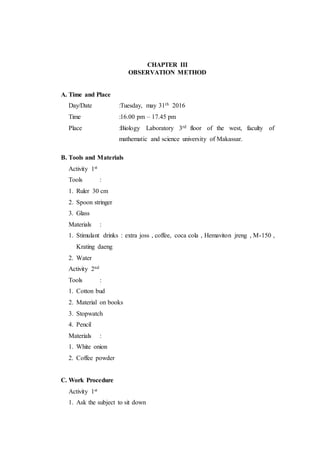
OBSERVATION METHOD
A. Time and Place
Day/Date :Tuesday, may 31th 2016
Time :16.00 pm – 17.45 pm
Place :Biology Laboratory 3rd floor of the west, faculty of
mathematic and science university of Makassar.
B. Tools and Materials
Activity 1st
Tools :
1. Ruler 30 cm
2. Spoon stringer
3. Glass
Materials :
1. Stimulant drinks : extra joss , coffee, coca cola , Hemaviton jreng , M-150 ,
Krating daeng
2. Water
Activity 2nd
Tools :
1. Cotton bud
2. Material on books
3. Stopwatch
4. Pencil
Materials :
1. White onion
2. Coffee powder
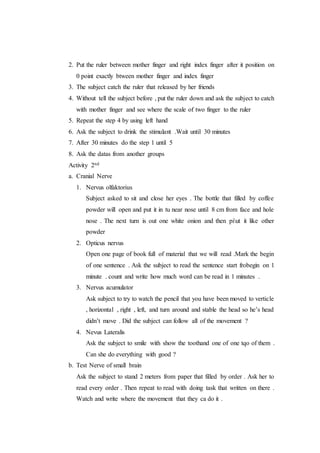
C. Work Procedure
Activity 1st
1. Ask the subject to sit down
2. Put the ruler between mother finger and right index finger after it position on
0 point exactly btween mother finger and index finger
3. The subject catch the ruler that released by her friends
4. Without tell the subject before , put the ruler down and ask the subject to catch
with mother finger and see where the scale of two finger to the ruler
5. Repeat the step 4 by using left hand
6. Ask the subject to drink the stimulant .Wait until 30 minutes
7. After 30 minutes do the step 1 until 5
8. Ask the datas from another groups
Activity 2nd
a. Cranial Nerve
1. Nervus olfaktorius
Subject asked to sit and close her eyes . The bottle that filled by coffee
powder will open and put it in tu near nose until 8 cm from face and hole
nose . The next turn is out one white onion and then piut it like other
powder
2. Opticus nervus
Open one page of book full of material that we will read .Mark the begin
of one sentence . Ask the subject to read the sentence start frobegin on 1
minute . count and write how much word can be read in 1 minutes .
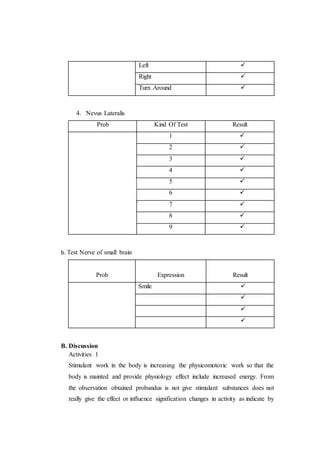
3. Nervus acumulator
Ask subject to try to watch the pencil that you have been moved to verticle
, horizontal , right , left, and turn around and stable the head so he’s head
didn’t move . Did the subject can follow all of the movement ?
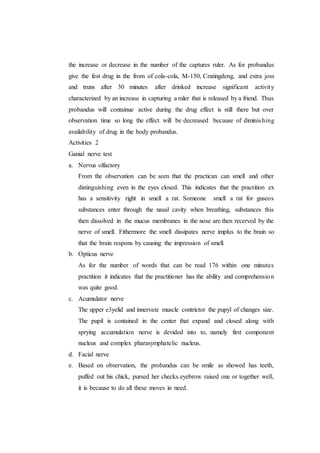
4. Nevus Lateralis
Ask the subject to smile with show the toothand one of one tqo of them .
Can she do everything with good ?
b. Test Nerve of small brain
Ask the subject to stand 2 meters from paper that filled by order . Ask her to
read every order . Then repeat to read with doing task that written on there .
Watch and write where the movement that they ca do it .
CHAPTER IV
OBSERVATION RESULT AND DISCUSSION
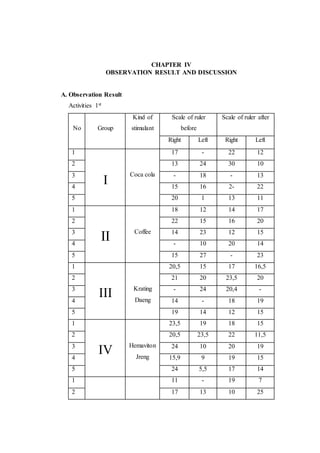
A. Observation Result
Activities 1st
No Group
Kind of
stimulant
Scale of ruler
before
Scale of ruler after
Right Left Right Left
1
I
Coca cola
17 - 22 12
2 13 24 30 10
3 - 18 - 13
4 15 16 2- 22
5 20 1 13 11
1
II Coffee
18 12 14 17
2 22 15 16 20
3 14 23 12 15
4 - 10 20 14
5 15 27 - 23
1
III Krating
Daeng
20,5 15 17 16,5
2 21 20 23,5 20
3 - 24 20,4 -
4 14 - 18 19
5 19 14 12 15
1
IV Hemaviton
Jreng
23,5 19 18 15
2 20,5 23,5 22 11,5
3 24 10 20 19
4 15,9 9 19 15
5 24 5,5 17 14
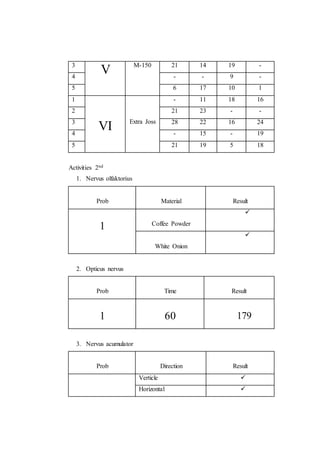
1 11 - 19 7
2 17 13 10 25
3
V M-150 21 14 19 -
4 - - 9 -
5 6 17 10 1
1
VI Extra Joss
- 11 18 16
2 21 23 - -
3 28 22 16 24
4 - 15 - 19
5 21 19 5 18
Activities 2nd
1. Nervus olfaktorius
Prob Material Result
1 Coffee Powder

White Onion

2. Opticus nervus
Prob Time Result
1 60 179
3. Nervus acumulator
Prob Direction Result
Verticle 
Horizontal 
Left 
Right 
Turn Around 
4. Nevus Lateralis
Prob Kind Of Test Result
1 
2 
3 
4 
5 
6 
7 
8 
9 
b. Test Nerve of small brain
Prob Expression Result
Smile 



B. Discussion
Activities 1
Stimulant work in the body is increasing the physicomotoric work so that the
body is mainted and provide physiology effect include increased energy. From
the observation obtained probandus is not give stimulant substances does not
really give the effect or influence signification changes in activity as indicate by
the increase or decrease in the number of the captures ruler. As for probandus
give the fest drug in the from of cola-cola, M-150, Cratingdeng, and extra joss
and truns after 30 minutes after drinked increase significant activity
characterized by an increase in capturing a ruler that is released by a friend. Thus
probandus will containue active during the drug effect is still there but over
observation time so long the effect will be decreased because of diminishing
availability of drug in the body probandus.
Activities 2
Ganial nerve test
a. Nervus olfactory
From the observation can be seen that the practican can smell and other
distinguishing even in the eyes closed. This indicates that the practition ex
has a sensitivity right in smell a rat. Someone smell a rat for guseos
substances enter through the nasal cavity when breathing, substances this
then dissolved in the mucus membranes in the nose are then recerved by the
nerve of smell. Fithermore the smell dissipates nerve implus to the brain so
that the brain respons by causing the impression of smell.
b. Opticus nerve
As for the number of words that can be read 176 within one minutes
practition it indicates that the practitioner has the ability and comprehension
was quite good.
c. Acumulator nerve
The upper e3yelid and innervate muscle contrictor the pupyl of changes size.
The pupil is contained in the center that expand and closed along with
sprying accumulation nerve is devided into to, namely first component
nucleus and complex pharasymphatelic nucleus.
d. Facial nerve
e. Based on observation, the probandus can be smile as showed has teeth,
puffed out his chick, pursed her checks.eyebrow raised one or together well,
it is because to do all these moves in need.
CHAPTER V
CLOSING
A. Conclusion
Based the observation that the five probandus is the same where
cerebellum helps maintain balance and is responsible for the smooth respone
of skeletal muscle. This result of the test can be seen that at all probandus can
distinguish and smell that has been in experiment in nerve test accumulator
prabandus of each with the subject with the movement easy it will is stretched
both arms leterally and move all the fungers activities.
B. Suggestion
I hope that further practical observers really focus observe and use the
microscope in order to produce a good observation and should also compact
between fellow members of the group in order to complete the practical work
with the time efficient as possible.
BIBLIOGRAPHY
Adnan, 2011. Penuntun Praktikum Struktur Hewan. Jurusan Biologi. FMIPA
UNM. Makassar.
Nurmawita . 2007 . Sistem Saraf . Jakarta : Erlangga
Sridianti.com. 2016. Fungsi system saraf tubuh manusia.
http://www.sridianti.com/fungsi-sistem-saraf-tubuh-manusia.html diakses senin,
20 juni 2016

Unit 3 nervous

  • 1.
    CHAPTER I INTRODUCTION A. Background Thenervous system is one of the most complex systems of the body and controls the work of almost all parts of the body. Nervous system functions described below.The role of the nervous system in our body is often compared to a centralized computer that controls the functioning of the entire system. This analogy may explain one of the best way the nervous system works. The nervous system plays an important role in the smooth functioning of the various parts of our body. The nervous system is basically a complex network of cells with specialized functions. Cells communicate with each other through an electrochemical wave. Neurons and glial cells is an important component of the nervous system. Given the complicated structure of the nervous system, all functions are not yet understood in their totality. The main function of the nervous system is to control the different systems of our body. Two sections in which our nervous system is divided is the central nervous system and the peripheral nervous system. Spinal cord and brain together make up the central nervous system. A network of nerves outside the central nervous system together form the peripheral nervous system. The main function of the peripheral nervous system (PNS) is to connect the limbs and other organs to the central nervous system. The peripheral nervous system sends information processed in the central nervous system to the glands and muscles of the body. An appropriate response is then activated by the glands and muscles. Motor neurons send instructions to the muscles or glands. This PNS is sub-divided into somatic and autonomic nervous system. Sensory receptors of the nervous system plays an important role in extracting information from the environment and send it back to the central nervous system. Sensory neurons carry information from the sensory receptors to the central nervous system. The central nervous system collects information from sensory
  • 2.
    receptors that process.Job transfer and interpret the information carried by interneurons. B. Purpose Activity 1 1. To know the effect of simulan substance that contain in soft don’t to neural responsi venses. Activity 2 1. Check the function of nerve and brain mostly great 2. Check the function of the cerebellum C. Benefit 1. To find out how the influence of stimulants to various types of beverage packaging to the speed of response of the nervous system 2. Tknow the function of the cerebrum and cerebellum
  • 3.
    CHAPTER II PREVIEW OFLITERATURE The nervous system consists of the central nervous system and the peripheral nervous system. The central nervous system includes the brain and spinal cord. The peripheral nervous system consists of clusters of nerves and ganglia scattered throughout the body, including the cranial nerves and spinal nerves. The nervous system is built by the components of nerve cells, or neurons, glial cells (Schwann cells, oligodendrocyte, microglia, ependymal, astrocytes, and satellite cells), and a true connective tissue (Adnan, 2015). The nervous system has the main function is to detect, analyze, use and deliver all the information generated by sensory stimuli (such as heat and light), and changes in mechanical and chemical that occur in the environment internally and in the external environment, and to organize and regulate, either directly or indirectly, most of the functions of the body, especially the motor activity, visceral, endocrine and mental (Adnan, 2015). The nervous system is a complex series of organ and continuous sertaterdiri mainly of nerve tissue. The nervous system is one organyang serve to neatly organize cooperation in the organization of the nervous tubuh.Sistem dankoordinasi activities arranged by millions of nerve cells that have varied shapes. The system includes the central nervous system and the peripheral nervous system. Nerves have a working relationship like chain (sequential) antarareseptor and effectors. Receptors is one or a group of nerve cells and cells identifies the specific stimulus that comes from outside or from on the body. Effector is a cell or organ that produces a response to stimuly Examples of muscles and glands (Nurmawita ,2007). According to (Adnan,2015 ) nerve cell consists of three main parts: 1. Dendrites: a short stretch and ramify and instrumental receive stimuli from the environment and deliver impulses toward the cell body. 2. The cell body: consisting of the cytoplasm and nucleus, acts as a central setting of nerve cells.
  • 4.
    3. Axon: along stretch and serves to deliver the nerve impulses to other cells. Axon is not entirely enveloped by myelin membrane, but at a certain point there are parts of axons were not covered by a membrane called myelin notch ranvier (node of ranfier). Neural network consists of nerve cells (neurons) and nerve fibers. Neural network serves as a conductor of stimuli, namely bringing excitatory stimulation of receivers (receptors) to the brain and then forwarded to the muscles. The neural networks are owned only animals and humans. There are two kinds of cells, the nerve cells (neurons) and supporting cells (glial cells), (Heru, 1997). Neurons contain cell bodies, nuclei, and penjuliran or fibers. One type of penjuluran are dendrites, which play a role dalammenerima signals from other cells and forwards it to the cell body. Type penjuluran other nerve cells, called axons (neurites), which plays a role in transmitting signals from the cell body to another neuron ( Nurmawita ,2007).
  • 5.
    CHAPTER III OBSERVATION METHOD A.Time and Place Day/Date :Tuesday, may 31th 2016 Time :16.00 pm – 17.45 pm Place :Biology Laboratory 3rd floor of the west, faculty of mathematic and science university of Makassar. B. Tools and Materials Activity 1st Tools : 1. Ruler 30 cm 2. Spoon stringer 3. Glass Materials : 1. Stimulant drinks : extra joss , coffee, coca cola , Hemaviton jreng , M-150 , Krating daeng 2. Water Activity 2nd Tools : 1. Cotton bud 2. Material on books 3. Stopwatch 4. Pencil Materials : 1. White onion 2. Coffee powder C. Work Procedure Activity 1st 1. Ask the subject to sit down
  • 6.
    2. Put theruler between mother finger and right index finger after it position on 0 point exactly btween mother finger and index finger 3. The subject catch the ruler that released by her friends 4. Without tell the subject before , put the ruler down and ask the subject to catch with mother finger and see where the scale of two finger to the ruler 5. Repeat the step 4 by using left hand 6. Ask the subject to drink the stimulant .Wait until 30 minutes 7. After 30 minutes do the step 1 until 5 8. Ask the datas from another groups Activity 2nd a. Cranial Nerve 1. Nervus olfaktorius Subject asked to sit and close her eyes . The bottle that filled by coffee powder will open and put it in tu near nose until 8 cm from face and hole nose . The next turn is out one white onion and then piut it like other powder 2. Opticus nervus Open one page of book full of material that we will read .Mark the begin of one sentence . Ask the subject to read the sentence start frobegin on 1 minute . count and write how much word can be read in 1 minutes . 3. Nervus acumulator Ask subject to try to watch the pencil that you have been moved to verticle , horizontal , right , left, and turn around and stable the head so he’s head didn’t move . Did the subject can follow all of the movement ? 4. Nevus Lateralis Ask the subject to smile with show the toothand one of one tqo of them . Can she do everything with good ? b. Test Nerve of small brain Ask the subject to stand 2 meters from paper that filled by order . Ask her to read every order . Then repeat to read with doing task that written on there . Watch and write where the movement that they ca do it .
  • 7.
    CHAPTER IV OBSERVATION RESULTAND DISCUSSION A. Observation Result Activities 1st No Group Kind of stimulant Scale of ruler before Scale of ruler after Right Left Right Left 1 I Coca cola 17 - 22 12 2 13 24 30 10 3 - 18 - 13 4 15 16 2- 22 5 20 1 13 11 1 II Coffee 18 12 14 17 2 22 15 16 20 3 14 23 12 15 4 - 10 20 14 5 15 27 - 23 1 III Krating Daeng 20,5 15 17 16,5 2 21 20 23,5 20 3 - 24 20,4 - 4 14 - 18 19 5 19 14 12 15 1 IV Hemaviton Jreng 23,5 19 18 15 2 20,5 23,5 22 11,5 3 24 10 20 19 4 15,9 9 19 15 5 24 5,5 17 14 1 11 - 19 7 2 17 13 10 25
  • 8.
    3 V M-150 2114 19 - 4 - - 9 - 5 6 17 10 1 1 VI Extra Joss - 11 18 16 2 21 23 - - 3 28 22 16 24 4 - 15 - 19 5 21 19 5 18 Activities 2nd 1. Nervus olfaktorius Prob Material Result 1 Coffee Powder  White Onion  2. Opticus nervus Prob Time Result 1 60 179 3. Nervus acumulator Prob Direction Result Verticle  Horizontal 
  • 9.
    Left  Right  TurnAround  4. Nevus Lateralis Prob Kind Of Test Result 1  2  3  4  5  6  7  8  9  b. Test Nerve of small brain Prob Expression Result Smile     B. Discussion Activities 1 Stimulant work in the body is increasing the physicomotoric work so that the body is mainted and provide physiology effect include increased energy. From the observation obtained probandus is not give stimulant substances does not really give the effect or influence signification changes in activity as indicate by
  • 10.
    the increase ordecrease in the number of the captures ruler. As for probandus give the fest drug in the from of cola-cola, M-150, Cratingdeng, and extra joss and truns after 30 minutes after drinked increase significant activity characterized by an increase in capturing a ruler that is released by a friend. Thus probandus will containue active during the drug effect is still there but over observation time so long the effect will be decreased because of diminishing availability of drug in the body probandus. Activities 2 Ganial nerve test a. Nervus olfactory From the observation can be seen that the practican can smell and other distinguishing even in the eyes closed. This indicates that the practition ex has a sensitivity right in smell a rat. Someone smell a rat for guseos substances enter through the nasal cavity when breathing, substances this then dissolved in the mucus membranes in the nose are then recerved by the nerve of smell. Fithermore the smell dissipates nerve implus to the brain so that the brain respons by causing the impression of smell. b. Opticus nerve As for the number of words that can be read 176 within one minutes practition it indicates that the practitioner has the ability and comprehension was quite good. c. Acumulator nerve The upper e3yelid and innervate muscle contrictor the pupyl of changes size. The pupil is contained in the center that expand and closed along with sprying accumulation nerve is devided into to, namely first component nucleus and complex pharasymphatelic nucleus. d. Facial nerve e. Based on observation, the probandus can be smile as showed has teeth, puffed out his chick, pursed her checks.eyebrow raised one or together well, it is because to do all these moves in need.
  • 11.
    CHAPTER V CLOSING A. Conclusion Basedthe observation that the five probandus is the same where cerebellum helps maintain balance and is responsible for the smooth respone of skeletal muscle. This result of the test can be seen that at all probandus can distinguish and smell that has been in experiment in nerve test accumulator prabandus of each with the subject with the movement easy it will is stretched both arms leterally and move all the fungers activities. B. Suggestion I hope that further practical observers really focus observe and use the microscope in order to produce a good observation and should also compact between fellow members of the group in order to complete the practical work with the time efficient as possible.
  • 12.
    BIBLIOGRAPHY Adnan, 2011. PenuntunPraktikum Struktur Hewan. Jurusan Biologi. FMIPA UNM. Makassar. Nurmawita . 2007 . Sistem Saraf . Jakarta : Erlangga Sridianti.com. 2016. Fungsi system saraf tubuh manusia. http://www.sridianti.com/fungsi-sistem-saraf-tubuh-manusia.html diakses senin, 20 juni 2016