1
University of Hail
College of Nursing
Physiology PHYL281
Dr Jupiter V. Cajigal
Assistant Professor, University of Hail
UNIT 2
The Nervous System
Objectives :
At the end of this lecture, the student will be able
to:
 Describe the functions of the nervous system
 Describe the parts of a neuron cell and identify how
they transmit electrochemical impulses.
 Compare and contrast the central and peripheral
nervous systems
 Identify and explain different areas of the brain and
their functions.
 Explain how the nervous system passes information
between the external environment and the many
parts of the body.
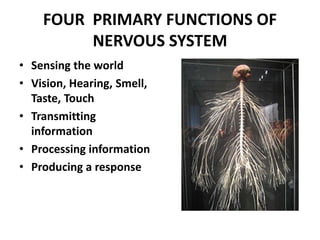
FOUR PRIMARY FUNCTIONS OF
NERVOUS SYSTEM
• Sensing the world
• Vision, Hearing, Smell,
Taste, Touch
• Transmitting
information
• Processing information
• Producing a response
NEURONS
• a specialized cell
transmitting nerve
impulses; a nerve
cell.
NEURONS
Glial cells surround neurons
and provide support for and
insulation between them.
Glial cells are the most
abundant cell types in the
central nervous system.
Types of glial cells include
oligodendrocytes,
astrocytes, ependymal cells,
Schwann cells, microglia,
and satellite cells.
Parts of nerve cell & Function of each part:
• Dendrites : receive
chemical signals from
neighboring cells.
• Dendrites are the
structures on the
neuron that receive
electrical messages.
These messages come
in two basic forms:
excitatory and
inhibitory.
Parts of nerve cell & Function of each part:
• Cell Body: contains the
nucleus & organelles
• It also contains the cell's
DNA, which is essentially
the neuron's blueprint.
The nucleus is another
organelle that serves a
vital purpose to the
functioning of the
neuron. It nucleolus
produces ribosomes,
which are essential to
protein production.
Parts of nerve cell & Function of each part:
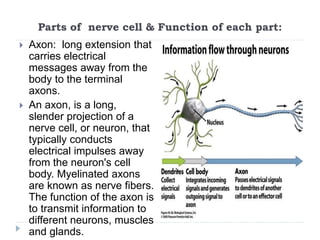
 Axon: long extension that
carries electrical
messages away from the
body to the terminal
axons.
 An axon, is a long,
slender projection of a
nerve cell, or neuron, that
typically conducts
electrical impulses away
from the neuron's cell
body. Myelinated axons
are known as nerve fibers.
The function of the axon is
to transmit information to
different neurons, muscles
and glands.
Parts of nerve cell & Function of each part:
 the somewhat enlarged,
often club-shaped
endings by which axons
make synaptic contacts
with other nerve cells or
with effector cells
(muscle or gland cells).
Axon terminals contain
neurotransmitters of
various kinds,
sometimes more than
one.
Parts of nerve cell & Function of each part:
 main purpose of myelin
is to increase the speed
at which electrical
impulses propagate
along the myelinated
fiber. In unmyelinated
fibers, electrical
impulses (action
potentials) travel as
continuous waves, but,
in myelinated fibers,
they "hop" or propagate
by saltatory conduction.
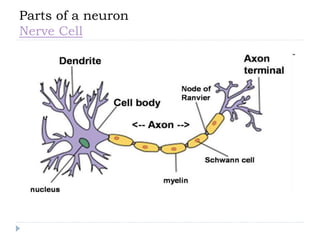
Parts of a neuron
Nerve Cell
Types of Neurons
 3 main types of neurons:
Sensory neuron = detect stimuli
Interneurons = relay sensory signals to
brain then return message back to motor
neurons.
Motor neuron = pass message from brain to
rest of body for muscle response.
This coordinated pathway is known as the
REFLEX ARC
Reflex Arc
“ what happens when you step on a nail”?
Reflexes are automatic
The Stimulus (nail ) is received by
the sensory neurons in the foot
This info travels to the spine, where
the interneuron is triggered
The interneuron transmits signal to
brain (through the spinal cord)and
carries message back and stimulates
the motor neuron, to move the foot
Nerve Impulse
A progressive wave of
electric and chemical
activity along a nerve
fiber that stimulates or
inhibits the action of a
muscle, gland, or other
nerve cell
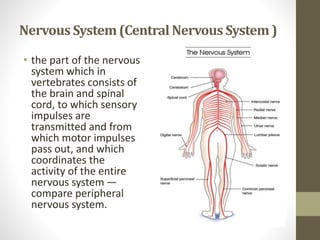
Nervous System(Central Nervous System)
• the part of the nervous
system which in
vertebrates consists of
the brain and spinal
cord, to which sensory
impulses are
transmitted and from
which motor impulses
pass out, and which
coordinates the
activity of the entire
nervous system —
compare peripheral
nervous system.
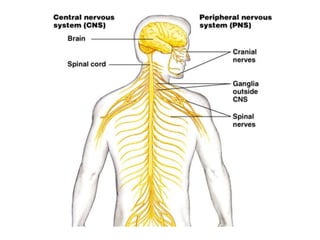
NervousSystem(PeripheralNervousSystem)
• The nerves in the
PNS connect the
central nervous
system (CNS) to
sensory organs, such
as the eye and ear,
and to other organs
of the body, muscles,
blood vessels, and
glands.
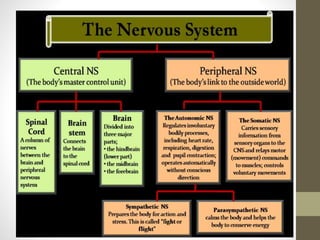
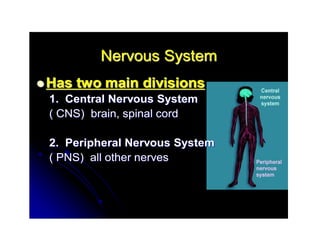
Nervous System
 Has two main divisions
1. Central Nervous System
( CNS) brain, spinal cord
2. Peripheral Nervous System
( PNS) all other nerves
The Nervous system is:
• A physically connected network of cells,
tissues and organs that allow us to
communicate with and react to the
environment and perform life activities.
2 main divisions:
Central Nervous System
(CNS)
• Receives, interprets and
sends signals to peripheral
nervous system (PNS).
• Has 2 main parts:
• Brain – main control
center
• Spinal Cord – connects
and relays nerve
impulses to the brain
Peripheral Nervous System (PNS)
 Connects CNS to all organ systems
 Made up of:
 Sensory Neurons: detect stimuli
 Motor Neurons: carry signal to stimulate response
 2 major subsystems:
 Somatic – voluntary movement (balance,
movement)
 Autonomic – involuntary movement (digestion,
fight or flight)
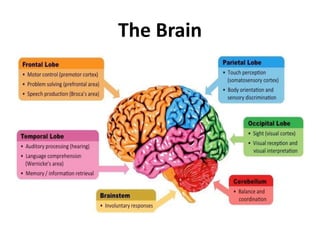
The Brain
Cerebrum
• Large front part of the brain
FUNCTIONS:
– Voluntary activity
– Memory
– Language
– Receives and responds to sensory signals
– Controls motor functions
Cerebellum
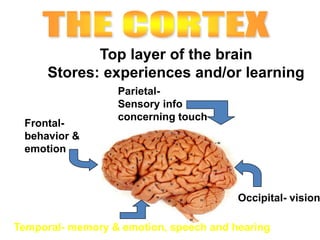
THE CORTEX
Top layer of the brain
Stores: experiences and/or learning
Frontal-
behavior &
emotion
Temporal- memory & emotion, speech and hearing
Occipital- vision
Parietal-
Sensory info
concerning touch
Brain Stem
 BRAIN STEM
 swallowing, coughing,
sneezing, and vomiting
 Includes the
Medulla Oblongata
Brain Stem
 PONS
 Breathing
 Heart rate
 Internal Organs
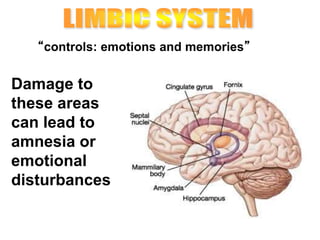
“controls: emotions and memories”
Damage to
these areas
can lead to
amnesia or
emotional
disturbances
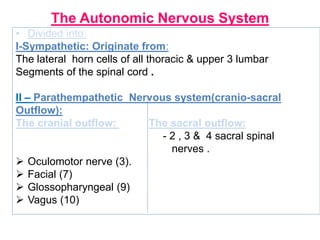
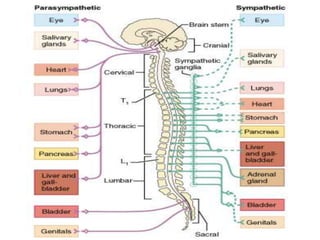
The Autonomic Nervous System
• Divided into:
I-Sympathetic: Originate from:
The lateral horn cells of all thoracic & upper 3 lumbar
Segments of the spinal cord .
II – Parathempathetic Nervous system(cranio-sacral
Outflow):
The cranial outflow: The sacral outflow:
- 2 , 3 & 4 sacral spinal
nerves .
 Oculomotor nerve (3).
 Facial (7)
 Glossopharyngeal (9)
 Vagus (10)
Innervation of Body Organs
-In the body there are organs which are
innervated by both sympathetic and
parasympathetic systems:
- Heart
- Digestive tract
- Pupil of the eye
- Salivary glands
There are organs with only sympathetic
innervation:
 Adrenal medulla
 Sweat glands
 Most blood vessels
Functions of 1- Sympathetic system:
 Excitation of
sympathetic centers will
cause:
 - Increase in heart
rate.
 - Increase in blood
pressure,
 - Blood glucose is
elevated
 - Increase in the
rate of metabolism
Function of Parasympathetic system
 2-parasympathetic
system: usually has
opposite effects to those
of sympathetic
system.
 Excitation of
parasympathetic
causes:
 Decrease in heart rate,
 Increase blood flow to
the digestive system,
 Increase activity of the
digestive system.
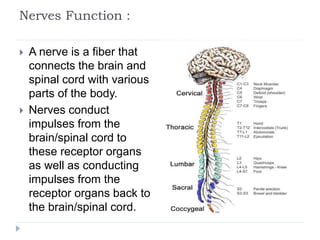
Nerves Function :
 A nerve is a fiber that
connects the brain and
spinal cord with various
parts of the body.
 Nerves conduct
impulses from the
brain/spinal cord to
these receptor organs
as well as conducting
impulses from the
receptor organs back to
the brain/spinal cord.
SYMPATHETIC NERVOUS SYSTEM
• Cause vasoconstriction by activation of a-adrenergic
receptors on vascular smooth muscle by
norepinephrine.
• Vasoconstriction of arterioles increased vascular
resistance and redistribution of blood flow
• Vasoconstriction of veins increased circulating blood
volume, increased venous return leads to increased
ventricular filling and stroke volume.
• Increase in the activity of the heart (heart rate and
contractility)
• There are also sympathetic vasodilator fibers which
release epinephrine acting on β-adrenergic receptors.
PARASYMPATHETIC SYSTEM
• 75% of all parasympathetic nerve fibers are in the
vagus nerves (cranial nerve X)
• Pass to the entire thoracic and abdominal regions
of the body , including the heart.
• Preganglionic nerves pass all the way to the organ.
• Postganglionic nerves are very short and located
entirely in the wall of the organ.
• Play a role in the regulation of circulation.
• Mainly control heart rate
• Stimulation of vagus nerves results in a decrease in
heart rate and contractility
Unit 2  nervous system

Unit 2 nervous system

  • 1.
    1 University of Hail Collegeof Nursing Physiology PHYL281 Dr Jupiter V. Cajigal Assistant Professor, University of Hail UNIT 2 The Nervous System
  • 2.
    Objectives : At theend of this lecture, the student will be able to:  Describe the functions of the nervous system  Describe the parts of a neuron cell and identify how they transmit electrochemical impulses.  Compare and contrast the central and peripheral nervous systems  Identify and explain different areas of the brain and their functions.  Explain how the nervous system passes information between the external environment and the many parts of the body.
  • 3.
    FOUR PRIMARY FUNCTIONSOF NERVOUS SYSTEM • Sensing the world • Vision, Hearing, Smell, Taste, Touch • Transmitting information • Processing information • Producing a response
  • 6.
    NEURONS • a specializedcell transmitting nerve impulses; a nerve cell.
  • 7.
    NEURONS Glial cells surroundneurons and provide support for and insulation between them. Glial cells are the most abundant cell types in the central nervous system. Types of glial cells include oligodendrocytes, astrocytes, ependymal cells, Schwann cells, microglia, and satellite cells.
  • 8.
    Parts of nervecell & Function of each part: • Dendrites : receive chemical signals from neighboring cells. • Dendrites are the structures on the neuron that receive electrical messages. These messages come in two basic forms: excitatory and inhibitory.
  • 9.
    Parts of nervecell & Function of each part: • Cell Body: contains the nucleus & organelles • It also contains the cell's DNA, which is essentially the neuron's blueprint. The nucleus is another organelle that serves a vital purpose to the functioning of the neuron. It nucleolus produces ribosomes, which are essential to protein production.
  • 10.
    Parts of nervecell & Function of each part:  Axon: long extension that carries electrical messages away from the body to the terminal axons.  An axon, is a long, slender projection of a nerve cell, or neuron, that typically conducts electrical impulses away from the neuron's cell body. Myelinated axons are known as nerve fibers. The function of the axon is to transmit information to different neurons, muscles and glands.
  • 11.
    Parts of nervecell & Function of each part:  the somewhat enlarged, often club-shaped endings by which axons make synaptic contacts with other nerve cells or with effector cells (muscle or gland cells). Axon terminals contain neurotransmitters of various kinds, sometimes more than one.
  • 12.
    Parts of nervecell & Function of each part:  main purpose of myelin is to increase the speed at which electrical impulses propagate along the myelinated fiber. In unmyelinated fibers, electrical impulses (action potentials) travel as continuous waves, but, in myelinated fibers, they "hop" or propagate by saltatory conduction.
  • 13.
    Parts of aneuron Nerve Cell
  • 14.
    Types of Neurons 3 main types of neurons: Sensory neuron = detect stimuli Interneurons = relay sensory signals to brain then return message back to motor neurons. Motor neuron = pass message from brain to rest of body for muscle response. This coordinated pathway is known as the REFLEX ARC
  • 16.
    Reflex Arc “ whathappens when you step on a nail”? Reflexes are automatic The Stimulus (nail ) is received by the sensory neurons in the foot This info travels to the spine, where the interneuron is triggered The interneuron transmits signal to brain (through the spinal cord)and carries message back and stimulates the motor neuron, to move the foot
  • 17.
    Nerve Impulse A progressivewave of electric and chemical activity along a nerve fiber that stimulates or inhibits the action of a muscle, gland, or other nerve cell
  • 18.
    Nervous System(Central NervousSystem) • the part of the nervous system which in vertebrates consists of the brain and spinal cord, to which sensory impulses are transmitted and from which motor impulses pass out, and which coordinates the activity of the entire nervous system — compare peripheral nervous system.
  • 19.
    NervousSystem(PeripheralNervousSystem) • The nervesin the PNS connect the central nervous system (CNS) to sensory organs, such as the eye and ear, and to other organs of the body, muscles, blood vessels, and glands.
  • 22.
    Nervous System  Hastwo main divisions 1. Central Nervous System ( CNS) brain, spinal cord 2. Peripheral Nervous System ( PNS) all other nerves
  • 23.
    The Nervous systemis: • A physically connected network of cells, tissues and organs that allow us to communicate with and react to the environment and perform life activities.
  • 24.
    2 main divisions: CentralNervous System (CNS) • Receives, interprets and sends signals to peripheral nervous system (PNS). • Has 2 main parts: • Brain – main control center • Spinal Cord – connects and relays nerve impulses to the brain
  • 25.
    Peripheral Nervous System(PNS)  Connects CNS to all organ systems  Made up of:  Sensory Neurons: detect stimuli  Motor Neurons: carry signal to stimulate response  2 major subsystems:  Somatic – voluntary movement (balance, movement)  Autonomic – involuntary movement (digestion, fight or flight)
  • 29.
  • 30.
  • 31.
    • Large frontpart of the brain FUNCTIONS: – Voluntary activity – Memory – Language – Receives and responds to sensory signals – Controls motor functions
  • 32.
  • 33.
  • 34.
    Top layer ofthe brain Stores: experiences and/or learning Frontal- behavior & emotion Temporal- memory & emotion, speech and hearing Occipital- vision Parietal- Sensory info concerning touch
  • 35.
    Brain Stem  BRAINSTEM  swallowing, coughing, sneezing, and vomiting  Includes the Medulla Oblongata
  • 36.
    Brain Stem  PONS Breathing  Heart rate  Internal Organs
  • 37.
    “controls: emotions andmemories” Damage to these areas can lead to amnesia or emotional disturbances
  • 38.
    The Autonomic NervousSystem • Divided into: I-Sympathetic: Originate from: The lateral horn cells of all thoracic & upper 3 lumbar Segments of the spinal cord . II – Parathempathetic Nervous system(cranio-sacral Outflow): The cranial outflow: The sacral outflow: - 2 , 3 & 4 sacral spinal nerves .  Oculomotor nerve (3).  Facial (7)  Glossopharyngeal (9)  Vagus (10)
  • 40.
    Innervation of BodyOrgans -In the body there are organs which are innervated by both sympathetic and parasympathetic systems: - Heart - Digestive tract - Pupil of the eye - Salivary glands There are organs with only sympathetic innervation:  Adrenal medulla  Sweat glands  Most blood vessels
  • 41.
    Functions of 1-Sympathetic system:  Excitation of sympathetic centers will cause:  - Increase in heart rate.  - Increase in blood pressure,  - Blood glucose is elevated  - Increase in the rate of metabolism
  • 42.
    Function of Parasympatheticsystem  2-parasympathetic system: usually has opposite effects to those of sympathetic system.  Excitation of parasympathetic causes:  Decrease in heart rate,  Increase blood flow to the digestive system,  Increase activity of the digestive system.
  • 44.
    Nerves Function : A nerve is a fiber that connects the brain and spinal cord with various parts of the body.  Nerves conduct impulses from the brain/spinal cord to these receptor organs as well as conducting impulses from the receptor organs back to the brain/spinal cord.
  • 45.
    SYMPATHETIC NERVOUS SYSTEM •Cause vasoconstriction by activation of a-adrenergic receptors on vascular smooth muscle by norepinephrine. • Vasoconstriction of arterioles increased vascular resistance and redistribution of blood flow • Vasoconstriction of veins increased circulating blood volume, increased venous return leads to increased ventricular filling and stroke volume. • Increase in the activity of the heart (heart rate and contractility) • There are also sympathetic vasodilator fibers which release epinephrine acting on β-adrenergic receptors.
  • 46.
    PARASYMPATHETIC SYSTEM • 75%of all parasympathetic nerve fibers are in the vagus nerves (cranial nerve X) • Pass to the entire thoracic and abdominal regions of the body , including the heart. • Preganglionic nerves pass all the way to the organ. • Postganglionic nerves are very short and located entirely in the wall of the organ. • Play a role in the regulation of circulation. • Mainly control heart rate • Stimulation of vagus nerves results in a decrease in heart rate and contractility