Power Point Presentation
SUBJECT CODE & NAME
20AG105PE
STORAGE AND PACKING TECHNOLOGY
UNIT – 3 FUNCTIONS OF PACKAGING
MATERIALS
Prepared by,
Dr. P. Dineshkumar M.E., Ph.D.,
Assistant Professor,
Department of Agricultural Engineering,
Kongunadu College of Engineering and Technology.
Dr. P. Dineshkumar / AP / AGE / KNCET 1
INTRODUCTION
• Packaging materials serve several important functions in the transportation,
storage, and protection of goods. They are designed to ensure that products
reach consumers in optimal condition while providing information and
convenience.
• The Packaging Institute International defines packaging as the enclosure of
products, items or packages in a wrapped pouch, bag, box, cup, tray, can,
tube, bottle or other container form
• Containment
• Protection and/or preservation
• Communications
• Utility or Performance
If the device or container performs one or more of these functions it is
considered a package. Dr. P. Dineshkumar / AP / AGE / KNCET 2
The selection of a packaging, will depend on
1. Existing economic ability.
2. Production and distribution efficiency.
3. Retailing pattern.
4. Consumer preferences.
5. Ecological aspects.
Dr. P. Dineshkumar / AP / AGE / KNCET 3
KEY FUNCTIONS OF PACKAGING MATERIALS
Dr. P. Dineshkumar / AP / AGE / KNCET 4
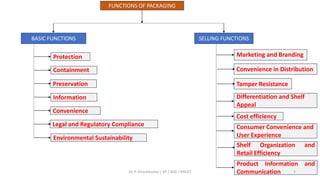
FUNCTIONS OF PACKAGING
BASIC FUNCTIONS SELLING FUNCTIONS
Protection
Containment
Preservation
Information
Marketing and Branding
Convenience
Legal and Regulatory Compliance
Convenience in Distribution
Tamper Resistance
Differentiation and Shelf
Appeal
Environmental Sustainability
Cost efficiency
Consumer Convenience and
User Experience
Shelf Organization and
Retail Efficiency
Product Information and
Communication
Dr. P. Dineshkumar / AP / AGE / KNCET 5
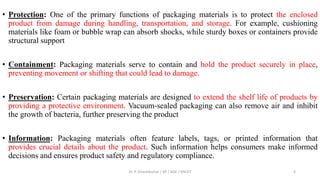
• Protection: One of the primary functions of packaging materials is to protect the enclosed
product from damage during handling, transportation, and storage. For example, cushioning
materials like foam or bubble wrap can absorb shocks, while sturdy boxes or containers provide
structural support
• Containment: Packaging materials serve to contain and hold the product securely in place,
preventing movement or shifting that could lead to damage.
• Preservation: Certain packaging materials are designed to extend the shelf life of products by
providing a protective environment. Vacuum-sealed packaging can also remove air and inhibit
the growth of bacteria, further preserving the product
• Information: Packaging materials often feature labels, tags, or printed information that
provides crucial details about the product. Such information helps consumers make informed
decisions and ensures product safety and regulatory compliance.
Dr. P. Dineshkumar / AP / AGE / KNCET 6
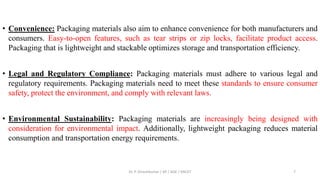
• Convenience: Packaging materials also aim to enhance convenience for both manufacturers and
consumers. Easy-to-open features, such as tear strips or zip locks, facilitate product access.
Packaging that is lightweight and stackable optimizes storage and transportation efficiency.
• Legal and Regulatory Compliance: Packaging materials must adhere to various legal and
regulatory requirements. Packaging materials need to meet these standards to ensure consumer
safety, protect the environment, and comply with relevant laws.
• Environmental Sustainability: Packaging materials are increasingly being designed with
consideration for environmental impact. Additionally, lightweight packaging reduces material
consumption and transportation energy requirements.
Dr. P. Dineshkumar / AP / AGE / KNCET 7
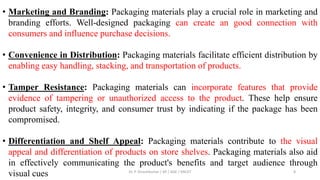
• Marketing and Branding: Packaging materials play a crucial role in marketing and
branding efforts. Well-designed packaging can create an good connection with
consumers and influence purchase decisions.
• Convenience in Distribution: Packaging materials facilitate efficient distribution by
enabling easy handling, stacking, and transportation of products.
• Tamper Resistance: Packaging materials can incorporate features that provide
evidence of tampering or unauthorized access to the product. These help ensure
product safety, integrity, and consumer trust by indicating if the package has been
compromised.
• Differentiation and Shelf Appeal: Packaging materials contribute to the visual
appeal and differentiation of products on store shelves. Packaging materials also aid
in effectively communicating the product's benefits and target audience through
visual cues Dr. P. Dineshkumar / AP / AGE / KNCET 8
• Consumer Convenience and User Experience: Packaging materials can enhance the overall
consumer experience by offering convenience features like easy opening, portion control, or
reseal ability.
• Shelf Organization and Retail Efficiency: Packaging materials assist in organizing products
on store shelves for efficient stocking and display. They can incorporate features like
standardized dimensions, barcode labels, or hanging tabs for easy identification and handling in
retail environments.
• Product Information and Communication: Packaging materials serve as a platform for
product communication and branding. In addition to mandatory labeling information, they may
include promotional messages, storytelling elements, or QR codes that direct consumers to
further product information or online resources.
• Cost Efficiency: Packaging materials play a role in cost management for manufacturers.
Optimizing packaging design, material selection, and production processes can contribute to
cost savings while still meeting functional requirements.
Dr. P. Dineshkumar / AP / AGE / KNCET 9
PACKAGING STRATEGIES FOR VARIOUS
ENVIRONMENT
Packaging strategies can vary depending on the specific environmental
conditions in which the products will be transported, stored, or displayed.
Here are some packaging strategies for different environments.
1. High Humidity Environments.
2. Extreme Temperature Environments.
3. Fragile or Delicate Products.
4. Retail Display Packaging.
5. E-commerce Packaging.
6. Environmental Sustainability.
Dr. P. Dineshkumar / AP / AGE / KNCET 10
PACKAGING STRATEGIES FOR HIGH HUMIDITY
ENVIRONMENTS
In high humidity environments, packaging strategies are essential to protect
products from moisture damage and maintain their quality. Here are some
packaging strategies for high humidity environments:
1. Moisture-Resistant Materials.
2. Desiccants.
3. Seal Integrity.
4. Individually Sealed Units.
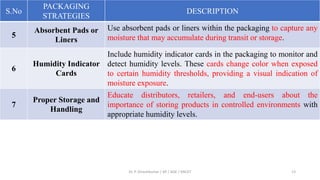
5. Absorbent Pads or Liners.
6. Humidity Indicator Cards.
7. Proper Storage and Handling.
Dr. P. Dineshkumar / AP / AGE / KNCET 11
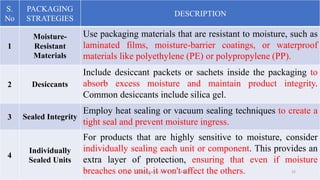
S.
No
PACKAGING
STRATEGIES
DESCRIPTION
1
Moisture-
Resistant
Materials
Use packaging materials that are resistant to moisture, such as
laminated films, moisture-barrier coatings, or waterproof
materials like polyethylene (PE) or polypropylene (PP).
2 Desiccants
Include desiccant packets or sachets inside the packaging to
absorb excess moisture and maintain product integrity.
Common desiccants include silica gel.
3 Sealed Integrity
Employ heat sealing or vacuum sealing techniques to create a
tight seal and prevent moisture ingress.
4
Individually
Sealed Units
For products that are highly sensitive to moisture, consider
individually sealing each unit or component. This provides an
extra layer of protection, ensuring that even if moisture
breaches one unit, it won't affect the others.
Dr. P. Dineshkumar / AP / AGE / KNCET 12
S.No
PACKAGING
STRATEGIES
DESCRIPTION
5
Absorbent Pads or
Liners
Use absorbent pads or liners within the packaging to capture any
moisture that may accumulate during transit or storage.
6
Humidity Indicator
Cards
Include humidity indicator cards in the packaging to monitor and
detect humidity levels. These cards change color when exposed
to certain humidity thresholds, providing a visual indication of
moisture exposure.
7
Proper Storage and
Handling
Educate distributors, retailers, and end-users about the
importance of storing products in controlled environments with
appropriate humidity levels.
Dr. P. Dineshkumar / AP / AGE / KNCET 13
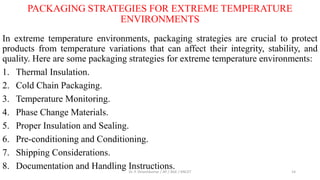
PACKAGING STRATEGIES FOR EXTREME TEMPERATURE
ENVIRONMENTS
In extreme temperature environments, packaging strategies are crucial to protect
products from temperature variations that can affect their integrity, stability, and
quality. Here are some packaging strategies for extreme temperature environments:
1. Thermal Insulation.
2. Cold Chain Packaging.
3. Temperature Monitoring.
4. Phase Change Materials.
5. Proper Insulation and Sealing.
6. Pre-conditioning and Conditioning.
7. Shipping Considerations.
8. Documentation and Handling Instructions.
Dr. P. Dineshkumar / AP / AGE / KNCET 14
S.No
PACKAGING
STRATEGIES
DESCRIPTION
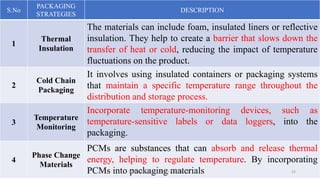
1
Thermal
Insulation
The materials can include foam, insulated liners or reflective
insulation. They help to create a barrier that slows down the
transfer of heat or cold, reducing the impact of temperature
fluctuations on the product.
2
Cold Chain
Packaging
It involves using insulated containers or packaging systems
that maintain a specific temperature range throughout the
distribution and storage process.
3
Temperature
Monitoring
Incorporate temperature-monitoring devices, such as
temperature-sensitive labels or data loggers, into the
packaging.
4
Phase Change
Materials
PCMs are substances that can absorb and release thermal
energy, helping to regulate temperature. By incorporating
PCMs into packaging materials
Dr. P. Dineshkumar / AP / AGE / KNCET 15
S.
No
PACKAGING
STRATEGIES
DESCRIPTION
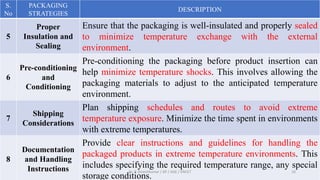
5
Proper
Insulation and
Sealing
Ensure that the packaging is well-insulated and properly sealed
to minimize temperature exchange with the external
environment.
6
Pre-conditioning
and
Conditioning
Pre-conditioning the packaging before product insertion can
help minimize temperature shocks. This involves allowing the
packaging materials to adjust to the anticipated temperature
environment.
7
Shipping
Considerations
Plan shipping schedules and routes to avoid extreme
temperature exposure. Minimize the time spent in environments
with extreme temperatures.
8
Documentation
and Handling
Instructions
Provide clear instructions and guidelines for handling the
packaged products in extreme temperature environments. This
includes specifying the required temperature range, any special
storage conditions.
Dr. P. Dineshkumar / AP / AGE / KNCET 16
PACKAGING STRATEGIES FOR FRAGILE (or) DELICATE
PRODUCTS
When it comes to packaging fragile or delicate products, it's essential to prioritize
protection to ensure they arrive intact and undamaged. Here are some packaging
strategies to consider
1. Select appropriate packaging materials.
2. Use double boxing.
3. Wrap items individually.
4. Reinforce corners and edges.
5. Secure items in place.
6. Label the package.
7. Test the packaging.
8. Consider custom packaging. Dr. P. Dineshkumar / AP / AGE / KNCET 17
S.No
PACKAGING
STRATEGIES
DESCRIPTION
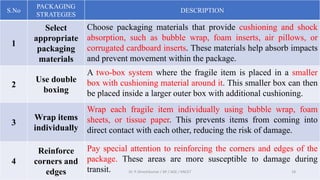
1
Select
appropriate
packaging
materials
Choose packaging materials that provide cushioning and shock
absorption, such as bubble wrap, foam inserts, air pillows, or
corrugated cardboard inserts. These materials help absorb impacts
and prevent movement within the package.
2
Use double
boxing
A two-box system where the fragile item is placed in a smaller
box with cushioning material around it. This smaller box can then
be placed inside a larger outer box with additional cushioning.
3
Wrap items
individually
Wrap each fragile item individually using bubble wrap, foam
sheets, or tissue paper. This prevents items from coming into
direct contact with each other, reducing the risk of damage.
4
Reinforce
corners and
edges
Pay special attention to reinforcing the corners and edges of the
package. These areas are more susceptible to damage during
transit. Dr. P. Dineshkumar / AP / AGE / KNCET 18
S.No
PACKAGING
STRATEGIES
DESCRIPTION
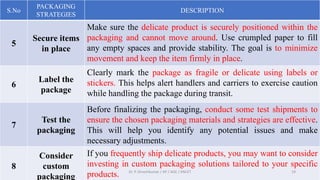
5
Secure items
in place
Make sure the delicate product is securely positioned within the
packaging and cannot move around. Use crumpled paper to fill
any empty spaces and provide stability. The goal is to minimize
movement and keep the item firmly in place.
6
Label the
package
Clearly mark the package as fragile or delicate using labels or
stickers. This helps alert handlers and carriers to exercise caution
while handling the package during transit.
7
Test the
packaging
Before finalizing the packaging, conduct some test shipments to
ensure the chosen packaging materials and strategies are effective.
This will help you identify any potential issues and make
necessary adjustments.
8
Consider
custom
packaging
If you frequently ship delicate products, you may want to consider
investing in custom packaging solutions tailored to your specific
products. Dr. P. Dineshkumar / AP / AGE / KNCET 19
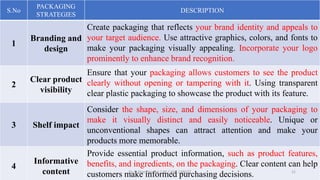
PACKAGING STRATEGIES FOR RETAIL DISPLAY PACKAGING
Retail display packaging plays a crucial role in attracting customers' attention,
showcasing products effectively, and promoting sales. Here are some packaging
strategies for retail display:
1. Branding and design.
2. Clear product visibility.
3. Shelf impact.
4. Informative content.
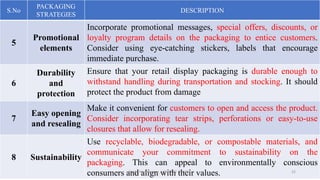
5. Promotional elements.
6. Durability and protection.
7. Easy opening and resealing.
8. Sustainability.
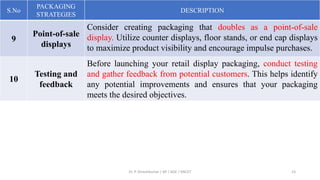
9. Point-of-sale displays.
10. Testing and feedback. Dr. P. Dineshkumar / AP / AGE / KNCET 20
S.No
PACKAGING
STRATEGIES
DESCRIPTION
1
Branding and
design
Create packaging that reflects your brand identity and appeals to
your target audience. Use attractive graphics, colors, and fonts to
make your packaging visually appealing. Incorporate your logo
prominently to enhance brand recognition.
2
Clear product
visibility
Ensure that your packaging allows customers to see the product
clearly without opening or tampering with it. Using transparent
clear plastic packaging to showcase the product with its feature.
3 Shelf impact
Consider the shape, size, and dimensions of your packaging to
make it visually distinct and easily noticeable. Unique or
unconventional shapes can attract attention and make your
products more memorable.
4
Informative
content
Provide essential product information, such as product features,
benefits, and ingredients, on the packaging. Clear content can help
customers make informed purchasing decisions.
Dr. P. Dineshkumar / AP / AGE / KNCET 21
S.No
PACKAGING
STRATEGIES
DESCRIPTION
5
Promotional
elements
Incorporate promotional messages, special offers, discounts, or
loyalty program details on the packaging to entice customers.
Consider using eye-catching stickers, labels that encourage
immediate purchase.
6
Durability
and
protection
Ensure that your retail display packaging is durable enough to
withstand handling during transportation and stocking. It should
protect the product from damage
7
Easy opening
and resealing
Make it convenient for customers to open and access the product.
Consider incorporating tear strips, perforations or easy-to-use
closures that allow for resealing.
8 Sustainability
Use recyclable, biodegradable, or compostable materials, and
communicate your commitment to sustainability on the
packaging. This can appeal to environmentally conscious
consumers and align with their values.
Dr. P. Dineshkumar / AP / AGE / KNCET 22
S.No
PACKAGING
STRATEGIES
DESCRIPTION
9
Point-of-sale
displays
Consider creating packaging that doubles as a point-of-sale
display. Utilize counter displays, floor stands, or end cap displays
to maximize product visibility and encourage impulse purchases.
10
Testing and
feedback
Before launching your retail display packaging, conduct testing
and gather feedback from potential customers. This helps identify
any potential improvements and ensures that your packaging
meets the desired objectives.
Dr. P. Dineshkumar / AP / AGE / KNCET 23
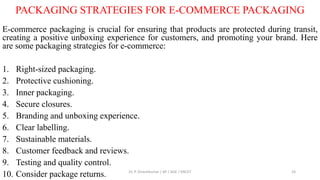
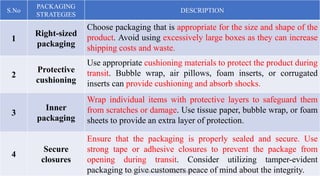
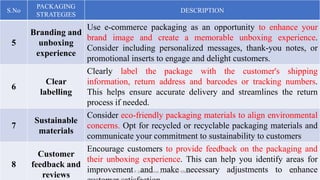
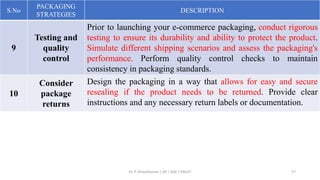
PACKAGING STRATEGIES FOR E-COMMERCE PACKAGING
E-commerce packaging is crucial for ensuring that products are protected during transit,
creating a positive unboxing experience for customers, and promoting your brand. Here
are some packaging strategies for e-commerce:
1. Right-sized packaging.
2. Protective cushioning.
3. Inner packaging.
4. Secure closures.
5. Branding and unboxing experience.
6. Clear labelling.
7. Sustainable materials.
8. Customer feedback and reviews.
9. Testing and quality control.
10. Consider package returns. Dr. P. Dineshkumar / AP / AGE / KNCET 24
S.No
PACKAGING
STRATEGIES
DESCRIPTION
1
Right-sized
packaging
Choose packaging that is appropriate for the size and shape of the
product. Avoid using excessively large boxes as they can increase
shipping costs and waste.
2
Protective
cushioning
Use appropriate cushioning materials to protect the product during
transit. Bubble wrap, air pillows, foam inserts, or corrugated
inserts can provide cushioning and absorb shocks.
3
Inner
packaging
Wrap individual items with protective layers to safeguard them
from scratches or damage. Use tissue paper, bubble wrap, or foam
sheets to provide an extra layer of protection.
4
Secure
closures
Ensure that the packaging is properly sealed and secure. Use
strong tape or adhesive closures to prevent the package from
opening during transit. Consider utilizing tamper-evident
packaging to give customers peace of mind about the integrity.
Dr. P. Dineshkumar / AP / AGE / KNCET 25
S.No
PACKAGING
STRATEGIES
DESCRIPTION
5
Branding and
unboxing
experience
Use e-commerce packaging as an opportunity to enhance your
brand image and create a memorable unboxing experience.
Consider including personalized messages, thank-you notes, or
promotional inserts to engage and delight customers.
6
Clear
labelling
Clearly label the package with the customer's shipping
information, return address and barcodes or tracking numbers.
This helps ensure accurate delivery and streamlines the return
process if needed.
7
Sustainable
materials
Consider eco-friendly packaging materials to align environmental
concerns. Opt for recycled or recyclable packaging materials and
communicate your commitment to sustainability to customers
8
Customer
feedback and
reviews
Encourage customers to provide feedback on the packaging and
their unboxing experience. This can help you identify areas for
improvement and make necessary adjustments to enhance
Dr. P. Dineshkumar / AP / AGE / KNCET 26
S.No
PACKAGING
STRATEGIES
DESCRIPTION
9
Testing and
quality
control
Prior to launching your e-commerce packaging, conduct rigorous
testing to ensure its durability and ability to protect the product.
Simulate different shipping scenarios and assess the packaging's
performance. Perform quality control checks to maintain
consistency in packaging standards.
10
Consider
package
returns
Design the packaging in a way that allows for easy and secure
resealing if the product needs to be returned. Provide clear
instructions and any necessary return labels or documentation.
Dr. P. Dineshkumar / AP / AGE / KNCET 27
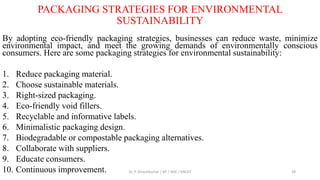
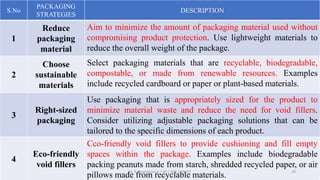
PACKAGING STRATEGIES FOR ENVIRONMENTAL
SUSTAINABILITY
By adopting eco-friendly packaging strategies, businesses can reduce waste, minimize
environmental impact, and meet the growing demands of environmentally conscious
consumers. Here are some packaging strategies for environmental sustainability:
1. Reduce packaging material.
2. Choose sustainable materials.
3. Right-sized packaging.
4. Eco-friendly void fillers.
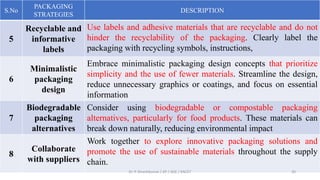
5. Recyclable and informative labels.
6. Minimalistic packaging design.
7. Biodegradable or compostable packaging alternatives.
8. Collaborate with suppliers.
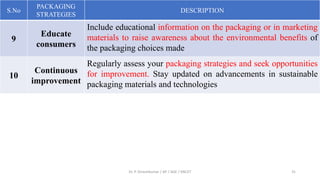
9. Educate consumers.
10. Continuous improvement. Dr. P. Dineshkumar / AP / AGE / KNCET 28
S.No
PACKAGING
STRATEGIES
DESCRIPTION
1
Reduce
packaging
material
Aim to minimize the amount of packaging material used without
compromising product protection. Use lightweight materials to
reduce the overall weight of the package.
2
Choose
sustainable
materials
Select packaging materials that are recyclable, biodegradable,
compostable, or made from renewable resources. Examples
include recycled cardboard or paper or plant-based materials.
3
Right-sized
packaging
Use packaging that is appropriately sized for the product to
minimize material waste and reduce the need for void fillers.
Consider utilizing adjustable packaging solutions that can be
tailored to the specific dimensions of each product.
4
Eco-friendly
void fillers
Cco-friendly void fillers to provide cushioning and fill empty
spaces within the package. Examples include biodegradable
packing peanuts made from starch, shredded recycled paper, or air
pillows made from recyclable materials.
Dr. P. Dineshkumar / AP / AGE / KNCET 29
S.No
PACKAGING
STRATEGIES
DESCRIPTION
5
Recyclable and
informative
labels
Use labels and adhesive materials that are recyclable and do not
hinder the recyclability of the packaging. Clearly label the
packaging with recycling symbols, instructions,
6
Minimalistic
packaging
design
Embrace minimalistic packaging design concepts that prioritize
simplicity and the use of fewer materials. Streamline the design,
reduce unnecessary graphics or coatings, and focus on essential
information
7
Biodegradable
packaging
alternatives
Consider using biodegradable or compostable packaging
alternatives, particularly for food products. These materials can
break down naturally, reducing environmental impact
8
Collaborate
with suppliers
Work together to explore innovative packaging solutions and
promote the use of sustainable materials throughout the supply
chain.
Dr. P. Dineshkumar / AP / AGE / KNCET 30
S.No
PACKAGING
STRATEGIES
DESCRIPTION
9
Educate
consumers
Include educational information on the packaging or in marketing
materials to raise awareness about the environmental benefits of
the packaging choices made
10
Continuous
improvement
Regularly assess your packaging strategies and seek opportunities
for improvement. Stay updated on advancements in sustainable
packaging materials and technologies
Dr. P. Dineshkumar / AP / AGE / KNCET 31
PACKAGING MATERIALS
Dr. P. Dineshkumar / AP / AGE / KNCET 32
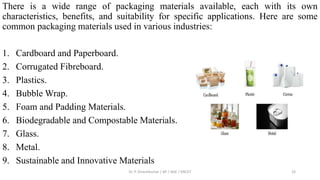
There is a wide range of packaging materials available, each with its own
characteristics, benefits, and suitability for specific applications. Here are some
common packaging materials used in various industries:
1. Cardboard and Paperboard.
2. Corrugated Fibreboard.
3. Plastics.
4. Bubble Wrap.
5. Foam and Padding Materials.
6. Biodegradable and Compostable Materials.
7. Glass.
8. Metal.
9. Sustainable and Innovative Materials
Dr. P. Dineshkumar / AP / AGE / KNCET 33
• Cardboard and Paperboard: Cardboard and paperboard are widely used for
packaging boxes, cartons, and containers. They are lightweight, cost-effective,
recyclable, and offer good printing surfaces for branding and product information
• Corrugated Fibreboard: Corrugated fibreboard, commonly known as corrugated
cardboard, consists of a fluted inner layer sandwiched between two flat
linerboards
• Plastic: Plastic packaging materials offer versatility, durability, and barrier
properties. Common types of plastic used in packaging include polyethylene (PE),
polypropylene (PP), polyethylene terephthalate (PET), and polystyrene (PS)
• Bubble Wrap: Bubble wrap is a plastic packaging material with air-filled bubbles
that provide cushioning and protection. It is commonly used to wrap fragile items,
electronics, and delicate products
Dr. P. Dineshkumar / AP / AGE / KNCET 34
• Foam and Padding Materials: Foam materials, such as polyurethane (PU) foam
or expanded polystyrene (EPS), are used for cushioning and shock absorption.
• Biodegradable and Compostable Materials: There is a growing demand for
biodegradable and compostable packaging materials. These materials, such as
bioplastics or plant-based packaging, break down naturally over time, reducing
environmental impact.
• Glass: Glass packaging is commonly used for food and beverage products,
cosmetics, and pharmaceuticalsIt provides excellent product visibility, is non-
reactive, and offers a premium look and feel.
• Metal: Metal packaging, such as aluminum cans or tin containers, is durable,
tamper-resistant, and offers excellent product protection.
• Sustainable and Innovative Materials: Various sustainable packaging materials
and innovations are emerging, including bio-based plastics, packaging made from
agricultural waste. These materials aim to reduce reliance on fossil fuels, minimize
waste, and promote a circular economy.
Dr. P. Dineshkumar / AP / AGE / KNCET 35
CUSHIONING MATERIALS
Dr. P. Dineshkumar / AP / AGE / KNCET 36
Cushioning materials are essential for protecting products from shocks, vibrations,
and impacts during transportation and handling. They help absorb energy and
prevent damage to the product. Here are some common cushioning materials used
in packaging:
• Bubble Wrap: Bubble wrap consists of air-filled bubbles that create a protective
cushioning layer. It is lightweight, flexible, and offers excellent shock absorption.
• Foam Inserts: Foam inserts, such as polyurethane (PU) foam or polyethylene
(PE) foam, are widely used for cushioning delicate and fragile items. They can be
pre-cut or custom-molded to fit the specific shape and contours of the product.
• Air Pillows: Air pillows are inflatable plastic cushions filled with air. They are
lightweight and provide cushioning and void-fill capabilities. Air pillows can be
easily adjusted to fit the package and offer protection against shocks and
vibrations.
Dr. P. Dineshkumar / AP / AGE / KNCET 37
Bubble Wrap Foam Inserts Air Pillows
Dr. P. Dineshkumar / AP / AGE / KNCET 38
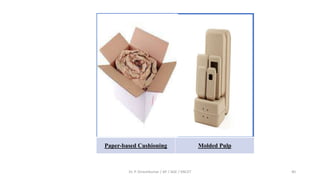
• Paper-based Cushioning: Various paper-based cushioning materials are
available, including kraft paper, crumpled paper, and honeycomb paper they
provide good shock absorption and void-fill properties.
• Molded Pulp: Molded pulp is made from recycled paper or cardboard fibers. It is
a sustainable cushioning material that is custom-formed to fit the shape of the
product.
• Peanuts: Packing peanuts, also known as loose-fill peanuts or foam peanuts, are
small, lightweight foam or biodegradable starch-based pieces. They are used to fill
empty spaces within packages, providing cushioning and preventing product
movement.
• Foam Sheets: Foam sheets, available in various thicknesses and densities, offer
versatile cushioning. They can be wrapped around products or cut into custom
shapes to provide a protective layer
Dr. P. Dineshkumar / AP / AGE / KNCET 39
Paper-based Cushioning Molded Pulp
Dr. P. Dineshkumar / AP / AGE / KNCET 40
• Corrugated Inserts: Corrugated cardboard inserts or dividers are used to
separate and protect individual items within a package. They provide structural
support, prevent items from colliding, and offer additional strength and rigidity.
• Inflatable Packaging Systems: Inflatable packaging systems use air-filled
chambers or bags that provide cushioning and protection. They are inflated on-
site, reducing storage space requirements, and can be easily adjusted to fit
different product sizes
• Eco-friendly Alternatives: Sustainable cushioning materials, such as
biodegradable foam or compostable packing peanuts made from plant-based
materials, offer environmentally friendly options that reduce waste and promote
sustainability
Dr. P. Dineshkumar / AP / AGE / KNCET 41
BIO DEGRADABLE PACKAGING
MATERIALS
Dr. P. Dineshkumar / AP / AGE / KNCET 42
Dr. P. Dineshkumar / AP / AGE / KNCET 43
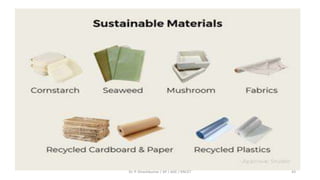
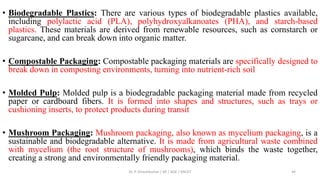
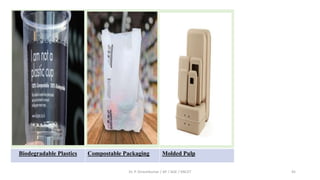
• Biodegradable Plastics: There are various types of biodegradable plastics available,
including polylactic acid (PLA), polyhydroxyalkanoates (PHA), and starch-based
plastics. These materials are derived from renewable resources, such as cornstarch or
sugarcane, and can break down into organic matter.
• Compostable Packaging: Compostable packaging materials are specifically designed to
break down in composting environments, turning into nutrient-rich soil
• Molded Pulp: Molded pulp is a biodegradable packaging material made from recycled
paper or cardboard fibers. It is formed into shapes and structures, such as trays or
cushioning inserts, to protect products during transit
• Mushroom Packaging: Mushroom packaging, also known as mycelium packaging, is a
sustainable and biodegradable alternative. It is made from agricultural waste combined
with mycelium (the root structure of mushrooms), which binds the waste together,
creating a strong and environmentally friendly packaging material.
Dr. P. Dineshkumar / AP / AGE / KNCET 44
Biodegradable Plastics Compostable Packaging Molded Pulp
Dr. P. Dineshkumar / AP / AGE / KNCET 45
• Biodegradable Films: Biodegradable films, often made from materials such as
PLA or cellulose, are used for various packaging applications. They can be used
for wrapping individual items, forming bags, or creating transparent windows in
packaging.
• Biodegradable Packing Peanuts: Packing peanuts made from biodegradable
materials, such as starch-based foam, offer an eco-friendly alternative to
traditional packing peanuts.
• Paper and Cardboard: Paper and cardboard are renewable and biodegradable
materials commonly used for packaging. They can be recycled multiple times and,
if disposed of in appropriate conditions, will naturally break down over time.
Dr. P. Dineshkumar / AP / AGE / KNCET 46
SHRINK AND STRETCH PACKAGING
MATERIALS
Dr. P. Dineshkumar / AP / AGE / KNCET 47
SHRINK WRAP
• Product Protection: Shrink wrap provides a tight, sealed barrier that protects
products from moisture, dust, and other contaminants.
• Tamper-Evident Packaging: Shrink wrap can be used to create tamper-evident
seals, ensuring the integrity of the product during transportation and storage.
• Enhanced Stability: Shrink wrap can improve the stability and stacking
strength of bundled items, preventing shifting or movement.
• Visibility: Clear shrink wrap allows for product visibility, enabling visual
inspection without compromising protection.
Dr. P. Dineshkumar / AP / AGE / KNCET 48
STRETCH WRAP
• Load Stability: Stretch wrap provides stability to palletized loads, preventing
shifting or toppling during handling and transportation
• Protection: Stretch wrap shields products from dust, moisture, and UV light
• Versatility: It can be used for wrapping individual items, bundling products
together, or securing palletized loads
• Cost-Effective: Stretch wrap is generally less expensive than other packaging
materials, making it a cost-effective option for unitizing and securing loads
• Accessibility: Stretch wrap is available in different widths, thicknesses, and
strengths to accommodate various packaging needs
Dr. P. Dineshkumar / AP / AGE / KNCET 49

Unit 3 Functions of packaging materials.pptx

  • 1.
    Power Point Presentation SUBJECTCODE & NAME 20AG105PE STORAGE AND PACKING TECHNOLOGY UNIT – 3 FUNCTIONS OF PACKAGING MATERIALS Prepared by, Dr. P. Dineshkumar M.E., Ph.D., Assistant Professor, Department of Agricultural Engineering, Kongunadu College of Engineering and Technology. Dr. P. Dineshkumar / AP / AGE / KNCET 1
  • 2.
    INTRODUCTION • Packaging materialsserve several important functions in the transportation, storage, and protection of goods. They are designed to ensure that products reach consumers in optimal condition while providing information and convenience. • The Packaging Institute International defines packaging as the enclosure of products, items or packages in a wrapped pouch, bag, box, cup, tray, can, tube, bottle or other container form • Containment • Protection and/or preservation • Communications • Utility or Performance If the device or container performs one or more of these functions it is considered a package. Dr. P. Dineshkumar / AP / AGE / KNCET 2
  • 3.
    The selection ofa packaging, will depend on 1. Existing economic ability. 2. Production and distribution efficiency. 3. Retailing pattern. 4. Consumer preferences. 5. Ecological aspects. Dr. P. Dineshkumar / AP / AGE / KNCET 3
  • 4.
    KEY FUNCTIONS OFPACKAGING MATERIALS Dr. P. Dineshkumar / AP / AGE / KNCET 4
  • 5.
    FUNCTIONS OF PACKAGING BASICFUNCTIONS SELLING FUNCTIONS Protection Containment Preservation Information Marketing and Branding Convenience Legal and Regulatory Compliance Convenience in Distribution Tamper Resistance Differentiation and Shelf Appeal Environmental Sustainability Cost efficiency Consumer Convenience and User Experience Shelf Organization and Retail Efficiency Product Information and Communication Dr. P. Dineshkumar / AP / AGE / KNCET 5
  • 6.
    • Protection: Oneof the primary functions of packaging materials is to protect the enclosed product from damage during handling, transportation, and storage. For example, cushioning materials like foam or bubble wrap can absorb shocks, while sturdy boxes or containers provide structural support • Containment: Packaging materials serve to contain and hold the product securely in place, preventing movement or shifting that could lead to damage. • Preservation: Certain packaging materials are designed to extend the shelf life of products by providing a protective environment. Vacuum-sealed packaging can also remove air and inhibit the growth of bacteria, further preserving the product • Information: Packaging materials often feature labels, tags, or printed information that provides crucial details about the product. Such information helps consumers make informed decisions and ensures product safety and regulatory compliance. Dr. P. Dineshkumar / AP / AGE / KNCET 6
  • 7.
    • Convenience: Packagingmaterials also aim to enhance convenience for both manufacturers and consumers. Easy-to-open features, such as tear strips or zip locks, facilitate product access. Packaging that is lightweight and stackable optimizes storage and transportation efficiency. • Legal and Regulatory Compliance: Packaging materials must adhere to various legal and regulatory requirements. Packaging materials need to meet these standards to ensure consumer safety, protect the environment, and comply with relevant laws. • Environmental Sustainability: Packaging materials are increasingly being designed with consideration for environmental impact. Additionally, lightweight packaging reduces material consumption and transportation energy requirements. Dr. P. Dineshkumar / AP / AGE / KNCET 7
  • 8.
    • Marketing andBranding: Packaging materials play a crucial role in marketing and branding efforts. Well-designed packaging can create an good connection with consumers and influence purchase decisions. • Convenience in Distribution: Packaging materials facilitate efficient distribution by enabling easy handling, stacking, and transportation of products. • Tamper Resistance: Packaging materials can incorporate features that provide evidence of tampering or unauthorized access to the product. These help ensure product safety, integrity, and consumer trust by indicating if the package has been compromised. • Differentiation and Shelf Appeal: Packaging materials contribute to the visual appeal and differentiation of products on store shelves. Packaging materials also aid in effectively communicating the product's benefits and target audience through visual cues Dr. P. Dineshkumar / AP / AGE / KNCET 8
  • 9.
    • Consumer Convenienceand User Experience: Packaging materials can enhance the overall consumer experience by offering convenience features like easy opening, portion control, or reseal ability. • Shelf Organization and Retail Efficiency: Packaging materials assist in organizing products on store shelves for efficient stocking and display. They can incorporate features like standardized dimensions, barcode labels, or hanging tabs for easy identification and handling in retail environments. • Product Information and Communication: Packaging materials serve as a platform for product communication and branding. In addition to mandatory labeling information, they may include promotional messages, storytelling elements, or QR codes that direct consumers to further product information or online resources. • Cost Efficiency: Packaging materials play a role in cost management for manufacturers. Optimizing packaging design, material selection, and production processes can contribute to cost savings while still meeting functional requirements. Dr. P. Dineshkumar / AP / AGE / KNCET 9
  • 10.
    PACKAGING STRATEGIES FORVARIOUS ENVIRONMENT Packaging strategies can vary depending on the specific environmental conditions in which the products will be transported, stored, or displayed. Here are some packaging strategies for different environments. 1. High Humidity Environments. 2. Extreme Temperature Environments. 3. Fragile or Delicate Products. 4. Retail Display Packaging. 5. E-commerce Packaging. 6. Environmental Sustainability. Dr. P. Dineshkumar / AP / AGE / KNCET 10
  • 11.
    PACKAGING STRATEGIES FORHIGH HUMIDITY ENVIRONMENTS In high humidity environments, packaging strategies are essential to protect products from moisture damage and maintain their quality. Here are some packaging strategies for high humidity environments: 1. Moisture-Resistant Materials. 2. Desiccants. 3. Seal Integrity. 4. Individually Sealed Units. 5. Absorbent Pads or Liners. 6. Humidity Indicator Cards. 7. Proper Storage and Handling. Dr. P. Dineshkumar / AP / AGE / KNCET 11
  • 12.
    S. No PACKAGING STRATEGIES DESCRIPTION 1 Moisture- Resistant Materials Use packaging materialsthat are resistant to moisture, such as laminated films, moisture-barrier coatings, or waterproof materials like polyethylene (PE) or polypropylene (PP). 2 Desiccants Include desiccant packets or sachets inside the packaging to absorb excess moisture and maintain product integrity. Common desiccants include silica gel. 3 Sealed Integrity Employ heat sealing or vacuum sealing techniques to create a tight seal and prevent moisture ingress. 4 Individually Sealed Units For products that are highly sensitive to moisture, consider individually sealing each unit or component. This provides an extra layer of protection, ensuring that even if moisture breaches one unit, it won't affect the others. Dr. P. Dineshkumar / AP / AGE / KNCET 12
  • 13.
    S.No PACKAGING STRATEGIES DESCRIPTION 5 Absorbent Pads or Liners Useabsorbent pads or liners within the packaging to capture any moisture that may accumulate during transit or storage. 6 Humidity Indicator Cards Include humidity indicator cards in the packaging to monitor and detect humidity levels. These cards change color when exposed to certain humidity thresholds, providing a visual indication of moisture exposure. 7 Proper Storage and Handling Educate distributors, retailers, and end-users about the importance of storing products in controlled environments with appropriate humidity levels. Dr. P. Dineshkumar / AP / AGE / KNCET 13
  • 14.
    PACKAGING STRATEGIES FOREXTREME TEMPERATURE ENVIRONMENTS In extreme temperature environments, packaging strategies are crucial to protect products from temperature variations that can affect their integrity, stability, and quality. Here are some packaging strategies for extreme temperature environments: 1. Thermal Insulation. 2. Cold Chain Packaging. 3. Temperature Monitoring. 4. Phase Change Materials. 5. Proper Insulation and Sealing. 6. Pre-conditioning and Conditioning. 7. Shipping Considerations. 8. Documentation and Handling Instructions. Dr. P. Dineshkumar / AP / AGE / KNCET 14
  • 15.
    S.No PACKAGING STRATEGIES DESCRIPTION 1 Thermal Insulation The materials caninclude foam, insulated liners or reflective insulation. They help to create a barrier that slows down the transfer of heat or cold, reducing the impact of temperature fluctuations on the product. 2 Cold Chain Packaging It involves using insulated containers or packaging systems that maintain a specific temperature range throughout the distribution and storage process. 3 Temperature Monitoring Incorporate temperature-monitoring devices, such as temperature-sensitive labels or data loggers, into the packaging. 4 Phase Change Materials PCMs are substances that can absorb and release thermal energy, helping to regulate temperature. By incorporating PCMs into packaging materials Dr. P. Dineshkumar / AP / AGE / KNCET 15
  • 16.
    S. No PACKAGING STRATEGIES DESCRIPTION 5 Proper Insulation and Sealing Ensure thatthe packaging is well-insulated and properly sealed to minimize temperature exchange with the external environment. 6 Pre-conditioning and Conditioning Pre-conditioning the packaging before product insertion can help minimize temperature shocks. This involves allowing the packaging materials to adjust to the anticipated temperature environment. 7 Shipping Considerations Plan shipping schedules and routes to avoid extreme temperature exposure. Minimize the time spent in environments with extreme temperatures. 8 Documentation and Handling Instructions Provide clear instructions and guidelines for handling the packaged products in extreme temperature environments. This includes specifying the required temperature range, any special storage conditions. Dr. P. Dineshkumar / AP / AGE / KNCET 16
  • 17.
    PACKAGING STRATEGIES FORFRAGILE (or) DELICATE PRODUCTS When it comes to packaging fragile or delicate products, it's essential to prioritize protection to ensure they arrive intact and undamaged. Here are some packaging strategies to consider 1. Select appropriate packaging materials. 2. Use double boxing. 3. Wrap items individually. 4. Reinforce corners and edges. 5. Secure items in place. 6. Label the package. 7. Test the packaging. 8. Consider custom packaging. Dr. P. Dineshkumar / AP / AGE / KNCET 17
  • 18.
    S.No PACKAGING STRATEGIES DESCRIPTION 1 Select appropriate packaging materials Choose packaging materialsthat provide cushioning and shock absorption, such as bubble wrap, foam inserts, air pillows, or corrugated cardboard inserts. These materials help absorb impacts and prevent movement within the package. 2 Use double boxing A two-box system where the fragile item is placed in a smaller box with cushioning material around it. This smaller box can then be placed inside a larger outer box with additional cushioning. 3 Wrap items individually Wrap each fragile item individually using bubble wrap, foam sheets, or tissue paper. This prevents items from coming into direct contact with each other, reducing the risk of damage. 4 Reinforce corners and edges Pay special attention to reinforcing the corners and edges of the package. These areas are more susceptible to damage during transit. Dr. P. Dineshkumar / AP / AGE / KNCET 18
  • 19.
    S.No PACKAGING STRATEGIES DESCRIPTION 5 Secure items in place Makesure the delicate product is securely positioned within the packaging and cannot move around. Use crumpled paper to fill any empty spaces and provide stability. The goal is to minimize movement and keep the item firmly in place. 6 Label the package Clearly mark the package as fragile or delicate using labels or stickers. This helps alert handlers and carriers to exercise caution while handling the package during transit. 7 Test the packaging Before finalizing the packaging, conduct some test shipments to ensure the chosen packaging materials and strategies are effective. This will help you identify any potential issues and make necessary adjustments. 8 Consider custom packaging If you frequently ship delicate products, you may want to consider investing in custom packaging solutions tailored to your specific products. Dr. P. Dineshkumar / AP / AGE / KNCET 19
  • 20.
    PACKAGING STRATEGIES FORRETAIL DISPLAY PACKAGING Retail display packaging plays a crucial role in attracting customers' attention, showcasing products effectively, and promoting sales. Here are some packaging strategies for retail display: 1. Branding and design. 2. Clear product visibility. 3. Shelf impact. 4. Informative content. 5. Promotional elements. 6. Durability and protection. 7. Easy opening and resealing. 8. Sustainability. 9. Point-of-sale displays. 10. Testing and feedback. Dr. P. Dineshkumar / AP / AGE / KNCET 20
  • 21.
    S.No PACKAGING STRATEGIES DESCRIPTION 1 Branding and design Create packagingthat reflects your brand identity and appeals to your target audience. Use attractive graphics, colors, and fonts to make your packaging visually appealing. Incorporate your logo prominently to enhance brand recognition. 2 Clear product visibility Ensure that your packaging allows customers to see the product clearly without opening or tampering with it. Using transparent clear plastic packaging to showcase the product with its feature. 3 Shelf impact Consider the shape, size, and dimensions of your packaging to make it visually distinct and easily noticeable. Unique or unconventional shapes can attract attention and make your products more memorable. 4 Informative content Provide essential product information, such as product features, benefits, and ingredients, on the packaging. Clear content can help customers make informed purchasing decisions. Dr. P. Dineshkumar / AP / AGE / KNCET 21
  • 22.
    S.No PACKAGING STRATEGIES DESCRIPTION 5 Promotional elements Incorporate promotional messages,special offers, discounts, or loyalty program details on the packaging to entice customers. Consider using eye-catching stickers, labels that encourage immediate purchase. 6 Durability and protection Ensure that your retail display packaging is durable enough to withstand handling during transportation and stocking. It should protect the product from damage 7 Easy opening and resealing Make it convenient for customers to open and access the product. Consider incorporating tear strips, perforations or easy-to-use closures that allow for resealing. 8 Sustainability Use recyclable, biodegradable, or compostable materials, and communicate your commitment to sustainability on the packaging. This can appeal to environmentally conscious consumers and align with their values. Dr. P. Dineshkumar / AP / AGE / KNCET 22
  • 23.
    S.No PACKAGING STRATEGIES DESCRIPTION 9 Point-of-sale displays Consider creating packagingthat doubles as a point-of-sale display. Utilize counter displays, floor stands, or end cap displays to maximize product visibility and encourage impulse purchases. 10 Testing and feedback Before launching your retail display packaging, conduct testing and gather feedback from potential customers. This helps identify any potential improvements and ensures that your packaging meets the desired objectives. Dr. P. Dineshkumar / AP / AGE / KNCET 23
  • 24.
    PACKAGING STRATEGIES FORE-COMMERCE PACKAGING E-commerce packaging is crucial for ensuring that products are protected during transit, creating a positive unboxing experience for customers, and promoting your brand. Here are some packaging strategies for e-commerce: 1. Right-sized packaging. 2. Protective cushioning. 3. Inner packaging. 4. Secure closures. 5. Branding and unboxing experience. 6. Clear labelling. 7. Sustainable materials. 8. Customer feedback and reviews. 9. Testing and quality control. 10. Consider package returns. Dr. P. Dineshkumar / AP / AGE / KNCET 24
  • 25.
    S.No PACKAGING STRATEGIES DESCRIPTION 1 Right-sized packaging Choose packaging thatis appropriate for the size and shape of the product. Avoid using excessively large boxes as they can increase shipping costs and waste. 2 Protective cushioning Use appropriate cushioning materials to protect the product during transit. Bubble wrap, air pillows, foam inserts, or corrugated inserts can provide cushioning and absorb shocks. 3 Inner packaging Wrap individual items with protective layers to safeguard them from scratches or damage. Use tissue paper, bubble wrap, or foam sheets to provide an extra layer of protection. 4 Secure closures Ensure that the packaging is properly sealed and secure. Use strong tape or adhesive closures to prevent the package from opening during transit. Consider utilizing tamper-evident packaging to give customers peace of mind about the integrity. Dr. P. Dineshkumar / AP / AGE / KNCET 25
  • 26.
    S.No PACKAGING STRATEGIES DESCRIPTION 5 Branding and unboxing experience Use e-commercepackaging as an opportunity to enhance your brand image and create a memorable unboxing experience. Consider including personalized messages, thank-you notes, or promotional inserts to engage and delight customers. 6 Clear labelling Clearly label the package with the customer's shipping information, return address and barcodes or tracking numbers. This helps ensure accurate delivery and streamlines the return process if needed. 7 Sustainable materials Consider eco-friendly packaging materials to align environmental concerns. Opt for recycled or recyclable packaging materials and communicate your commitment to sustainability to customers 8 Customer feedback and reviews Encourage customers to provide feedback on the packaging and their unboxing experience. This can help you identify areas for improvement and make necessary adjustments to enhance Dr. P. Dineshkumar / AP / AGE / KNCET 26
  • 27.
    S.No PACKAGING STRATEGIES DESCRIPTION 9 Testing and quality control Prior tolaunching your e-commerce packaging, conduct rigorous testing to ensure its durability and ability to protect the product. Simulate different shipping scenarios and assess the packaging's performance. Perform quality control checks to maintain consistency in packaging standards. 10 Consider package returns Design the packaging in a way that allows for easy and secure resealing if the product needs to be returned. Provide clear instructions and any necessary return labels or documentation. Dr. P. Dineshkumar / AP / AGE / KNCET 27
  • 28.
    PACKAGING STRATEGIES FORENVIRONMENTAL SUSTAINABILITY By adopting eco-friendly packaging strategies, businesses can reduce waste, minimize environmental impact, and meet the growing demands of environmentally conscious consumers. Here are some packaging strategies for environmental sustainability: 1. Reduce packaging material. 2. Choose sustainable materials. 3. Right-sized packaging. 4. Eco-friendly void fillers. 5. Recyclable and informative labels. 6. Minimalistic packaging design. 7. Biodegradable or compostable packaging alternatives. 8. Collaborate with suppliers. 9. Educate consumers. 10. Continuous improvement. Dr. P. Dineshkumar / AP / AGE / KNCET 28
  • 29.
    S.No PACKAGING STRATEGIES DESCRIPTION 1 Reduce packaging material Aim to minimizethe amount of packaging material used without compromising product protection. Use lightweight materials to reduce the overall weight of the package. 2 Choose sustainable materials Select packaging materials that are recyclable, biodegradable, compostable, or made from renewable resources. Examples include recycled cardboard or paper or plant-based materials. 3 Right-sized packaging Use packaging that is appropriately sized for the product to minimize material waste and reduce the need for void fillers. Consider utilizing adjustable packaging solutions that can be tailored to the specific dimensions of each product. 4 Eco-friendly void fillers Cco-friendly void fillers to provide cushioning and fill empty spaces within the package. Examples include biodegradable packing peanuts made from starch, shredded recycled paper, or air pillows made from recyclable materials. Dr. P. Dineshkumar / AP / AGE / KNCET 29
  • 30.
    S.No PACKAGING STRATEGIES DESCRIPTION 5 Recyclable and informative labels Use labelsand adhesive materials that are recyclable and do not hinder the recyclability of the packaging. Clearly label the packaging with recycling symbols, instructions, 6 Minimalistic packaging design Embrace minimalistic packaging design concepts that prioritize simplicity and the use of fewer materials. Streamline the design, reduce unnecessary graphics or coatings, and focus on essential information 7 Biodegradable packaging alternatives Consider using biodegradable or compostable packaging alternatives, particularly for food products. These materials can break down naturally, reducing environmental impact 8 Collaborate with suppliers Work together to explore innovative packaging solutions and promote the use of sustainable materials throughout the supply chain. Dr. P. Dineshkumar / AP / AGE / KNCET 30
  • 31.
    S.No PACKAGING STRATEGIES DESCRIPTION 9 Educate consumers Include educational informationon the packaging or in marketing materials to raise awareness about the environmental benefits of the packaging choices made 10 Continuous improvement Regularly assess your packaging strategies and seek opportunities for improvement. Stay updated on advancements in sustainable packaging materials and technologies Dr. P. Dineshkumar / AP / AGE / KNCET 31
  • 32.
    PACKAGING MATERIALS Dr. P.Dineshkumar / AP / AGE / KNCET 32
  • 33.
    There is awide range of packaging materials available, each with its own characteristics, benefits, and suitability for specific applications. Here are some common packaging materials used in various industries: 1. Cardboard and Paperboard. 2. Corrugated Fibreboard. 3. Plastics. 4. Bubble Wrap. 5. Foam and Padding Materials. 6. Biodegradable and Compostable Materials. 7. Glass. 8. Metal. 9. Sustainable and Innovative Materials Dr. P. Dineshkumar / AP / AGE / KNCET 33
  • 34.
    • Cardboard andPaperboard: Cardboard and paperboard are widely used for packaging boxes, cartons, and containers. They are lightweight, cost-effective, recyclable, and offer good printing surfaces for branding and product information • Corrugated Fibreboard: Corrugated fibreboard, commonly known as corrugated cardboard, consists of a fluted inner layer sandwiched between two flat linerboards • Plastic: Plastic packaging materials offer versatility, durability, and barrier properties. Common types of plastic used in packaging include polyethylene (PE), polypropylene (PP), polyethylene terephthalate (PET), and polystyrene (PS) • Bubble Wrap: Bubble wrap is a plastic packaging material with air-filled bubbles that provide cushioning and protection. It is commonly used to wrap fragile items, electronics, and delicate products Dr. P. Dineshkumar / AP / AGE / KNCET 34
  • 35.
    • Foam andPadding Materials: Foam materials, such as polyurethane (PU) foam or expanded polystyrene (EPS), are used for cushioning and shock absorption. • Biodegradable and Compostable Materials: There is a growing demand for biodegradable and compostable packaging materials. These materials, such as bioplastics or plant-based packaging, break down naturally over time, reducing environmental impact. • Glass: Glass packaging is commonly used for food and beverage products, cosmetics, and pharmaceuticalsIt provides excellent product visibility, is non- reactive, and offers a premium look and feel. • Metal: Metal packaging, such as aluminum cans or tin containers, is durable, tamper-resistant, and offers excellent product protection. • Sustainable and Innovative Materials: Various sustainable packaging materials and innovations are emerging, including bio-based plastics, packaging made from agricultural waste. These materials aim to reduce reliance on fossil fuels, minimize waste, and promote a circular economy. Dr. P. Dineshkumar / AP / AGE / KNCET 35
  • 36.
    CUSHIONING MATERIALS Dr. P.Dineshkumar / AP / AGE / KNCET 36
  • 37.
    Cushioning materials areessential for protecting products from shocks, vibrations, and impacts during transportation and handling. They help absorb energy and prevent damage to the product. Here are some common cushioning materials used in packaging: • Bubble Wrap: Bubble wrap consists of air-filled bubbles that create a protective cushioning layer. It is lightweight, flexible, and offers excellent shock absorption. • Foam Inserts: Foam inserts, such as polyurethane (PU) foam or polyethylene (PE) foam, are widely used for cushioning delicate and fragile items. They can be pre-cut or custom-molded to fit the specific shape and contours of the product. • Air Pillows: Air pillows are inflatable plastic cushions filled with air. They are lightweight and provide cushioning and void-fill capabilities. Air pillows can be easily adjusted to fit the package and offer protection against shocks and vibrations. Dr. P. Dineshkumar / AP / AGE / KNCET 37
  • 38.
    Bubble Wrap FoamInserts Air Pillows Dr. P. Dineshkumar / AP / AGE / KNCET 38
  • 39.
    • Paper-based Cushioning:Various paper-based cushioning materials are available, including kraft paper, crumpled paper, and honeycomb paper they provide good shock absorption and void-fill properties. • Molded Pulp: Molded pulp is made from recycled paper or cardboard fibers. It is a sustainable cushioning material that is custom-formed to fit the shape of the product. • Peanuts: Packing peanuts, also known as loose-fill peanuts or foam peanuts, are small, lightweight foam or biodegradable starch-based pieces. They are used to fill empty spaces within packages, providing cushioning and preventing product movement. • Foam Sheets: Foam sheets, available in various thicknesses and densities, offer versatile cushioning. They can be wrapped around products or cut into custom shapes to provide a protective layer Dr. P. Dineshkumar / AP / AGE / KNCET 39
  • 40.
    Paper-based Cushioning MoldedPulp Dr. P. Dineshkumar / AP / AGE / KNCET 40
  • 41.
    • Corrugated Inserts:Corrugated cardboard inserts or dividers are used to separate and protect individual items within a package. They provide structural support, prevent items from colliding, and offer additional strength and rigidity. • Inflatable Packaging Systems: Inflatable packaging systems use air-filled chambers or bags that provide cushioning and protection. They are inflated on- site, reducing storage space requirements, and can be easily adjusted to fit different product sizes • Eco-friendly Alternatives: Sustainable cushioning materials, such as biodegradable foam or compostable packing peanuts made from plant-based materials, offer environmentally friendly options that reduce waste and promote sustainability Dr. P. Dineshkumar / AP / AGE / KNCET 41
  • 42.
    BIO DEGRADABLE PACKAGING MATERIALS Dr.P. Dineshkumar / AP / AGE / KNCET 42
  • 43.
    Dr. P. Dineshkumar/ AP / AGE / KNCET 43
  • 44.
    • Biodegradable Plastics:There are various types of biodegradable plastics available, including polylactic acid (PLA), polyhydroxyalkanoates (PHA), and starch-based plastics. These materials are derived from renewable resources, such as cornstarch or sugarcane, and can break down into organic matter. • Compostable Packaging: Compostable packaging materials are specifically designed to break down in composting environments, turning into nutrient-rich soil • Molded Pulp: Molded pulp is a biodegradable packaging material made from recycled paper or cardboard fibers. It is formed into shapes and structures, such as trays or cushioning inserts, to protect products during transit • Mushroom Packaging: Mushroom packaging, also known as mycelium packaging, is a sustainable and biodegradable alternative. It is made from agricultural waste combined with mycelium (the root structure of mushrooms), which binds the waste together, creating a strong and environmentally friendly packaging material. Dr. P. Dineshkumar / AP / AGE / KNCET 44
  • 45.
    Biodegradable Plastics CompostablePackaging Molded Pulp Dr. P. Dineshkumar / AP / AGE / KNCET 45
  • 46.
    • Biodegradable Films:Biodegradable films, often made from materials such as PLA or cellulose, are used for various packaging applications. They can be used for wrapping individual items, forming bags, or creating transparent windows in packaging. • Biodegradable Packing Peanuts: Packing peanuts made from biodegradable materials, such as starch-based foam, offer an eco-friendly alternative to traditional packing peanuts. • Paper and Cardboard: Paper and cardboard are renewable and biodegradable materials commonly used for packaging. They can be recycled multiple times and, if disposed of in appropriate conditions, will naturally break down over time. Dr. P. Dineshkumar / AP / AGE / KNCET 46
  • 47.
    SHRINK AND STRETCHPACKAGING MATERIALS Dr. P. Dineshkumar / AP / AGE / KNCET 47
  • 48.
    SHRINK WRAP • ProductProtection: Shrink wrap provides a tight, sealed barrier that protects products from moisture, dust, and other contaminants. • Tamper-Evident Packaging: Shrink wrap can be used to create tamper-evident seals, ensuring the integrity of the product during transportation and storage. • Enhanced Stability: Shrink wrap can improve the stability and stacking strength of bundled items, preventing shifting or movement. • Visibility: Clear shrink wrap allows for product visibility, enabling visual inspection without compromising protection. Dr. P. Dineshkumar / AP / AGE / KNCET 48
  • 49.
    STRETCH WRAP • LoadStability: Stretch wrap provides stability to palletized loads, preventing shifting or toppling during handling and transportation • Protection: Stretch wrap shields products from dust, moisture, and UV light • Versatility: It can be used for wrapping individual items, bundling products together, or securing palletized loads • Cost-Effective: Stretch wrap is generally less expensive than other packaging materials, making it a cost-effective option for unitizing and securing loads • Accessibility: Stretch wrap is available in different widths, thicknesses, and strengths to accommodate various packaging needs Dr. P. Dineshkumar / AP / AGE / KNCET 49