LABELING AND
PACKAGING MATERIALS
FOR FOOD PROCESSING
WEEK 6 (SEPTEMBER 12-16, 2022)
What is the importance
of our name?
Our names are an incredibly
important part of our identity. They
carry deep personal, cultural,
familial, and historical connections.
They also give us a sense of who
we are, the communities in which
we belong, and our place in the
world.
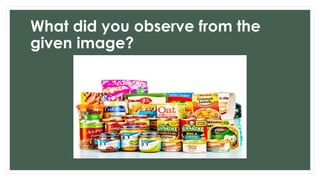
What did you observe from the
given image?
What is product labeling?
•It is a key feature in marketing. It
helps to market the product
allowing customers to know
about the item and give
necessary messages including
ingredients, instructions, and uses.
What are the different
types of a label in
marketing?
1. Brand label
•If the only brand is used on the
package of a product, this is called
a brand label. The brand itself is
expressed in the label.
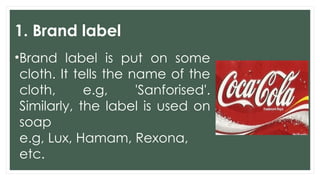
1. Brand label
•Brand label is put on some
cloth. It tells the name of the
cloth, e.g, 'Sanforised'.
Similarly, the label is used on
soap
e.g, Lux, Hamam, Rexona,
etc.
2. Grade label
•Some products have given grade
labels. This type of label shows the
grade of the product. It shows the
quality of products by words, letters, or
figures. A, B, C, D grades can be put on
peas packed into cans.
2. Grade label
•Similarly, the grade label can be
mentioned as 1,2,3,4 grade for
packed wheat. Some firms may use
labels as good, better, best, etc. on
their products.
3. Informative label
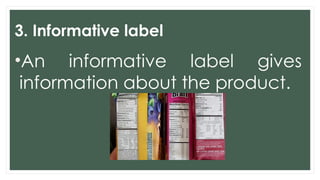
•An informative label gives
information about the product.
3. Informative label
•Using method and security of the
product, name of the producer,
manufactured date, expiry date,
name of intermediary, additional
instructions regarding the use of the
product, etc. are mentioned in the
informative label.
What is the
importance of food
Labelling?
Product labeling can be done in
a variety of sizes, materials, and
shapes. It plays a key role as a
point of sale display on the
market shelves. They can also
communicate information about
how to handle a product or how
to dispose of it.
You can use the labeling for security
reasons so that a product should not
be misused. It is for these purposes the
labeling having the logo or the
trademark of the company. All these
are different types of uses of the label
for a product in the world of business.
Why do we need to
label our processed
products?
Marketers use labeling to their
products to bring identification.
This kind of labeling helps a viewer
to differentiate the product from
the rest on the shelves of the
market. There are several uses of
the label for the products in the
market.
Labeling is used for packaging
the product. In marketing, a
marketer can also use sticker
inedible products to impart
knowledge of the ingredients of
the food items.
This helps to spread awareness
among the customers about the
item they are consuming and
labeling also helps to mention
ingredients.
What are the different
functional aspects of
product packaging?
1. Protects the product
•At its most base level, product packaging
serves to protect the product inside.
Packaging must keep the product safe
during shipment between the
manufacturing facility and the retailer and
must prevent damage while the product
sits on the shelf.
•Therefore, product packaging must
be sturdy and reliable. Many
companies package their products
with seals and locks that prevent
tampering and further ensure the
safety and integrity of the product.
2. Displays and promotes the
product
•Many products, particularly food products,
include a description of ingredients and
nutritional information on the packaging.
Another product packaging may display
instructions explaining how to set up and
use the product.
•Displaying important information
regarding the product helps manage
consumer expectations and promotes
customer satisfaction. The better the
buyer understands what they are
purchasing, the more likely they are to
be happy with said purchase.
3. Attracts buyers
The main goal of creating any product,
after all, is to attract customers and
encourage them to buy your product.
Because first impressions are so important to
the buying process, well-designed product
packaging can go a long way in putting
your product into the hands of buyers.
Choosing a style and colors that
will appeal to consumers and
encourage them to pick up
your product is very important,
as is choosing high-quality
packaging materials.
The product packaging is a reflection
of the product inside and the brand as
a whole. When designing product
packaging, therefore, many brands
conduct extensive research into the
wants and needs of consumers to
ensure their packaging is attractive and
compelling.
4. Differentiates the product from
competitors
•When walking through the aisles of a store, it
quickly becomes clear that there is no shortage
of new and interesting products on the market.
Many retailers often group similar products on
shelves, so the need to separate your products
from the competition is highly important.
•Well-made, eye-catching product
packaging is a great way to do just
that. While the size and shape of
the packaging may be similar to
the competition, the design should
be different.
•The colors, fonts, and style you choose
for your packaging can easily help set
your product apart from other
companies. Innovative designs such as
clear plastic boxes will catch the
consumer’s eye and help put your
product a cut above the rest.
What are the factors to
consider in packaging the
products?
1. Visibility
•Packaging should capture the
customer's attention.
2. Cost
•Packaging can represent a
significant portion of a product’s
selling price.
3. Relevance
•Packaging should depict
your logo or brand name if
applicable.
4. Innovative
•The packaging design
should be unique from the
rest.
5. Creativity
•Creative packaging helps to
better impress potential
customers to buy your
product.
6. Informative
•This includes the
important details of the
product.
7. Environmental issues
•Packaging issues must also
include an assessment of its
environmental impact.
Different packaging
materials.
1. Glass containers
•For high-quality fruit
beverages glass is still the
preferred packaging
medium although the hot-fill
hold cold process should be
applied with care to avoid
breakage of the containers.
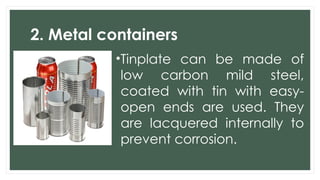
2. Metal containers
•Tinplate can be made of
low carbon mild steel,
coated with tin with easy-
open ends are used. They
are lacquered internally to
prevent corrosion.
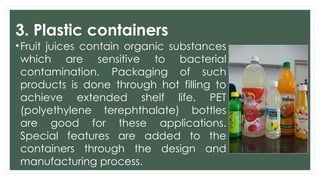
3. Plastic containers
•Fruit juices contain organic substances
which are sensitive to bacterial
contamination. Packaging of such
products is done through hot filling to
achieve extended shelf life. PET
(polyethylene terephthalate) bottles
are good for these applications.
Special features are added to the
containers through the design and
manufacturing process.
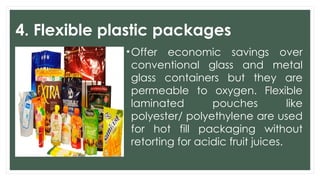
4. Flexible plastic packages
•Offer economic savings over
conventional glass and metal
glass containers but they are
permeable to oxygen. Flexible
laminated pouches like
polyester/ polyethylene are used
for hot fill packaging without
retorting for acidic fruit juices.
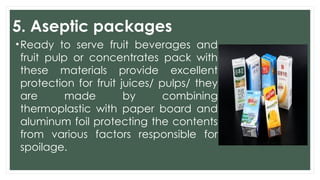
5. Aseptic packages
•Ready to serve fruit beverages and
fruit pulp or concentrates pack with
these materials provide excellent
protection for fruit juices/ pulps/ they
are made by combining
thermoplastic with paper board and
aluminum foil protecting the contents
from various factors responsible for
spoilage.
The aluminum foil is a strong barrier to
oxygen and light. The inner plastic layer
made of polyethylene makes it possible to
seal through the liquid. The outer paper
layer provides stiffness making it possible for
the cartons in a broken shape, thus
enabling maximum utilization of available
storage and transportation space.
To provide convenient access to
the contents beverage cartons
offer a variety of opening
devices such as the following:
•A drinking straw is attached to the
package as an opening feature of the
pack.
•Pull tab opening, which can be
detached from a pre-punched hole.
•Designed caps and closures for easier
pouring and for enhancing the brand
image.
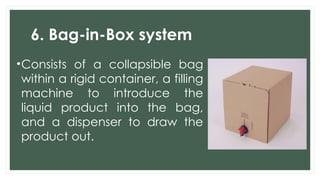
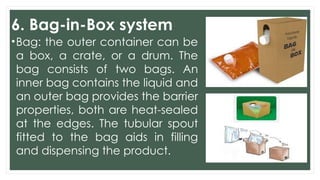
6. Bag-in-Box system
•Consists of a collapsible bag
within a rigid container, a filling
machine to introduce the
liquid product into the bag,
and a dispenser to draw the
product out.
6. Bag-in-Box system
•Bag: the outer container can be
a box, a crate, or a drum. The
bag consists of two bags. An
inner bag contains the liquid and
an outer bag provides the barrier
properties, both are heat-sealed
at the edges. The tubular spout
fitted to the bag aids in filling
and dispensing the product.
The bag is the "life" of the system. The bag itself
consists of three components:
•An inner layer- provides the bag with seal integrity,
polyethylene with excellent sealing and puncture
properties are best for this.
•An outer layer- provides the bag with a barrier
commensurate with the expectation of the shelf-life of
the product.
•A spout and cap- made of molded plastic. Used to fill
the product in the bag and are also to dispense the
product from the pack.
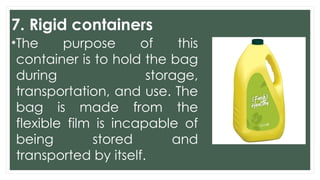
7. Rigid containers
•The purpose of this
container is to hold the bag
during storage,
transportation, and use. The
bag is made from the
flexible film is incapable of
being stored and
transported by itself.
What would happen if
consumer products were
not packaged and
labeled?
In summary, food that is not
packaged according to FDA
regulations will be considered
adulterated and prohibited from
being sold. The next topic is
labeling. If the food package is not
properly labeled, the food will be
considered misbranded.
THANK YOU FOR
LISTENING! 

WEEK6-LABELING----AND-PACKAGING (1).pptx

  • 1.
    LABELING AND PACKAGING MATERIALS FORFOOD PROCESSING WEEK 6 (SEPTEMBER 12-16, 2022)
  • 2.
    What is theimportance of our name?
  • 3.
    Our names arean incredibly important part of our identity. They carry deep personal, cultural, familial, and historical connections. They also give us a sense of who we are, the communities in which we belong, and our place in the world.
  • 4.
    What did youobserve from the given image?
  • 5.
    What is productlabeling? •It is a key feature in marketing. It helps to market the product allowing customers to know about the item and give necessary messages including ingredients, instructions, and uses.
  • 6.
    What are thedifferent types of a label in marketing?
  • 7.
    1. Brand label •Ifthe only brand is used on the package of a product, this is called a brand label. The brand itself is expressed in the label.
  • 8.
    1. Brand label •Brandlabel is put on some cloth. It tells the name of the cloth, e.g, 'Sanforised'. Similarly, the label is used on soap e.g, Lux, Hamam, Rexona, etc.
  • 9.
    2. Grade label •Someproducts have given grade labels. This type of label shows the grade of the product. It shows the quality of products by words, letters, or figures. A, B, C, D grades can be put on peas packed into cans.
  • 10.
    2. Grade label •Similarly,the grade label can be mentioned as 1,2,3,4 grade for packed wheat. Some firms may use labels as good, better, best, etc. on their products.
  • 11.
    3. Informative label •Aninformative label gives information about the product.
  • 12.
    3. Informative label •Usingmethod and security of the product, name of the producer, manufactured date, expiry date, name of intermediary, additional instructions regarding the use of the product, etc. are mentioned in the informative label.
  • 13.
    What is the importanceof food Labelling?
  • 14.
    Product labeling canbe done in a variety of sizes, materials, and shapes. It plays a key role as a point of sale display on the market shelves. They can also communicate information about how to handle a product or how to dispose of it.
  • 15.
    You can usethe labeling for security reasons so that a product should not be misused. It is for these purposes the labeling having the logo or the trademark of the company. All these are different types of uses of the label for a product in the world of business.
  • 16.
    Why do weneed to label our processed products?
  • 17.
    Marketers use labelingto their products to bring identification. This kind of labeling helps a viewer to differentiate the product from the rest on the shelves of the market. There are several uses of the label for the products in the market.
  • 18.
    Labeling is usedfor packaging the product. In marketing, a marketer can also use sticker inedible products to impart knowledge of the ingredients of the food items.
  • 19.
    This helps tospread awareness among the customers about the item they are consuming and labeling also helps to mention ingredients.
  • 20.
    What are thedifferent functional aspects of product packaging?
  • 21.
    1. Protects theproduct •At its most base level, product packaging serves to protect the product inside. Packaging must keep the product safe during shipment between the manufacturing facility and the retailer and must prevent damage while the product sits on the shelf.
  • 22.
    •Therefore, product packagingmust be sturdy and reliable. Many companies package their products with seals and locks that prevent tampering and further ensure the safety and integrity of the product.
  • 23.
    2. Displays andpromotes the product •Many products, particularly food products, include a description of ingredients and nutritional information on the packaging. Another product packaging may display instructions explaining how to set up and use the product.
  • 24.
    •Displaying important information regardingthe product helps manage consumer expectations and promotes customer satisfaction. The better the buyer understands what they are purchasing, the more likely they are to be happy with said purchase.
  • 25.
    3. Attracts buyers Themain goal of creating any product, after all, is to attract customers and encourage them to buy your product. Because first impressions are so important to the buying process, well-designed product packaging can go a long way in putting your product into the hands of buyers.
  • 26.
    Choosing a styleand colors that will appeal to consumers and encourage them to pick up your product is very important, as is choosing high-quality packaging materials.
  • 27.
    The product packagingis a reflection of the product inside and the brand as a whole. When designing product packaging, therefore, many brands conduct extensive research into the wants and needs of consumers to ensure their packaging is attractive and compelling.
  • 28.
    4. Differentiates theproduct from competitors •When walking through the aisles of a store, it quickly becomes clear that there is no shortage of new and interesting products on the market. Many retailers often group similar products on shelves, so the need to separate your products from the competition is highly important.
  • 29.
    •Well-made, eye-catching product packagingis a great way to do just that. While the size and shape of the packaging may be similar to the competition, the design should be different.
  • 30.
    •The colors, fonts,and style you choose for your packaging can easily help set your product apart from other companies. Innovative designs such as clear plastic boxes will catch the consumer’s eye and help put your product a cut above the rest.
  • 31.
    What are thefactors to consider in packaging the products?
  • 32.
    1. Visibility •Packaging shouldcapture the customer's attention.
  • 33.
    2. Cost •Packaging canrepresent a significant portion of a product’s selling price.
  • 34.
    3. Relevance •Packaging shoulddepict your logo or brand name if applicable.
  • 35.
    4. Innovative •The packagingdesign should be unique from the rest.
  • 36.
    5. Creativity •Creative packaginghelps to better impress potential customers to buy your product.
  • 37.
    6. Informative •This includesthe important details of the product.
  • 38.
    7. Environmental issues •Packagingissues must also include an assessment of its environmental impact.
  • 39.
  • 40.
    1. Glass containers •Forhigh-quality fruit beverages glass is still the preferred packaging medium although the hot-fill hold cold process should be applied with care to avoid breakage of the containers.
  • 41.
    2. Metal containers •Tinplatecan be made of low carbon mild steel, coated with tin with easy- open ends are used. They are lacquered internally to prevent corrosion.
  • 42.
    3. Plastic containers •Fruitjuices contain organic substances which are sensitive to bacterial contamination. Packaging of such products is done through hot filling to achieve extended shelf life. PET (polyethylene terephthalate) bottles are good for these applications. Special features are added to the containers through the design and manufacturing process.
  • 43.
    4. Flexible plasticpackages •Offer economic savings over conventional glass and metal glass containers but they are permeable to oxygen. Flexible laminated pouches like polyester/ polyethylene are used for hot fill packaging without retorting for acidic fruit juices.
  • 44.
    5. Aseptic packages •Readyto serve fruit beverages and fruit pulp or concentrates pack with these materials provide excellent protection for fruit juices/ pulps/ they are made by combining thermoplastic with paper board and aluminum foil protecting the contents from various factors responsible for spoilage.
  • 45.
    The aluminum foilis a strong barrier to oxygen and light. The inner plastic layer made of polyethylene makes it possible to seal through the liquid. The outer paper layer provides stiffness making it possible for the cartons in a broken shape, thus enabling maximum utilization of available storage and transportation space.
  • 46.
    To provide convenientaccess to the contents beverage cartons offer a variety of opening devices such as the following:
  • 47.
    •A drinking strawis attached to the package as an opening feature of the pack. •Pull tab opening, which can be detached from a pre-punched hole. •Designed caps and closures for easier pouring and for enhancing the brand image.
  • 48.
    6. Bag-in-Box system •Consistsof a collapsible bag within a rigid container, a filling machine to introduce the liquid product into the bag, and a dispenser to draw the product out.
  • 49.
    6. Bag-in-Box system •Bag:the outer container can be a box, a crate, or a drum. The bag consists of two bags. An inner bag contains the liquid and an outer bag provides the barrier properties, both are heat-sealed at the edges. The tubular spout fitted to the bag aids in filling and dispensing the product.
  • 50.
    The bag isthe "life" of the system. The bag itself consists of three components: •An inner layer- provides the bag with seal integrity, polyethylene with excellent sealing and puncture properties are best for this. •An outer layer- provides the bag with a barrier commensurate with the expectation of the shelf-life of the product. •A spout and cap- made of molded plastic. Used to fill the product in the bag and are also to dispense the product from the pack.
  • 51.
    7. Rigid containers •Thepurpose of this container is to hold the bag during storage, transportation, and use. The bag is made from the flexible film is incapable of being stored and transported by itself.
  • 52.
    What would happenif consumer products were not packaged and labeled?
  • 53.
    In summary, foodthat is not packaged according to FDA regulations will be considered adulterated and prohibited from being sold. The next topic is labeling. If the food package is not properly labeled, the food will be considered misbranded.
  • 54.