
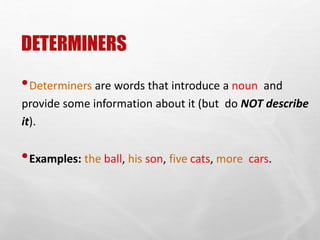
•Determiners are words that introduce a noun and
provide some information about it (but do NOT describe
it).
•Examples: the ball, his son, five cats, more cars.
DETERMINERS
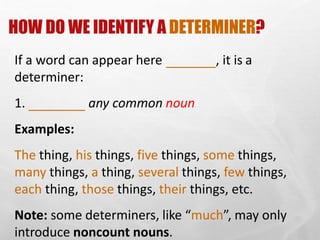
HOW DO WE IDENTIFY A DETERMINER?
If a word can appear here , it is a
determiner:
1. any common noun
Examples:
The thing, his things, five things, some things,
many things, a thing, several things, few things,
each thing, those things, their things, etc.
Note: some determiners, like “much”, may only
introduce noncount nouns.
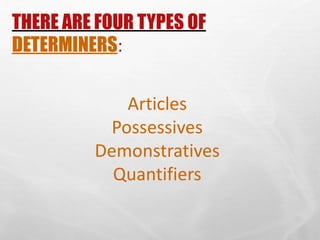
THERE ARE FOUR TYPES OF
DETERMINERS:
Articles
Possessives
Demonstratives
Quantifiers
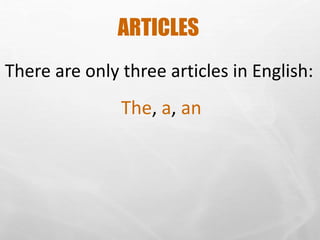
ARTICLES
There are only three articles in English:
The, a, an
“the” is called the Definite Article:
It normally introduces a noun that is familiar
to the listener. Example: The earth is round.
“the” may introduce either a singular or a
plural noun.
“a” or “an” are called the Indefinite Article:
“a” or “an” normally introduce a noun that is
not yet familiar to the listener. Example:
I saw a new movie.
“a” or “an” may only introduce a singular noun.
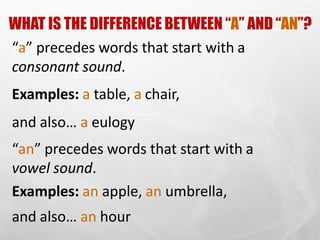
WHAT IS THE DIFFERENCE BETWEEN “A” AND “AN”?
“a” precedes words that start with a
consonant sound.
Examples: a table, a chair,
and also… a eulogy
“an” precedes words that start with a
vowel sound.
Examples: an apple, an umbrella,
and also… an hour
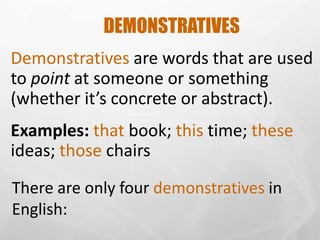
DEMONSTRATIVES
Demonstratives are words that are used
to point at someone or something
(whether it’s concrete or abstract).
Examples: that book; this time; these
ideas; those chairs
There are only four demonstratives in
English:
Singular Demonstratives:
This
That
Plural Demonstratives:
These
Those
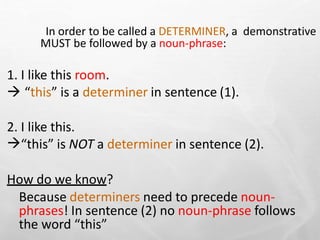
In order to be called a DETERMINER, a demonstrative
MUST be followed by a noun-phrase:
1. I like this room.
 “this” is a determiner in sentence (1).
2. I like this.
“this” is NOT a determiner in sentence (2).
How do we know?
Because determiners need to precede noun-
phrases! In sentence (2) no noun-phrase follows
the word “this”
IS THE UNDERLINED WORDA
DETERMINER?
•
•
•
•
John likes that movie.
That is the best.
That guy is nice.
John thinks that apples are tasty.
“that” in (4) is NOT a determiner, because
it is not used to point at apples!
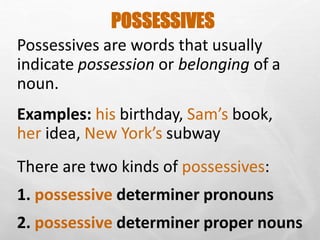
POSSESSIVES
Possessives are words that usually
indicate possession or belonging of a
noun.
Examples: his birthday, Sam’s book,
her idea, New York’s subway
There are two kinds of possessives:
1. possessive determiner pronouns
2. possessive determiner proper nouns
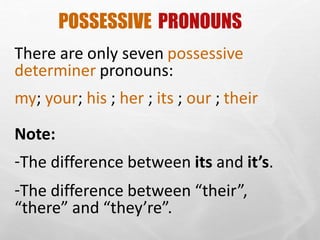
POSSESSIVE PRONOUNS
There are only seven possessive
determiner pronouns:
my; your; his ; her ; its ; our ; their
Note:
-The difference between its and it’s.
-The difference between “their”,
“there” and “they’re”.
In order to be called a DETERMINER, a possessive
pronoun MUST be followed by a noun-phrase:
1. His essay was the best.
 “His” is a determiner in sentence (1).
2. His was the best essay.
“His” is NOT a determiner in sentence (2).
How do we know?
Because determiners need to precede noun-
phrases! In sentence (2) no noun-phrase follows
the word “his”.
ANOTHER WAY TO TEST IF A POSSESSIVE
PRONOUN IS A DETERMINER OR NOT:
Replace “his” with “her”, and see if the
sentence is grammatical:
1. His essay was the best. 
Her essay was the best.
2. His was the best exam. 
*Her was the best exam.
Since in (2) the Test Sentence gets a *,
“his” in (2) is NOT a determiner.
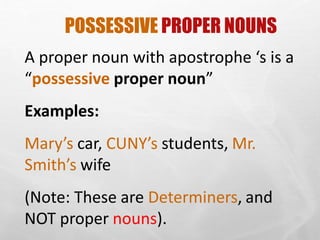
POSSESSIVE PROPER NOUNS
A proper noun with apostrophe ‘s is a
“possessive proper noun”
Examples:
Mary’s car, CUNY’s students, Mr.
Smith’s wife
(Note: These are Determiners, and
NOT proper nouns).
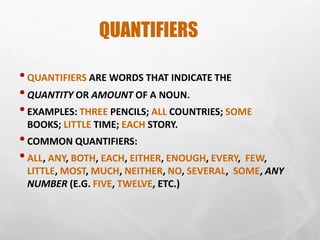
QUANTIFIERS
•QUANTIFIERS ARE WORDS THAT INDICATE THE
•QUANTITY OR AMOUNT OF A NOUN.
•EXAMPLES: THREE PENCILS; ALL COUNTRIES; SOME
BOOKS; LITTLE TIME; EACH STORY.
•COMMON QUANTIFIERS:
•ALL, ANY, BOTH, EACH, EITHER, ENOUGH, EVERY, FEW,
LITTLE, MOST, MUCH, NEITHER, NO, SEVERAL, SOME, ANY
NUMBER (E.G. FIVE, TWELVE, ETC.)
TO CONCLUDE:
The Determiners are:
•
•
•
•
Articles
Demonstratives
Possessives
Quantifiers

Determiners

  • 2.
    •Determiners are wordsthat introduce a noun and provide some information about it (but do NOT describe it). •Examples: the ball, his son, five cats, more cars. DETERMINERS
  • 3.
    HOW DO WEIDENTIFY A DETERMINER? If a word can appear here , it is a determiner: 1. any common noun Examples: The thing, his things, five things, some things, many things, a thing, several things, few things, each thing, those things, their things, etc. Note: some determiners, like “much”, may only introduce noncount nouns.
  • 4.
    THERE ARE FOURTYPES OF DETERMINERS: Articles Possessives Demonstratives Quantifiers
  • 5.
    ARTICLES There are onlythree articles in English: The, a, an
  • 6.
    “the” is calledthe Definite Article: It normally introduces a noun that is familiar to the listener. Example: The earth is round. “the” may introduce either a singular or a plural noun. “a” or “an” are called the Indefinite Article: “a” or “an” normally introduce a noun that is not yet familiar to the listener. Example: I saw a new movie. “a” or “an” may only introduce a singular noun.
  • 7.
    WHAT IS THEDIFFERENCE BETWEEN “A” AND “AN”? “a” precedes words that start with a consonant sound. Examples: a table, a chair, and also… a eulogy “an” precedes words that start with a vowel sound. Examples: an apple, an umbrella, and also… an hour
  • 8.
    DEMONSTRATIVES Demonstratives are wordsthat are used to point at someone or something (whether it’s concrete or abstract). Examples: that book; this time; these ideas; those chairs There are only four demonstratives in English:
  • 9.
  • 10.
    In order tobe called a DETERMINER, a demonstrative MUST be followed by a noun-phrase: 1. I like this room.  “this” is a determiner in sentence (1). 2. I like this. “this” is NOT a determiner in sentence (2). How do we know? Because determiners need to precede noun- phrases! In sentence (2) no noun-phrase follows the word “this”
  • 11.
    IS THE UNDERLINEDWORDA DETERMINER? • • • • John likes that movie. That is the best. That guy is nice. John thinks that apples are tasty. “that” in (4) is NOT a determiner, because it is not used to point at apples!
  • 12.
    POSSESSIVES Possessives are wordsthat usually indicate possession or belonging of a noun. Examples: his birthday, Sam’s book, her idea, New York’s subway There are two kinds of possessives: 1. possessive determiner pronouns 2. possessive determiner proper nouns
  • 13.
    POSSESSIVE PRONOUNS There areonly seven possessive determiner pronouns: my; your; his ; her ; its ; our ; their Note: -The difference between its and it’s. -The difference between “their”, “there” and “they’re”.
  • 14.
    In order tobe called a DETERMINER, a possessive pronoun MUST be followed by a noun-phrase: 1. His essay was the best.  “His” is a determiner in sentence (1). 2. His was the best essay. “His” is NOT a determiner in sentence (2). How do we know? Because determiners need to precede noun- phrases! In sentence (2) no noun-phrase follows the word “his”.
  • 15.
    ANOTHER WAY TOTEST IF A POSSESSIVE PRONOUN IS A DETERMINER OR NOT: Replace “his” with “her”, and see if the sentence is grammatical: 1. His essay was the best.  Her essay was the best. 2. His was the best exam.  *Her was the best exam. Since in (2) the Test Sentence gets a *, “his” in (2) is NOT a determiner.
  • 16.
    POSSESSIVE PROPER NOUNS Aproper noun with apostrophe ‘s is a “possessive proper noun” Examples: Mary’s car, CUNY’s students, Mr. Smith’s wife (Note: These are Determiners, and NOT proper nouns).
  • 17.
    QUANTIFIERS •QUANTIFIERS ARE WORDSTHAT INDICATE THE •QUANTITY OR AMOUNT OF A NOUN. •EXAMPLES: THREE PENCILS; ALL COUNTRIES; SOME BOOKS; LITTLE TIME; EACH STORY. •COMMON QUANTIFIERS: •ALL, ANY, BOTH, EACH, EITHER, ENOUGH, EVERY, FEW, LITTLE, MOST, MUCH, NEITHER, NO, SEVERAL, SOME, ANY NUMBER (E.G. FIVE, TWELVE, ETC.)
  • 18.
    TO CONCLUDE: The Determinersare: • • • • Articles Demonstratives Possessives Quantifiers