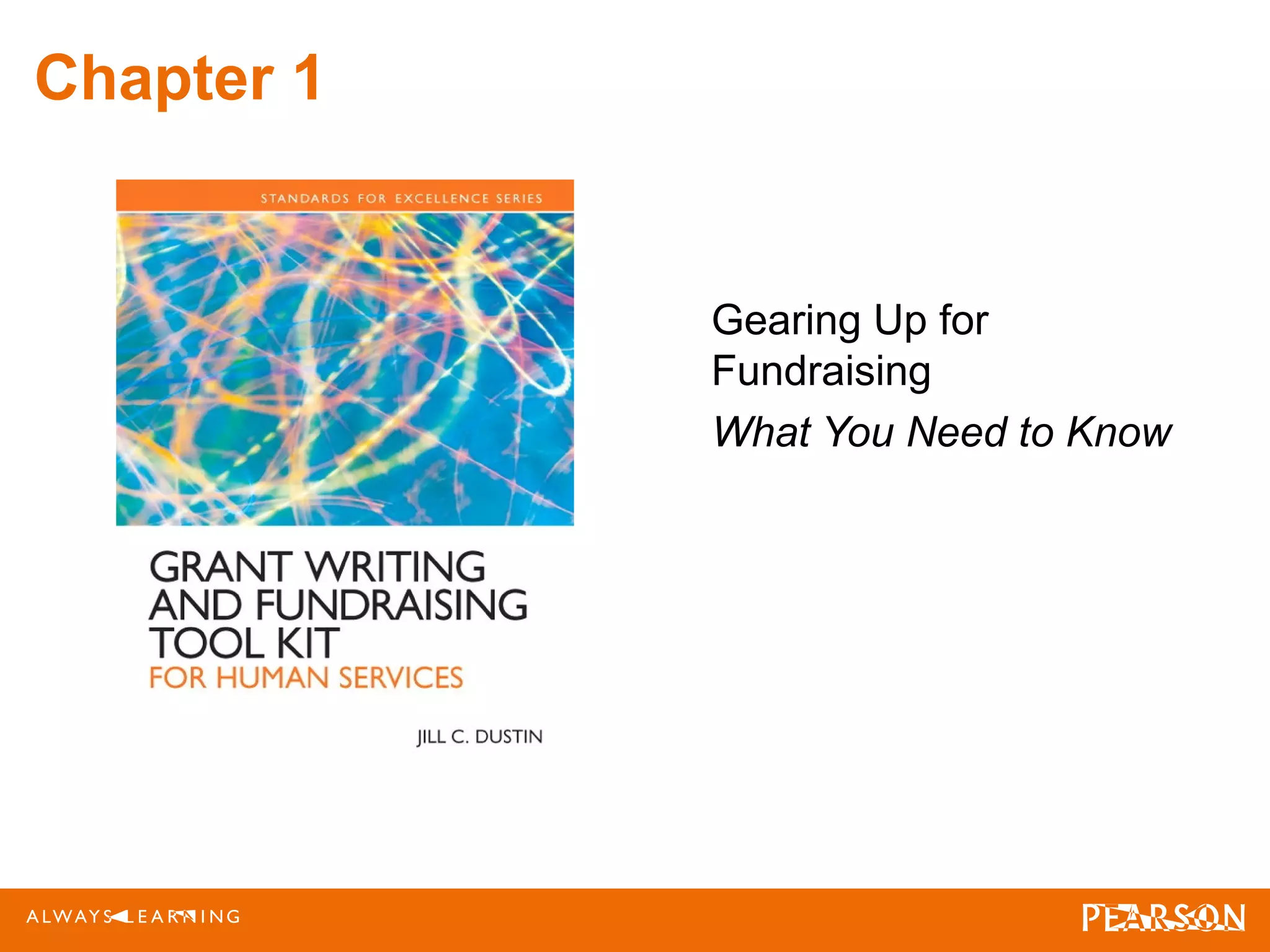
Chapter 1
Gearing Up for
Fundraising
What You Need to Know
© 2013 Pearson Education, Inc. All rights reserved.
Nonprofit versus
Charitable Nonprofit Organizations
• Nonprofit organizations may be eligible for
certain benefits such as state property,
sales, and income tax exemptions.
• Nonprofit charitable organizations are set
up and operated to improve some part of
society without a profit motive.
© 2013 Pearson Education, Inc. All rights reserved.
Nonprofit versus Not-for-Profit
Organizations
• Not-for-Profit organizations are devoted to
some sort of activity, such as a hobby.
• Nonprofit organizations or agencies are
founded for purposes other than profit
making.
© 2013 Pearson Education, Inc. All rights reserved.
Nonprofit Fundraising Registration
• The Federal Trade Commission is the
government’s chief consumer protection
agency. Laws may vary state to state.
• Applicants must submit determination
letters, audit paperwork, bylaws,
fundraising contracts, IRS 990 forms,
notarized signatures, and fees.
© 2013 Pearson Education, Inc. All rights reserved.
Unified Registration System, 1997
• The URS was developed to merge the
information and date requirements of
those states that require registration of
nonprofit organizations, which solicit for
funds within their jurisdictions.
• As of August 2010, 37 states accepted the
URS.
© 2013 Pearson Education, Inc. All rights reserved.
Three Stages of the URS
1. Assembling an inventory of registration
information requirements from all states.
2. Constructing a form which includes all (or
most) of these requirements.
3. Persuading states to agree to this
“standardized” format as a replacement for their
own forms.
© 2013 Pearson Education, Inc. All rights reserved.
Unrestricted versus
Restricted Funds
• Unrestricted funds are available for the
agency to use toward any purpose.
• Restricted funds are limited to a
designated purpose as per the donor’s
request or are raised for a specific
purpose or project.
© 2013 Pearson Education, Inc. All rights reserved.
Temporarily or
Permanently Restricted Funds
• Temporarily restricted funds have donor-
imposed restrictions; either by time or
purpose.
• Permanently restricted funds are also
restricted by the donor and never expire.
© 2013 Pearson Education, Inc. All rights reserved.
Understanding the
Ethics of Fundraising
• Agencies may be tempted to seek funding
wherever they can find it.
• The leaders of the organization must
embrace ethical decision-making and
recognize the importance of values and
ensure that no one individual is to profit
from the organization.
© 2013 Pearson Education, Inc. All rights reserved.
Some Fundraising Pitfalls
• Failing to have a solid team in place.
• Failing to motivate the team.
• Failing to have a mission statement and
set of goals.
• Failing to plan, develop evaluation, and
seek consultation.
• Failing to choose the best fundraisers.
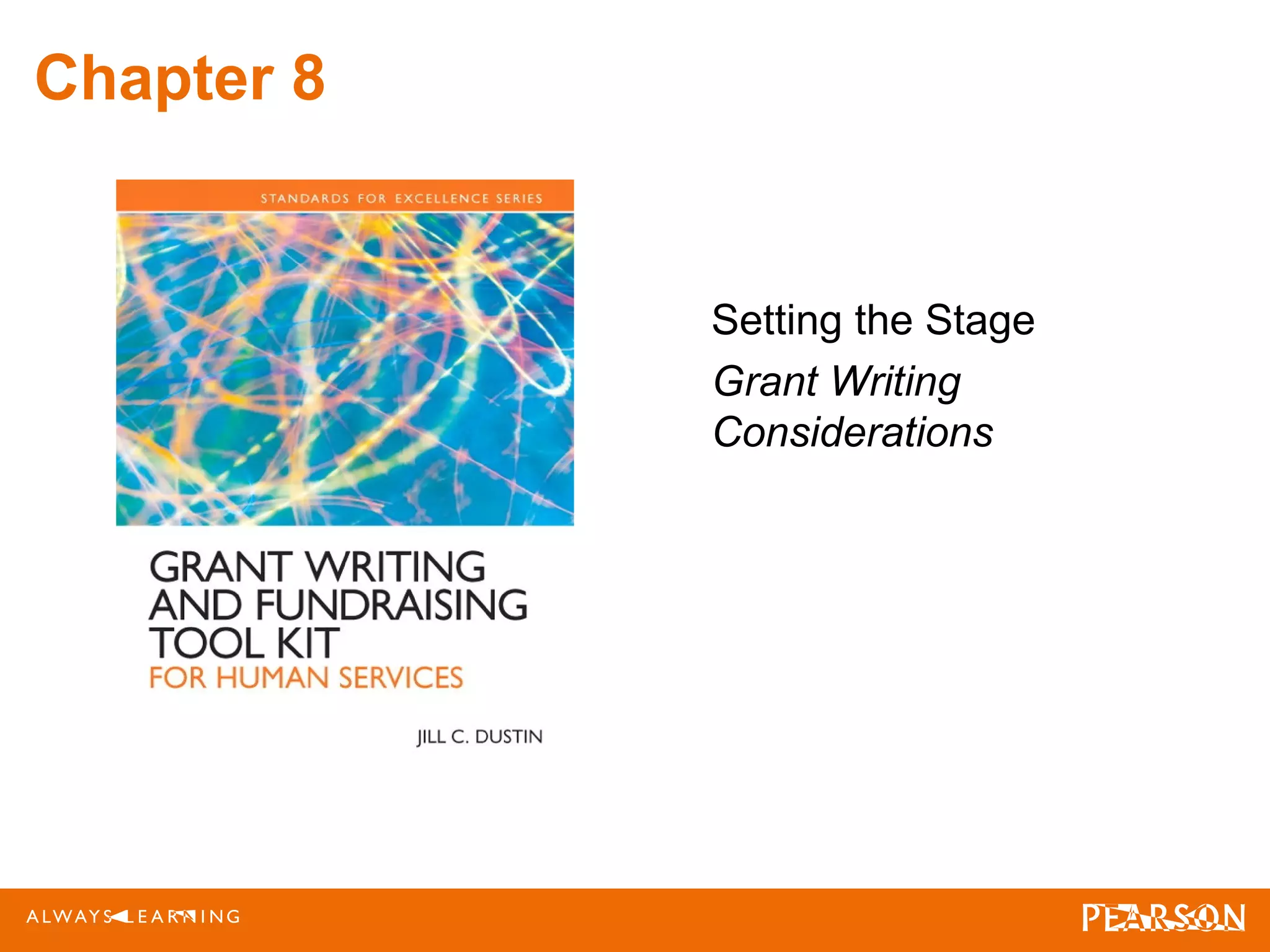
Chapter 8
Setting the Stage
Grant Writing
Considerations
© 2013 Pearson Education, Inc. All rights reserved.
Grant Writing: A Collaborative
Effort?
• Collaboration can enhance or complicate
the grant writing process.
• Agencies must look at both the benefits
and complications associated with the
collaborative efforts.
© 2013 Pearson Education, Inc. All rights reserved.
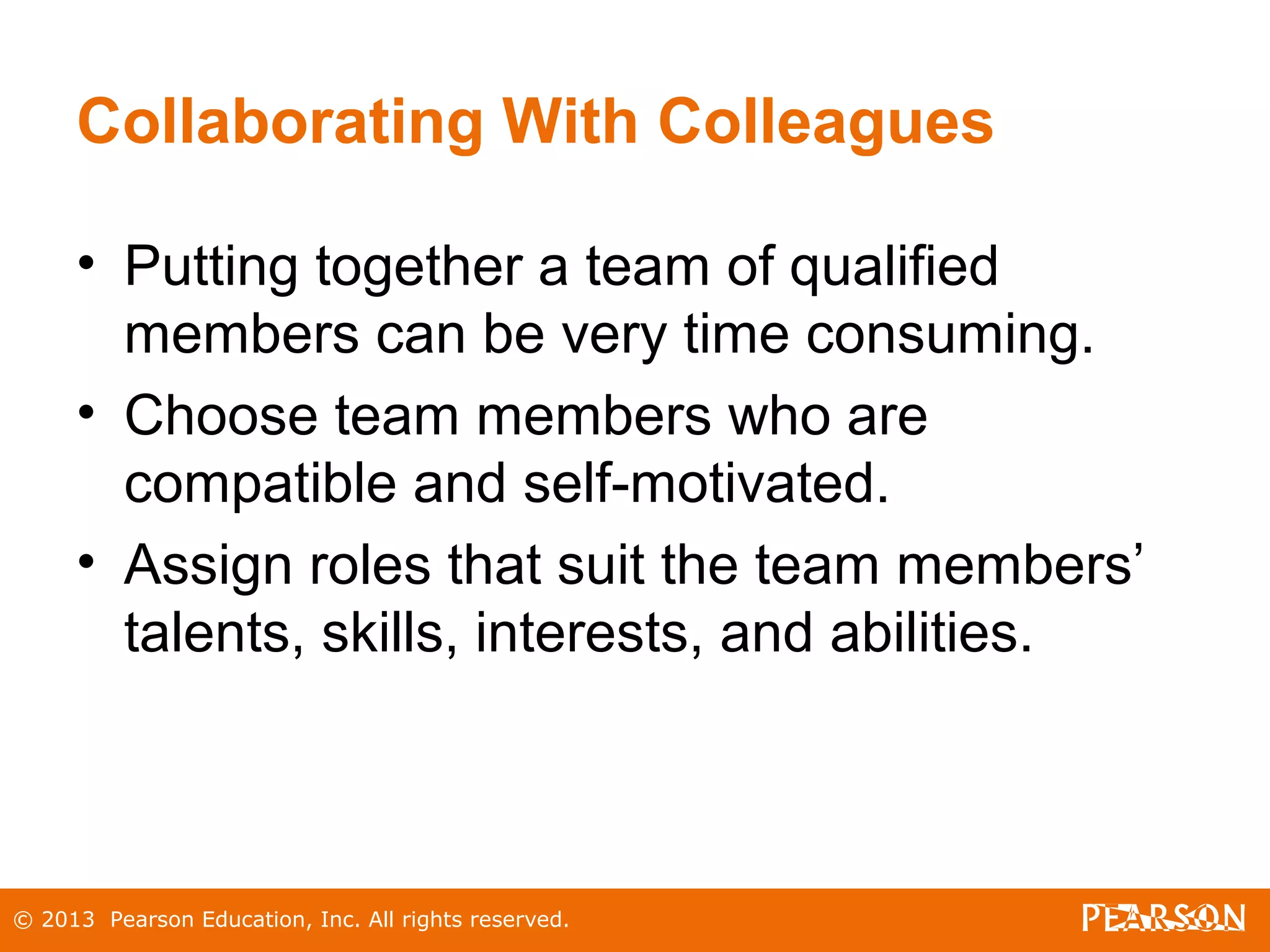
Collaborating With Colleagues
• Putting together a team of qualified
members can be very time consuming.
• Choose team members who are
compatible and self-motivated.
• Assign roles that suit the team members’
talents, skills, interests, and abilities.
© 2013 Pearson Education, Inc. All rights reserved.
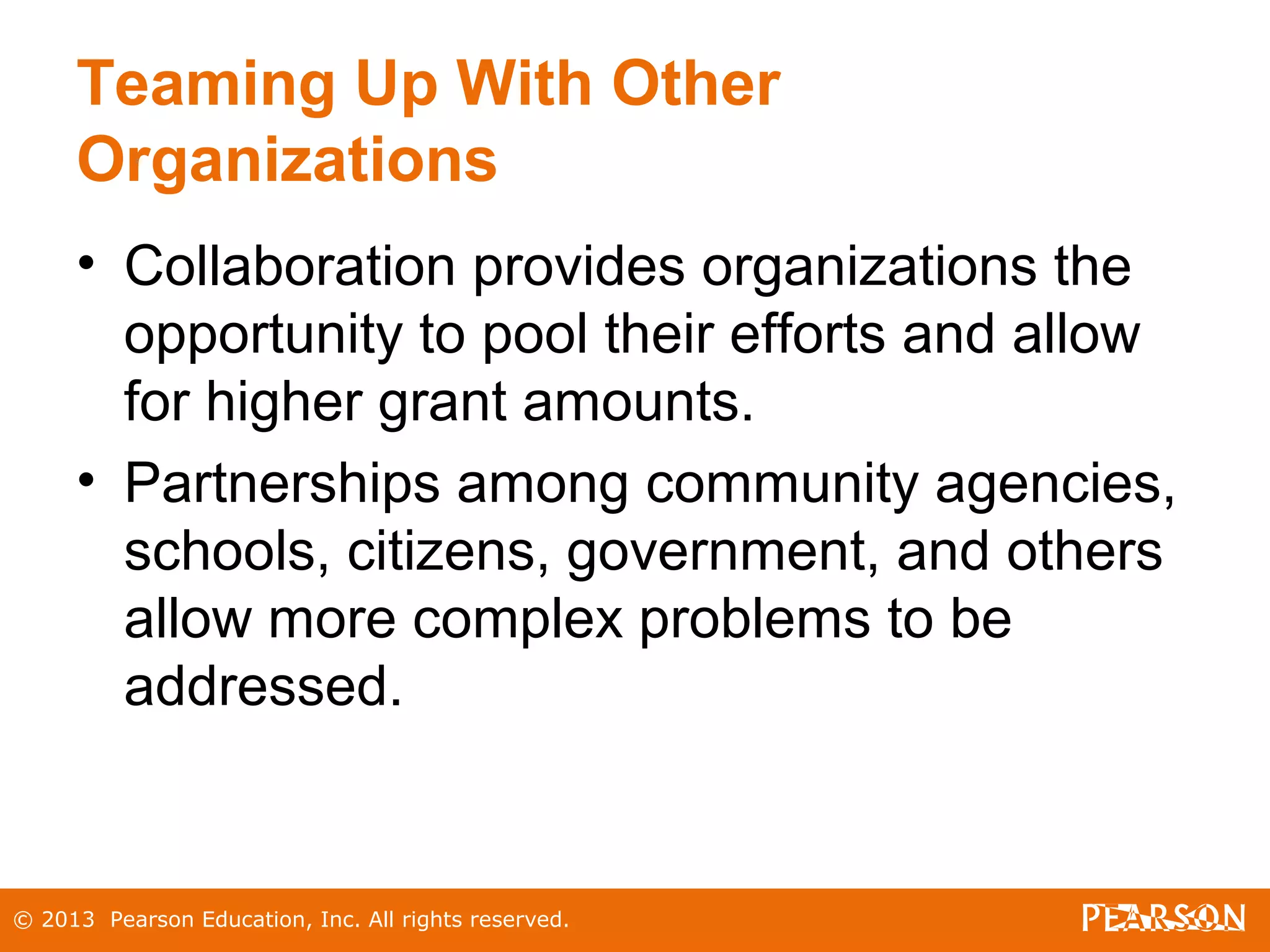
Teaming Up With Other
Organizations
• Collaboration provides organizations the
opportunity to pool their efforts and allow
for higher grant amounts.
• Partnerships among community agencies,
schools, citizens, government, and others
allow more complex problems to be
addressed.
© 2013 Pearson Education, Inc. All rights reserved.
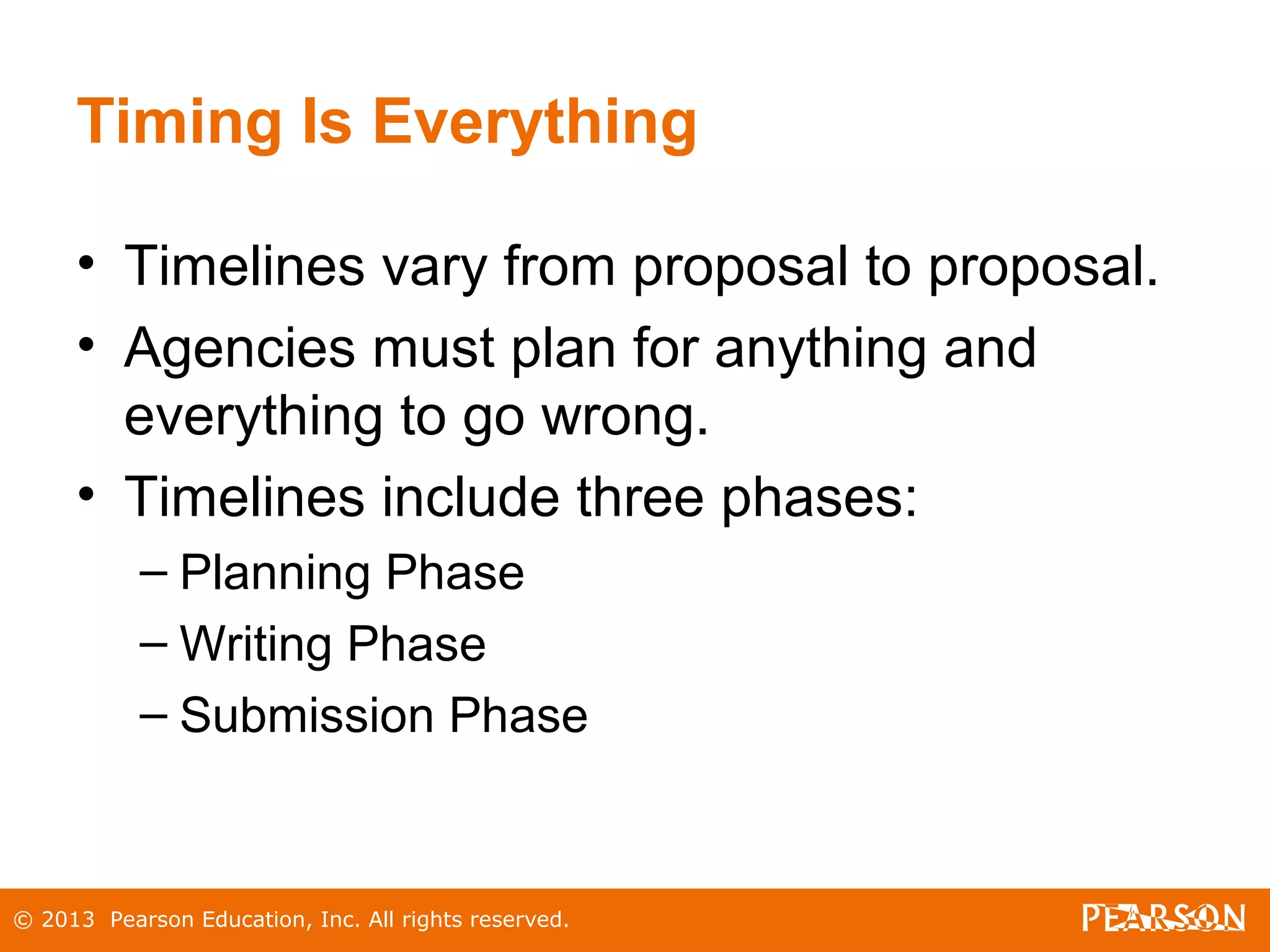
Timing Is Everything
• Timelines vary from proposal to proposal.
• Agencies must plan for anything and
everything to go wrong.
• Timelines include three phases:
– Planning Phase
– Writing Phase
– Submission Phase
© 2013 Pearson Education, Inc. All rights reserved.
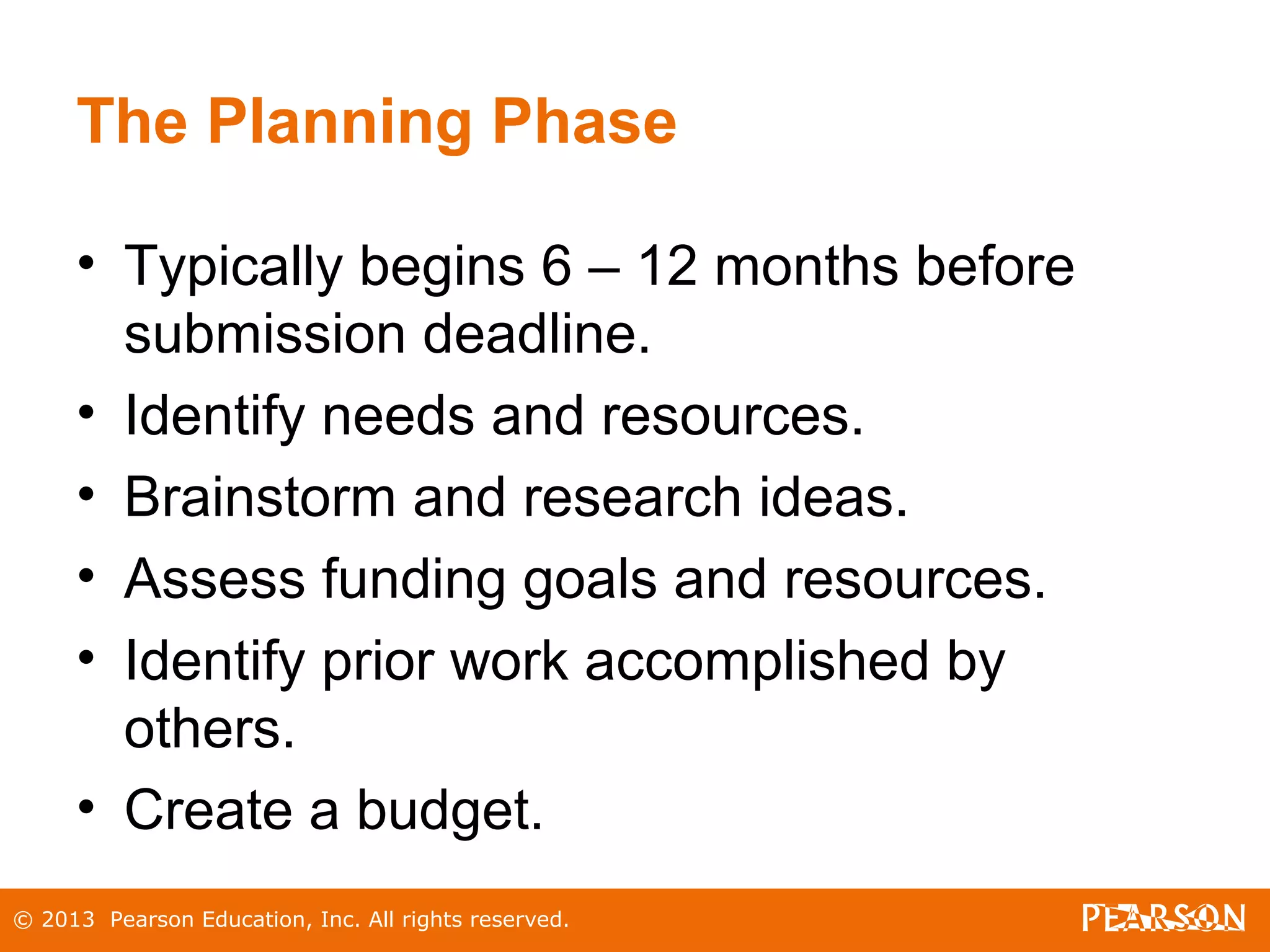
The Planning Phase
• Typically begins 6 – 12 months before
submission deadline.
• Identify needs and resources.
• Brainstorm and research ideas.
• Assess funding goals and resources.
• Identify prior work accomplished by
others.
• Create a budget.
© 2013 Pearson Education, Inc. All rights reserved.
The Writing Phase
• Typically begins 2 – 6 months before
submission deadline.
• Outline the structure of the application.
• Complete the required forms.
• Plan and develop first draft.
• Proof the draft.
• Write all sections of the proposal.
© 2013 Pearson Education, Inc. All rights reserved.
The Submission Phase
• Typically takes place 1 – 2 months before
submission deadline.
• Proofread and make all revisions.
• Submit the final copy to a proposal review
office.
• Submit the final grant at least 2 days
before the deadline.
© 2013 Pearson Education, Inc. All rights reserved.
Quality Trumps Deadlines
• Producing a top-notch proposal is more
important than meeting a deadline.
• Throwing a proposal together at the last
minute is a certain denial.
• Submitting a proposal the following year or
to a similar funder once it has been
redone is a better idea.
© 2013 Pearson Education, Inc. All rights reserved.
Contracting With a Professional
Grant Writer
• Agencies may not have the time and staff
available to dedicate to grant writing.
• If discretionary funds are available, a
professional grant writer may be the best
decision.
• Agencies should weigh the pros and cons
of hiring a professional grant writer.
© 2013 Pearson Education, Inc. All rights reserved.
Pros of Hiring a Professional Grant
Writer
• Have the time to devote to the project.
• Have the knowledge and expertise.
• Have exposure to current trends.
• More likely to complete the grant on time.
• Can teach the basics of grant writing to
the agency’s staff.
© 2013 Pearson Education, Inc. All rights reserved.
Cons of Hiring a Professional Grant
Writer
• Grants may lack the passion.
• Writers do not know the grant history of
the agency.
• Choosing a grant writer can be a difficult
task.
• Hiring a grant writer can be very costly.
© 2013 Pearson Education, Inc. All rights reserved.
The Grant Writer Selection Process
• Begin the process early.
• Ask for referrals from other agencies.
• Contact grant writer associations for
referrals.
• Determine the length of the grant writer’s
position; temporary or permanent.
• Advertise the position.
© 2013 Pearson Education, Inc. All rights reserved.
Assisting Nonprofits in Connecting
With Grant Writers
• Several associations provide resources,
services, and directories to assist
nonprofits in connecting with grant writers.
– American Grant Writers’ Association
– Association of Fundraising Professionals
– Charity Channel
– Grant Professionals Association

Unit 1 Grantwriting

  • 1.
    Chapter 1 Gearing Upfor Fundraising What You Need to Know
  • 2.
    © 2013 PearsonEducation, Inc. All rights reserved. Nonprofit versus Charitable Nonprofit Organizations • Nonprofit organizations may be eligible for certain benefits such as state property, sales, and income tax exemptions. • Nonprofit charitable organizations are set up and operated to improve some part of society without a profit motive.
  • 3.
    © 2013 PearsonEducation, Inc. All rights reserved. Nonprofit versus Not-for-Profit Organizations • Not-for-Profit organizations are devoted to some sort of activity, such as a hobby. • Nonprofit organizations or agencies are founded for purposes other than profit making.
  • 4.
    © 2013 PearsonEducation, Inc. All rights reserved. Nonprofit Fundraising Registration • The Federal Trade Commission is the government’s chief consumer protection agency. Laws may vary state to state. • Applicants must submit determination letters, audit paperwork, bylaws, fundraising contracts, IRS 990 forms, notarized signatures, and fees.
  • 5.
    © 2013 PearsonEducation, Inc. All rights reserved. Unified Registration System, 1997 • The URS was developed to merge the information and date requirements of those states that require registration of nonprofit organizations, which solicit for funds within their jurisdictions. • As of August 2010, 37 states accepted the URS.
  • 6.
    © 2013 PearsonEducation, Inc. All rights reserved. Three Stages of the URS 1. Assembling an inventory of registration information requirements from all states. 2. Constructing a form which includes all (or most) of these requirements. 3. Persuading states to agree to this “standardized” format as a replacement for their own forms.
  • 7.
    © 2013 PearsonEducation, Inc. All rights reserved. Unrestricted versus Restricted Funds • Unrestricted funds are available for the agency to use toward any purpose. • Restricted funds are limited to a designated purpose as per the donor’s request or are raised for a specific purpose or project.
  • 8.
    © 2013 PearsonEducation, Inc. All rights reserved. Temporarily or Permanently Restricted Funds • Temporarily restricted funds have donor- imposed restrictions; either by time or purpose. • Permanently restricted funds are also restricted by the donor and never expire.
  • 9.
    © 2013 PearsonEducation, Inc. All rights reserved. Understanding the Ethics of Fundraising • Agencies may be tempted to seek funding wherever they can find it. • The leaders of the organization must embrace ethical decision-making and recognize the importance of values and ensure that no one individual is to profit from the organization.
  • 10.
    © 2013 PearsonEducation, Inc. All rights reserved. Some Fundraising Pitfalls • Failing to have a solid team in place. • Failing to motivate the team. • Failing to have a mission statement and set of goals. • Failing to plan, develop evaluation, and seek consultation. • Failing to choose the best fundraisers.
  • 11.
    Chapter 8 Setting theStage Grant Writing Considerations
  • 12.
    © 2013 PearsonEducation, Inc. All rights reserved. Grant Writing: A Collaborative Effort? • Collaboration can enhance or complicate the grant writing process. • Agencies must look at both the benefits and complications associated with the collaborative efforts.
  • 13.
    © 2013 PearsonEducation, Inc. All rights reserved. Collaborating With Colleagues • Putting together a team of qualified members can be very time consuming. • Choose team members who are compatible and self-motivated. • Assign roles that suit the team members’ talents, skills, interests, and abilities.
  • 14.
    © 2013 PearsonEducation, Inc. All rights reserved. Teaming Up With Other Organizations • Collaboration provides organizations the opportunity to pool their efforts and allow for higher grant amounts. • Partnerships among community agencies, schools, citizens, government, and others allow more complex problems to be addressed.
  • 15.
    © 2013 PearsonEducation, Inc. All rights reserved. Timing Is Everything • Timelines vary from proposal to proposal. • Agencies must plan for anything and everything to go wrong. • Timelines include three phases: – Planning Phase – Writing Phase – Submission Phase
  • 16.
    © 2013 PearsonEducation, Inc. All rights reserved. The Planning Phase • Typically begins 6 – 12 months before submission deadline. • Identify needs and resources. • Brainstorm and research ideas. • Assess funding goals and resources. • Identify prior work accomplished by others. • Create a budget.
  • 17.
    © 2013 PearsonEducation, Inc. All rights reserved. The Writing Phase • Typically begins 2 – 6 months before submission deadline. • Outline the structure of the application. • Complete the required forms. • Plan and develop first draft. • Proof the draft. • Write all sections of the proposal.
  • 18.
    © 2013 PearsonEducation, Inc. All rights reserved. The Submission Phase • Typically takes place 1 – 2 months before submission deadline. • Proofread and make all revisions. • Submit the final copy to a proposal review office. • Submit the final grant at least 2 days before the deadline.
  • 19.
    © 2013 PearsonEducation, Inc. All rights reserved. Quality Trumps Deadlines • Producing a top-notch proposal is more important than meeting a deadline. • Throwing a proposal together at the last minute is a certain denial. • Submitting a proposal the following year or to a similar funder once it has been redone is a better idea.
  • 20.
    © 2013 PearsonEducation, Inc. All rights reserved. Contracting With a Professional Grant Writer • Agencies may not have the time and staff available to dedicate to grant writing. • If discretionary funds are available, a professional grant writer may be the best decision. • Agencies should weigh the pros and cons of hiring a professional grant writer.
  • 21.
    © 2013 PearsonEducation, Inc. All rights reserved. Pros of Hiring a Professional Grant Writer • Have the time to devote to the project. • Have the knowledge and expertise. • Have exposure to current trends. • More likely to complete the grant on time. • Can teach the basics of grant writing to the agency’s staff.
  • 22.
    © 2013 PearsonEducation, Inc. All rights reserved. Cons of Hiring a Professional Grant Writer • Grants may lack the passion. • Writers do not know the grant history of the agency. • Choosing a grant writer can be a difficult task. • Hiring a grant writer can be very costly.
  • 23.
    © 2013 PearsonEducation, Inc. All rights reserved. The Grant Writer Selection Process • Begin the process early. • Ask for referrals from other agencies. • Contact grant writer associations for referrals. • Determine the length of the grant writer’s position; temporary or permanent. • Advertise the position.
  • 24.
    © 2013 PearsonEducation, Inc. All rights reserved. Assisting Nonprofits in Connecting With Grant Writers • Several associations provide resources, services, and directories to assist nonprofits in connecting with grant writers. – American Grant Writers’ Association – Association of Fundraising Professionals – Charity Channel – Grant Professionals Association