
ENG 4340WEEK 5
 The core strategy is what connects all the other components
of your content strategy together: It provides the all-necessary
“guiding light” that keeps you moving in the right direction, no
mater what might happen along the way.
CORE STRATEGY
 Achieve: What does your content strategy need to accomplish
(for the organization, for your industry, for your product, etc.)?
 Be: What “content product(s)” will we create? (In other words,
what will we produce for our users/consumers? How will those
content products be valuable to the users/consumers?)
 Do: What will the organization need to do to support the
content effort?
DEVELOP & DEFINE A CORE STRATEGY
 Substance: What content do you need and why?
 Structure: How will your content be prioritized, organized,
formatted, and displayed?
CONTENT STRATEGY
 Audience: Set some parameters and
 priorities about who your content is for.
 Messaging: Primary, Secondary, Details
 Topics: Maps
 Purpose: Persuade, inform, validate instruct, entertain
 Voice and tone: how it feels, what values live behind it, the
different media in which it might manifest; Combine that with
what you know about the user’s native voice and the objective
of the specific website or channel content you are creating
 Sources
CONTENT: FACTORS TO CONSIDER
 Primary message: The single most important thing you want
the user to know after viewing your content. Tis message is
applicable to all of your audiences.
 Secondary messages: A group of key messages that support
the primary message and provide context. These messages
often highlight the things that are competitive advantages or
differentiators. They may or may not be applicable to every
single audience.
 Details: All of the various proof points behind the primary and
secondary messages. Topic maps help.
MESSAGING
 Primary message: AwesomeCo is the best-kept secret in
business soft]ware.
 Secondary messages:
 We don’t sell products. We sell systems tailored to your needs.
 We use open source technology, so you’re never held hostage to
proprietary code.
 We work with 83 companies in the Fortune 100, new startups, and
 everyone in between.
 We don’t do marketing; we’re too busy making software. Our
business comes from word of mouth.
EXAMPLE
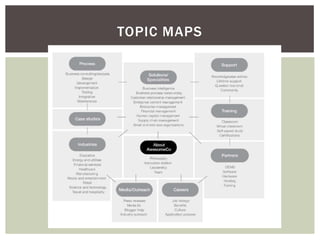
TOPIC MAPS
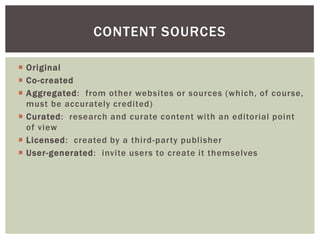
 Original
 Co-created
 Aggregated: from other websites or sources (which, of course,
must be accurately credited)
 Curated: research and curate content with an editorial point
of view
 Licensed: created by a third-party publisher
 User-generated: invite users to create it themselves
CONTENT SOURCES
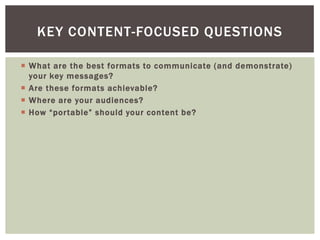
 What are the best formats to communicate (and demonstrate)
your key messages?
 Are these formats achievable?
 Where are your audiences?
 How “portable” should your content be?
KEY CONTENT-FOCUSED QUESTIONS
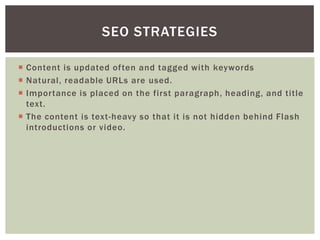
 Content is updated often and tagged with keywords
 Natural, readable URLs are used.
 Importance is placed on the first paragraph, heading, and title
text.
 The content is text-heavy so that it is not hidden behind Flash
introductions or video.
SEO STRATEGIES
 Listen
 Join
 Provide a platform
IDEA GENERATION
1. How does Texas Tech use Facebook, Twitter, and LinkedIn?
2. How should the MSPWTC program propose using Twitter,
blogs, Facebook, Linkedin, photosharing and podcasting for
the MSPWTC ? What overall campaign objectives might each
advance or marketing need might it meet?
3. What unique feature or inherent strength of each particular
media makes it optimal for its proposed use.
4. What weakness or dilemma might using each pose?
5. Draw a conceptual model of how you might integrate the
media. How will the content and aims of one arm feed the
others? What content will be shared? What content will be
unique to each platform? How will the efforts on one
platform amplify or augment efforts on the others?
ANSWER THE FOLLOWING

Week 5 4340

  • 1.
  • 2.
     The corestrategy is what connects all the other components of your content strategy together: It provides the all-necessary “guiding light” that keeps you moving in the right direction, no mater what might happen along the way. CORE STRATEGY
  • 3.
     Achieve: Whatdoes your content strategy need to accomplish (for the organization, for your industry, for your product, etc.)?  Be: What “content product(s)” will we create? (In other words, what will we produce for our users/consumers? How will those content products be valuable to the users/consumers?)  Do: What will the organization need to do to support the content effort? DEVELOP & DEFINE A CORE STRATEGY
  • 4.
     Substance: Whatcontent do you need and why?  Structure: How will your content be prioritized, organized, formatted, and displayed? CONTENT STRATEGY
  • 5.
     Audience: Setsome parameters and  priorities about who your content is for.  Messaging: Primary, Secondary, Details  Topics: Maps  Purpose: Persuade, inform, validate instruct, entertain  Voice and tone: how it feels, what values live behind it, the different media in which it might manifest; Combine that with what you know about the user’s native voice and the objective of the specific website or channel content you are creating  Sources CONTENT: FACTORS TO CONSIDER
  • 6.
     Primary message:The single most important thing you want the user to know after viewing your content. Tis message is applicable to all of your audiences.  Secondary messages: A group of key messages that support the primary message and provide context. These messages often highlight the things that are competitive advantages or differentiators. They may or may not be applicable to every single audience.  Details: All of the various proof points behind the primary and secondary messages. Topic maps help. MESSAGING
  • 7.
     Primary message:AwesomeCo is the best-kept secret in business soft]ware.  Secondary messages:  We don’t sell products. We sell systems tailored to your needs.  We use open source technology, so you’re never held hostage to proprietary code.  We work with 83 companies in the Fortune 100, new startups, and  everyone in between.  We don’t do marketing; we’re too busy making software. Our business comes from word of mouth. EXAMPLE
  • 8.
  • 9.
     Original  Co-created Aggregated: from other websites or sources (which, of course, must be accurately credited)  Curated: research and curate content with an editorial point of view  Licensed: created by a third-party publisher  User-generated: invite users to create it themselves CONTENT SOURCES
  • 10.
     What arethe best formats to communicate (and demonstrate) your key messages?  Are these formats achievable?  Where are your audiences?  How “portable” should your content be? KEY CONTENT-FOCUSED QUESTIONS
  • 11.
     Content isupdated often and tagged with keywords  Natural, readable URLs are used.  Importance is placed on the first paragraph, heading, and title text.  The content is text-heavy so that it is not hidden behind Flash introductions or video. SEO STRATEGIES
  • 12.
     Listen  Join Provide a platform IDEA GENERATION
  • 13.
    1. How doesTexas Tech use Facebook, Twitter, and LinkedIn? 2. How should the MSPWTC program propose using Twitter, blogs, Facebook, Linkedin, photosharing and podcasting for the MSPWTC ? What overall campaign objectives might each advance or marketing need might it meet? 3. What unique feature or inherent strength of each particular media makes it optimal for its proposed use. 4. What weakness or dilemma might using each pose? 5. Draw a conceptual model of how you might integrate the media. How will the content and aims of one arm feed the others? What content will be shared? What content will be unique to each platform? How will the efforts on one platform amplify or augment efforts on the others? ANSWER THE FOLLOWING