Chapter 10
Writing, Submitting, and
Revising Grant Proposals
© 2013 Pearson Education, Inc. All rights reserved.
Prior to the Grant Writing Process
• Keep a journal/notebook to note ideas.
• Gather documents before writing begins,
such as tax certificates and bylaws.
• Develop a grant-tracking form to record
grant applications, funding cycles, funding
received, etc.
© 2013 Pearson Education, Inc. All rights reserved.
Initial Steps of the Grant Writing
Process
• Make a plan; identify needs/wants.
• Locate potential funders.
• Identify the audience.
• Draft the grant proposal.
• Revise/edit and prepare the final proposal.
© 2013 Pearson Education, Inc. All rights reserved.
Elements of a Grant Proposal
• Grant proposals vary.
• There are usually a number of elements,
but the sections will likely vary.
• Grants are extremely competitive and
each section must be prepared
meticulously in order to not be rejected by
the reviewers.
© 2013 Pearson Education, Inc. All rights reserved.
Letter of Inquiry/Intent
• Sometimes required to determine if the
agency’s project falls within the funder’s
criteria.
• Includes contact information.
• Presents overview of agency’s mission.
• Provides the total amount requested.
• Includes a statement of gratitude.
© 2013 Pearson Education, Inc. All rights reserved.
Cover Letter
• Some grants only require an agency
submit a cover letter to the grantor.
• Very much like a cover letter does for a
job applicant, it introduces an agency to a
prospective funder.
• Short, friendly, stand out.
• Charm the reader and display enthusiasm.
© 2013 Pearson Education, Inc. All rights reserved.
Title Page/Cover Sheet
• Project’s title.
• Names of the principle investigators.
• The agency’s name, address, and
phone/fax numbers.
• Project dates, type of grant, amount of
funding, and the grant period.
© 2013 Pearson Education, Inc. All rights reserved.
Abstract/Executive
Summary/Introduction
• One of the shortest yet most important
sections of the grant proposal.
• Often forms the first impression; must
convince grantor the proposed is worth the
investment.
• A strong abstract is concise, limited to key
points, strongly written.
© 2013 Pearson Education, Inc. All rights reserved.
Literature Review
• Sometimes required to provide crucial
background information.
• Compiled reviews highlighting published
writings on subjects related to the project.
• A basic literature review is comprised of
the introduction, body, and conclusion.
© 2013 Pearson Education, Inc. All rights reserved.
Needs/Problem Statement
• Proves that the grant meets a vital societal
need.
• Clear, well-supported statement of the
problem that will be addressed.
• Addresses the need and how the agency’s
clients are affected.
• Both qualitative and quantitative.
© 2013 Pearson Education, Inc. All rights reserved.
Goals and Objectives
• Provide a map to the project, influence the
design of the program, determine the
methods and strategies needed to achieve
the goals/objectives.
• Goals are long term statements of hope.
• Objectives are narrow, precise, and short
term.
© 2013 Pearson Education, Inc. All rights reserved.
Program Design/Methods/Strategies
• Methods for achieving the goals/objectives
set.
• Include supporting statements that cite
research, expert opinions, personal
communication, and past experience.
• Justify the course of action that will be
taken.
© 2013 Pearson Education, Inc. All rights reserved.
Evaluation Plan
• Defines how success will be determined.
• Clarifies the purpose of the project.
• Chronicles the progress and assesses the
effectiveness.
• Obtains feedback from the individuals
served as well as community members.
• Facilitates project improvement.
© 2013 Pearson Education, Inc. All rights reserved.
Types of Evaluations
• Process Evaluations – descriptive and
ongoing.
• Outcome Evaluations – identify if a
project’s outcomes have been achieved.
• Impact Evaluations – assess the changes
that can be attributed to a project.
© 2013 Pearson Education, Inc. All rights reserved.
Organizational Information
• Provides a convincing argument of the
agency’s credibility to accomplish the
goals/objectives of the project.
• Position the nonprofit as the best agency
to implement the proposed project.
© 2013 Pearson Education, Inc. All rights reserved.
Program’s Budget and Budget
Narrative
• Lists both administrative and project costs.
• Consists of a spreadsheet or table with
detailed line items.
• Explains how the budget will be spent and
why it is cost-effective.
• Provides a clear picture of the impact that
can be made with the requested funds.
© 2013 Pearson Education, Inc. All rights reserved.
Special Considerations
• Equipment Purchases
• Additional Space and Equipment
• Increases in the Cost of Insurance
• Salaries
• Indirect Costs
• Matching Funds
© 2013 Pearson Education, Inc. All rights reserved.
Other Funding/Sustainability
• Describes the nonprofit’s long-term
continuation plan or vision for the project
after the grant period has ended.
• Explains how the agency will raise funds
to continue the project.
• Includes a list of other funders
approached.
© 2013 Pearson Education, Inc. All rights reserved.
Commonly Requested Supplemental
Materials
• IRS tax-exempt verification letter
• List of board directors and affiliations
• List of staff experience
• Financial statement for the previous year
• Current fiscal year’s budget
• Next fiscal year’s budget
• List of clients served and annual report
© 2013 Pearson Education, Inc. All rights reserved.
Review and Proof
• The proposal should be reviewed by a
neutral third party.
• Reviewed for continuity, reasoning, and
clarity.
• The proposal must not contain any
unsupported assumptions or jargon.
• Reviewed for neatness and accuracy.
© 2013 Pearson Education, Inc. All rights reserved.
Submitting the Proposal
• Copy the entire application.
• Check with the grantor on the preferred
format for binding the original proposal.
• Mail the proposal in the format requested
and several days before deadline.
• A follow-up call may be placed after a
week of not hearing from the grantor.
© 2013 Pearson Education, Inc. All rights reserved.
Online Grant Applications
• Sometimes paperless formats have limited
space.
• Online grant applications can improve the
efficiency and accuracy of the process.
• Submission must be made early in order
to avoid possible technology issues.
© 2013 Pearson Education, Inc. All rights reserved.
Some Grant Writing Mistakes
• Hastily assembled.
• Too lengthy.
• Written in first person.
• Included false, inaccurate cost estimates.
• Overkilled a point.
• Not logically formatted.
• Did not follow grantor’s instructions.
© 2013 Pearson Education, Inc. All rights reserved.
The Review Process
• Proposal reviews are very rigorous and
competitive.
• Proposals are normally scored using a
grading rubric to ensure consistency of
evaluation.
• Process varies based on the type of grant.
© 2013 Pearson Education, Inc. All rights reserved.
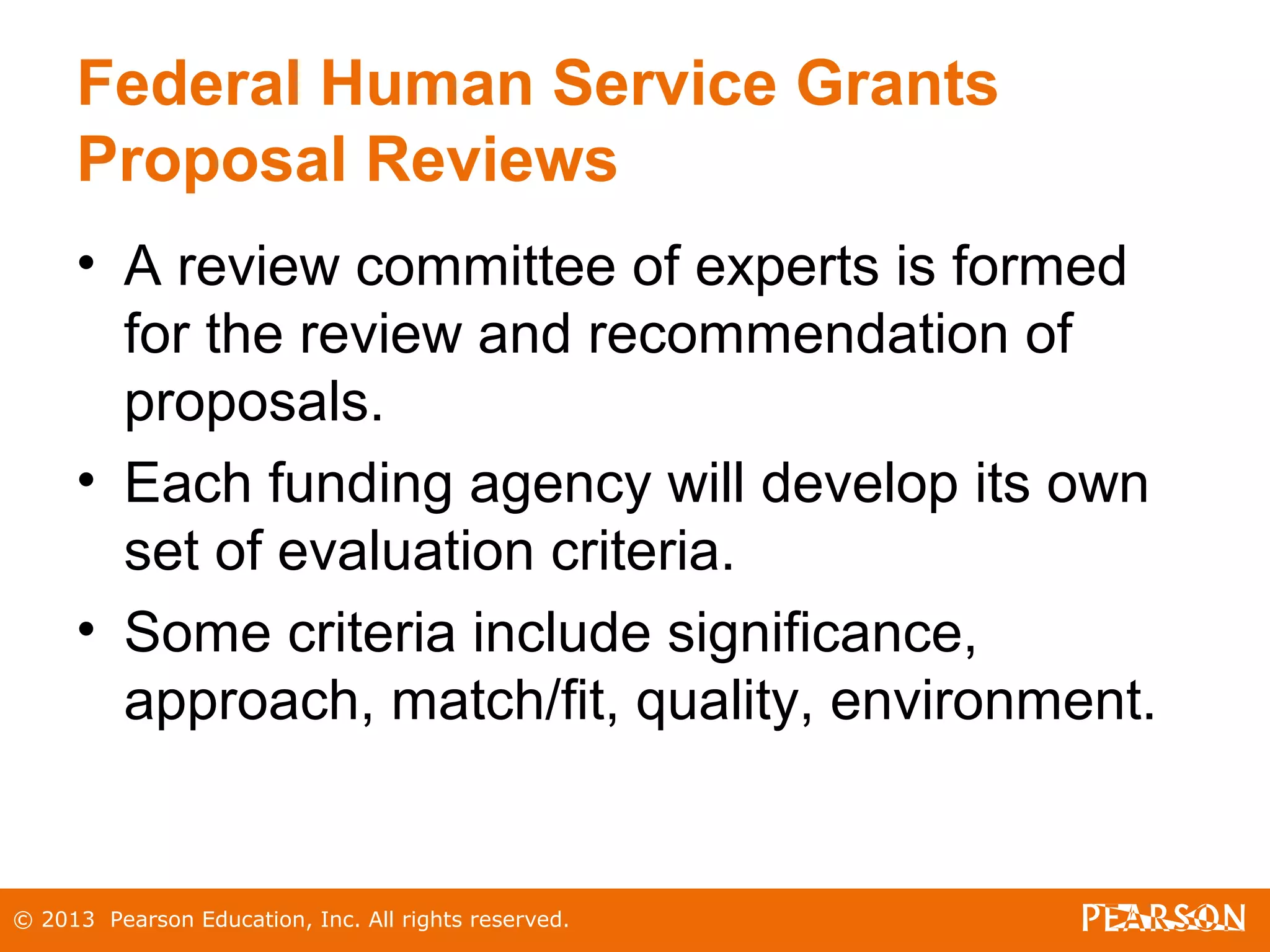
Federal Human Service Grants
Proposal Reviews
• A review committee of experts is formed
for the review and recommendation of
proposals.
• Each funding agency will develop its own
set of evaluation criteria.
• Some criteria include significance,
approach, match/fit, quality, environment.
© 2013 Pearson Education, Inc. All rights reserved.
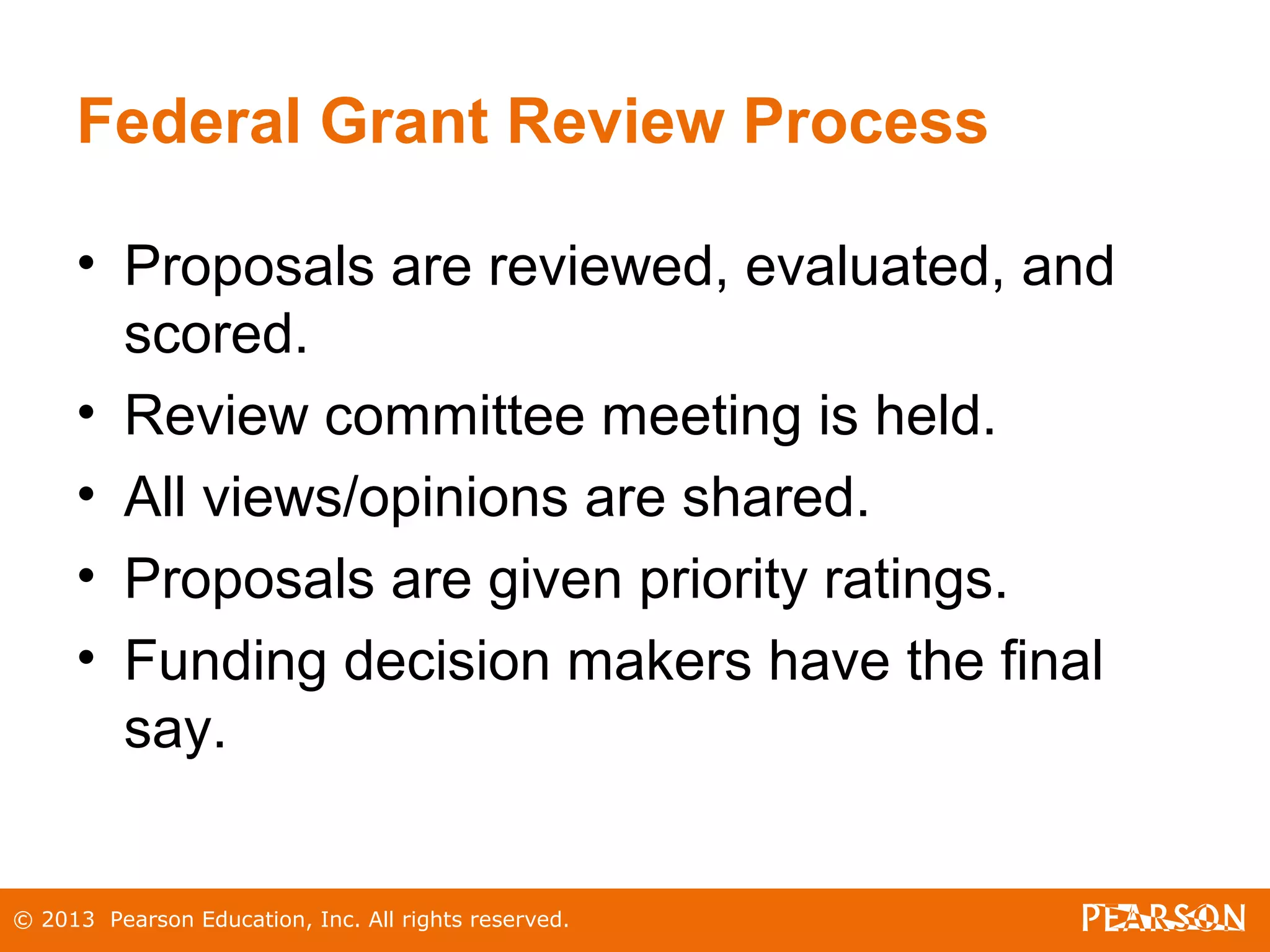
Federal Grant Review Process
• Proposals are reviewed, evaluated, and
scored.
• Review committee meeting is held.
• All views/opinions are shared.
• Proposals are given priority ratings.
• Funding decision makers have the final
say.
© 2013 Pearson Education, Inc. All rights reserved.
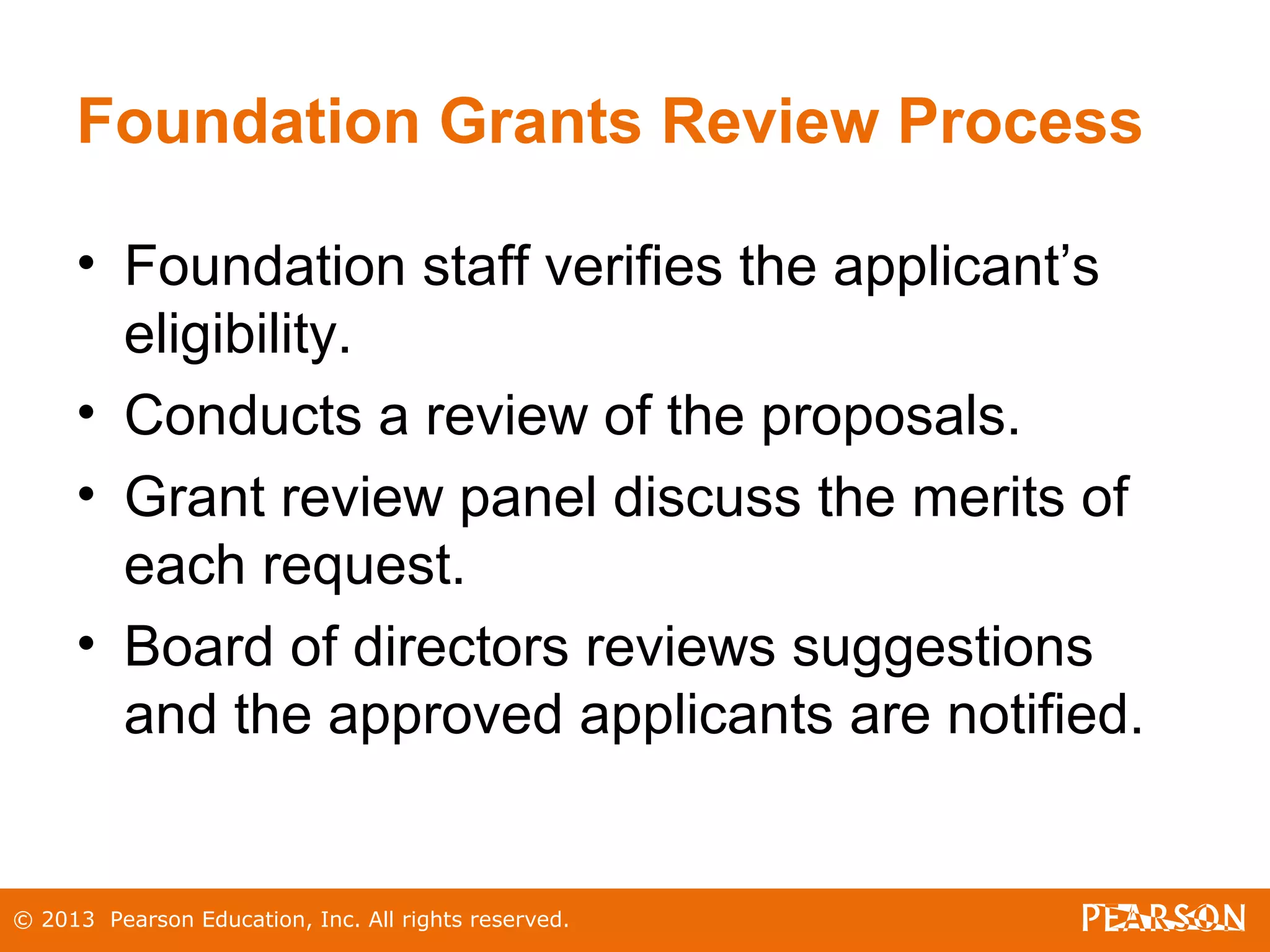
Foundation Grants Review Process
• Foundation staff verifies the applicant’s
eligibility.
• Conducts a review of the proposals.
• Grant review panel discuss the merits of
each request.
• Board of directors reviews suggestions
and the approved applicants are notified.
© 2013 Pearson Education, Inc. All rights reserved.
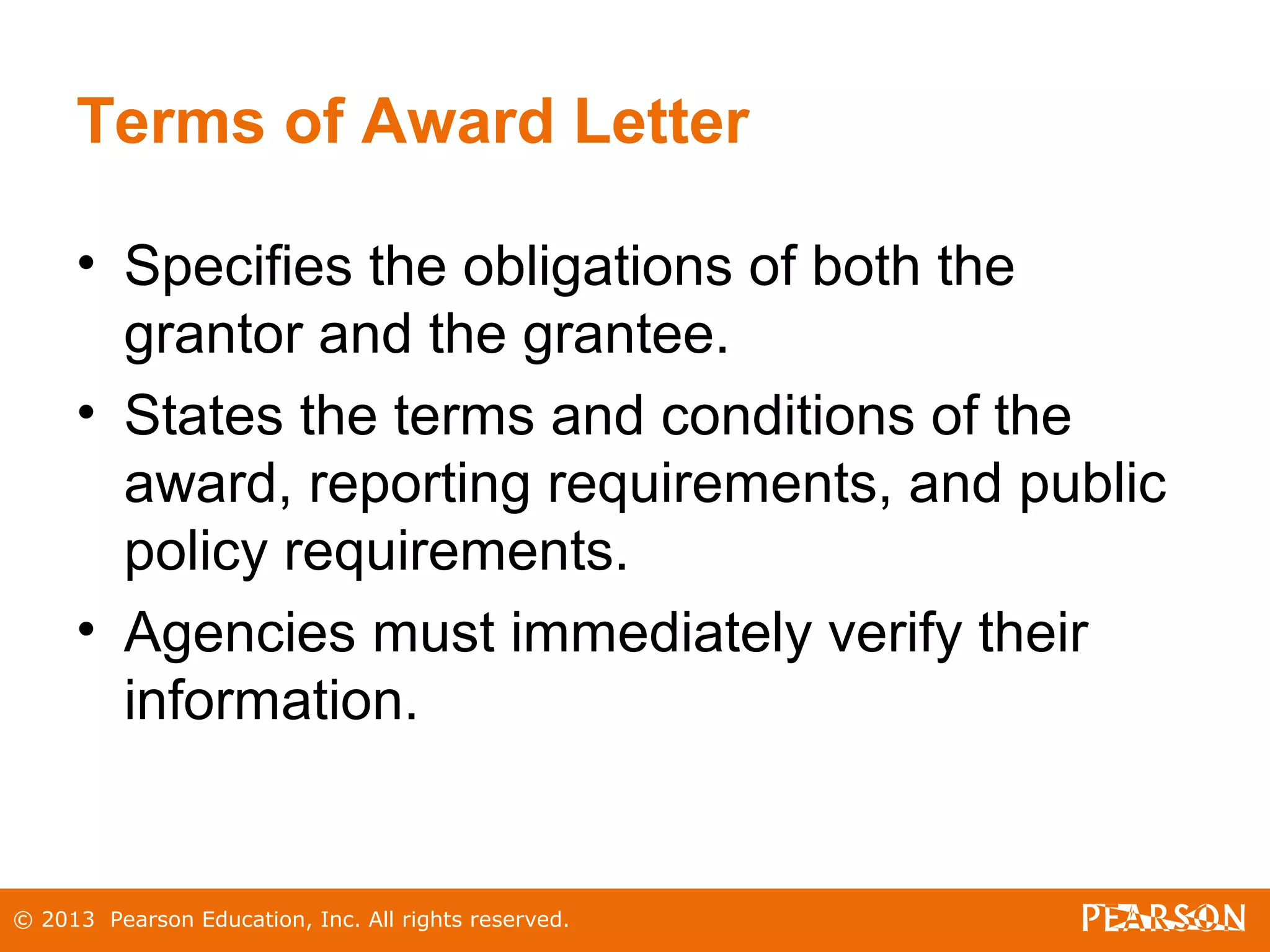
Terms of Award Letter
• Specifies the obligations of both the
grantor and the grantee.
• States the terms and conditions of the
award, reporting requirements, and public
policy requirements.
• Agencies must immediately verify their
information.
© 2013 Pearson Education, Inc. All rights reserved.
Rejection Is a Step to Future
Success
• The success rate for most federal grants
is less than 25 percent.
• Rejection may mean that there was
another proposal that was a better match.
• If possible, organizations should request
the reviewers’ evaluations and comments
to assist in preparing future proposals.

Unit 4 Grantwriting

  • 1.
    Chapter 10 Writing, Submitting,and Revising Grant Proposals
  • 2.
    © 2013 PearsonEducation, Inc. All rights reserved. Prior to the Grant Writing Process • Keep a journal/notebook to note ideas. • Gather documents before writing begins, such as tax certificates and bylaws. • Develop a grant-tracking form to record grant applications, funding cycles, funding received, etc.
  • 3.
    © 2013 PearsonEducation, Inc. All rights reserved. Initial Steps of the Grant Writing Process • Make a plan; identify needs/wants. • Locate potential funders. • Identify the audience. • Draft the grant proposal. • Revise/edit and prepare the final proposal.
  • 4.
    © 2013 PearsonEducation, Inc. All rights reserved. Elements of a Grant Proposal • Grant proposals vary. • There are usually a number of elements, but the sections will likely vary. • Grants are extremely competitive and each section must be prepared meticulously in order to not be rejected by the reviewers.
  • 5.
    © 2013 PearsonEducation, Inc. All rights reserved. Letter of Inquiry/Intent • Sometimes required to determine if the agency’s project falls within the funder’s criteria. • Includes contact information. • Presents overview of agency’s mission. • Provides the total amount requested. • Includes a statement of gratitude.
  • 6.
    © 2013 PearsonEducation, Inc. All rights reserved. Cover Letter • Some grants only require an agency submit a cover letter to the grantor. • Very much like a cover letter does for a job applicant, it introduces an agency to a prospective funder. • Short, friendly, stand out. • Charm the reader and display enthusiasm.
  • 7.
    © 2013 PearsonEducation, Inc. All rights reserved. Title Page/Cover Sheet • Project’s title. • Names of the principle investigators. • The agency’s name, address, and phone/fax numbers. • Project dates, type of grant, amount of funding, and the grant period.
  • 8.
    © 2013 PearsonEducation, Inc. All rights reserved. Abstract/Executive Summary/Introduction • One of the shortest yet most important sections of the grant proposal. • Often forms the first impression; must convince grantor the proposed is worth the investment. • A strong abstract is concise, limited to key points, strongly written.
  • 9.
    © 2013 PearsonEducation, Inc. All rights reserved. Literature Review • Sometimes required to provide crucial background information. • Compiled reviews highlighting published writings on subjects related to the project. • A basic literature review is comprised of the introduction, body, and conclusion.
  • 10.
    © 2013 PearsonEducation, Inc. All rights reserved. Needs/Problem Statement • Proves that the grant meets a vital societal need. • Clear, well-supported statement of the problem that will be addressed. • Addresses the need and how the agency’s clients are affected. • Both qualitative and quantitative.
  • 11.
    © 2013 PearsonEducation, Inc. All rights reserved. Goals and Objectives • Provide a map to the project, influence the design of the program, determine the methods and strategies needed to achieve the goals/objectives. • Goals are long term statements of hope. • Objectives are narrow, precise, and short term.
  • 12.
    © 2013 PearsonEducation, Inc. All rights reserved. Program Design/Methods/Strategies • Methods for achieving the goals/objectives set. • Include supporting statements that cite research, expert opinions, personal communication, and past experience. • Justify the course of action that will be taken.
  • 13.
    © 2013 PearsonEducation, Inc. All rights reserved. Evaluation Plan • Defines how success will be determined. • Clarifies the purpose of the project. • Chronicles the progress and assesses the effectiveness. • Obtains feedback from the individuals served as well as community members. • Facilitates project improvement.
  • 14.
    © 2013 PearsonEducation, Inc. All rights reserved. Types of Evaluations • Process Evaluations – descriptive and ongoing. • Outcome Evaluations – identify if a project’s outcomes have been achieved. • Impact Evaluations – assess the changes that can be attributed to a project.
  • 15.
    © 2013 PearsonEducation, Inc. All rights reserved. Organizational Information • Provides a convincing argument of the agency’s credibility to accomplish the goals/objectives of the project. • Position the nonprofit as the best agency to implement the proposed project.
  • 16.
    © 2013 PearsonEducation, Inc. All rights reserved. Program’s Budget and Budget Narrative • Lists both administrative and project costs. • Consists of a spreadsheet or table with detailed line items. • Explains how the budget will be spent and why it is cost-effective. • Provides a clear picture of the impact that can be made with the requested funds.
  • 17.
    © 2013 PearsonEducation, Inc. All rights reserved. Special Considerations • Equipment Purchases • Additional Space and Equipment • Increases in the Cost of Insurance • Salaries • Indirect Costs • Matching Funds
  • 18.
    © 2013 PearsonEducation, Inc. All rights reserved. Other Funding/Sustainability • Describes the nonprofit’s long-term continuation plan or vision for the project after the grant period has ended. • Explains how the agency will raise funds to continue the project. • Includes a list of other funders approached.
  • 19.
    © 2013 PearsonEducation, Inc. All rights reserved. Commonly Requested Supplemental Materials • IRS tax-exempt verification letter • List of board directors and affiliations • List of staff experience • Financial statement for the previous year • Current fiscal year’s budget • Next fiscal year’s budget • List of clients served and annual report
  • 20.
    © 2013 PearsonEducation, Inc. All rights reserved. Review and Proof • The proposal should be reviewed by a neutral third party. • Reviewed for continuity, reasoning, and clarity. • The proposal must not contain any unsupported assumptions or jargon. • Reviewed for neatness and accuracy.
  • 21.
    © 2013 PearsonEducation, Inc. All rights reserved. Submitting the Proposal • Copy the entire application. • Check with the grantor on the preferred format for binding the original proposal. • Mail the proposal in the format requested and several days before deadline. • A follow-up call may be placed after a week of not hearing from the grantor.
  • 22.
    © 2013 PearsonEducation, Inc. All rights reserved. Online Grant Applications • Sometimes paperless formats have limited space. • Online grant applications can improve the efficiency and accuracy of the process. • Submission must be made early in order to avoid possible technology issues.
  • 23.
    © 2013 PearsonEducation, Inc. All rights reserved. Some Grant Writing Mistakes • Hastily assembled. • Too lengthy. • Written in first person. • Included false, inaccurate cost estimates. • Overkilled a point. • Not logically formatted. • Did not follow grantor’s instructions.
  • 24.
    © 2013 PearsonEducation, Inc. All rights reserved. The Review Process • Proposal reviews are very rigorous and competitive. • Proposals are normally scored using a grading rubric to ensure consistency of evaluation. • Process varies based on the type of grant.
  • 25.
    © 2013 PearsonEducation, Inc. All rights reserved. Federal Human Service Grants Proposal Reviews • A review committee of experts is formed for the review and recommendation of proposals. • Each funding agency will develop its own set of evaluation criteria. • Some criteria include significance, approach, match/fit, quality, environment.
  • 26.
    © 2013 PearsonEducation, Inc. All rights reserved. Federal Grant Review Process • Proposals are reviewed, evaluated, and scored. • Review committee meeting is held. • All views/opinions are shared. • Proposals are given priority ratings. • Funding decision makers have the final say.
  • 27.
    © 2013 PearsonEducation, Inc. All rights reserved. Foundation Grants Review Process • Foundation staff verifies the applicant’s eligibility. • Conducts a review of the proposals. • Grant review panel discuss the merits of each request. • Board of directors reviews suggestions and the approved applicants are notified.
  • 28.
    © 2013 PearsonEducation, Inc. All rights reserved. Terms of Award Letter • Specifies the obligations of both the grantor and the grantee. • States the terms and conditions of the award, reporting requirements, and public policy requirements. • Agencies must immediately verify their information.
  • 29.
    © 2013 PearsonEducation, Inc. All rights reserved. Rejection Is a Step to Future Success • The success rate for most federal grants is less than 25 percent. • Rejection may mean that there was another proposal that was a better match. • If possible, organizations should request the reviewers’ evaluations and comments to assist in preparing future proposals.