CALSA Summer Institute  Presented by: Lisa Gonzales Santa Clara County Office of Education & Devin Vodicka, Ed.D. Carlsbad Unified School District
Workshop Overview Empowering you! Introduction to grants Researching opportunities Developing a grant proposal one element at a time Tailoring your standard proposal Packaging for submission Review of grants Tips for success
What is a grant? “Free money”  Don’t have to pay it back Conditioned on meeting certain outcomes SIGNED contract! Reporting and other requirements
Who gives grants? Federal government State government Local government  Philanthropic foundations Corporations / local businesses Clubs / organizations  Rotary, Lion’s, Elk’s, etc.
Schools & 501(c)(3) Status Schools are tax-exempt, but do not automatically have 501(c)(3) status  http://foundationcenter.org/getstarted/faqs/html/school501c3.html See  http:// www.cceflink.org  for more information on starting your own LEF (local education foundation)
What will grants fund? Stand-alone projects / programs Start-up / Expand / Replicate One-time capital / equipment purchases Capacity building / Technical assistance Training, Consultants, etc.  Innovative initiatives / Partnerships
What is it harder to get grant funding to support? General Operating Costs Administrative staffing, building maintenance, insurance, etc.  Ongoing expenses for a successful program that is not changing Conference, publications, programs that only benefit a few Endowment funds Seed funding for a new organization
When Do You Need the Money By? Grants can rarely provide emergency funding Foundation funding lags  —  money may be awarded 6 +  months after you’ve  submitted the proposal Corporations tend to have quicker turn-around time, due to less formal boards and deadlines
Places to Conduct Research Foundation Center – San Francisco  Online Foundation Finder (free) http://foundationcenter.org/findfunders Foundation Directory Online (subscription) SCCOE Grant Resource Center – Foundation Directory Online (searchable database), circulating books,  Funding Update  & our  website  (portal to online grant resources)! http://www.sccoe.org/resourcesed/grantcenter/
Finding the Right Funder Look at their stated funding priorities: Subject Area Education, the arts, social services, etc. Geographic Limitation Only fund projects in a specific place? Type of Financial Need Projects, capital, endowment, operating costs Dollar Range of Grants / Average award Right ballpark? (25% rule) Plus: Existing relationships
Recently Funded Projects Look for previous grantees/projects online. Would yours fall into a similar category?  Besides databases and foundation websites, you can go to  www.guidestar.org  to research a foundation’s 990-PF form, the tax return that lists grants awarded during that tax year The Foundation Center can answer some of your questions regarding 990s. Go to   http://foundationcenter.org/getstarted/faqs/full_list.html
If it’s not a good match, MOVE ON! Don’t waste your time on a proposal that will be disqualified before ever being read You need a funder who has demonstrated interest (financial support) in similar programs in your area, in amounts that fall in roughly the same range as your request (consider parceling up your ideas)
Once you have a list of potential funders . . .   GET THEIR GUIDELINES!!!   Visit their website, call, email, or write Unless it explicitly states not to, calling to ask clarifying questions (while being respectful of their time) can sometimes serve to introduce you to the funder  —  but be prepared with some phone-friendly descriptions of your agency and proposed program
The Grant Proposal
Begin with  The Formula … The seven elements of a standard grant narrative (in order): Executive Summary Agency History Problem / Statement of Need Goals and Objectives Methods Evaluation  Sustainability  (Don’t forget the BUDGET!)
Developing the Elements of a Standard Grant Proposal
I. Agency History When your agency was established What its mission statement is Briefly highlight key past successes  Note key individuals  Board/leadership team, staff, founders # clients served by your agency
II. Problem / Statement of Need What is the problem or need that your program will address? DON’T assume the reader knows or understands the problem or need! You have to demonstrate your understanding of the problem for them to believe that you can address it effectively
Building the foundation of your case for funding You must address:  Who are the people with the problem or need? Where is the geographic location of these people? When did the need present itself? Why did this need occur? “ So what?”  What difference does your problem make?
Using Evidence Use data / evidence to support your case Don’t overwhelm your reader with statistics Choose the most relevant to building your case Verify that your evidence is accurate, and cite it Whenever possible, describe the need at the local, community level Present a case study or anecdote, when possible
Other Types of Evidence It doesn’t have to be strictly scientific data, or data other people have reported Consider a survey or a needs assessment Our constituency tells us that these are the problems we face, these are the barriers to our doing a more effective job
III.  Goals and Objectives Goals  are broad and abstract  The “Big Picture” purpose of your project, often conceptual (e.g. “Our literacy program will help students in our district read better.”); the ultimate result of the change being undertaken  Long-term, probably not feasible in the grant period (e.g. “Every student will graduate from high school”) Agencies typically have no more than 3 or 4 overall goals
Objectives are  S.M.A.R.T. S pecific and tangible  The  M EASURABLE program outcomes  A chievable and  R ealistic  You will want to report to the funder that you met all your stated objectives T ime-specific  ***  Within the grant period! ***
Examples of Objectives 85% of students enrolled in this class will improve his/her STAR score by at least 15 points this spring 50 more students will have access to computers than last year, and 95% of them will pass a computer literacy test by the end of the year    What you hope to ACHIEVE    How you will define SUCCESS
Good Verbs for Objectives Increase, decrease Expand, reduce Enhance, diminish Develop, lessen Improve, shorten  Equalize Achieve
IV.  Methods Program description, with activities and strategies  Be specific, but avoid giving  too  many details
WHEN will you do all this? WHY will you do all this? Consider including a timeline. Justify your methods (esp. if they are unconventional).  Explain why your chosen methods will lead to the success you anticipated in the objectives section. In some proposals, it may make sense to list or describe methods directly beneath each related objective.
Staffing / Administration Show management capacity to effectively execute the project  Number of staff, their qualifications (relevant experience, level of expertise, educational background), their specific assignments Can be a different section/in the appendix
Evaluation What kind of evaluation tools and techniques are available? Will you be doing an internal evaluation or hiring outside evaluators?  Budget for this!  How will you collect and analyze the data? How will you report the outcomes? Who will receive an assessment report? Who is your AUDIENCE?
Possible Types of Evaluations Pre/Post-tests Rubric assessments Focus Groups Client Surveys Teacher feedback forms Report Cards Attendance rates Standardized exam scores
VI. Sustainability They want to make their investment a lasting one!  DON’T  assume that the foundation who’s funding you now will fund you in the future
Sustainability Strategies Is your project finite?  Will it serve as a model for others, or will you disseminate what you learned to others? Can you fold the project into the curriculum that the school will fund? Will the project itself be revenue generating, or contribute to the self-sufficiency of your agency? Or will you sustain the project through future funding?  Will the project make your agency more attractive to future funders?
VII. Executive Summary Write this piece  LAST  (even though it’s the first piece of the narrative) It has to summarize who you are, what the problem is, how you propose to solve it, and how much money you’re asking for . . . . . . AND be  compelling  enough for the funder to want to read the rest of the proposal.  Think of it as writing the jacket for a book you just wrote. Try to keep it original, even though there will be duplication of information.
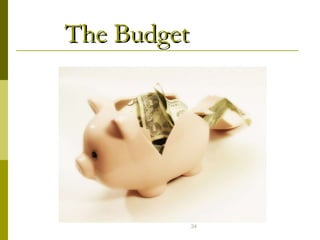
The Budget
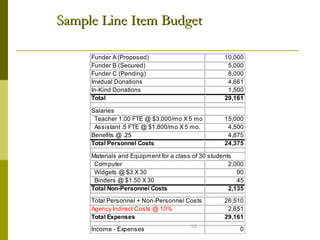
Budget Be as specific as possible.  Instead of saying “office supplies,” list what you’re purchasing, in what quantity, at what cost.  Show the math: widgets @ $3 X 30 = $ 90 So the project doesn’t put you in debt, consider the full costs of your program Be REALISTIC.  Don’t ask for outrageous amounts as a negotiating tool  As always, follow their guidelines if they request the budget in a specific format
Sample Line Item Budget
Attachments Standard Attachments 501(c)(3) letter (School letterhead may suffice) Board of Director’s List Agency’s Annual Budget  Financial Statements (audited, if possible) Annual Report
Possible Attachments Attachments that may be requested Memoranda of Understanding Resumes/ C.V.s of key staff members Letters of support from other organizations Board of Directors resolution approving the proposal Brochures/newsletters Press clippings Graphs or charts Articles of Incorporation / bylaws Photographs (not generally suggested) Videos (almost never!)
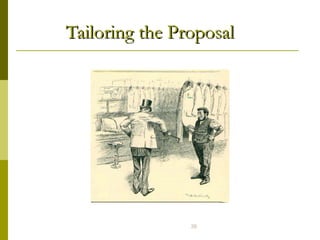
Tailoring the Proposal
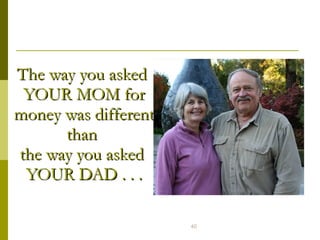
The way you asked  YOUR MOM for money was different than  the way you asked  YOUR DAD . . .
Know Your Audience! Try to  integrate  words or phrases that frequently appear in the RFP (buzzwords) Try to look at several proposals that have been funded recently  Point out how your project aligns with their funding priorities If your project budget is larger than this funder will fund, you should show your full costs but ask them for only a portion of it (be explicit about which pieces you’re asking for)
Presentation Counts!  Always consult the GUIDELINES! 11- or 12- point font, 1” margins Single space the narrative, double spacing between paragraphs and sections Headings and sub-headings provide organization One-sided printing on plain, white bond paper bound with a binder clip —  *** no staples, binders, or folders*** Regular mail in an envelope big enough so that the paper will lay flat; consider inserting a piece of cardboard in back Make sure it arrives on time!!! (Postmark/delivery)
Editing Although many people may be contributing to the  grant proposal, it is best for there to be one writer – at the very least, it needs to have one unified “voice” Take advantage of as many editors as you can find! The proposal should be easy to read and free of typos Triple check the spelling of the program officer’s name and verify the address before you send it
A Word on Words “ Good writing will not save bad ideas, but bad writing will kill good ones.” —  Dr. Jacob Kaicer University of Toronto
Things to Keep in Mind Be REALISTIC and HONEST Make sure the proposal is LOGICAL Make the proposal as CLEAR as you possibly can.  This is all they have to go on! Before submitting, have someone outside your field read it if possible. Ensure that EVERY piece of the proposal works together to build a strong case for funding your project
Drum roll, please . . . If it’s a  no : The proposal was an introduction; don’t shut the door on a potential future funder!  (3-Strike Rule) Thank them for their time, and ask if they have suggestions on how to improve your proposal How can you re-apply? If it’s a  yes : Send a  formal  thank-you
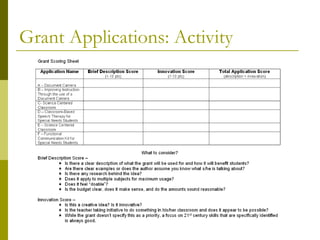
Grant Applications: Activity
Recommended Reading The Foundation Center’s  Guide to Proposal Writing , 4th. Edition THE essential guide to writing winning proposals!  Demystifying Grant Seeking , by Larissa Golden Brown and Martin John Brown A hand-holding guide to the entire grant process, to make you more efficient and successful  —  A MUST-HAVE! Cheryl Clarke’s  Storytelling for Grantseekers  A refreshing new way to approach the grant proposal narrative
Grant Resource Center Foundation Directory Online  —  searchable database for finding funding opportunities Funding Update  monthly newsletter Circulating books/materials on the grant process Portal to online grant resources:  http://www.sccoe.org/resourcesed/grantcenter/
Good Luck!!!

Follow The Yellow Grant Road

  • 1.
    CALSA Summer Institute Presented by: Lisa Gonzales Santa Clara County Office of Education & Devin Vodicka, Ed.D. Carlsbad Unified School District
  • 2.
    Workshop Overview Empoweringyou! Introduction to grants Researching opportunities Developing a grant proposal one element at a time Tailoring your standard proposal Packaging for submission Review of grants Tips for success
  • 3.
    What is agrant? “Free money” Don’t have to pay it back Conditioned on meeting certain outcomes SIGNED contract! Reporting and other requirements
  • 4.
    Who gives grants?Federal government State government Local government Philanthropic foundations Corporations / local businesses Clubs / organizations Rotary, Lion’s, Elk’s, etc.
  • 5.
    Schools & 501(c)(3)Status Schools are tax-exempt, but do not automatically have 501(c)(3) status http://foundationcenter.org/getstarted/faqs/html/school501c3.html See http:// www.cceflink.org for more information on starting your own LEF (local education foundation)
  • 6.
    What will grantsfund? Stand-alone projects / programs Start-up / Expand / Replicate One-time capital / equipment purchases Capacity building / Technical assistance Training, Consultants, etc. Innovative initiatives / Partnerships
  • 7.
    What is itharder to get grant funding to support? General Operating Costs Administrative staffing, building maintenance, insurance, etc. Ongoing expenses for a successful program that is not changing Conference, publications, programs that only benefit a few Endowment funds Seed funding for a new organization
  • 8.
    When Do YouNeed the Money By? Grants can rarely provide emergency funding Foundation funding lags — money may be awarded 6 + months after you’ve submitted the proposal Corporations tend to have quicker turn-around time, due to less formal boards and deadlines
  • 9.
    Places to ConductResearch Foundation Center – San Francisco Online Foundation Finder (free) http://foundationcenter.org/findfunders Foundation Directory Online (subscription) SCCOE Grant Resource Center – Foundation Directory Online (searchable database), circulating books, Funding Update & our website (portal to online grant resources)! http://www.sccoe.org/resourcesed/grantcenter/
  • 10.
    Finding the RightFunder Look at their stated funding priorities: Subject Area Education, the arts, social services, etc. Geographic Limitation Only fund projects in a specific place? Type of Financial Need Projects, capital, endowment, operating costs Dollar Range of Grants / Average award Right ballpark? (25% rule) Plus: Existing relationships
  • 11.
    Recently Funded ProjectsLook for previous grantees/projects online. Would yours fall into a similar category? Besides databases and foundation websites, you can go to www.guidestar.org to research a foundation’s 990-PF form, the tax return that lists grants awarded during that tax year The Foundation Center can answer some of your questions regarding 990s. Go to http://foundationcenter.org/getstarted/faqs/full_list.html
  • 12.
    If it’s nota good match, MOVE ON! Don’t waste your time on a proposal that will be disqualified before ever being read You need a funder who has demonstrated interest (financial support) in similar programs in your area, in amounts that fall in roughly the same range as your request (consider parceling up your ideas)
  • 13.
    Once you havea list of potential funders . . . GET THEIR GUIDELINES!!! Visit their website, call, email, or write Unless it explicitly states not to, calling to ask clarifying questions (while being respectful of their time) can sometimes serve to introduce you to the funder — but be prepared with some phone-friendly descriptions of your agency and proposed program
  • 14.
  • 15.
    Begin with The Formula … The seven elements of a standard grant narrative (in order): Executive Summary Agency History Problem / Statement of Need Goals and Objectives Methods Evaluation Sustainability (Don’t forget the BUDGET!)
  • 16.
    Developing the Elementsof a Standard Grant Proposal
  • 17.
    I. Agency HistoryWhen your agency was established What its mission statement is Briefly highlight key past successes Note key individuals Board/leadership team, staff, founders # clients served by your agency
  • 18.
    II. Problem /Statement of Need What is the problem or need that your program will address? DON’T assume the reader knows or understands the problem or need! You have to demonstrate your understanding of the problem for them to believe that you can address it effectively
  • 19.
    Building the foundationof your case for funding You must address: Who are the people with the problem or need? Where is the geographic location of these people? When did the need present itself? Why did this need occur? “ So what?” What difference does your problem make?
  • 20.
    Using Evidence Usedata / evidence to support your case Don’t overwhelm your reader with statistics Choose the most relevant to building your case Verify that your evidence is accurate, and cite it Whenever possible, describe the need at the local, community level Present a case study or anecdote, when possible
  • 21.
    Other Types ofEvidence It doesn’t have to be strictly scientific data, or data other people have reported Consider a survey or a needs assessment Our constituency tells us that these are the problems we face, these are the barriers to our doing a more effective job
  • 22.
    III. Goalsand Objectives Goals are broad and abstract The “Big Picture” purpose of your project, often conceptual (e.g. “Our literacy program will help students in our district read better.”); the ultimate result of the change being undertaken Long-term, probably not feasible in the grant period (e.g. “Every student will graduate from high school”) Agencies typically have no more than 3 or 4 overall goals
  • 23.
    Objectives are S.M.A.R.T. S pecific and tangible The M EASURABLE program outcomes A chievable and R ealistic You will want to report to the funder that you met all your stated objectives T ime-specific *** Within the grant period! ***
  • 24.
    Examples of Objectives85% of students enrolled in this class will improve his/her STAR score by at least 15 points this spring 50 more students will have access to computers than last year, and 95% of them will pass a computer literacy test by the end of the year  What you hope to ACHIEVE  How you will define SUCCESS
  • 25.
    Good Verbs forObjectives Increase, decrease Expand, reduce Enhance, diminish Develop, lessen Improve, shorten Equalize Achieve
  • 26.
    IV. MethodsProgram description, with activities and strategies Be specific, but avoid giving too many details
  • 27.
    WHEN will youdo all this? WHY will you do all this? Consider including a timeline. Justify your methods (esp. if they are unconventional). Explain why your chosen methods will lead to the success you anticipated in the objectives section. In some proposals, it may make sense to list or describe methods directly beneath each related objective.
  • 28.
    Staffing / AdministrationShow management capacity to effectively execute the project Number of staff, their qualifications (relevant experience, level of expertise, educational background), their specific assignments Can be a different section/in the appendix
  • 29.
    Evaluation What kindof evaluation tools and techniques are available? Will you be doing an internal evaluation or hiring outside evaluators? Budget for this! How will you collect and analyze the data? How will you report the outcomes? Who will receive an assessment report? Who is your AUDIENCE?
  • 30.
    Possible Types ofEvaluations Pre/Post-tests Rubric assessments Focus Groups Client Surveys Teacher feedback forms Report Cards Attendance rates Standardized exam scores
  • 31.
    VI. Sustainability Theywant to make their investment a lasting one! DON’T assume that the foundation who’s funding you now will fund you in the future
  • 32.
    Sustainability Strategies Isyour project finite? Will it serve as a model for others, or will you disseminate what you learned to others? Can you fold the project into the curriculum that the school will fund? Will the project itself be revenue generating, or contribute to the self-sufficiency of your agency? Or will you sustain the project through future funding? Will the project make your agency more attractive to future funders?
  • 33.
    VII. Executive SummaryWrite this piece LAST (even though it’s the first piece of the narrative) It has to summarize who you are, what the problem is, how you propose to solve it, and how much money you’re asking for . . . . . . AND be compelling enough for the funder to want to read the rest of the proposal. Think of it as writing the jacket for a book you just wrote. Try to keep it original, even though there will be duplication of information.
  • 34.
  • 35.
    Budget Be asspecific as possible. Instead of saying “office supplies,” list what you’re purchasing, in what quantity, at what cost. Show the math: widgets @ $3 X 30 = $ 90 So the project doesn’t put you in debt, consider the full costs of your program Be REALISTIC. Don’t ask for outrageous amounts as a negotiating tool As always, follow their guidelines if they request the budget in a specific format
  • 36.
  • 37.
    Attachments Standard Attachments501(c)(3) letter (School letterhead may suffice) Board of Director’s List Agency’s Annual Budget Financial Statements (audited, if possible) Annual Report
  • 38.
    Possible Attachments Attachmentsthat may be requested Memoranda of Understanding Resumes/ C.V.s of key staff members Letters of support from other organizations Board of Directors resolution approving the proposal Brochures/newsletters Press clippings Graphs or charts Articles of Incorporation / bylaws Photographs (not generally suggested) Videos (almost never!)
  • 39.
  • 40.
    The way youasked YOUR MOM for money was different than the way you asked YOUR DAD . . .
  • 41.
    Know Your Audience!Try to integrate words or phrases that frequently appear in the RFP (buzzwords) Try to look at several proposals that have been funded recently Point out how your project aligns with their funding priorities If your project budget is larger than this funder will fund, you should show your full costs but ask them for only a portion of it (be explicit about which pieces you’re asking for)
  • 42.
    Presentation Counts! Always consult the GUIDELINES! 11- or 12- point font, 1” margins Single space the narrative, double spacing between paragraphs and sections Headings and sub-headings provide organization One-sided printing on plain, white bond paper bound with a binder clip — *** no staples, binders, or folders*** Regular mail in an envelope big enough so that the paper will lay flat; consider inserting a piece of cardboard in back Make sure it arrives on time!!! (Postmark/delivery)
  • 43.
    Editing Although manypeople may be contributing to the grant proposal, it is best for there to be one writer – at the very least, it needs to have one unified “voice” Take advantage of as many editors as you can find! The proposal should be easy to read and free of typos Triple check the spelling of the program officer’s name and verify the address before you send it
  • 44.
    A Word onWords “ Good writing will not save bad ideas, but bad writing will kill good ones.” — Dr. Jacob Kaicer University of Toronto
  • 45.
    Things to Keepin Mind Be REALISTIC and HONEST Make sure the proposal is LOGICAL Make the proposal as CLEAR as you possibly can. This is all they have to go on! Before submitting, have someone outside your field read it if possible. Ensure that EVERY piece of the proposal works together to build a strong case for funding your project
  • 46.
    Drum roll, please. . . If it’s a no : The proposal was an introduction; don’t shut the door on a potential future funder! (3-Strike Rule) Thank them for their time, and ask if they have suggestions on how to improve your proposal How can you re-apply? If it’s a yes : Send a formal thank-you
  • 47.
  • 48.
    Recommended Reading TheFoundation Center’s Guide to Proposal Writing , 4th. Edition THE essential guide to writing winning proposals! Demystifying Grant Seeking , by Larissa Golden Brown and Martin John Brown A hand-holding guide to the entire grant process, to make you more efficient and successful — A MUST-HAVE! Cheryl Clarke’s Storytelling for Grantseekers A refreshing new way to approach the grant proposal narrative
  • 49.
    Grant Resource CenterFoundation Directory Online — searchable database for finding funding opportunities Funding Update monthly newsletter Circulating books/materials on the grant process Portal to online grant resources: http://www.sccoe.org/resourcesed/grantcenter/
  • 50.