
ART, ARCHITECTURE AND DESING Laura Koort Kristine Truija 11c
Architecture & Art
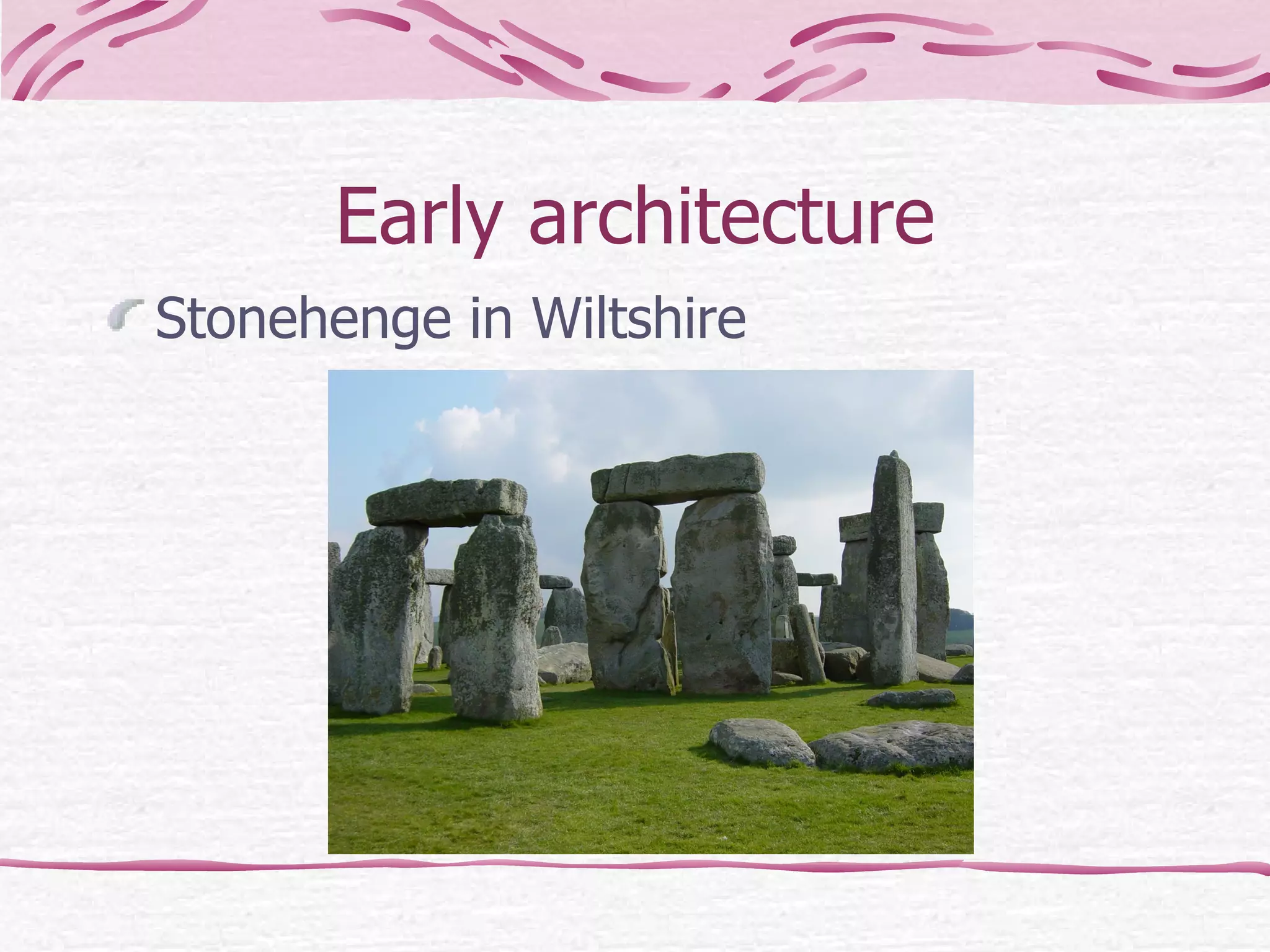
Early architecture Stonehenge in Wiltshire
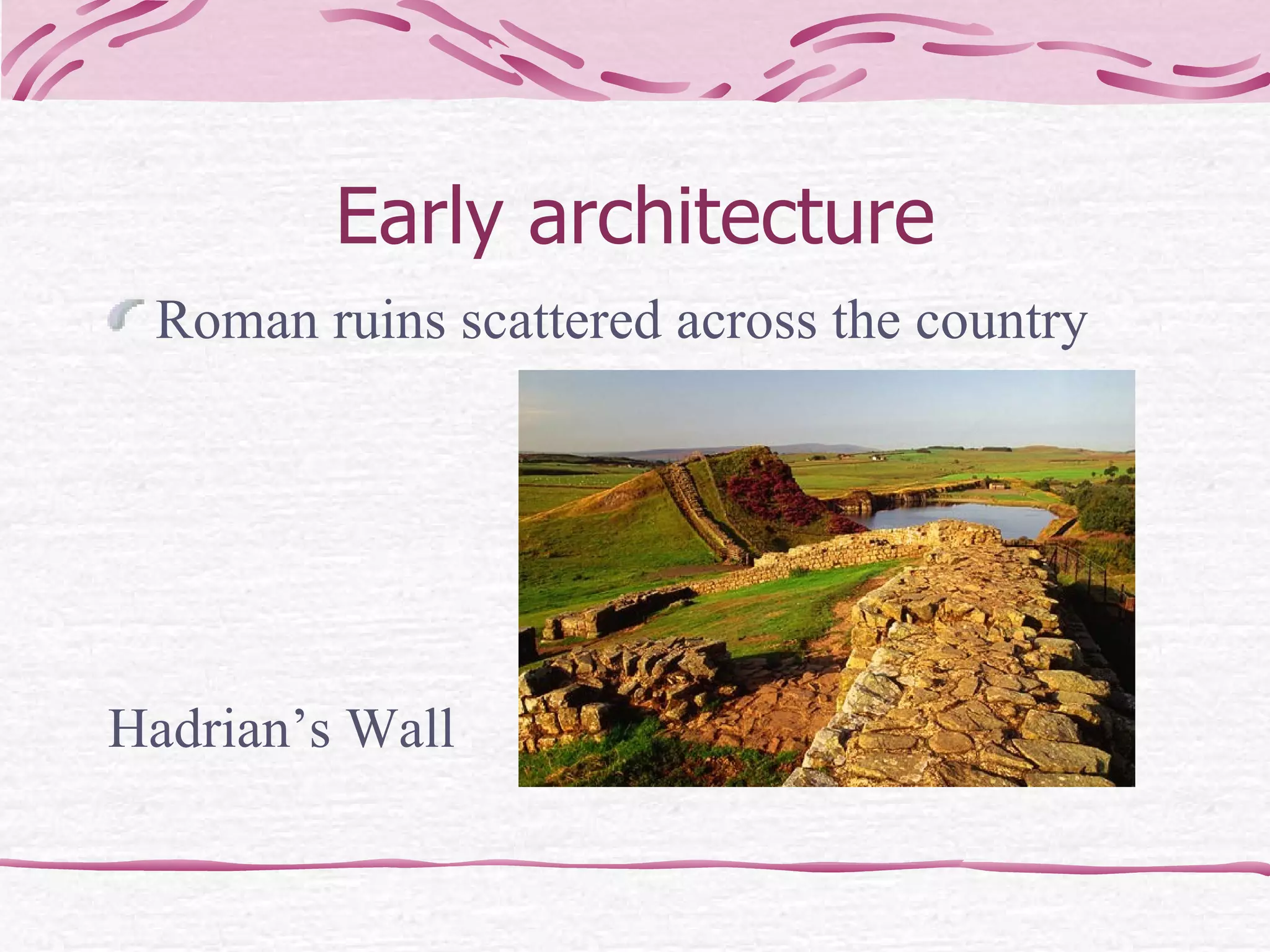
Early architecture Roman ruins scattered across the country Hadrian’s Wall
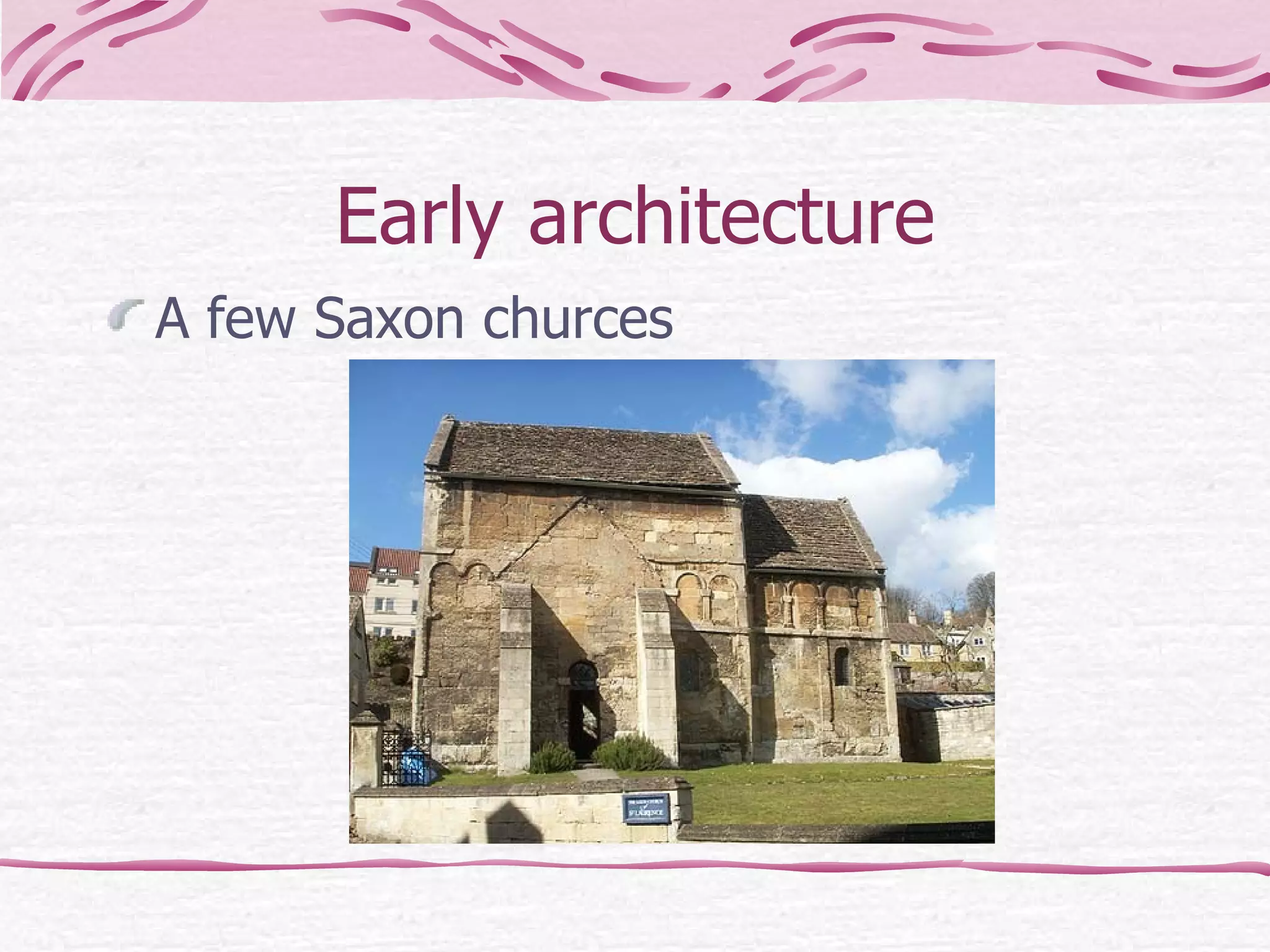
Early architecture A few Saxon churces
Middle Ages to the Reformation Medieval churces – richly decorated with colourful statues, murals and paintings Thick-walled stone castles Massive cathedrals with long naves and carved round arches
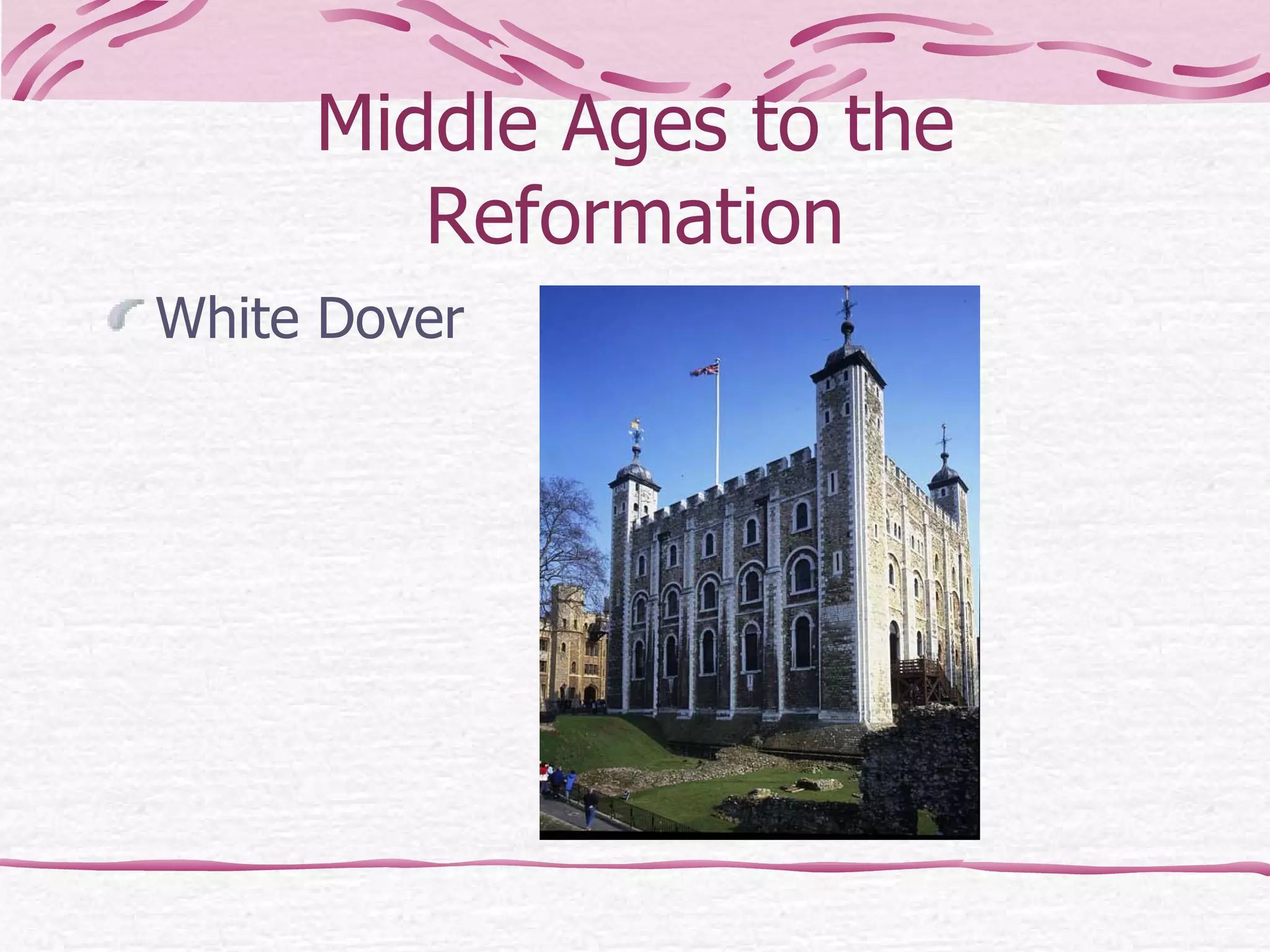
Middle Ages to the Reformation White Dover
Middle Ages to the Reformation The English Gothic Style -  round arches became pointed, more and larger windows were made, roof vaults became more complex   Divided into three periods:
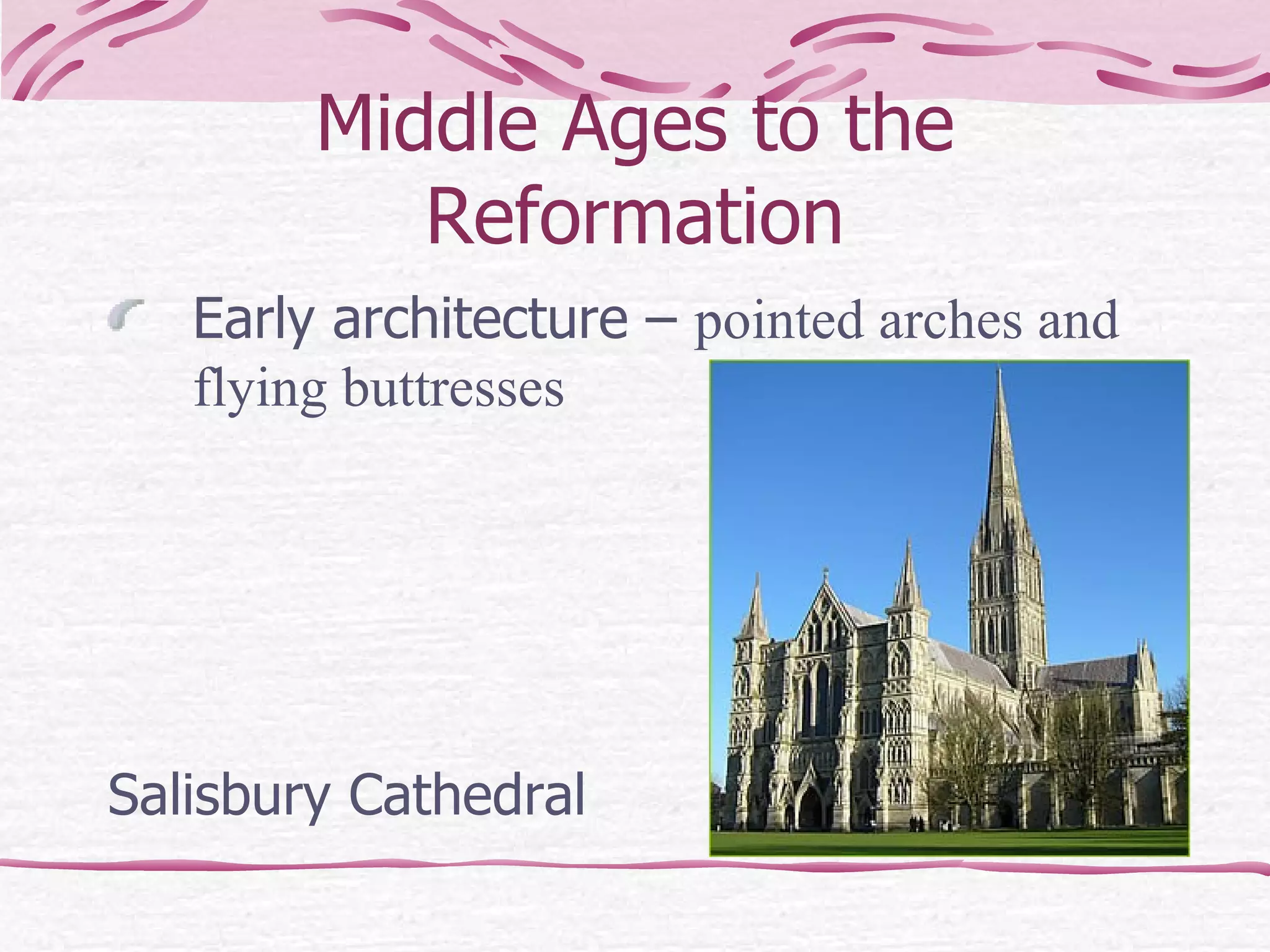
Middle Ages to the Reformation Early architecture –  pointed arches and flying buttresses Salisbury Cathedral
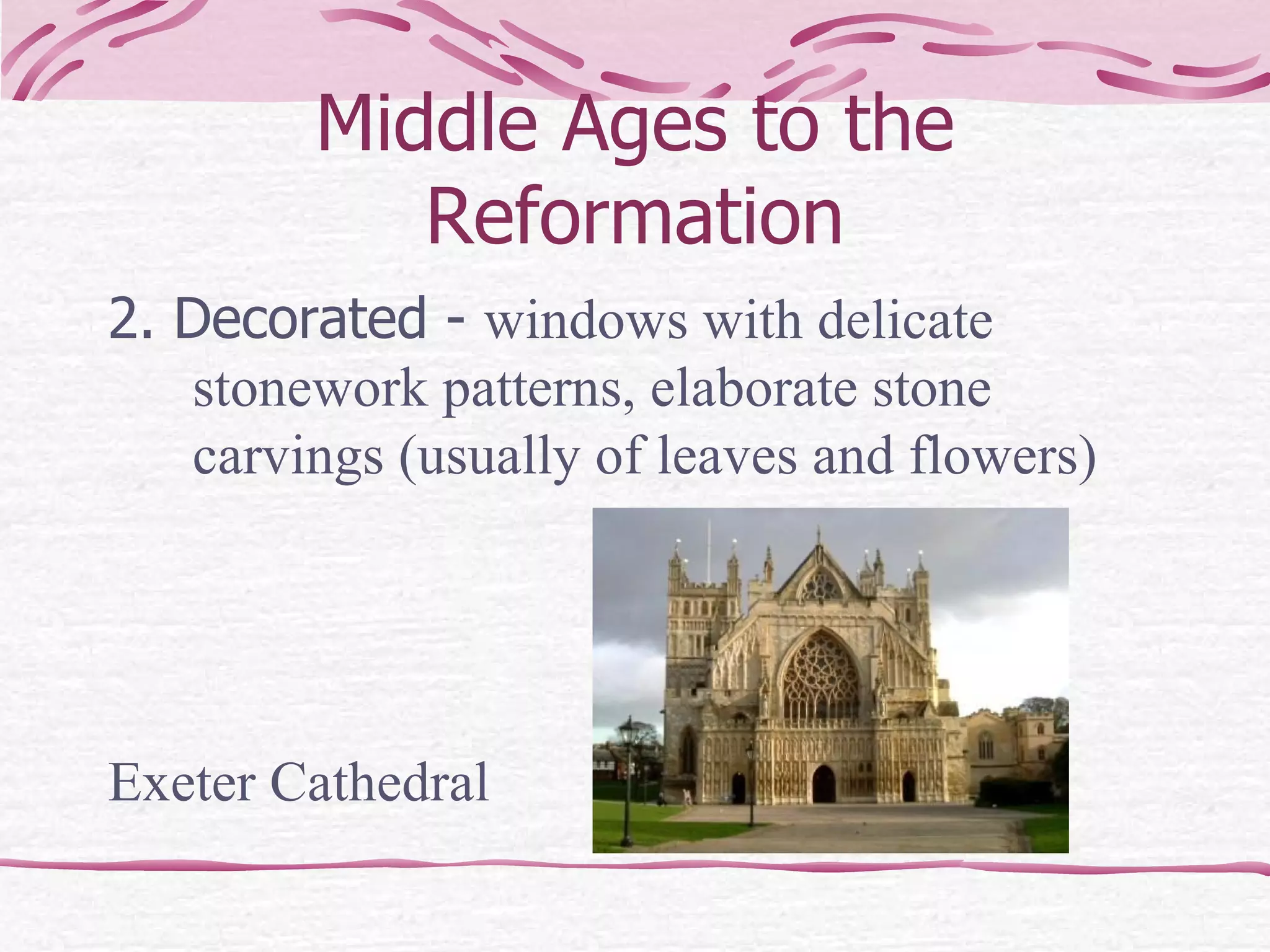
Middle Ages to the Reformation 2. Decorated -  windows with delicate stonework patterns, elaborate stone carvings (usually of leaves and flowers) Exeter Cathedral
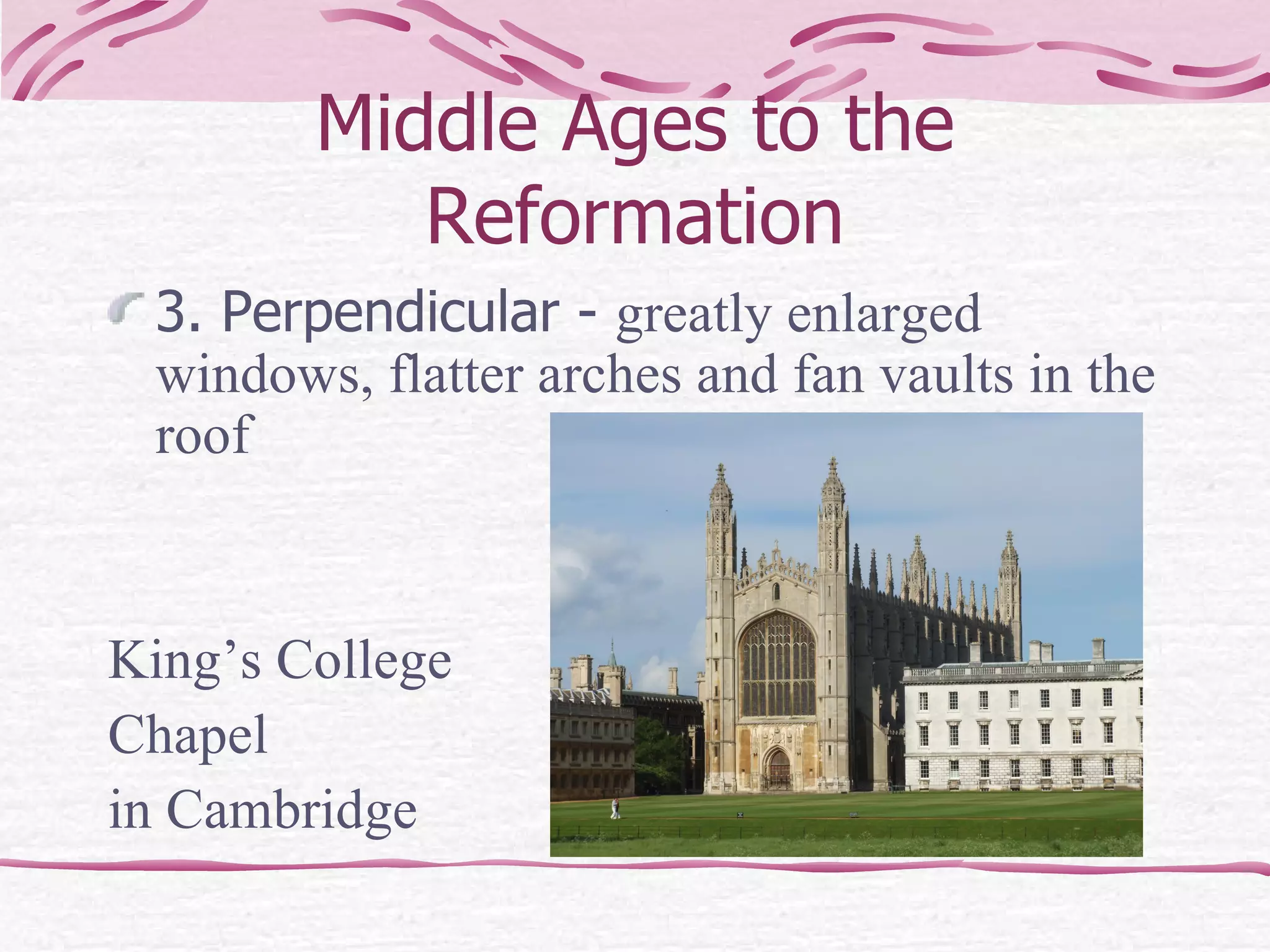
Middle Ages to the Reformation 3. Perpendicular -  greatly enlarged windows, flatter arches and fan vaults in the roof  King’s College  Chapel  in Cambridge
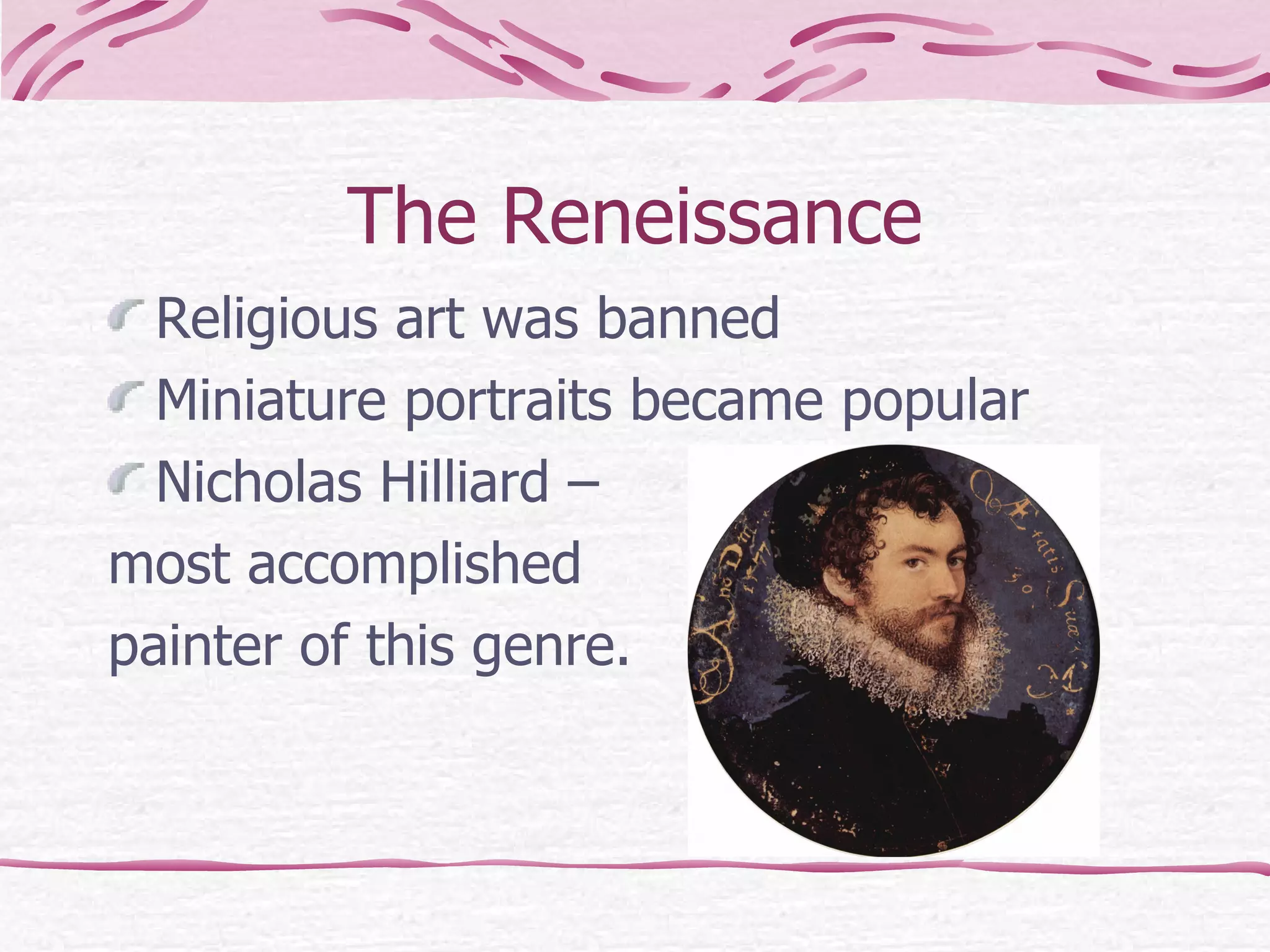
The Reneissance Religious art was banned Miniature portraits became popular Nicholas Hilliard – most accomplished  painter of this genre.
The Reneissance Sculpture was limited to the decoration of the tombs England’s   nobility was prosperous and could afford country houses surrounded by elegant gardens
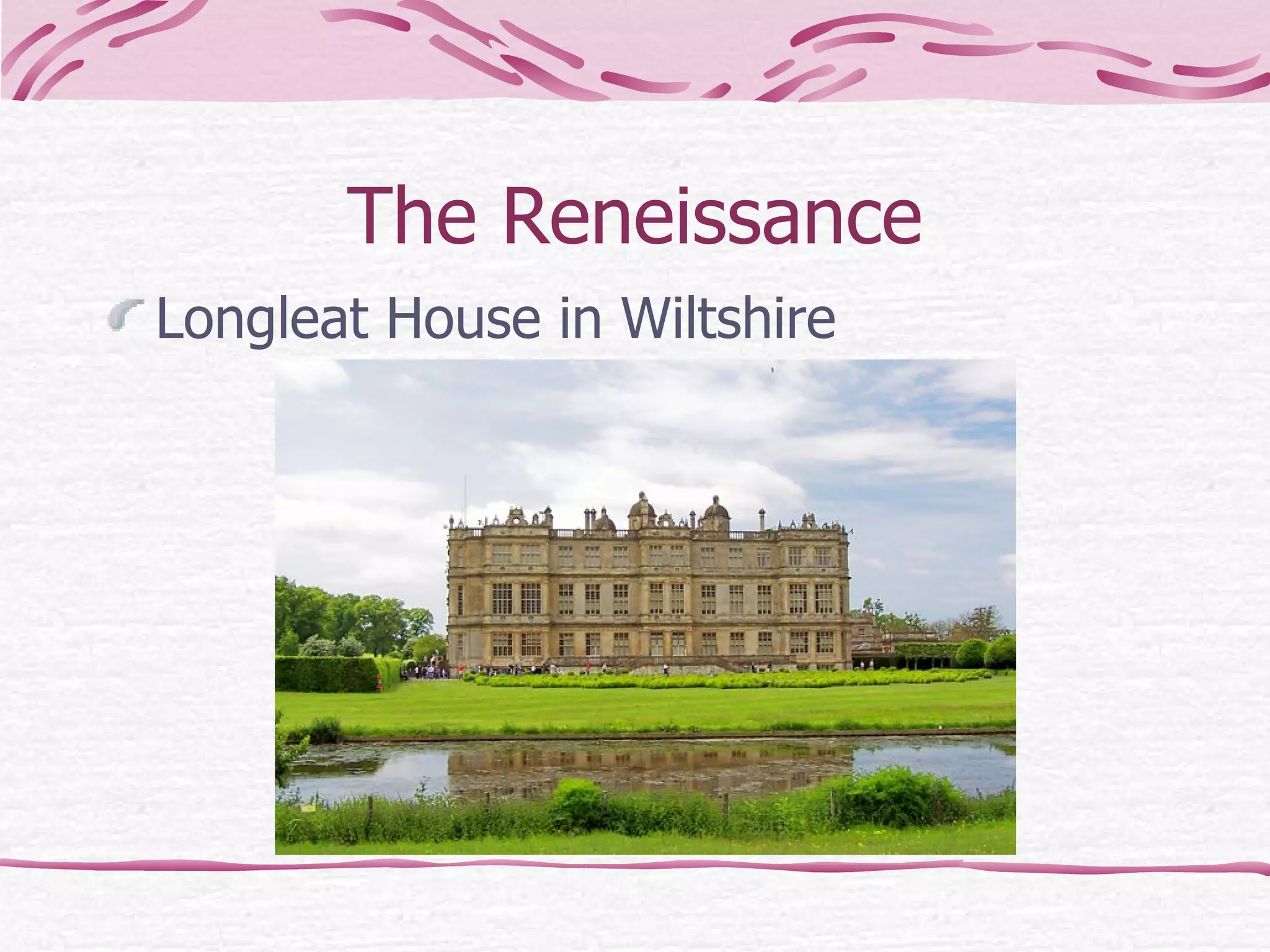
The Reneissance Longleat House in Wiltshire
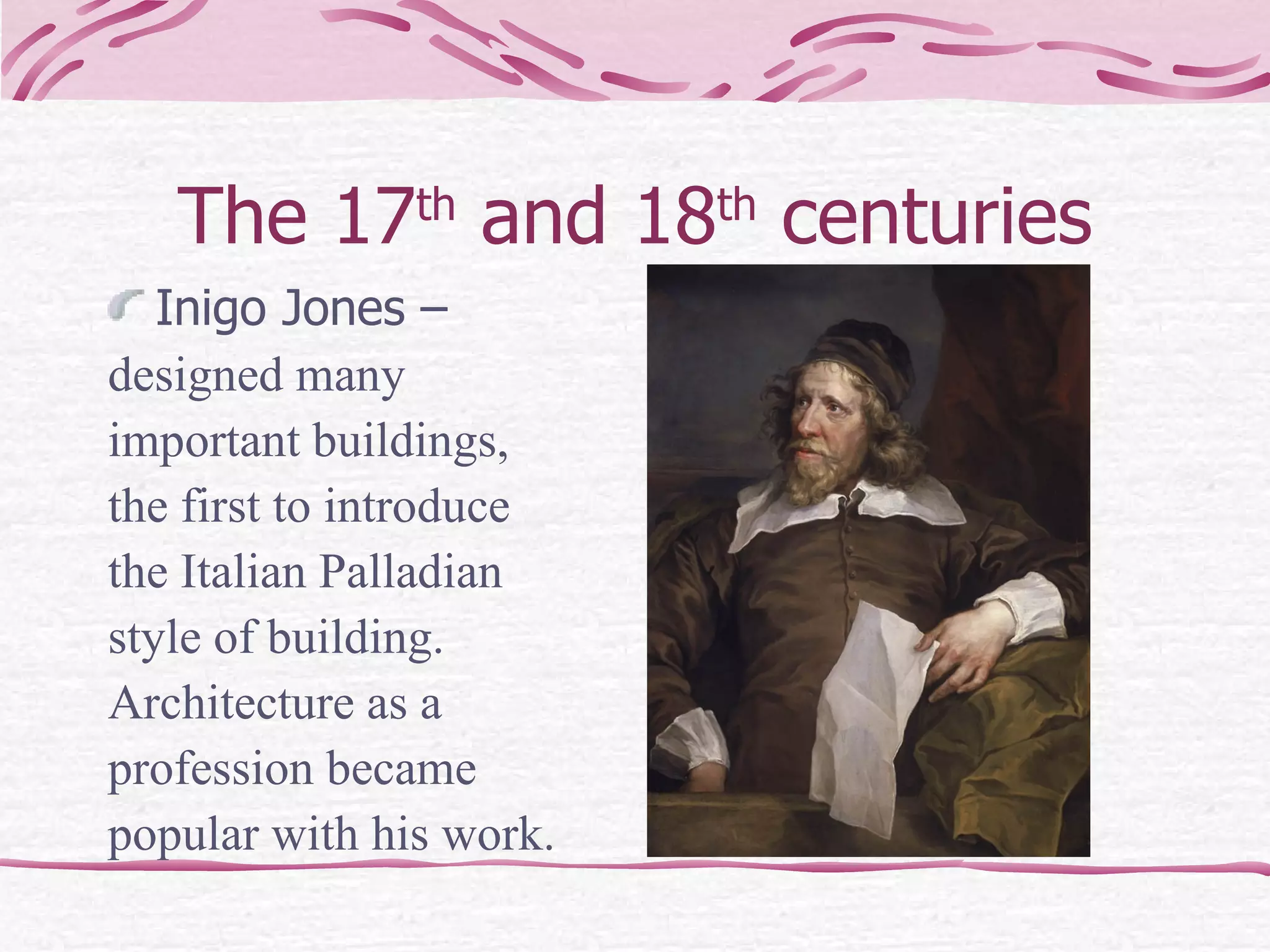
The 17 th  and 18 th  centuries Inigo Jones –  designed many  important buildings,  the first to introduce  the Italian Palladian  style of building.  Architecture as a  profession became  popular with his work.
The 17 th  and 18 th  centuries The Palladian style -  followed the principles of classical architecture,  correct proportions of height and width.
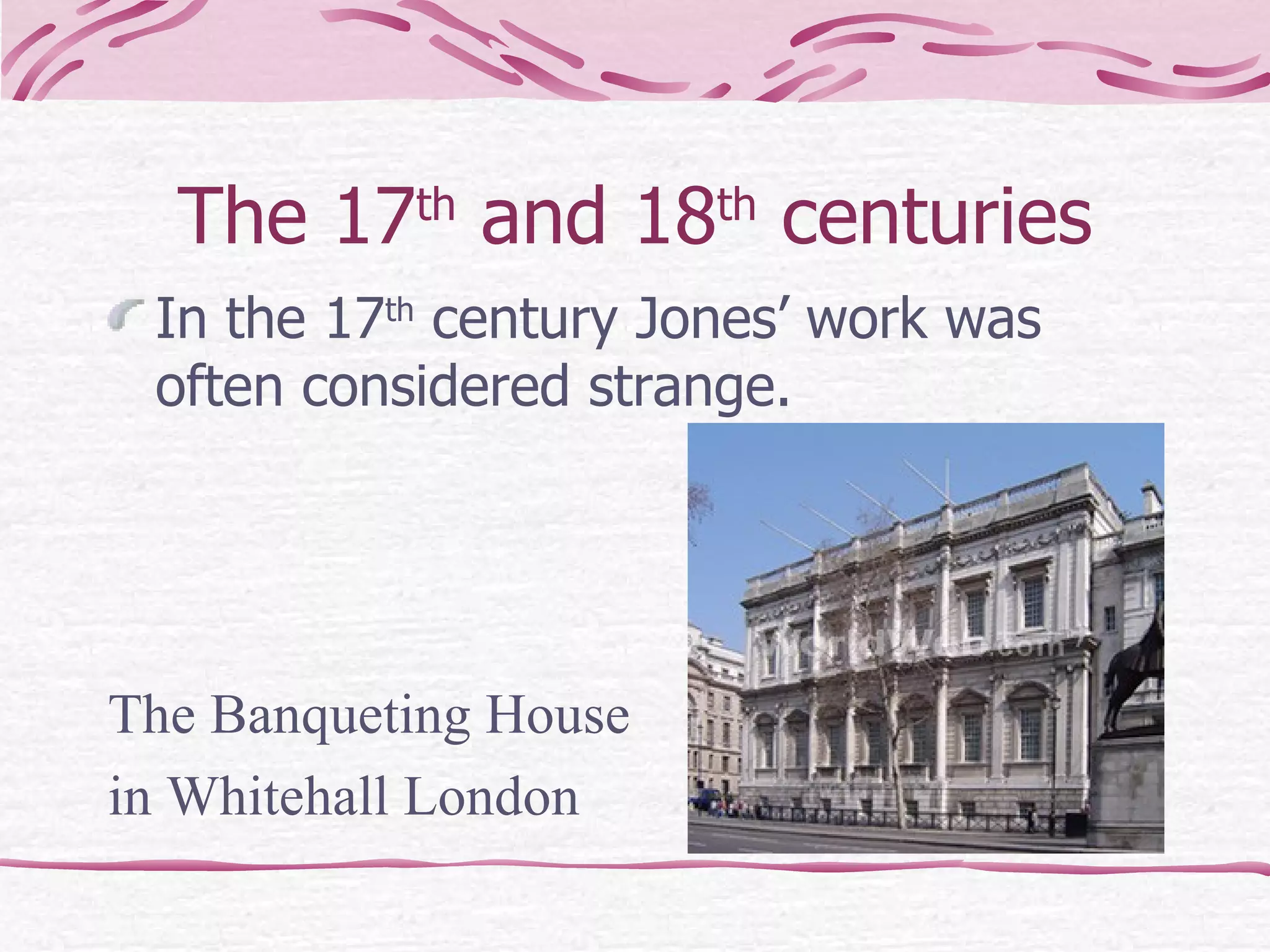
The 17 th  and 18 th  centuries In the 17 th  century Jones’ work was often considered strange. The Banqueting House  in Whitehall London
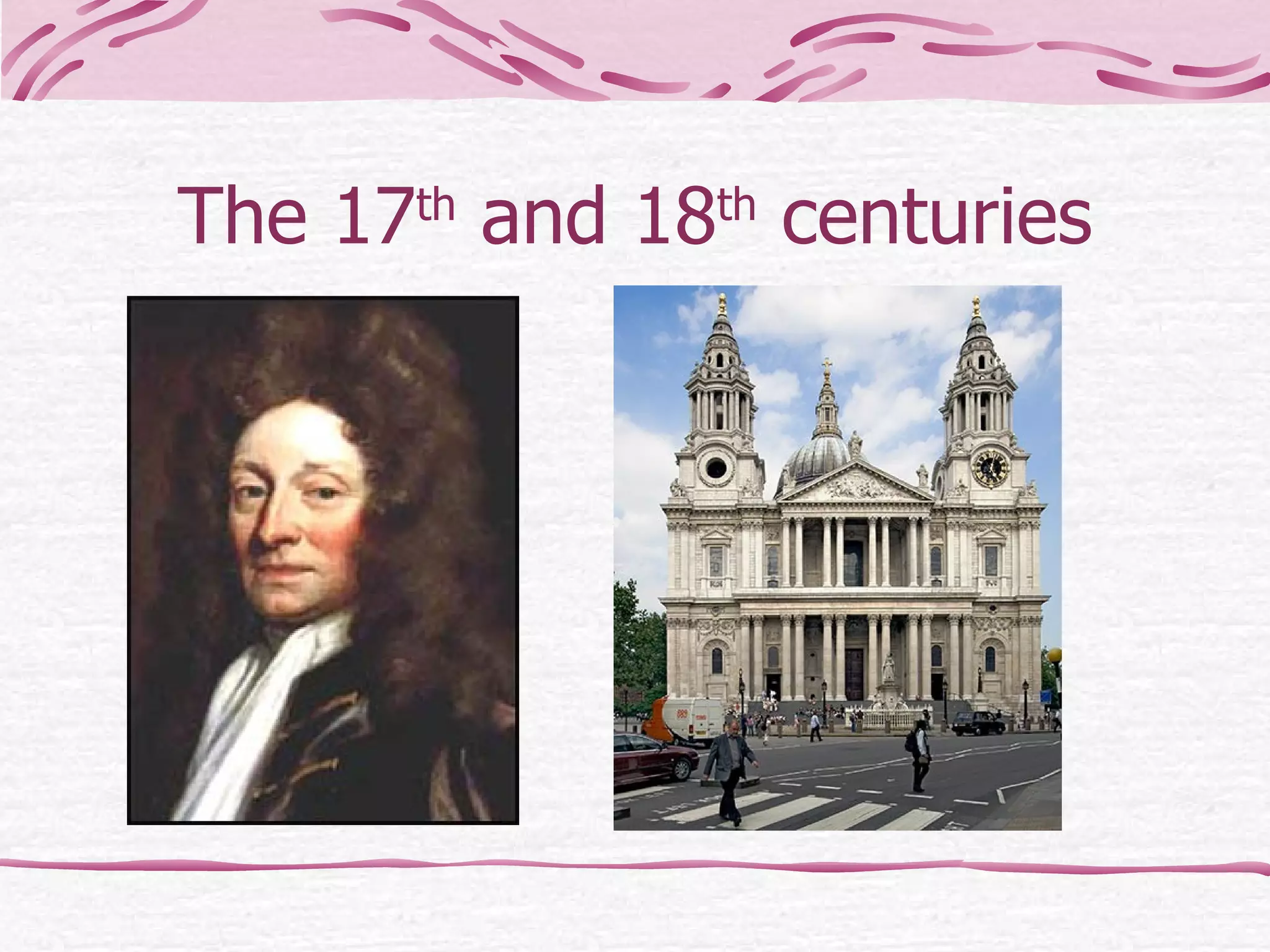
The 17 th  and 18 th  centuries English Baroque appeared after the Great Fire of London in 1666  Christopher Wren (1632-1723)   was commissioned to design the new St. Paul’s Cathedral that was destroyed in the fire.   His style was essentially Baroque, but with English touch.
The 17 th  and 18 th  centuries
The 17 th  and 18 th  centuries In the early 18 th  century some architects succeeded in replacing the Baroque style with a simpler one based on classical principles. The latter remained dominant throughout the century.
The 17 th  and 18 th  centuries The most famous painters working in England in the 17 th  century were all foreign-born: Rubens, Van Dyck, Lely.
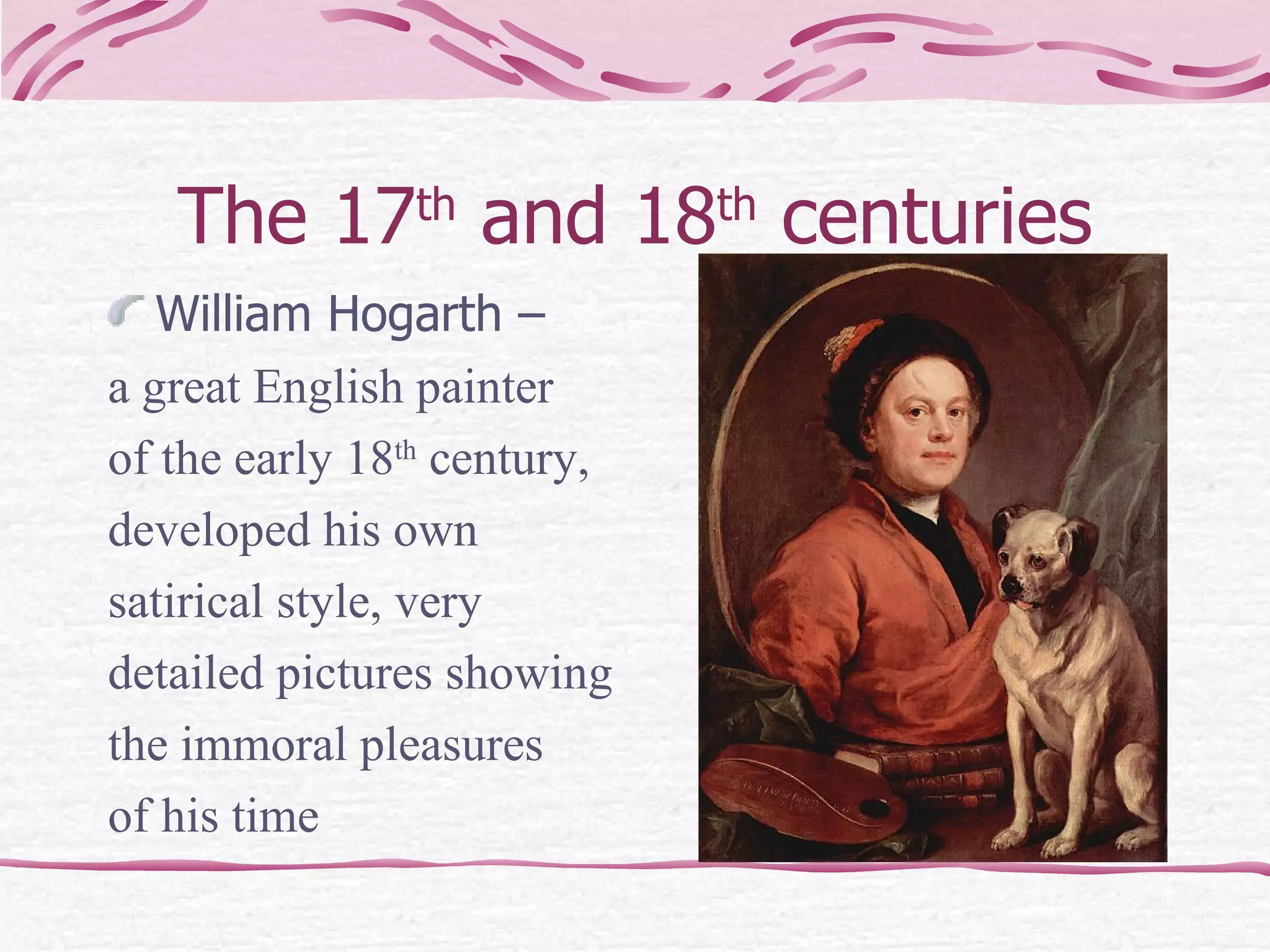
The 17 th  and 18 th  centuries William Hogarth –  a great English painter  of the early 18 th  century,  developed his own  satirical style, very  detailed pictures showing  the immoral pleasures  of his time
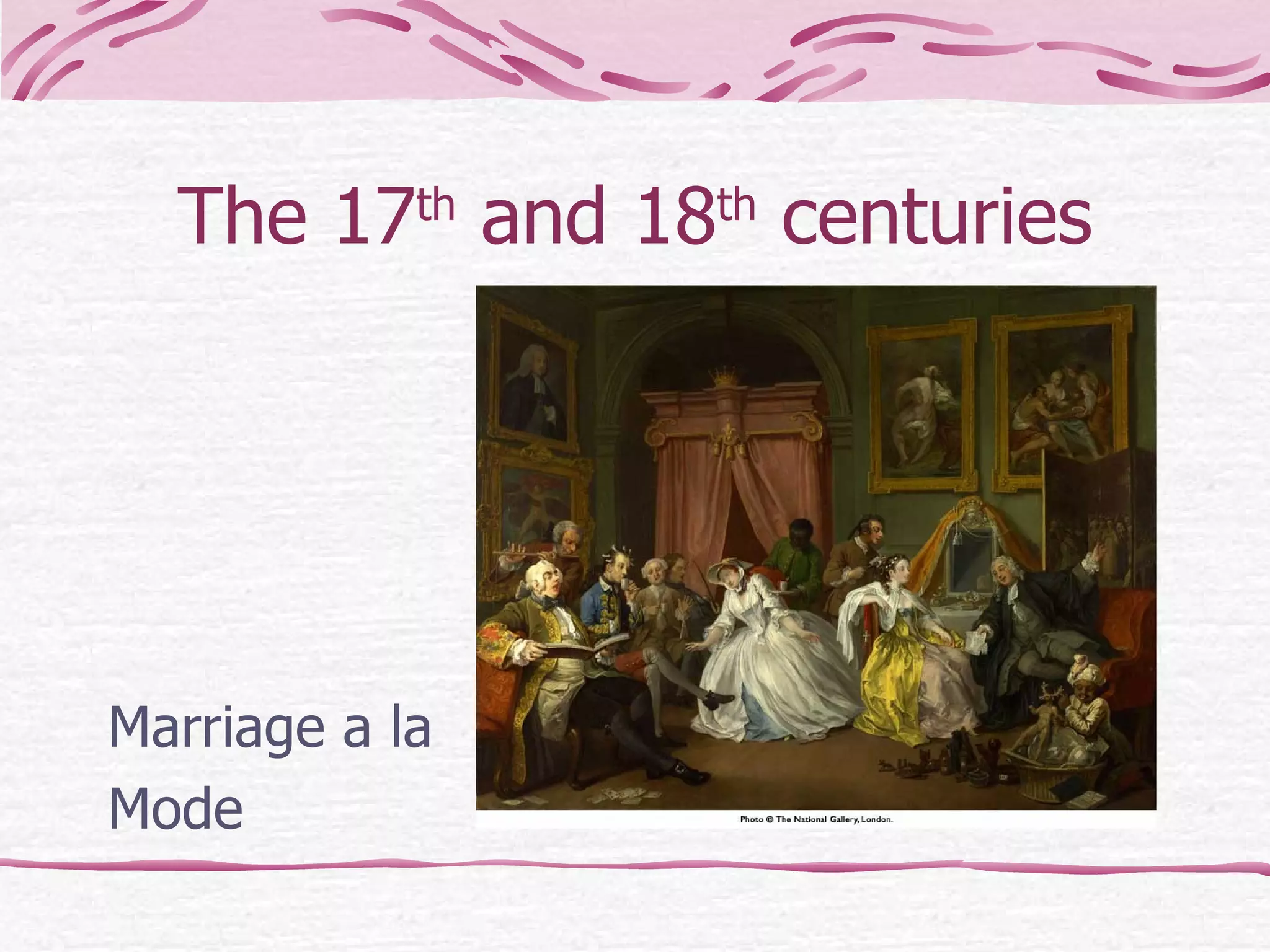
The 17 th  and 18 th  centuries Marriage a la  Mode
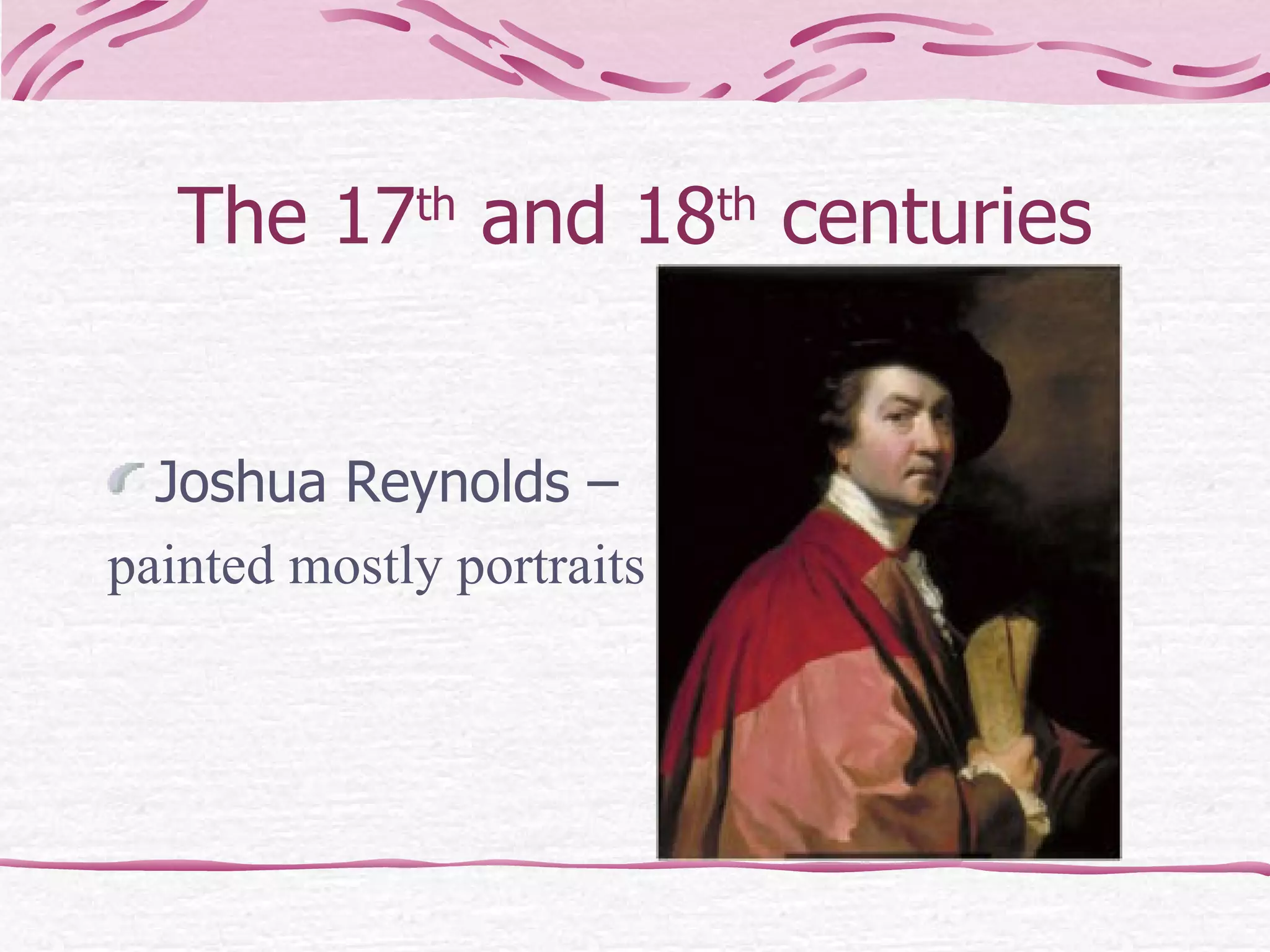
The 17 th  and 18 th  centuries Joshua Reynolds –  painted mostly portraits
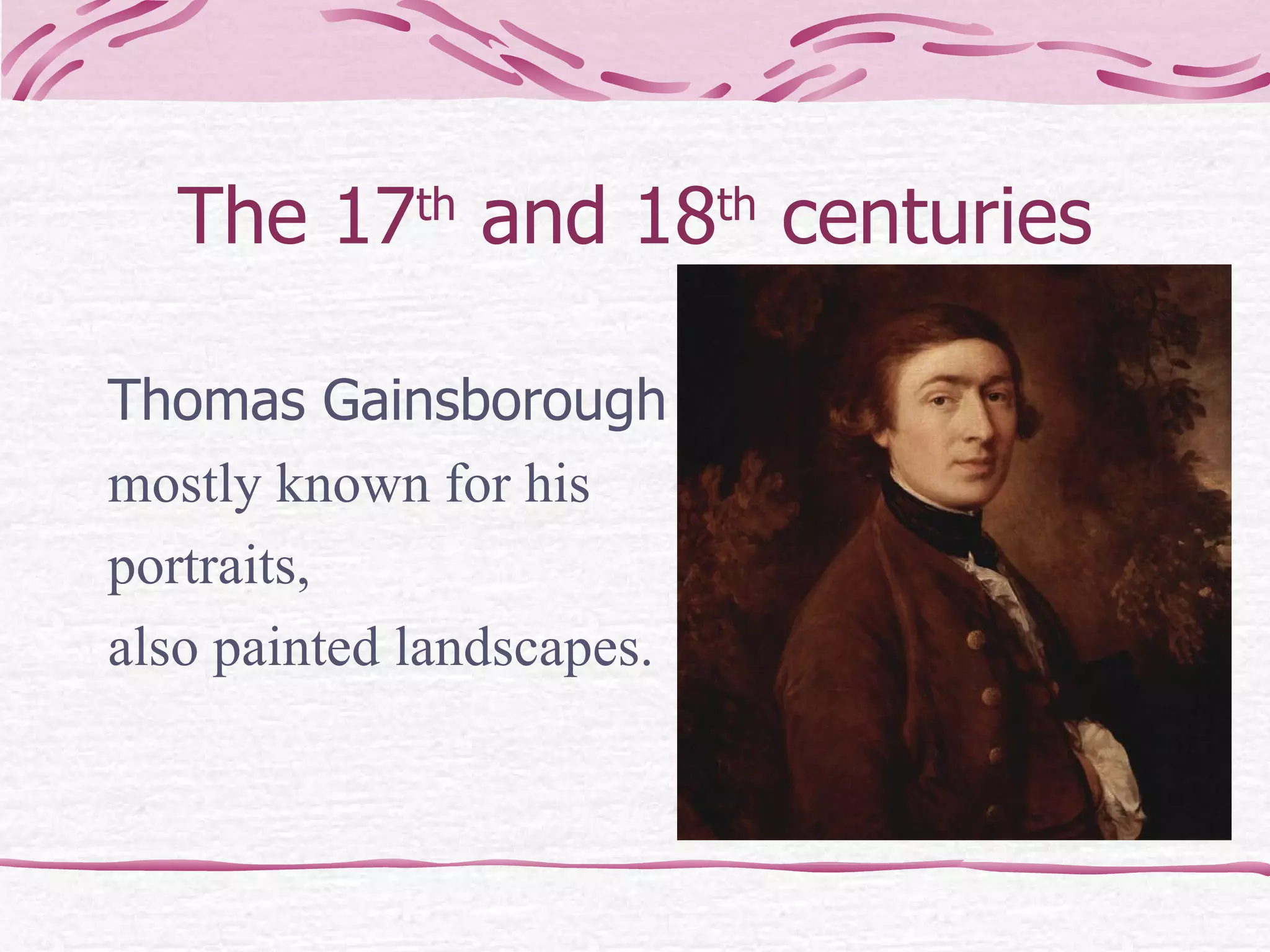
The 17 th  and 18 th  centuries Thomas Gainsborough –   mostly known for his  portraits,  also painted landscapes.
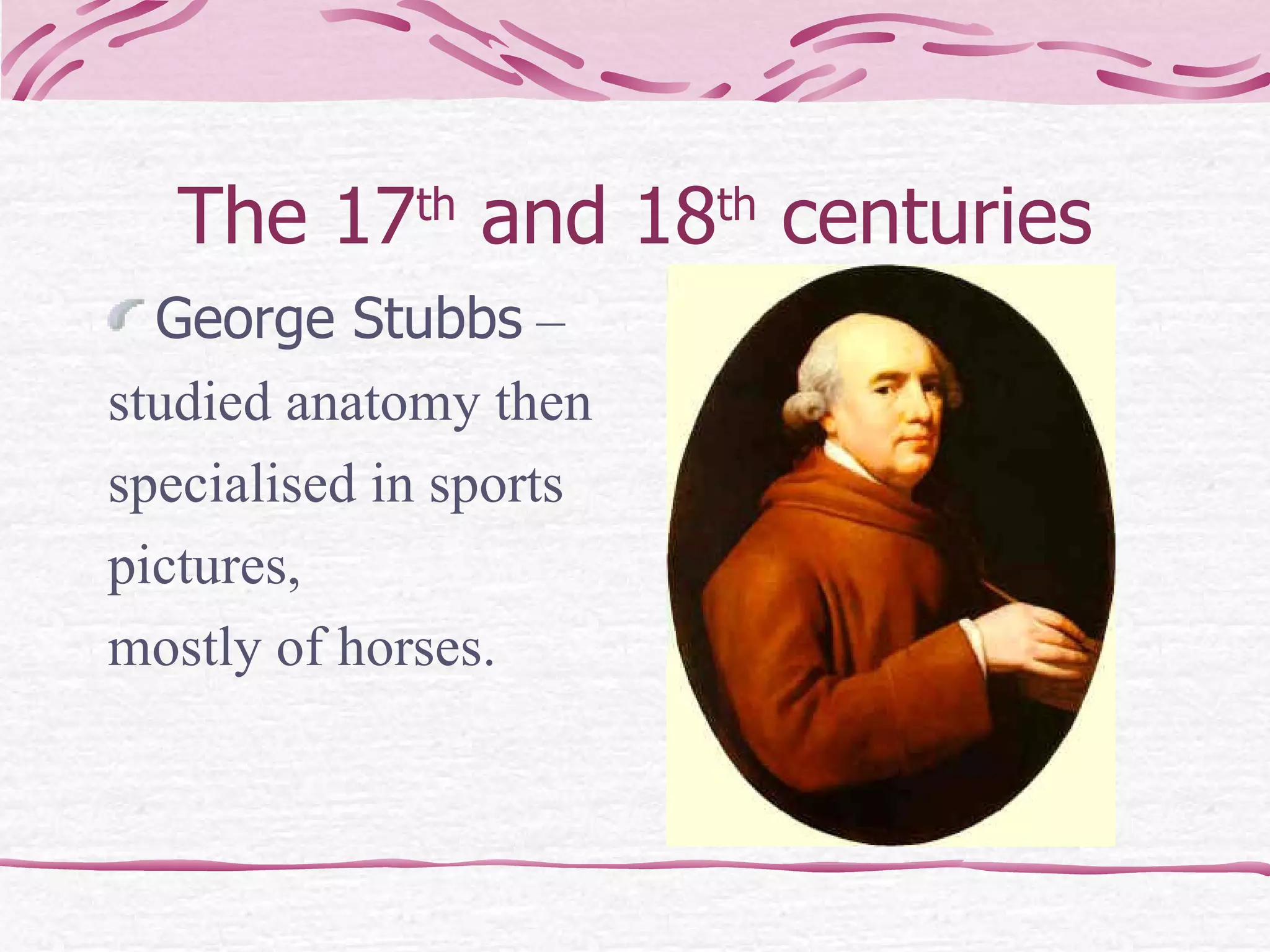
The 17 th  and 18 th  centuries George Stubbs  –  studied anatomy then  specialised in sports  pictures,  mostly of horses.
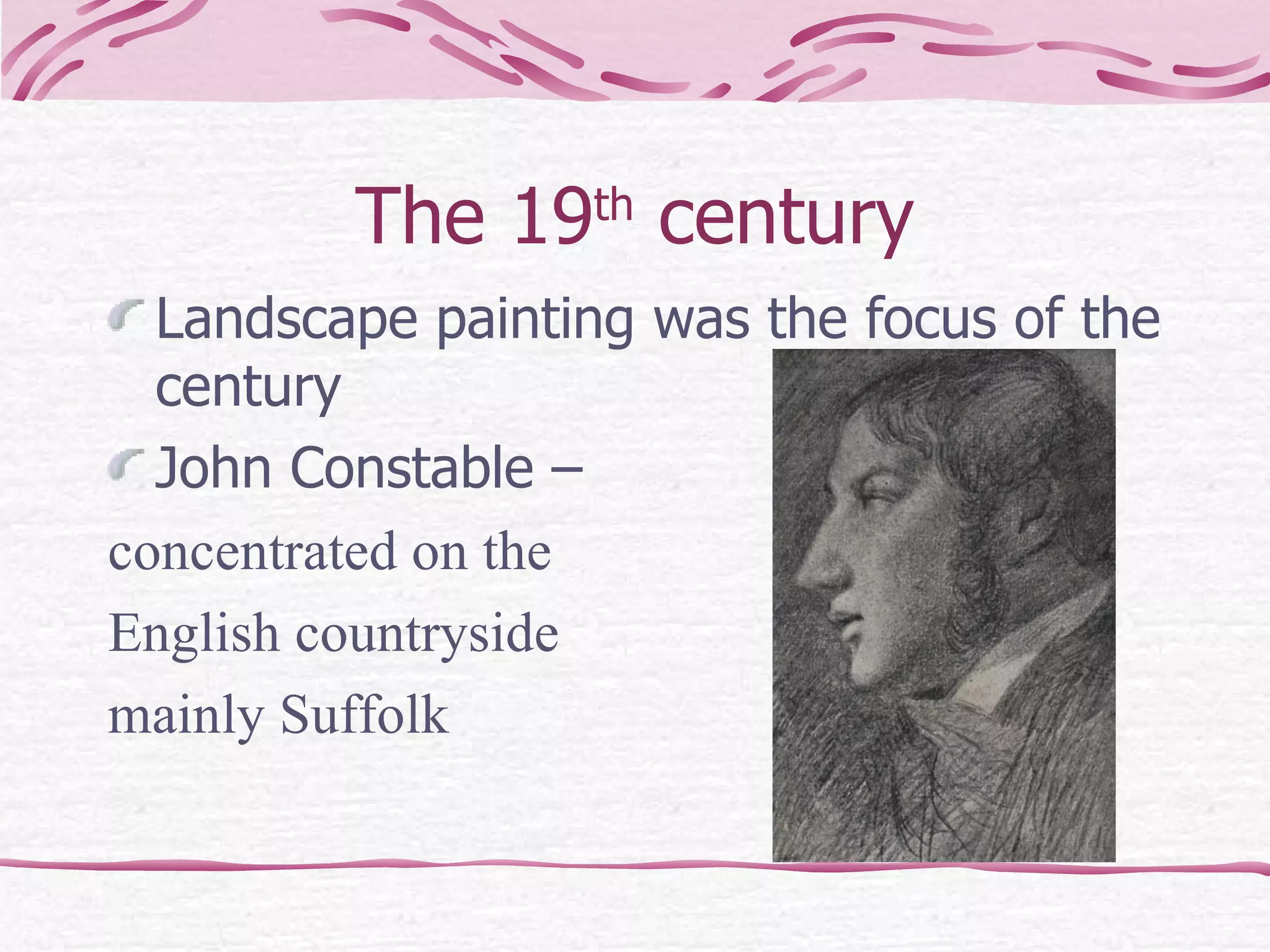
The 19 th  century Landscape painting was the focus of the century John Constable –  concentrated on the  English countryside  mainly Suffolk
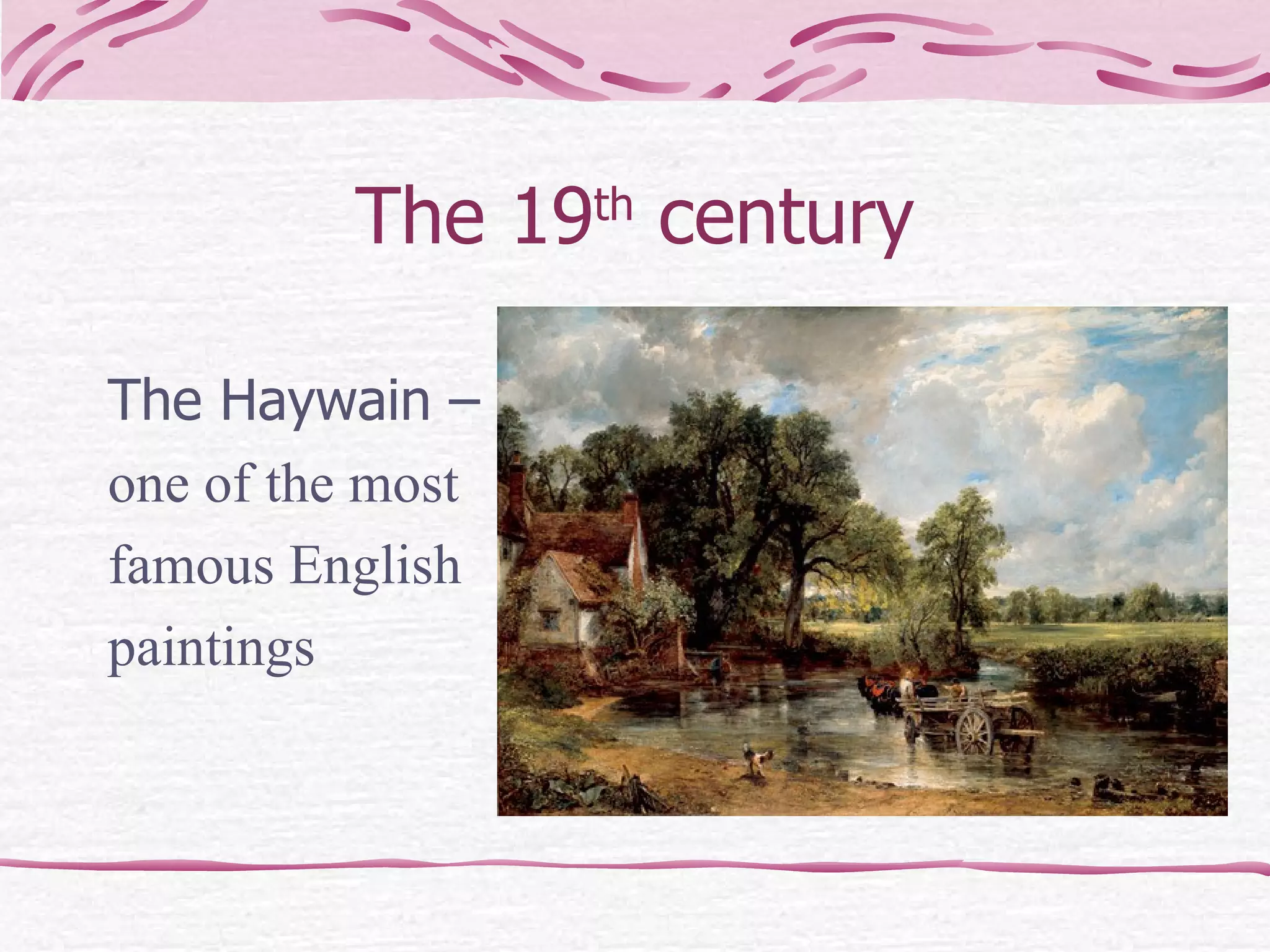
The 19 th  century The Haywain –  one of the most  famous English  paintings
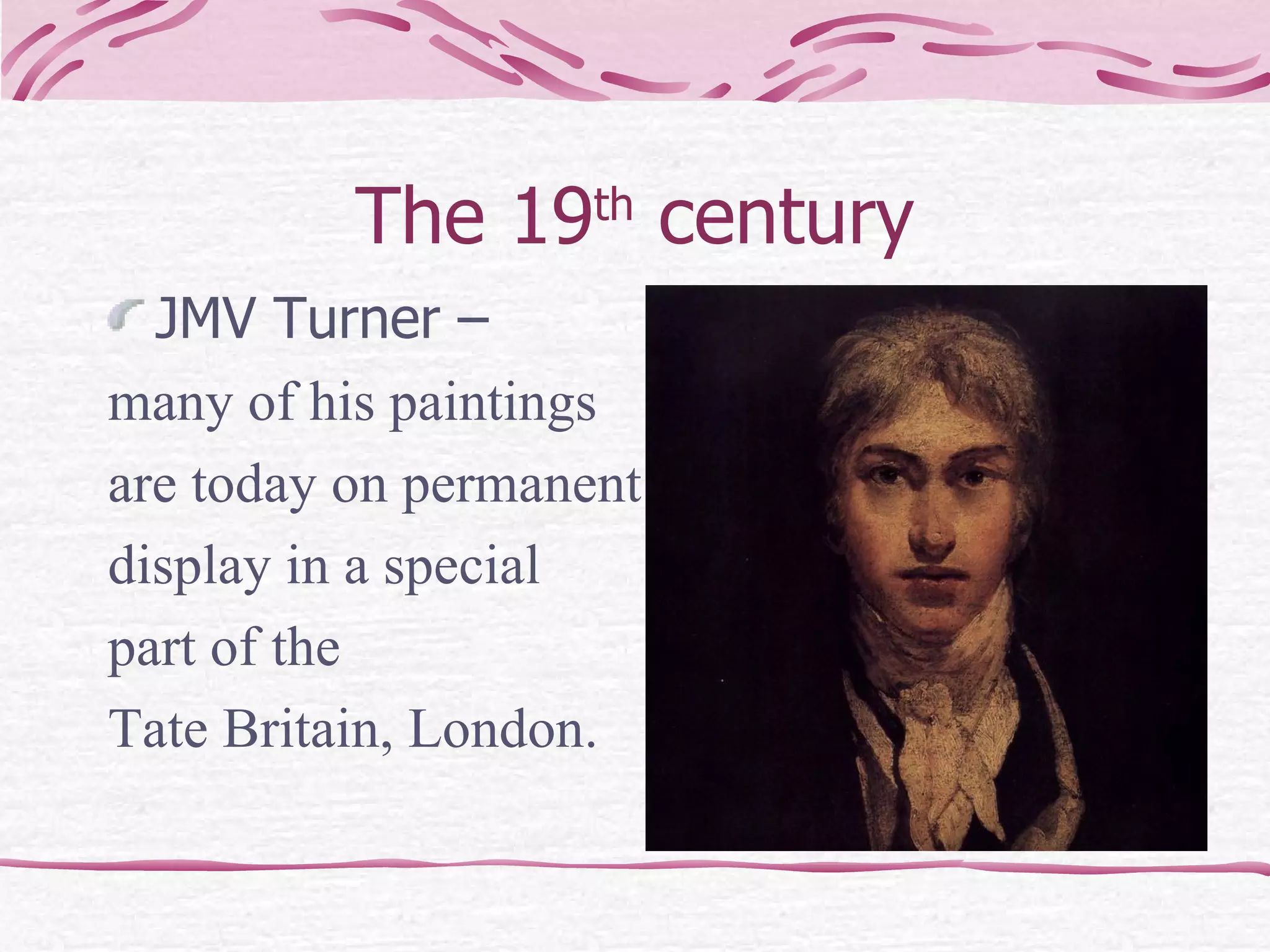
The 19 th  century JMV Turner –  many of his paintings  are today on permanent display in a special  part of the  Tate Britain, London.
The 19 th  century The Pre-Raphaelites –  the foremost group in English art during the 19 th  century.  The aim was to return to the style of the painting of the Middle Ages- bright colours, small details typical of Italian painting before the artist Raphael.
The 19 th  century Regency architecture- neo-classical in style influenced by the Orient. Revival of traditional styles, especially Gothic, with traditional building material such as brick.
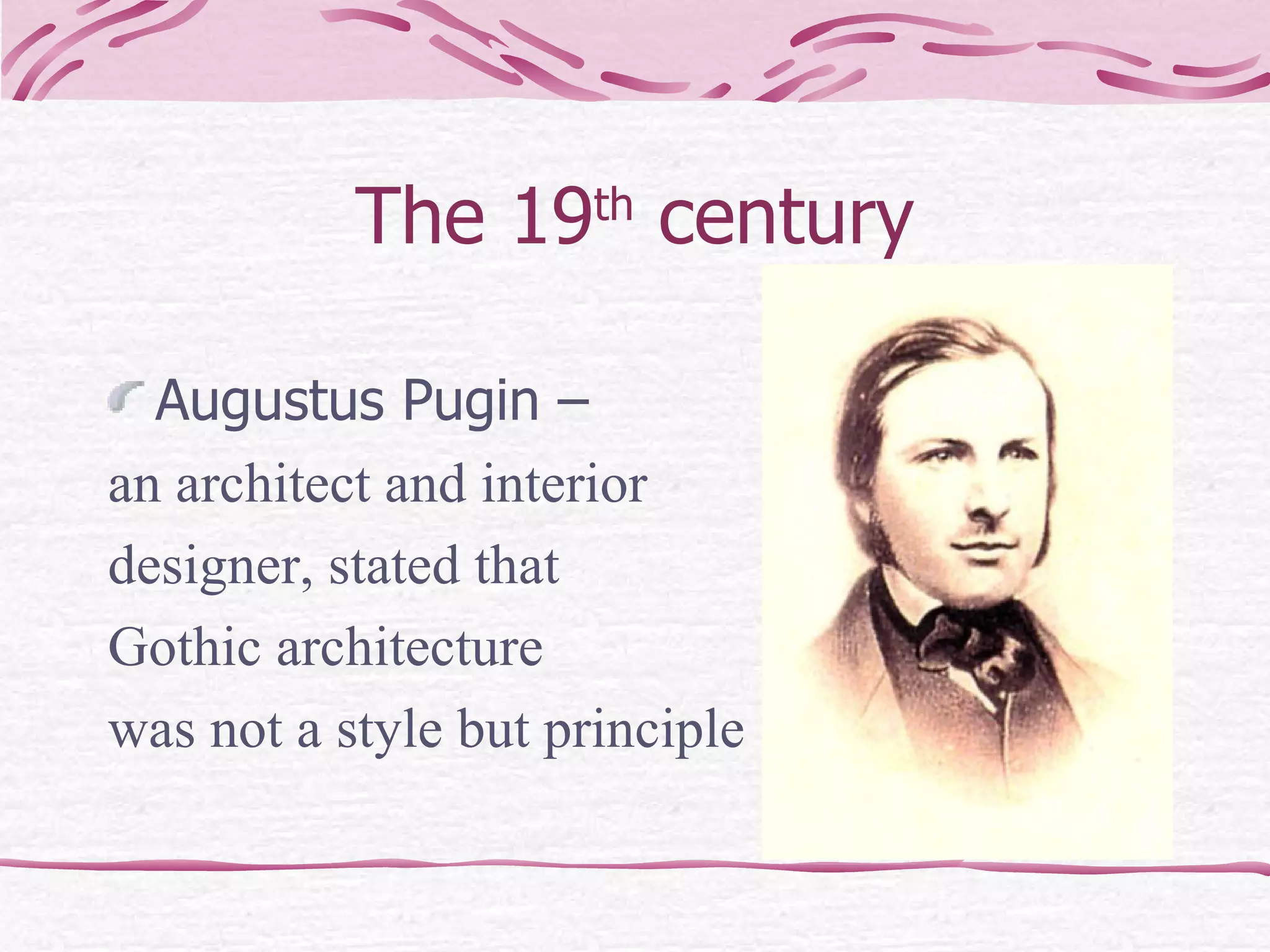
The 19 th  century Augustus Pugin –  an architect and interior  designer, stated that  Gothic architecture was not a style but principle
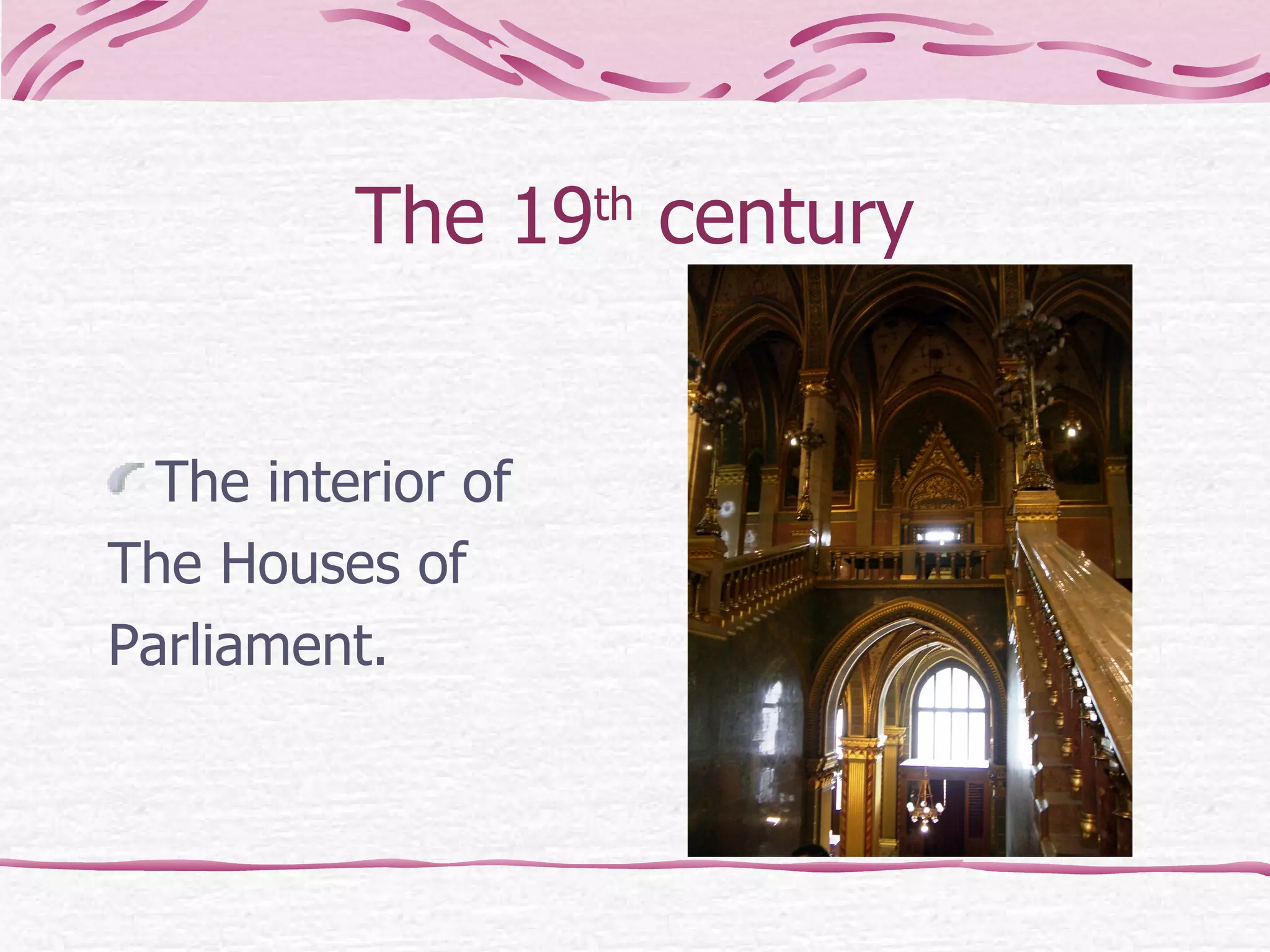
The 19 th  century The interior of  The Houses of  Parliament.
The 19 th  century ‘Battle of the Styles’-  rivalry between architecture styles in the mid-19 th  century, Liberal politicians supported the classical style, but the Conservatives favoured the Gothic revival. The outcome was a compromise
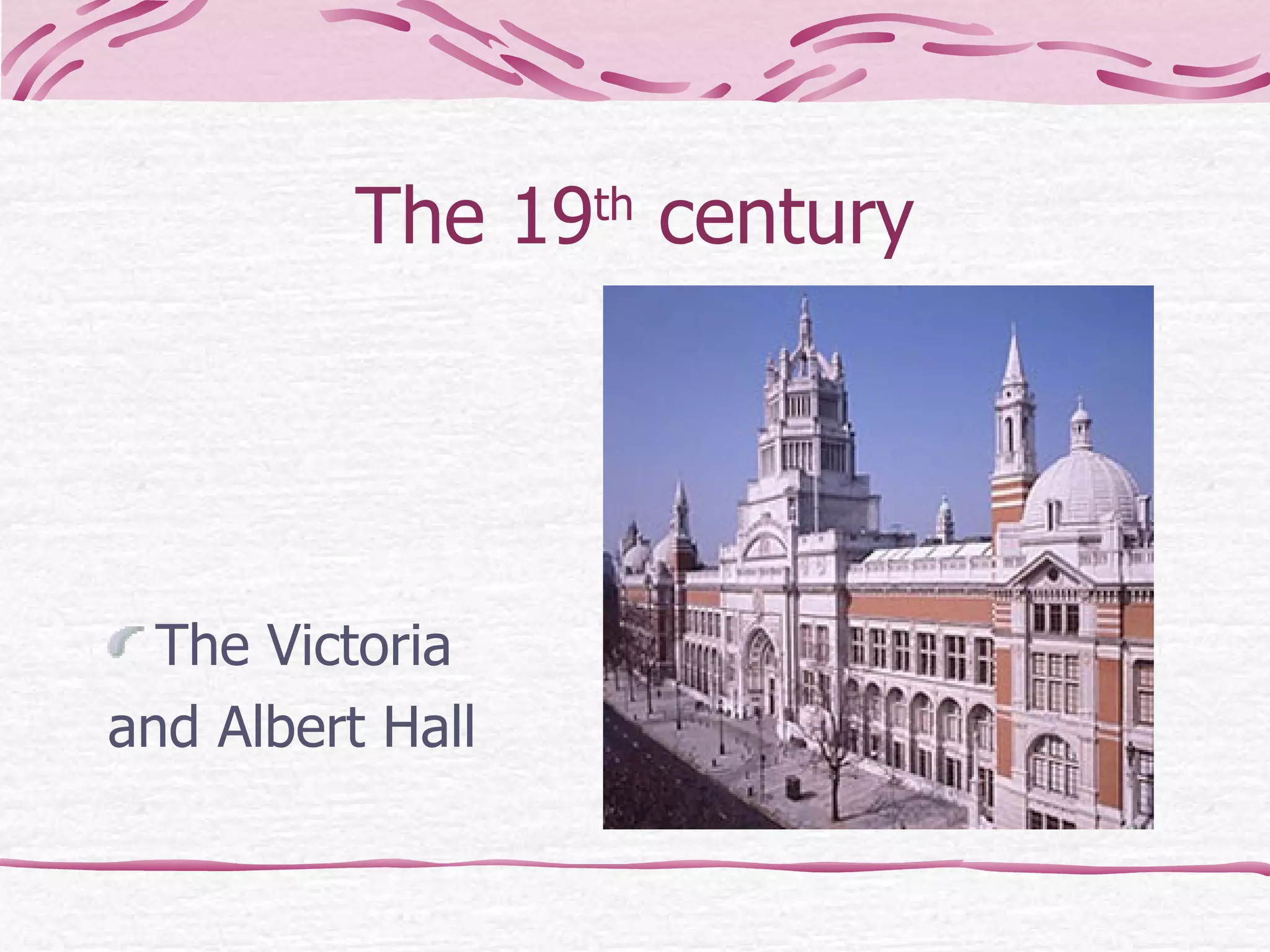
The 19 th  century The Victoria  and Albert Hall
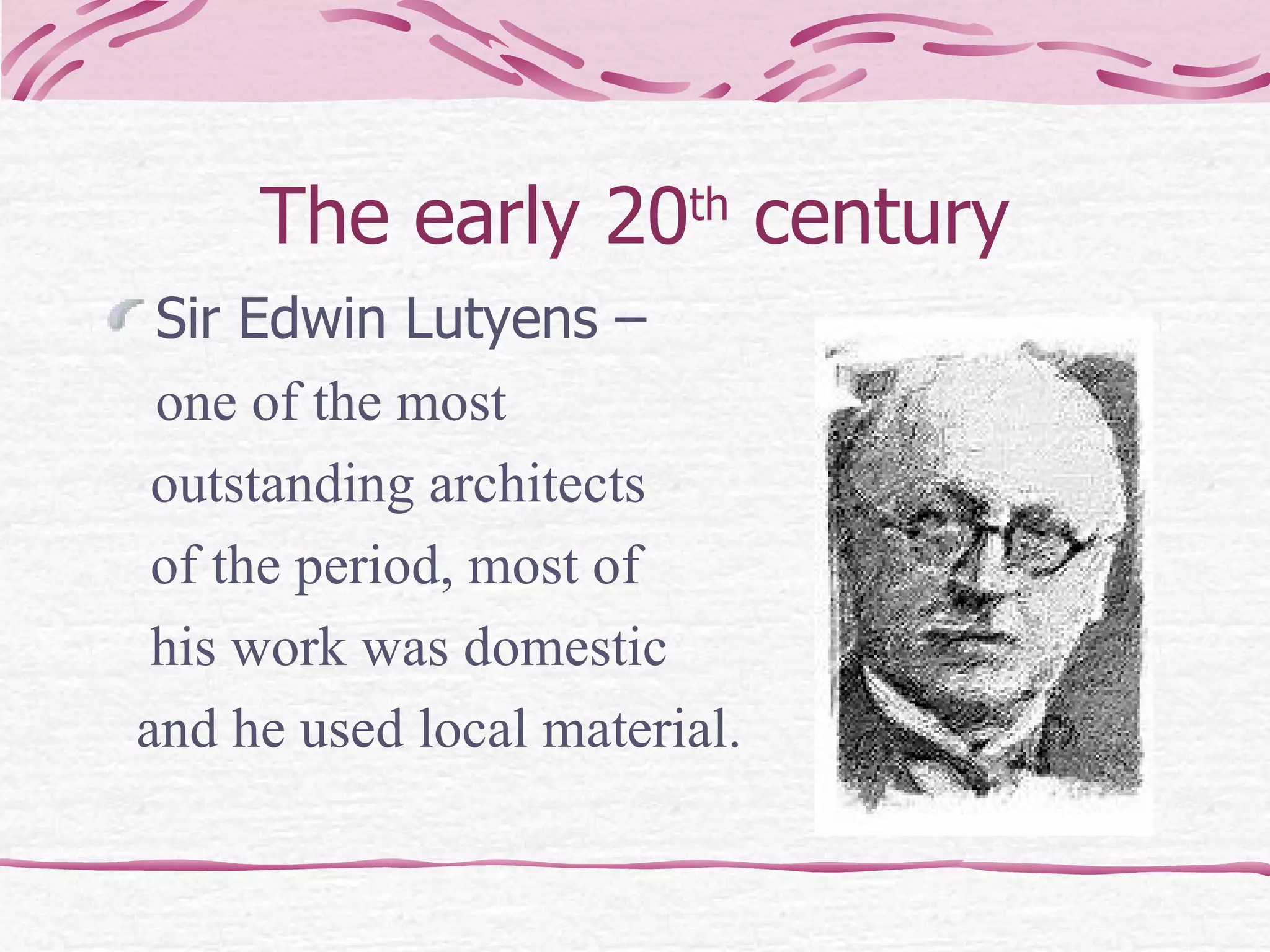
The early 20 th  century Sir Edwin Lutyens –  one of the most  outstanding architects  of the period, most of  his work was domestic  and he used local material.
The early 20 th  century The modernism that flourished in Europe during the first 30 years of the 20 th  century did not have a strong influence on English art and architecture.
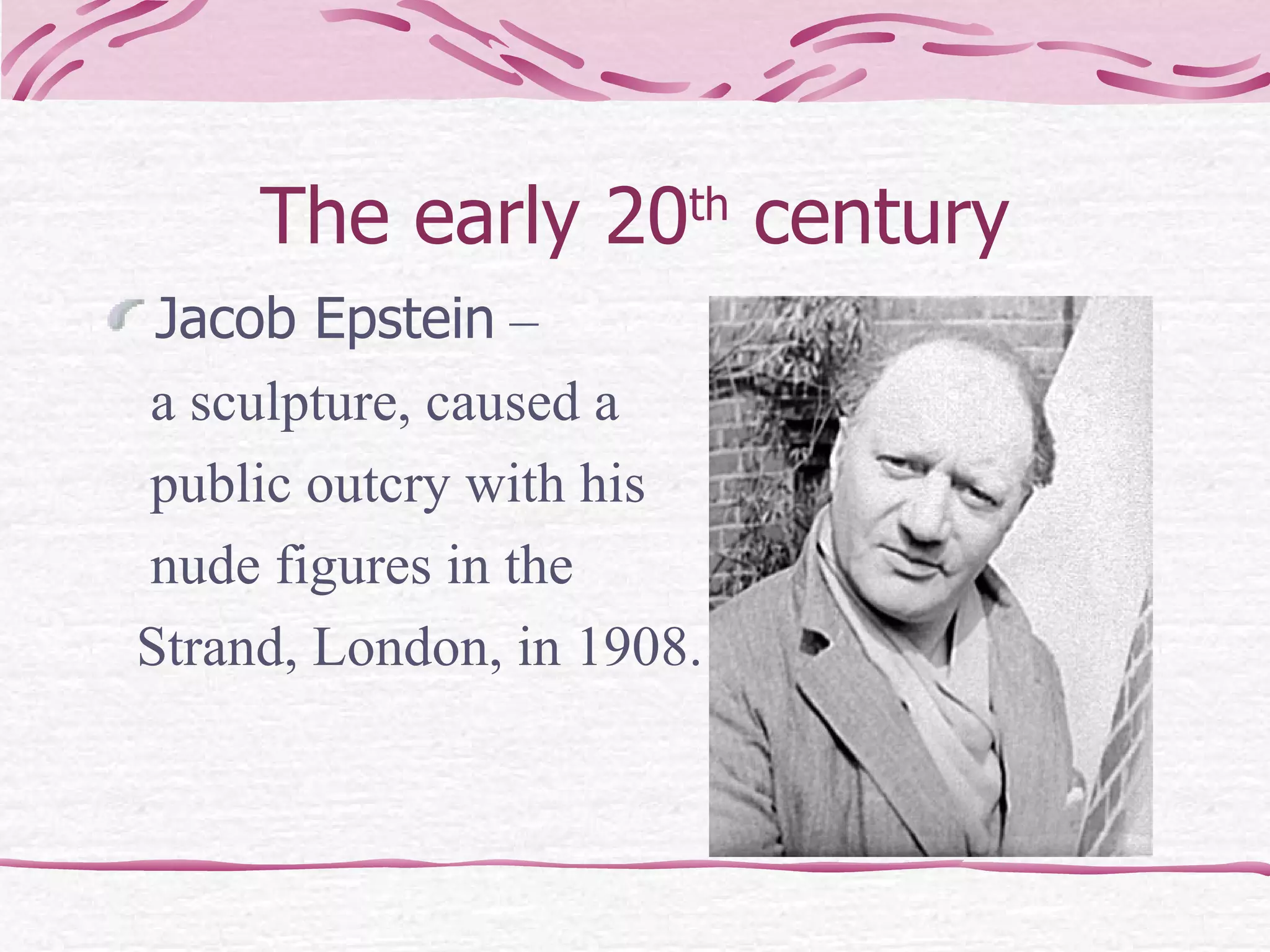
The early 20 th  century Jacob Epstein  –  a sculpture, caused a  public outcry with his  nude figures in the  Strand, London, in 1908.
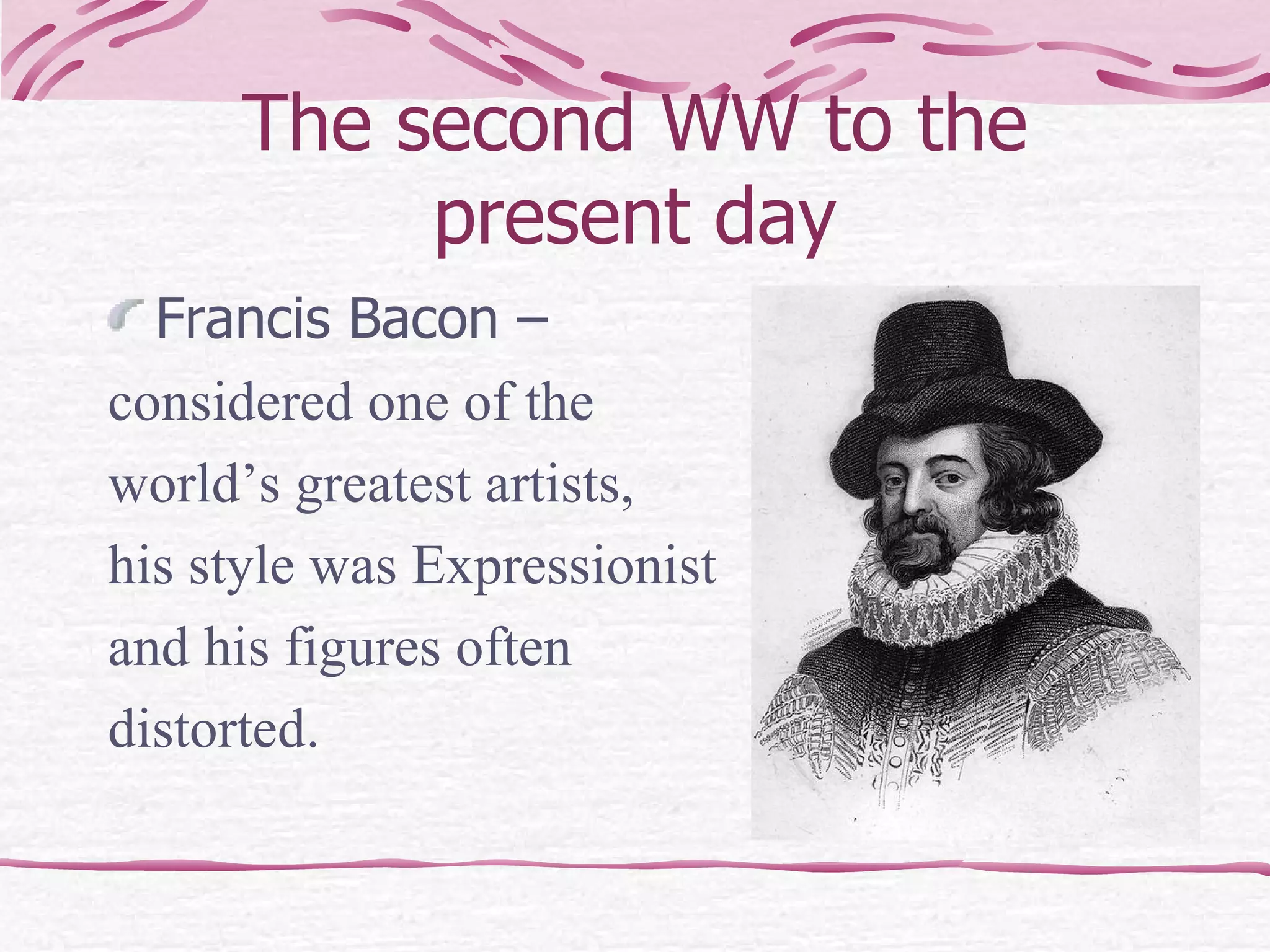
The second WW to the present day Francis Bacon –  considered one of the  world’s greatest artists,  his style was Expressionist  and his figures often  distorted.
The second WW to the present day Damien Hirst –  one of the best-known contemporary artists, his work and that of his fellow students tends to be regarded as the beginning of ‘BritArt’  BritArt – a group of Young British Artists who put on their shows and promote themselves through the media.
The second WW to the present day Modern architecture arrived in England with the Modern Movement, which used contemporary materials.  The use of concrete led to a style known as ‘New Brutalism’. The architects of the late 20 th  century used modern material to achieve dramatic effects.
Domestic architecture The oldest houses are timber framed. Thatch was widely used for groups but went out of fashion because it was associated by the homes of the poorest people. All over England a large variety of different types of stone is used for building purposes.
Decorative arts Developed in actively in England during the last two or three hundred years. The 19 th  century saw progress in ceramic art.
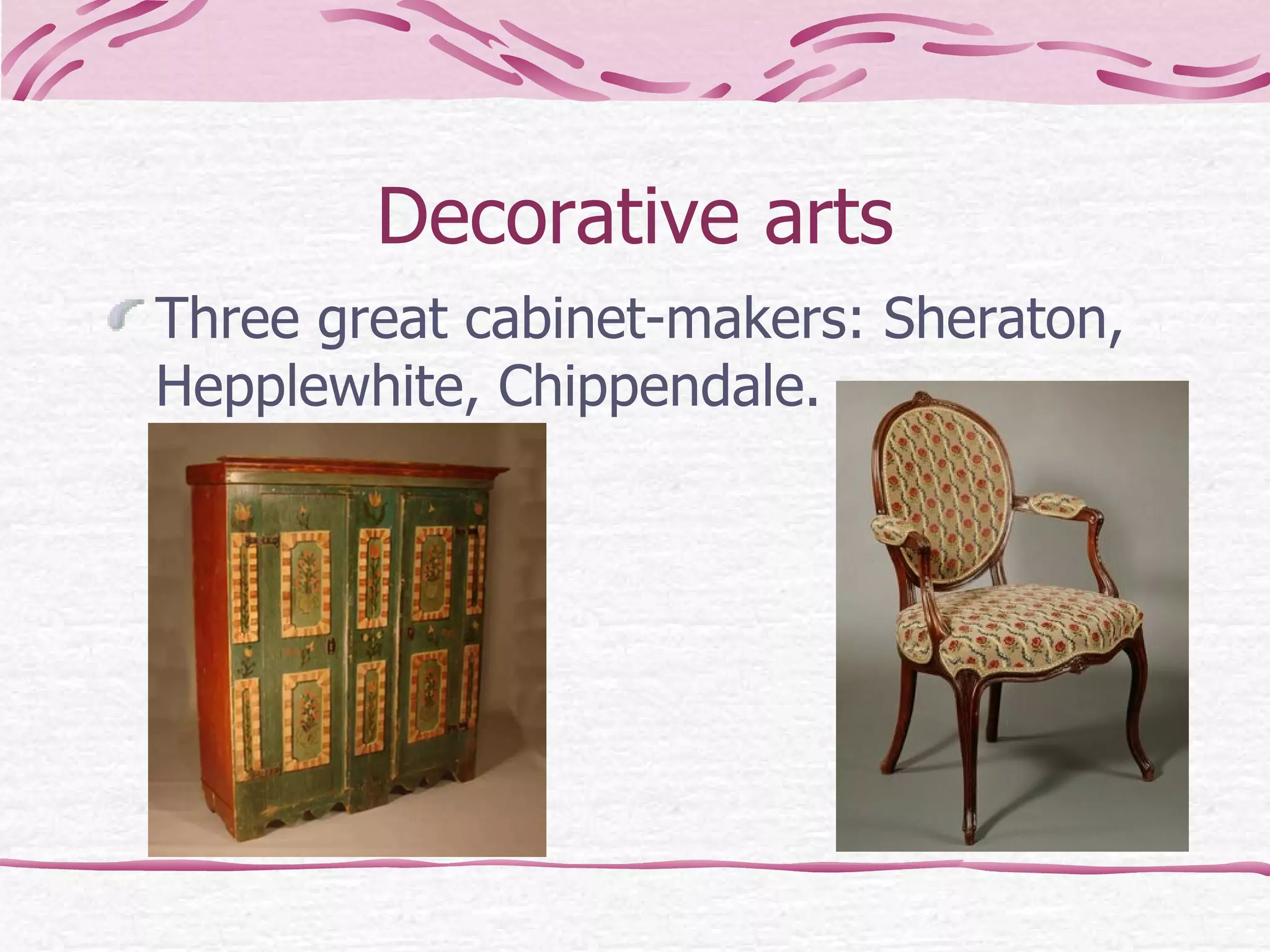
Decorative arts Three great cabinet-makers: Sheraton, Hepplewhite, Chippendale.
DESING
Design British designers use new technologies, processes and materials to create market advantage. Current British design is really ‘the design workshop of the world’ ready for future challenges, but also aware of traditions.
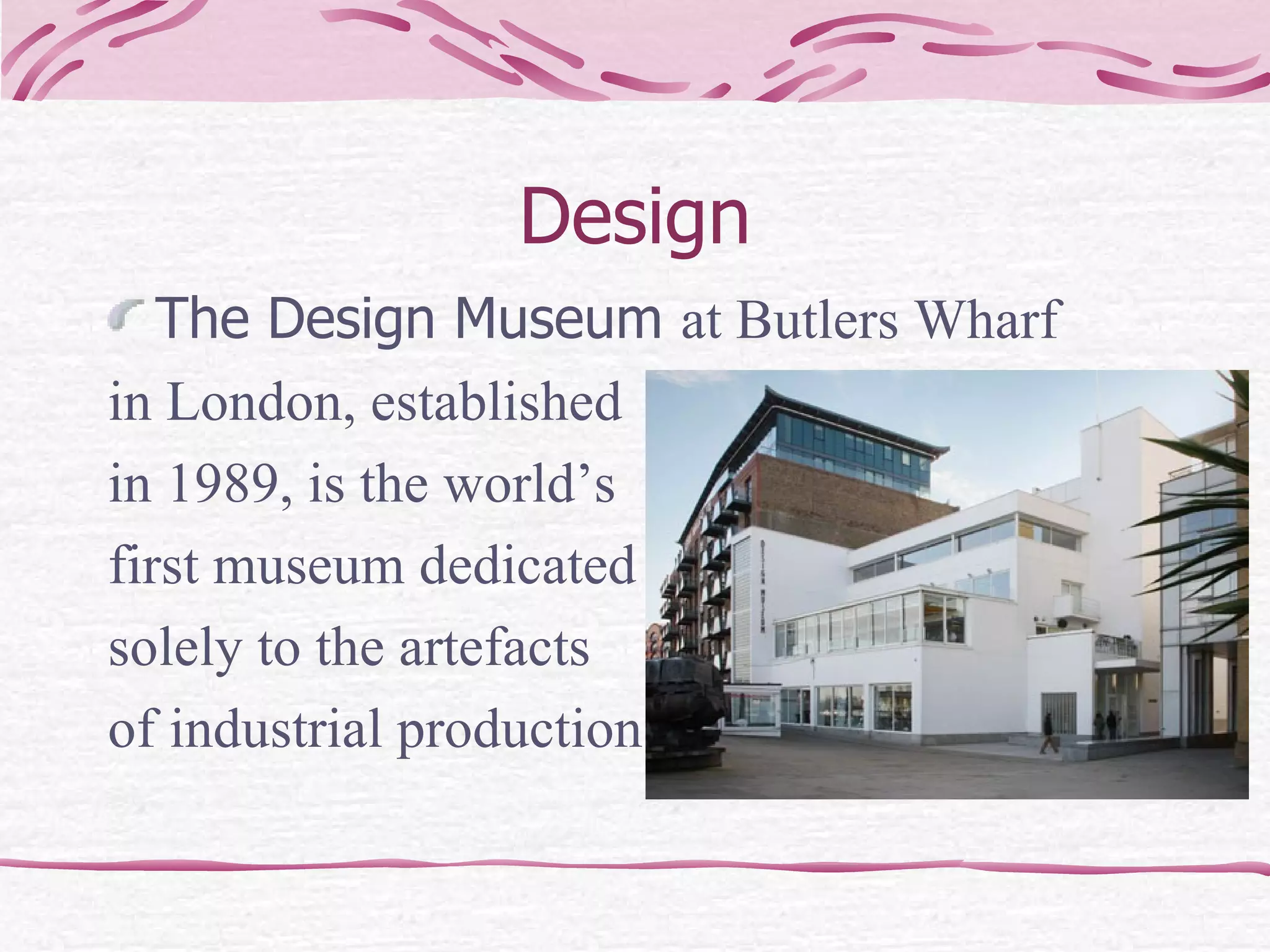
Design The Design Museum  at Butlers Wharf  in London, established in 1989, is the world’s first museum dedicated solely to the artefacts of industrial production.
Fashion design The best-known British designers of the 20 th  century included Hardy Avis and Norman Hartnel -  worked in Paris, later appointed dressmakers to the British Royal Family, as they were known for their conservative style of clothing.
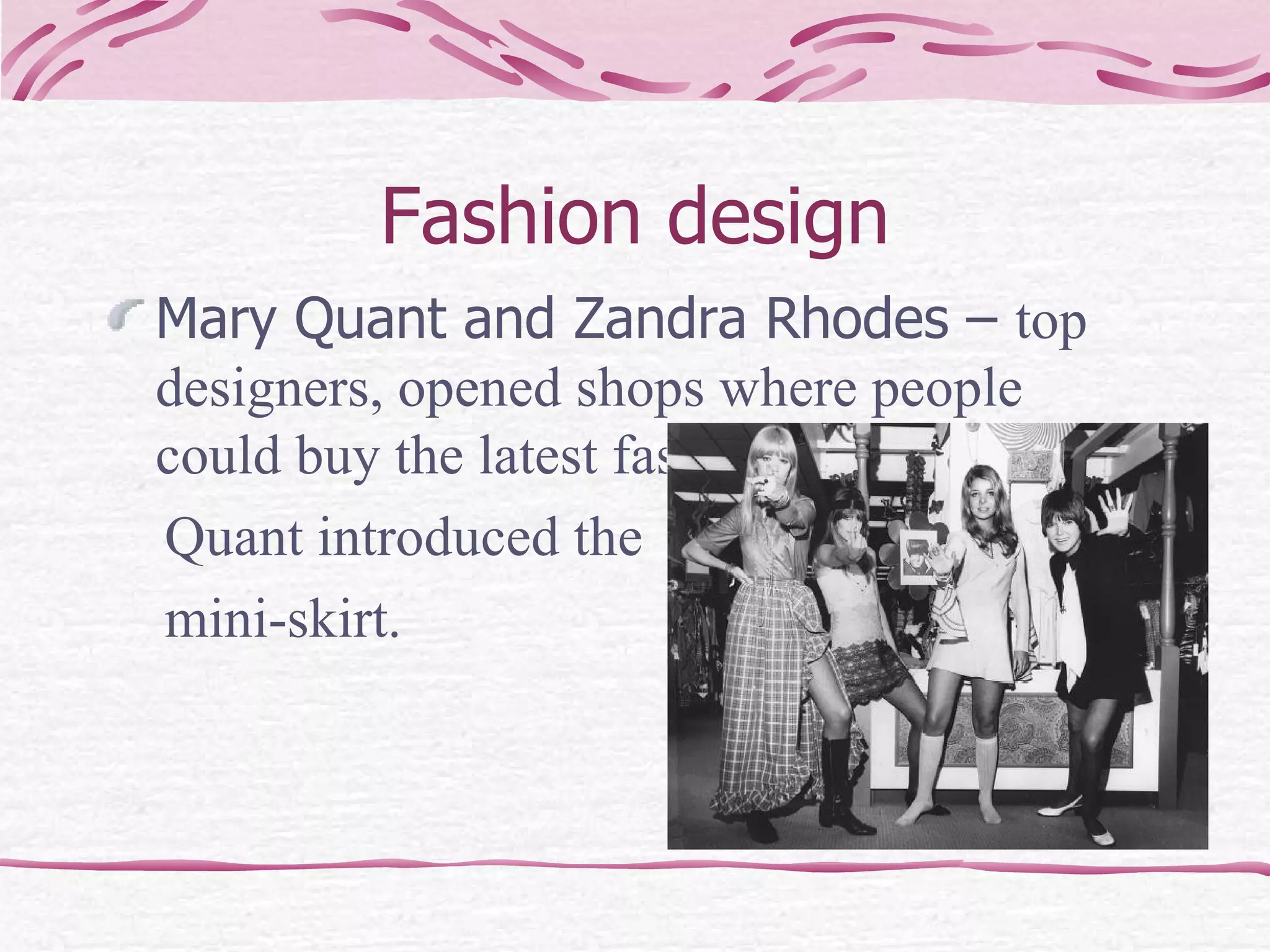
Fashion design Mary Quant and Zandra Rhodes –  top designers, opened shops where people could buy the latest fashion. Quant introduced the mini-skirt.
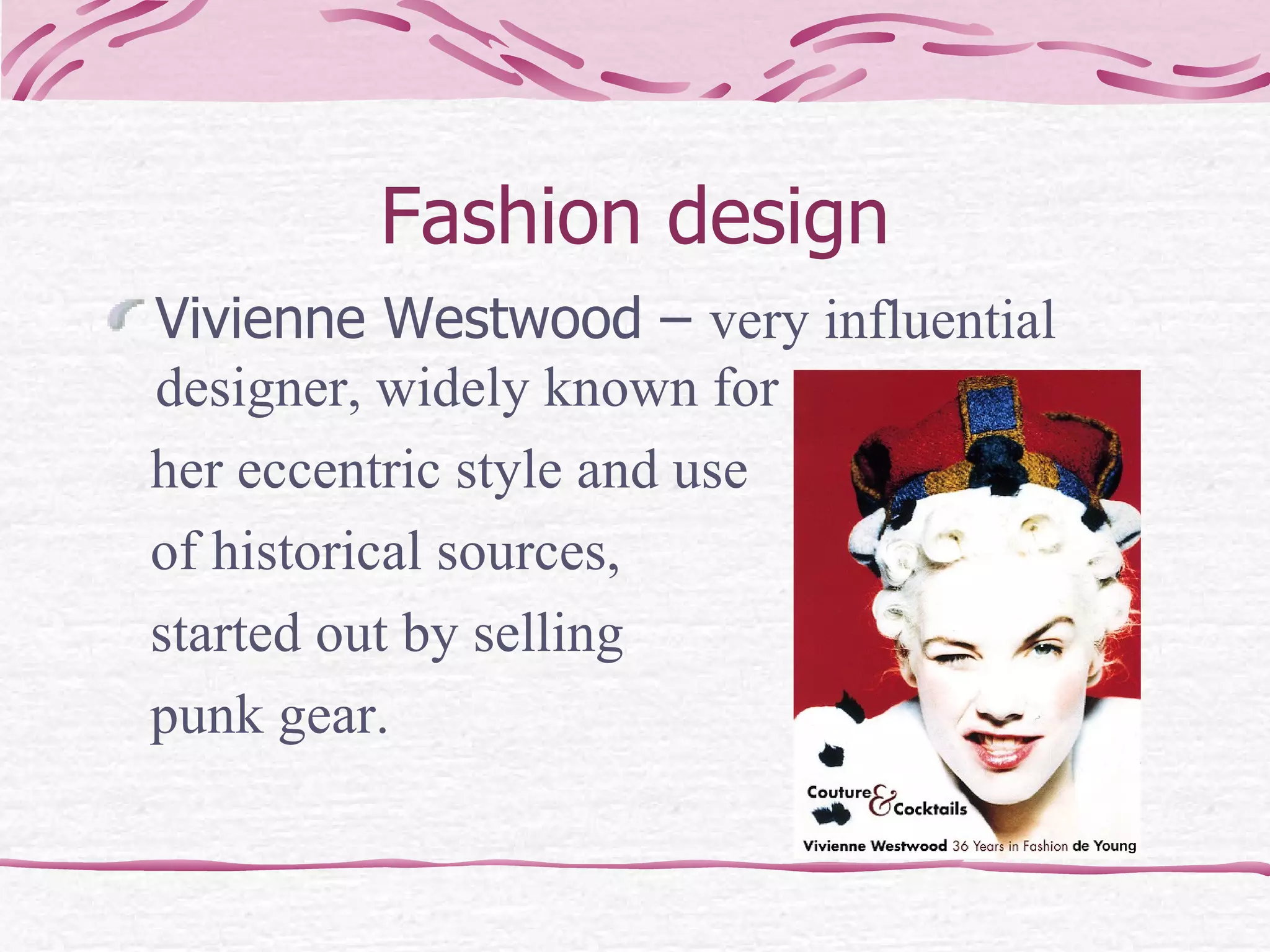
Fashion design Vivienne Westwood –  very influential designer, widely known for  her eccentric style and use of historical sources,  started out by selling  punk gear.
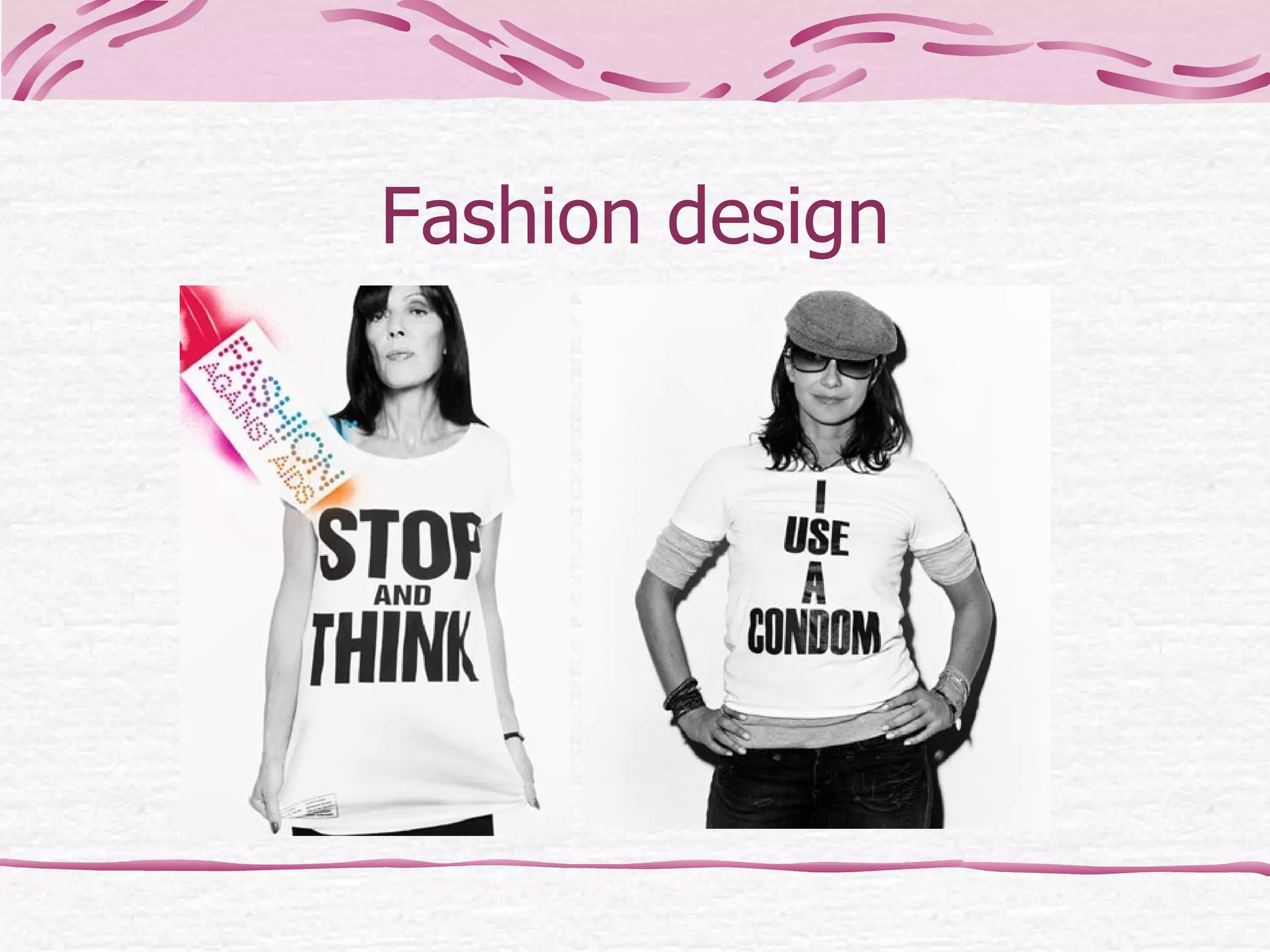
Fashion design Katharine Hamnett –  specialised in ready-to-wear fashions often based on work clothes, example T-shirts printed with slogans.
Fashion design
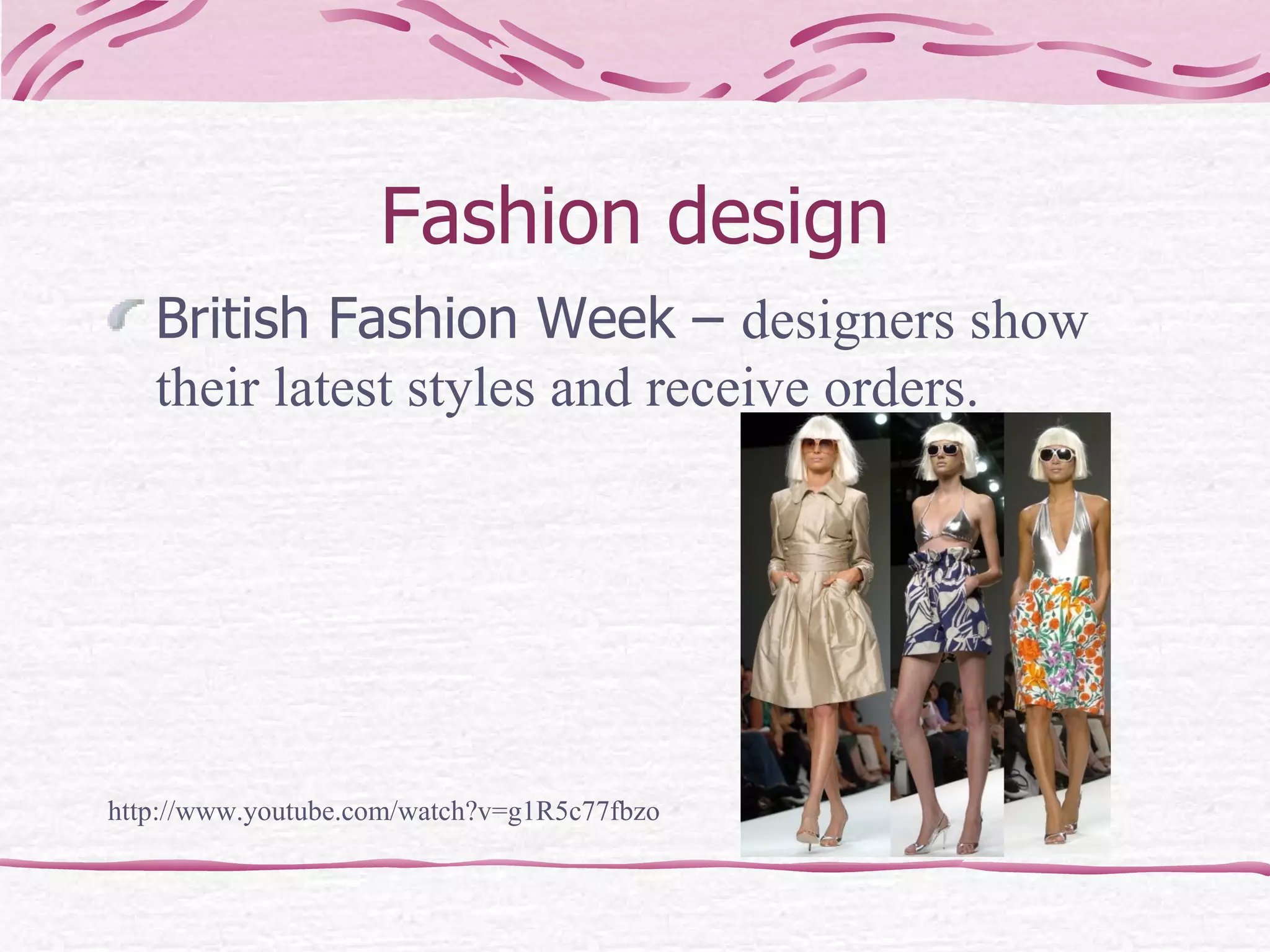
Fashion design British Fashion Week –  designers show their latest styles and receive orders. http://www.youtube.com/watch?v=g1R5c77fbzo
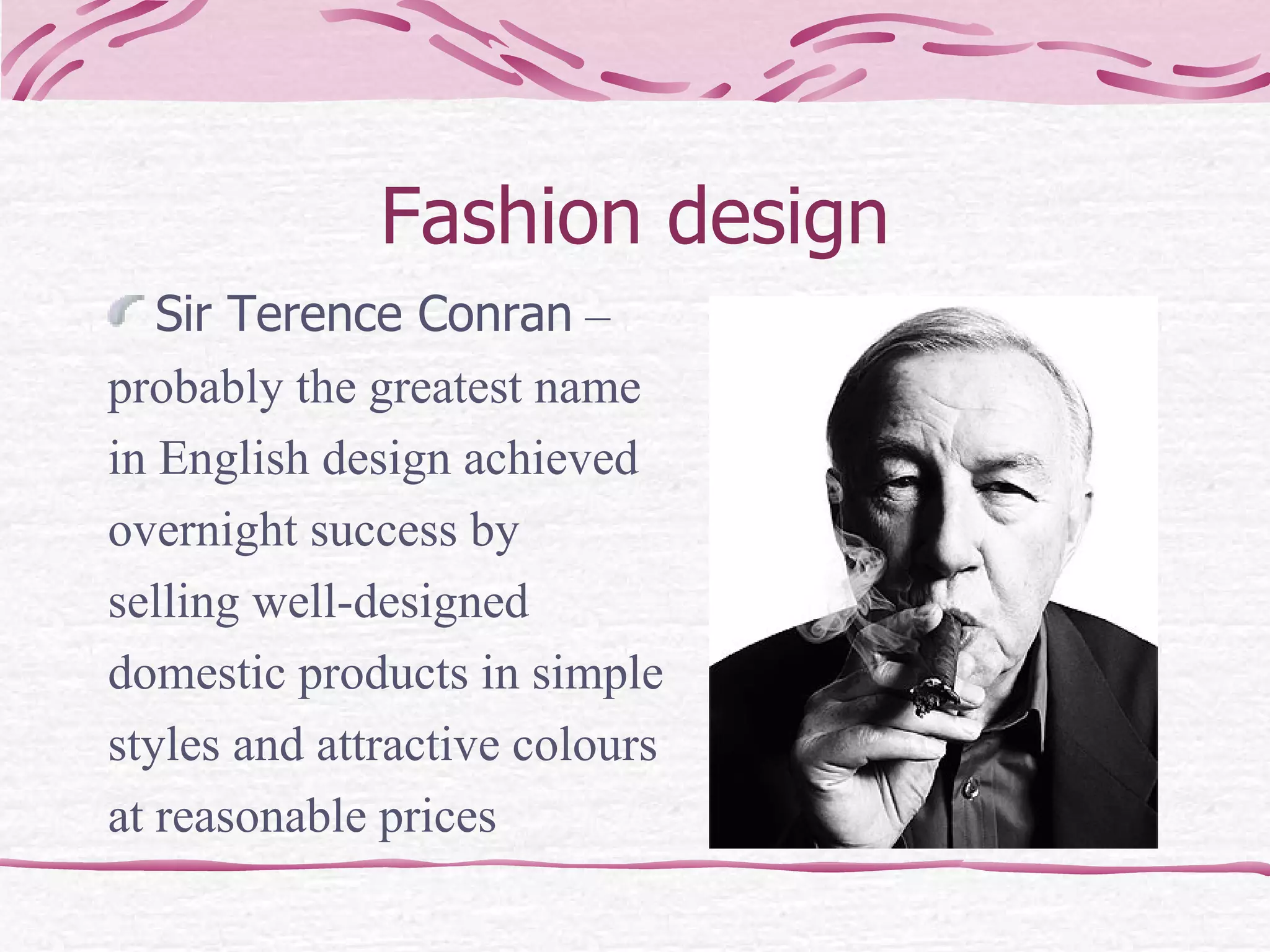
Fashion design Sir Terence Conran  –  probably the greatest name in English design achieved overnight success by  selling well-designed  domestic products in simple styles and attractive colours  at reasonable prices
Thank you for bearing with us!

Unit 10: Arts and Architecture

  • 1.
    ART, ARCHITECTURE ANDDESING Laura Koort Kristine Truija 11c
  • 2.
  • 3.
  • 4.
    Early architecture Romanruins scattered across the country Hadrian’s Wall
  • 5.
    Early architecture Afew Saxon churces
  • 6.
    Middle Ages tothe Reformation Medieval churces – richly decorated with colourful statues, murals and paintings Thick-walled stone castles Massive cathedrals with long naves and carved round arches
  • 7.
    Middle Ages tothe Reformation White Dover
  • 8.
    Middle Ages tothe Reformation The English Gothic Style - round arches became pointed, more and larger windows were made, roof vaults became more complex Divided into three periods:
  • 9.
    Middle Ages tothe Reformation Early architecture – pointed arches and flying buttresses Salisbury Cathedral
  • 10.
    Middle Ages tothe Reformation 2. Decorated - windows with delicate stonework patterns, elaborate stone carvings (usually of leaves and flowers) Exeter Cathedral
  • 11.
    Middle Ages tothe Reformation 3. Perpendicular - greatly enlarged windows, flatter arches and fan vaults in the roof King’s College Chapel in Cambridge
  • 12.
    The Reneissance Religiousart was banned Miniature portraits became popular Nicholas Hilliard – most accomplished painter of this genre.
  • 13.
    The Reneissance Sculpturewas limited to the decoration of the tombs England’s nobility was prosperous and could afford country houses surrounded by elegant gardens
  • 14.
    The Reneissance LongleatHouse in Wiltshire
  • 15.
    The 17 th and 18 th centuries Inigo Jones – designed many important buildings, the first to introduce the Italian Palladian style of building. Architecture as a profession became popular with his work.
  • 16.
    The 17 th and 18 th centuries The Palladian style - followed the principles of classical architecture, correct proportions of height and width.
  • 17.
    The 17 th and 18 th centuries In the 17 th century Jones’ work was often considered strange. The Banqueting House in Whitehall London
  • 18.
    The 17 th and 18 th centuries English Baroque appeared after the Great Fire of London in 1666 Christopher Wren (1632-1723) was commissioned to design the new St. Paul’s Cathedral that was destroyed in the fire. His style was essentially Baroque, but with English touch.
  • 19.
    The 17 th and 18 th centuries
  • 20.
    The 17 th and 18 th centuries In the early 18 th century some architects succeeded in replacing the Baroque style with a simpler one based on classical principles. The latter remained dominant throughout the century.
  • 21.
    The 17 th and 18 th centuries The most famous painters working in England in the 17 th century were all foreign-born: Rubens, Van Dyck, Lely.
  • 22.
    The 17 th and 18 th centuries William Hogarth – a great English painter of the early 18 th century, developed his own satirical style, very detailed pictures showing the immoral pleasures of his time
  • 23.
    The 17 th and 18 th centuries Marriage a la Mode
  • 24.
    The 17 th and 18 th centuries Joshua Reynolds – painted mostly portraits
  • 25.
    The 17 th and 18 th centuries Thomas Gainsborough – mostly known for his portraits, also painted landscapes.
  • 26.
    The 17 th and 18 th centuries George Stubbs – studied anatomy then specialised in sports pictures, mostly of horses.
  • 27.
    The 19 th century Landscape painting was the focus of the century John Constable – concentrated on the English countryside mainly Suffolk
  • 28.
    The 19 th century The Haywain – one of the most famous English paintings
  • 29.
    The 19 th century JMV Turner – many of his paintings are today on permanent display in a special part of the Tate Britain, London.
  • 30.
    The 19 th century The Pre-Raphaelites – the foremost group in English art during the 19 th century. The aim was to return to the style of the painting of the Middle Ages- bright colours, small details typical of Italian painting before the artist Raphael.
  • 31.
    The 19 th century Regency architecture- neo-classical in style influenced by the Orient. Revival of traditional styles, especially Gothic, with traditional building material such as brick.
  • 32.
    The 19 th century Augustus Pugin – an architect and interior designer, stated that Gothic architecture was not a style but principle
  • 33.
    The 19 th century The interior of The Houses of Parliament.
  • 34.
    The 19 th century ‘Battle of the Styles’- rivalry between architecture styles in the mid-19 th century, Liberal politicians supported the classical style, but the Conservatives favoured the Gothic revival. The outcome was a compromise
  • 35.
    The 19 th century The Victoria and Albert Hall
  • 36.
    The early 20th century Sir Edwin Lutyens – one of the most outstanding architects of the period, most of his work was domestic and he used local material.
  • 37.
    The early 20th century The modernism that flourished in Europe during the first 30 years of the 20 th century did not have a strong influence on English art and architecture.
  • 38.
    The early 20th century Jacob Epstein – a sculpture, caused a public outcry with his nude figures in the Strand, London, in 1908.
  • 39.
    The second WWto the present day Francis Bacon – considered one of the world’s greatest artists, his style was Expressionist and his figures often distorted.
  • 40.
    The second WWto the present day Damien Hirst – one of the best-known contemporary artists, his work and that of his fellow students tends to be regarded as the beginning of ‘BritArt’ BritArt – a group of Young British Artists who put on their shows and promote themselves through the media.
  • 41.
    The second WWto the present day Modern architecture arrived in England with the Modern Movement, which used contemporary materials. The use of concrete led to a style known as ‘New Brutalism’. The architects of the late 20 th century used modern material to achieve dramatic effects.
  • 42.
    Domestic architecture Theoldest houses are timber framed. Thatch was widely used for groups but went out of fashion because it was associated by the homes of the poorest people. All over England a large variety of different types of stone is used for building purposes.
  • 43.
    Decorative arts Developedin actively in England during the last two or three hundred years. The 19 th century saw progress in ceramic art.
  • 44.
    Decorative arts Threegreat cabinet-makers: Sheraton, Hepplewhite, Chippendale.
  • 45.
  • 46.
    Design British designersuse new technologies, processes and materials to create market advantage. Current British design is really ‘the design workshop of the world’ ready for future challenges, but also aware of traditions.
  • 47.
    Design The DesignMuseum at Butlers Wharf in London, established in 1989, is the world’s first museum dedicated solely to the artefacts of industrial production.
  • 48.
    Fashion design Thebest-known British designers of the 20 th century included Hardy Avis and Norman Hartnel - worked in Paris, later appointed dressmakers to the British Royal Family, as they were known for their conservative style of clothing.
  • 49.
    Fashion design MaryQuant and Zandra Rhodes – top designers, opened shops where people could buy the latest fashion. Quant introduced the mini-skirt.
  • 50.
    Fashion design VivienneWestwood – very influential designer, widely known for her eccentric style and use of historical sources, started out by selling punk gear.
  • 51.
    Fashion design KatharineHamnett – specialised in ready-to-wear fashions often based on work clothes, example T-shirts printed with slogans.
  • 52.
  • 53.
    Fashion design BritishFashion Week – designers show their latest styles and receive orders. http://www.youtube.com/watch?v=g1R5c77fbzo
  • 54.
    Fashion design SirTerence Conran – probably the greatest name in English design achieved overnight success by selling well-designed domestic products in simple styles and attractive colours at reasonable prices
  • 55.
    Thank you forbearing with us!