Contemporary Britain Unit 5 from Let Us Explore the British Isles, pp. 46-57 Marcus Hildebrandt
Contemporary Britain Economy Industry Agriculture Science and Technology Transport Environmental Issues Tourism
Economy 1 UK fifth largest economy in the world, second in Europe Britain’s GDP (Gross Domestic Product) in 2007 £1,410 billion, with an increasing tendency GDP per sector: agriculture (1%), industry (26%), services (73%) Inflation: 4.4%; unemployment: 5.4% UK living standards among the highest in Europe
Economy 2 In 2003, 39 of the world’s 500 largest companies were based in the UK, 34 of which were UK-owned. Top 5 companies in 2003: 1.  BP Energy 2.  Vodafone   3. GlaxoSmithKlein  4. HSBC Holdings (banking) 5. Royal Bank of Scotland
Industry Great changes since WW II, with a shift from heavy industries to services Today about 70% employed in services (tourism, insurance, banking [City of London: 555 banks and 300,000workers!]) Most British companies are small and make expensive products
Agriculture 80% of the land in England used in agriculture, but only 1-2% of the total workforce large fields mainly in eastern and southern England (wheat, barley, oilseed rape, sugar beet, peas, beans) Over 50% of farms rear lifestock (sheep!) 60% of Britain’s demands in food produced in England At the end of the 20th century big crises: cheap imports    22,000 farmers lost their jobs BSE (bovine spongiform encephalopathy) =“mad cow disease”    worldwide ban on British beef 3% of land used for organic farming (Prince of Wales one of its promoters)
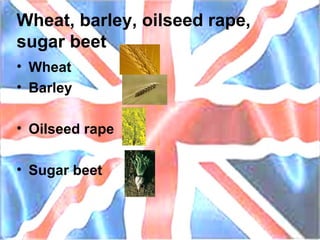
Wheat, barley, oilseed rape, sugar beet Wheat Barley Oilseed rape Sugar beet
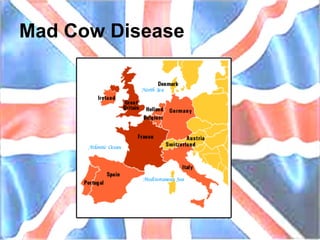
Mad Cow Disease
Science and Technology 46 Nobel prizes! (biotechnology, biomedicine, chemicals, aerospace, etc.) Pp. 48/49: important scientific developments and inventions over the last 25 years Science festivals to promote science among the public (Edinburgh International Science Festival: 70,000 people) Various museums around the country: 1.  Natural   History   Museum   in London (UK’s  top visitor attraction) 2.  The   Deep   in Hull (Europe’s deepest  aquarium) 3.  W5  Interactive   Discovery   Centre   in Belfast 4.  The  Eden Project   in Cornwall
Transport 1 Survey by the Commission for Integrated Transport (November 2001): “British public transport the worst in Europe” 46 minutes of commuting per day; traffic jams; high travel fares (less subsidised); high level of car use
Transport 2 Inter-city public transport: buses, trains (privatised; many delays and cancellations due to serious accidents and subsequent engineering works) Urban public transport: buses (famous  red   double-deckers   are being replaced, taxis, the Tube (since the 1860s; 2 million people per day) Park-and-Ride services The Channel Tunnel (opened in 1994):  Eurostar  (London-Brussels-Paris) and  Eurotunnel  (Folkstone-Calais) Airlines: Ryan Air, EasyJet; London Heathrow (64.6 million passengers in 2000) Required age to drive a car: 17
Environmental Issues 1 Nature Conservation A wide range of projects to recover threatened species Many protected areas (over 300 national nature reserves with over 200,000 hectares); around 6,700 Sites of Special Interest (SSSIs) Britain once covered completely by forest, since prehistoric times large areas have been cleared
Environmental Issues 2 B. Environmental problems Government strategy: new homes on brownfield sites as opposed to greenfield sites Many organisations committed to sustainable development: National  Trust   (2.7 million members; responsible for ca. 200 buildings and gardens) English Nature (government agency responsible for the SSSIs) English Heritage  (government organisation that protects many old, historic buildings; rescue archaeology)
Environmental Issues 3 Other actions include: - cleaning up of contaminated land - noise and vibration control - wastewater treatment - marine pollution control - renewable energy sources (right    now around 5%, by 2010 10%) - recycling waste (landfill sites,    incinerators; only 8% recycled) at    bottle banks, etc.
Tourism 1 Thomas  Cook   (1808-92): founder of the first worldwide travel agency, inventor of the conducted tour Over 2 million people employed in tourism Over £ 50 million each year Tourists come from: Western Europe (66%) Most important airports:  Heathrow , Gatwick, Manchester, Luton, Stansted Ferries,  hovercrafts ;  Strait   of   Dover   (busiest passenger port in Europe) Good system of motorways and roads, extensive rail network Where to stay? B&B (bed and breakfast) a cheap alternative; youth hostels, caravan parks Sites: UNESCO World Heritage List (e.g.,  Tower of London ;  Canterbury Cathedral ,  Hadrian’s Wall ;  Bath ;  Stonehenge )
Tourism 2 Top sites in number of visitors: 1.  Blackpool (Pleasure Beach Theme Park ) 2.  British Museum 3.  National Gallery 4.  Palace Pier (Brighton) 5.  Madame Tussaud’s Favourite cities: London,  Oxford , Stratford-upon-Avon, Cambridge BTA (British Tourist Authority)    Festival of Art in Culture in 1995 (the biggest international campaign to promote Britain’s culture); many publications National Parks (12 in England and Wales) Areas of Outstanding Natural Beauty (AONBs): Isles of Scilly (smallest), Cotswolds (the largest) Lake District National Park
Thank you! For further information, see also: www.visitbritain.com

Unit 5: Contemporary Britain

  • 1.
    Contemporary Britain Unit5 from Let Us Explore the British Isles, pp. 46-57 Marcus Hildebrandt
  • 2.
    Contemporary Britain EconomyIndustry Agriculture Science and Technology Transport Environmental Issues Tourism
  • 3.
    Economy 1 UKfifth largest economy in the world, second in Europe Britain’s GDP (Gross Domestic Product) in 2007 £1,410 billion, with an increasing tendency GDP per sector: agriculture (1%), industry (26%), services (73%) Inflation: 4.4%; unemployment: 5.4% UK living standards among the highest in Europe
  • 4.
    Economy 2 In2003, 39 of the world’s 500 largest companies were based in the UK, 34 of which were UK-owned. Top 5 companies in 2003: 1. BP Energy 2. Vodafone 3. GlaxoSmithKlein 4. HSBC Holdings (banking) 5. Royal Bank of Scotland
  • 5.
    Industry Great changessince WW II, with a shift from heavy industries to services Today about 70% employed in services (tourism, insurance, banking [City of London: 555 banks and 300,000workers!]) Most British companies are small and make expensive products
  • 6.
    Agriculture 80% ofthe land in England used in agriculture, but only 1-2% of the total workforce large fields mainly in eastern and southern England (wheat, barley, oilseed rape, sugar beet, peas, beans) Over 50% of farms rear lifestock (sheep!) 60% of Britain’s demands in food produced in England At the end of the 20th century big crises: cheap imports  22,000 farmers lost their jobs BSE (bovine spongiform encephalopathy) =“mad cow disease”  worldwide ban on British beef 3% of land used for organic farming (Prince of Wales one of its promoters)
  • 7.
    Wheat, barley, oilseedrape, sugar beet Wheat Barley Oilseed rape Sugar beet
  • 8.
  • 9.
    Science and Technology46 Nobel prizes! (biotechnology, biomedicine, chemicals, aerospace, etc.) Pp. 48/49: important scientific developments and inventions over the last 25 years Science festivals to promote science among the public (Edinburgh International Science Festival: 70,000 people) Various museums around the country: 1. Natural History Museum in London (UK’s top visitor attraction) 2. The Deep in Hull (Europe’s deepest aquarium) 3. W5 Interactive Discovery Centre in Belfast 4. The Eden Project in Cornwall
  • 10.
    Transport 1 Surveyby the Commission for Integrated Transport (November 2001): “British public transport the worst in Europe” 46 minutes of commuting per day; traffic jams; high travel fares (less subsidised); high level of car use
  • 11.
    Transport 2 Inter-citypublic transport: buses, trains (privatised; many delays and cancellations due to serious accidents and subsequent engineering works) Urban public transport: buses (famous red double-deckers are being replaced, taxis, the Tube (since the 1860s; 2 million people per day) Park-and-Ride services The Channel Tunnel (opened in 1994): Eurostar (London-Brussels-Paris) and Eurotunnel (Folkstone-Calais) Airlines: Ryan Air, EasyJet; London Heathrow (64.6 million passengers in 2000) Required age to drive a car: 17
  • 12.
    Environmental Issues 1Nature Conservation A wide range of projects to recover threatened species Many protected areas (over 300 national nature reserves with over 200,000 hectares); around 6,700 Sites of Special Interest (SSSIs) Britain once covered completely by forest, since prehistoric times large areas have been cleared
  • 13.
    Environmental Issues 2B. Environmental problems Government strategy: new homes on brownfield sites as opposed to greenfield sites Many organisations committed to sustainable development: National Trust (2.7 million members; responsible for ca. 200 buildings and gardens) English Nature (government agency responsible for the SSSIs) English Heritage (government organisation that protects many old, historic buildings; rescue archaeology)
  • 14.
    Environmental Issues 3Other actions include: - cleaning up of contaminated land - noise and vibration control - wastewater treatment - marine pollution control - renewable energy sources (right now around 5%, by 2010 10%) - recycling waste (landfill sites, incinerators; only 8% recycled) at bottle banks, etc.
  • 15.
    Tourism 1 Thomas Cook (1808-92): founder of the first worldwide travel agency, inventor of the conducted tour Over 2 million people employed in tourism Over £ 50 million each year Tourists come from: Western Europe (66%) Most important airports: Heathrow , Gatwick, Manchester, Luton, Stansted Ferries, hovercrafts ; Strait of Dover (busiest passenger port in Europe) Good system of motorways and roads, extensive rail network Where to stay? B&B (bed and breakfast) a cheap alternative; youth hostels, caravan parks Sites: UNESCO World Heritage List (e.g., Tower of London ; Canterbury Cathedral , Hadrian’s Wall ; Bath ; Stonehenge )
  • 16.
    Tourism 2 Topsites in number of visitors: 1. Blackpool (Pleasure Beach Theme Park ) 2. British Museum 3. National Gallery 4. Palace Pier (Brighton) 5. Madame Tussaud’s Favourite cities: London, Oxford , Stratford-upon-Avon, Cambridge BTA (British Tourist Authority)  Festival of Art in Culture in 1995 (the biggest international campaign to promote Britain’s culture); many publications National Parks (12 in England and Wales) Areas of Outstanding Natural Beauty (AONBs): Isles of Scilly (smallest), Cotswolds (the largest) Lake District National Park
  • 17.
    Thank you! Forfurther information, see also: www.visitbritain.com