


Teaching Learning
Process
PREPARED BY: MS. MEERA CHANDRAN
TEACHING LEARNING PROCESS
DEFINITION:
It is a systematic, sequential, planned
course of action on the part of both
teacher and the learner to achieve the
outcome of the teaching learning
TEACHING LEARNING PROCESS
MEANING:
It is a combined process in which a
teacher assess the students learning need
and implement a plan of work and
estimate the outcome of the instruction
OBJECTIVES OF TEACHING LEARNING PROCESS
1. To help students to acquire knowledge
2. To shape character and behaviour
3. To foster independence
4. To motivate students
5. To nurture creative thinking
6. To develop social skills
7. To assist school/educational institution
8. To involve parents in their children’s education
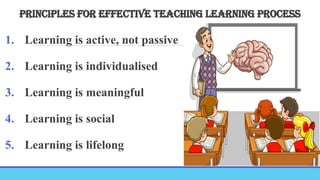
PRINCIPLES FOR EFFECTIVE TEACHING LEARNING PROCESS
1. Learning is active, not passive
2. Learning is individualised
3. Learning is meaningful
4. Learning is social
5. Learning is lifelong
TEACHING Learning PROCESS CYCLE
1. Prior knowledge
2. Presenting new material
3. Challenge
4. Feedback
5. Repetition
PHASES OF TEACHING

PRE-ACTIVE STAGE: The planning stage that happens
before meeting with students, involves planning lessons,
choosing books.

INTER-ACTIVE STAGE: The execution stage that involves
classroom interaction between teacher and students. Involves
perceiving the class, diagnosing students' knowledge, and
facilitating reaction and response

POST-ACTIVE STAGE: The teacher assess how well
pupils has understood the topic(evaluation cum feedback
stage)
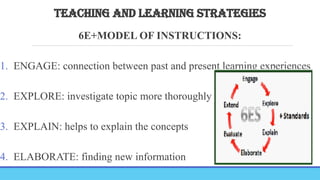
TEACHING AND LEARNING STRATEGIES
6E+MODEL OF INSTRUCTIONS:
1. ENGAGE: connection between past and present learning experiences
2. EXPLORE: investigate topic more thoroughly
3. EXPLAIN: helps to explain the concepts
4. ELABORATE: finding new information
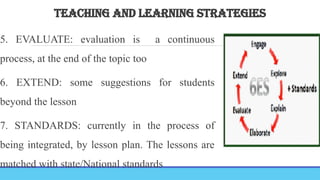
TEACHING AND LEARNING STRATEGIES
5. EVALUATE: evaluation is a continuous
process, at the end of the topic too
6. EXTEND: some suggestions for students
beyond the lesson
7. STANDARDS: currently in the process of
being integrated, by lesson plan. The lessons are
matched with state/National standards
TEACHING PRINCIPLES
Effective teaching involves:
1. Acquiring relevant knowledge about students and using that knowledge to inform our course design
and classroom teaching.
2. Aligning the three major components of instruction: learning objectives, assessments, and
instructional activities.
3. Articulating clear expectations regarding learning objectives and policies.
4. Prioritizing the knowledge and skills we choose to focus on.
5. Recognizing and overcoming our expert blind spots(slow down to make sure students understand
the concept).
6. Adopting appropriate teaching roles to support our learning goals.
7. Progressively refining our courses based on reflection and feedback.
TEACHING STRATEGIES
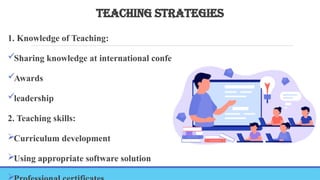
1. Knowledge of Teaching:
Sharing knowledge at international conference
Awards
leadership
2. Teaching skills:
Curriculum development
Using appropriate software solution

TEACHING STRATEGIES
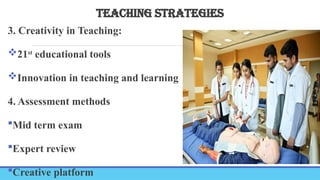
3. Creativity in Teaching:
21st
educational tools
Innovation in teaching and learning
4. Assessment methods
Mid term exam
Expert review
Creative platform
PRINCIPLES OF TEACHING AND LEARNING
1. Students' beliefs about intelligence affect their
cognitive functions/ learning.
2. What students already know affects their
learning.
3. Student's cognitive development based on
student's knowledge domain.
4. Learning is based on context(situation/settings);
it needs to be facilitated.
5. Acquiring long-term knowledge and skill is
largely dependent on practice.
PRINCIPLES OF TEACHING AND LEARNING
6. Clear, explanatory and timely feedback to
students is important for learning.
7. Students' self-regulatory skills (attention
&organization) can be taught.
8. Student creativity can be fostered.
9. Students tend to enjoy learning and to do better,
when they are intrinsically motivated.
10. Students continue in the face of challenging
tasks when they adopt mastery goals.
PRINCIPLES OF TEACHING AND LEARNING
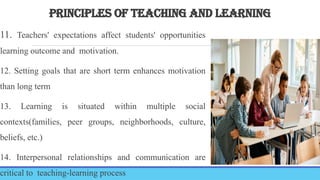
11. Teachers' expectations affect students' opportunities
learning outcome and motivation.
12. Setting goals that are short term enhances motivation
than long term
13. Learning is situated within multiple social
contexts(families, peer groups, neighborhoods, culture,
beliefs, etc.)
14. Interpersonal relationships and communication are
critical to teaching-learning process
PRINCIPLES OF TEACHING AND LEARNING
15. Emotional well-being influences educational
performance, learning and development.
16. Expectations for classroom conduct and social
interaction are learned with effective classroom
instruction.
17. Effective classroom management is based on
(a)Setting (b) nurturing positive relationships and
©Providing student support.
PRINCIPLES OF TEACHING AND LEARNING
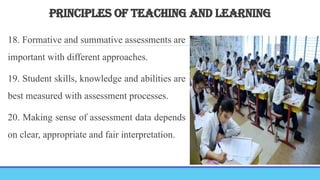
18. Formative and summative assessments are
important with different approaches.
19. Student skills, knowledge and abilities are
best measured with assessment processes.
20. Making sense of assessment data depends
on clear, appropriate and fair interpretation.
GENERAL PRINCIPLES
1.Principle of direction: Goal/Objectives
2. Principle of Learning by Doing: Self-learning
3. Principle of interest and linking with life: By generating interest
4. Principle of definite aim: Aim/Objective.
5. Principle of making provision for individual differences: Abilities,
attitude, socioeconomic background.
6. Principle of selection: Content-Relevant/ concise / learner’s objectives
GENERAL PRINCIPLES
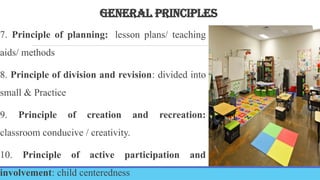
7. Principle of planning: lesson plans/ teaching
aids/ methods
8. Principle of division and revision: divided into
small & Practice
9. Principle of creation and recreation:
classroom conducive / creativity.
10. Principle of active participation and
involvement: child centeredness
PSYCHOLOGICAL PRINCIPLES
Some psychological principles should be followed by the teachers.
1. Principle of Readiness
2. Principle of Satisfaction and Effect
3. Principle of Attention
4. Principle of Motivation
5. Principle of Group Dynamics
6. Principle of multi-sensory approach
7. Principle of Tolerance, Cooperation and Praise
MAXIMS OF TEACHING

From known to unknown

From simple to complex

From concrete to abstract(real life –concept)

From whole to part(overall pic-division)

From particular to general

From direct to indirect(clear info-concept)

From empirical to rational(Experience-logic)

From induction to deduction(examples-new situation)

From analysis to synthesis(division of parts-coming together)
FACTORS AFFECTING TEACHING LEARNING PROCESS

There are three things which are involved in teaching-learning process
i.e. Teacher, Student and Learning Environment.
1. Intellectual Factors: Good Academic performances
2. Learning Factors: learning power and performance
3. Physical Factors: Visuals, health issues, physical defect &
developmental problems
4. Attitude Factors: ability and willingness
5. Environmental Factors: class rooms, text books, equipment, class
mates, instructional material
6. Teacher’s Personality: Leading, inspiring, guiding
BARRIERS IN TEACHING LEARNING PROCESS
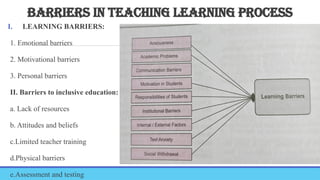
I. LEARNING BARRIERS:
1. Emotional barriers
2. Motivational barriers
3. Personal barriers
II. Barriers to inclusive education:
a. Lack of resources
b. Attitudes and beliefs
c.Limited teacher training
d.Physical barriers
e.Assessment and testing
CONCEPT OF LEARNING
Learning: learning is the modification of our ready-made behavior due
to experiences ( Colvin)
CHARECTERISTICS OF LEARNING PROCES:
Personal: Age, gender, language spoken, cultural back ground
Academic: prior knowledge, level of education
Social and emotional: self image, self efficacy, cohesiveness
Cognitive: mental capabilities, intellectual skills, problem solving
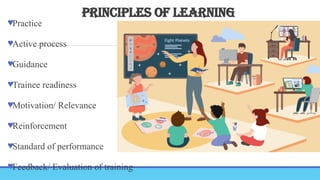
PRINCIPLES OF LEARNING
♥Practice
♥Active process
♥Guidance
♥Trainee readiness
♥Motivation/ Relevance
♥Reinforcement
♥Standard of performance
♥Feedback/ Evaluation of training
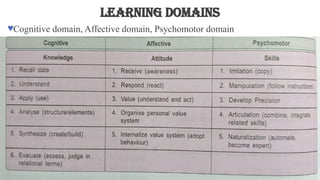
LEARNING DOMAINS
♥Cognitive domain, Affective domain, Psychomotor domain
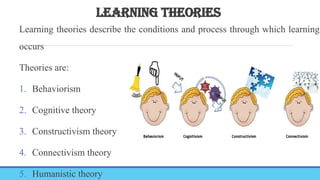
LEARNING THEORIES
Learning theories describe the conditions and process through which learning
occurs
Theories are:
1. Behaviorism
2. Cognitive theory
3. Constructivism theory
4. Connectivism theory
5. Humanistic theory
LEARNING THEORIES
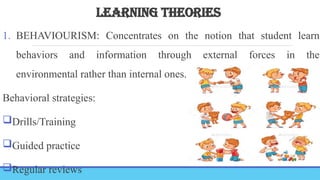
1. BEHAVIOURISM: Concentrates on the notion that student learn
behaviors and information through external forces in the
environmental rather than internal ones.
Behavioral strategies:
Drills/Training
Guided practice
Regular reviews
LEARNING THEORIES
Strengths:
It can be used to formulate behavioral contracts in school/home
Helpful in behavior modification
Success of outcome is easily measurable
Guarantees specific learning
Ease of application
Cueing(prompting) responses to predictable behavior
LEARNING THEORIES
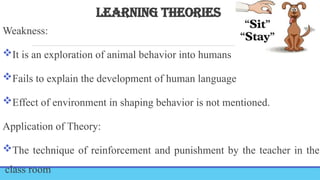
Weakness:
It is an exploration of animal behavior into humans
Fails to explain the development of human language
Effect of environment in shaping behavior is not mentioned.
Application of Theory:
The technique of reinforcement and punishment by the teacher in the
class room
LEARNING THEORIES
2. COGNITIVE THEORY:
It involves the learner seeing something new, processing it internally and
then acting on it some how
Behavioral strategies:
Discussions
Reflections
Visualizations
LEARNING THEORIES
Strengths:
Organized structure to learning: observe-perceive-interpret
Problems broken down in to smaller parts helps to process smaller bits.
Weakness:
Learning is structured so difficult to adapt changes, what has already been processed.
Application of this theory:
It is suited well for problem solving where concepts are broken down in to smaller
parts
LEARNING THEORIES
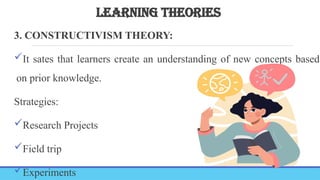
3. CONSTRUCTIVISM THEORY:
It sates that learners create an understanding of new concepts based
on prior knowledge.
Strategies:
Research Projects
Field trip
Experiments
LEARNING THEORIES
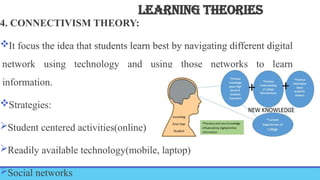
4. CONNECTIVISM THEORY:
It focus the idea that students learn best by navigating different digital
network using technology and using those networks to learn
information.
Strategies:
Student centered activities(online)
Readily available technology(mobile, laptop)
Social networks
LEARNING THEORIES
CONNECTIVISM THEORY:
Strengths:
Are generally relevant to the learner and real world based.
Learners construct knowledge and relate the information to their own experiences,
beliefs, and attitude.
Weakness:
Individual experiences and attitude can vary
Desired outcome may not always be achieved, when different people approach the
problem
LEARNING THEORIES
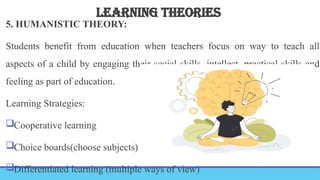
5. HUMANISTIC THEORY:
Students benefit from education when teachers focus on way to teach all
aspects of a child by engaging their social skills, intellect, practical skills and
feeling as part of education.
Learning Strategies:
Cooperative learning
Choice boards(choose subjects)
Differentiated learning (multiple ways of view)

UNIT 1 TEACHING LEARNING PROCESS-NURSING EDUCATION. V SEM BSC NURSING.pptx

  • 1.
  • 2.
    TEACHING LEARNING PROCESS DEFINITION: Itis a systematic, sequential, planned course of action on the part of both teacher and the learner to achieve the outcome of the teaching learning
  • 3.
    TEACHING LEARNING PROCESS MEANING: Itis a combined process in which a teacher assess the students learning need and implement a plan of work and estimate the outcome of the instruction
  • 4.
    OBJECTIVES OF TEACHINGLEARNING PROCESS 1. To help students to acquire knowledge 2. To shape character and behaviour 3. To foster independence 4. To motivate students 5. To nurture creative thinking 6. To develop social skills 7. To assist school/educational institution 8. To involve parents in their children’s education
  • 5.
    PRINCIPLES FOR EFFECTIVETEACHING LEARNING PROCESS 1. Learning is active, not passive 2. Learning is individualised 3. Learning is meaningful 4. Learning is social 5. Learning is lifelong
  • 6.
    TEACHING Learning PROCESSCYCLE 1. Prior knowledge 2. Presenting new material 3. Challenge 4. Feedback 5. Repetition
  • 7.
    PHASES OF TEACHING  PRE-ACTIVESTAGE: The planning stage that happens before meeting with students, involves planning lessons, choosing books.  INTER-ACTIVE STAGE: The execution stage that involves classroom interaction between teacher and students. Involves perceiving the class, diagnosing students' knowledge, and facilitating reaction and response  POST-ACTIVE STAGE: The teacher assess how well pupils has understood the topic(evaluation cum feedback stage)
  • 8.
    TEACHING AND LEARNINGSTRATEGIES 6E+MODEL OF INSTRUCTIONS: 1. ENGAGE: connection between past and present learning experiences 2. EXPLORE: investigate topic more thoroughly 3. EXPLAIN: helps to explain the concepts 4. ELABORATE: finding new information
  • 9.
    TEACHING AND LEARNINGSTRATEGIES 5. EVALUATE: evaluation is a continuous process, at the end of the topic too 6. EXTEND: some suggestions for students beyond the lesson 7. STANDARDS: currently in the process of being integrated, by lesson plan. The lessons are matched with state/National standards
  • 10.
    TEACHING PRINCIPLES Effective teachinginvolves: 1. Acquiring relevant knowledge about students and using that knowledge to inform our course design and classroom teaching. 2. Aligning the three major components of instruction: learning objectives, assessments, and instructional activities. 3. Articulating clear expectations regarding learning objectives and policies. 4. Prioritizing the knowledge and skills we choose to focus on. 5. Recognizing and overcoming our expert blind spots(slow down to make sure students understand the concept). 6. Adopting appropriate teaching roles to support our learning goals. 7. Progressively refining our courses based on reflection and feedback.
  • 11.
    TEACHING STRATEGIES 1. Knowledgeof Teaching: Sharing knowledge at international conference Awards leadership 2. Teaching skills: Curriculum development Using appropriate software solution 
  • 12.
    TEACHING STRATEGIES 3. Creativityin Teaching: 21st educational tools Innovation in teaching and learning 4. Assessment methods Mid term exam Expert review Creative platform
  • 13.
    PRINCIPLES OF TEACHINGAND LEARNING 1. Students' beliefs about intelligence affect their cognitive functions/ learning. 2. What students already know affects their learning. 3. Student's cognitive development based on student's knowledge domain. 4. Learning is based on context(situation/settings); it needs to be facilitated. 5. Acquiring long-term knowledge and skill is largely dependent on practice.
  • 14.
    PRINCIPLES OF TEACHINGAND LEARNING 6. Clear, explanatory and timely feedback to students is important for learning. 7. Students' self-regulatory skills (attention &organization) can be taught. 8. Student creativity can be fostered. 9. Students tend to enjoy learning and to do better, when they are intrinsically motivated. 10. Students continue in the face of challenging tasks when they adopt mastery goals.
  • 15.
    PRINCIPLES OF TEACHINGAND LEARNING 11. Teachers' expectations affect students' opportunities learning outcome and motivation. 12. Setting goals that are short term enhances motivation than long term 13. Learning is situated within multiple social contexts(families, peer groups, neighborhoods, culture, beliefs, etc.) 14. Interpersonal relationships and communication are critical to teaching-learning process
  • 16.
    PRINCIPLES OF TEACHINGAND LEARNING 15. Emotional well-being influences educational performance, learning and development. 16. Expectations for classroom conduct and social interaction are learned with effective classroom instruction. 17. Effective classroom management is based on (a)Setting (b) nurturing positive relationships and ©Providing student support.
  • 17.
    PRINCIPLES OF TEACHINGAND LEARNING 18. Formative and summative assessments are important with different approaches. 19. Student skills, knowledge and abilities are best measured with assessment processes. 20. Making sense of assessment data depends on clear, appropriate and fair interpretation.
  • 18.
    GENERAL PRINCIPLES 1.Principle ofdirection: Goal/Objectives 2. Principle of Learning by Doing: Self-learning 3. Principle of interest and linking with life: By generating interest 4. Principle of definite aim: Aim/Objective. 5. Principle of making provision for individual differences: Abilities, attitude, socioeconomic background. 6. Principle of selection: Content-Relevant/ concise / learner’s objectives
  • 19.
    GENERAL PRINCIPLES 7. Principleof planning: lesson plans/ teaching aids/ methods 8. Principle of division and revision: divided into small & Practice 9. Principle of creation and recreation: classroom conducive / creativity. 10. Principle of active participation and involvement: child centeredness
  • 20.
    PSYCHOLOGICAL PRINCIPLES Some psychologicalprinciples should be followed by the teachers. 1. Principle of Readiness 2. Principle of Satisfaction and Effect 3. Principle of Attention 4. Principle of Motivation 5. Principle of Group Dynamics 6. Principle of multi-sensory approach 7. Principle of Tolerance, Cooperation and Praise
  • 21.
    MAXIMS OF TEACHING  Fromknown to unknown  From simple to complex  From concrete to abstract(real life –concept)  From whole to part(overall pic-division)  From particular to general  From direct to indirect(clear info-concept)  From empirical to rational(Experience-logic)  From induction to deduction(examples-new situation)  From analysis to synthesis(division of parts-coming together)
  • 22.
    FACTORS AFFECTING TEACHINGLEARNING PROCESS  There are three things which are involved in teaching-learning process i.e. Teacher, Student and Learning Environment. 1. Intellectual Factors: Good Academic performances 2. Learning Factors: learning power and performance 3. Physical Factors: Visuals, health issues, physical defect & developmental problems 4. Attitude Factors: ability and willingness 5. Environmental Factors: class rooms, text books, equipment, class mates, instructional material 6. Teacher’s Personality: Leading, inspiring, guiding
  • 23.
    BARRIERS IN TEACHINGLEARNING PROCESS I. LEARNING BARRIERS: 1. Emotional barriers 2. Motivational barriers 3. Personal barriers II. Barriers to inclusive education: a. Lack of resources b. Attitudes and beliefs c.Limited teacher training d.Physical barriers e.Assessment and testing
  • 24.
    CONCEPT OF LEARNING Learning:learning is the modification of our ready-made behavior due to experiences ( Colvin) CHARECTERISTICS OF LEARNING PROCES: Personal: Age, gender, language spoken, cultural back ground Academic: prior knowledge, level of education Social and emotional: self image, self efficacy, cohesiveness Cognitive: mental capabilities, intellectual skills, problem solving
  • 25.
    PRINCIPLES OF LEARNING ♥Practice ♥Activeprocess ♥Guidance ♥Trainee readiness ♥Motivation/ Relevance ♥Reinforcement ♥Standard of performance ♥Feedback/ Evaluation of training
  • 26.
    LEARNING DOMAINS ♥Cognitive domain,Affective domain, Psychomotor domain
  • 27.
    LEARNING THEORIES Learning theoriesdescribe the conditions and process through which learning occurs Theories are: 1. Behaviorism 2. Cognitive theory 3. Constructivism theory 4. Connectivism theory 5. Humanistic theory
  • 28.
    LEARNING THEORIES 1. BEHAVIOURISM:Concentrates on the notion that student learn behaviors and information through external forces in the environmental rather than internal ones. Behavioral strategies: Drills/Training Guided practice Regular reviews
  • 29.
    LEARNING THEORIES Strengths: It canbe used to formulate behavioral contracts in school/home Helpful in behavior modification Success of outcome is easily measurable Guarantees specific learning Ease of application Cueing(prompting) responses to predictable behavior
  • 30.
    LEARNING THEORIES Weakness: It isan exploration of animal behavior into humans Fails to explain the development of human language Effect of environment in shaping behavior is not mentioned. Application of Theory: The technique of reinforcement and punishment by the teacher in the class room
  • 31.
    LEARNING THEORIES 2. COGNITIVETHEORY: It involves the learner seeing something new, processing it internally and then acting on it some how Behavioral strategies: Discussions Reflections Visualizations
  • 32.
    LEARNING THEORIES Strengths: Organized structureto learning: observe-perceive-interpret Problems broken down in to smaller parts helps to process smaller bits. Weakness: Learning is structured so difficult to adapt changes, what has already been processed. Application of this theory: It is suited well for problem solving where concepts are broken down in to smaller parts
  • 33.
    LEARNING THEORIES 3. CONSTRUCTIVISMTHEORY: It sates that learners create an understanding of new concepts based on prior knowledge. Strategies: Research Projects Field trip Experiments
  • 34.
    LEARNING THEORIES 4. CONNECTIVISMTHEORY: It focus the idea that students learn best by navigating different digital network using technology and using those networks to learn information. Strategies: Student centered activities(online) Readily available technology(mobile, laptop) Social networks
  • 35.
    LEARNING THEORIES CONNECTIVISM THEORY: Strengths: Aregenerally relevant to the learner and real world based. Learners construct knowledge and relate the information to their own experiences, beliefs, and attitude. Weakness: Individual experiences and attitude can vary Desired outcome may not always be achieved, when different people approach the problem
  • 36.
    LEARNING THEORIES 5. HUMANISTICTHEORY: Students benefit from education when teachers focus on way to teach all aspects of a child by engaging their social skills, intellect, practical skills and feeling as part of education. Learning Strategies: Cooperative learning Choice boards(choose subjects) Differentiated learning (multiple ways of view)