PROBLEM SOVING
PREPARED BY: MEERA CHANDRAN
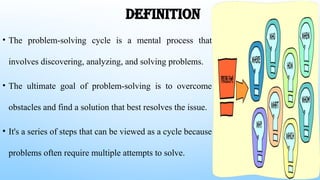
DEFINITION
• The problem-solving cycle is a mental process that
involves discovering, analyzing, and solving problems.
• The ultimate goal of problem-solving is to overcome
obstacles and find a solution that best resolves the issue.
• It's a series of steps that can be viewed as a cycle because
problems often require multiple attempts to solve.
STEPS OF PROBLEM SOLVING
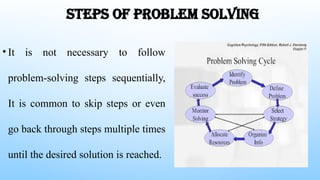
• It is not necessary to follow
problem-solving steps sequentially,
It is common to skip steps or even
go back through steps multiple times
until the desired solution is reached.
STEPS OF PROBLEM SOLVING
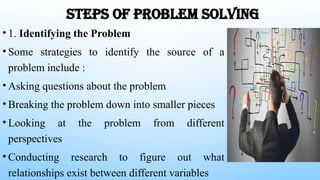
• 1. Identifying the Problem
• Some strategies to identify the source of a
problem include :
• Asking questions about the problem
• Breaking the problem down into smaller pieces
• Looking at the problem from different
perspectives
• Conducting research to figure out what
relationships exist between different variables
STEPS OF PROBLEM SOLVING
•2. Defining the Problem
•After the problem has been identified,
it is important to fully define the
problem so that it can be solved. State
the problem clearly and identify the
scope of the solution.
STEPS OF PROBLEM SOLVING
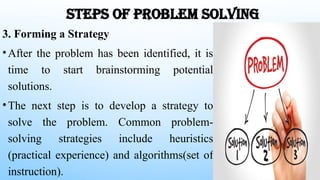
3. Forming a Strategy
•After the problem has been identified, it is
time to start brainstorming potential
solutions.
•The next step is to develop a strategy to
solve the problem. Common problem-
solving strategies include heuristics
(practical experience) and algorithms(set of
instruction).
STEPS OF PROBLEM SOLVING
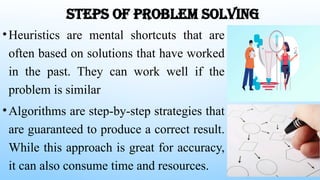
•Heuristics are mental shortcuts that are
often based on solutions that have worked
in the past. They can work well if the
problem is similar
•Algorithms are step-by-step strategies that
are guaranteed to produce a correct result.
While this approach is great for accuracy,
it can also consume time and resources.
STEPS OF PROBLEM SOLVING
4. Organizing Information
•Before coming up with a solution, you need
to first organize the available information.
•The more information that is available the
better preparation and an accurate solution.
•Collect all the data for solving a problem.
STEPS OF PROBLEM SOLVING
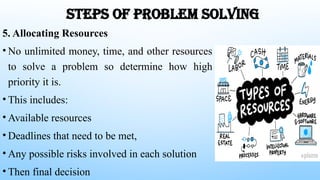
5. Allocating Resources
• No unlimited money, time, and other resources
to solve a problem so determine how high
priority it is.
• This includes:
• Available resources
• Deadlines that need to be met,
• Any possible risks involved in each solution
• Then final decision
STEPS OF PROBLEM SOLVING
6. Monitoring Progress
• After selecting a problem-solving method, put the plan into
action
• It involve trying out different solutions
• Monitor the situation after implementing a solution
• Ensure that no new problems have arisen as a result of the
proposed solution.
• Effective problem-solvers tend to monitor their progress as
they work towards a solution
• If no success with this solution, reevaluate their approach or
look for new strategies.
STEPS OF PROBLEM SOLVING
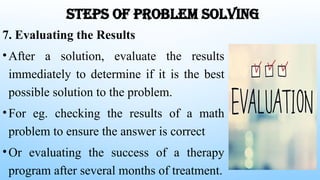
7. Evaluating the Results
•After a solution, evaluate the results
immediately to determine if it is the best
possible solution to the problem.
•For eg. checking the results of a math
problem to ensure the answer is correct
•Or evaluating the success of a therapy
program after several months of treatment.
Unit VI. 6. 6 A PROBLEM SOVING, DEFINITION, STEPS INVOLVED IN PROBLEM SOLVING.pptx

  • 1.
  • 2.
    DEFINITION • The problem-solvingcycle is a mental process that involves discovering, analyzing, and solving problems. • The ultimate goal of problem-solving is to overcome obstacles and find a solution that best resolves the issue. • It's a series of steps that can be viewed as a cycle because problems often require multiple attempts to solve.
  • 3.
    STEPS OF PROBLEMSOLVING • It is not necessary to follow problem-solving steps sequentially, It is common to skip steps or even go back through steps multiple times until the desired solution is reached.
  • 4.
    STEPS OF PROBLEMSOLVING • 1. Identifying the Problem • Some strategies to identify the source of a problem include : • Asking questions about the problem • Breaking the problem down into smaller pieces • Looking at the problem from different perspectives • Conducting research to figure out what relationships exist between different variables
  • 5.
    STEPS OF PROBLEMSOLVING •2. Defining the Problem •After the problem has been identified, it is important to fully define the problem so that it can be solved. State the problem clearly and identify the scope of the solution.
  • 6.
    STEPS OF PROBLEMSOLVING 3. Forming a Strategy •After the problem has been identified, it is time to start brainstorming potential solutions. •The next step is to develop a strategy to solve the problem. Common problem- solving strategies include heuristics (practical experience) and algorithms(set of instruction).
  • 7.
    STEPS OF PROBLEMSOLVING •Heuristics are mental shortcuts that are often based on solutions that have worked in the past. They can work well if the problem is similar •Algorithms are step-by-step strategies that are guaranteed to produce a correct result. While this approach is great for accuracy, it can also consume time and resources.
  • 8.
    STEPS OF PROBLEMSOLVING 4. Organizing Information •Before coming up with a solution, you need to first organize the available information. •The more information that is available the better preparation and an accurate solution. •Collect all the data for solving a problem.
  • 9.
    STEPS OF PROBLEMSOLVING 5. Allocating Resources • No unlimited money, time, and other resources to solve a problem so determine how high priority it is. • This includes: • Available resources • Deadlines that need to be met, • Any possible risks involved in each solution • Then final decision
  • 10.
    STEPS OF PROBLEMSOLVING 6. Monitoring Progress • After selecting a problem-solving method, put the plan into action • It involve trying out different solutions • Monitor the situation after implementing a solution • Ensure that no new problems have arisen as a result of the proposed solution. • Effective problem-solvers tend to monitor their progress as they work towards a solution • If no success with this solution, reevaluate their approach or look for new strategies.
  • 11.
    STEPS OF PROBLEMSOLVING 7. Evaluating the Results •After a solution, evaluate the results immediately to determine if it is the best possible solution to the problem. •For eg. checking the results of a math problem to ensure the answer is correct •Or evaluating the success of a therapy program after several months of treatment.