Astronomy and Astrophysics
Ms Dhivya R
Assistant Professor
Department of Physics
Sri Ramakrishna College of Arts and Science
Coimbatore - 641 006
Tamil Nadu, India
1
Unit I – Astronomical Instruments
 Light and its properties
 The Earth’s Atmosphere
 Electromagnetic Radiation
 Telescopes - Optical telescopes
 Types of Reflecting Telescopes
 The Refracting telescope
 Relative Advantages of Reflectors and
Refractors
 Radio telescopes
 The Hubble space telescope (HST)
2
Sri Ramakrishna College of Arts and Science
Light and its properties
 Light is the important source of information for an astronomer.
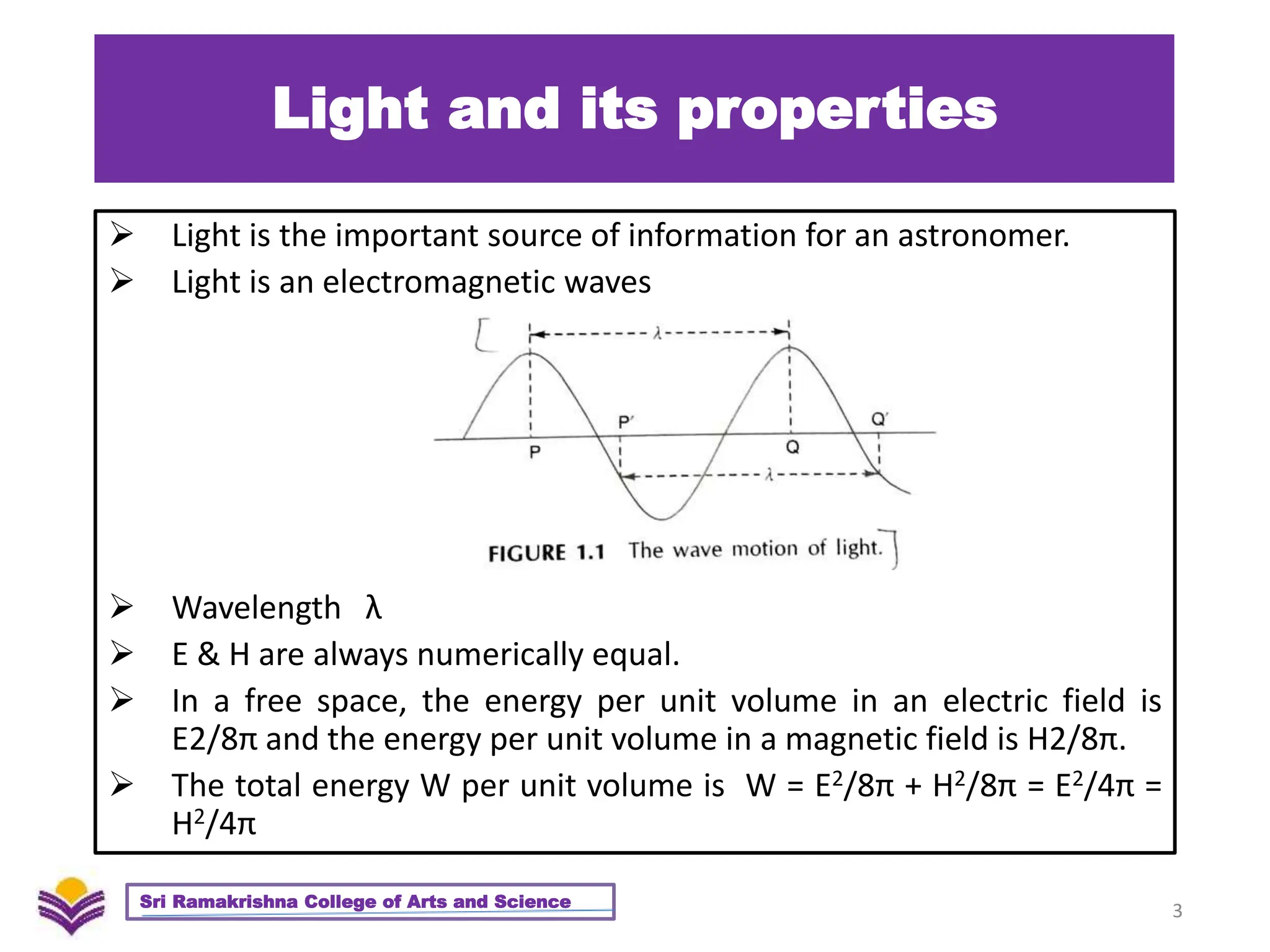
 Light is an electromagnetic waves
 Wavelength λ
 E & H are always numerically equal.
 In a free space, the energy per unit volume in an electric field is
E2/8π and the energy per unit volume in a magnetic field is H2/8π.
 The total energy W per unit volume is W = E2/8π + H2/8π = E2/4π =
H2/4π
3
Sri Ramakrishna College of Arts and Science
Light and its properties
 The intensity of the EM radiation at any point in space is defined as
energy the flows per unit time per unit area perpendicular to the
direction of propagation.
 I= cE2/4π = cH2/4π
 The number of oscillations in unit time of E and H at a given point is
called frequency
λν = c
 The numerical value of ν is very high. It is 6 x 10¹⁴ for green light.
 Monochromatic
 Reflection – smooth surface – regular
 Reflection – rough surface – reflected irregularly - diffused
 Reflectivity - ratio of the energy associated with reflected radiation
to the incident radiation
 “Albedo” reflectivity from an astronomical body
4
Sri Ramakrishna College of Arts and Science
Light and its properties
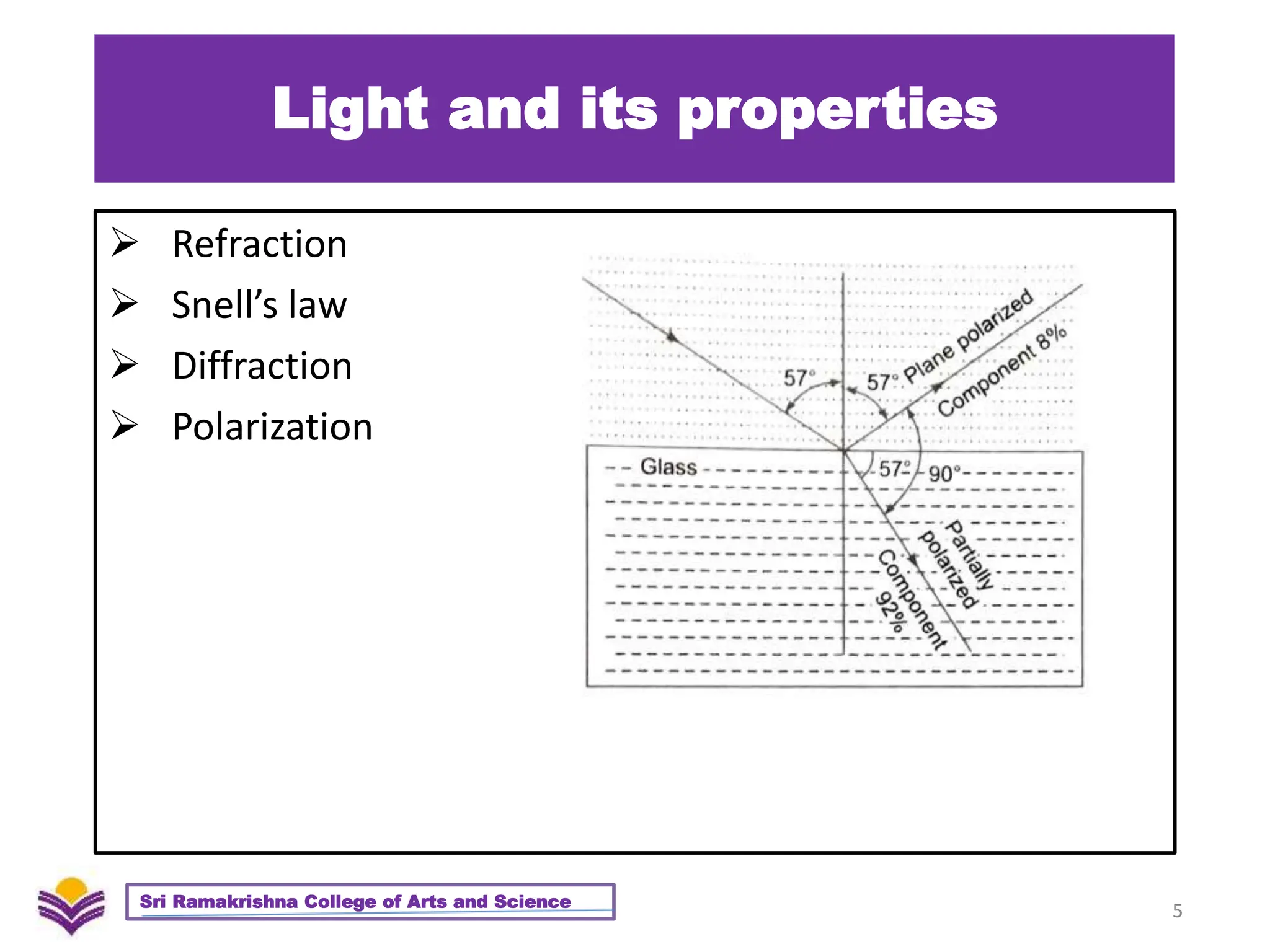
 Refraction
 Snell’s law
 Diffraction
 Polarization
5
Sri Ramakrishna College of Arts and Science
Ancient Astronomical
Instruments
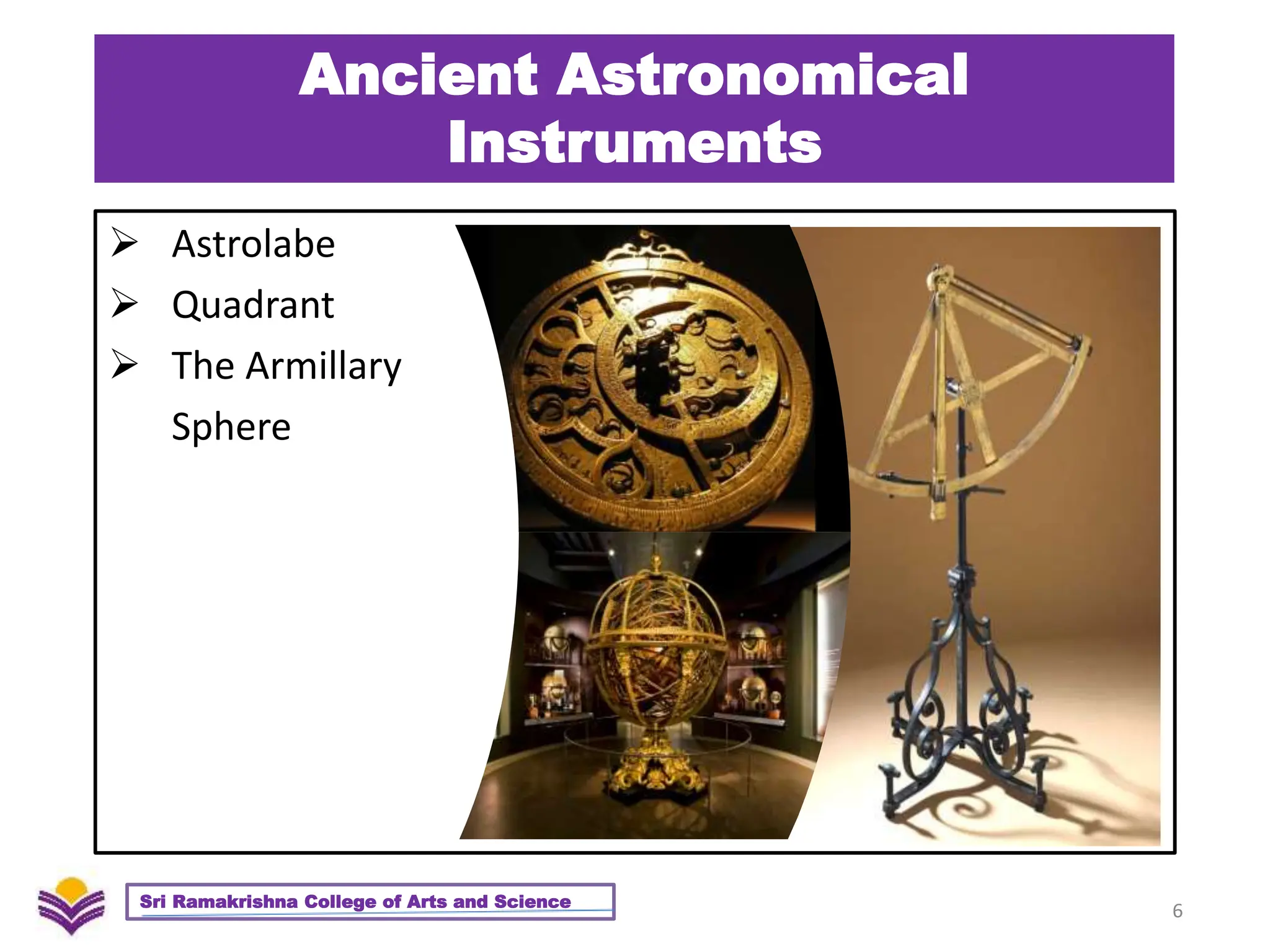
 Astrolabe
 Quadrant
 The Armillary
Sphere
6
Sri Ramakrishna College of Arts and Science
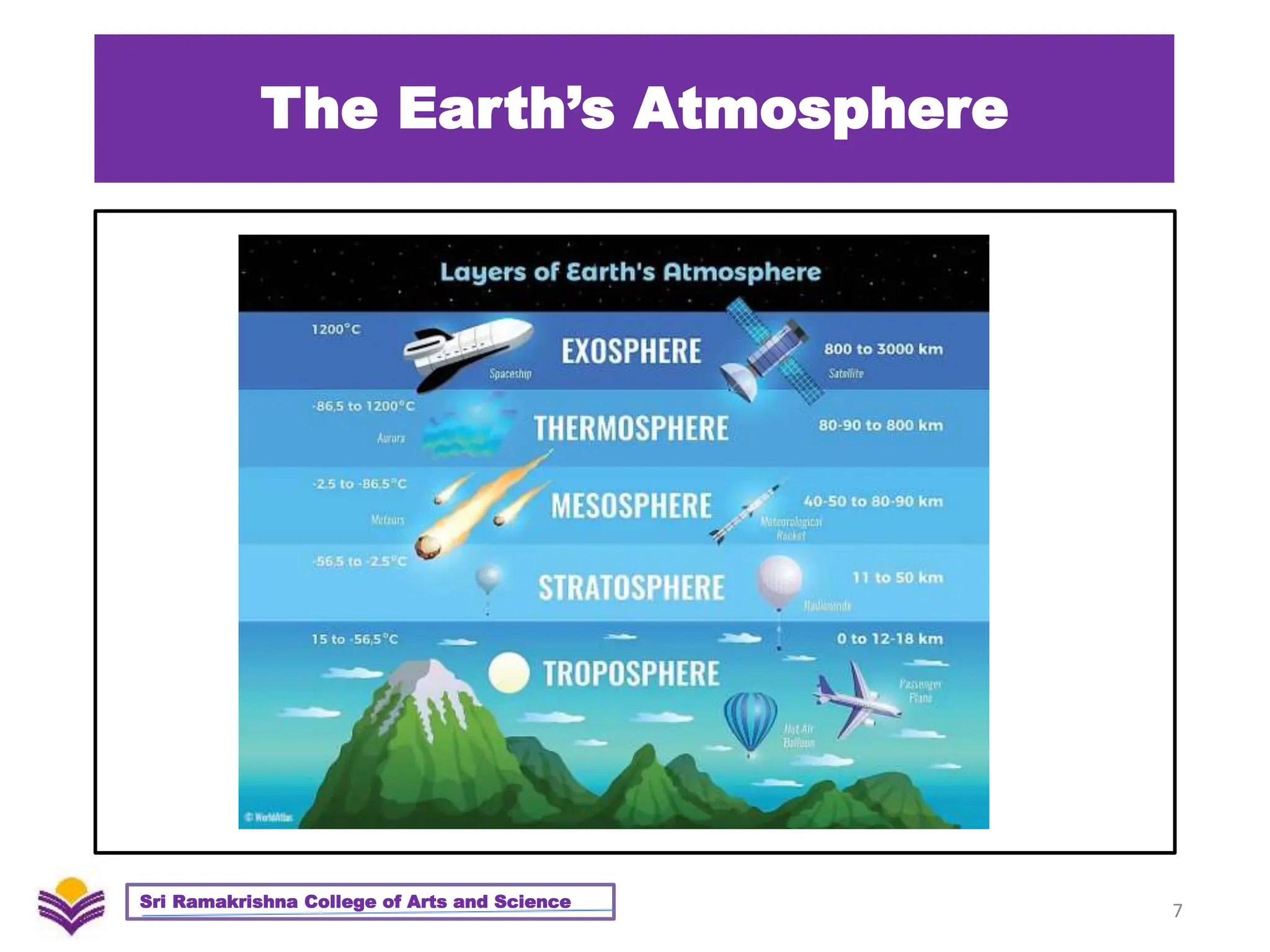
The Earth’s Atmosphere
7
Sri Ramakrishna College of Arts and Science
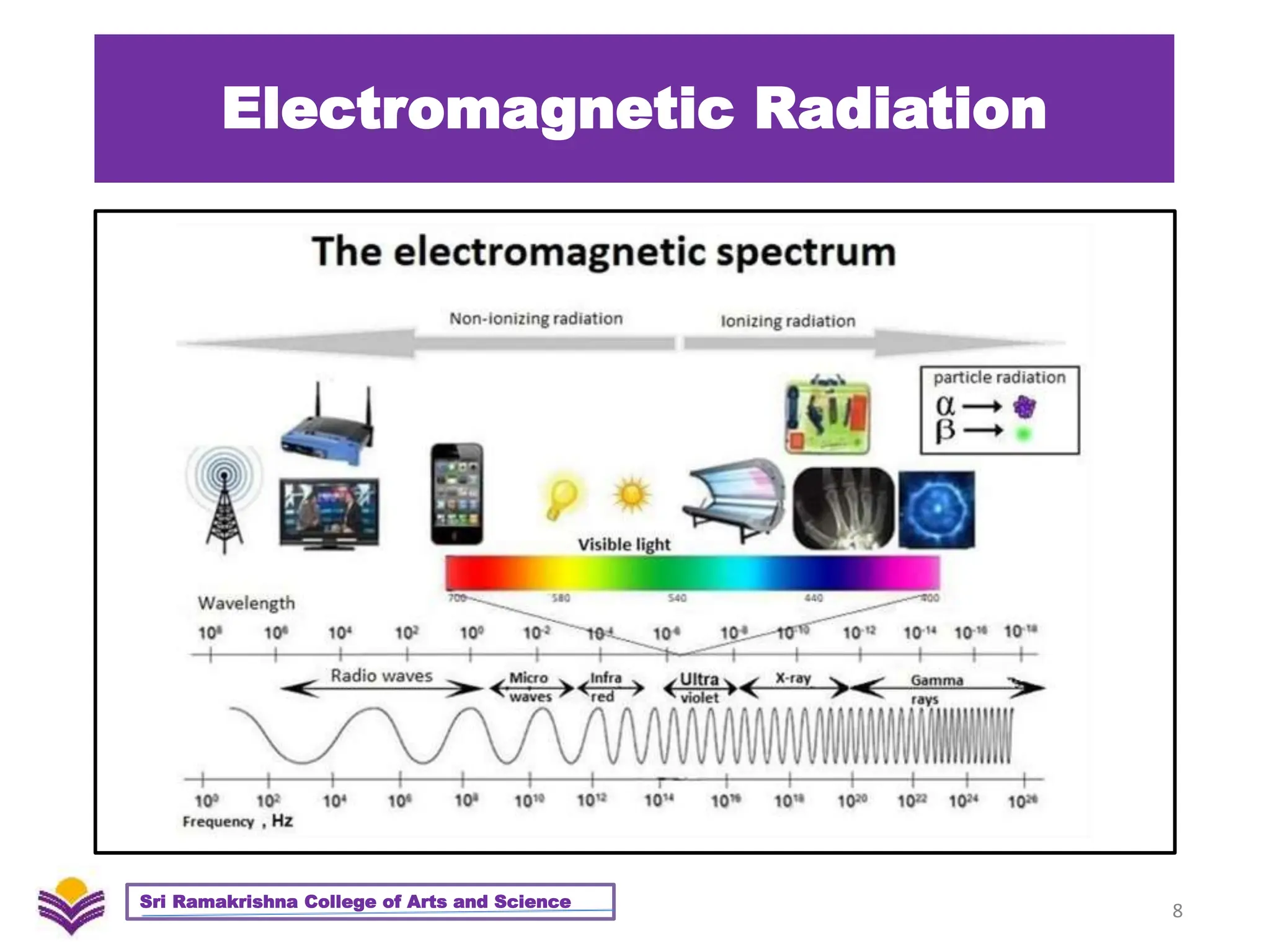
Electromagnetic Radiation
8
Sri Ramakrishna College of Arts and Science
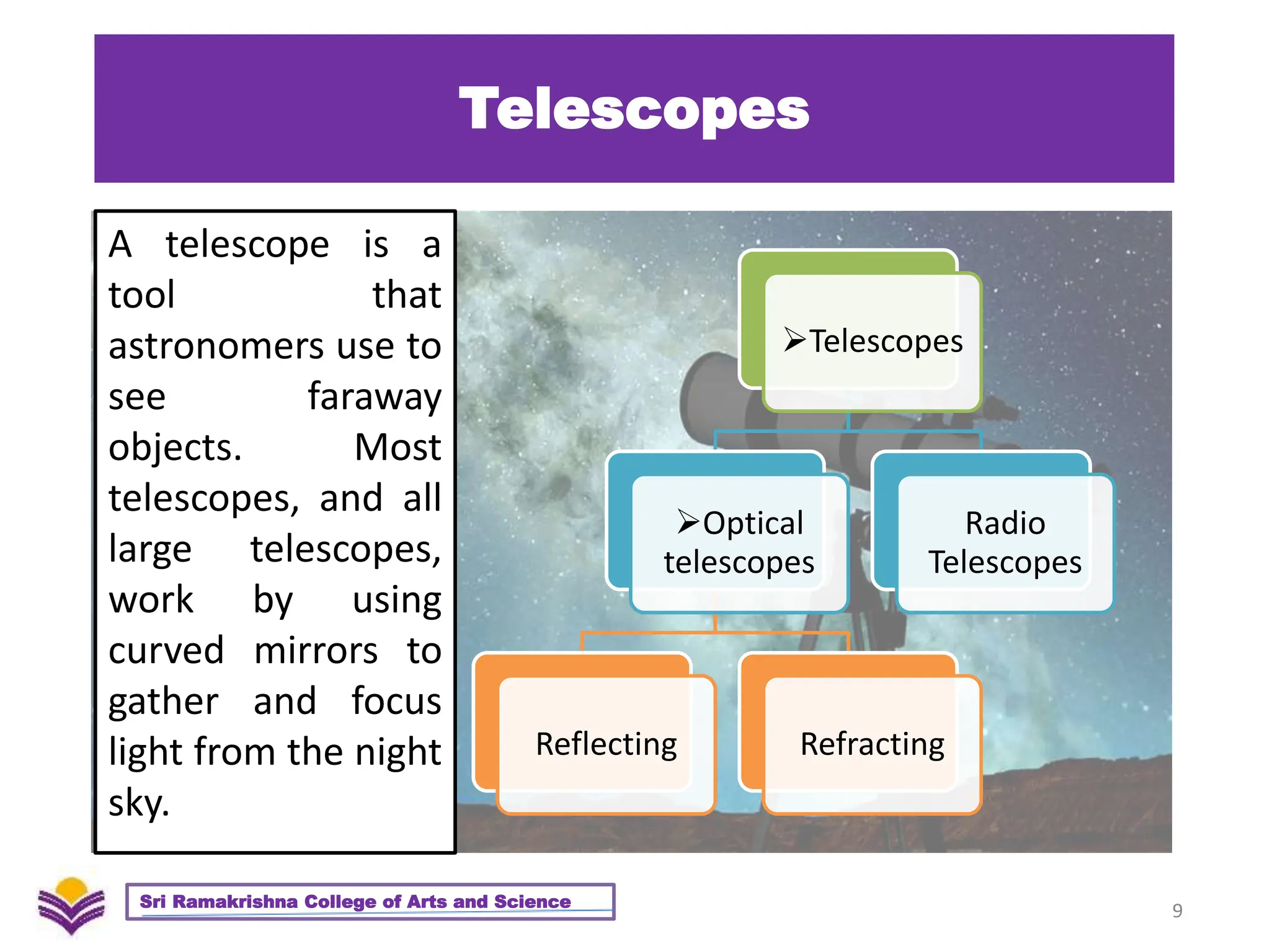
Telescopes
A telescope is a
tool that
astronomers use to
see faraway
objects. Most
telescopes, and all
large telescopes,
work by using
curved mirrors to
gather and focus
light from the night
sky.
9
Sri Ramakrishna College of Arts and Science
Telescopes
Optical
telescopes
Reflecting Refracting
Radio
Telescopes
Optical Telescopes
 Telescopes which are used for observation in the optical
wavelengths of the electromagnetic spectrum are known as
optical telescopes.
 Two types of optical telescope
 Reflecting telescopes (largest telescopes in the world)
 Refracting telescopes (general use and small in size)
 The fundamental principles is the same for both the
telescopes.
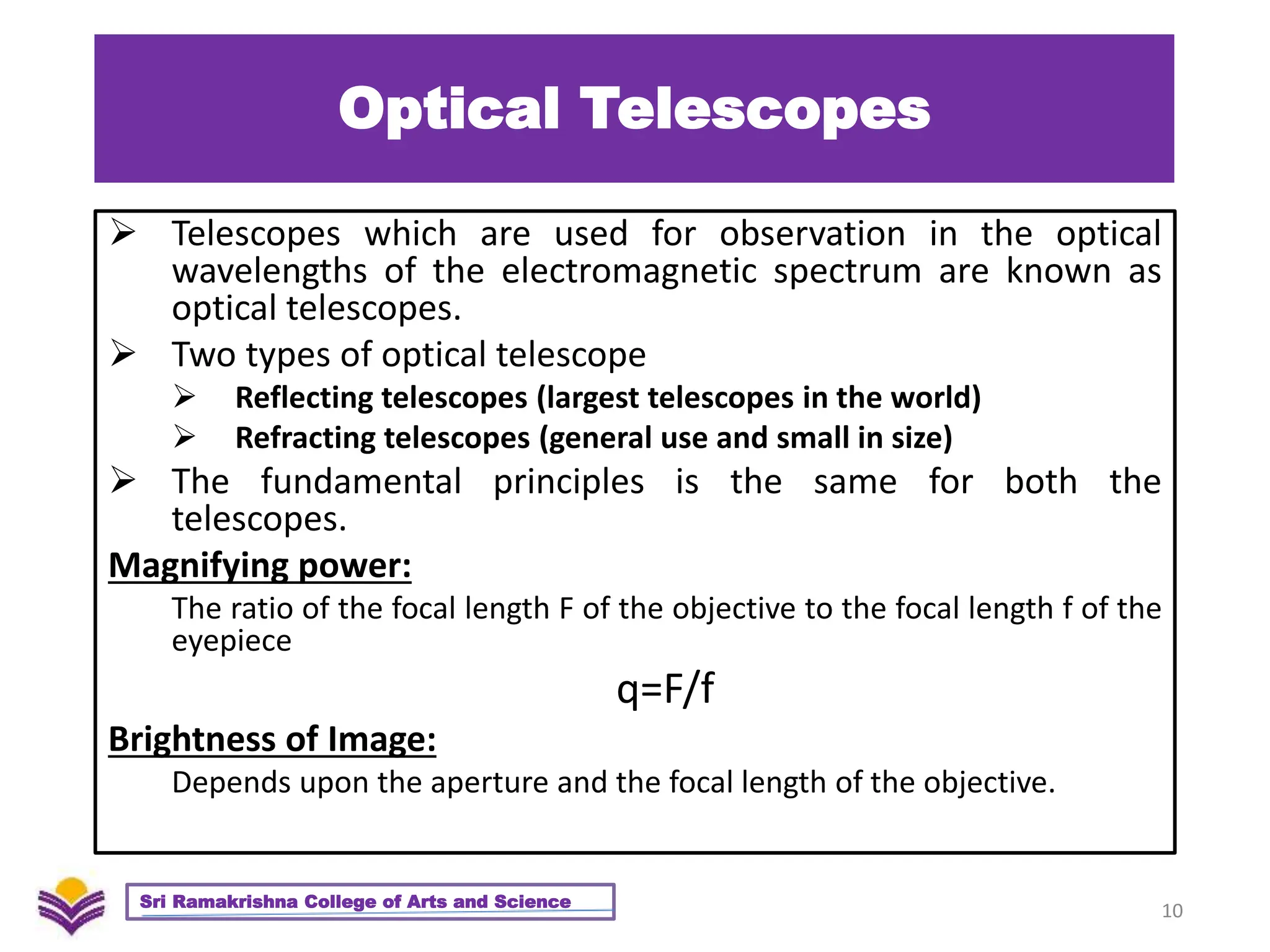
Magnifying power:
The ratio of the focal length F of the objective to the focal length f of the
eyepiece
q=F/f
Brightness of Image:
Depends upon the aperture and the focal length of the objective.
10
Sri Ramakrishna College of Arts and Science
Types of Reflecting Telescopes
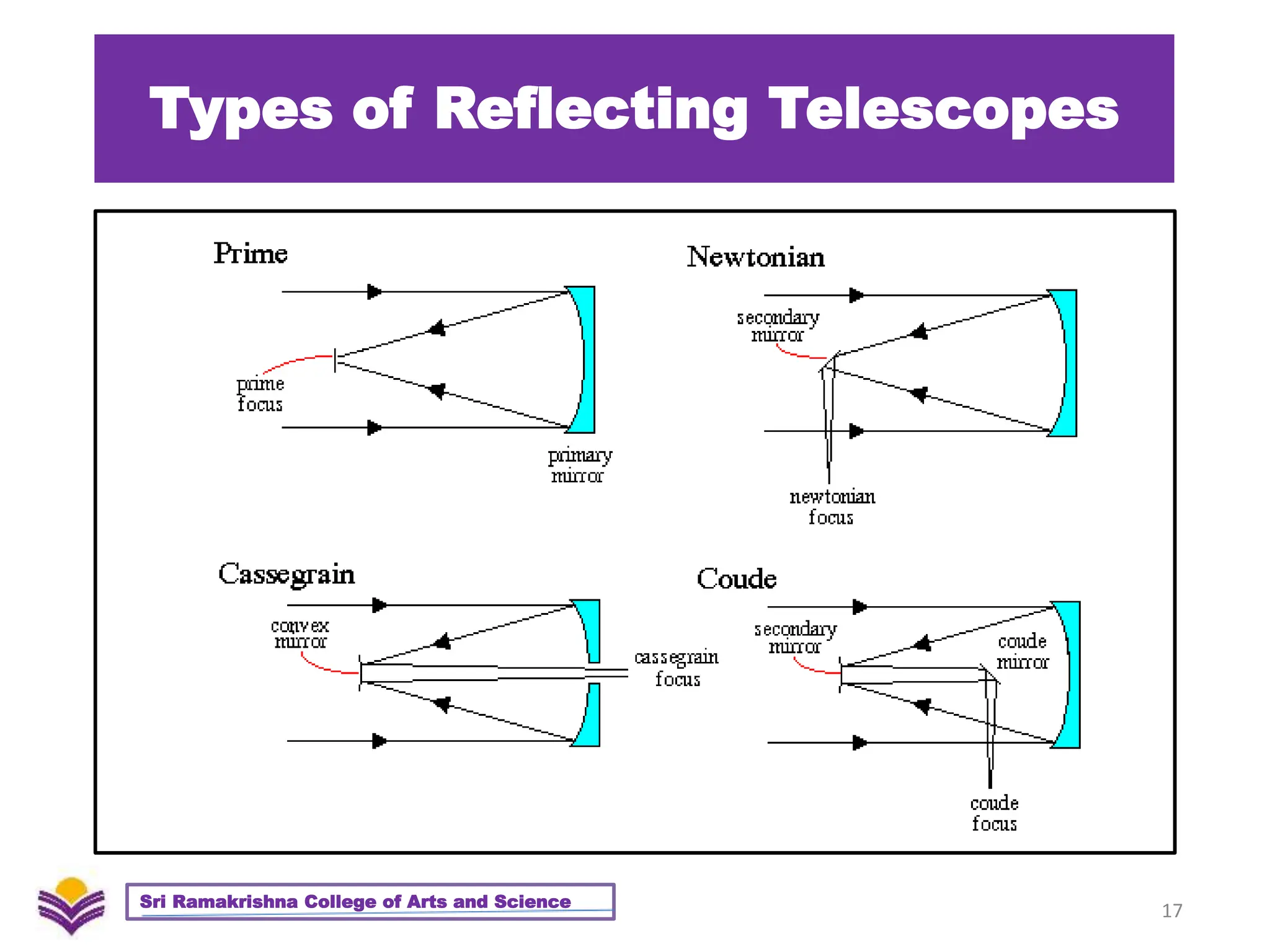
 There are 3 main types of reflecting telescopes.
 Newtonians,
 Cassegrains, and
 Coude Foci
 They all share many things in common like the use of
mirrors instead of lenses, but their designs vary.
 Reflecting telescopes are known for being powerful
because of their high apertures and being budget friendly
because of the materials they use and how easy they are
to manufacture
11
Sri Ramakrishna College of Arts and Science
Newtonian Reflecting Telescopes
Characteristics of reflecting telescopes
 Reflecting telescopes were invented by Isaac Newton in the 17th
century. The big innovation they had over the telescopes at the time
is they used mirrors instead of lenses to reflect the light – hence the
name – instead of refracting it into a single point. This allowed for
much bigger telescopes that also fixed chromatic aberrations (wrong
colors and colored rings around the objects).
 One important note about reflectors is that they require more
maintenance than other types of telescopes. Because of their open
design, some dust will inevitably enter the tube. This means the
interior and the primary mirror need to be cleaned regularly.
 With regular use, the mirrors also tend to move a little, so once
every few months, reflectors need to be re-aligned. This process is
called collimation, and while it is simple once you get the hang of it,
it can seem intimidating for beginners. Collimating a telescope can
take anywhere from 5 minutes to 1 hour depending on the type of
reflector.
12
Sri Ramakrishna College of Arts and Science
Newtonian Reflecting Telescopes
Characteristics of Newtonians
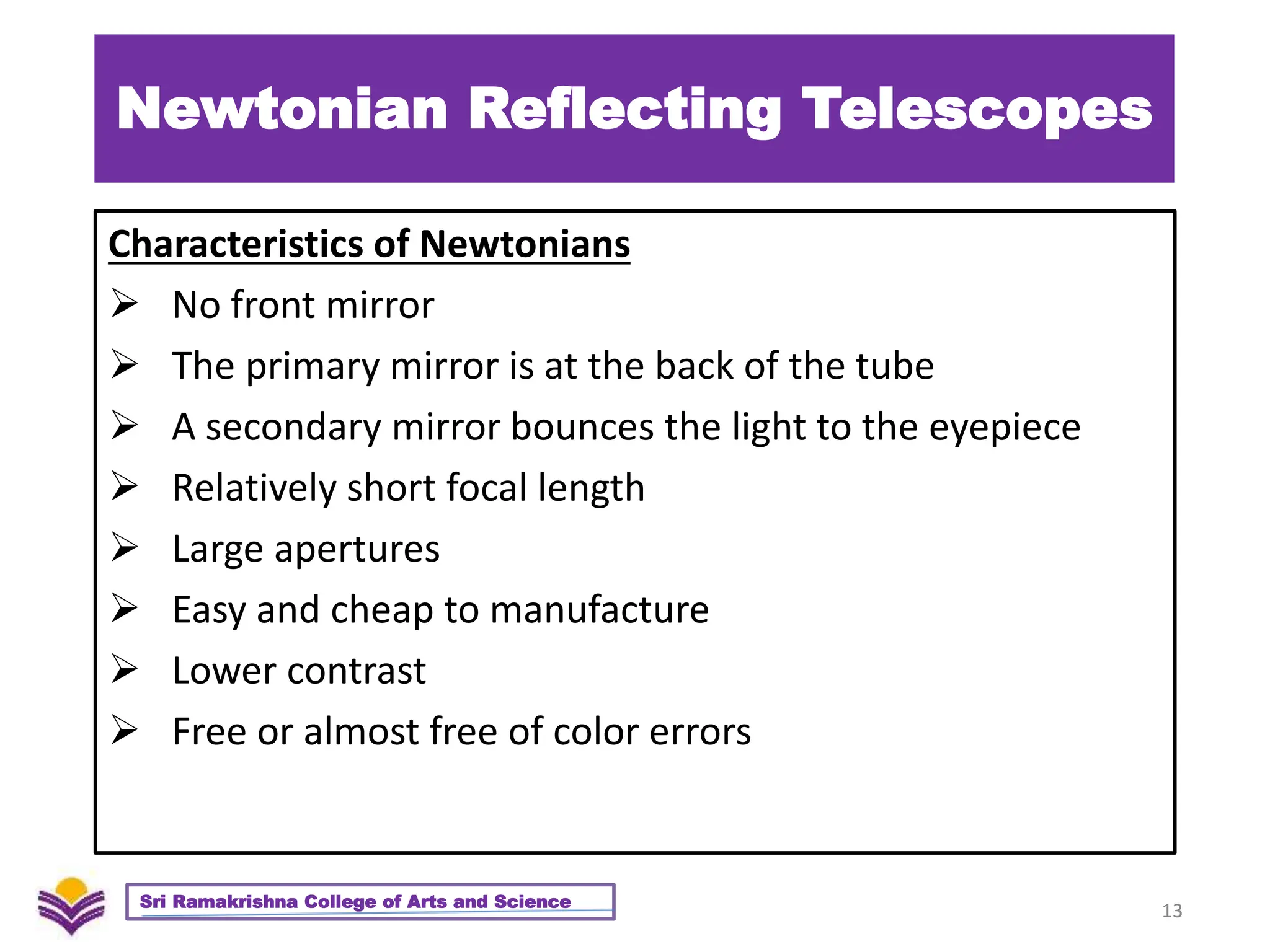
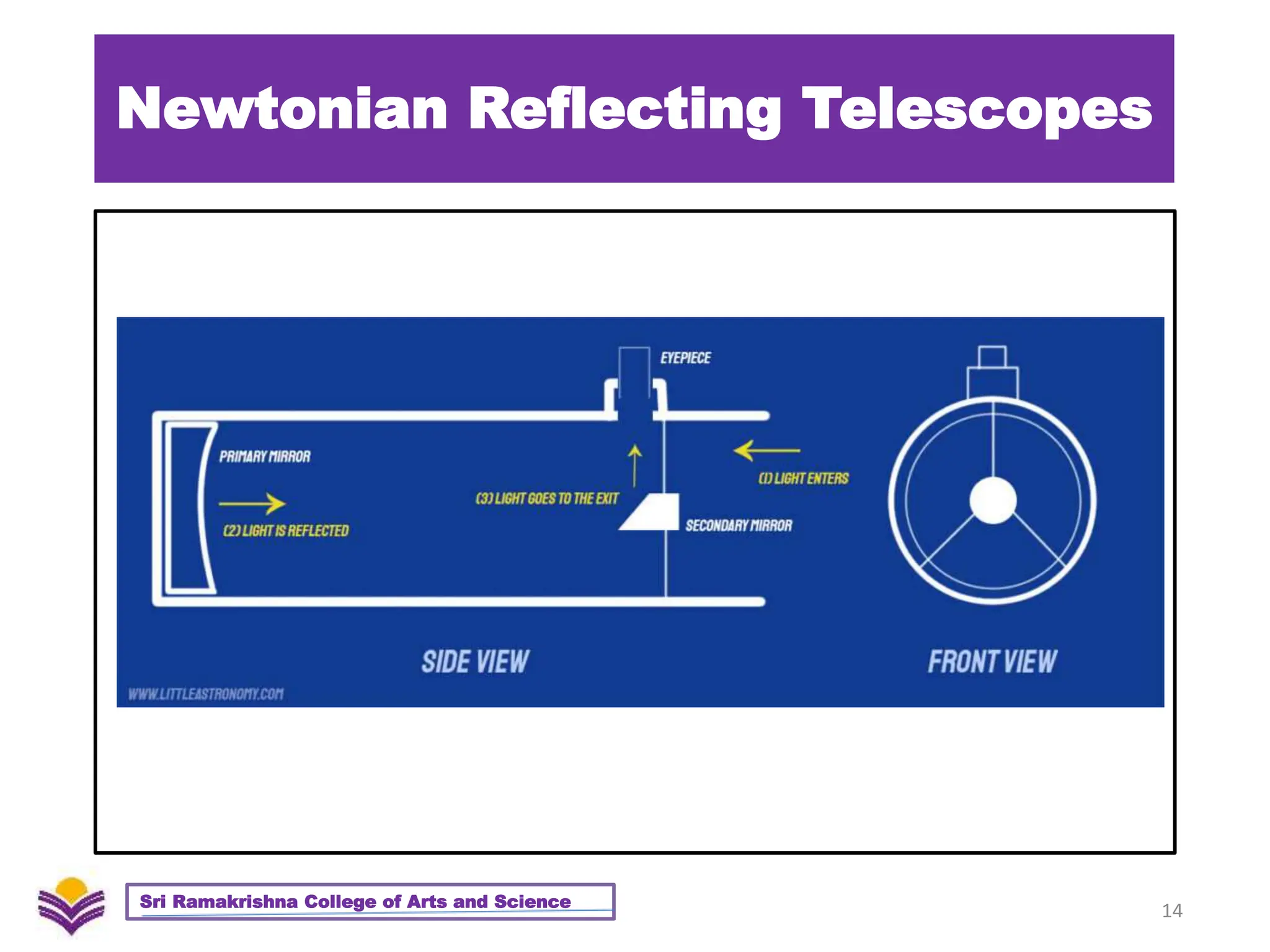
 No front mirror
 The primary mirror is at the back of the tube
 A secondary mirror bounces the light to the eyepiece
 Relatively short focal length
 Large apertures
 Easy and cheap to manufacture
 Lower contrast
 Free or almost free of color errors
13
Sri Ramakrishna College of Arts and Science
Newtonian Reflecting Telescopes
14
Sri Ramakrishna College of Arts and Science
Cassegrains Reflecting
Telescopes
15
Sri Ramakrishna College of Arts and Science
Coude Foci Reflecting Telescopes
16
Sri Ramakrishna College of Arts and Science
Types of Reflecting Telescopes
17
Sri Ramakrishna College of Arts and Science
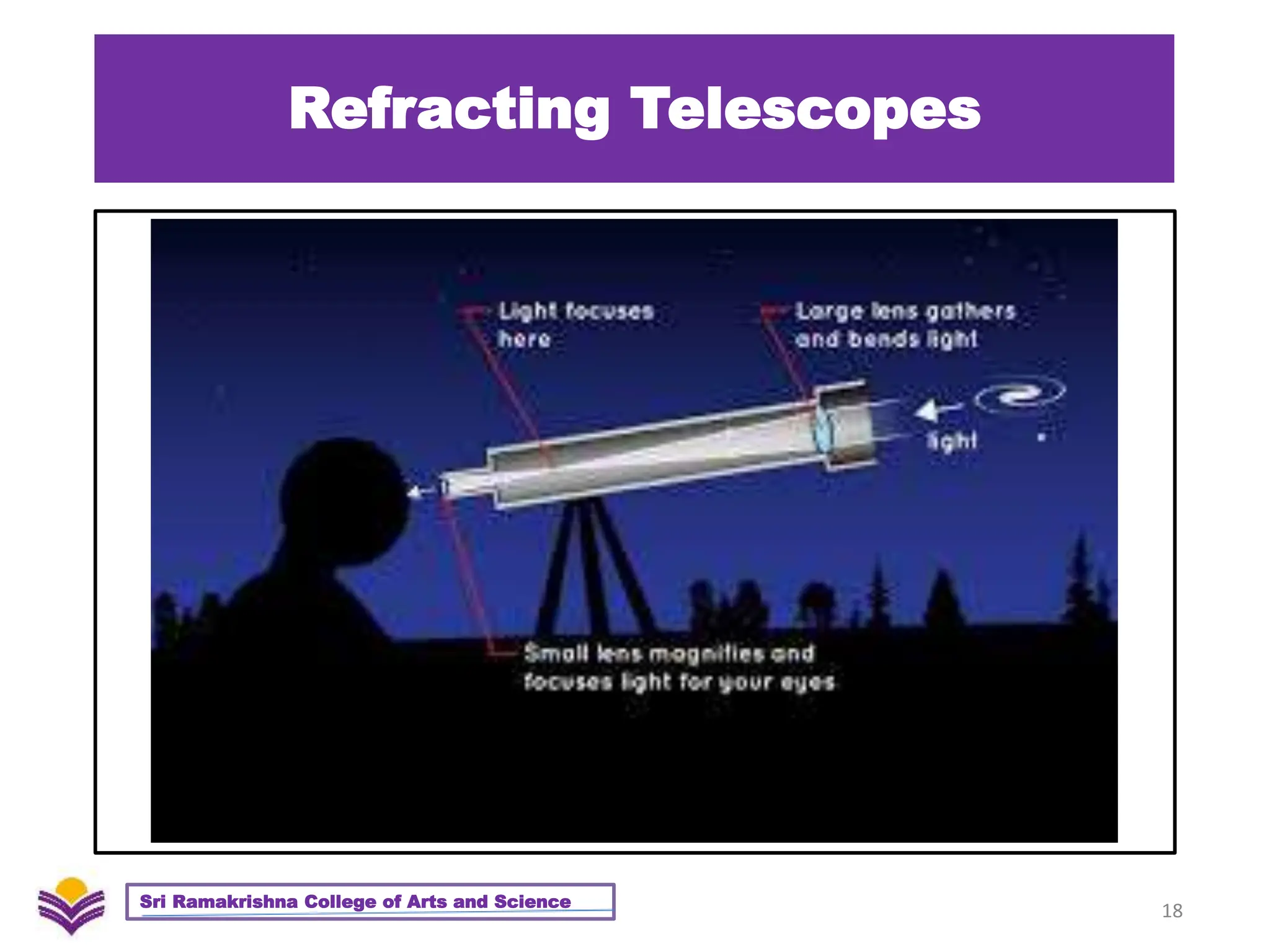
Refracting Telescopes
18
Sri Ramakrishna College of Arts and Science
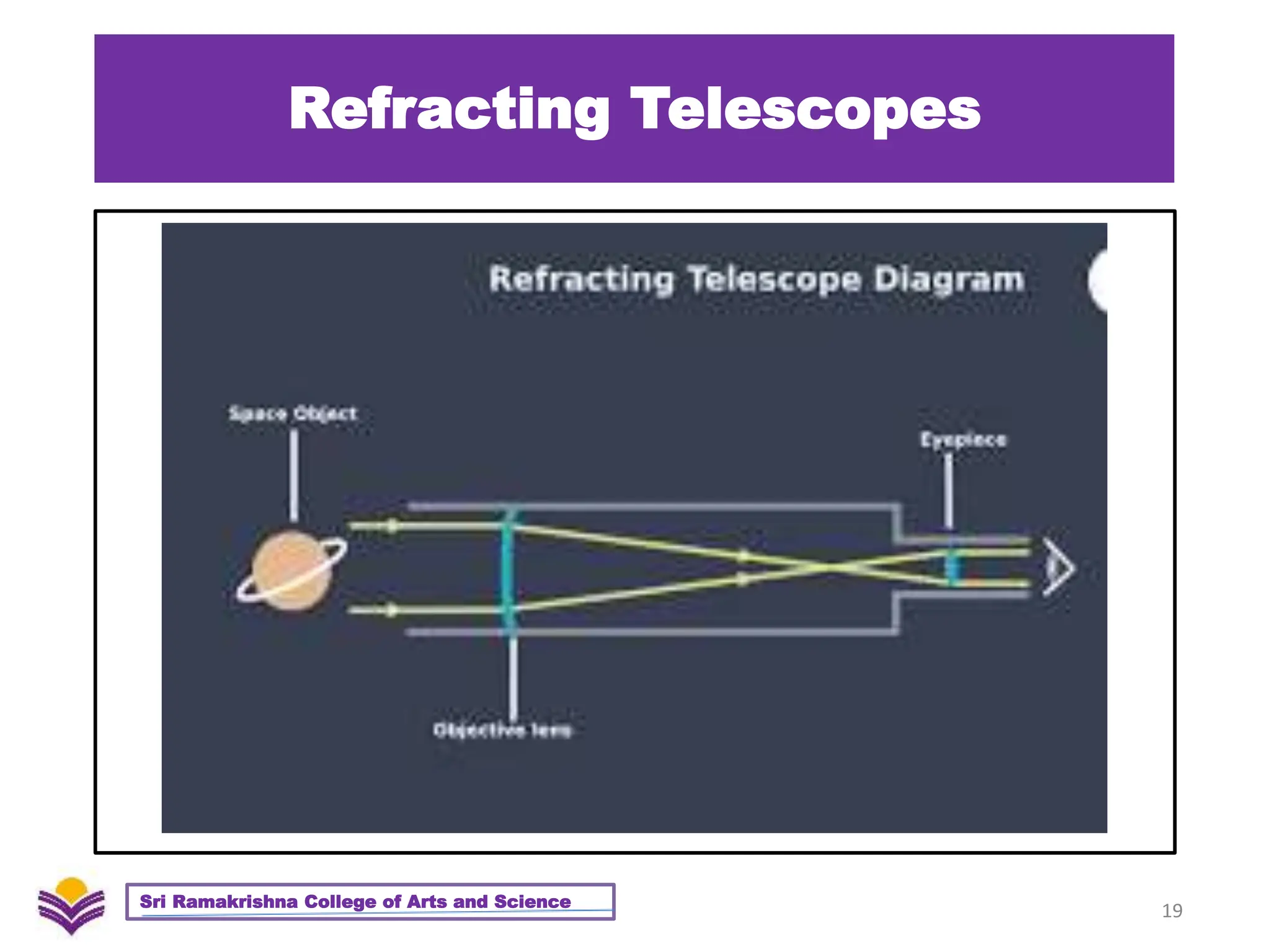
Refracting Telescopes
19
Sri Ramakrishna College of Arts and Science
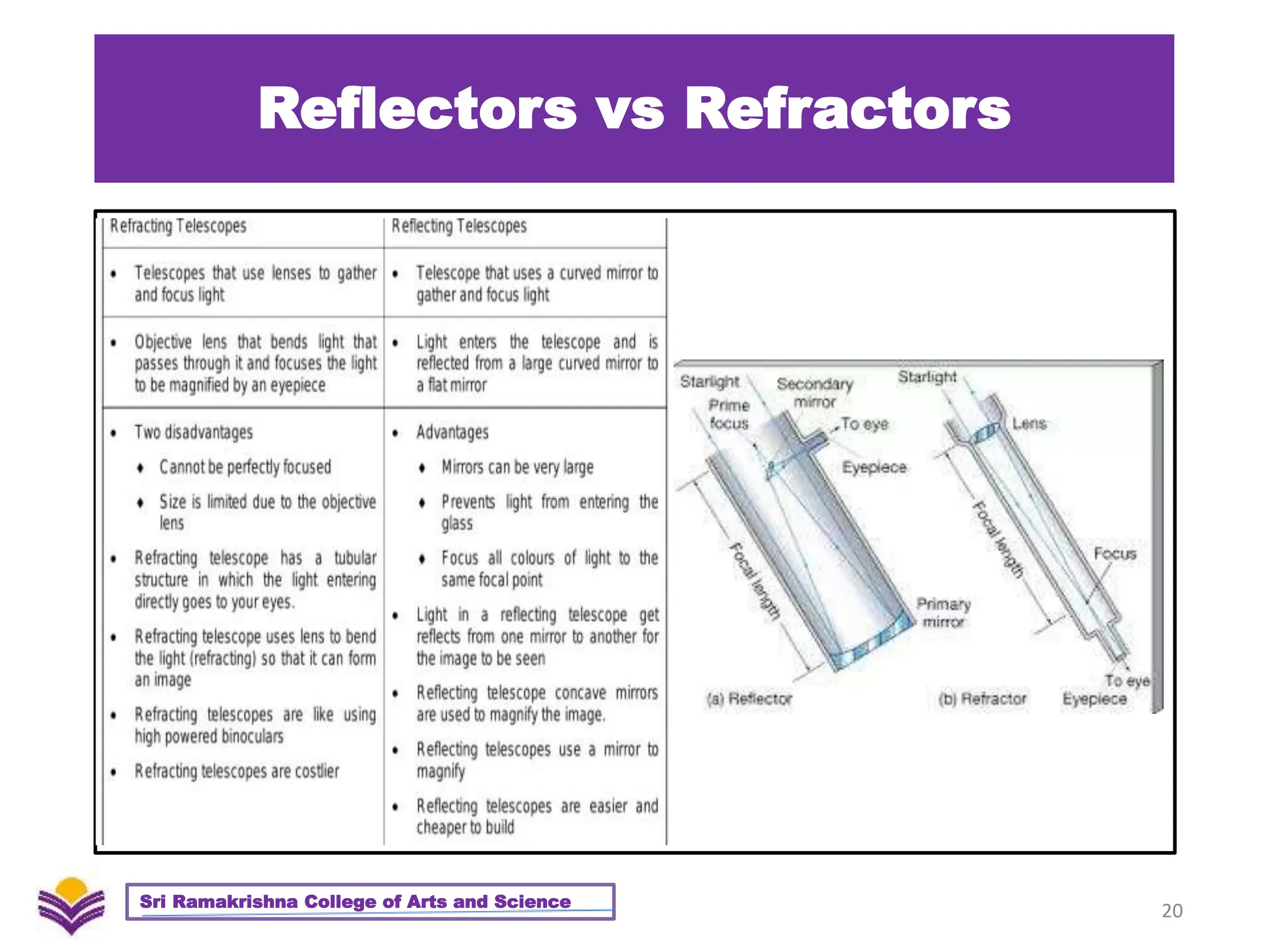
Reflectors vs Refractors
20
Sri Ramakrishna College of Arts and Science
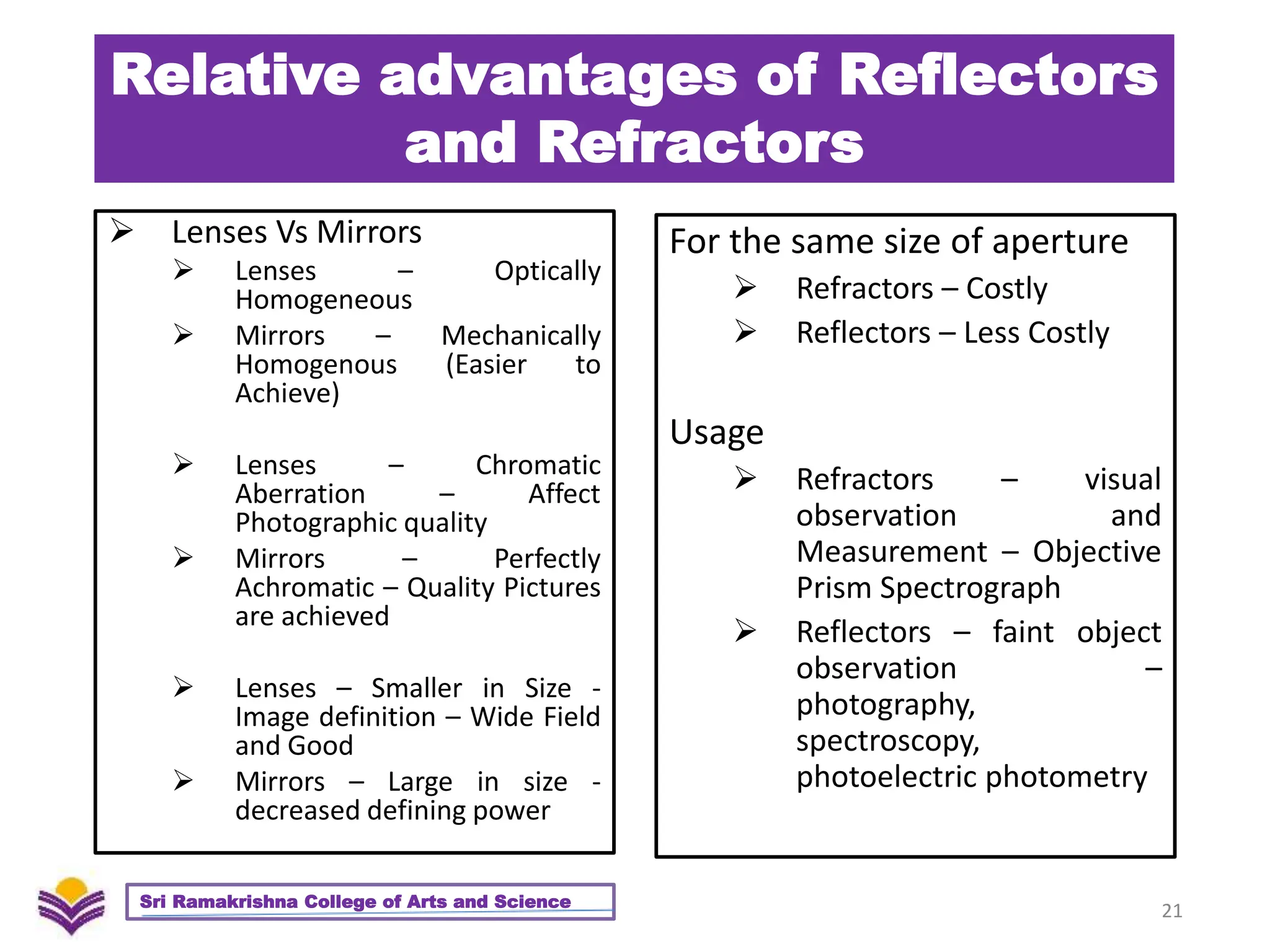
Relative advantages of Reflectors
and Refractors
 Lenses Vs Mirrors
 Lenses – Optically
Homogeneous
 Mirrors – Mechanically
Homogenous (Easier to
Achieve)
 Lenses – Chromatic
Aberration – Affect
Photographic quality
 Mirrors – Perfectly
Achromatic – Quality Pictures
are achieved
 Lenses – Smaller in Size -
Image definition – Wide Field
and Good
 Mirrors – Large in size -
decreased defining power
21
Sri Ramakrishna College of Arts and Science
For the same size of aperture
 Refractors – Costly
 Reflectors – Less Costly
Usage
 Refractors – visual
observation and
Measurement – Objective
Prism Spectrograph
 Reflectors – faint object
observation –
photography,
spectroscopy,
photoelectric photometry
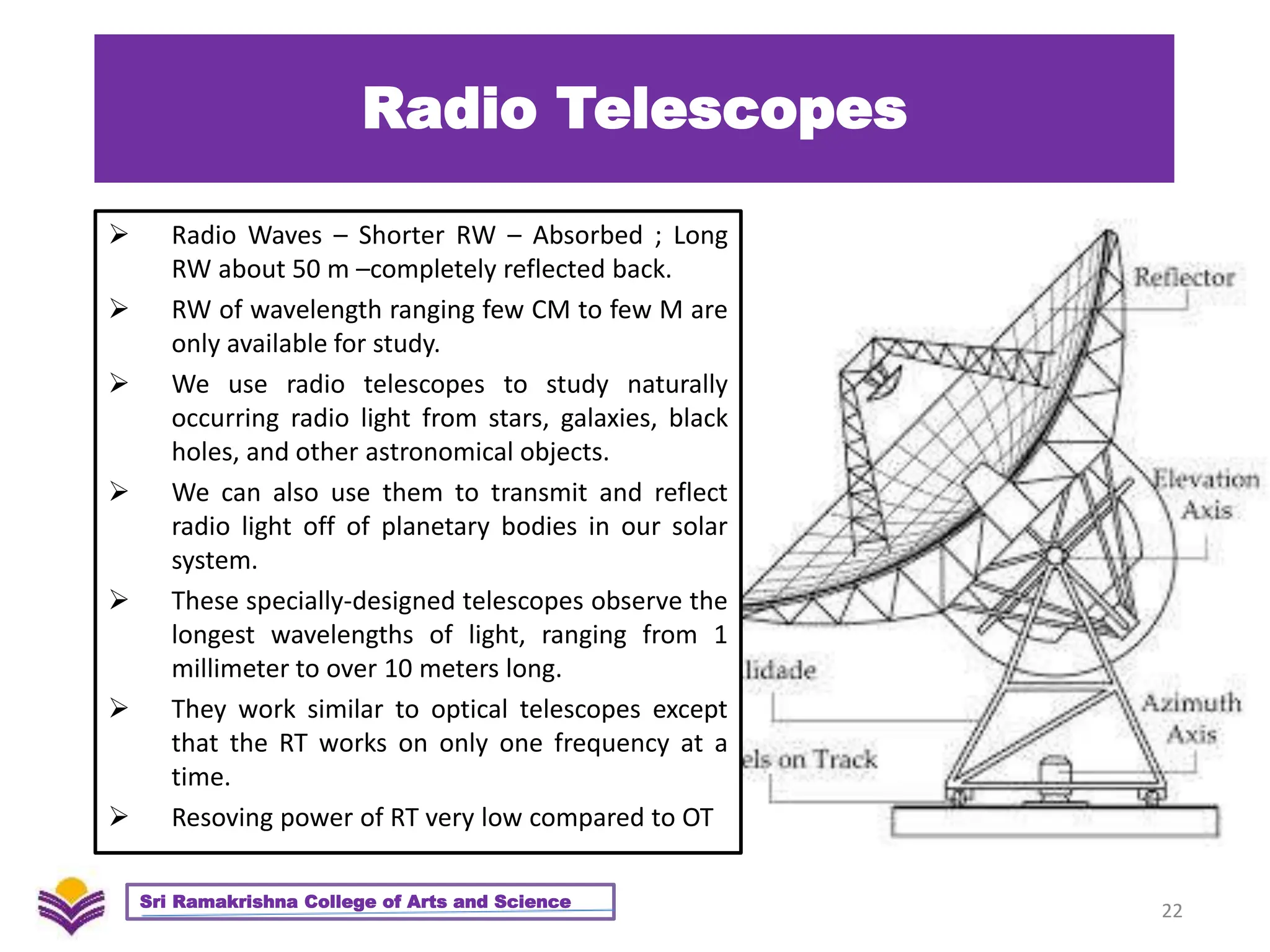
Radio Telescopes
 Radio Waves – Shorter RW – Absorbed ; Long
RW about 50 m –completely reflected back.
 RW of wavelength ranging few CM to few M are
only available for study.
 We use radio telescopes to study naturally
occurring radio light from stars, galaxies, black
holes, and other astronomical objects.
 We can also use them to transmit and reflect
radio light off of planetary bodies in our solar
system.
 These specially-designed telescopes observe the
longest wavelengths of light, ranging from 1
millimeter to over 10 meters long.
 They work similar to optical telescopes except
that the RT works on only one frequency at a
time.
 Resoving power of RT very low compared to OT
22
Sri Ramakrishna College of Arts and Science
Radio Telescopes
23
Sri Ramakrishna College of Arts and Science
Radio Telescopes
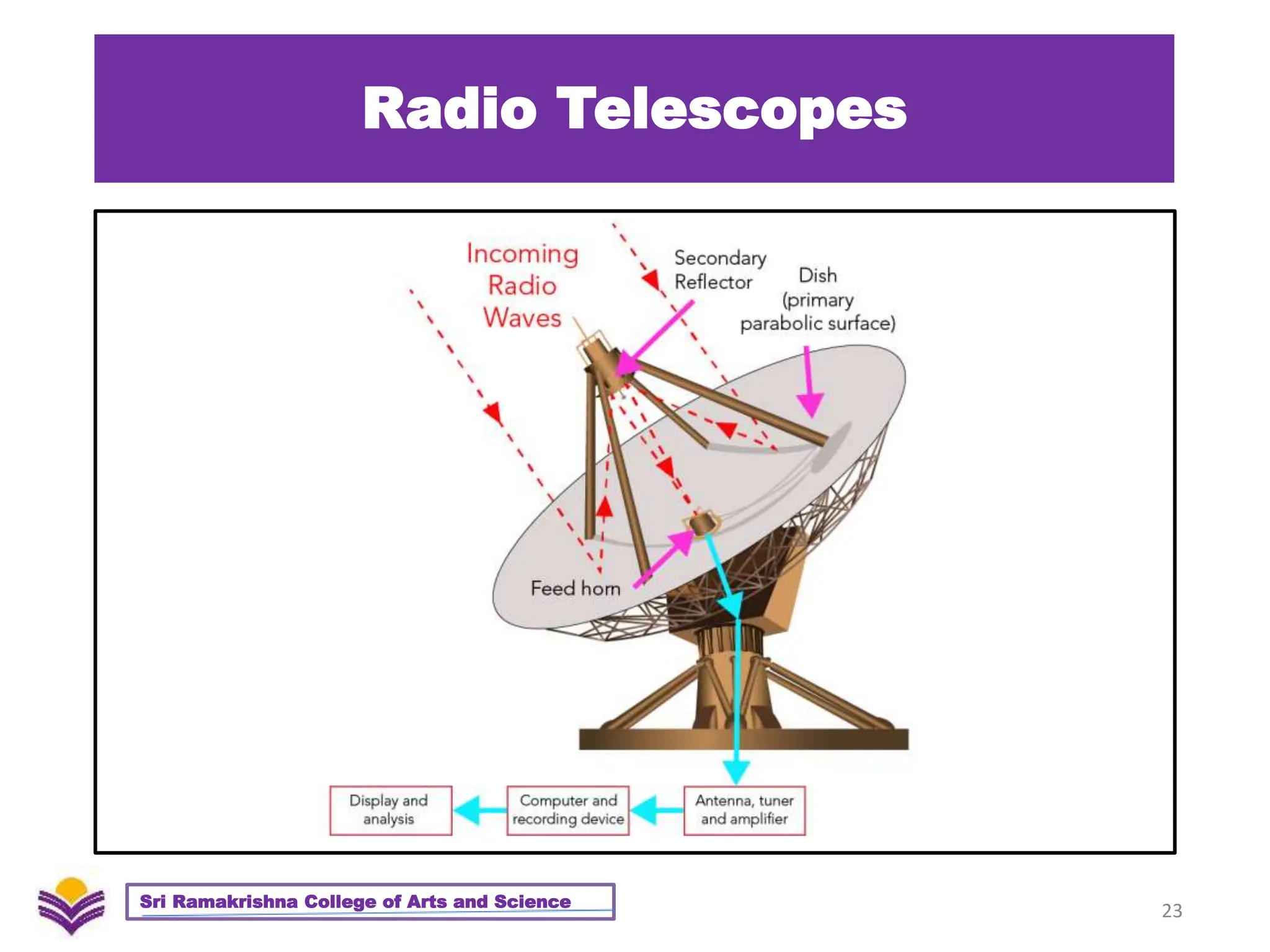
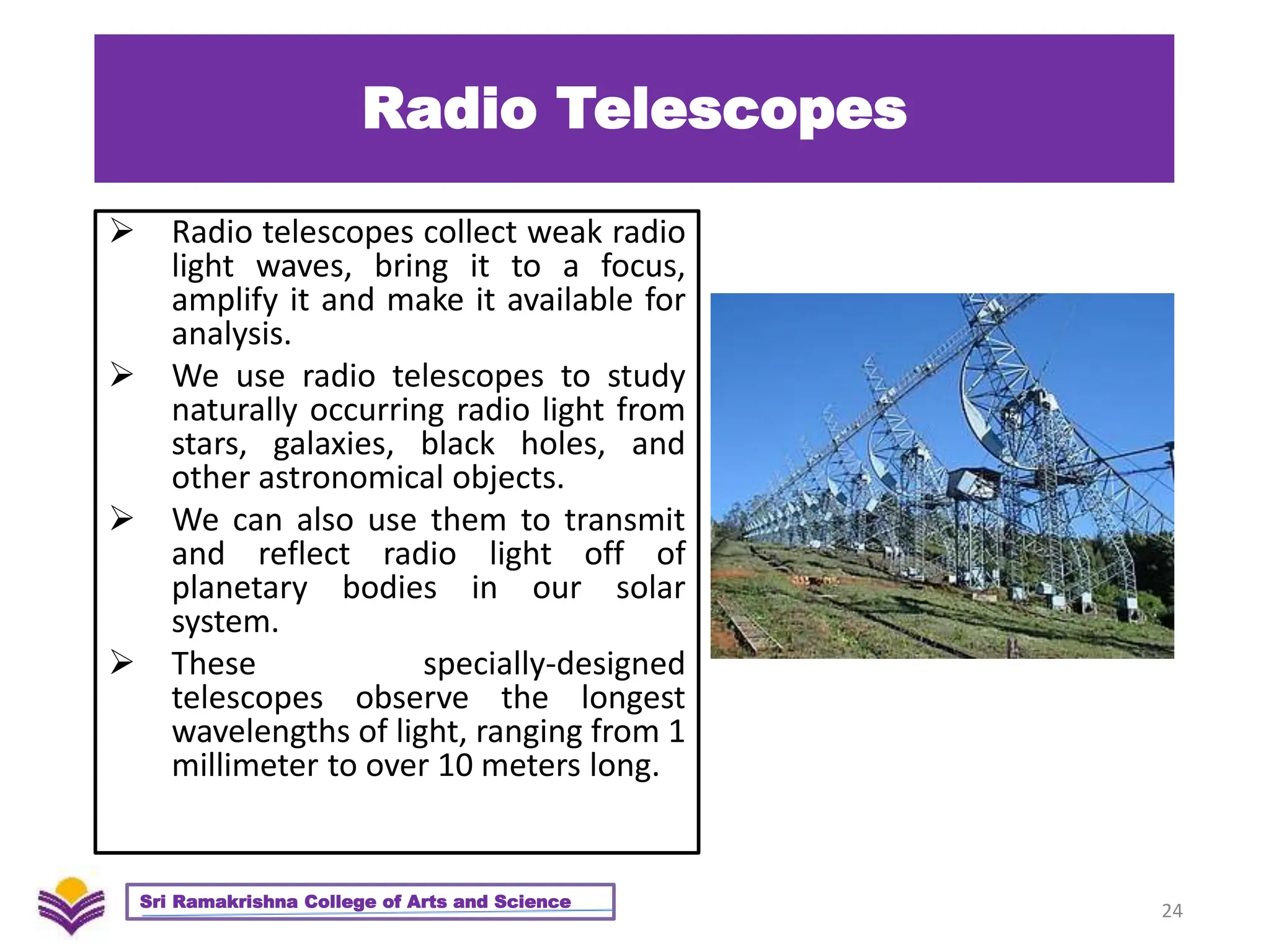
 Radio telescopes collect weak radio
light waves, bring it to a focus,
amplify it and make it available for
analysis.
 We use radio telescopes to study
naturally occurring radio light from
stars, galaxies, black holes, and
other astronomical objects.
 We can also use them to transmit
and reflect radio light off of
planetary bodies in our solar
system.
 These specially-designed
telescopes observe the longest
wavelengths of light, ranging from 1
millimeter to over 10 meters long.
24
Sri Ramakrishna College of Arts and Science
Radio Telescopes in India
25
Sri Ramakrishna College of Arts and Science
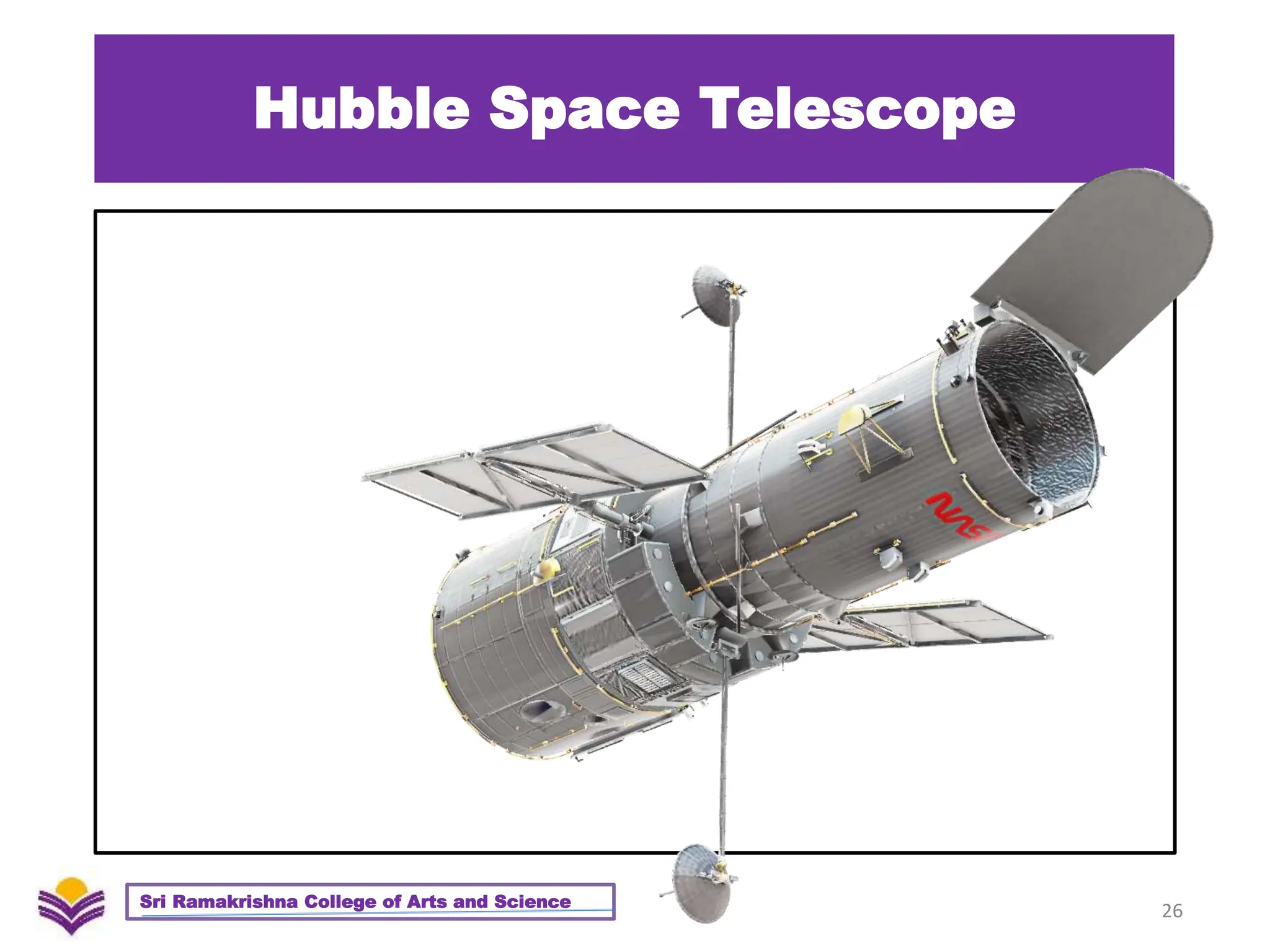
Hubble Space Telescope
26
Sri Ramakrishna College of Arts and Science
Hubble Space Telescope
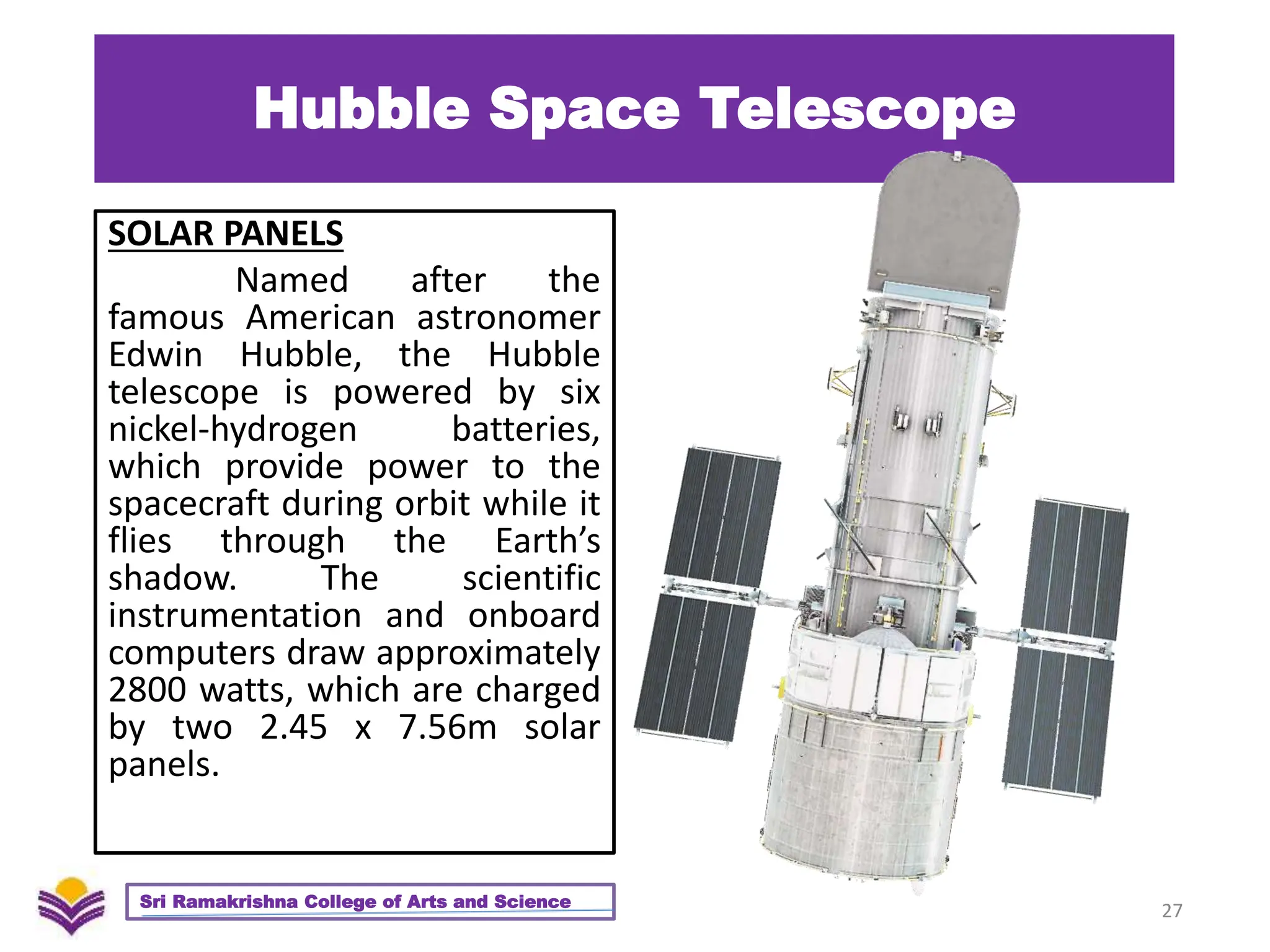
SOLAR PANELS
Named after the
famous American astronomer
Edwin Hubble, the Hubble
telescope is powered by six
nickel-hydrogen batteries,
which provide power to the
spacecraft during orbit while it
flies through the Earth’s
shadow. The scientific
instrumentation and onboard
computers draw approximately
2800 watts, which are charged
by two 2.45 x 7.56m solar
panels.
27
Sri Ramakrishna College of Arts and Science
Hubble Space Telescope
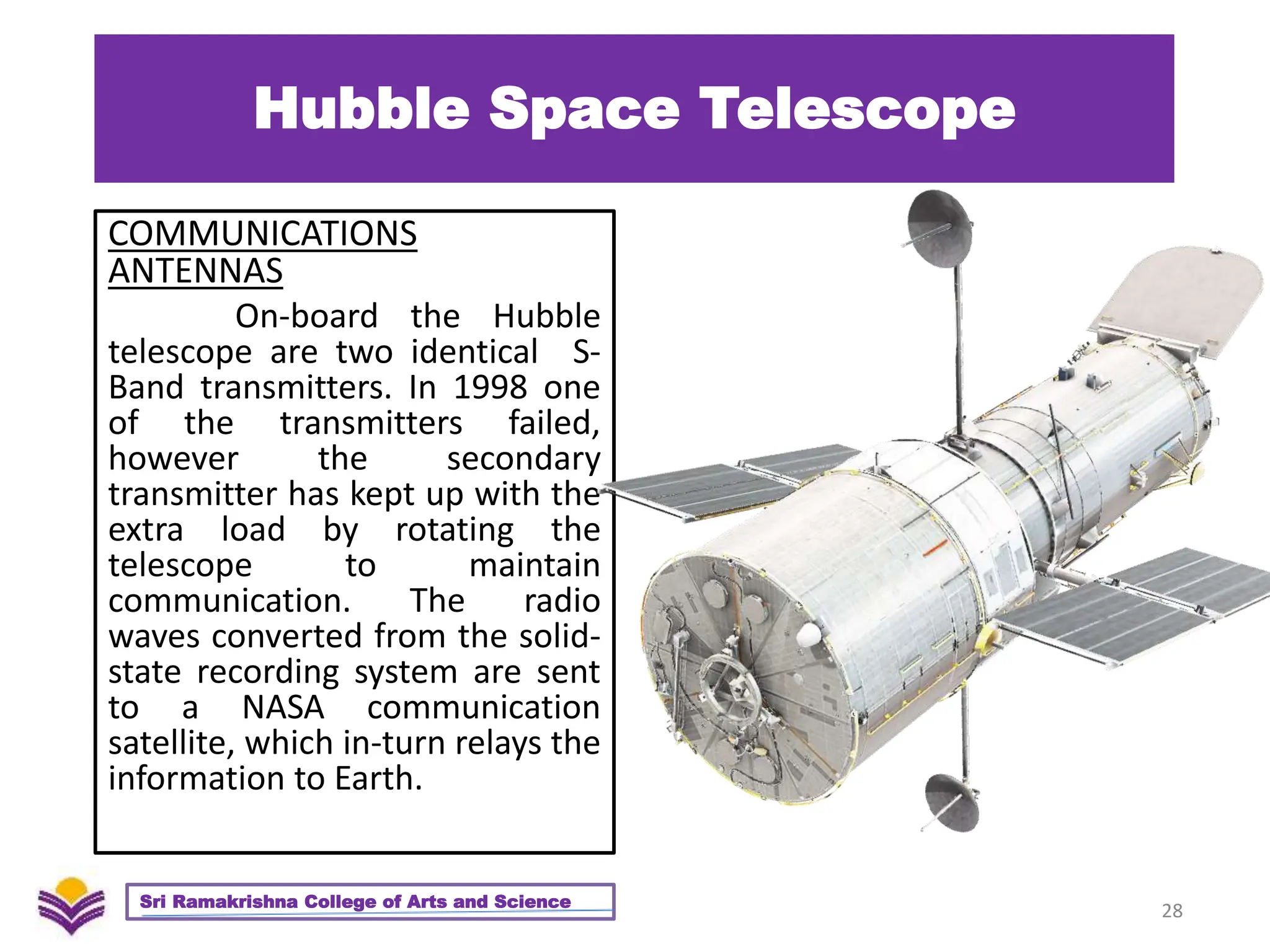
COMMUNICATIONS
ANTENNAS
On-board the Hubble
telescope are two identical S-
Band transmitters. In 1998 one
of the transmitters failed,
however the secondary
transmitter has kept up with the
extra load by rotating the
telescope to maintain
communication. The radio
waves converted from the solid-
state recording system are sent
to a NASA communication
satellite, which in-turn relays the
information to Earth.
28
Sri Ramakrishna College of Arts and Science
Hubble Space Telescope
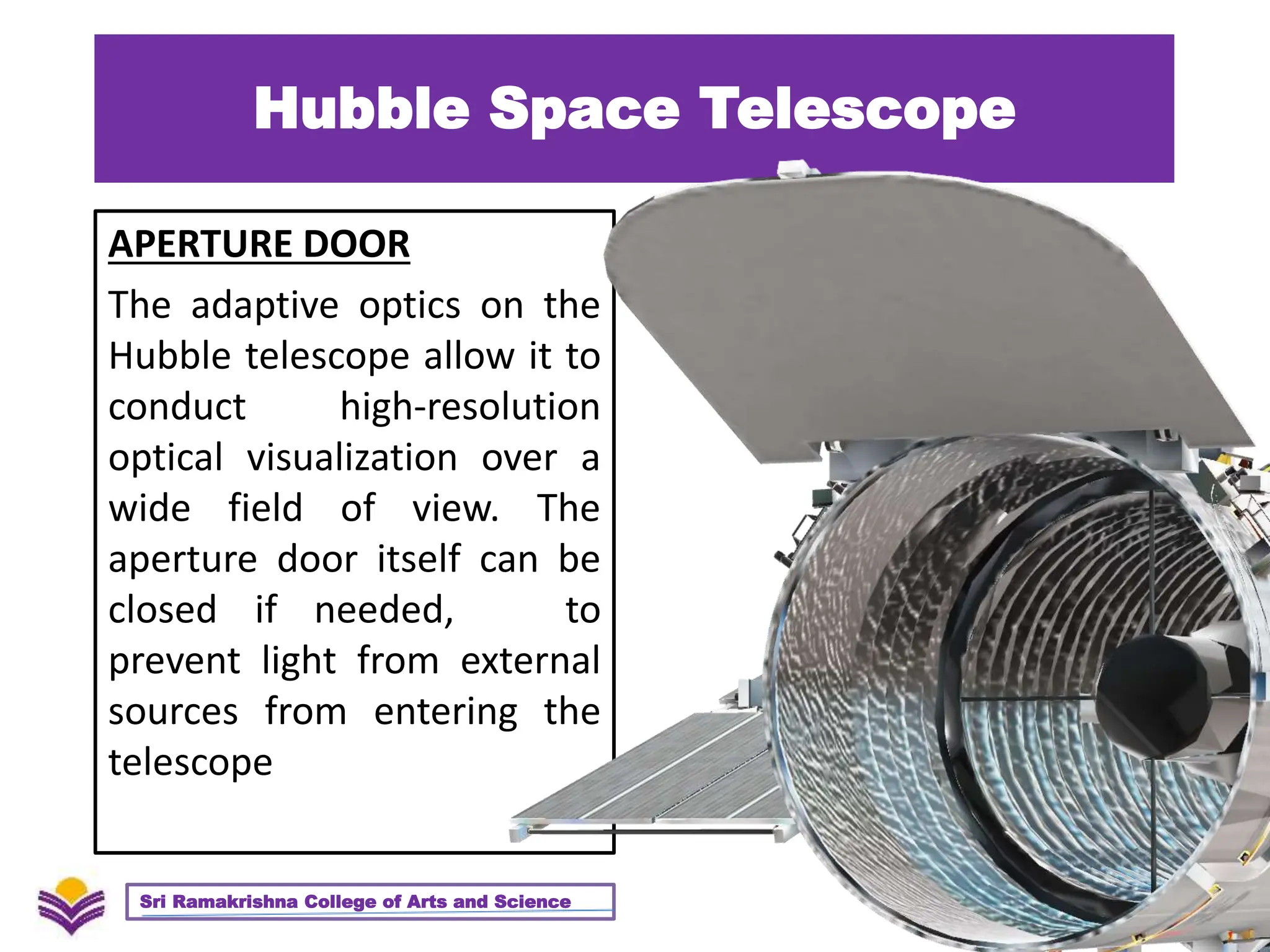
APERTURE DOOR
The adaptive optics on the
Hubble telescope allow it to
conduct high-resolution
optical visualization over a
wide field of view. The
aperture door itself can be
closed if needed, to
prevent light from external
sources from entering the
telescope
29
Sri Ramakrishna College of Arts and Science
Hubble Space Telescope
30
Sri Ramakrishna College of Arts and Science
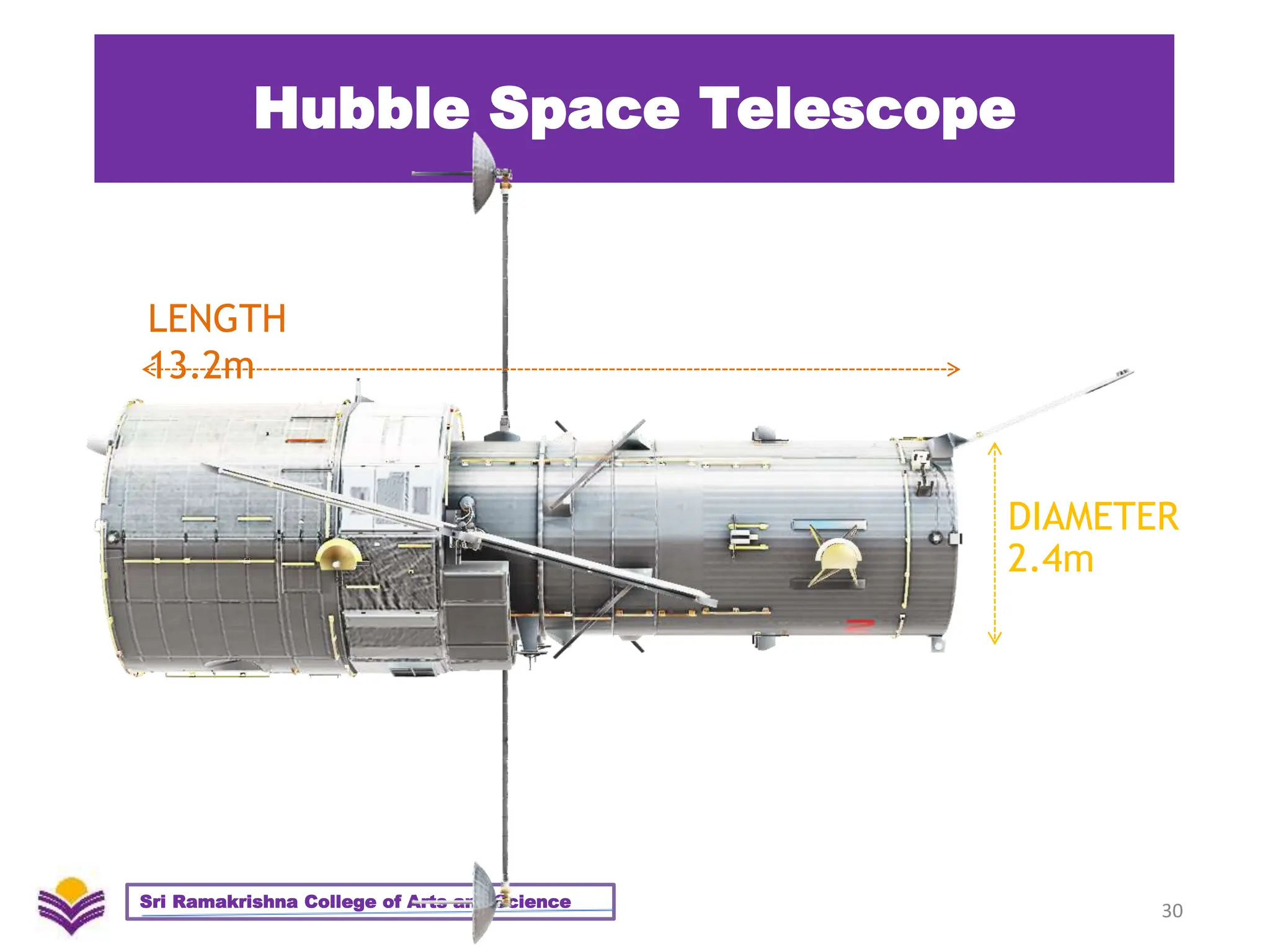
LENGTH
13.2m
DIAMETER
2.4m
Hubble Space Telescope
1. The Wide Field Planetary Camera (WFPC) – survey selected
area of Faint Objects
2. The Faint Object Spectrograph (FOS) – perform low resolution
spectroscopy
3. The High-Resolution Spectrograph (HRS) – perform very high-
resolution spectroscopy
4. High Speed Photometer (HSP) – to study brightness
fluctuations
5. Faint Object Camera (FOC) – Study Very Faint Object
31
Sri Ramakrishna College of Arts and Science
22PH503 - Astronomy and Astrophysics - Unit 1 - Astronomical Instruments

22PH503 - Astronomy and Astrophysics - Unit 1 - Astronomical Instruments

  • 1.
    Astronomy and Astrophysics MsDhivya R Assistant Professor Department of Physics Sri Ramakrishna College of Arts and Science Coimbatore - 641 006 Tamil Nadu, India 1
  • 2.
    Unit I –Astronomical Instruments  Light and its properties  The Earth’s Atmosphere  Electromagnetic Radiation  Telescopes - Optical telescopes  Types of Reflecting Telescopes  The Refracting telescope  Relative Advantages of Reflectors and Refractors  Radio telescopes  The Hubble space telescope (HST) 2 Sri Ramakrishna College of Arts and Science
  • 3.
    Light and itsproperties  Light is the important source of information for an astronomer.  Light is an electromagnetic waves  Wavelength λ  E & H are always numerically equal.  In a free space, the energy per unit volume in an electric field is E2/8π and the energy per unit volume in a magnetic field is H2/8π.  The total energy W per unit volume is W = E2/8π + H2/8π = E2/4π = H2/4π 3 Sri Ramakrishna College of Arts and Science
  • 4.
    Light and itsproperties  The intensity of the EM radiation at any point in space is defined as energy the flows per unit time per unit area perpendicular to the direction of propagation.  I= cE2/4π = cH2/4π  The number of oscillations in unit time of E and H at a given point is called frequency λν = c  The numerical value of ν is very high. It is 6 x 10¹⁴ for green light.  Monochromatic  Reflection – smooth surface – regular  Reflection – rough surface – reflected irregularly - diffused  Reflectivity - ratio of the energy associated with reflected radiation to the incident radiation  “Albedo” reflectivity from an astronomical body 4 Sri Ramakrishna College of Arts and Science
  • 5.
    Light and itsproperties  Refraction  Snell’s law  Diffraction  Polarization 5 Sri Ramakrishna College of Arts and Science
  • 6.
    Ancient Astronomical Instruments  Astrolabe Quadrant  The Armillary Sphere 6 Sri Ramakrishna College of Arts and Science
  • 7.
    The Earth’s Atmosphere 7 SriRamakrishna College of Arts and Science
  • 8.
  • 9.
    Telescopes A telescope isa tool that astronomers use to see faraway objects. Most telescopes, and all large telescopes, work by using curved mirrors to gather and focus light from the night sky. 9 Sri Ramakrishna College of Arts and Science Telescopes Optical telescopes Reflecting Refracting Radio Telescopes
  • 10.
    Optical Telescopes  Telescopeswhich are used for observation in the optical wavelengths of the electromagnetic spectrum are known as optical telescopes.  Two types of optical telescope  Reflecting telescopes (largest telescopes in the world)  Refracting telescopes (general use and small in size)  The fundamental principles is the same for both the telescopes. Magnifying power: The ratio of the focal length F of the objective to the focal length f of the eyepiece q=F/f Brightness of Image: Depends upon the aperture and the focal length of the objective. 10 Sri Ramakrishna College of Arts and Science
  • 11.
    Types of ReflectingTelescopes  There are 3 main types of reflecting telescopes.  Newtonians,  Cassegrains, and  Coude Foci  They all share many things in common like the use of mirrors instead of lenses, but their designs vary.  Reflecting telescopes are known for being powerful because of their high apertures and being budget friendly because of the materials they use and how easy they are to manufacture 11 Sri Ramakrishna College of Arts and Science
  • 12.
    Newtonian Reflecting Telescopes Characteristicsof reflecting telescopes  Reflecting telescopes were invented by Isaac Newton in the 17th century. The big innovation they had over the telescopes at the time is they used mirrors instead of lenses to reflect the light – hence the name – instead of refracting it into a single point. This allowed for much bigger telescopes that also fixed chromatic aberrations (wrong colors and colored rings around the objects).  One important note about reflectors is that they require more maintenance than other types of telescopes. Because of their open design, some dust will inevitably enter the tube. This means the interior and the primary mirror need to be cleaned regularly.  With regular use, the mirrors also tend to move a little, so once every few months, reflectors need to be re-aligned. This process is called collimation, and while it is simple once you get the hang of it, it can seem intimidating for beginners. Collimating a telescope can take anywhere from 5 minutes to 1 hour depending on the type of reflector. 12 Sri Ramakrishna College of Arts and Science
  • 13.
    Newtonian Reflecting Telescopes Characteristicsof Newtonians  No front mirror  The primary mirror is at the back of the tube  A secondary mirror bounces the light to the eyepiece  Relatively short focal length  Large apertures  Easy and cheap to manufacture  Lower contrast  Free or almost free of color errors 13 Sri Ramakrishna College of Arts and Science
  • 14.
    Newtonian Reflecting Telescopes 14 SriRamakrishna College of Arts and Science
  • 15.
  • 16.
    Coude Foci ReflectingTelescopes 16 Sri Ramakrishna College of Arts and Science
  • 17.
    Types of ReflectingTelescopes 17 Sri Ramakrishna College of Arts and Science
  • 18.
    Refracting Telescopes 18 Sri RamakrishnaCollege of Arts and Science
  • 19.
    Refracting Telescopes 19 Sri RamakrishnaCollege of Arts and Science
  • 20.
    Reflectors vs Refractors 20 SriRamakrishna College of Arts and Science
  • 21.
    Relative advantages ofReflectors and Refractors  Lenses Vs Mirrors  Lenses – Optically Homogeneous  Mirrors – Mechanically Homogenous (Easier to Achieve)  Lenses – Chromatic Aberration – Affect Photographic quality  Mirrors – Perfectly Achromatic – Quality Pictures are achieved  Lenses – Smaller in Size - Image definition – Wide Field and Good  Mirrors – Large in size - decreased defining power 21 Sri Ramakrishna College of Arts and Science For the same size of aperture  Refractors – Costly  Reflectors – Less Costly Usage  Refractors – visual observation and Measurement – Objective Prism Spectrograph  Reflectors – faint object observation – photography, spectroscopy, photoelectric photometry
  • 22.
    Radio Telescopes  RadioWaves – Shorter RW – Absorbed ; Long RW about 50 m –completely reflected back.  RW of wavelength ranging few CM to few M are only available for study.  We use radio telescopes to study naturally occurring radio light from stars, galaxies, black holes, and other astronomical objects.  We can also use them to transmit and reflect radio light off of planetary bodies in our solar system.  These specially-designed telescopes observe the longest wavelengths of light, ranging from 1 millimeter to over 10 meters long.  They work similar to optical telescopes except that the RT works on only one frequency at a time.  Resoving power of RT very low compared to OT 22 Sri Ramakrishna College of Arts and Science
  • 23.
    Radio Telescopes 23 Sri RamakrishnaCollege of Arts and Science
  • 24.
    Radio Telescopes  Radiotelescopes collect weak radio light waves, bring it to a focus, amplify it and make it available for analysis.  We use radio telescopes to study naturally occurring radio light from stars, galaxies, black holes, and other astronomical objects.  We can also use them to transmit and reflect radio light off of planetary bodies in our solar system.  These specially-designed telescopes observe the longest wavelengths of light, ranging from 1 millimeter to over 10 meters long. 24 Sri Ramakrishna College of Arts and Science
  • 25.
    Radio Telescopes inIndia 25 Sri Ramakrishna College of Arts and Science
  • 26.
    Hubble Space Telescope 26 SriRamakrishna College of Arts and Science
  • 27.
    Hubble Space Telescope SOLARPANELS Named after the famous American astronomer Edwin Hubble, the Hubble telescope is powered by six nickel-hydrogen batteries, which provide power to the spacecraft during orbit while it flies through the Earth’s shadow. The scientific instrumentation and onboard computers draw approximately 2800 watts, which are charged by two 2.45 x 7.56m solar panels. 27 Sri Ramakrishna College of Arts and Science
  • 28.
    Hubble Space Telescope COMMUNICATIONS ANTENNAS On-boardthe Hubble telescope are two identical S- Band transmitters. In 1998 one of the transmitters failed, however the secondary transmitter has kept up with the extra load by rotating the telescope to maintain communication. The radio waves converted from the solid- state recording system are sent to a NASA communication satellite, which in-turn relays the information to Earth. 28 Sri Ramakrishna College of Arts and Science
  • 29.
    Hubble Space Telescope APERTUREDOOR The adaptive optics on the Hubble telescope allow it to conduct high-resolution optical visualization over a wide field of view. The aperture door itself can be closed if needed, to prevent light from external sources from entering the telescope 29 Sri Ramakrishna College of Arts and Science
  • 30.
    Hubble Space Telescope 30 SriRamakrishna College of Arts and Science LENGTH 13.2m DIAMETER 2.4m
  • 31.
    Hubble Space Telescope 1.The Wide Field Planetary Camera (WFPC) – survey selected area of Faint Objects 2. The Faint Object Spectrograph (FOS) – perform low resolution spectroscopy 3. The High-Resolution Spectrograph (HRS) – perform very high- resolution spectroscopy 4. High Speed Photometer (HSP) – to study brightness fluctuations 5. Faint Object Camera (FOC) – Study Very Faint Object 31 Sri Ramakrishna College of Arts and Science