Concept and Nature
of Communication
Unit 1
INTRODUCTION
The word communication originates from the Latin word
“communis”, which means “common” and the word
business stands for any economic activity which is
undertaken with a view to earn profit and the
communication undertaken in the process of this activity
is termed as "business communication”.
DEFINITION
 Communication is a process of passing information and
understanding from one person to another.
- Keith Devis
 Communication is generally defined as the activity of
conveying information. Communication has been derived
from the Latin word "communis", meaning to share.
-Wikipedia
MEANING
Communication is defined as “The flow of material information
perception, understanding and imagination among various
parties”.
Business includes those organizations, which are engaged in the
production and distribution of goods and services to earn profit.
Therefore Business communication means, “Flow of information,
perception etc. either within a business organization or outside
the organization among different parties”.
OBJECTIVES &PURPOSE OF COMMUNICATION
 To give and receive information
 To provide advice
 To educate and train customer
 To issue orders and instruction
 To persuade target audience
 To receive suggestion
 To motivate and to integrate
 To relate and to entertain
Importance of Business
Communication
 Persuasion is one of the factors of marketing
communications. Persuasion is the main reason companies
engage in marketing: to persuade their target audience to
take action, as in, buy their product or subscribe to their
services, make a phone call, or donate money.
 All marketing communication is goal oriented, as the
predetermine objective helps to create effective marketing
communication strategy.
 Every successful marketing communications helps plan the
Importance of Business
Communication
 It facilitates in controlling the performance and take
necessary remedial actions on the basis of feedback
information from them.
 Communication creates a meeting of minds and improve
industrial relations.
 It helps to develop mutual co-operation and understanding
thereby improving industrial productivity.
 Communication is indispensable for every organization to
develop and maintain reputation or goodwill with its
customers, investors, dealers, suppliers etc.
Principles and Nature of
Communications
 Communication involves plurality of persons
 Existence of message is essential which may be the
orders, instructions or information about the managerial
plans, policies, programmes
 It’s a two way and continuous process
 Its primary purpose is to motivate a response
 Communication may be formal controllable or informal
uncontrollable
 It can be in vertical, horizontal or diagonal
The Seven Cs of
Communication
 Consideration
 Clarity
 Completeness
 Conciseness
 Correctness
 Concreteness
 Courtesy
Consideration: consideration states that every message
should be prepared keeping in mind the person who will be the
receiver of the message. Receiver's interest should be kept in
mind while drafting the message. Specific ways to indicate
candidness are: -
 Focus on "you" attitude instead of "I" on "We"
 Material or content of the message should be from reader's point
of view.
 Use of positive words should be allowed so that positive reaction
could be received by the readers.
 Benefits of readers should be the prominent part of message.
Examples:
We Attitude: I am delighted to announce that there will be extra
classes for the students in college to clarify their problems.
You Attitude: You will be able to clarify your problems in the extra
classes organized in college.
Clarity: Clarity is most important characteristic of communication
especially in case or oral Communication/Presentation. Clarity in
words, language of expression is very important to ensure proper
presentation of ideas, message one wants to communicate during
conversation.
Clarity can be achieved through following ways:
 Precise, familiar use of words or language during communication,
Effective sentences should be framed,
 There should be unity in all one words of message so that the
main idea of message can be properly communicated.
 Short length sentences of average 17 to 20 words should be
preferred.
Completeness: Complete message is very important to
communicate the main idea or information behind the message.
Oral presentations should be as far as possible planned on
restructured and all the information related to message should be
properly communicated.
Guidelines for ensuring completeness are as follows:
 Provide all necessary information required for accurate
understanding of message.
 All Questions asked by the audience should be properly answered
by presenter during oral presentation/communication.
 Some extra information when ever desirable should be given to
audience to make the presentation topic more clear, specific of
 Conciseness: Conciseness is the essential requirement of oral
communication. Concise message saves time on expense for both
sender on receiver concise means brief, short on informative
message which is able to explain the idea of message with
minimum words. Words in message should not be repetitive in
nature & only relevant information should be communicated in
message.
 Correctness: In oral communication grammatical errors should be
avoided. Right level of language should be used both in formal &
informal communication. Use of accurate words and spellings
should be considered.
 Concreteness: It means specific, definite on valid use of
information than vague or general. Concrete facts on figures should
be used to make the receivers know exactly what is required or
desired. Concrete language on information helps in interpreting the
message in same way as communicate intend to communicate the
message.
 Courtesy: A proper decorum of speaking should be maintained
while making oral communication/ presentation. One should say
things with force of assertive without being rude. Polite or humble
language shall be used which should not be insulting, against the
religious, social as personal values of listener. Discriminatory
language based, on gender, race, age, colour, cost creed, religion
PROCESS OF
COMMUNICATION
The process of communication involves two or more
persons participating through a medium that carries the
information or message for a particular purpose which is
mutually understood by both the sender and receiver.
Only when these conditions are fulfilled, a significant
communicative situation will take shape.
4. Noise
(Physical and Psychological Distraction
1. Source
/Sender
(Encoding)
2.
Message
and
content
3.
3.Communic
ation
Channel
media TV.
Radio,
Newspapers,
Magazines,
Internet,
Mail, Phone
5.
Receiver
(Decodin
g)
6. Feedback-Interactivity
Immediate Response
Delayed Response
No Response
-------------------------------
--
-------------------------------------------------------------
---------------------------------------
---
------------------------------
--
-------------------------------------------------------------
---------------------
1. Sender
The sender or the communicator generates the message and
conveys it to the receiver. He is the source and the one who
starts the communication
2. Message
It is the idea, information, view, fact, feeling, etc. that is generated
by the sender and is then intended to be communicated further.
3. Encoding
The message generated by the sender is encoded symbolically
such as in the form of words, pictures, gestures, etc. before it is
being conveyed.
4. Media/Channel
It is the manner in which the encoded message is transmitted.
The message may be transmitted orally or in writing. The medium
of communication includes telephone, internet, post, fax, e-mail,
etc. The choice of medium is decided by the sender.
5. Decoding
It is the process of converting the symbols encoded by the sender. After
decoding the message is received by the receiver.
6. Receiver
He is the person who is last in the chain and for whom the message was
sent by the sender. Once the receiver receives the message and
understands it in proper perspective and acts according to the message,
only then the purpose of communication is successful.
7. Feedback
Once the receiver confirms to the sender that he has received the message
and understood it, the process of communication is complete.
8. Noise
It refers to any obstruction that is caused by the sender, message or
receiver during the process of communication. For example, bad telephone
connection, faulty encoding, faulty decoding, inattentive receiver, poor
understanding of message due to prejudice or inappropriate gestures, etc.
Channel of Communication
 Meaning :- Communication channel are established by
the organization and are accepted & recognized by
employees & managers
External Communication
 External communication – Communication with those
outside the organization is known as external
communication.
A. Outward- The messages which go out of the
organization to customers, suppliers, banks, insurance
companies, govt. departments, mass media & the general
public. They may be in the form of letters, taxes, banners,
reports, telegrams, advertisements, press handouts,
speeches, visits, trade fairs, etc.
B. Inward - messages that are received from outside by
the company. An organization may receive letters, faxes,
telegrams, telephone calls, personal visits, magazines.
etc., these may be, from customers, suppliers, other
organization, govt. departments, etc.
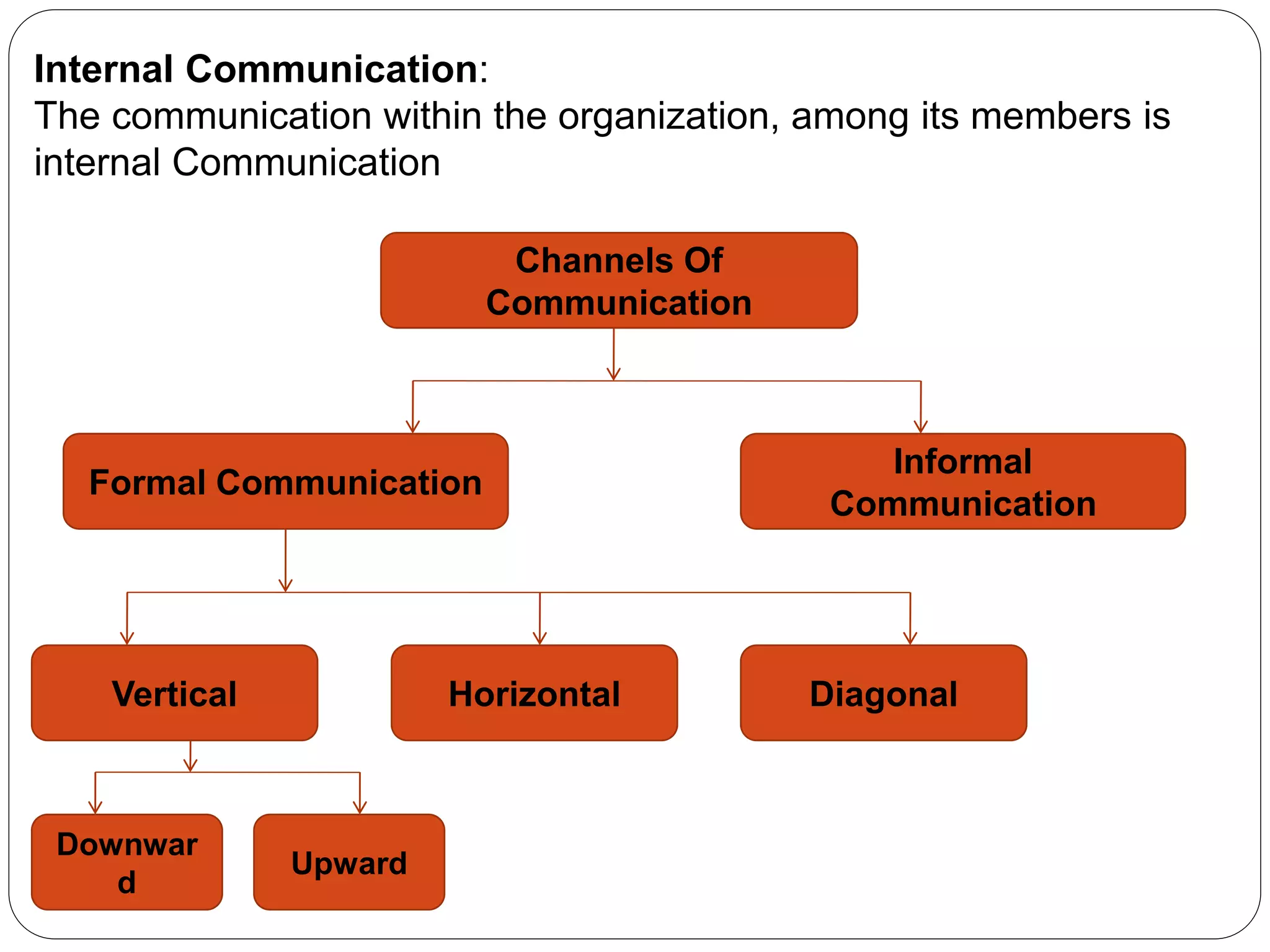
Internal Communication:
The communication within the organization, among its members is
internal Communication
Channels Of
Communication
Vertical
Informal
Communication
Formal Communication
Horizontal Diagonal
Downwar
d
Upward
A. Formal channel — the communication when takes
place within the official i.e. the lines of
communication is approved by senior management.
This is the channel which carries the official
messages in the organization.
Under a formal channel
There are efforts made by each & every individual at various
levels.
The most important aspect of formal channel is that no level of the
organization is overlooked or bypassed: The information passes
through an already fixed, systematic channel.
It is the process or sharing official information with others who
need to know it, which is according to the prescribed patterns
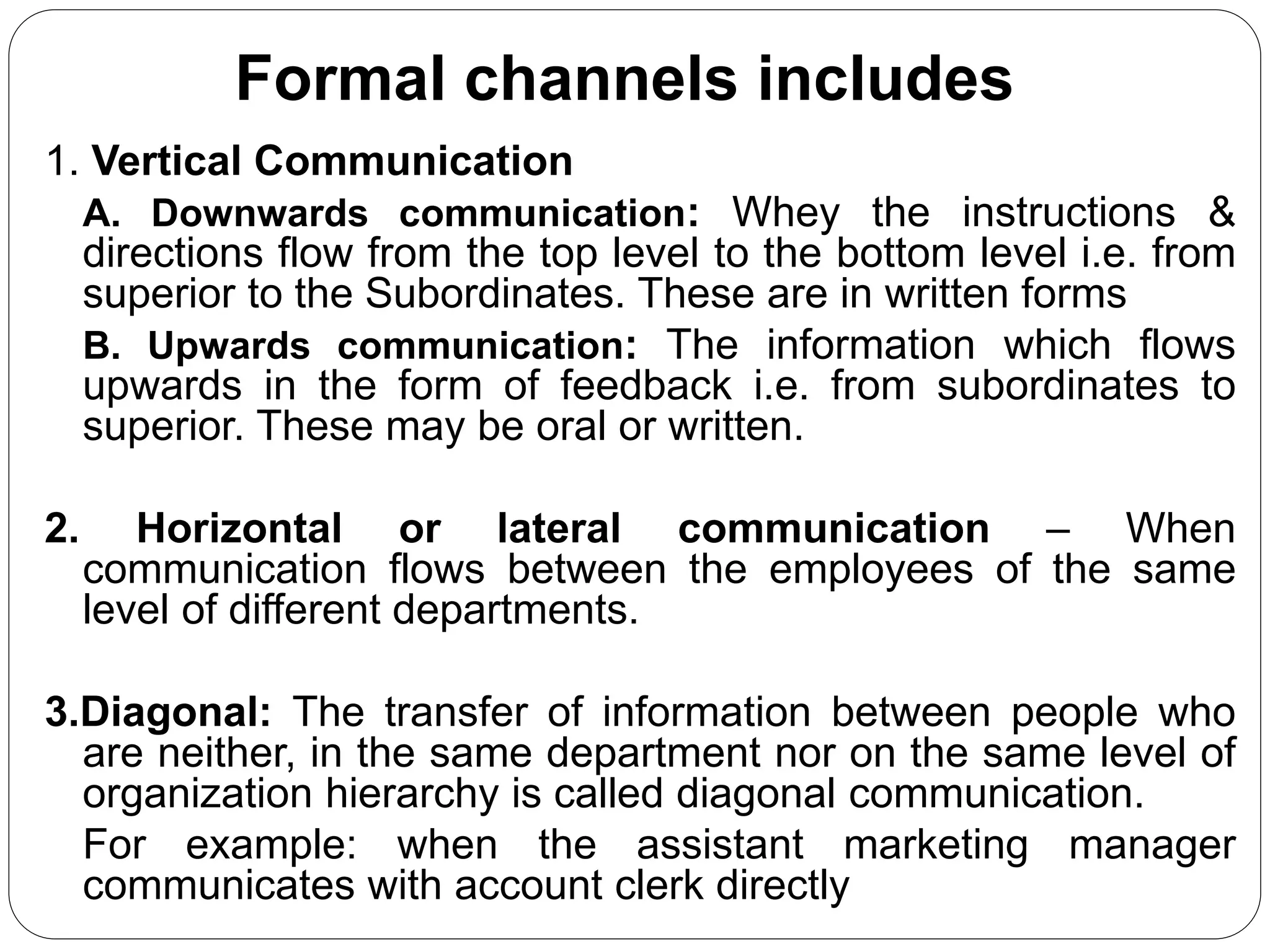
Formal channels includes
1. Vertical Communication
A. Downwards communication: Whey the instructions &
directions flow from the top level to the bottom level i.e. from
superior to the Subordinates. These are in written forms
B. Upwards communication: The information which flows
upwards in the form of feedback i.e. from subordinates to
superior. These may be oral or written.
2. Horizontal or lateral communication – When
communication flows between the employees of the same
level of different departments.
3.Diagonal: The transfer of information between people who
are neither, in the same department nor on the same level of
organization hierarchy is called diagonal communication.
For example: when the assistant marketing manager
communicates with account clerk directly
Informal channel
 Grape vine
 It forms a lease of informal relation between two or more
individuals.
 It is not planned & organized or acquaintances.
 It may be both official and personal
 It is based on friendship
 Meaning – The informal channel of communication may-be
defined as passing information outside the official channels,
Example:- employees chatting, in the canteen or pub. It can
affect the future of the business, particularly if the formal
system has broken down.
 Grapevine is an informal channel of communication.
 Primarily a channel of horizontal communication, it cal flow
even vertically and diagonally.
Four types
Single stand: flow like a chain.
Gossip: one person tells everybody else
Probability (random): information may move from
anybody to anybody.
Cluster: moves through selected group
Barriers to Communication
 No matter how good the communication system in an
organization is, unfortunately barriers can and do often
occur. This may be caused by a number of factors which
can usually be summarized being as due to physical barrier,
languages, and organizational, emotional, personal barriers.
 A communication becomes successful only if the receiver
understands what the sender is trying to convey. When your
message is not clearly understood, you should understand
that you should understand that your message is facing a
Commonly Experienced
Barriers
 Noise
 Emotions
 Lack of planning
 Filtering information
 Wrong & unclarified assumption
 Loss by transmission
 Goal conflict
 Culture
 Offensive style
 Social; Psychological barriers.
 Time distance
1. Physical barrier
Physical barrier in an organization includes large
working areas that are physically separated from
others.
 Marked out territories, empires into which strangers
are not allowed
 Closed office doors, barriers screens, separate
areas for People of different status.
Physical barriers may include –
1. Noise
2. Physical Distance
3. Improper Time
4. Information Overload
2. Language barrier -
 The barrier created due to the improper of
language, words, phrases, etc.
 Variety of Meaning. : For example: a person may
be present at function and receive a present and
present some thoughts on budget.
3.Cultural barrier —
 Values & norms
 Non verbal communication
 Social relationship
 Perception
 Concept of time
 Use of voice
 Concept of space
 Specialist language
 Thinking process
 Appearance (we react unconsciously to the biological
 Appearance color & texture of skin, color eyes of Body
structure, way of dressing etc.)
The factors internal to the organization which adversely
affect the flow of communication arc called on barriers.
This includes —
 Organization polity
 Complex organizational structure
 Rules and regulations
 Facilities
 Status difference
 Wrong choice of channel

Unit 1

  • 1.
    Concept and Nature ofCommunication Unit 1
  • 2.
    INTRODUCTION The word communicationoriginates from the Latin word “communis”, which means “common” and the word business stands for any economic activity which is undertaken with a view to earn profit and the communication undertaken in the process of this activity is termed as "business communication”.
  • 3.
    DEFINITION  Communication isa process of passing information and understanding from one person to another. - Keith Devis  Communication is generally defined as the activity of conveying information. Communication has been derived from the Latin word "communis", meaning to share. -Wikipedia
  • 4.
    MEANING Communication is definedas “The flow of material information perception, understanding and imagination among various parties”. Business includes those organizations, which are engaged in the production and distribution of goods and services to earn profit. Therefore Business communication means, “Flow of information, perception etc. either within a business organization or outside the organization among different parties”.
  • 5.
    OBJECTIVES &PURPOSE OFCOMMUNICATION  To give and receive information  To provide advice  To educate and train customer  To issue orders and instruction  To persuade target audience  To receive suggestion  To motivate and to integrate  To relate and to entertain
  • 6.
    Importance of Business Communication Persuasion is one of the factors of marketing communications. Persuasion is the main reason companies engage in marketing: to persuade their target audience to take action, as in, buy their product or subscribe to their services, make a phone call, or donate money.  All marketing communication is goal oriented, as the predetermine objective helps to create effective marketing communication strategy.  Every successful marketing communications helps plan the
  • 7.
    Importance of Business Communication It facilitates in controlling the performance and take necessary remedial actions on the basis of feedback information from them.  Communication creates a meeting of minds and improve industrial relations.  It helps to develop mutual co-operation and understanding thereby improving industrial productivity.  Communication is indispensable for every organization to develop and maintain reputation or goodwill with its customers, investors, dealers, suppliers etc.
  • 8.
    Principles and Natureof Communications  Communication involves plurality of persons  Existence of message is essential which may be the orders, instructions or information about the managerial plans, policies, programmes  It’s a two way and continuous process  Its primary purpose is to motivate a response  Communication may be formal controllable or informal uncontrollable  It can be in vertical, horizontal or diagonal
  • 9.
    The Seven Csof Communication  Consideration  Clarity  Completeness  Conciseness  Correctness  Concreteness  Courtesy
  • 10.
    Consideration: consideration statesthat every message should be prepared keeping in mind the person who will be the receiver of the message. Receiver's interest should be kept in mind while drafting the message. Specific ways to indicate candidness are: -  Focus on "you" attitude instead of "I" on "We"  Material or content of the message should be from reader's point of view.  Use of positive words should be allowed so that positive reaction could be received by the readers.  Benefits of readers should be the prominent part of message. Examples: We Attitude: I am delighted to announce that there will be extra classes for the students in college to clarify their problems. You Attitude: You will be able to clarify your problems in the extra classes organized in college.
  • 11.
    Clarity: Clarity ismost important characteristic of communication especially in case or oral Communication/Presentation. Clarity in words, language of expression is very important to ensure proper presentation of ideas, message one wants to communicate during conversation. Clarity can be achieved through following ways:  Precise, familiar use of words or language during communication, Effective sentences should be framed,  There should be unity in all one words of message so that the main idea of message can be properly communicated.  Short length sentences of average 17 to 20 words should be preferred.
  • 12.
    Completeness: Complete messageis very important to communicate the main idea or information behind the message. Oral presentations should be as far as possible planned on restructured and all the information related to message should be properly communicated. Guidelines for ensuring completeness are as follows:  Provide all necessary information required for accurate understanding of message.  All Questions asked by the audience should be properly answered by presenter during oral presentation/communication.  Some extra information when ever desirable should be given to audience to make the presentation topic more clear, specific of
  • 13.
     Conciseness: Concisenessis the essential requirement of oral communication. Concise message saves time on expense for both sender on receiver concise means brief, short on informative message which is able to explain the idea of message with minimum words. Words in message should not be repetitive in nature & only relevant information should be communicated in message.  Correctness: In oral communication grammatical errors should be avoided. Right level of language should be used both in formal & informal communication. Use of accurate words and spellings should be considered.
  • 14.
     Concreteness: Itmeans specific, definite on valid use of information than vague or general. Concrete facts on figures should be used to make the receivers know exactly what is required or desired. Concrete language on information helps in interpreting the message in same way as communicate intend to communicate the message.  Courtesy: A proper decorum of speaking should be maintained while making oral communication/ presentation. One should say things with force of assertive without being rude. Polite or humble language shall be used which should not be insulting, against the religious, social as personal values of listener. Discriminatory language based, on gender, race, age, colour, cost creed, religion
  • 15.
    PROCESS OF COMMUNICATION The processof communication involves two or more persons participating through a medium that carries the information or message for a particular purpose which is mutually understood by both the sender and receiver. Only when these conditions are fulfilled, a significant communicative situation will take shape.
  • 16.
    4. Noise (Physical andPsychological Distraction 1. Source /Sender (Encoding) 2. Message and content 3. 3.Communic ation Channel media TV. Radio, Newspapers, Magazines, Internet, Mail, Phone 5. Receiver (Decodin g) 6. Feedback-Interactivity Immediate Response Delayed Response No Response ------------------------------- -- ------------------------------------------------------------- --------------------------------------- --- ------------------------------ -- ------------------------------------------------------------- ---------------------
  • 18.
    1. Sender The senderor the communicator generates the message and conveys it to the receiver. He is the source and the one who starts the communication 2. Message It is the idea, information, view, fact, feeling, etc. that is generated by the sender and is then intended to be communicated further. 3. Encoding The message generated by the sender is encoded symbolically such as in the form of words, pictures, gestures, etc. before it is being conveyed. 4. Media/Channel It is the manner in which the encoded message is transmitted. The message may be transmitted orally or in writing. The medium of communication includes telephone, internet, post, fax, e-mail, etc. The choice of medium is decided by the sender.
  • 19.
    5. Decoding It isthe process of converting the symbols encoded by the sender. After decoding the message is received by the receiver. 6. Receiver He is the person who is last in the chain and for whom the message was sent by the sender. Once the receiver receives the message and understands it in proper perspective and acts according to the message, only then the purpose of communication is successful. 7. Feedback Once the receiver confirms to the sender that he has received the message and understood it, the process of communication is complete. 8. Noise It refers to any obstruction that is caused by the sender, message or receiver during the process of communication. For example, bad telephone connection, faulty encoding, faulty decoding, inattentive receiver, poor understanding of message due to prejudice or inappropriate gestures, etc.
  • 20.
    Channel of Communication Meaning :- Communication channel are established by the organization and are accepted & recognized by employees & managers
  • 21.
    External Communication  Externalcommunication – Communication with those outside the organization is known as external communication. A. Outward- The messages which go out of the organization to customers, suppliers, banks, insurance companies, govt. departments, mass media & the general public. They may be in the form of letters, taxes, banners, reports, telegrams, advertisements, press handouts, speeches, visits, trade fairs, etc. B. Inward - messages that are received from outside by the company. An organization may receive letters, faxes, telegrams, telephone calls, personal visits, magazines. etc., these may be, from customers, suppliers, other organization, govt. departments, etc.
  • 22.
    Internal Communication: The communicationwithin the organization, among its members is internal Communication Channels Of Communication Vertical Informal Communication Formal Communication Horizontal Diagonal Downwar d Upward
  • 23.
    A. Formal channel— the communication when takes place within the official i.e. the lines of communication is approved by senior management. This is the channel which carries the official messages in the organization. Under a formal channel There are efforts made by each & every individual at various levels. The most important aspect of formal channel is that no level of the organization is overlooked or bypassed: The information passes through an already fixed, systematic channel. It is the process or sharing official information with others who need to know it, which is according to the prescribed patterns
  • 24.
    Formal channels includes 1.Vertical Communication A. Downwards communication: Whey the instructions & directions flow from the top level to the bottom level i.e. from superior to the Subordinates. These are in written forms B. Upwards communication: The information which flows upwards in the form of feedback i.e. from subordinates to superior. These may be oral or written. 2. Horizontal or lateral communication – When communication flows between the employees of the same level of different departments. 3.Diagonal: The transfer of information between people who are neither, in the same department nor on the same level of organization hierarchy is called diagonal communication. For example: when the assistant marketing manager communicates with account clerk directly
  • 25.
    Informal channel  Grapevine  It forms a lease of informal relation between two or more individuals.  It is not planned & organized or acquaintances.  It may be both official and personal  It is based on friendship  Meaning – The informal channel of communication may-be defined as passing information outside the official channels, Example:- employees chatting, in the canteen or pub. It can affect the future of the business, particularly if the formal system has broken down.  Grapevine is an informal channel of communication.  Primarily a channel of horizontal communication, it cal flow even vertically and diagonally.
  • 26.
    Four types Single stand:flow like a chain. Gossip: one person tells everybody else Probability (random): information may move from anybody to anybody. Cluster: moves through selected group
  • 27.
    Barriers to Communication No matter how good the communication system in an organization is, unfortunately barriers can and do often occur. This may be caused by a number of factors which can usually be summarized being as due to physical barrier, languages, and organizational, emotional, personal barriers.  A communication becomes successful only if the receiver understands what the sender is trying to convey. When your message is not clearly understood, you should understand that you should understand that your message is facing a
  • 28.
    Commonly Experienced Barriers  Noise Emotions  Lack of planning  Filtering information  Wrong & unclarified assumption  Loss by transmission  Goal conflict  Culture  Offensive style  Social; Psychological barriers.  Time distance
  • 29.
    1. Physical barrier Physicalbarrier in an organization includes large working areas that are physically separated from others.  Marked out territories, empires into which strangers are not allowed  Closed office doors, barriers screens, separate areas for People of different status. Physical barriers may include – 1. Noise 2. Physical Distance 3. Improper Time 4. Information Overload
  • 30.
    2. Language barrier-  The barrier created due to the improper of language, words, phrases, etc.  Variety of Meaning. : For example: a person may be present at function and receive a present and present some thoughts on budget.
  • 31.
    3.Cultural barrier — Values & norms  Non verbal communication  Social relationship  Perception  Concept of time  Use of voice  Concept of space  Specialist language  Thinking process  Appearance (we react unconsciously to the biological  Appearance color & texture of skin, color eyes of Body structure, way of dressing etc.)
  • 32.
    The factors internalto the organization which adversely affect the flow of communication arc called on barriers. This includes —  Organization polity  Complex organizational structure  Rules and regulations  Facilities  Status difference  Wrong choice of channel