PLANNING
Definition
 Koontz, O'Donnell and Weihrich:
"Planning is an intellectually demanding process; it
requires the conscious determination of courses of
action and the basing of decisions on purpose,
knowledge and considered estimates".
Elements of Planning
1. What will be done ?
2. What resources will be required ?
3. How it will be done ?
4. Who will do it?
5. When it will be done?
NATURE AND SCOPE OF PLANNING
 Planning does attempt to make future decisions
 Planning is a Continuous Process
 Planning concerns all Managers
 Plans are arranged in a Hierarchy
 Planning Commits an Organization into the Future
 Planning is Antithesis of States Quo
IMPORTANCE OF PLANNING
 Planning is essential in modern business
 Planning affects performance
 Planning puts focus on objectives
 Planning anticipates problems and
uncertainties
 Planning is necessary to facilitate control
 Planning helps in the process of decision
ADVANTAGES OF PLANNING
 Focuses Attention on Objectives
 Ensures Economical Operation
 Reduces Uncertainty
 Facilitates Control
 Encourages Innovation and Creativity
 Improves Motivation
 Improves Competitive Strength
 Achieves Better Coordination
LIMITATIONS OF PLANNING
 Lack of reliable data
 Lack of initiative
 Costly process
 Rigidity in organizational working
 Non-acceptability of change
 External limitations
 Psychological barriers
ESSENTILAS OF EFFECTIVE
PLANNING
 Setting Clear-cut Objectives
 Management Information System
 Carefully Premising
 Business Forecasting
 Dynamic Managers
 Flexibility
 Availability of Resources
 Cost-Benefit Analysis
TYPES OF PLANNING
 Strategic and Functional Planning
 Long-term and short-term Planning
 Adhoc and Standing Planning
 Administrative and Operational Planning
 Physical Planning
 Formal and Informal Planning
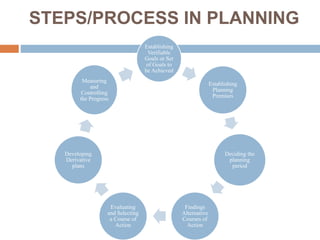
STEPS/PROCESS IN PLANNING
Establishing
Verifiable
Goals or Set
of Goals to
be Achieved
Establishing
Planning
Premises
Deciding the
planning
period
Findings
Alternative
Courses of
Action
Evaluating
and Selecting
a Course of
Action
Developing
Derivative
plans
Measuring
and
Controlling
the Progress
Set of Goals to be Achieved
 The first step in planning is to determine the enterprise objectives.
 These are most often set by upper level or top managers, usually
after a number of possible objectives have been carefully
considered.
 There are many types of objectives managers may select: a
desired sales volume or growth rate, the development of a new
product or service etc.
 The type of goal selected will depend on number of factors: the
basic mission of the organization, the values its managers hold,
Establishing Planning
Premises
The second step in planning is to establish
planning premises, i.e. certain assumptions about
the future on the basis of which the plan will be
intimately formulated. Planning premises are vital
to the success of planning as they supply
economic conditions, production costs and prices,
probable competitive behaviour, capital and
material availability, governmental control and so
Deciding the planning period
 Once upper-level managers have selected the basic long-
term goals and the planning premises, the next task is to
decide the period of the plan.
 Business varies considerably in their planning periods.
 In some instances plans are made for a year only while in
others they span decades.
 In each case, however, there is always some logic in
selecting a particular time range for planning. Companies
generally base their period on a future that can reasonably be
Findings Alternative Courses of
Action
 The fourth step is planning is to search for and examining
alternative courses of action.
 For instance, technical know-how may be secured by
engaging a foreign technician or by training staff abroad.
 Similarly, products may be sold directly to the consumer by
the company's salesmen or through exclusive agencies.
 There is seldom a plan for which reasonable alternatives do
not exit, and quite often an alternative that is not obvious
proves to be the best.
Evaluating and Selecting a Course of
Action
Having sought alternative courses, the fifth step is
to evaluate them in the light of the premises and
goals and to select the best course or courses of
action. This is done with the help of quantitative
techniques and operations research.
Developing Derivative plans
 Once the plan has been formulated, its broad goals must be
translated into day-to-day operations of the organization.
 Middle and lower-level managers must draw up the appropriate
plans, programmes and budgets for their sub-units.
 These are described as derivative plans.
 In developing these derivative plans, lower-level managers take
steps similar to those taken by upper-level managers – selecting
realistic goals, assessing their sub-units particular strength and
weaknesses and analyzing those parts of the environment that can
affect them.
Measuring and Controlling the
Progress
 Obviously, it is foolish to let a plan run its course without
monitoring its progress.
 Hence the process of controlling is a critical part of any plan.
Managers need to check the progress of their plans so that
they can
(a) take whatever remedial action is necessary to make the
plan work, or
(b) change the original plan if it is unrealistic.
DEISION-MAKING
 According to D.E. McFarland, "A decision is an act
of choice wherein an executive forms a conclusion
about what must be done in a given situation. A
decision represents a course of behaviour chosen
from a number of possible alternatives”.
 Haynes and Massie, "A decision is a course of
action which is consciously chosen for achieving a
desired result"
CHARACTERISTICS OF DECISION MAKING
 It is a process of choosing a course of action from among
the alternative courses of action.
 It is a human process involving to a great extent the
application of intellectual abilities.
 It is the end process preceded by deliberation and
reasoning.
 It is always related to the environment. A manager may
take one decision in a particular set of circumstances and
another in a different set of circumstances.
 It involves a time dimension and a time lag.
 It always has a purpose. Keeping this in view, there may
just be a decision not to decide.
 It involves all actions like defining the problem and
probing and analyzing the various alternatives which take
place before a final choice is made
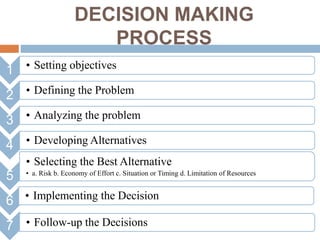
DECISION MAKING
PROCESS
1 • Setting objectives
2 • Defining the Problem
3 • Analyzing the problem
4 • Developing Alternatives
5
• Selecting the Best Alternative
• a. Risk b. Economy of Effort c. Situation or Timing d. Limitation of Resources
6 • Implementing the Decision
7 • Follow-up the Decisions
TYPES OF DECISIONS
 Programmed and non-programmed decisions
 Basic and routine decisions
 Policy and operative decisions
 Individual and group decisions

Planning

  • 1.
  • 2.
    Definition  Koontz, O'Donnelland Weihrich: "Planning is an intellectually demanding process; it requires the conscious determination of courses of action and the basing of decisions on purpose, knowledge and considered estimates".
  • 3.
    Elements of Planning 1.What will be done ? 2. What resources will be required ? 3. How it will be done ? 4. Who will do it? 5. When it will be done?
  • 4.
    NATURE AND SCOPEOF PLANNING  Planning does attempt to make future decisions  Planning is a Continuous Process  Planning concerns all Managers  Plans are arranged in a Hierarchy  Planning Commits an Organization into the Future  Planning is Antithesis of States Quo
  • 5.
    IMPORTANCE OF PLANNING Planning is essential in modern business  Planning affects performance  Planning puts focus on objectives  Planning anticipates problems and uncertainties  Planning is necessary to facilitate control  Planning helps in the process of decision
  • 6.
    ADVANTAGES OF PLANNING Focuses Attention on Objectives  Ensures Economical Operation  Reduces Uncertainty  Facilitates Control  Encourages Innovation and Creativity  Improves Motivation  Improves Competitive Strength  Achieves Better Coordination
  • 7.
    LIMITATIONS OF PLANNING Lack of reliable data  Lack of initiative  Costly process  Rigidity in organizational working  Non-acceptability of change  External limitations  Psychological barriers
  • 8.
    ESSENTILAS OF EFFECTIVE PLANNING Setting Clear-cut Objectives  Management Information System  Carefully Premising  Business Forecasting  Dynamic Managers  Flexibility  Availability of Resources  Cost-Benefit Analysis
  • 9.
    TYPES OF PLANNING Strategic and Functional Planning  Long-term and short-term Planning  Adhoc and Standing Planning  Administrative and Operational Planning  Physical Planning  Formal and Informal Planning
  • 10.
    STEPS/PROCESS IN PLANNING Establishing Verifiable Goalsor Set of Goals to be Achieved Establishing Planning Premises Deciding the planning period Findings Alternative Courses of Action Evaluating and Selecting a Course of Action Developing Derivative plans Measuring and Controlling the Progress
  • 11.
    Set of Goalsto be Achieved  The first step in planning is to determine the enterprise objectives.  These are most often set by upper level or top managers, usually after a number of possible objectives have been carefully considered.  There are many types of objectives managers may select: a desired sales volume or growth rate, the development of a new product or service etc.  The type of goal selected will depend on number of factors: the basic mission of the organization, the values its managers hold,
  • 12.
    Establishing Planning Premises The secondstep in planning is to establish planning premises, i.e. certain assumptions about the future on the basis of which the plan will be intimately formulated. Planning premises are vital to the success of planning as they supply economic conditions, production costs and prices, probable competitive behaviour, capital and material availability, governmental control and so
  • 13.
    Deciding the planningperiod  Once upper-level managers have selected the basic long- term goals and the planning premises, the next task is to decide the period of the plan.  Business varies considerably in their planning periods.  In some instances plans are made for a year only while in others they span decades.  In each case, however, there is always some logic in selecting a particular time range for planning. Companies generally base their period on a future that can reasonably be
  • 14.
    Findings Alternative Coursesof Action  The fourth step is planning is to search for and examining alternative courses of action.  For instance, technical know-how may be secured by engaging a foreign technician or by training staff abroad.  Similarly, products may be sold directly to the consumer by the company's salesmen or through exclusive agencies.  There is seldom a plan for which reasonable alternatives do not exit, and quite often an alternative that is not obvious proves to be the best.
  • 15.
    Evaluating and Selectinga Course of Action Having sought alternative courses, the fifth step is to evaluate them in the light of the premises and goals and to select the best course or courses of action. This is done with the help of quantitative techniques and operations research.
  • 16.
    Developing Derivative plans Once the plan has been formulated, its broad goals must be translated into day-to-day operations of the organization.  Middle and lower-level managers must draw up the appropriate plans, programmes and budgets for their sub-units.  These are described as derivative plans.  In developing these derivative plans, lower-level managers take steps similar to those taken by upper-level managers – selecting realistic goals, assessing their sub-units particular strength and weaknesses and analyzing those parts of the environment that can affect them.
  • 17.
    Measuring and Controllingthe Progress  Obviously, it is foolish to let a plan run its course without monitoring its progress.  Hence the process of controlling is a critical part of any plan. Managers need to check the progress of their plans so that they can (a) take whatever remedial action is necessary to make the plan work, or (b) change the original plan if it is unrealistic.
  • 18.
    DEISION-MAKING  According toD.E. McFarland, "A decision is an act of choice wherein an executive forms a conclusion about what must be done in a given situation. A decision represents a course of behaviour chosen from a number of possible alternatives”.  Haynes and Massie, "A decision is a course of action which is consciously chosen for achieving a desired result"
  • 19.
    CHARACTERISTICS OF DECISIONMAKING  It is a process of choosing a course of action from among the alternative courses of action.  It is a human process involving to a great extent the application of intellectual abilities.  It is the end process preceded by deliberation and reasoning.  It is always related to the environment. A manager may take one decision in a particular set of circumstances and another in a different set of circumstances.
  • 20.
     It involvesa time dimension and a time lag.  It always has a purpose. Keeping this in view, there may just be a decision not to decide.  It involves all actions like defining the problem and probing and analyzing the various alternatives which take place before a final choice is made
  • 21.
    DECISION MAKING PROCESS 1 •Setting objectives 2 • Defining the Problem 3 • Analyzing the problem 4 • Developing Alternatives 5 • Selecting the Best Alternative • a. Risk b. Economy of Effort c. Situation or Timing d. Limitation of Resources 6 • Implementing the Decision 7 • Follow-up the Decisions
  • 22.
    TYPES OF DECISIONS Programmed and non-programmed decisions  Basic and routine decisions  Policy and operative decisions  Individual and group decisions