Spain
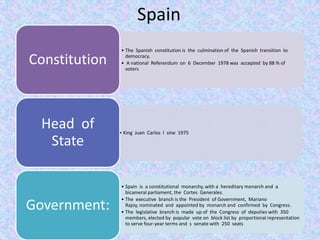
               • The Spanish constitution is the culmination of the Spanish transition to

Constitution     democracy.
               • A national Referendum on 6 December 1978 was accepted by 88 % of
                 voters


  Head of      • King Juan Carlos I sine 1975

   State

               • Spain is a constitutional monarchy, with a hereditary monarch and a
                 bicameral parliament, the Cortes Generales.
               • The executive branch is the President of Government, Mariano
Government:      Rajoy, nominated and appointed by monarch and confirmed by Congress.
               • The legislative branch is made up of the Congress of deputies with 350
                 members, elected by popular vote on block list by proportional representation
                 to serve four-year terms and s senate with 250 seats
Administrative system


                         There are 17
                         Autonomous
                         Communities            There are two
                        They have their              foral
  Spain is a               own elected          administrations
descentralised         parliaments, govern    , Basque Country
   country .              ments, public      and Navarra , They
                       administrations, bu   have got their own
                        dgets , therefore      public finances.
                            health and
                       education systems
Administrative divisions:
The basic institutional law of the autonomous community is the statute of Autonomy. They establish the
  denomination of the community according to its historical identity, the limits of their territories , the
                                                flag…


   The government of all autonomous communities must be based on a division of powers comprising:
1-A legislative Assembly whose members must be elected by universal suffrage according to the system of
                                    proportional representation .


           2- a government Council , with executive and administrative functions headed by a
           president, elected by the Legislative Assembly and nominated by the King of Spain
                 3-A supreme Court of Justice , under the Supreme Court of the State
The current fifty
  province structure is
   based on the one
  created in 1833 by
Javier de Burgos . The
     communities of
 Asturias, Cantabria, La
   Rioja, The Balearic
Island, Madrid , Murcia
  and Navarre having
      been granted
  autonomy as single-
provinces for historical
 reasons are counted
         as well
Cabildos are a Spanish system of government administration that are now only used in the
              Canary Islands, each governing one of the seven main islands -
Tenerife, Fuerteventura, Gran Canaria, Lanzarote, La Palma, La Gomera and El Hierro The
       island of La Graciosa falls under the jurisdiction of the cabildo of Lanzarote
It is a traditional region or local administrative division found in parts of
 Spain, Portugal,. The term is derived from the term marca, meaning a
       "march, mark" plus the prefix co- meaning "together, jointly".

Spain

  • 1.
    Spain • The Spanish constitution is the culmination of the Spanish transition to Constitution democracy. • A national Referendum on 6 December 1978 was accepted by 88 % of voters Head of • King Juan Carlos I sine 1975 State • Spain is a constitutional monarchy, with a hereditary monarch and a bicameral parliament, the Cortes Generales. • The executive branch is the President of Government, Mariano Government: Rajoy, nominated and appointed by monarch and confirmed by Congress. • The legislative branch is made up of the Congress of deputies with 350 members, elected by popular vote on block list by proportional representation to serve four-year terms and s senate with 250 seats
  • 2.
    Administrative system There are 17 Autonomous Communities There are two They have their foral Spain is a own elected administrations descentralised parliaments, govern , Basque Country country . ments, public and Navarra , They administrations, bu have got their own dgets , therefore public finances. health and education systems
  • 3.
    Administrative divisions: The basicinstitutional law of the autonomous community is the statute of Autonomy. They establish the denomination of the community according to its historical identity, the limits of their territories , the flag… The government of all autonomous communities must be based on a division of powers comprising: 1-A legislative Assembly whose members must be elected by universal suffrage according to the system of proportional representation . 2- a government Council , with executive and administrative functions headed by a president, elected by the Legislative Assembly and nominated by the King of Spain 3-A supreme Court of Justice , under the Supreme Court of the State
  • 5.
    The current fifty province structure is based on the one created in 1833 by Javier de Burgos . The communities of Asturias, Cantabria, La Rioja, The Balearic Island, Madrid , Murcia and Navarre having been granted autonomy as single- provinces for historical reasons are counted as well
  • 6.
    Cabildos are aSpanish system of government administration that are now only used in the Canary Islands, each governing one of the seven main islands - Tenerife, Fuerteventura, Gran Canaria, Lanzarote, La Palma, La Gomera and El Hierro The island of La Graciosa falls under the jurisdiction of the cabildo of Lanzarote
  • 7.
    It is atraditional region or local administrative division found in parts of Spain, Portugal,. The term is derived from the term marca, meaning a "march, mark" plus the prefix co- meaning "together, jointly".