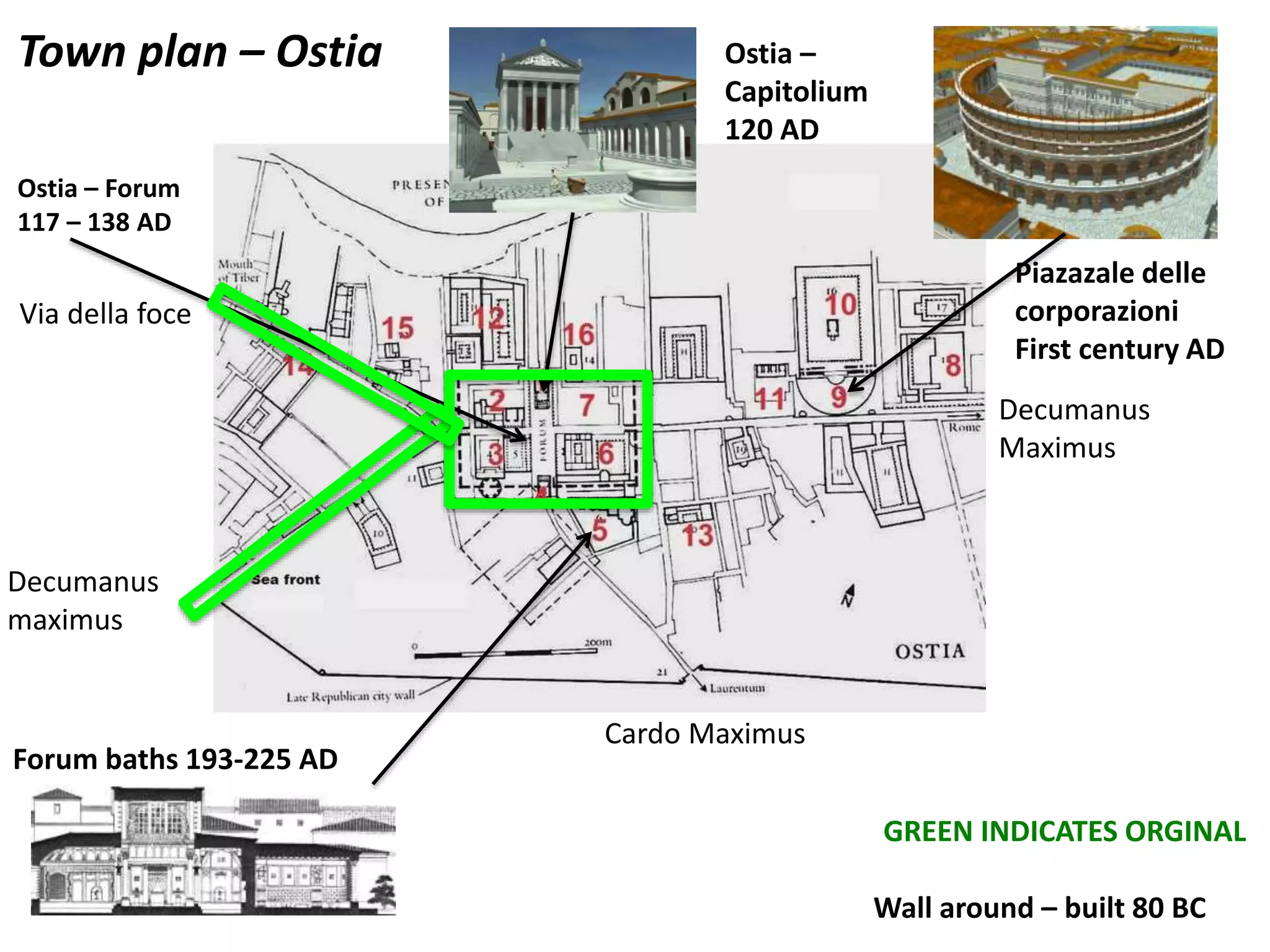
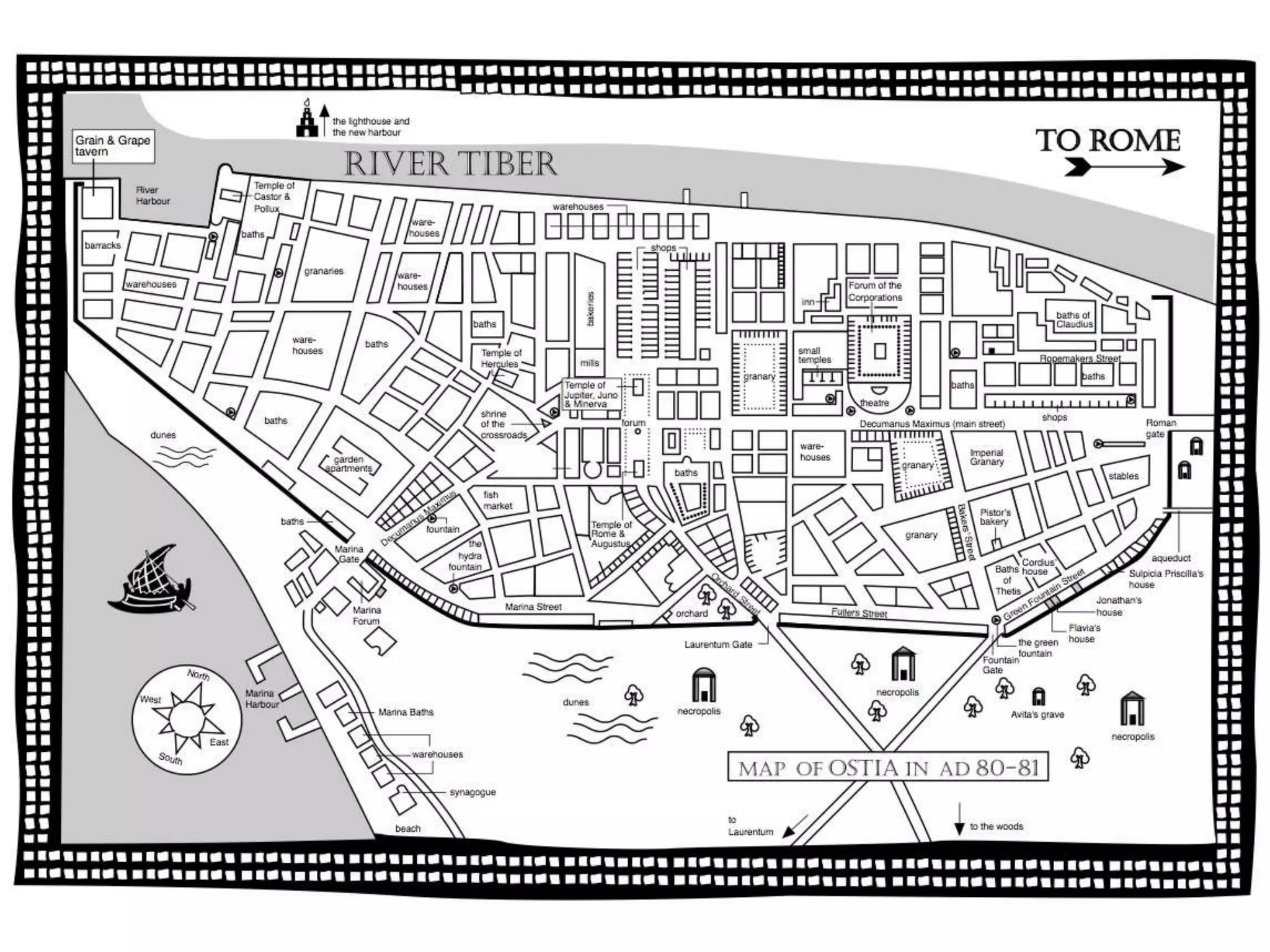
Town plan – Ostia
Forum baths 193-225 AD
Ostia –
Capitolium
120 AD
Ostia – Forum
117 – 138 AD
Piazazale delle
corporazioni
First century AD
Wall around – built 80 BC
GREEN INDICATES ORGINAL
Decumanus
maximus
Via della foce
Decumanus
Maximus
Cardo Maximus
Ostia town plan notes
• Originally roman military base (87BC civil war)
• Key to defense and trading ability
• Became main harbor – originally not because didn’t offer
natural protection to ships
• Went on developing into 3rd century BC
• Mouth of the Tiber
• 30 miles west of Rome
• Two-way phase development during early years BC
• Ostia spread south and west from small rectangular shape
• Surrounded by defensive walls w/ 3 city gates
• Eastern development following population increase
• Width of street varies (private property etc)
• Porticoes flanking the streets – identical facing porticos =
beautiful!!
• Small rectangular settlement around forum spilt exactly by
main N-S and W-E road
• Initial period of growth – involved spreading streets west and
south irregularly
• 80 BC walls built enclosing extended town
• Trajans harbour = commerical opportunities
• Forum sidelined by the growing infulence of the new square
of corportations in the new city
Water supply!
Originally drew from
wells and rivers
Aqueduct – first half of
1st century AD
System of storage tanks
w/ pipes to street
fountains and wealthy
houses
More modern system
than Pompeii
Received aqueduct after
Pompeii
Forum at Ostia
Capitolium dominates
the northern117-138 AD
Square surrounded by 4
major buildings –
Capitolium (N) temple of
Rome and Augustus (S),
curia (NW)and basilica
(SE)
Decumanus
Maximus continues
through the square
Pedestrians could only
enter from north and
south
Square covered in
concrete
W + E sides have hadrianic
porticoes
W/ granite columns and
marble pavement
Alter of Concordia (somewhere)
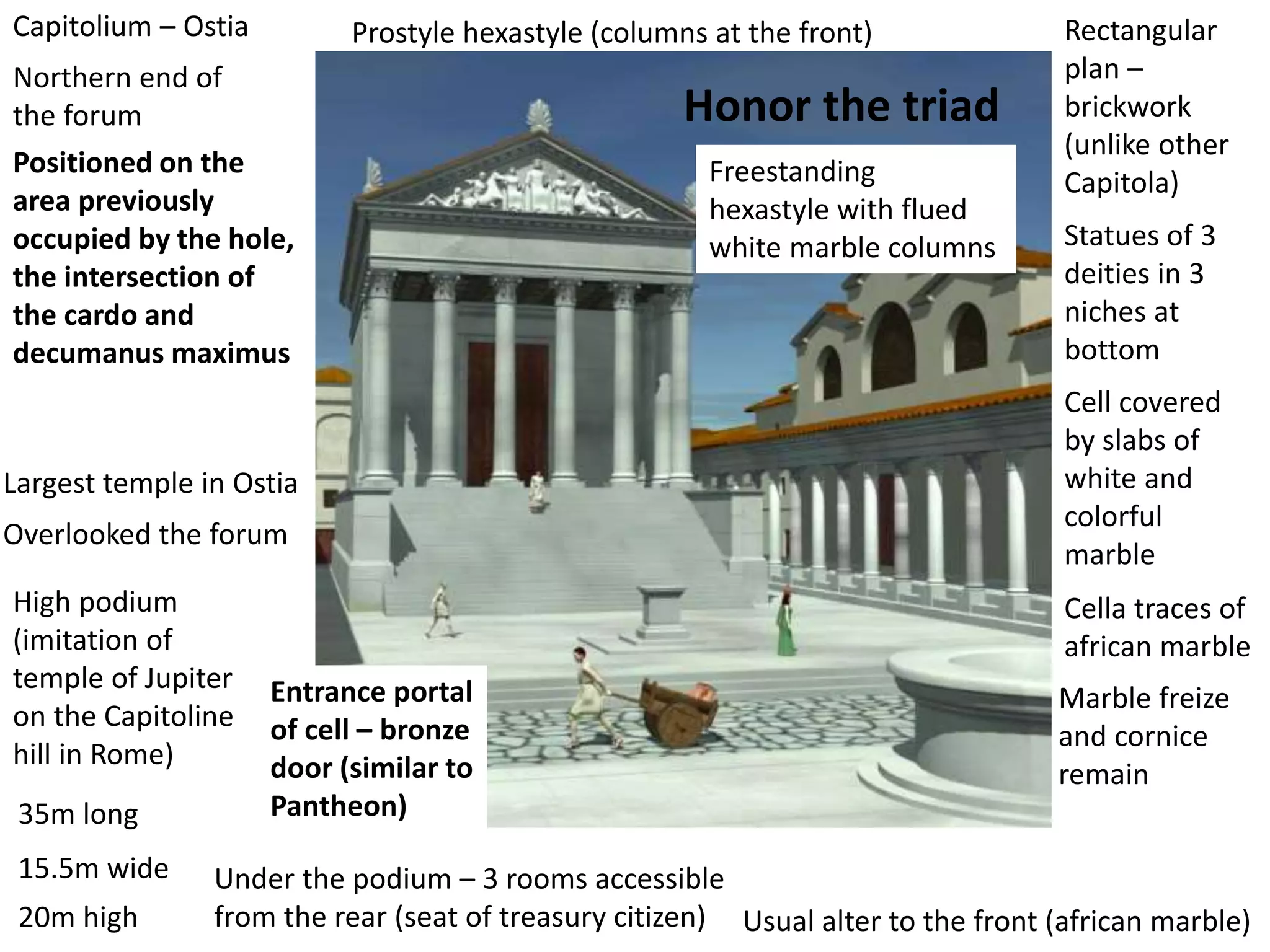
Capitolium – Ostia
Northern end of
the forum
Positioned on the
area previously
occupied by the hole,
the intersection of
the cardo and
decumanus maximus
Largest temple in Ostia
Overlooked the forum
High podium
(imitation of
temple of Jupiter
on the Capitoline
hill in Rome)
Prostyle hexastyle (columns at the front)
35m long
15.5m wide
20m high
Under the podium – 3 rooms accessible
from the rear (seat of treasury citizen)
Rectangular
plan –
brickwork
(unlike other
Capitola)
Statues of 3
deities in 3
niches at
bottom
Cell covered
by slabs of
white and
colorful
marble
Entrance portal
of cell – bronze
door (similar to
Pantheon)
Cella traces of
african marble
Marble freize
and cornice
remain
Usual alter to the front (african marble)
Honor the triad
Freestanding
hexastyle with flued
white marble columns
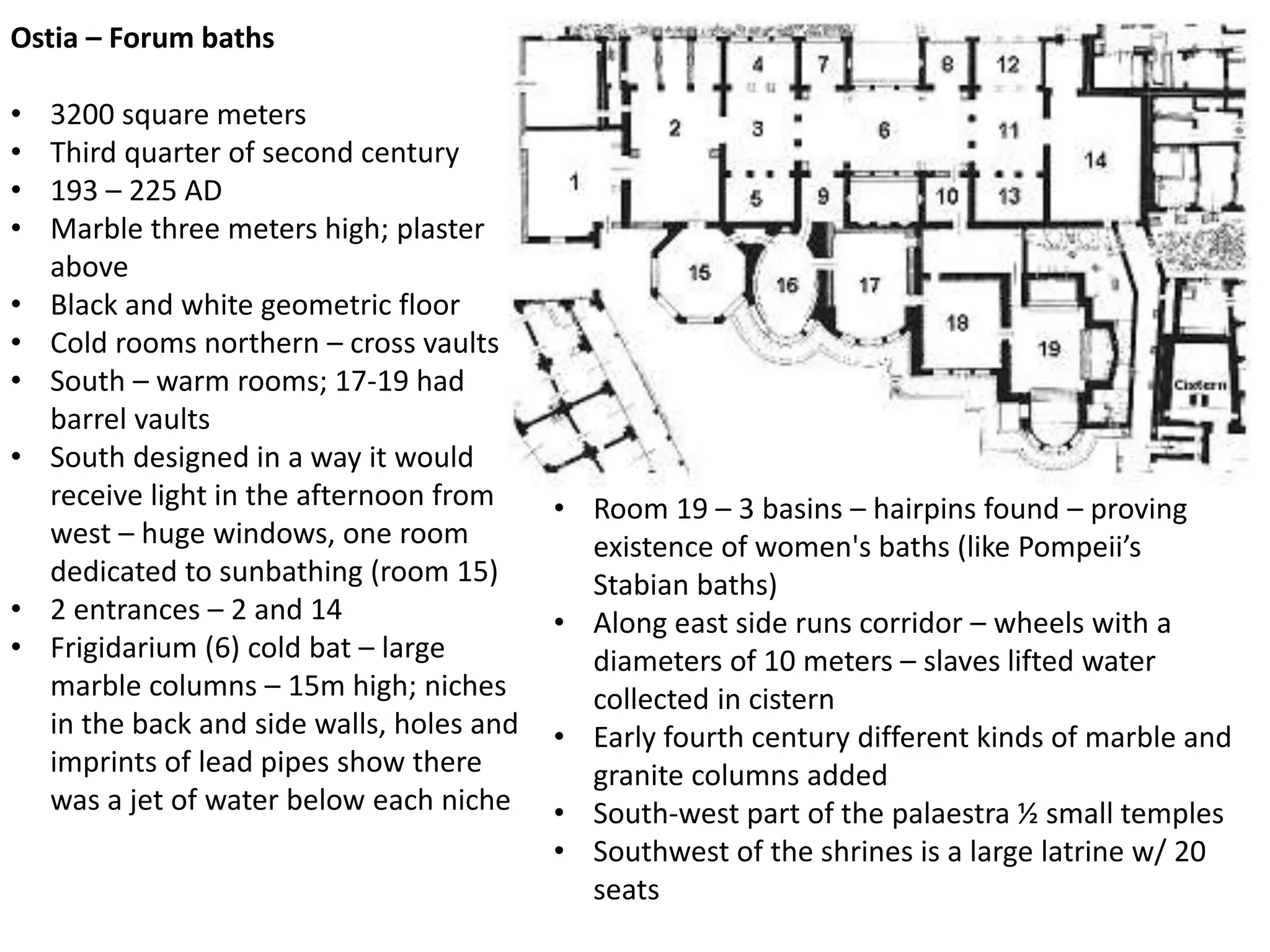
Ostia – Forum baths
• 3200 square meters
• Third quarter of second century
• 193 – 225 AD
• Marble three meters high; plaster
above
• Black and white geometric floor
• Cold rooms northern – cross vaults
• South – warm rooms; 17-19 had
barrel vaults
• South designed in a way it would
receive light in the afternoon from
west – huge windows, one room
dedicated to sunbathing (room 15)
• 2 entrances – 2 and 14
• Frigidarium (6) cold bat – large
marble columns – 15m high; niches
in the back and side walls, holes and
imprints of lead pipes show there
was a jet of water below each niche
• Room 19 – 3 basins – hairpins found – proving
existence of women's baths (like Pompeii’s
Stabian baths)
• Along east side runs corridor – wheels with a
diameters of 10 meters – slaves lifted water
collected in cistern
• Early fourth century different kinds of marble and
granite columns added
• South-west part of the palaestra ½ small temples
• Southwest of the shrines is a large latrine w/ 20
seats
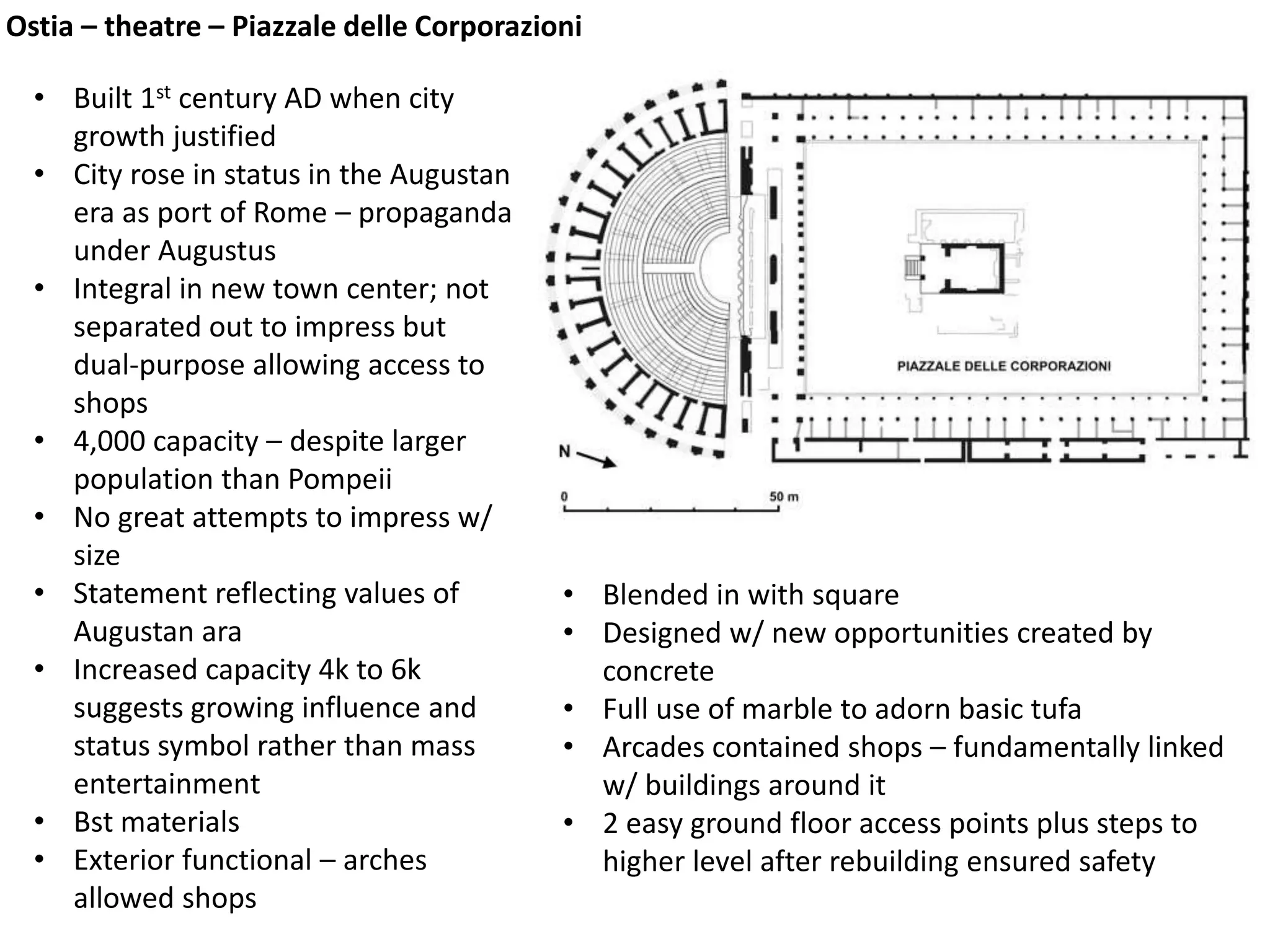
Ostia – theatre – Piazzale delle Corporazioni
• Built 1st century AD when city
growth justified
• City rose in status in the Augustan
era as port of Rome – propaganda
under Augustus
• Integral in new town center; not
separated out to impress but
dual-purpose allowing access to
shops
• 4,000 capacity – despite larger
population than Pompeii
• No great attempts to impress w/
size
• Statement reflecting values of
Augustan ara
• Increased capacity 4k to 6k
suggests growing influence and
status symbol rather than mass
entertainment
• Bst materials
• Exterior functional – arches
allowed shops
• Blended in with square
• Designed w/ new opportunities created by
concrete
• Full use of marble to adorn basic tufa
• Arcades contained shops – fundamentally linked
w/ buildings around it
• 2 easy ground floor access points plus steps to
higher level after rebuilding ensured safety
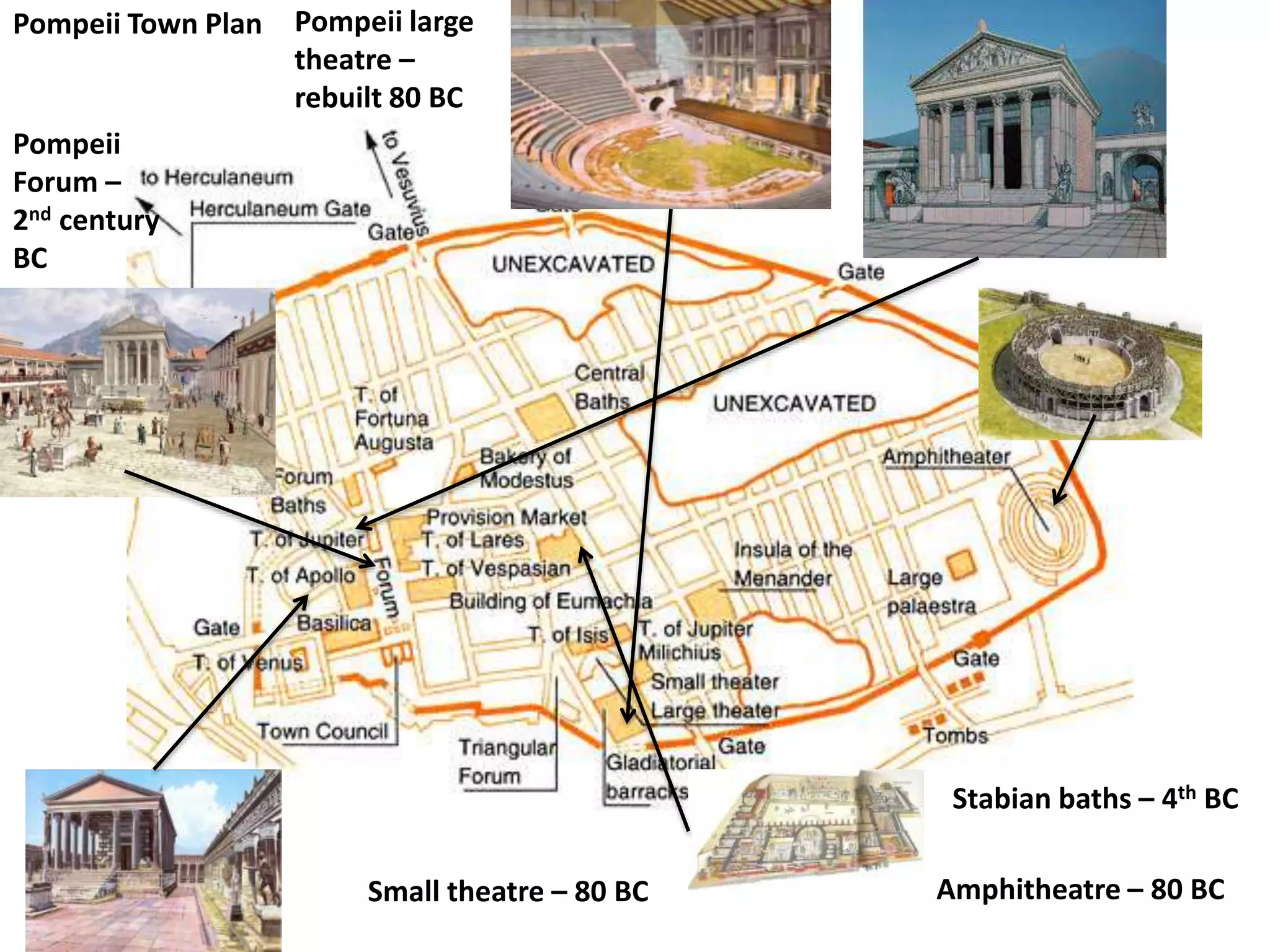
Pompeii Town Plan
Pompeii
Forum –
2nd century
BC
Pompeii large
theatre –
rebuilt 80 BC
Small theatre – 80 BC Amphitheatre – 80 BC
Stabian baths – 4th BC
POMPEII
Pompeii town plan notes Water supply!
Source – Starno river – wells helped
until demand outstripped supply
No aqueducts in early days, Sulla’s
Romanization of 80 BC = aqueducts
provided from Avella
1st century AD Augustus added new
aqueduct – Serino which replaced
orginal and served wider area = droop
in amount of water received by
Pompeii
Systems of storage tanks w/ pipes to
street fountains and the wealthy
houses – water supply earlier than
Ostia.
Public baths – distribution tanks;
effect on demand of water
Stabian baths dependent on wells/ran
water; Early hypocaust system,
eventually gender suites
PROBLEMS DEALT W/ - primitive
drainage system pre-roman – sewage
removal left running down streets
• Greek settlement – greek influence
• Colony in 80 BC – soldiers home etc
• Mix of orderly and less orderly planning
• Greek background meant roman grid-plan came after
period of less organized growth
• Development cut off 79 BC – VOLCANO
• STREET PLANS: 2 way phase development during early
years, spread North east from Greek settlement
• Surrounded by defensive walls w/ 7 gates
• Population growth = growth to the east
• Final stage encompassed area of main north south
street; developed on regular roman grid plan to this
road
• By 3rd century BC the town was at its final size
• Commercial – based around forum, rendered off by
eastward developments, houses key political and
religious buildings. Baths + theatres eastward
• Political – forum; cura
• Population growth – domus expansions – 80 BC
gradual growth, destruction of 79 AD froze
• Leisure – standard facilities, 2 theatres from early,
improvements included large Amphitheatre
Forum - Pompeii Forum
Temple of Jupiter
– Northern –
closes forum off
from the North.
Dominated
Narrow –
142m x 38m
Open piazza
with 2-storey
portico
around West,
South and East
Sides
Open central
area
Filled with
statues,
platforms and
notice boards
Gathering space
Forum baths just behind
Laid out 2nd century BC
Three civil offices – Thought to
be comitia, curia and junior
magistrates offices
Covered market
South west
corner of the
city
Central when built
Later Roman development to the North and East left the forum in the original (irregularly planned) south
west corner of the city
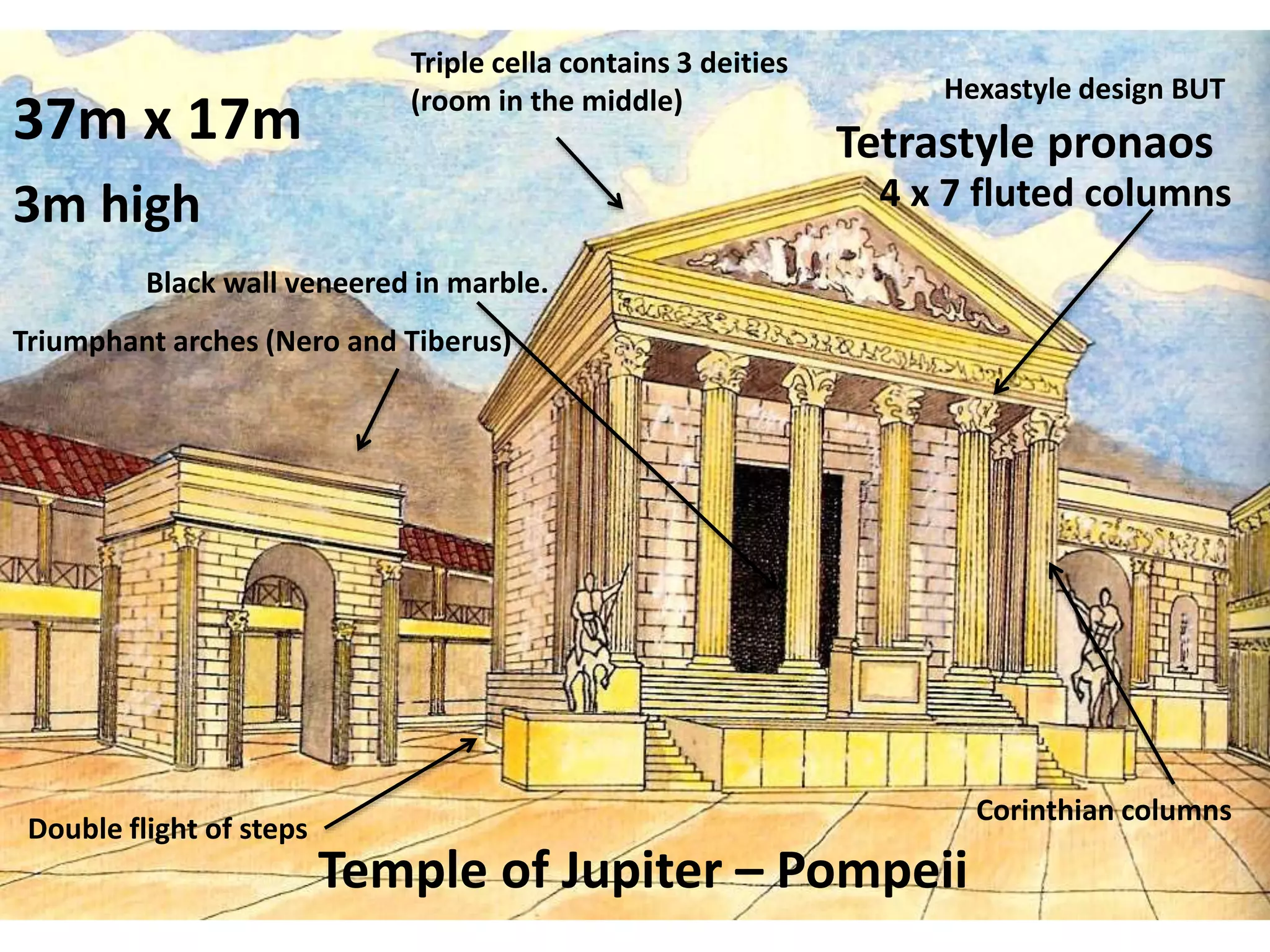
Temple of Jupiter – Pompeii
37m x 17m
3m high
Tetrastyle pronaos
4 x 7 fluted columns
Triumphant arches (Nero and Tiberus)
Triple cella contains 3 deities
(room in the middle)
Black wall veneered in marble.
Double flight of steps
Hexastyle design BUT
Corinthian columns
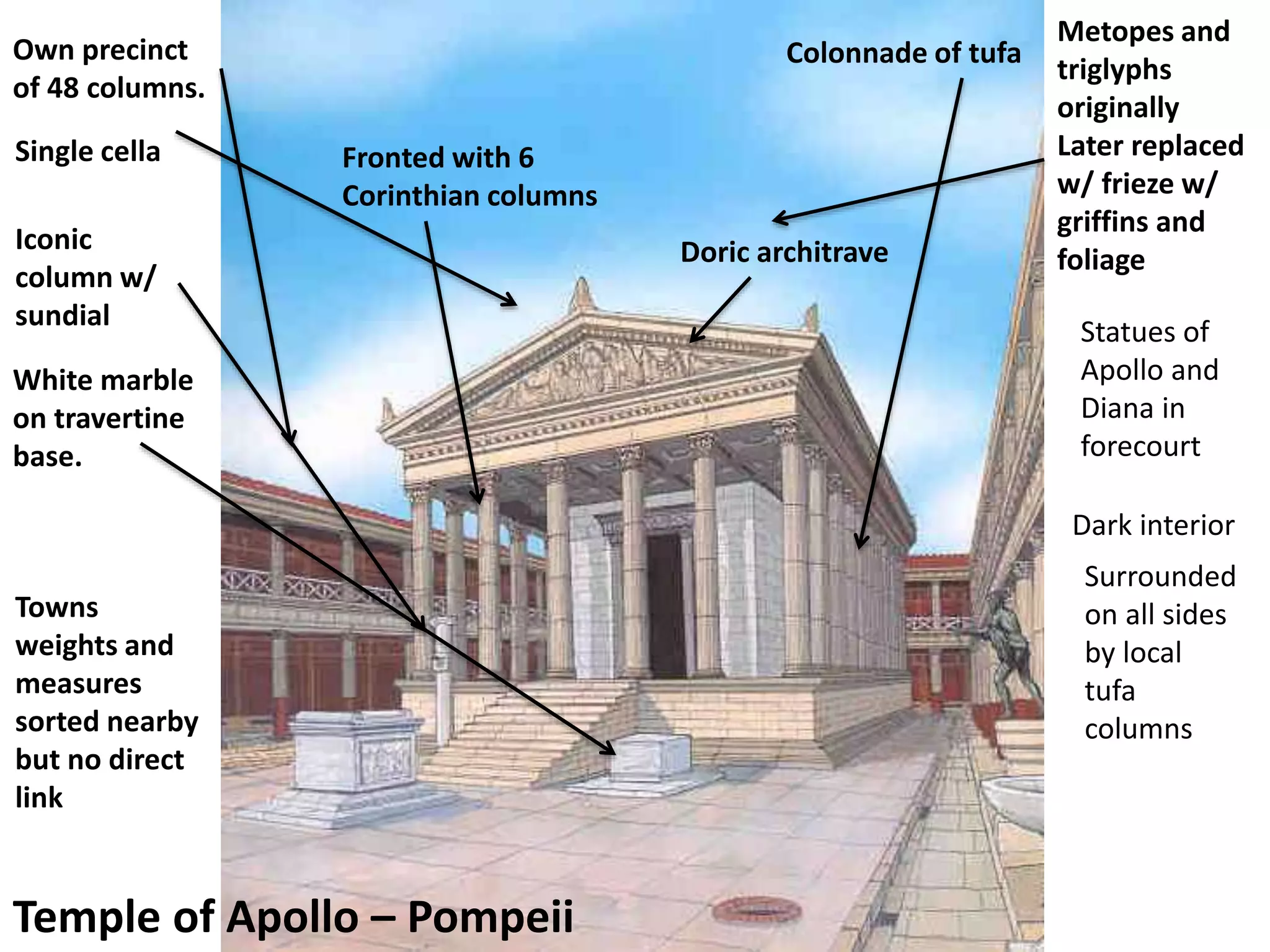
Temple of Apollo – Pompeii
Iconic
column w/
sundial
White marble
on travertine
base.
Own precinct
of 48 columns.
Single cella Fronted with 6
Corinthian columns
Doric architrave
Metopes and
triglyphs
originally
Later replaced
w/ frieze w/
griffins and
foliage
Colonnade of tufa
Statues of
Apollo and
Diana in
forecourt
Dark interior
Surrounded
on all sides
by local
tufa
columns
Towns
weights and
measures
sorted nearby
but no direct
link
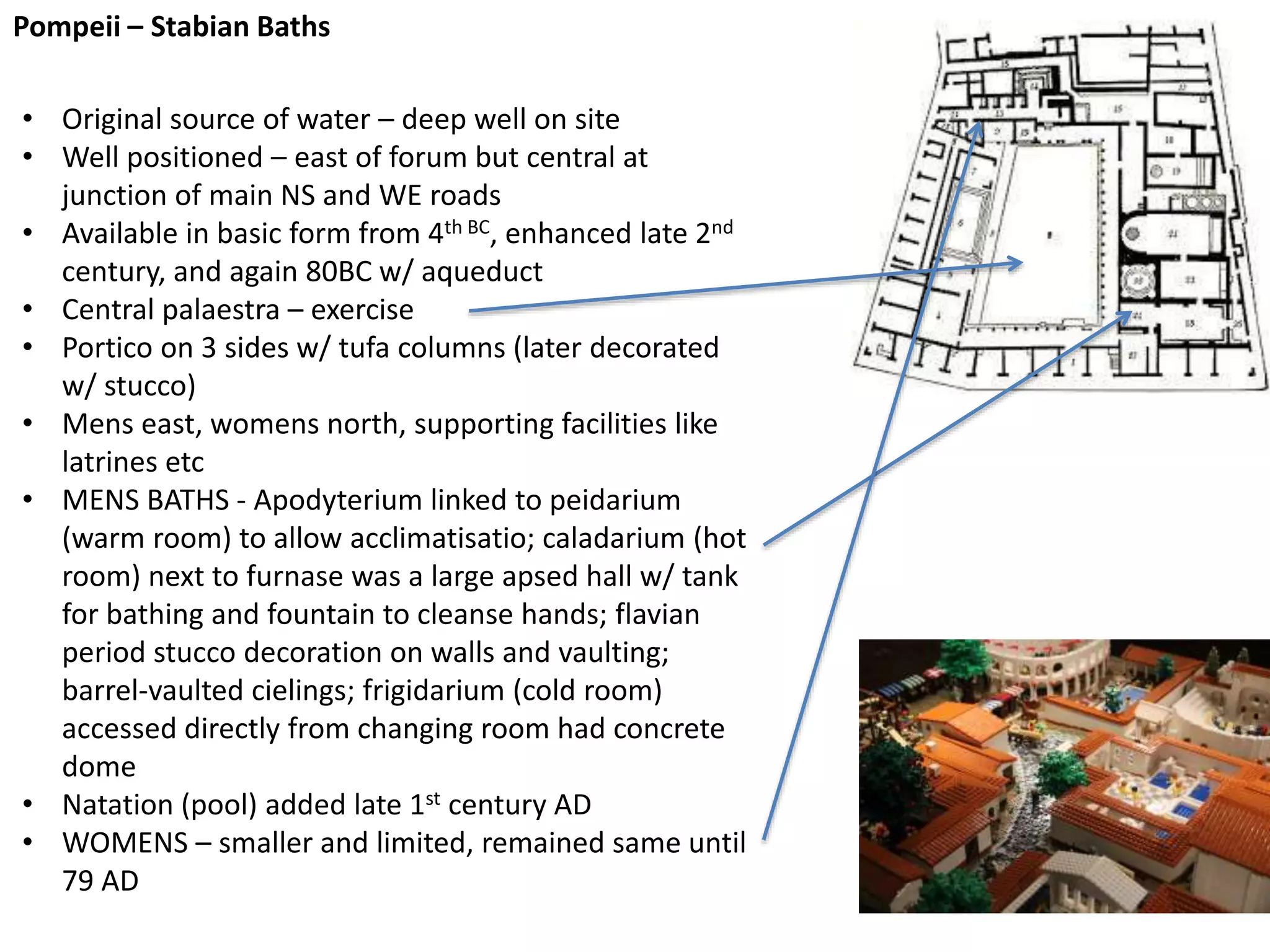
Pompeii – Stabian Baths
• Original source of water – deep well on site
• Well positioned – east of forum but central at
junction of main NS and WE roads
• Available in basic form from 4th BC, enhanced late 2nd
century, and again 80BC w/ aqueduct
• Central palaestra – exercise
• Portico on 3 sides w/ tufa columns (later decorated
w/ stucco)
• Mens east, womens north, supporting facilities like
latrines etc
• MENS BATHS - Apodyterium linked to peidarium
(warm room) to allow acclimatisatio; caladarium (hot
room) next to furnase was a large apsed hall w/ tank
for bathing and fountain to cleanse hands; flavian
period stucco decoration on walls and vaulting;
barrel-vaulted cielings; frigidarium (cold room)
accessed directly from changing room had concrete
dome
• Natation (pool) added late 1st century AD
• WOMENS – smaller and limited, remained same until
79 AD
Pompeii Large theatre and gladiatorial barracks
• Provided in 80 BC – population increased because it
was made a colony
• Pre-roman (first half of 2nd century) but rebuilt in 80 BC
• Unimposing position by the original Greek forum
• Built into hillside
• Capacity 3k – roman rebuilding added 2k = 5k
• Functional rather than a political statement
• Provision of new access at the top
• Removal of the gathering piazza outside to provide
gladiator barracks in support of the new Amphitheatre
• All deliberate to emphasize new roman city
• Local stone used w/ little decoration
• Enlargement of 80 BC = marble to impress (paid by
local merchants)
• Safety provided by adding top tier access from old
forum to access lower tiers (from either side of
orchestra w/ five rows of stairs)
• Cover against weather provided by awning on
temporary basis as needed
• Safe given small capacity
Pompeii Small theatre
• Provided 80 BC
• Local chiefs sponsored – Valgus and Porcius paying
for this and Amphitheatre
• Capacity of 1k
• Attractive but hidden behind large theatre
• Hard to see from outside
• Impressive by its existence – magistrates seeking to
influence rich minority
• All-over roof extravagant – acoustic reasons?
• Aimed at small minority – exclusive
• Permanent roof made of wood – improve quality of
sound
• Personal performances such as concerts, recitals and
mimes
Pompeii Amphitheatre
• 80 BC samnite influence seen off by Sulla; new
rulers wanted to put stamp on city
• 2 magistrates paid for construction
• Eastern part – well away from original town
center
• Providing games = support
• 20,000 capacity by 79 AD
• Eastern side of city – new focus among the
buildings of new roman town which grew around
it
• Basic materials
• No attempt to face w/ marble concrete
• Faced w/ opus incetum instead – giving strength
• Later techniques of support; vaulted passages or
subterranean cells
• Buttresses used and building onto city walls gave
further strength
• Basic frame of arches but blind offering no access
to interior
• Steps of exterior steps narrow
• 2 small tunnels led to small
circulation area and railed off
rows for elite
• Cramped for everyone
• Set into ground – no dominance
from height
• Use of local stone and
embellished appearance more
function
• First arena made of masonry –
impressed
• Arches w/ outside staircases
gave impression of style!!!
WATER SUPPLY BASICS
ROMAN WATER SUPPLY
Rome water supply
• River tiber water supply – fine for
original town but couldn’t cope w/
increasing demand
• Aqueducts and associated water
channels
• Aqua Appia 392 BC
• Three more built before 100 BC –
three shorter ones followed during
Augustan era; finally there was 11
total over 500 miles
• Public baths: supplied from
distribution tanks direct from own
aqueduct
• Aqua Marcia in the case of the baths
of Caracalla
• Caracalla had major impact on the
demand for water – 1600 bathers a
minute!!!!
How the problems were dealt with…
CLOACAO MAXIMA – SEWAGE
SYSTEM!!!!!
• Water supply wasn’t originally top
priority in any city
• Rome had population over over 1 million
by 1st century AD
• All cities had availability of some natural
water sources (wells and rivers)
• Aimed to provide drinking water; settling
chambers and reception reservoirs used
to offload from aqueducts in both cities
• Water pumped into distribution tanks,
often ornate in appearance, from here
pipes led to public fountains to supply
the poor
• Rain collected in impluvia supplemented
individual houses
PROBLEMS
• Leakage, conflict between practical and
aesthetic issues at city approaches,
difficulties in maintaining underground
channels
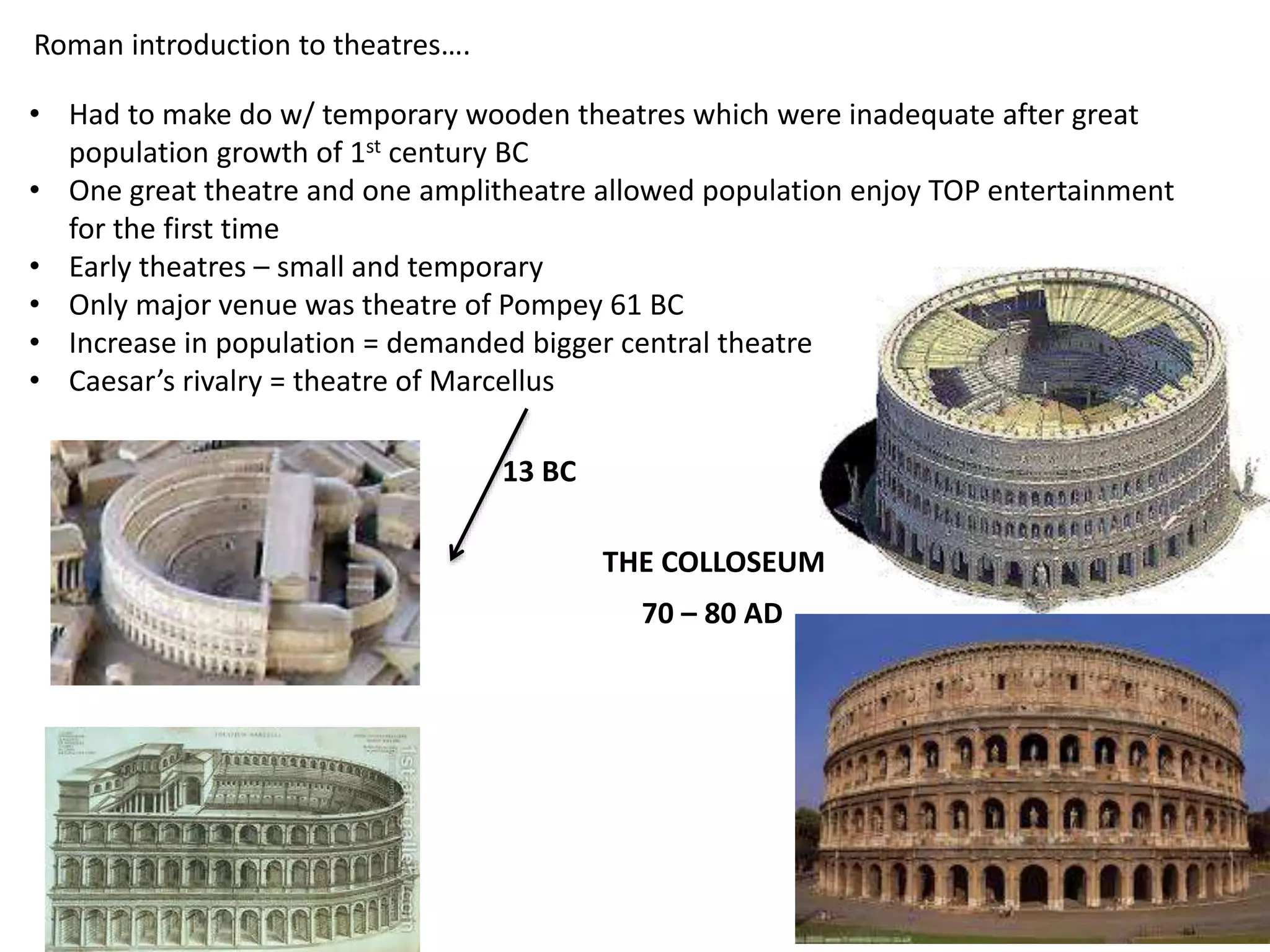
Roman introduction to theatres….
• Had to make do w/ temporary wooden theatres which were inadequate after great
population growth of 1st century BC
• One great theatre and one amplitheatre allowed population enjoy TOP entertainment
for the first time
• Early theatres – small and temporary
• Only major venue was theatre of Pompey 61 BC
• Increase in population = demanded bigger central theatre
• Caesar’s rivalry = theatre of Marcellus
13 BC
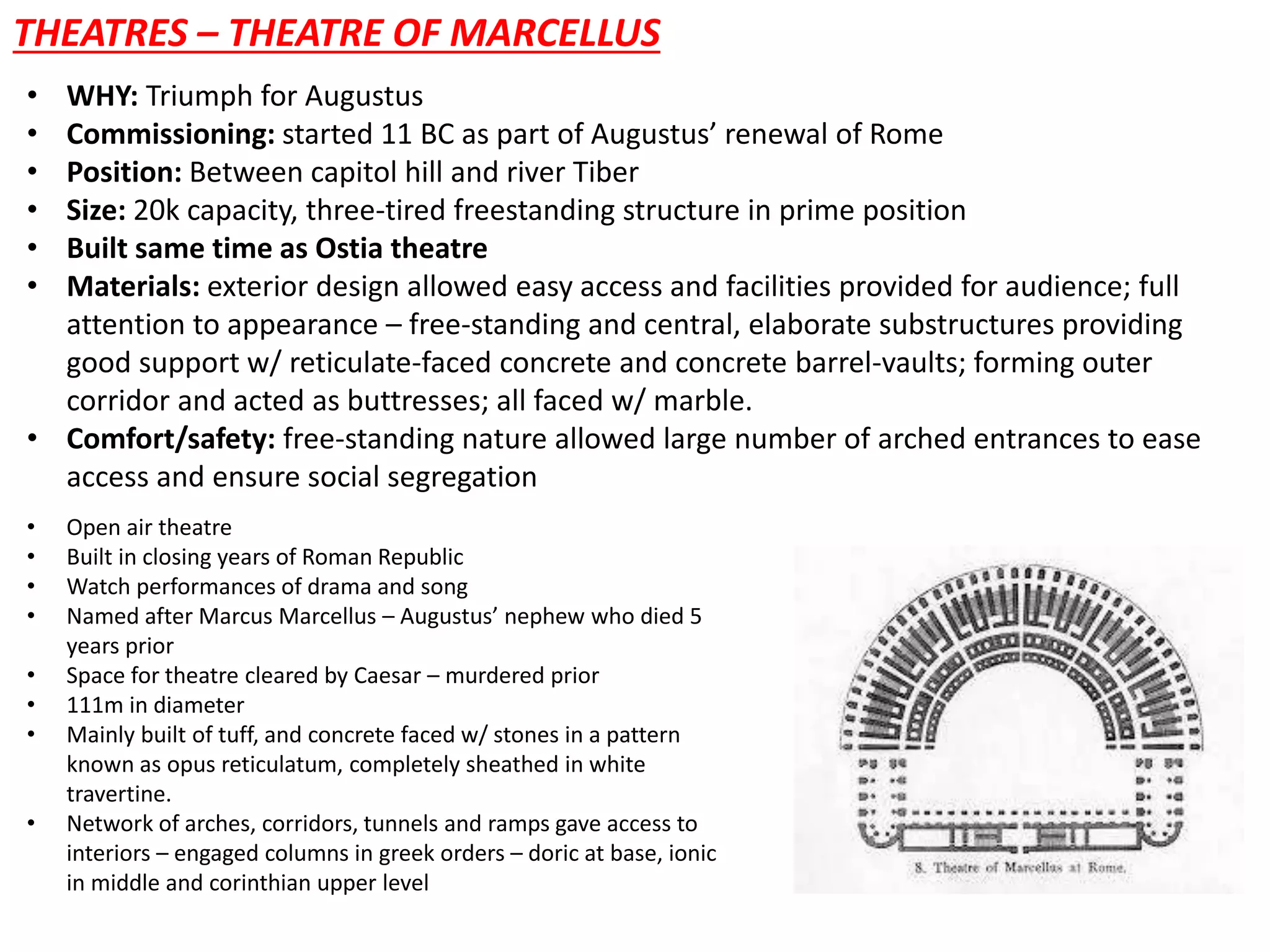
THE COLLOSEUM
70 – 80 AD
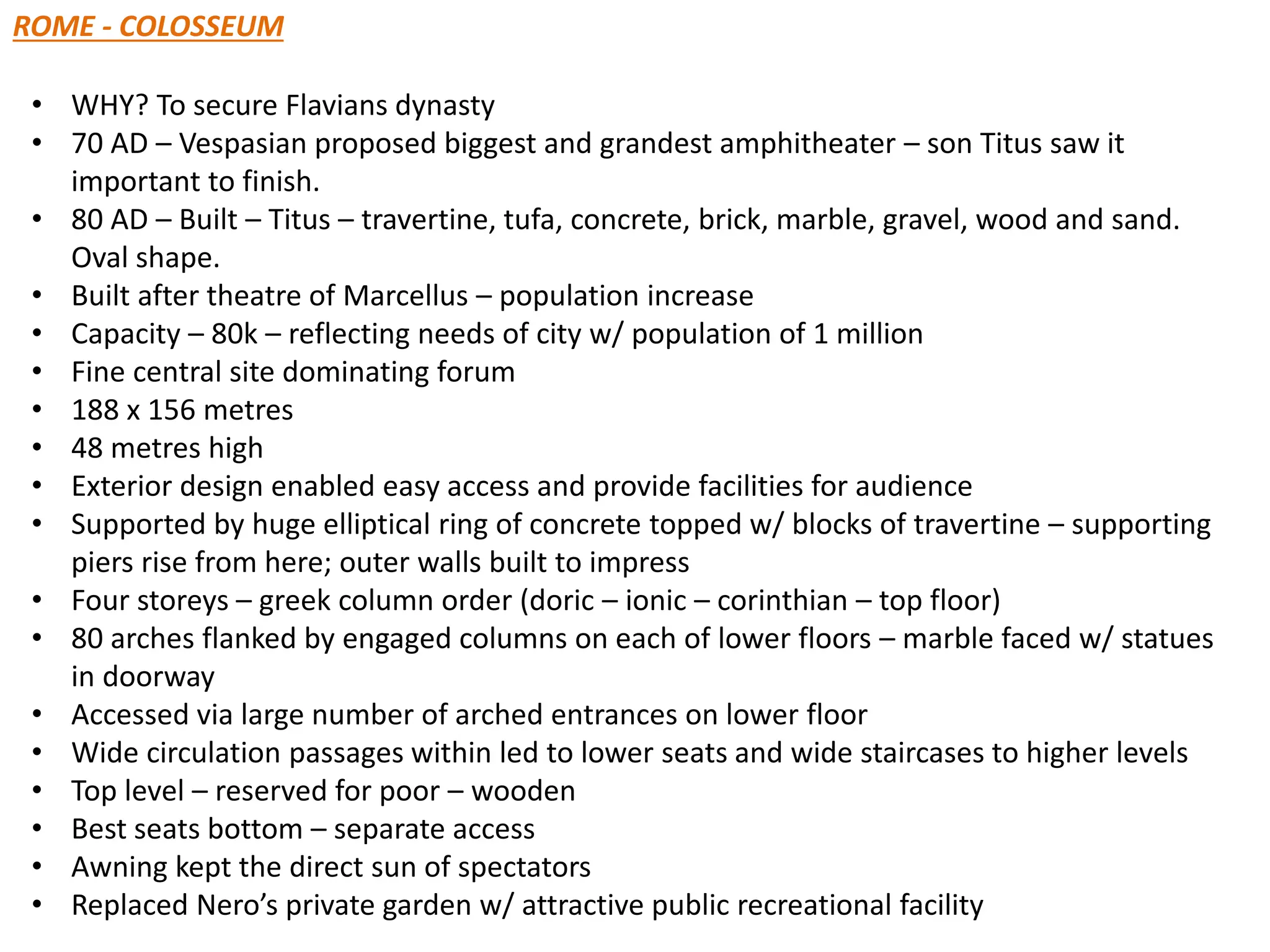
THEATRES – THEATRE OF MARCELLUS
• WHY: Triumph for Augustus
• Commissioning: started 11 BC as part of Augustus’ renewal of Rome
• Position: Between capitol hill and river Tiber
• Size: 20k capacity, three-tired freestanding structure in prime position
• Built same time as Ostia theatre
• Materials: exterior design allowed easy access and facilities provided for audience; full
attention to appearance – free-standing and central, elaborate substructures providing
good support w/ reticulate-faced concrete and concrete barrel-vaults; forming outer
corridor and acted as buttresses; all faced w/ marble.
• Comfort/safety: free-standing nature allowed large number of arched entrances to ease
access and ensure social segregation
• Open air theatre
• Built in closing years of Roman Republic
• Watch performances of drama and song
• Named after Marcus Marcellus – Augustus’ nephew who died 5
years prior
• Space for theatre cleared by Caesar – murdered prior
• 111m in diameter
• Mainly built of tuff, and concrete faced w/ stones in a pattern
known as opus reticulatum, completely sheathed in white
travertine.
• Network of arches, corridors, tunnels and ramps gave access to
interiors – engaged columns in greek orders – doric at base, ionic
in middle and corinthian upper level
THEATRES – COLLOSEUM
ROME - COLOSSEUM
• WHY? To secure Flavians dynasty
• 70 AD – Vespasian proposed biggest and grandest amphitheater – son Titus saw it
important to finish.
• 80 AD – Built – Titus – travertine, tufa, concrete, brick, marble, gravel, wood and sand.
Oval shape.
• Built after theatre of Marcellus – population increase
• Capacity – 80k – reflecting needs of city w/ population of 1 million
• Fine central site dominating forum
• 188 x 156 metres
• 48 metres high
• Exterior design enabled easy access and provide facilities for audience
• Supported by huge elliptical ring of concrete topped w/ blocks of travertine – supporting
piers rise from here; outer walls built to impress
• Four storeys – greek column order (doric – ionic – corinthian – top floor)
• 80 arches flanked by engaged columns on each of lower floors – marble faced w/ statues
in doorway
• Accessed via large number of arched entrances on lower floor
• Wide circulation passages within led to lower seats and wide staircases to higher levels
• Top level – reserved for poor – wooden
• Best seats bottom – separate access
• Awning kept the direct sun of spectators
• Replaced Nero’s private garden w/ attractive public recreational facility
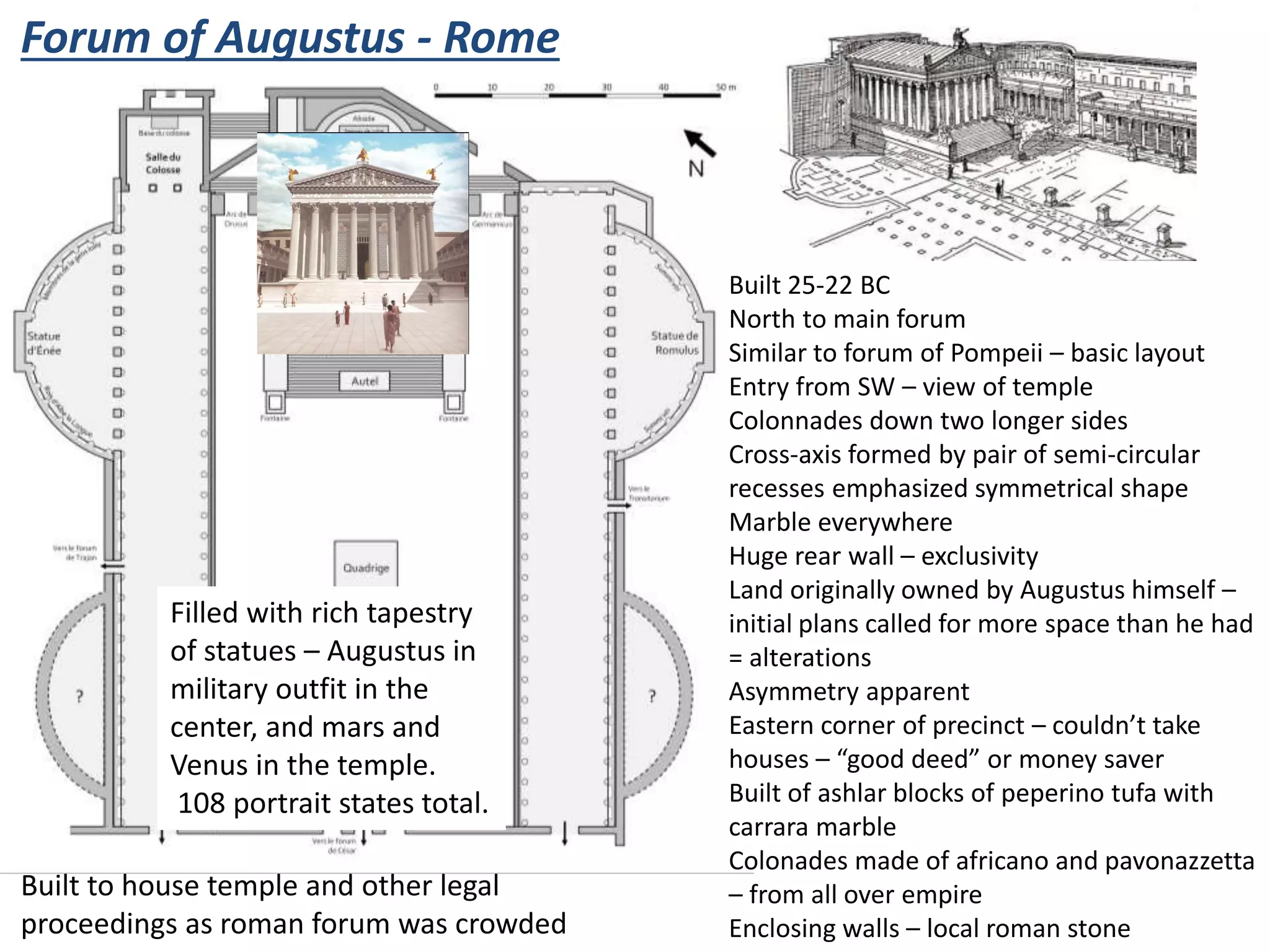
Forum of Augustus - Rome
Built 25-22 BC
North to main forum
Similar to forum of Pompeii – basic layout
Entry from SW – view of temple
Colonnades down two longer sides
Cross-axis formed by pair of semi-circular
recesses emphasized symmetrical shape
Marble everywhere
Huge rear wall – exclusivity
Land originally owned by Augustus himself –
initial plans called for more space than he had
= alterations
Asymmetry apparent
Eastern corner of precinct – couldn’t take
houses – “good deed” or money saver
Built of ashlar blocks of peperino tufa with
carrara marble
Colonades made of africano and pavonazzetta
– from all over empire
Enclosing walls – local roman stone
Built to house temple and other legal
proceedings as roman forum was crowded
Filled with rich tapestry
of statues – Augustus in
military outfit in the
center, and mars and
Venus in the temple.
108 portrait states total.
Temple of Mars the Avenger - ROME
2BC
High podium – more
roman style by Augustus
Propaganda at home
Fully integrated into the
design of forum of
augustus
Steep steps to approach
Asymmetry apparent –
houses in east corner
Square plan
Frontal focus
Long cella
Leading to
statues of Mars
and Venus
Senate met here
Young men
accepted their
toga virillis
First roman
temple made
entirely of
marble
Abutting on to
tufa back wall of
forum that had
to be incorpated
Pediment and
decoration lost
8 solid white marble Corinthian
columns on sides backing to precint
wall
Rome Pantheon
27 BC Renovated at the same time as
the temple of trajan
Formal gateway
Forecourt – 44m x 60m wide
Size spoke for itself – no podium
needed
Traditional frontage of 8
unfluted corinthian pillars (14m)
Two more at each side
Pronaos of 3 vaulted corridors
divided by further 8 red inner
columns
Interior surprise! Rotunda
Rotunda consisted of circular
drum topped by hemispherical
dome
Oculus for light
Sign of roman technological
progress + confidence
Temple for ALL gods
Granite columns in forecourt
Outer structure
was tufa faced w/
white marble
Interior marble
and granite
Coffered ceiling of light
pumice lined with lead
sheets
43m concrete dome
Lower section of dome was actually core structure
Weight distribution – 8 giant pillars
Bronze eagle in wreath
Inscription naming M.Agrippa builder
Front suggested rectangular structure
Gilded tiles from
rotunda visible
from above
Pantheon
Interior a surprise
Oculus for light
Floor of marble and granite slabs
Screens of pilasters
Columns in various marbles from all
over the empire
Oculus at dome’s apex for light and to
cool and ventilate
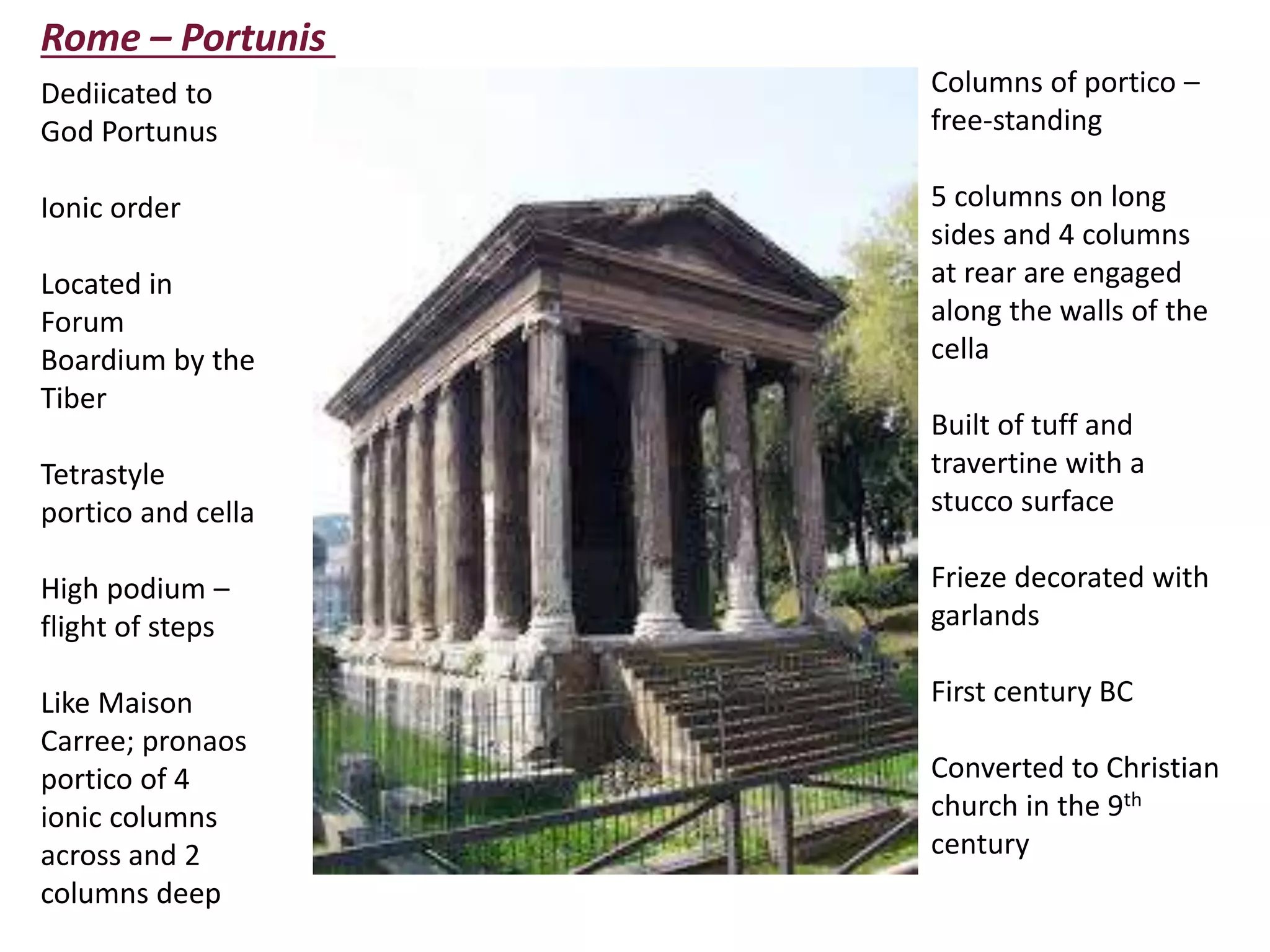
Rome – Portunis
Dediicated to
God Portunus
Ionic order
Located in
Forum
Boardium by the
Tiber
Tetrastyle
portico and cella
High podium –
flight of steps
Like Maison
Carree; pronaos
portico of 4
ionic columns
across and 2
columns deep
Columns of portico –
free-standing
5 columns on long
sides and 4 columns
at rear are engaged
along the walls of the
cella
Built of tuff and
travertine with a
stucco surface
Frieze decorated with
garlands
First century BC
Converted to Christian
church in the 9th
century
38 m high
106 – 113 AD
North west of main
forum
Main square – flanked
by 2 porticoes (112m
long)
Marble paving in
square
Market nearby – not
part of it
Designed to surpass
forum of Augustus
Basilica w/ civil
buildings
2 storeyed building
Entrance screened by
10 columns
Huge project to dig out
Quirinal Hill to build
On the via dei fori
imperiali
Opposite end to
Colosseum
Cobbled w/ rectangular
blocks of white marble
Built from stoa-lined
piazza 200mx120m
Exedrae on each side
Forum and Market of Trajan
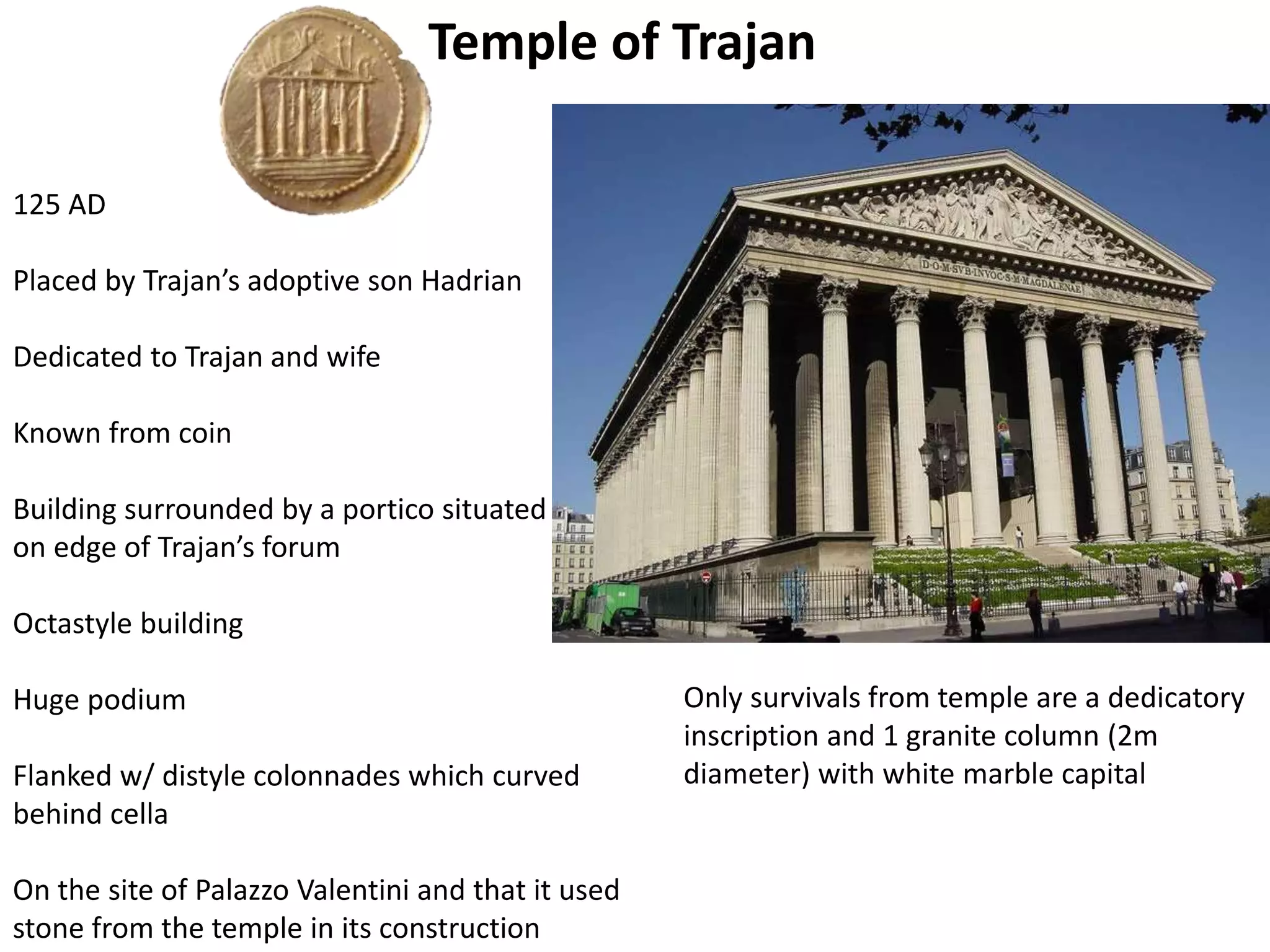
Temple of Trajan
125 AD
Placed by Trajan’s adoptive son Hadrian
Dedicated to Trajan and wife
Known from coin
Building surrounded by a portico situated
on edge of Trajan’s forum
Octastyle building
Huge podium
Flanked w/ distyle colonnades which curved
behind cella
On the site of Palazzo Valentini and that it used
stone from the temple in its construction
Only survivals from temple are a dedicatory
inscription and 1 granite column (2m
diameter) with white marble capital
Temple of Vesta
Located in the Roman forum
near the Regia and house of
the vestal virgins
Greek architecture w/
Corinthian columns
Marble
Central Cella
20 Corinthian columns built
on a podium 15m in
diameter
Roof had vent at the apex to
allow smoke release
Eastern entrance to
symbolize connection
between Vesta’s fire and sun
as sources of life
Cult activity as far back as 7th
century BCE
Built by Pompollius w/
Regia and house of
Vestal Virgins
Temple stood in Sacred
Grave - graveyard
One of the earliest
structures in the
Roman Forum
Instead of cult statue in
the cella there was a
hearth which held the
sacred flame
Storehouse for legal
wills and documents
of Roman senators +
cult objects (e.g.
palladium)
Romans believed the
sacred flame’s
extinction as a portent
of disaster
Burnt down twice (not
because of hazards
flame though) – 64
great fire of Rome
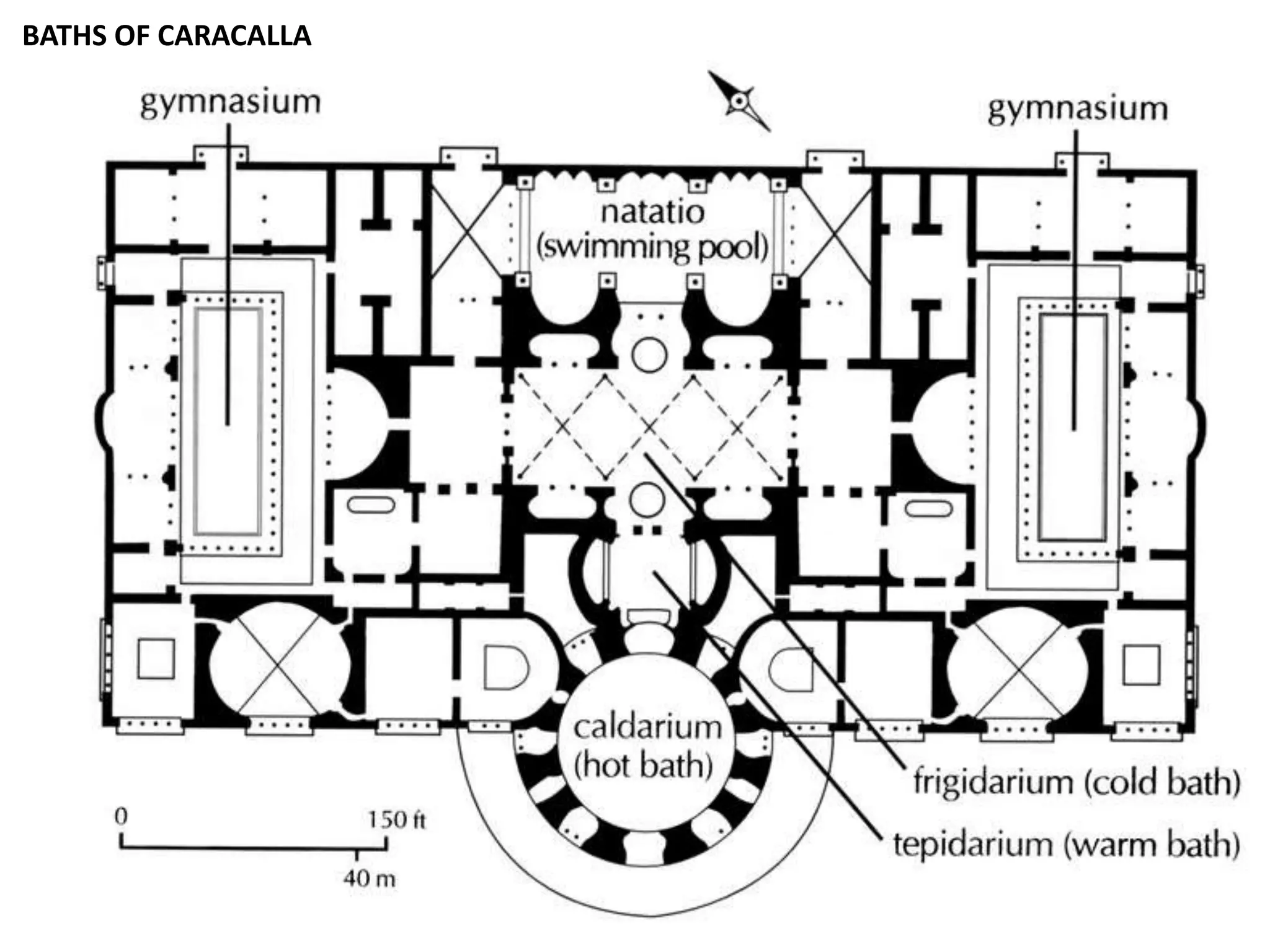
BATHS OF CARACALLA
BATHS OF CARACALLA
• Built 211-216 AD by Caracalla as
statement of imperial power to
cement position to the people
• Population growth led to hygiene
problems
• 100,000 square metres; main hall w/
4 different entrnaces, cross vaulted
in 3 bays w/ huge piers to support
• 225 x 185 x 35 meters high
• Central imposing block with
natation, frigidarium and circular
caldarium aligned on central axis
• Elegant balance of added structured
235 AD
• 9,000 workmen 5 years
• Flattening existing buildings, removal
of 150,000cm of earth; provision of
earth, stone and mortar for
foundations
• Creation of substructures
• 280,000cm of tufa and mortar and
15 million pieces of brick
• Cranes to raise walls and vaults of
concrete
• 815,000 whole bricks
• Creation of orante columns not struturally
necessary – architectural statement
• Baths made of granite, basalt and
alabaster
8.2 million litre
capacity OMG
BATHS OF CARACALLA EXTERNAL AND INTERNAL DECORATION
• New street created parallel to via appai = full effect
of baths
• Use of marble and granite (252 full column shafts)
• Décor in main rooms – mix of statues, exotic marble
facing and mosaic work
• Interior of bathsfocal point of style but exterior not
neglected
EXTERIOR
• Multi-tiered ranks of columns and niches recall
theatre frontages
• Spiritually uplifting
Facilities provided
• Baths – giant frigidarium at center (3 cross vaults,
bays in each corner w/ plunge baths – decorated w/
2 columns)
• Circular caldarium = unique
• Palaestra in east wing open to the sky with portico of
Corinthian columns on 3 sides
• Libraries, shops, gardens etc
• Fresh air and open spaces
Cosa – Capitolium2nd BC
Good site
Levelled ground but
above city rather
than in forum
Stone steps up to
high podium
(3.7m)
Surrounded
by stone wall
Brick-built temple
4 widely spaced
Tuscan columns
fronted the porch
Back half was
enclosed (allowed
entrants light to dark
effect)
Shallow ridge roof
hung over entablature
and porch as well as
sides – weather
protection
Brick but
substructure
and roof
framework of
WOOD
Triple cella at the back
Decorations
of terracotta
but only at
the front
No freize all around
Deep porch with façade
of tuscan columns
projecting side walls at
cella end of porch
Triple cella
had statues of
capitoline
triad
Terracotta roof
Building
had
blank
walls
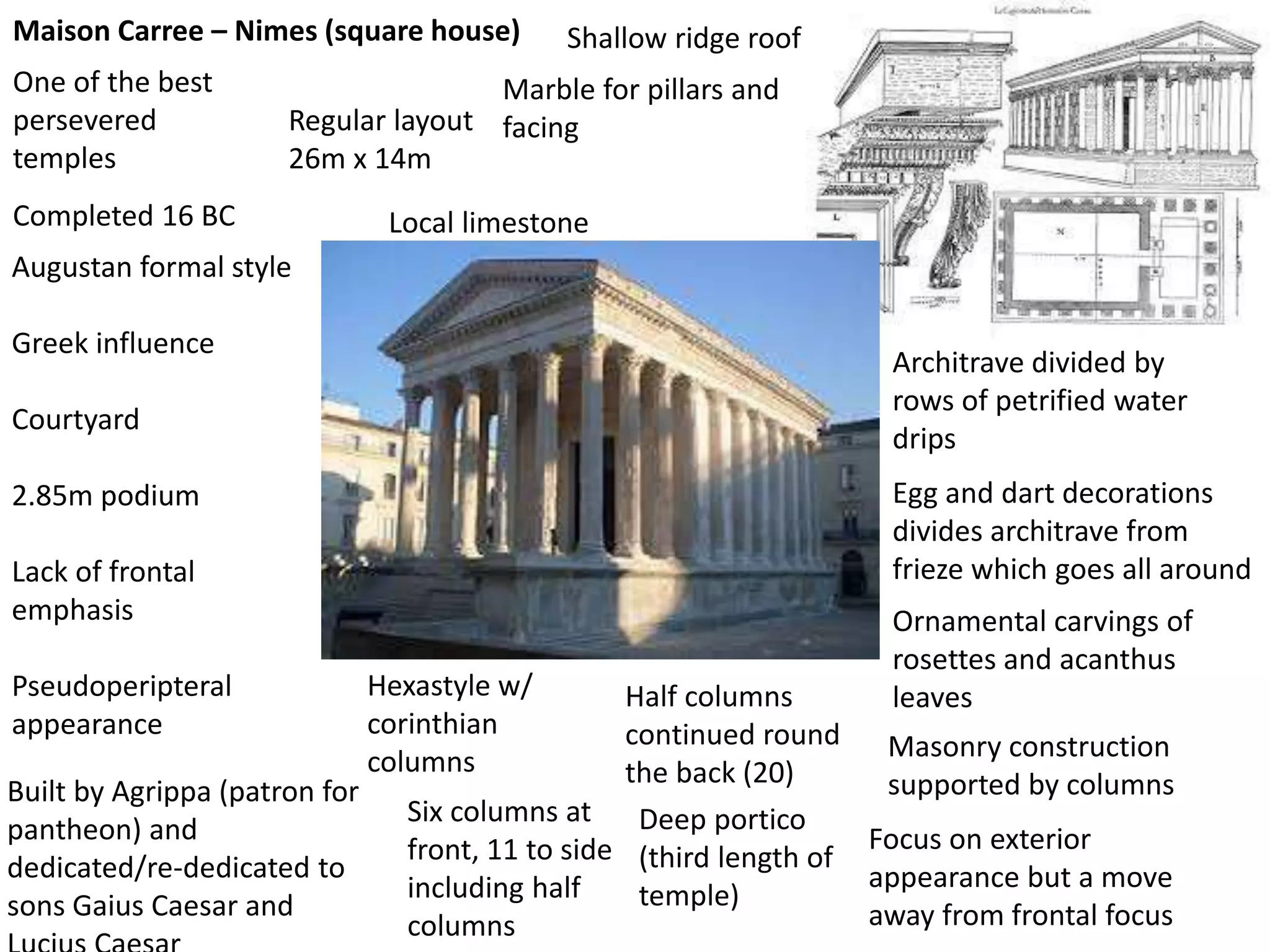
Maison Carree – Nimes (square house)
One of the best
persevered
temples
Completed 16 BC
Augustan formal style
Greek influence
Courtyard
2.85m podium
Lack of frontal
emphasis
Pseudoperipteral
appearance
Built by Agrippa (patron for
pantheon) and
dedicated/re-dedicated to
sons Gaius Caesar and
Regular layout
26m x 14m
Local limestone
Marble for pillars and
facing
Hexastyle w/
corinthian
columns
Six columns at
front, 11 to side
including half
columns
Half columns
continued round
the back (20)
Architrave divided by
rows of petrified water
drips
Egg and dart decorations
divides architrave from
frieze which goes all around
Ornamental carvings of
rosettes and acanthus
leaves
Masonry construction
supported by columns
Deep portico
(third length of
temple)
Shallow ridge roof
Focus on exterior
appearance but a move
away from frontal focus
Rome – Basilica Nova
Largest building in the
Roman Forum
Started in 308 –
Maxentius
Finished 312 –
Constatine after his
defeat of Maxentius
Building consists of
central nave covered
by 3 groin vaults
suspended 39 meters
above the floor on
large piers
Ending at apse at
western end
containing statue of
Constatine
Offices of the perfect city
Sited on Velia (low ridge
connecting the esquiline
and palatine hill)
Built with arches (all other B’s had ceilings
supported by wooden beams)
Construction techniques borrowed from
baths
Rectangular plan – 100mx65m
Divided into central nave, atrium on east side
(orginal entrance was) and lateral isles
Each of the 2 side aisles made up of 3
interconnected coffered vaults (2.5m wide)
connecting w/ central nave by 3 huge
openings
Light provided w/ 3 windows in 5/6 lateral
vaults + windows in the sides of the cross
vaults over the central nave
Statues of Gods in niches in walls
Floor in central + lateral spaces geometric
pattern of squares and circles w/ multi-
colored marble (like Pantheon)
Pompeii Houses
Made of various types of local stone, covered w/ plaster + lavishly decorated (depending on
finances). Houses built close together, up against street. Streets recessed, raised sidewalks,
stepping stones available for crossing. Uncommon to have second stories; concrete floors.
Floorplan varys according to profession. Common elements; entry would be a short corridor,
leading to atrium. Atrium was central room; surrounded by small rooms (main feature
impluvium – catching rainwater). Shops outside. Bright colors' for painting, and murals in
houses.
Via Dell’Abbondanza
House of the Vettii
House of the faun
House of Menader
House of Pansa
House of Sallust
House of the tragic poet
House of Loreius Tiburtinius
House of the faun
Evidence in eastern walls
of tetrastyle atrium that
after the earthquake of
AD 62 repaired/rebuilt
Named for the
bronze statue of
the dancing faun
on the lip of the
impluvium
(rainwater catcher)
3000 square meters –
entire city block
5 major parts – tuscan
atrium, tetrastyle atrium,
service rooms and
corridors, iconic peristyle
and doric peristyle.
Had tabernae (storefront
shops)
Iconic
peristyle
Doric
Peristyle
Entrance is decorated with latin message “HAVE”
2nd century BC - Samnite period (200-
80 BC)
Private bath system (balneum) –right ofentrance
Great position – north
entrance to forum; one
of main roads of the city;
close to baths
‘Standard’ domus (standard
atrium – tablinum – hortus axis)
Basic shape but built on bigger
scale w/ atrium combined with
peristyle (and 2 tablina)
Servants quarters dark and
cramped – little furniture
House of Loreius Tiburtinus
Known for artwork and
large gardens
Found on Via Dell’Abbondanza
Occupies entire insula w/
combination of residential area
and garden
Included in the insula was two
cauponae (inns)
Near both palaestra +
amphitheatre, area closed off to
cart traffic
Layout matches roman
architecture
2 storefront shops
Impluvium
Atrium
Modest peristyle – tablinum (office) was
Several oeci off main atrium –
receiving rooms w/ art displayed
Stone seating at the front – for
visitors
Decorated with frescoed plasterwork
Canal – eastern end – biclinum (dining)
Temple-esque structure
w/ corinthian columns
Pompeii – House of Menander
Southern half of the town
Northeast of the little and large
theatres, and gladiators barracks
Almost as big as a
whole city block
Original small house was
atrium based 0 peristyle
added later
Referred to house of
menanders – well
preserved fresco of
menander in niche in the
peristyle – bold yellow
and red coloring (sign of
wealth)
Large columns (tufa) in
peristyle – representative
of doric style of
architecture (greek
origins) Garden – grand peristyle with
stucooed doric columns –
Build in 3rd century BC
Flanked by masonry seating
Fauces – decorated in fourth style
w/ large black panels above lower
black frieze – pictures of animals
and bird life
Atrium – central marble lined
impluvium – rooms off all 4
sides
Richly decorated in fourth style
23 ionic
columns
support roof in
peristyle
Small wall (plutenus)
connects bases of columns
to enclose garden
Pompeii – House of the tragic poet
Famous for elaborate
mosaic floors + frescoes
of greek mythology
Atrium – most
decorated of rooms –
rectangular impluvium
Western wall of atrium –
cubicula (bedrooms)
Right of the peristyle –
dining room and
kitchen area
Left side of peristyle –
small back door opens
onto street
North-western corner of
peristyle – lararium
(shrine used in worship)
Vestibule floor – mosaic
picture of dog – CAVE
CANEM – warning –
beware of dog
Rest of vestibule decorated in
checker-like-pattern of black
and white tiles – framed y
border of stripes
Tablinum floor – mosaic image
Samnite period
Next to house of Pansa
Second story now lost
House of the Vettii
Located on back street – opposite bar
Built round 2 compluviums, centres open to
the sky, a dim atrium which a vistor would
pass, coming from dark vestibule that left
the street
Peristyle of fluted doric columns
surrounded all sides by a richly frescoed
portico
Servants quarters to the side off
atrium – arranged round small atrium
of own
Main atrium – large and marble impluvium
Corridor from main atrium to
second entrance has staircase –
indicating upper storey
Focus on large peristyle + garden area w/ lavish statues
Two dining rooms Lack of frontal shop – no need for extra income
No entrance from main street – no need to
be open to masses
Peristyle laid out for elaborate water display –
basins and fountains – carved heads and
marble sculptures
14 jets of water for statues
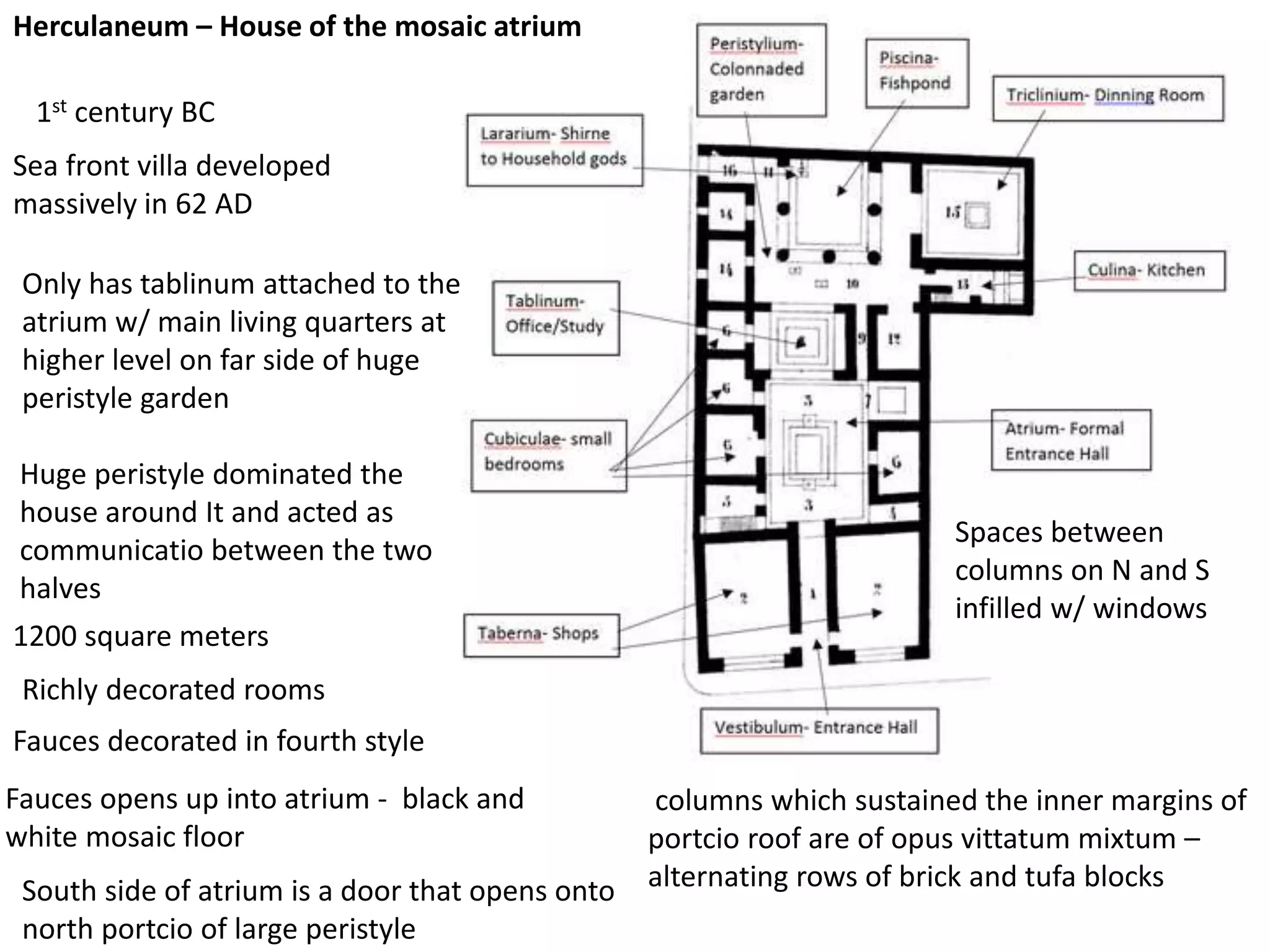
Herculaneum – House of the mosaic atrium
1st century BC
Sea front villa developed
massively in 62 AD
Only has tablinum attached to the
atrium w/ main living quarters at
higher level on far side of huge
peristyle garden
Huge peristyle dominated the
house around It and acted as
communicatio between the two
halves
1200 square meters
Richly decorated rooms
Fauces decorated in fourth style
Fauces opens up into atrium - black and
white mosaic floor
South side of atrium is a door that opens onto
north portcio of large peristyle
columns which sustained the inner margins of
portcio roof are of opus vittatum mixtum –
alternating rows of brick and tufa blocks
Spaces between
columns on N and S
infilled w/ windows
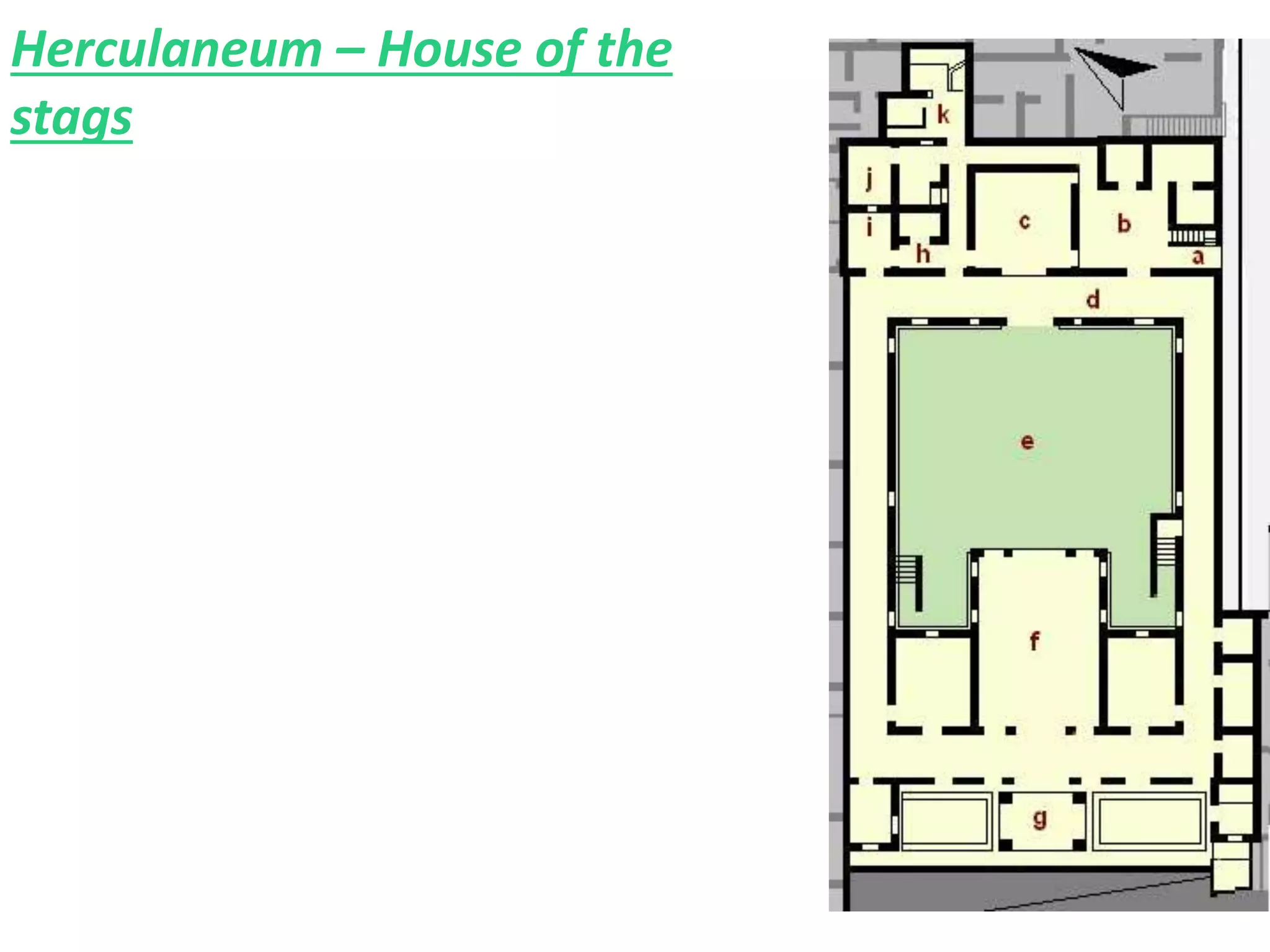
Herculaneum – House of the
stags
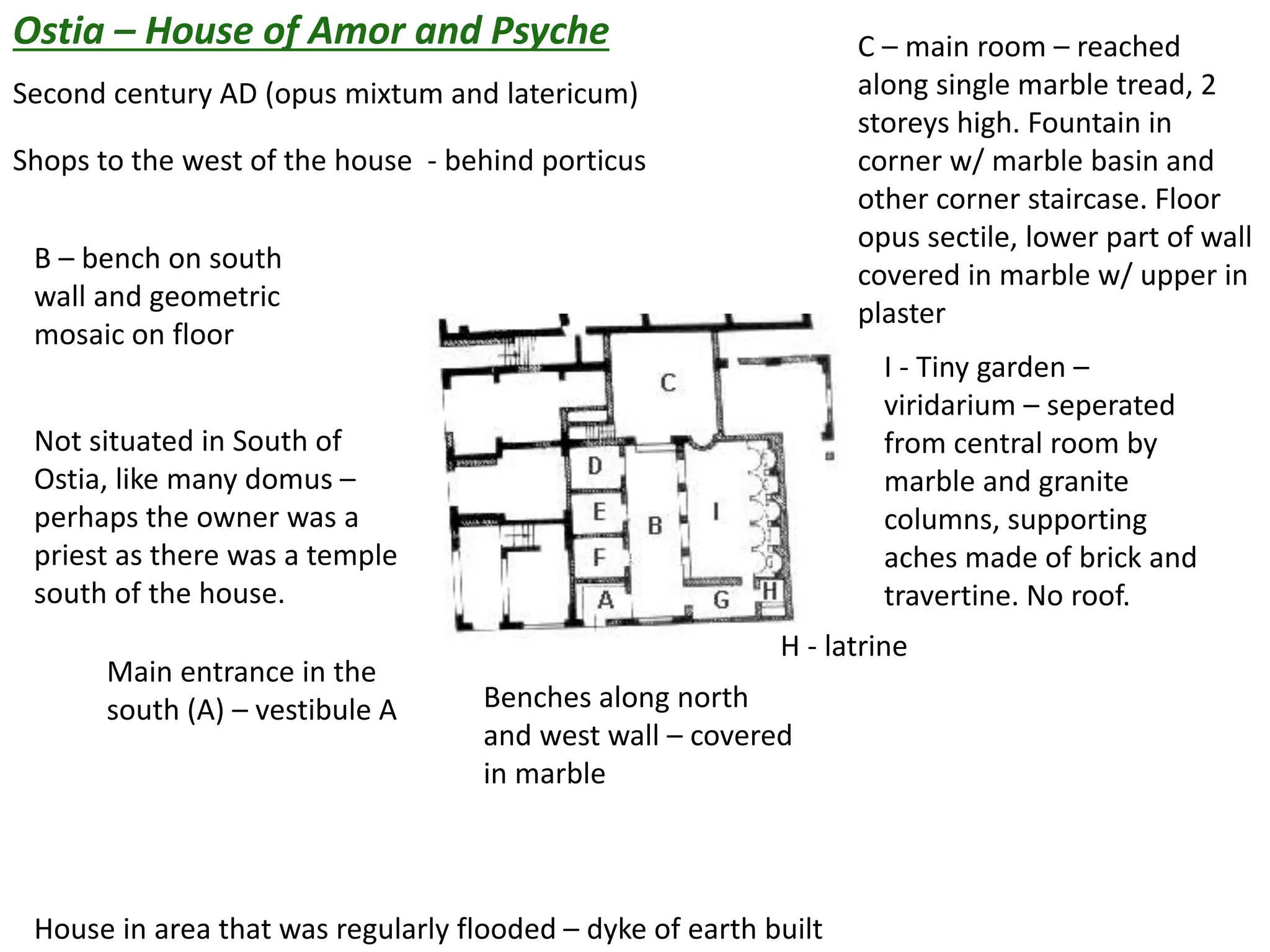
Ostia – House of Amor and Psyche
Second century AD (opus mixtum and latericum)
Shops to the west of the house - behind porticus
Main entrance in the
south (A) – vestibule A Benches along north
and west wall – covered
in marble
B – bench on south
wall and geometric
mosaic on floor
C – main room – reached
along single marble tread, 2
storeys high. Fountain in
corner w/ marble basin and
other corner staircase. Floor
opus sectile, lower part of wall
covered in marble w/ upper in
plaster
H - latrine
I - Tiny garden –
viridarium – seperated
from central room by
marble and granite
columns, supporting
aches made of brick and
travertine. No roof.
House in area that was regularly flooded – dyke of earth built
Not situated in South of
Ostia, like many domus –
perhaps the owner was a
priest as there was a temple
south of the house.
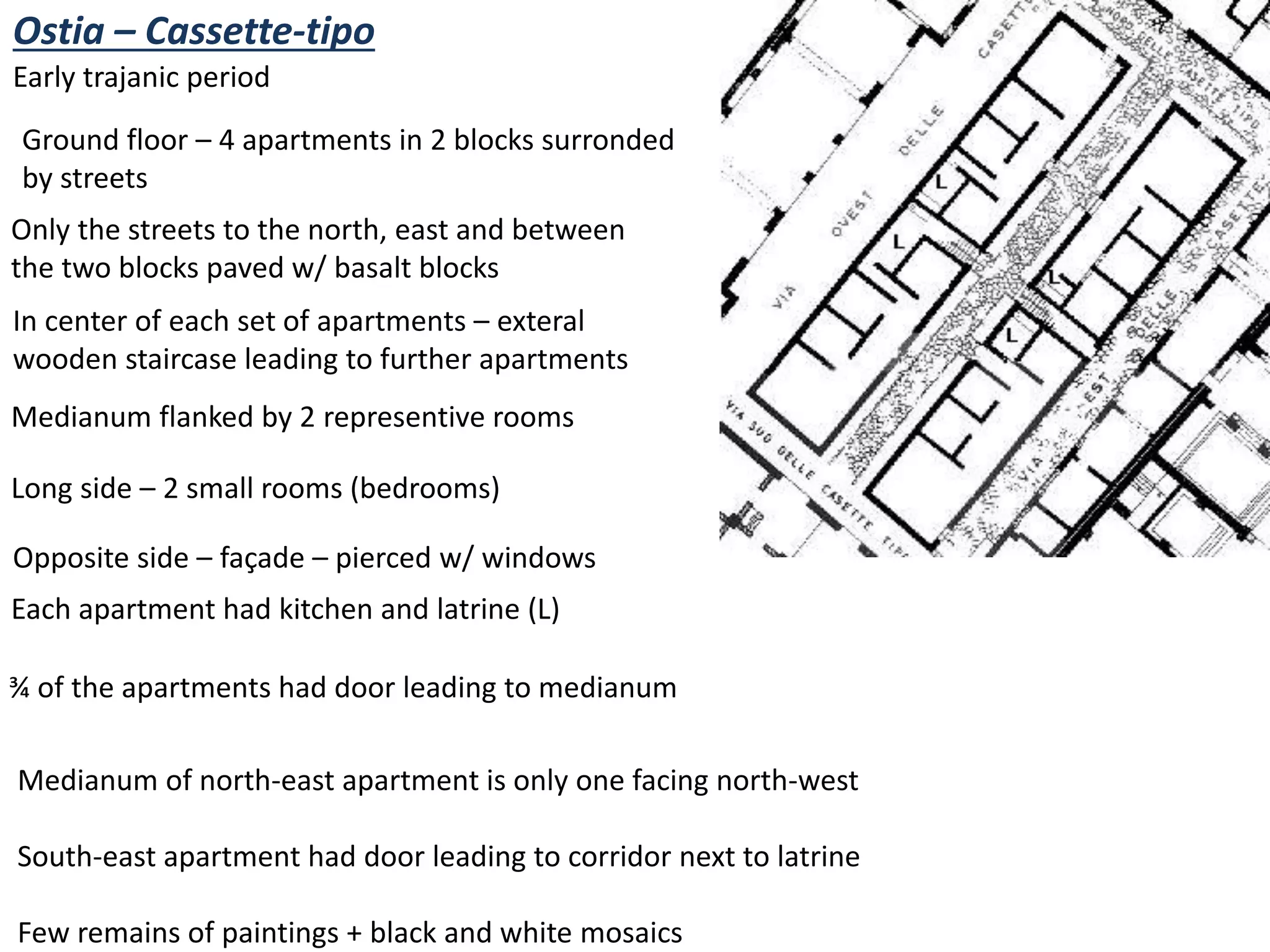
Ostia – Cassette-tipo
Early trajanic period
Ground floor – 4 apartments in 2 blocks surronded
by streets
Only the streets to the north, east and between
the two blocks paved w/ basalt blocks
In center of each set of apartments – exteral
wooden staircase leading to further apartments
Medianum flanked by 2 representive rooms
Long side – 2 small rooms (bedrooms)
Opposite side – façade – pierced w/ windows
Each apartment had kitchen and latrine (L)
¾ of the apartments had door leading to medianum
Medianum of north-east apartment is only one facing north-west
South-east apartment had door leading to corridor next to latrine
Few remains of paintings + black and white mosaics
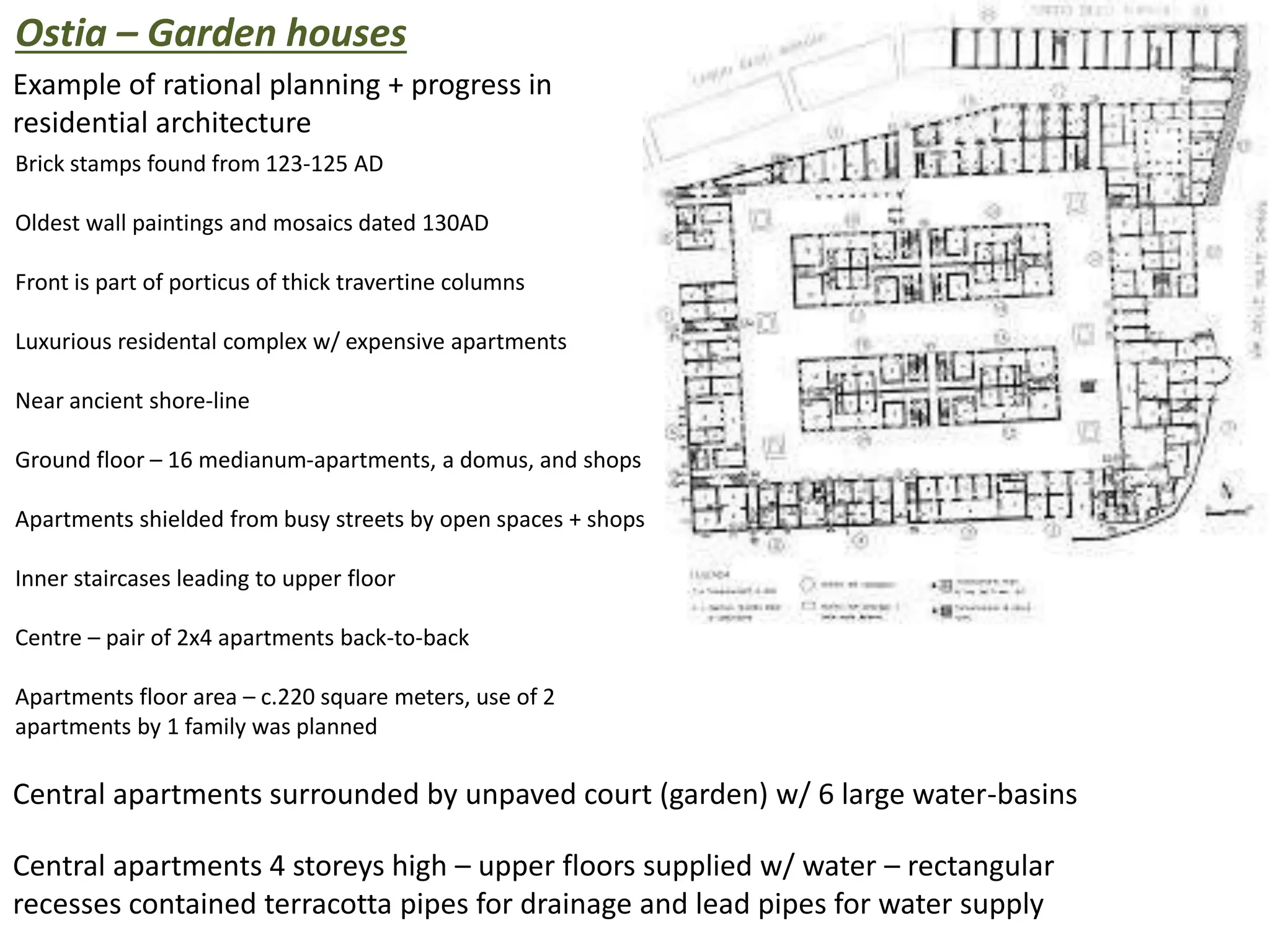
Ostia – Garden houses
Example of rational planning + progress in
residential architecture
Brick stamps found from 123-125 AD
Oldest wall paintings and mosaics dated 130AD
Front is part of porticus of thick travertine columns
Luxurious residental complex w/ expensive apartments
Near ancient shore-line
Ground floor – 16 medianum-apartments, a domus, and shops
Apartments shielded from busy streets by open spaces + shops
Inner staircases leading to upper floor
Centre – pair of 2x4 apartments back-to-back
Apartments floor area – c.220 square meters, use of 2
apartments by 1 family was planned
Central apartments surrounded by unpaved court (garden) w/ 6 large water-basins
Central apartments 4 storeys high – upper floors supplied w/ water – rectangular
recesses contained terracotta pipes for drainage and lead pipes for water supply
House of Diana
Antonine period – 150 AD
Higher level than surrounding streets; Via dei balconi to the west
and via di Diana to south
Along west and south façade is sidewalk
To the east is an alley
SE corner – travertine staircase
Insula
20m high and included stairway, shops and homes facing street
Central courtyard w/ arcades in center.
Ostia - Horrea Epagathiana
Store building
Above entrance – marble slab
w/ words HORREA
EPAGATHIANA ET
EPAPHRODITIANA 145-150 AD
SW – rows of shops
N – remains of cult
niche – aedicula-
facade
Door decorated by brick
columns w/ capitals, an
architrave and pediment
Behind door – double
vestibule
Lateral walls of second
vestibule – 2 niches for
statue of a deity
Doors and rooms and
staircases – barred w/
wooden beams
Interior – square
courtyard
surrounded by
porticus w/ brick
piers
All four sides are
rooms covered by
cross-vaults
Remains of white
plaster
Center of east side are
2 niches; flank the
entrance to a deep
room (maybe a office)
Floor of courtyard black-and-white mosaic w/
panther on west end – meant to be seen from
entrance
Locking devices suggest valuable
goods stored here

Unit 02E - Roman Architecture and Town Planning

  • 1.
    Town plan –Ostia Forum baths 193-225 AD Ostia – Capitolium 120 AD Ostia – Forum 117 – 138 AD Piazazale delle corporazioni First century AD Wall around – built 80 BC GREEN INDICATES ORGINAL Decumanus maximus Via della foce Decumanus Maximus Cardo Maximus
  • 2.
    Ostia town plannotes • Originally roman military base (87BC civil war) • Key to defense and trading ability • Became main harbor – originally not because didn’t offer natural protection to ships • Went on developing into 3rd century BC • Mouth of the Tiber • 30 miles west of Rome • Two-way phase development during early years BC • Ostia spread south and west from small rectangular shape • Surrounded by defensive walls w/ 3 city gates • Eastern development following population increase • Width of street varies (private property etc) • Porticoes flanking the streets – identical facing porticos = beautiful!! • Small rectangular settlement around forum spilt exactly by main N-S and W-E road • Initial period of growth – involved spreading streets west and south irregularly • 80 BC walls built enclosing extended town • Trajans harbour = commerical opportunities • Forum sidelined by the growing infulence of the new square of corportations in the new city Water supply! Originally drew from wells and rivers Aqueduct – first half of 1st century AD System of storage tanks w/ pipes to street fountains and wealthy houses More modern system than Pompeii Received aqueduct after Pompeii
  • 3.
    Forum at Ostia Capitoliumdominates the northern117-138 AD Square surrounded by 4 major buildings – Capitolium (N) temple of Rome and Augustus (S), curia (NW)and basilica (SE) Decumanus Maximus continues through the square Pedestrians could only enter from north and south Square covered in concrete W + E sides have hadrianic porticoes W/ granite columns and marble pavement Alter of Concordia (somewhere)
  • 4.
    Capitolium – Ostia Northernend of the forum Positioned on the area previously occupied by the hole, the intersection of the cardo and decumanus maximus Largest temple in Ostia Overlooked the forum High podium (imitation of temple of Jupiter on the Capitoline hill in Rome) Prostyle hexastyle (columns at the front) 35m long 15.5m wide 20m high Under the podium – 3 rooms accessible from the rear (seat of treasury citizen) Rectangular plan – brickwork (unlike other Capitola) Statues of 3 deities in 3 niches at bottom Cell covered by slabs of white and colorful marble Entrance portal of cell – bronze door (similar to Pantheon) Cella traces of african marble Marble freize and cornice remain Usual alter to the front (african marble) Honor the triad Freestanding hexastyle with flued white marble columns
  • 5.
    Ostia – Forumbaths • 3200 square meters • Third quarter of second century • 193 – 225 AD • Marble three meters high; plaster above • Black and white geometric floor • Cold rooms northern – cross vaults • South – warm rooms; 17-19 had barrel vaults • South designed in a way it would receive light in the afternoon from west – huge windows, one room dedicated to sunbathing (room 15) • 2 entrances – 2 and 14 • Frigidarium (6) cold bat – large marble columns – 15m high; niches in the back and side walls, holes and imprints of lead pipes show there was a jet of water below each niche • Room 19 – 3 basins – hairpins found – proving existence of women's baths (like Pompeii’s Stabian baths) • Along east side runs corridor – wheels with a diameters of 10 meters – slaves lifted water collected in cistern • Early fourth century different kinds of marble and granite columns added • South-west part of the palaestra ½ small temples • Southwest of the shrines is a large latrine w/ 20 seats
  • 6.
    Ostia – theatre– Piazzale delle Corporazioni • Built 1st century AD when city growth justified • City rose in status in the Augustan era as port of Rome – propaganda under Augustus • Integral in new town center; not separated out to impress but dual-purpose allowing access to shops • 4,000 capacity – despite larger population than Pompeii • No great attempts to impress w/ size • Statement reflecting values of Augustan ara • Increased capacity 4k to 6k suggests growing influence and status symbol rather than mass entertainment • Bst materials • Exterior functional – arches allowed shops • Blended in with square • Designed w/ new opportunities created by concrete • Full use of marble to adorn basic tufa • Arcades contained shops – fundamentally linked w/ buildings around it • 2 easy ground floor access points plus steps to higher level after rebuilding ensured safety
  • 7.
    Pompeii Town Plan Pompeii Forum– 2nd century BC Pompeii large theatre – rebuilt 80 BC Small theatre – 80 BC Amphitheatre – 80 BC Stabian baths – 4th BC
  • 8.
  • 9.
    Pompeii town plannotes Water supply! Source – Starno river – wells helped until demand outstripped supply No aqueducts in early days, Sulla’s Romanization of 80 BC = aqueducts provided from Avella 1st century AD Augustus added new aqueduct – Serino which replaced orginal and served wider area = droop in amount of water received by Pompeii Systems of storage tanks w/ pipes to street fountains and the wealthy houses – water supply earlier than Ostia. Public baths – distribution tanks; effect on demand of water Stabian baths dependent on wells/ran water; Early hypocaust system, eventually gender suites PROBLEMS DEALT W/ - primitive drainage system pre-roman – sewage removal left running down streets • Greek settlement – greek influence • Colony in 80 BC – soldiers home etc • Mix of orderly and less orderly planning • Greek background meant roman grid-plan came after period of less organized growth • Development cut off 79 BC – VOLCANO • STREET PLANS: 2 way phase development during early years, spread North east from Greek settlement • Surrounded by defensive walls w/ 7 gates • Population growth = growth to the east • Final stage encompassed area of main north south street; developed on regular roman grid plan to this road • By 3rd century BC the town was at its final size • Commercial – based around forum, rendered off by eastward developments, houses key political and religious buildings. Baths + theatres eastward • Political – forum; cura • Population growth – domus expansions – 80 BC gradual growth, destruction of 79 AD froze • Leisure – standard facilities, 2 theatres from early, improvements included large Amphitheatre
  • 10.
    Forum - PompeiiForum Temple of Jupiter – Northern – closes forum off from the North. Dominated Narrow – 142m x 38m Open piazza with 2-storey portico around West, South and East Sides Open central area Filled with statues, platforms and notice boards Gathering space Forum baths just behind Laid out 2nd century BC Three civil offices – Thought to be comitia, curia and junior magistrates offices Covered market South west corner of the city Central when built Later Roman development to the North and East left the forum in the original (irregularly planned) south west corner of the city
  • 11.
    Temple of Jupiter– Pompeii 37m x 17m 3m high Tetrastyle pronaos 4 x 7 fluted columns Triumphant arches (Nero and Tiberus) Triple cella contains 3 deities (room in the middle) Black wall veneered in marble. Double flight of steps Hexastyle design BUT Corinthian columns
  • 12.
    Temple of Apollo– Pompeii Iconic column w/ sundial White marble on travertine base. Own precinct of 48 columns. Single cella Fronted with 6 Corinthian columns Doric architrave Metopes and triglyphs originally Later replaced w/ frieze w/ griffins and foliage Colonnade of tufa Statues of Apollo and Diana in forecourt Dark interior Surrounded on all sides by local tufa columns Towns weights and measures sorted nearby but no direct link
  • 13.
  • 14.
    Pompeii – StabianBaths • Original source of water – deep well on site • Well positioned – east of forum but central at junction of main NS and WE roads • Available in basic form from 4th BC, enhanced late 2nd century, and again 80BC w/ aqueduct • Central palaestra – exercise • Portico on 3 sides w/ tufa columns (later decorated w/ stucco) • Mens east, womens north, supporting facilities like latrines etc • MENS BATHS - Apodyterium linked to peidarium (warm room) to allow acclimatisatio; caladarium (hot room) next to furnase was a large apsed hall w/ tank for bathing and fountain to cleanse hands; flavian period stucco decoration on walls and vaulting; barrel-vaulted cielings; frigidarium (cold room) accessed directly from changing room had concrete dome • Natation (pool) added late 1st century AD • WOMENS – smaller and limited, remained same until 79 AD
  • 15.
    Pompeii Large theatreand gladiatorial barracks • Provided in 80 BC – population increased because it was made a colony • Pre-roman (first half of 2nd century) but rebuilt in 80 BC • Unimposing position by the original Greek forum • Built into hillside • Capacity 3k – roman rebuilding added 2k = 5k • Functional rather than a political statement • Provision of new access at the top • Removal of the gathering piazza outside to provide gladiator barracks in support of the new Amphitheatre • All deliberate to emphasize new roman city • Local stone used w/ little decoration • Enlargement of 80 BC = marble to impress (paid by local merchants) • Safety provided by adding top tier access from old forum to access lower tiers (from either side of orchestra w/ five rows of stairs) • Cover against weather provided by awning on temporary basis as needed • Safe given small capacity
  • 16.
    Pompeii Small theatre •Provided 80 BC • Local chiefs sponsored – Valgus and Porcius paying for this and Amphitheatre • Capacity of 1k • Attractive but hidden behind large theatre • Hard to see from outside • Impressive by its existence – magistrates seeking to influence rich minority • All-over roof extravagant – acoustic reasons? • Aimed at small minority – exclusive • Permanent roof made of wood – improve quality of sound • Personal performances such as concerts, recitals and mimes
  • 17.
    Pompeii Amphitheatre • 80BC samnite influence seen off by Sulla; new rulers wanted to put stamp on city • 2 magistrates paid for construction • Eastern part – well away from original town center • Providing games = support • 20,000 capacity by 79 AD • Eastern side of city – new focus among the buildings of new roman town which grew around it • Basic materials • No attempt to face w/ marble concrete • Faced w/ opus incetum instead – giving strength • Later techniques of support; vaulted passages or subterranean cells • Buttresses used and building onto city walls gave further strength • Basic frame of arches but blind offering no access to interior • Steps of exterior steps narrow • 2 small tunnels led to small circulation area and railed off rows for elite • Cramped for everyone • Set into ground – no dominance from height • Use of local stone and embellished appearance more function • First arena made of masonry – impressed • Arches w/ outside staircases gave impression of style!!!
  • 18.
    WATER SUPPLY BASICS ROMANWATER SUPPLY Rome water supply • River tiber water supply – fine for original town but couldn’t cope w/ increasing demand • Aqueducts and associated water channels • Aqua Appia 392 BC • Three more built before 100 BC – three shorter ones followed during Augustan era; finally there was 11 total over 500 miles • Public baths: supplied from distribution tanks direct from own aqueduct • Aqua Marcia in the case of the baths of Caracalla • Caracalla had major impact on the demand for water – 1600 bathers a minute!!!! How the problems were dealt with… CLOACAO MAXIMA – SEWAGE SYSTEM!!!!! • Water supply wasn’t originally top priority in any city • Rome had population over over 1 million by 1st century AD • All cities had availability of some natural water sources (wells and rivers) • Aimed to provide drinking water; settling chambers and reception reservoirs used to offload from aqueducts in both cities • Water pumped into distribution tanks, often ornate in appearance, from here pipes led to public fountains to supply the poor • Rain collected in impluvia supplemented individual houses PROBLEMS • Leakage, conflict between practical and aesthetic issues at city approaches, difficulties in maintaining underground channels
  • 19.
    Roman introduction totheatres…. • Had to make do w/ temporary wooden theatres which were inadequate after great population growth of 1st century BC • One great theatre and one amplitheatre allowed population enjoy TOP entertainment for the first time • Early theatres – small and temporary • Only major venue was theatre of Pompey 61 BC • Increase in population = demanded bigger central theatre • Caesar’s rivalry = theatre of Marcellus 13 BC THE COLLOSEUM 70 – 80 AD
  • 20.
    THEATRES – THEATREOF MARCELLUS • WHY: Triumph for Augustus • Commissioning: started 11 BC as part of Augustus’ renewal of Rome • Position: Between capitol hill and river Tiber • Size: 20k capacity, three-tired freestanding structure in prime position • Built same time as Ostia theatre • Materials: exterior design allowed easy access and facilities provided for audience; full attention to appearance – free-standing and central, elaborate substructures providing good support w/ reticulate-faced concrete and concrete barrel-vaults; forming outer corridor and acted as buttresses; all faced w/ marble. • Comfort/safety: free-standing nature allowed large number of arched entrances to ease access and ensure social segregation • Open air theatre • Built in closing years of Roman Republic • Watch performances of drama and song • Named after Marcus Marcellus – Augustus’ nephew who died 5 years prior • Space for theatre cleared by Caesar – murdered prior • 111m in diameter • Mainly built of tuff, and concrete faced w/ stones in a pattern known as opus reticulatum, completely sheathed in white travertine. • Network of arches, corridors, tunnels and ramps gave access to interiors – engaged columns in greek orders – doric at base, ionic in middle and corinthian upper level
  • 21.
  • 22.
    ROME - COLOSSEUM •WHY? To secure Flavians dynasty • 70 AD – Vespasian proposed biggest and grandest amphitheater – son Titus saw it important to finish. • 80 AD – Built – Titus – travertine, tufa, concrete, brick, marble, gravel, wood and sand. Oval shape. • Built after theatre of Marcellus – population increase • Capacity – 80k – reflecting needs of city w/ population of 1 million • Fine central site dominating forum • 188 x 156 metres • 48 metres high • Exterior design enabled easy access and provide facilities for audience • Supported by huge elliptical ring of concrete topped w/ blocks of travertine – supporting piers rise from here; outer walls built to impress • Four storeys – greek column order (doric – ionic – corinthian – top floor) • 80 arches flanked by engaged columns on each of lower floors – marble faced w/ statues in doorway • Accessed via large number of arched entrances on lower floor • Wide circulation passages within led to lower seats and wide staircases to higher levels • Top level – reserved for poor – wooden • Best seats bottom – separate access • Awning kept the direct sun of spectators • Replaced Nero’s private garden w/ attractive public recreational facility
  • 23.
    Forum of Augustus- Rome Built 25-22 BC North to main forum Similar to forum of Pompeii – basic layout Entry from SW – view of temple Colonnades down two longer sides Cross-axis formed by pair of semi-circular recesses emphasized symmetrical shape Marble everywhere Huge rear wall – exclusivity Land originally owned by Augustus himself – initial plans called for more space than he had = alterations Asymmetry apparent Eastern corner of precinct – couldn’t take houses – “good deed” or money saver Built of ashlar blocks of peperino tufa with carrara marble Colonades made of africano and pavonazzetta – from all over empire Enclosing walls – local roman stone Built to house temple and other legal proceedings as roman forum was crowded Filled with rich tapestry of statues – Augustus in military outfit in the center, and mars and Venus in the temple. 108 portrait states total.
  • 24.
    Temple of Marsthe Avenger - ROME 2BC High podium – more roman style by Augustus Propaganda at home Fully integrated into the design of forum of augustus Steep steps to approach Asymmetry apparent – houses in east corner Square plan Frontal focus Long cella Leading to statues of Mars and Venus Senate met here Young men accepted their toga virillis First roman temple made entirely of marble Abutting on to tufa back wall of forum that had to be incorpated Pediment and decoration lost 8 solid white marble Corinthian columns on sides backing to precint wall
  • 25.
    Rome Pantheon 27 BCRenovated at the same time as the temple of trajan Formal gateway Forecourt – 44m x 60m wide Size spoke for itself – no podium needed Traditional frontage of 8 unfluted corinthian pillars (14m) Two more at each side Pronaos of 3 vaulted corridors divided by further 8 red inner columns Interior surprise! Rotunda Rotunda consisted of circular drum topped by hemispherical dome Oculus for light Sign of roman technological progress + confidence Temple for ALL gods Granite columns in forecourt Outer structure was tufa faced w/ white marble Interior marble and granite Coffered ceiling of light pumice lined with lead sheets 43m concrete dome Lower section of dome was actually core structure Weight distribution – 8 giant pillars Bronze eagle in wreath Inscription naming M.Agrippa builder Front suggested rectangular structure Gilded tiles from rotunda visible from above
  • 26.
    Pantheon Interior a surprise Oculusfor light Floor of marble and granite slabs Screens of pilasters Columns in various marbles from all over the empire Oculus at dome’s apex for light and to cool and ventilate
  • 27.
    Rome – Portunis Dediicatedto God Portunus Ionic order Located in Forum Boardium by the Tiber Tetrastyle portico and cella High podium – flight of steps Like Maison Carree; pronaos portico of 4 ionic columns across and 2 columns deep Columns of portico – free-standing 5 columns on long sides and 4 columns at rear are engaged along the walls of the cella Built of tuff and travertine with a stucco surface Frieze decorated with garlands First century BC Converted to Christian church in the 9th century
  • 28.
    38 m high 106– 113 AD North west of main forum Main square – flanked by 2 porticoes (112m long) Marble paving in square Market nearby – not part of it Designed to surpass forum of Augustus Basilica w/ civil buildings 2 storeyed building Entrance screened by 10 columns Huge project to dig out Quirinal Hill to build On the via dei fori imperiali Opposite end to Colosseum Cobbled w/ rectangular blocks of white marble Built from stoa-lined piazza 200mx120m Exedrae on each side Forum and Market of Trajan
  • 29.
    Temple of Trajan 125AD Placed by Trajan’s adoptive son Hadrian Dedicated to Trajan and wife Known from coin Building surrounded by a portico situated on edge of Trajan’s forum Octastyle building Huge podium Flanked w/ distyle colonnades which curved behind cella On the site of Palazzo Valentini and that it used stone from the temple in its construction Only survivals from temple are a dedicatory inscription and 1 granite column (2m diameter) with white marble capital
  • 30.
    Temple of Vesta Locatedin the Roman forum near the Regia and house of the vestal virgins Greek architecture w/ Corinthian columns Marble Central Cella 20 Corinthian columns built on a podium 15m in diameter Roof had vent at the apex to allow smoke release Eastern entrance to symbolize connection between Vesta’s fire and sun as sources of life Cult activity as far back as 7th century BCE Built by Pompollius w/ Regia and house of Vestal Virgins Temple stood in Sacred Grave - graveyard One of the earliest structures in the Roman Forum Instead of cult statue in the cella there was a hearth which held the sacred flame Storehouse for legal wills and documents of Roman senators + cult objects (e.g. palladium) Romans believed the sacred flame’s extinction as a portent of disaster Burnt down twice (not because of hazards flame though) – 64 great fire of Rome
  • 31.
  • 32.
    BATHS OF CARACALLA •Built 211-216 AD by Caracalla as statement of imperial power to cement position to the people • Population growth led to hygiene problems • 100,000 square metres; main hall w/ 4 different entrnaces, cross vaulted in 3 bays w/ huge piers to support • 225 x 185 x 35 meters high • Central imposing block with natation, frigidarium and circular caldarium aligned on central axis • Elegant balance of added structured 235 AD • 9,000 workmen 5 years • Flattening existing buildings, removal of 150,000cm of earth; provision of earth, stone and mortar for foundations • Creation of substructures • 280,000cm of tufa and mortar and 15 million pieces of brick • Cranes to raise walls and vaults of concrete • 815,000 whole bricks • Creation of orante columns not struturally necessary – architectural statement • Baths made of granite, basalt and alabaster 8.2 million litre capacity OMG
  • 33.
    BATHS OF CARACALLAEXTERNAL AND INTERNAL DECORATION • New street created parallel to via appai = full effect of baths • Use of marble and granite (252 full column shafts) • Décor in main rooms – mix of statues, exotic marble facing and mosaic work • Interior of bathsfocal point of style but exterior not neglected EXTERIOR • Multi-tiered ranks of columns and niches recall theatre frontages • Spiritually uplifting Facilities provided • Baths – giant frigidarium at center (3 cross vaults, bays in each corner w/ plunge baths – decorated w/ 2 columns) • Circular caldarium = unique • Palaestra in east wing open to the sky with portico of Corinthian columns on 3 sides • Libraries, shops, gardens etc • Fresh air and open spaces
  • 34.
    Cosa – Capitolium2ndBC Good site Levelled ground but above city rather than in forum Stone steps up to high podium (3.7m) Surrounded by stone wall Brick-built temple 4 widely spaced Tuscan columns fronted the porch Back half was enclosed (allowed entrants light to dark effect) Shallow ridge roof hung over entablature and porch as well as sides – weather protection Brick but substructure and roof framework of WOOD Triple cella at the back Decorations of terracotta but only at the front No freize all around Deep porch with façade of tuscan columns projecting side walls at cella end of porch Triple cella had statues of capitoline triad Terracotta roof Building had blank walls
  • 35.
    Maison Carree –Nimes (square house) One of the best persevered temples Completed 16 BC Augustan formal style Greek influence Courtyard 2.85m podium Lack of frontal emphasis Pseudoperipteral appearance Built by Agrippa (patron for pantheon) and dedicated/re-dedicated to sons Gaius Caesar and Regular layout 26m x 14m Local limestone Marble for pillars and facing Hexastyle w/ corinthian columns Six columns at front, 11 to side including half columns Half columns continued round the back (20) Architrave divided by rows of petrified water drips Egg and dart decorations divides architrave from frieze which goes all around Ornamental carvings of rosettes and acanthus leaves Masonry construction supported by columns Deep portico (third length of temple) Shallow ridge roof Focus on exterior appearance but a move away from frontal focus
  • 36.
    Rome – BasilicaNova Largest building in the Roman Forum Started in 308 – Maxentius Finished 312 – Constatine after his defeat of Maxentius Building consists of central nave covered by 3 groin vaults suspended 39 meters above the floor on large piers Ending at apse at western end containing statue of Constatine Offices of the perfect city Sited on Velia (low ridge connecting the esquiline and palatine hill) Built with arches (all other B’s had ceilings supported by wooden beams) Construction techniques borrowed from baths Rectangular plan – 100mx65m Divided into central nave, atrium on east side (orginal entrance was) and lateral isles Each of the 2 side aisles made up of 3 interconnected coffered vaults (2.5m wide) connecting w/ central nave by 3 huge openings Light provided w/ 3 windows in 5/6 lateral vaults + windows in the sides of the cross vaults over the central nave Statues of Gods in niches in walls Floor in central + lateral spaces geometric pattern of squares and circles w/ multi- colored marble (like Pantheon)
  • 37.
    Pompeii Houses Made ofvarious types of local stone, covered w/ plaster + lavishly decorated (depending on finances). Houses built close together, up against street. Streets recessed, raised sidewalks, stepping stones available for crossing. Uncommon to have second stories; concrete floors. Floorplan varys according to profession. Common elements; entry would be a short corridor, leading to atrium. Atrium was central room; surrounded by small rooms (main feature impluvium – catching rainwater). Shops outside. Bright colors' for painting, and murals in houses. Via Dell’Abbondanza House of the Vettii House of the faun House of Menader House of Pansa House of Sallust House of the tragic poet House of Loreius Tiburtinius
  • 38.
    House of thefaun Evidence in eastern walls of tetrastyle atrium that after the earthquake of AD 62 repaired/rebuilt Named for the bronze statue of the dancing faun on the lip of the impluvium (rainwater catcher) 3000 square meters – entire city block 5 major parts – tuscan atrium, tetrastyle atrium, service rooms and corridors, iconic peristyle and doric peristyle. Had tabernae (storefront shops) Iconic peristyle Doric Peristyle Entrance is decorated with latin message “HAVE” 2nd century BC - Samnite period (200- 80 BC) Private bath system (balneum) –right ofentrance Great position – north entrance to forum; one of main roads of the city; close to baths ‘Standard’ domus (standard atrium – tablinum – hortus axis) Basic shape but built on bigger scale w/ atrium combined with peristyle (and 2 tablina) Servants quarters dark and cramped – little furniture
  • 39.
    House of LoreiusTiburtinus Known for artwork and large gardens Found on Via Dell’Abbondanza Occupies entire insula w/ combination of residential area and garden Included in the insula was two cauponae (inns) Near both palaestra + amphitheatre, area closed off to cart traffic Layout matches roman architecture 2 storefront shops Impluvium Atrium Modest peristyle – tablinum (office) was Several oeci off main atrium – receiving rooms w/ art displayed Stone seating at the front – for visitors Decorated with frescoed plasterwork Canal – eastern end – biclinum (dining) Temple-esque structure w/ corinthian columns
  • 40.
    Pompeii – Houseof Menander Southern half of the town Northeast of the little and large theatres, and gladiators barracks Almost as big as a whole city block Original small house was atrium based 0 peristyle added later Referred to house of menanders – well preserved fresco of menander in niche in the peristyle – bold yellow and red coloring (sign of wealth) Large columns (tufa) in peristyle – representative of doric style of architecture (greek origins) Garden – grand peristyle with stucooed doric columns – Build in 3rd century BC Flanked by masonry seating Fauces – decorated in fourth style w/ large black panels above lower black frieze – pictures of animals and bird life Atrium – central marble lined impluvium – rooms off all 4 sides Richly decorated in fourth style 23 ionic columns support roof in peristyle Small wall (plutenus) connects bases of columns to enclose garden
  • 41.
    Pompeii – Houseof the tragic poet Famous for elaborate mosaic floors + frescoes of greek mythology Atrium – most decorated of rooms – rectangular impluvium Western wall of atrium – cubicula (bedrooms) Right of the peristyle – dining room and kitchen area Left side of peristyle – small back door opens onto street North-western corner of peristyle – lararium (shrine used in worship) Vestibule floor – mosaic picture of dog – CAVE CANEM – warning – beware of dog Rest of vestibule decorated in checker-like-pattern of black and white tiles – framed y border of stripes Tablinum floor – mosaic image Samnite period Next to house of Pansa Second story now lost
  • 42.
    House of theVettii Located on back street – opposite bar Built round 2 compluviums, centres open to the sky, a dim atrium which a vistor would pass, coming from dark vestibule that left the street Peristyle of fluted doric columns surrounded all sides by a richly frescoed portico Servants quarters to the side off atrium – arranged round small atrium of own Main atrium – large and marble impluvium Corridor from main atrium to second entrance has staircase – indicating upper storey Focus on large peristyle + garden area w/ lavish statues Two dining rooms Lack of frontal shop – no need for extra income No entrance from main street – no need to be open to masses Peristyle laid out for elaborate water display – basins and fountains – carved heads and marble sculptures 14 jets of water for statues
  • 43.
    Herculaneum – Houseof the mosaic atrium 1st century BC Sea front villa developed massively in 62 AD Only has tablinum attached to the atrium w/ main living quarters at higher level on far side of huge peristyle garden Huge peristyle dominated the house around It and acted as communicatio between the two halves 1200 square meters Richly decorated rooms Fauces decorated in fourth style Fauces opens up into atrium - black and white mosaic floor South side of atrium is a door that opens onto north portcio of large peristyle columns which sustained the inner margins of portcio roof are of opus vittatum mixtum – alternating rows of brick and tufa blocks Spaces between columns on N and S infilled w/ windows
  • 44.
  • 46.
    Ostia – Houseof Amor and Psyche Second century AD (opus mixtum and latericum) Shops to the west of the house - behind porticus Main entrance in the south (A) – vestibule A Benches along north and west wall – covered in marble B – bench on south wall and geometric mosaic on floor C – main room – reached along single marble tread, 2 storeys high. Fountain in corner w/ marble basin and other corner staircase. Floor opus sectile, lower part of wall covered in marble w/ upper in plaster H - latrine I - Tiny garden – viridarium – seperated from central room by marble and granite columns, supporting aches made of brick and travertine. No roof. House in area that was regularly flooded – dyke of earth built Not situated in South of Ostia, like many domus – perhaps the owner was a priest as there was a temple south of the house.
  • 47.
    Ostia – Cassette-tipo Earlytrajanic period Ground floor – 4 apartments in 2 blocks surronded by streets Only the streets to the north, east and between the two blocks paved w/ basalt blocks In center of each set of apartments – exteral wooden staircase leading to further apartments Medianum flanked by 2 representive rooms Long side – 2 small rooms (bedrooms) Opposite side – façade – pierced w/ windows Each apartment had kitchen and latrine (L) ¾ of the apartments had door leading to medianum Medianum of north-east apartment is only one facing north-west South-east apartment had door leading to corridor next to latrine Few remains of paintings + black and white mosaics
  • 48.
    Ostia – Gardenhouses Example of rational planning + progress in residential architecture Brick stamps found from 123-125 AD Oldest wall paintings and mosaics dated 130AD Front is part of porticus of thick travertine columns Luxurious residental complex w/ expensive apartments Near ancient shore-line Ground floor – 16 medianum-apartments, a domus, and shops Apartments shielded from busy streets by open spaces + shops Inner staircases leading to upper floor Centre – pair of 2x4 apartments back-to-back Apartments floor area – c.220 square meters, use of 2 apartments by 1 family was planned Central apartments surrounded by unpaved court (garden) w/ 6 large water-basins Central apartments 4 storeys high – upper floors supplied w/ water – rectangular recesses contained terracotta pipes for drainage and lead pipes for water supply
  • 49.
    House of Diana Antonineperiod – 150 AD Higher level than surrounding streets; Via dei balconi to the west and via di Diana to south Along west and south façade is sidewalk To the east is an alley SE corner – travertine staircase Insula 20m high and included stairway, shops and homes facing street Central courtyard w/ arcades in center.
  • 50.
    Ostia - HorreaEpagathiana Store building Above entrance – marble slab w/ words HORREA EPAGATHIANA ET EPAPHRODITIANA 145-150 AD SW – rows of shops N – remains of cult niche – aedicula- facade Door decorated by brick columns w/ capitals, an architrave and pediment Behind door – double vestibule Lateral walls of second vestibule – 2 niches for statue of a deity Doors and rooms and staircases – barred w/ wooden beams Interior – square courtyard surrounded by porticus w/ brick piers All four sides are rooms covered by cross-vaults Remains of white plaster Center of east side are 2 niches; flank the entrance to a deep room (maybe a office) Floor of courtyard black-and-white mosaic w/ panther on west end – meant to be seen from entrance Locking devices suggest valuable goods stored here