“Mens sana in corpore
sano”
Sound mind in a sound
body
Leisure and Entertainment
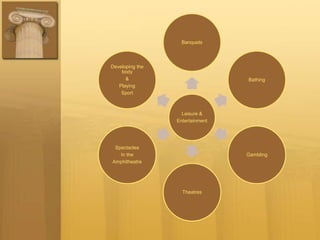
Leisure &
Entertainment
Banquets
Bathing
Gambling
Theatres
Spectacles
In the
Amphitheatre
Developing the
body
&
Playing
Sport
ROME- Founded on Blood
• "we are dealing here, not with individual sadistic
psychopathology, but with a deep cultural difference.“( Keith
Hopkins) Attending gladiatorial contests in the amphitheater was
an essential part of being a Roman. Rome was a warrior state
that had achieved its large empire by military violence
• In such a cultural climate it is not surprising that gladiatorial
games were immensely popular and a characteristic symbol of
Roman culture for almost seven centuries. It may be no
accident that the most dramatic increase in the popularity of
gladiatorial games occurred during the first two centuries AD,
when the Augustan peace throughout the empire provided
little opportunity for citizens to participate in real warfare. If
there were not enough real warfare to satisfy Roman tastes,
then counterfeit warfare would have to do. Hopkins calls the
amphitheater "artificial battlefields" where the Romans
created battlefield conditions for public amusement
Leisure, Otium
• “God knows, my Martial, if we two could be
To enjoy our days set wholly free;
To the true life together bend our mind,
And take a furlough from the falser kind.
No rich saloon, nor palace of the great,
Nor suit at law should trouble our estate;
On no vainglorious statues should we look,
But of a walk, a talk, a little book,
Baths, wells and meads, and the veranda shade,”
• The abundance of graffiti, inscriptions, mozaics and
public buildings which refer to leisure pastimes and
entertainment suggest that the inhabitants of Pompeii
and Herculaneum were enthusiastic supporters,
spectators and participaters in such activities.
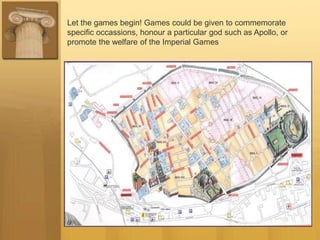
Let the games begin! Games could be given to commemorate
specific occassions, honour a particular god such as Apollo, or
promote the welfare of the Imperial Games
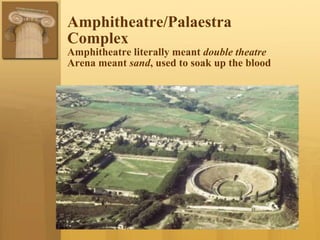
Amphitheatre/Palaestra
Complex
Amphitheatre literally meant double theatre
Arena meant sand, used to soak up the blood
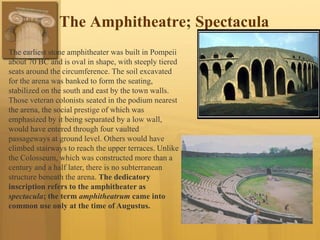
The Amphitheatre; Spectacula
The earliest stone amphitheater was built in Pompeii
about 70 BC and is oval in shape, with steeply tiered
seats around the circumference. The soil excavated
for the arena was banked to form the seating,
stabilized on the south and east by the town walls.
Those veteran colonists seated in the podium nearest
the arena, the social prestige of which was
emphasized by it being separated by a low wall,
would have entered through four vaulted
passageways at ground level. Others would have
climbed stairways to reach the upper terraces. Unlike
the Colosseum, which was constructed more than a
century and a half later, there is no subterranean
structure beneath the arena. The dedicatory
inscription refers to the amphitheater as
spectacula; the term amphitheatrum came into
common use only at the time of Augustus.
Reading in to an Inscription
“Caius Quintus Valgus, son of
Caius and Marcus Porcius, son of
Marcus, in their capacity as
quinquennial duumviri, to
demonstrate the honour of the
colony, erected this sports
complex at their own expense
and donated it to the colonists
for their perpetual use.”
It has been suggested that the construction of the amphitheatre
and its dedication, built after the settlement of veterans in the
area, somehow served to emphasize the status of colony and
remind Pompeians of their new status with Rome…..J Berry
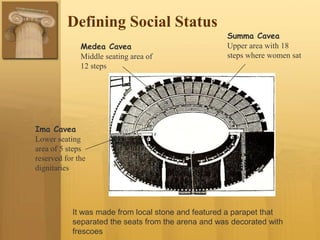
Defining Social Status
Ima Cavea
Lower seating
area of 5 steps
reserved for the
dignitaries
Medea Cavea
Middle seating area of
12 steps
Summa Cavea
Upper area with 18
steps where women sat
It was made from local stone and featured a parapet that
separated the seats from the arena and was decorated with
frescoes
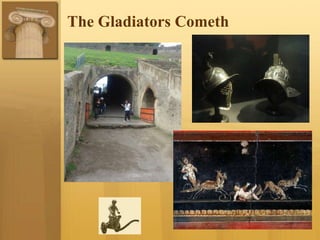
The Gladiators Cometh
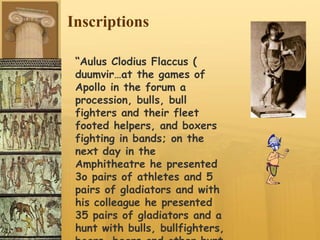
Inscriptions
“Aulus Clodius Flaccus (
duumvir…at the games of
Apollo in the forum a
procession, bulls, bull
fighters and their fleet
footed helpers, and boxers
fighting in bands; on the
next day in the
Amphitheatre he presented
3o pairs of athletes and 5
pairs of gladiators and with
his colleague he presented
35 pairs of gladiators and a
hunt with bulls, bullfighters,
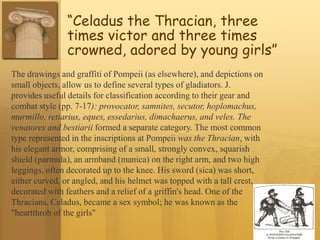
“Celadus the Thracian, three
times victor and three times
crowned, adored by young girls”
The drawings and graffiti of Pompeii (as elsewhere), and depictions on
small objects, allow us to define several types of gladiators. J.
provides useful details for classification according to their gear and
combat style (pp. 7-17): provocator, samnites, secutor, hoplomachus,
murmillo, retiarius, eques, essedarius, dimachaerus, and veles. The
venatores and bestiarii formed a separate category. The most common
type represented in the inscriptions at Pompeii was the Thracian, with
his elegant armor, comprising of a small, strongly convex, squarish
shield (parmula), an armband (manica) on the right arm, and two high
leggings, often decorated up to the knee. His sword (sica) was short,
either curved, or angled, and his helmet was topped with a tall crest,
decorated with feathers and a relief of a griffin's head. One of the
Thracians, Celadus, became a sex symbol; he was known as the
"heartthrob of the girls"
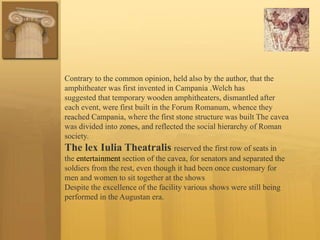
Contrary to the common opinion, held also by the author, that the
amphitheater was first invented in Campania .Welch has
suggested that temporary wooden amphitheaters, dismantled after
each event, were first built in the Forum Romanum, whence they
reached Campania, where the first stone structure was built The cavea
was divided into zones, and reflected the social hierarchy of Roman
society.
The lex Iulia Theatralis reserved the first row of seats in
the entertainment section of the cavea, for senators and separated the
soldiers from the rest, even though it had been once customary for
men and women to sit together at the shows
Despite the excellence of the facility various shows were still being
performed in the Augustan era.
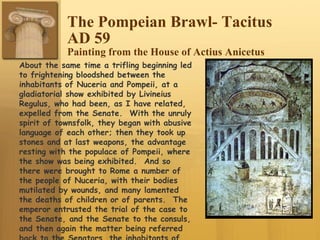
The Pompeian Brawl- Tacitus
AD 59
Painting from the House of Actius Anicetus
About the same time a trifling beginning led
to frightening bloodshed between the
inhabitants of Nuceria and Pompeii, at a
gladiatorial show exhibited by Livineius
Regulus, who had been, as I have related,
expelled from the Senate. With the unruly
spirit of townsfolk, they began with abusive
language of each other; then they took up
stones and at last weapons, the advantage
resting with the populace of Pompeii, where
the show was being exhibited. And so
there were brought to Rome a number of
the people of Nuceria, with their bodies
mutilated by wounds, and many lamented
the deaths of children or of parents. The
emperor entrusted the trial of the case to
the Senate, and the Senate to the consuls,
and then again the matter being referred
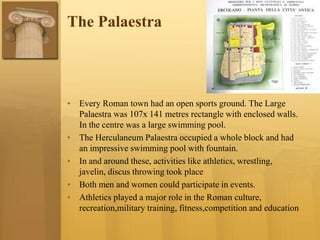
The Palaestra
• Every Roman town had an open sports ground. The Large
Palaestra was 107x 141 metres rectangle with enclosed walls.
In the centre was a large swimming pool.
• The Herculaneum Palaestra occupied a whole block and had
an impressive swimming pool with fountain.
• In and around these, activities like athletics, wrestling,
javelin, discus throwing took place
• Both men and women could participate in events.
• Athletics played a major role in the Roman culture,
recreation,military training, fitness,competition and education
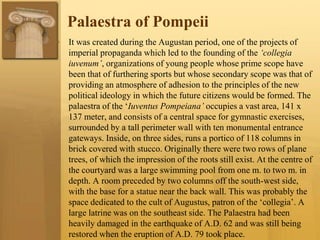
Palaestra of Pompeii
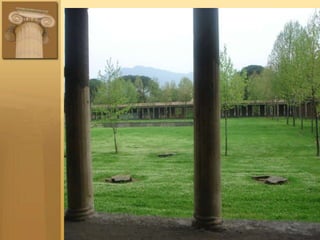
• It was created during the Augustan period, one of the projects of
imperial propaganda which led to the founding of the ‘collegia
iuvenum’, organizations of young people whose prime scope have
been that of furthering sports but whose secondary scope was that of
providing an atmosphere of adhesion to the principles of the new
political ideology in which the future citizens would be formed. The
palaestra of the ‘Iuventus Pompeiana’ occupies a vast area, 141 x
137 meter, and consists of a central space for gymnastic exercises,
surrounded by a tall perimeter wall with ten monumental entrance
gateways. Inside, on three sides, runs a portico of 118 columns in
brick covered with stucco. Originally there were two rows of plane
trees, of which the impression of the roots still exist. At the centre of
the courtyard was a large swimming pool from one m. to two m. in
depth. A room preceded by two columns off the south-west side,
with the base for a statue near the back wall. This was probably the
space dedicated to the cult of Augustus, patron of the ‘collegia’. A
large latrine was on the southeast side. The Palaestra had been
heavily damaged in the earthquake of A.D. 62 and was still being
restored when the eruption of A.D. 79 took place.
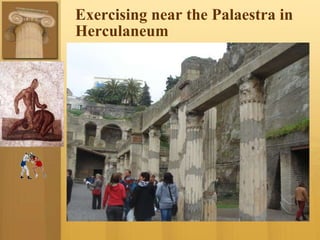
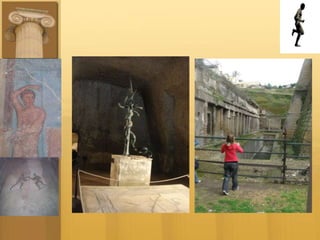
Exercising near the Palaestra in
Herculaneum
Earthquake Damage
• These barracks were damaged by the earthquake of AD 62 and
the gladiators transferred to the quadriporticus of the theater,
which was converted into a training school (ludus). It was here
that were found much of the armor discovered at Pompeii,
including helmets, greaves, belts, and the shoulder piece worn by
the retiarius, some of which were stamped NER or NER.AUG,
indicating that the belonged to the Neroniani, gladiators from the
imperial school at nearby Capua, to which Nero had given his
name.
• Here, too, was found the skeletons of a lady adorned with jewels
and that of her gladiator lover. As poignantly, there also was a
graffito scratched on the wall of the dining hall (which could
hold no more than two hundred men): "The philosopher Annaeus
Senecas [sic] is the only Roman writer to condemn the bloody
games."
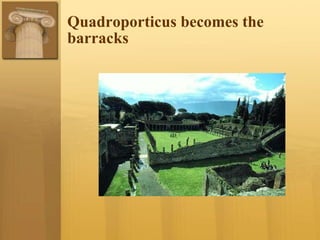
Quadroporticus becomes the
barracks
Gladiators Barracks
• In the primitive gladiators' barracks (ludus), comprising a large
courtyard surrounded by a peristyle, between 15 and 20 gladiators of
all types, both free and freed, lived. More than 100 different graffiti
made by gladiators were found on the columns of the peristyle. The
quadriporticus in the rear of the theater was converted after the
earthquake of 62 CE to a large ludus gladiatorum. The conversion was
perhaps due to damage to the earlier ludus from the earthquake; also,
the ever-growing number of gladiators involved in the games during
Nero's reign made a larger building necessary. The living quarters all
around the courtyard were small separate rooms of 10-15 sq m, laid out
on two levels with a wooden gallery, each accommodating 2-3 gladiators,
who seem to have slept on straw mattresses, not on beds. There were
also a kitchen, a dining room, and storerooms. The gladiators were free
to come and go from the barracks and to receive guests there. A
bejeweled female skeleton found in one of the cells seems to have been
one of the guests who found her death when Vesuvius erupted. Some seem
to have lived there with their families
Attending the Theatre
• Theatre and Roman culture had an ambivalent relationship.
• On the one hand Greek classic tragedies, religion and
architecture were admired, studied and imitated.
• Cicero the great orator even declared that much could be
learned about rhetoric from actors.
• Actors however were considered lower class and had no
voting rights
• “Through the whole of Greece it was accounted a great glory
to be proclaimed a conqueror at Olympia; while to appear
upon the stage, and become a spectacle to the public,was a
dishonour to no one in that nation; but all these practices
are, with us, deemed partly infamous, partly mean, and at
variance with respectability.” Cornelius Nepos
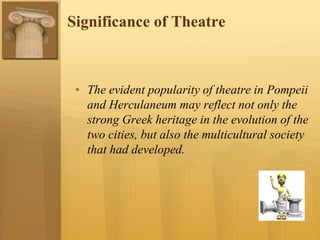
Significance of Theatre
• The evident popularity of theatre in Pompeii
and Herculaneum may reflect not only the
strong Greek heritage in the evolution of the
two cities, but also the multicultural society
that had developed.
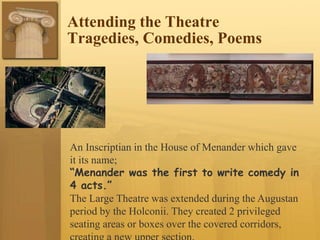
Attending the Theatre
Tragedies, Comedies, Poems
An Inscriptian in the House of Menander which gave
it its name;
“Menander was the first to write comedy in
4 acts.”
The Large Theatre was extended during the Augustan
period by the Holconii. They created 2 privileged
seating areas or boxes over the covered corridors,
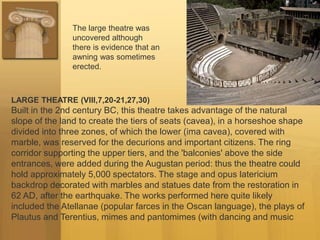
LARGE THEATRE (VIII,7,20-21,27,30)
Built in the 2nd century BC, this theatre takes advantage of the natural
slope of the land to create the tiers of seats (cavea), in a horseshoe shape
divided into three zones, of which the lower (ima cavea), covered with
marble, was reserved for the decurions and important citizens. The ring
corridor supporting the upper tiers, and the 'balconies' above the side
entrances, were added during the Augustan period: thus the theatre could
hold approximately 5,000 spectators. The stage and opus latericium
backdrop decorated with marbles and statues date from the restoration in
62 AD, after the earthquake. The works performed here quite likely
included the Atellanae (popular farces in the Oscan language), the plays of
Plautus and Terentius, mimes and pantomimes (with dancing and music
The large theatre was
uncovered although
there is evidence that an
awning was sometimes
erected.
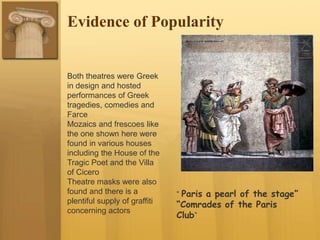
Evidence of Popularity
Both theatres were Greek
in design and hosted
performances of Greek
tragedies, comedies and
Farce
Mozaics and frescoes like
the one shown here were
found in various houses
including the House of the
Tragic Poet and the Villa
of Cicero
Theatre masks were also
found and there is a
plentiful supply of graffiti
concerning actors
“ Paris a pearl of the stage”
“Comrades of the Paris
Club”
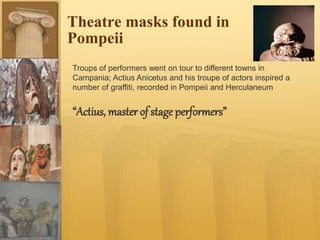
Theatre masks found in
Pompeii
Troups of performers went on tour to different towns in
Campania; Actius Anicetus and his troupe of actors inspired a
number of graffiti, recorded in Pompeii and Herculaneum
“Actius, master of stage performers”
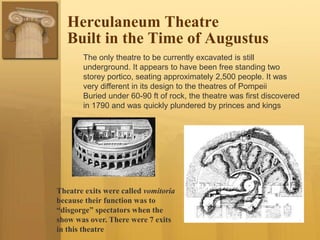
Herculaneum Theatre
Built in the Time of Augustus
The only theatre to be currently excavated is still
underground. It appears to have been free standing two
storey portico, seating approximately 2,500 people. It was
very different in its design to the theatres of Pompeii
Buried under 60-90 ft of rock, the theatre was first discovered
in 1790 and was quickly plundered by princes and kings
Theatre exits were called vomitoria
because their function was to
“disgorge” spectators when the
show was over. There were 7 exits
in this theatre
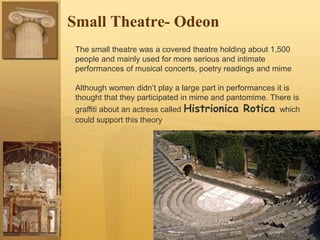
Small Theatre- Odeon
The small theatre was a covered theatre holding about 1,500
people and mainly used for more serious and intimate
performances of musical concerts, poetry readings and mime
Although women didn’t play a large part in performances it is
thought that they participated in mime and pantomime. There is
graffiti about an actress called Histrionica Rotica which
could support this theory
The Odeon
• SMALL THEATRE (VIII,7,17-20)
• This ‘small theatre’, perhaps used for musical
performances and poetry readings, was built in the
early years of the Sullan colony (around 80 BC).
According to inscriptions found here, it had a roof to
ensure excellent acoustics: this rested on outer walls
that bordered the tiers of seats (cavea), decorated with
sculpted telamons: the lower part (ima cavea) has low,
wide seating steps (bisellia) reserved for the decurions;
a balustrade decorated with winged gryphon paws
distinguishes it from the media cavea.
Poets
• Although both Greek and Roman poetry would be
performed it is thought that the only local poet to
perform was the love elegies of Tiburtinus
• There is considerable debate over the naming of
this particular house. Its original name of Loreius
Tiburtinus was derived from electoral
advertisements of sorts etched in the outer façade,
some saying "Vote for Loreius" and others "Vote
for Tiburtinus." In fact, the last known owner of the
house was a man named Octavius Quartio, whose
bronze seal was found inside the house during
excavation. Some historians choose to refer to the
house as the House of Octavius Quartio.
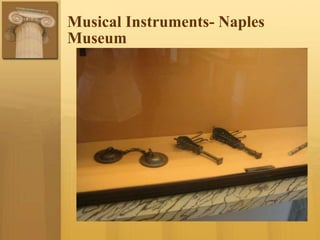
Musical Instruments- Naples
Museum
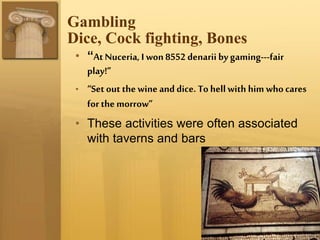
Gambling
Dice, Cock fighting, Bones
• “At Nuceria, I won 8552 denarii by gaming---fair
play!”
• “Set out the wine and dice. To hell with him who cares
for the morrow”
• These activities were often associated
with taverns and bars
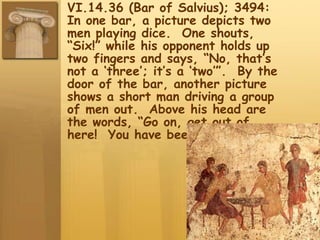
VI.14.36 (Bar of Salvius); 3494:
In one bar, a picture depicts two
men playing dice. One shouts,
“Six!” while his opponent holds up
two fingers and says, “No, that’s
not a ‘three’; it’s a ‘two’”. By the
door of the bar, another picture
shows a short man driving a group
of men out. Above his head are
the words, “Go on, get out of
here! You have been fighting!

Leisure and entertainment pomp

  • 1.
    “Mens sana incorpore sano” Sound mind in a sound body Leisure and Entertainment
  • 2.
  • 3.
    ROME- Founded onBlood • "we are dealing here, not with individual sadistic psychopathology, but with a deep cultural difference.“( Keith Hopkins) Attending gladiatorial contests in the amphitheater was an essential part of being a Roman. Rome was a warrior state that had achieved its large empire by military violence • In such a cultural climate it is not surprising that gladiatorial games were immensely popular and a characteristic symbol of Roman culture for almost seven centuries. It may be no accident that the most dramatic increase in the popularity of gladiatorial games occurred during the first two centuries AD, when the Augustan peace throughout the empire provided little opportunity for citizens to participate in real warfare. If there were not enough real warfare to satisfy Roman tastes, then counterfeit warfare would have to do. Hopkins calls the amphitheater "artificial battlefields" where the Romans created battlefield conditions for public amusement
  • 4.
    Leisure, Otium • “Godknows, my Martial, if we two could be To enjoy our days set wholly free; To the true life together bend our mind, And take a furlough from the falser kind. No rich saloon, nor palace of the great, Nor suit at law should trouble our estate; On no vainglorious statues should we look, But of a walk, a talk, a little book, Baths, wells and meads, and the veranda shade,” • The abundance of graffiti, inscriptions, mozaics and public buildings which refer to leisure pastimes and entertainment suggest that the inhabitants of Pompeii and Herculaneum were enthusiastic supporters, spectators and participaters in such activities.
  • 5.
    Let the gamesbegin! Games could be given to commemorate specific occassions, honour a particular god such as Apollo, or promote the welfare of the Imperial Games
  • 6.
    Amphitheatre/Palaestra Complex Amphitheatre literally meantdouble theatre Arena meant sand, used to soak up the blood
  • 7.
    The Amphitheatre; Spectacula Theearliest stone amphitheater was built in Pompeii about 70 BC and is oval in shape, with steeply tiered seats around the circumference. The soil excavated for the arena was banked to form the seating, stabilized on the south and east by the town walls. Those veteran colonists seated in the podium nearest the arena, the social prestige of which was emphasized by it being separated by a low wall, would have entered through four vaulted passageways at ground level. Others would have climbed stairways to reach the upper terraces. Unlike the Colosseum, which was constructed more than a century and a half later, there is no subterranean structure beneath the arena. The dedicatory inscription refers to the amphitheater as spectacula; the term amphitheatrum came into common use only at the time of Augustus.
  • 8.
    Reading in toan Inscription “Caius Quintus Valgus, son of Caius and Marcus Porcius, son of Marcus, in their capacity as quinquennial duumviri, to demonstrate the honour of the colony, erected this sports complex at their own expense and donated it to the colonists for their perpetual use.” It has been suggested that the construction of the amphitheatre and its dedication, built after the settlement of veterans in the area, somehow served to emphasize the status of colony and remind Pompeians of their new status with Rome…..J Berry
  • 9.
    Defining Social Status ImaCavea Lower seating area of 5 steps reserved for the dignitaries Medea Cavea Middle seating area of 12 steps Summa Cavea Upper area with 18 steps where women sat It was made from local stone and featured a parapet that separated the seats from the arena and was decorated with frescoes
  • 10.
  • 11.
    Inscriptions “Aulus Clodius Flaccus( duumvir…at the games of Apollo in the forum a procession, bulls, bull fighters and their fleet footed helpers, and boxers fighting in bands; on the next day in the Amphitheatre he presented 3o pairs of athletes and 5 pairs of gladiators and with his colleague he presented 35 pairs of gladiators and a hunt with bulls, bullfighters,
  • 12.
    “Celadus the Thracian,three times victor and three times crowned, adored by young girls” The drawings and graffiti of Pompeii (as elsewhere), and depictions on small objects, allow us to define several types of gladiators. J. provides useful details for classification according to their gear and combat style (pp. 7-17): provocator, samnites, secutor, hoplomachus, murmillo, retiarius, eques, essedarius, dimachaerus, and veles. The venatores and bestiarii formed a separate category. The most common type represented in the inscriptions at Pompeii was the Thracian, with his elegant armor, comprising of a small, strongly convex, squarish shield (parmula), an armband (manica) on the right arm, and two high leggings, often decorated up to the knee. His sword (sica) was short, either curved, or angled, and his helmet was topped with a tall crest, decorated with feathers and a relief of a griffin's head. One of the Thracians, Celadus, became a sex symbol; he was known as the "heartthrob of the girls"
  • 13.
    Contrary to thecommon opinion, held also by the author, that the amphitheater was first invented in Campania .Welch has suggested that temporary wooden amphitheaters, dismantled after each event, were first built in the Forum Romanum, whence they reached Campania, where the first stone structure was built The cavea was divided into zones, and reflected the social hierarchy of Roman society. The lex Iulia Theatralis reserved the first row of seats in the entertainment section of the cavea, for senators and separated the soldiers from the rest, even though it had been once customary for men and women to sit together at the shows Despite the excellence of the facility various shows were still being performed in the Augustan era.
  • 14.
    The Pompeian Brawl-Tacitus AD 59 Painting from the House of Actius Anicetus About the same time a trifling beginning led to frightening bloodshed between the inhabitants of Nuceria and Pompeii, at a gladiatorial show exhibited by Livineius Regulus, who had been, as I have related, expelled from the Senate. With the unruly spirit of townsfolk, they began with abusive language of each other; then they took up stones and at last weapons, the advantage resting with the populace of Pompeii, where the show was being exhibited. And so there were brought to Rome a number of the people of Nuceria, with their bodies mutilated by wounds, and many lamented the deaths of children or of parents. The emperor entrusted the trial of the case to the Senate, and the Senate to the consuls, and then again the matter being referred
  • 15.
    The Palaestra • EveryRoman town had an open sports ground. The Large Palaestra was 107x 141 metres rectangle with enclosed walls. In the centre was a large swimming pool. • The Herculaneum Palaestra occupied a whole block and had an impressive swimming pool with fountain. • In and around these, activities like athletics, wrestling, javelin, discus throwing took place • Both men and women could participate in events. • Athletics played a major role in the Roman culture, recreation,military training, fitness,competition and education
  • 16.
    Palaestra of Pompeii •It was created during the Augustan period, one of the projects of imperial propaganda which led to the founding of the ‘collegia iuvenum’, organizations of young people whose prime scope have been that of furthering sports but whose secondary scope was that of providing an atmosphere of adhesion to the principles of the new political ideology in which the future citizens would be formed. The palaestra of the ‘Iuventus Pompeiana’ occupies a vast area, 141 x 137 meter, and consists of a central space for gymnastic exercises, surrounded by a tall perimeter wall with ten monumental entrance gateways. Inside, on three sides, runs a portico of 118 columns in brick covered with stucco. Originally there were two rows of plane trees, of which the impression of the roots still exist. At the centre of the courtyard was a large swimming pool from one m. to two m. in depth. A room preceded by two columns off the south-west side, with the base for a statue near the back wall. This was probably the space dedicated to the cult of Augustus, patron of the ‘collegia’. A large latrine was on the southeast side. The Palaestra had been heavily damaged in the earthquake of A.D. 62 and was still being restored when the eruption of A.D. 79 took place.
  • 17.
    Exercising near thePalaestra in Herculaneum
  • 20.
    Earthquake Damage • Thesebarracks were damaged by the earthquake of AD 62 and the gladiators transferred to the quadriporticus of the theater, which was converted into a training school (ludus). It was here that were found much of the armor discovered at Pompeii, including helmets, greaves, belts, and the shoulder piece worn by the retiarius, some of which were stamped NER or NER.AUG, indicating that the belonged to the Neroniani, gladiators from the imperial school at nearby Capua, to which Nero had given his name. • Here, too, was found the skeletons of a lady adorned with jewels and that of her gladiator lover. As poignantly, there also was a graffito scratched on the wall of the dining hall (which could hold no more than two hundred men): "The philosopher Annaeus Senecas [sic] is the only Roman writer to condemn the bloody games."
  • 21.
  • 22.
    Gladiators Barracks • Inthe primitive gladiators' barracks (ludus), comprising a large courtyard surrounded by a peristyle, between 15 and 20 gladiators of all types, both free and freed, lived. More than 100 different graffiti made by gladiators were found on the columns of the peristyle. The quadriporticus in the rear of the theater was converted after the earthquake of 62 CE to a large ludus gladiatorum. The conversion was perhaps due to damage to the earlier ludus from the earthquake; also, the ever-growing number of gladiators involved in the games during Nero's reign made a larger building necessary. The living quarters all around the courtyard were small separate rooms of 10-15 sq m, laid out on two levels with a wooden gallery, each accommodating 2-3 gladiators, who seem to have slept on straw mattresses, not on beds. There were also a kitchen, a dining room, and storerooms. The gladiators were free to come and go from the barracks and to receive guests there. A bejeweled female skeleton found in one of the cells seems to have been one of the guests who found her death when Vesuvius erupted. Some seem to have lived there with their families
  • 23.
    Attending the Theatre •Theatre and Roman culture had an ambivalent relationship. • On the one hand Greek classic tragedies, religion and architecture were admired, studied and imitated. • Cicero the great orator even declared that much could be learned about rhetoric from actors. • Actors however were considered lower class and had no voting rights • “Through the whole of Greece it was accounted a great glory to be proclaimed a conqueror at Olympia; while to appear upon the stage, and become a spectacle to the public,was a dishonour to no one in that nation; but all these practices are, with us, deemed partly infamous, partly mean, and at variance with respectability.” Cornelius Nepos
  • 24.
    Significance of Theatre •The evident popularity of theatre in Pompeii and Herculaneum may reflect not only the strong Greek heritage in the evolution of the two cities, but also the multicultural society that had developed.
  • 25.
    Attending the Theatre Tragedies,Comedies, Poems An Inscriptian in the House of Menander which gave it its name; “Menander was the first to write comedy in 4 acts.” The Large Theatre was extended during the Augustan period by the Holconii. They created 2 privileged seating areas or boxes over the covered corridors,
  • 26.
    LARGE THEATRE (VIII,7,20-21,27,30) Builtin the 2nd century BC, this theatre takes advantage of the natural slope of the land to create the tiers of seats (cavea), in a horseshoe shape divided into three zones, of which the lower (ima cavea), covered with marble, was reserved for the decurions and important citizens. The ring corridor supporting the upper tiers, and the 'balconies' above the side entrances, were added during the Augustan period: thus the theatre could hold approximately 5,000 spectators. The stage and opus latericium backdrop decorated with marbles and statues date from the restoration in 62 AD, after the earthquake. The works performed here quite likely included the Atellanae (popular farces in the Oscan language), the plays of Plautus and Terentius, mimes and pantomimes (with dancing and music The large theatre was uncovered although there is evidence that an awning was sometimes erected.
  • 27.
    Evidence of Popularity Boththeatres were Greek in design and hosted performances of Greek tragedies, comedies and Farce Mozaics and frescoes like the one shown here were found in various houses including the House of the Tragic Poet and the Villa of Cicero Theatre masks were also found and there is a plentiful supply of graffiti concerning actors “ Paris a pearl of the stage” “Comrades of the Paris Club”
  • 28.
    Theatre masks foundin Pompeii Troups of performers went on tour to different towns in Campania; Actius Anicetus and his troupe of actors inspired a number of graffiti, recorded in Pompeii and Herculaneum “Actius, master of stage performers”
  • 29.
    Herculaneum Theatre Built inthe Time of Augustus The only theatre to be currently excavated is still underground. It appears to have been free standing two storey portico, seating approximately 2,500 people. It was very different in its design to the theatres of Pompeii Buried under 60-90 ft of rock, the theatre was first discovered in 1790 and was quickly plundered by princes and kings Theatre exits were called vomitoria because their function was to “disgorge” spectators when the show was over. There were 7 exits in this theatre
  • 30.
    Small Theatre- Odeon Thesmall theatre was a covered theatre holding about 1,500 people and mainly used for more serious and intimate performances of musical concerts, poetry readings and mime Although women didn’t play a large part in performances it is thought that they participated in mime and pantomime. There is graffiti about an actress called Histrionica Rotica which could support this theory
  • 31.
    The Odeon • SMALLTHEATRE (VIII,7,17-20) • This ‘small theatre’, perhaps used for musical performances and poetry readings, was built in the early years of the Sullan colony (around 80 BC). According to inscriptions found here, it had a roof to ensure excellent acoustics: this rested on outer walls that bordered the tiers of seats (cavea), decorated with sculpted telamons: the lower part (ima cavea) has low, wide seating steps (bisellia) reserved for the decurions; a balustrade decorated with winged gryphon paws distinguishes it from the media cavea.
  • 32.
    Poets • Although bothGreek and Roman poetry would be performed it is thought that the only local poet to perform was the love elegies of Tiburtinus • There is considerable debate over the naming of this particular house. Its original name of Loreius Tiburtinus was derived from electoral advertisements of sorts etched in the outer façade, some saying "Vote for Loreius" and others "Vote for Tiburtinus." In fact, the last known owner of the house was a man named Octavius Quartio, whose bronze seal was found inside the house during excavation. Some historians choose to refer to the house as the House of Octavius Quartio.
  • 33.
  • 34.
    Gambling Dice, Cock fighting,Bones • “At Nuceria, I won 8552 denarii by gaming---fair play!” • “Set out the wine and dice. To hell with him who cares for the morrow” • These activities were often associated with taverns and bars
  • 35.
    VI.14.36 (Bar ofSalvius); 3494: In one bar, a picture depicts two men playing dice. One shouts, “Six!” while his opponent holds up two fingers and says, “No, that’s not a ‘three’; it’s a ‘two’”. By the door of the bar, another picture shows a short man driving a group of men out. Above his head are the words, “Go on, get out of here! You have been fighting!