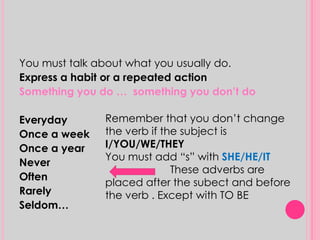
You must talk about what you usually do. 
Express a habit or a repeated action 
Something you do … something you don’t do 
Everyday 
Once a week 
Once a year 
Never 
Often 
Rarely 
Seldom… 
Remember that you don’t change 
the verb if the subject is 
I/YOU/WE/THEY 
You must add “s” with SHE/HE/IT 
These adverbs are 
placed after the subect and before 
the verb . Except with TO BE
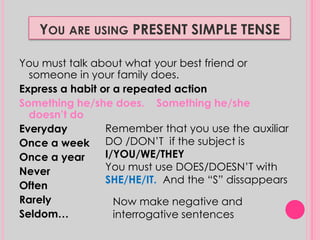
YOU ARE USING PRESENT SIMPLE TENSE 
You must talk about what your best friend or 
someone in your family does. 
Express a habit or a repeated action 
Something he/she does. Something he/she 
doesn’t do 
Everyday 
Once a week 
Once a year 
Never 
Often 
Rarely 
Seldom… 
Remember that you use the auxiliar 
DO /DON’T if the subject is 
I/YOU/WE/THEY 
You must use DOES/DOESN’T with 
SHE/HE/IT. And the “S” dissappears 
Now make negative and 
interrogative sentences
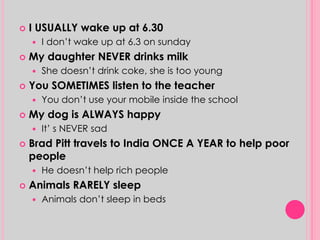
 I USUALLY wake up at 6.30 
 I don’t wake up at 6.3 on sunday 
 My daughter NEVER drinks milk 
 She doesn’t drink coke, she is too young 
 You SOMETIMES listen to the teacher 
 You don’t use your mobile inside the school 
 My dog is ALWAYS happy 
 It’ s NEVER sad 
 Brad Pitt travels to India ONCE A YEAR to help poor 
people 
 He doesn’t help rich people 
 Animals RARELY sleep 
 Animals don’t sleep in beds
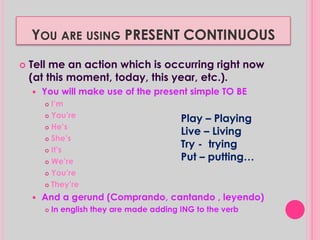
YOU ARE USING PRESENT CONTINUOUS 
 Tell me an action which is occurring right now 
(at this moment, today, this year, etc.). 
 You will make use of the present simple TO BE 
 I’m 
 You’re 
 He’s 
 She’s 
 It’s 
 We’re 
 You’re 
 They’re 
Play – Playing 
Live – Living 
Try - trying 
Put – putting… 
 And a gerund (Comprando, cantando , leyendo) 
 In english they are made adding ING to the verb
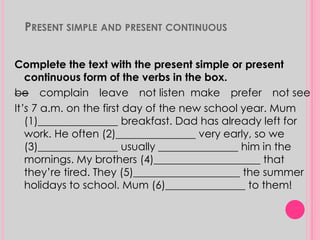
PRESENT SIMPLE AND PRESENT CONTINUOUS 
Complete the text with the present simple or present 
continuous form of the verbs in the box. 
be complain leave not listen make prefer not see 
It’s 7 a.m. on the first day of the new school year. Mum 
(1)_______________ breakfast. Dad has already left for 
work. He often (2)_______________ very early, so we 
(3)_______________ usually _______________ him in the 
mornings. My brothers (4)____________________ that 
they’re tired. They (5)____________________ the summer 
holidays to school. Mum (6)_______________ to them!
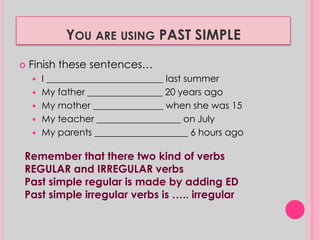
YOU ARE USING PAST SIMPLE 
 Finish these sentences… 
 I _________________________ last summer 
 My father ________________ 20 years ago 
 My mother _______________ when she was 15 
 My teacher __________________ on July 
 My parents ____________________ 6 hours ago 
Remember that there two kind of verbs 
REGULAR and IRREGULAR verbs 
Past simple regular is made by adding ED 
Past simple irregular verbs is ….. irregular
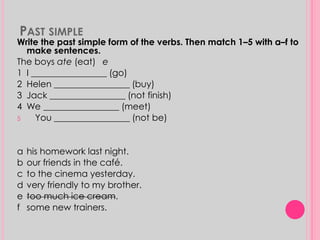
PAST SIMPLE 
Write the past simple form of the verbs. Then match 1–5 with a–f to 
make sentences. 
The boys ate (eat) e 
1 I _________________ (go) 
2 Helen _________________ (buy) 
3 Jack _________________ (not finish) 
4 We _________________ (meet) 
5 You _________________ (not be) 
a his homework last night. 
b our friends in the café. 
c to the cinema yesterday. 
d very friendly to my brother. 
e too much ice cream. 
f some new trainers.
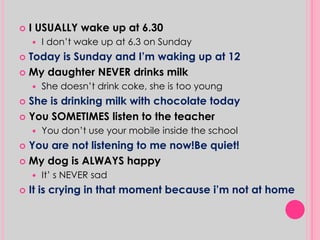
 I USUALLY wake up at 6.30 
 I don’t wake up at 6.3 on Sunday 
 Today is Sunday and I’m waking up at 12 
 My daughter NEVER drinks milk 
 She doesn’t drink coke, she is too young 
 She is drinking milk with chocolate today 
 You SOMETIMES listen to the teacher 
 You don’t use your mobile inside the school 
 You are not listening to me now!Be quiet! 
 My dog is ALWAYS happy 
 It’ s NEVER sad 
 It is crying in that moment because i’m not at home
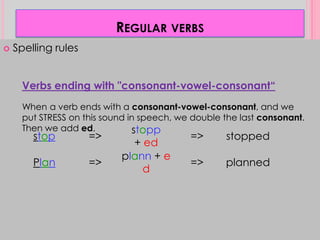
REGULAR VERBS 
 Spelling rules 
Verbs ending with "consonant-vowel-consonant“ 
When a verb ends with a consonant-vowel-consonant, and we 
put STRESS on this sound in speech, we double the last consonant. 
Then we add ed. 
stop => 
stopp 
+ ed 
=> stopped 
Plan => 
plann + e 
d 
=> planned
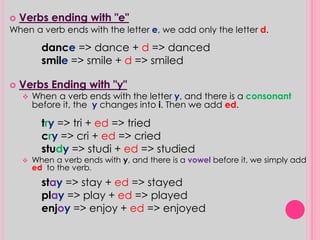
 Verbs ending with "e" 
When a verb ends with the letter e, we add only the letter d. 
dance => dance + d => danced 
smile => smile + d => smiled 
 Verbs Ending with "y" 
 When a verb ends with the letter y, and there is a consonant 
before it, the y changes into i. Then we add ed. 
try => tri + ed => tried 
cry => cri + ed => cried 
study => studi + ed => studied 
 When a verb ends with y, and there is a vowel before it, we simply add 
ed to the verb. 
stay => stay + ed => stayed 
play => play + ed => played 
enjoy => enjoy + ed => enjoyed
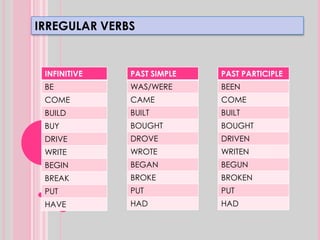
IRREGULAR VERBS 
INFINITIVE 
BE 
COME 
BUILD 
BUY 
DRIVE 
WRITE 
BEGIN 
BREAK 
PUT 
HAVE 
PAST SIMPLE 
WAS/WERE 
CAME 
BUILT 
BOUGHT 
DROVE 
WROTE 
BEGAN 
BROKE 
PUT 
HAD 
PAST PARTICIPLE 
BEEN 
COME 
BUILT 
BOUGHT 
DRIVEN 
WRITEN 
BEGUN 
BROKEN 
PUT 
HAD
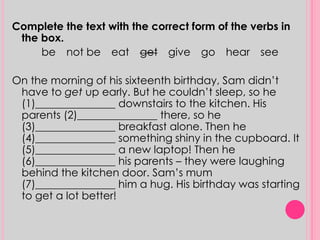
Complete the text with the correct form of the verbs in 
the box. 
be not be eat get give go hear see 
On the morning of his sixteenth birthday, Sam didn’t 
have to get up early. But he couldn’t sleep, so he 
(1)_______________ downstairs to the kitchen. His 
parents (2)_______________ there, so he 
(3)_______________ breakfast alone. Then he 
(4)_______________ something shiny in the cupboard. It 
(5)_______________ a new laptop! Then he 
(6)_______________ his parents – they were laughing 
behind the kitchen door. Sam’s mum 
(7)_______________ him a hug. His birthday was starting 
to get a lot better!

Unit 0. summary last year

  • 2.
    You must talkabout what you usually do. Express a habit or a repeated action Something you do … something you don’t do Everyday Once a week Once a year Never Often Rarely Seldom… Remember that you don’t change the verb if the subject is I/YOU/WE/THEY You must add “s” with SHE/HE/IT These adverbs are placed after the subect and before the verb . Except with TO BE
  • 3.
    YOU ARE USINGPRESENT SIMPLE TENSE You must talk about what your best friend or someone in your family does. Express a habit or a repeated action Something he/she does. Something he/she doesn’t do Everyday Once a week Once a year Never Often Rarely Seldom… Remember that you use the auxiliar DO /DON’T if the subject is I/YOU/WE/THEY You must use DOES/DOESN’T with SHE/HE/IT. And the “S” dissappears Now make negative and interrogative sentences
  • 4.
     I USUALLYwake up at 6.30  I don’t wake up at 6.3 on sunday  My daughter NEVER drinks milk  She doesn’t drink coke, she is too young  You SOMETIMES listen to the teacher  You don’t use your mobile inside the school  My dog is ALWAYS happy  It’ s NEVER sad  Brad Pitt travels to India ONCE A YEAR to help poor people  He doesn’t help rich people  Animals RARELY sleep  Animals don’t sleep in beds
  • 5.
    YOU ARE USINGPRESENT CONTINUOUS  Tell me an action which is occurring right now (at this moment, today, this year, etc.).  You will make use of the present simple TO BE  I’m  You’re  He’s  She’s  It’s  We’re  You’re  They’re Play – Playing Live – Living Try - trying Put – putting…  And a gerund (Comprando, cantando , leyendo)  In english they are made adding ING to the verb
  • 6.
    PRESENT SIMPLE ANDPRESENT CONTINUOUS Complete the text with the present simple or present continuous form of the verbs in the box. be complain leave not listen make prefer not see It’s 7 a.m. on the first day of the new school year. Mum (1)_______________ breakfast. Dad has already left for work. He often (2)_______________ very early, so we (3)_______________ usually _______________ him in the mornings. My brothers (4)____________________ that they’re tired. They (5)____________________ the summer holidays to school. Mum (6)_______________ to them!
  • 7.
    YOU ARE USINGPAST SIMPLE  Finish these sentences…  I _________________________ last summer  My father ________________ 20 years ago  My mother _______________ when she was 15  My teacher __________________ on July  My parents ____________________ 6 hours ago Remember that there two kind of verbs REGULAR and IRREGULAR verbs Past simple regular is made by adding ED Past simple irregular verbs is ….. irregular
  • 8.
    PAST SIMPLE Writethe past simple form of the verbs. Then match 1–5 with a–f to make sentences. The boys ate (eat) e 1 I _________________ (go) 2 Helen _________________ (buy) 3 Jack _________________ (not finish) 4 We _________________ (meet) 5 You _________________ (not be) a his homework last night. b our friends in the café. c to the cinema yesterday. d very friendly to my brother. e too much ice cream. f some new trainers.
  • 9.
     I USUALLYwake up at 6.30  I don’t wake up at 6.3 on Sunday  Today is Sunday and I’m waking up at 12  My daughter NEVER drinks milk  She doesn’t drink coke, she is too young  She is drinking milk with chocolate today  You SOMETIMES listen to the teacher  You don’t use your mobile inside the school  You are not listening to me now!Be quiet!  My dog is ALWAYS happy  It’ s NEVER sad  It is crying in that moment because i’m not at home
  • 10.
    REGULAR VERBS Spelling rules Verbs ending with "consonant-vowel-consonant“ When a verb ends with a consonant-vowel-consonant, and we put STRESS on this sound in speech, we double the last consonant. Then we add ed. stop => stopp + ed => stopped Plan => plann + e d => planned
  • 11.
     Verbs endingwith "e" When a verb ends with the letter e, we add only the letter d. dance => dance + d => danced smile => smile + d => smiled  Verbs Ending with "y"  When a verb ends with the letter y, and there is a consonant before it, the y changes into i. Then we add ed. try => tri + ed => tried cry => cri + ed => cried study => studi + ed => studied  When a verb ends with y, and there is a vowel before it, we simply add ed to the verb. stay => stay + ed => stayed play => play + ed => played enjoy => enjoy + ed => enjoyed
  • 12.
    IRREGULAR VERBS INFINITIVE BE COME BUILD BUY DRIVE WRITE BEGIN BREAK PUT HAVE PAST SIMPLE WAS/WERE CAME BUILT BOUGHT DROVE WROTE BEGAN BROKE PUT HAD PAST PARTICIPLE BEEN COME BUILT BOUGHT DRIVEN WRITEN BEGUN BROKEN PUT HAD
  • 13.
    Complete the textwith the correct form of the verbs in the box. be not be eat get give go hear see On the morning of his sixteenth birthday, Sam didn’t have to get up early. But he couldn’t sleep, so he (1)_______________ downstairs to the kitchen. His parents (2)_______________ there, so he (3)_______________ breakfast alone. Then he (4)_______________ something shiny in the cupboard. It (5)_______________ a new laptop! Then he (6)_______________ his parents – they were laughing behind the kitchen door. Sam’s mum (7)_______________ him a hug. His birthday was starting to get a lot better!