





Preview
2-1 Expressing past time: the simple past
2-2 Forms of the simple past: regular verbs
2-3 Forms of the simple past: be
2-4 Regular verbs: pronunciation of –ed endings
2-5 Spelling of –ing and –ed forms
2-6 The principal parts of a verb
2-7 Irregular verbs: a reference list
2-8 The simple past and the past progressive
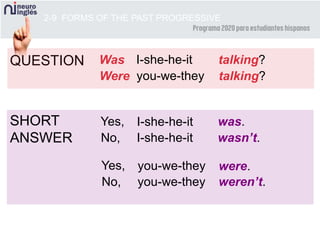
2-9 Forms of the past progressive
2-10 Expressing past time: using time clauses
2-11 Expressing past habit: used to
CONTENTS
CHAPTER 2: PREVIEW
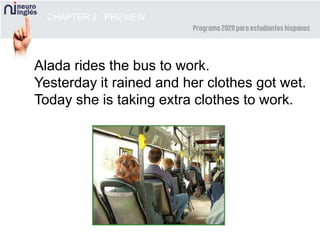
Alada rides the bus to work.
Yesterday it rained and her clothes got wet.
Today she is taking extra clothes to work.
CHAPTER 2: PREVIEW
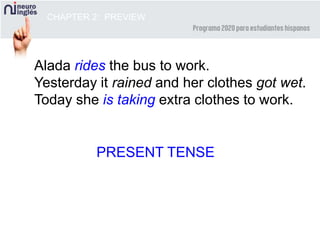
Alada rides the bus to work.
Yesterday it rained and her clothes got wet.
Today she is taking extra clothes to work.
PRESENT TENSE
CHAPTER 2: PREVIEW
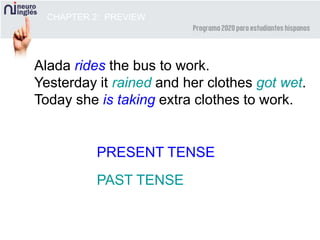
Alada rides the bus to work.
Yesterday it rained and her clothes got wet.
Today she is taking extra clothes to work.
PAST TENSE
PRESENT TENSE
2-1 EXPRESSING PAST TIME: THE SIMPLE PAST
We graduated from college in 2007.
2-1 EXPRESSING PAST TIME: THE SIMPLE PAST
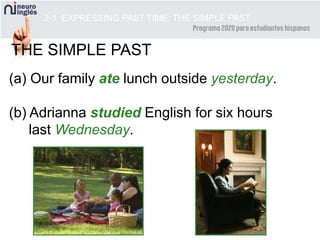
(a) Our family ate lunch outside yesterday.
(b) Adrianna studied English for six hours
last Wednesday.
THE SIMPLE PAST
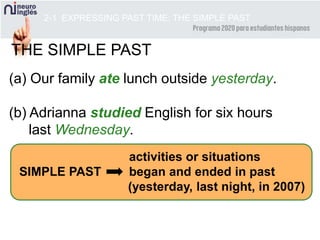
activities or situations
SIMPLE PAST began and ended in past
(yesterday, last night, in 2007)
2-1 EXPRESSING PAST TIME: THE SIMPLE PAST
(a) Our family ate lunch outside yesterday.
(b) Adrianna studied English for six hours
last Wednesday.
THE SIMPLE PAST
watch
2-1 EXPRESSING PAST TIME: THE SIMPLE PAST
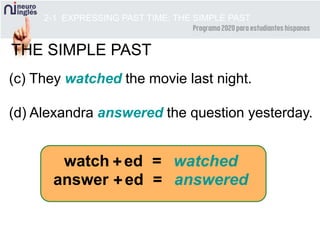
(c) They watched the movie last night.
(d) Alexandra answered the question yesterday.
THE SIMPLE PAST
+ed = watched
answer +ed = answered
2-1 EXPRESSING PAST TIME: THE SIMPLE PAST
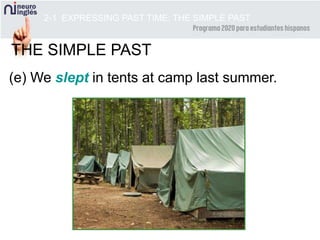
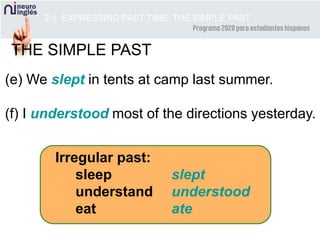
(e) We slept in tents at camp last summer.
THE SIMPLE PAST
2-1 EXPRESSING PAST TIME: THE SIMPLE PAST
(e) We slept in tents at camp last summer.
(f) I understood most of the directions yesterday.
THE SIMPLE PAST
Irregular past:
sleep slept
understand understood
eat ate
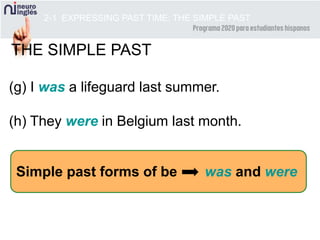
Simple past forms of be was and were
2-1 EXPRESSING PAST TIME: THE SIMPLE PAST
(g) I was a lifeguard last summer.
(h) They were in Belgium last month.
THE SIMPLE PAST
We started school last week.
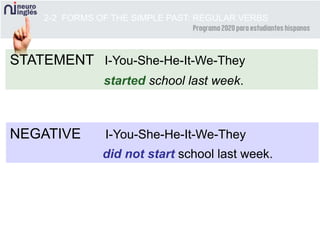
2-2 FORMS OF THE SIMPLE PAST: REGULAR VERBS
STATEMENT I-You-She-He-It-We-They
started school last week.
2-2 FORMS OF THE SIMPLE PAST: REGULAR VERBS
STATEMENT
NEGATIVE
I-You-She-He-It-We-They
started school last week.
I-You-She-He-It-We-They
did not start school last week.
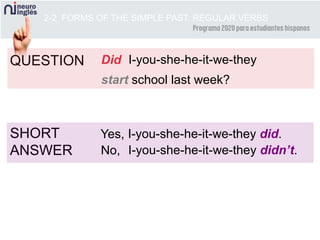
2-2 FORMS OF THE SIMPLE PAST: REGULAR VERBS
QUESTION
SHORT
ANSWER
I-you-she-he-it-we-they
start school last week?
Did
I-you-she-he-it-we-they did.Yes,
I-you-she-he-it-we-they didn’t.No,
2-3 FORMS OF THE SIMPLE PAST: BE
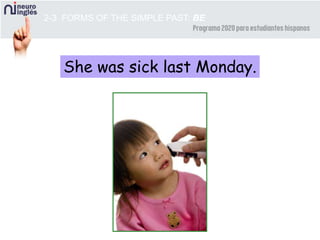
She was sick last Monday.
STATEMENT
2-3 FORMS OF THE SIMPLE PAST: BE
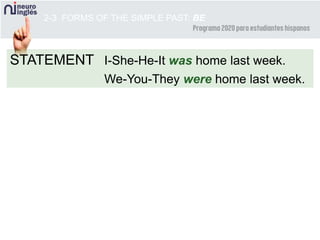
I-She-He-It was home last week.
We-You-They were home last week.
STATEMENT
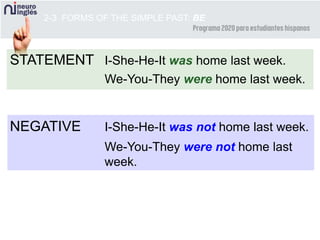
NEGATIVE I-She-He-It was not home last week.
2-3 FORMS OF THE SIMPLE PAST: BE
I-She-He-It was home last week.
We-You-They were home last week.
We-You-They were not home last
week.
QUESTION
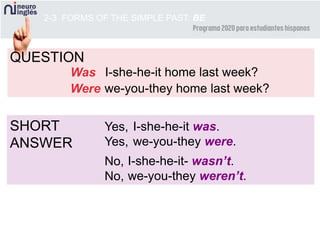
I-she-he-it home last week?Was
2-3 FORMS OF THE SIMPLE PAST: BE
we-you-they home last week?Were
SHORT
ANSWER
I-she-he-it was.
we-you-they were.
Yes,
Yes,
I-she-he-it- wasn’t.
we-you-they weren’t.
No,
No,
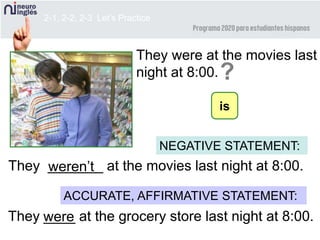
They _______ at the movies last night at 8:00.
2-1, 2-2, 2-3 Let’s Practice
They ____ at the grocery store last night at 8:00.
weren’t
were
is
They were at the movies last
night at 8:00.?
ACCURATE, AFFIRMATIVE STATEMENT:
NEGATIVE STATEMENT:
2-1, 2-2, 2-3 Let’s Practice
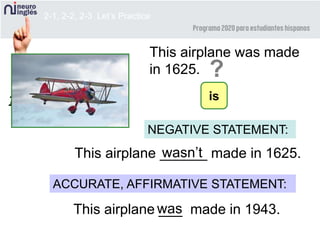
This airplane was made
in 1625.
This airplane ______ made in 1625.
This airplane ___ made in 1943.
wasn’t
was
?
1943 is
ACCURATE, AFFIRMATIVE STATEMENT:
NEGATIVE STATEMENT:
ACCURATE, AFFIRMATIVE STATEMENT:
2-1, 2-2, 2-3 Let’s Practice
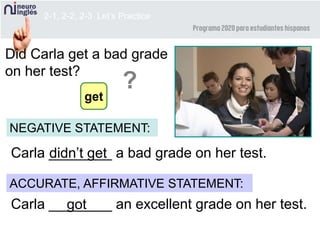
Did Carla get a bad grade
on her test?
Carla ________ a bad grade on her test.
Carla ________ an excellent grade on her test.
didn’t get
got
NEGATIVE STATEMENT:
get
?
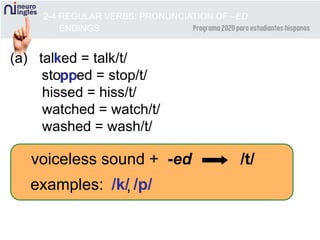
2-4 REGULAR VERBS: PRONUNCIATION OF –ED
ENDINGS
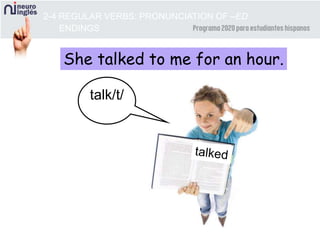
talk/t/
She talked to me for an hour.
voiceless sound + -ed /t/
(a) talked = talk/t/
stopped = stop/t/
hissed = hiss/t/
watched = watch/t/
washed = wash/t/
examples:
k
/k/ /p/
pp
,
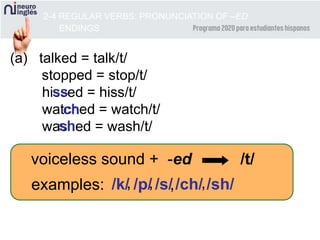
2-4 REGULAR VERBS: PRONUNCIATION OF –ED
ENDINGS
/k/ /s/ /ch/ /sh/,
voiceless sound + -ed /t/
(a) talked = talk/t/
stopped = stop/t/
hissed = hiss/t/
watched = watch/t/
washed = wash/t/
examples: /p/
ss
ch
sh
, , ,
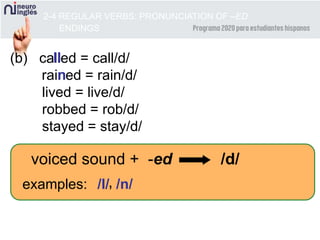
2-4 REGULAR VERBS: PRONUNCIATION OF –ED
ENDINGS
voiced sound + -ed /d/
(b) called = call/d/
rained = rain/d/
lived = live/d/
robbed = rob/d/
stayed = stay/d/
examples:
ll
/l/ /n/
n
,
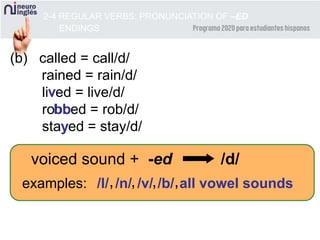
2-4 REGULAR VERBS: PRONUNCIATION OF –ED
ENDINGS
voiced sound + -ed /d/
(b) called = call/d/
rained = rain/d/
lived = live/d/
robbed = rob/d/
stayed = stay/d/
examples: /l/ /n/ /v/
v
/b/
bb
all vowel sounds
y
, , , ,
2-4 REGULAR VERBS: PRONUNCIATION OF –ED
ENDINGS
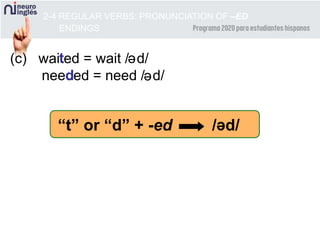
“t” or “d” + -ed / d/
(c) waited = wait / d/
needed = need / d/
t
d
e
e
e
2-4 REGULAR VERBS: PRONUNCIATION OF –ED
ENDINGS
2-4 Let’s Practice
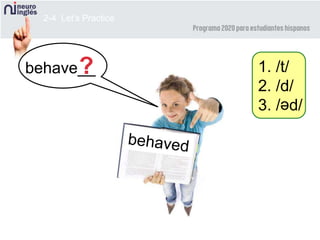
behave__ 1. /t/
2. /d/
3. / d/
e
?
2-4 Let’s Practice
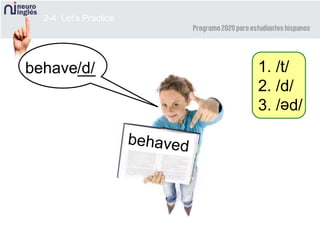
behave__ 1. /t/
2. /d/
3. / d/
e
/d/
2-4 Let’s Practice
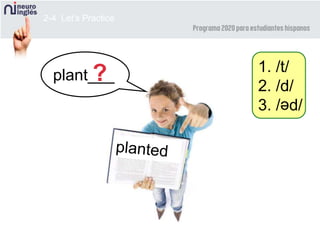
plant___? 1. /t/
2. /d/
3. / d/
e
plant___
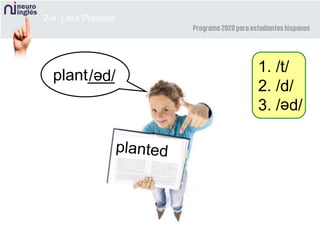
2-4 Let’s Practice
/ d/
e 1. /t/
2. /d/
3. / d/
e
We are learning to speak English.
2-5 SPELLING OF –ING AND –ED FORMS
smiledsmilingsmile
hopedhoping
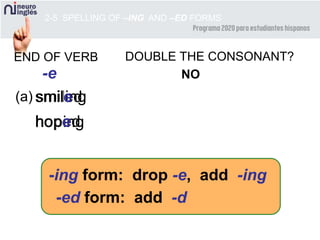
2-5 SPELLING OF –ING AND –ED FORMS
-ing form: drop -e, add -ing
END OF VERB DOUBLE THE CONSONANT?
-e NO
-ed form: add -d
hope
(a)
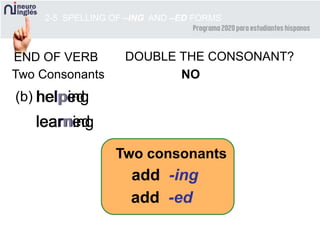
learnlearning
helpinghelphelped
learned
2-5 SPELLING OF –ING AND –ED FORMS
add -ing
END OF VERB DOUBLE THE CONSONANT?
Two Consonants NO
add -ed
(b)
Two consonants
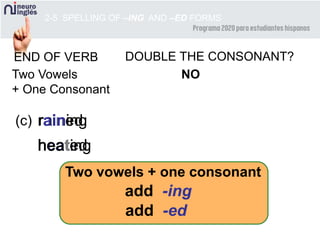
heatheatingheated
rainedrainingrain
2-5 SPELLING OF –ING AND –ED FORMS
add -ing
END OF VERB DOUBLE THE CONSONANT?
Two Vowels
+ One Consonant
NO
add -ed
(c)
Two vowels + one consonant
planningplanned
stopping
plan
stoppedstop
2-5 SPELLING OF –ING AND –ED FORMS
add -ing
END OF VERB DOUBLE THE CONSONANT?
One Vowel
+ One Consonant
YES
add -ed
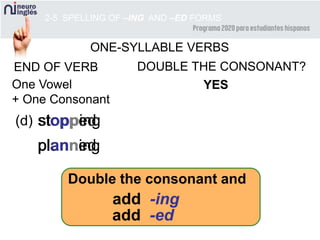
(d)
ONE-SYLLABLE VERBS
Double the consonant and
visit
offeringoffered
visiting
offer
visited
2-5 SPELLING OF –ING AND –ED FORMS
add -ing
END OF VERB DOUBLE THE CONSONANT?
One Vowel
+ One Consonant
NO
add -ed
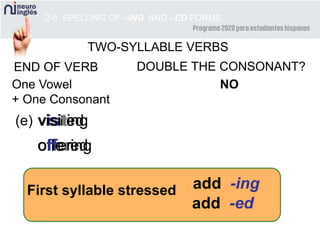
(e)
TWO-SYLLABLE VERBS
First syllable stressed
preferredprefer
admitting admitted
preferring
admit
2-5 SPELLING OF –ING AND –ED FORMS
add -ing
END OF VERB DOUBLE THE CONSONANT?
One Vowel
+ One Consonant
YES
add -ed
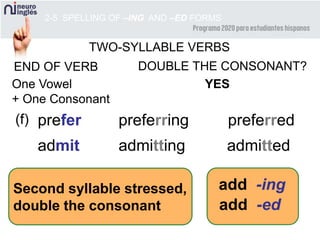
(f)
TWO-SYLLABLE VERBS
Second syllable stressed,
double the consonant
playedplay
enjoying enjoyed
playing
enjoy
2-5 SPELLING OF –ING AND –ED FORMS
END OF VERB DOUBLE THE CONSONANT?
NO
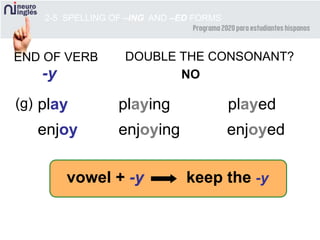
keep the -y
(g)
vowel + -y
-y
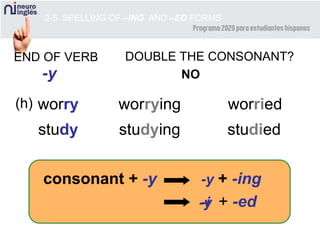
worriedworry
studying studied
worrying
study
2-5 SPELLING OF –ING AND –ED FORMS
END OF VERB DOUBLE THE CONSONANT?
NO
-y + -ing
(h)
consonant + -y
-y
-i + -ed-y
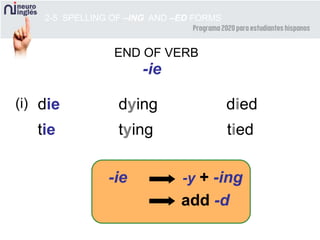
dieddie
tying tied
dying
tie
2-5 SPELLING OF –ING AND –ED FORMS
END OF VERB
-y + -ing
(i)
-ie
-ie
add -d
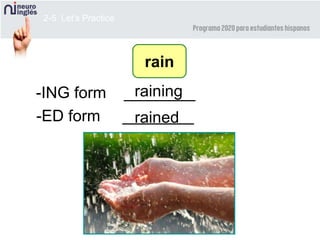
2-5 Let’s Practice
-ING form ________
rain
-ED form ________
raining
rained
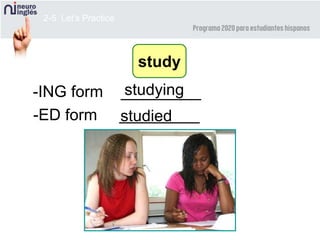
2-5 Let’s Practice
-ING form _________
study
-ED form _________
studying
studied
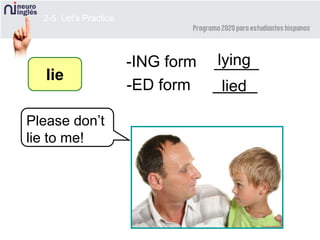
2-5 Let’s Practice
-ING form _____
lie
-ED form _____
lying
lied
Please don’t
lie to me!
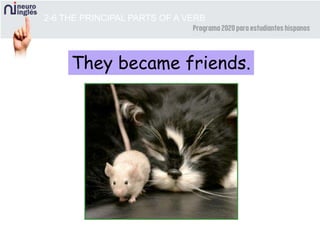
They became friends.
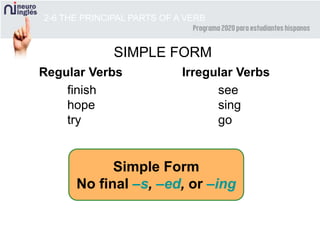
2-6 THE PRINCIPAL PARTS OF A VERB
SIMPLE FORM
Regular Verbs Irregular Verbs
finish
hope
try
Simple Form
No final –s, –ed, or –ing
see
sing
go
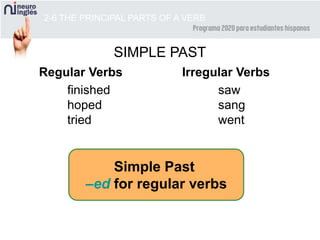
2-6 THE PRINCIPAL PARTS OF A VERB
SIMPLE PAST
Regular Verbs Irregular Verbs
finished
hoped
tried
Simple Past
–ed for regular verbs
saw
sang
went
2-6 THE PRINCIPAL PARTS OF A VERB
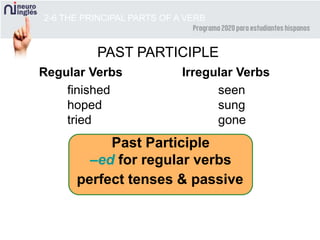
PAST PARTICIPLE
Regular Verbs Irregular Verbs
finished
hoped
tried
Past Participle
–ed for regular verbs
seen
sung
gone
perfect tenses & passive
2-6 THE PRINCIPAL PARTS OF A VERB
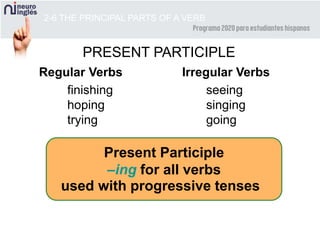
PRESENT PARTICIPLE
Regular Verbs Irregular Verbs
finishing
hoping
trying
Present Participle
–ing for all verbs
seeing
singing
going
used with progressive tenses
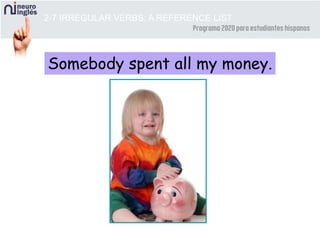
Somebody spent all my money.
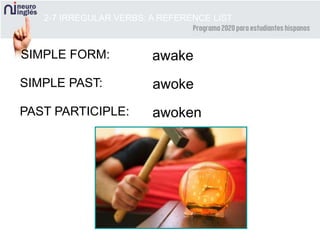
2-7 IRREGULAR VERBS: A REFERENCE LIST
SIMPLE FORM: awake
SIMPLE PAST: awoke
PAST PARTICIPLE: awoken
2-7 IRREGULAR VERBS: A REFERENCE LIST
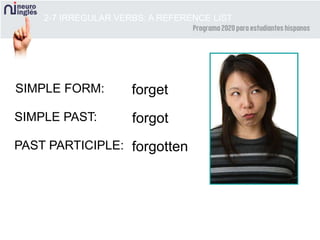
SIMPLE FORM: forget
SIMPLE PAST: forgot
PAST PARTICIPLE: forgotten
2-7 IRREGULAR VERBS: A REFERENCE LIST
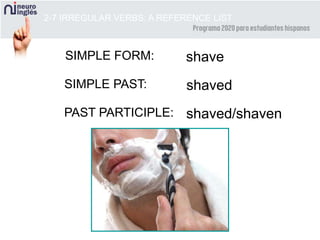
SIMPLE FORM: shave
SIMPLE PAST: shaved
PAST PARTICIPLE: shaved/shaven
2-7 IRREGULAR VERBS: A REFERENCE LIST
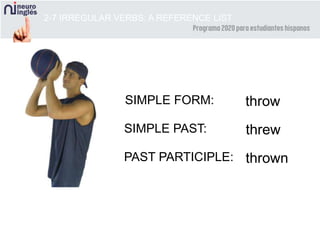
SIMPLE FORM: throw
SIMPLE PAST: threw
PAST PARTICIPLE: thrown
2-7 Let’s Practice
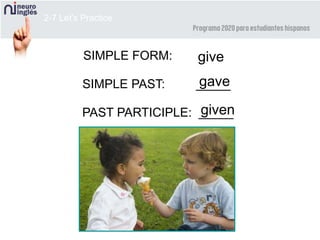
SIMPLE FORM: give
SIMPLE PAST: _____gave
PAST PARTICIPLE: _____given
2-7 Let’s Practice
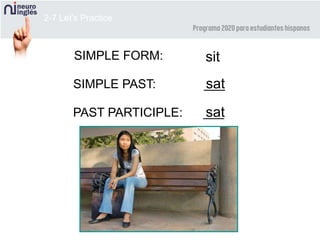
SIMPLE FORM: sit
SIMPLE PAST: ___sat
PAST PARTICIPLE: ___sat
2-7 Let’s Practice
SIMPLE FORM: think
SIMPLE PAST: _______thought
PAST PARTICIPLE: _______thought
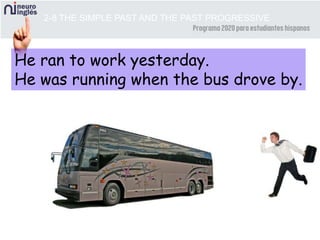
He ran to work yesterday.
He was running when the bus drove by.
2-8 THE SIMPLE PAST AND THE PAST PROGRESSIVE
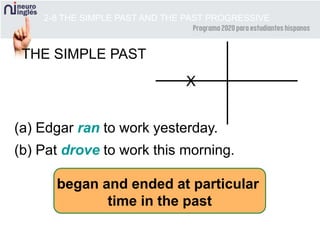
THE SIMPLE PAST
X
(a) Edgar ran to work yesterday.
(b) Pat drove to work this morning.
began and ended at particular
time in the past
2-8 THE SIMPLE PAST AND THE PAST PROGRESSIVE
THE PAST PROGRESSIVE
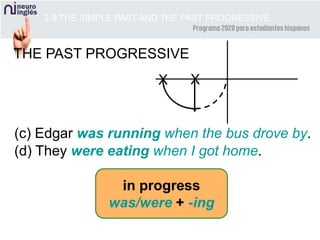
(c) Edgar was running when the bus drove by.
(d) They were eating when I got home.
in progress
was/were + -ing
XX
2-8 THE SIMPLE PAST AND THE PAST PROGRESSIVE
THE PAST PROGRESSIVE
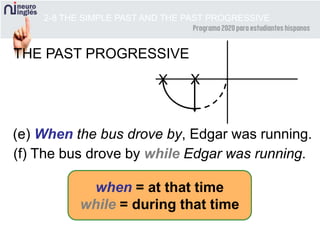
(e) When the bus drove by, Edgar was running.
(f) The bus drove by while Edgar was running.
when = at that time
while = during that time
XX
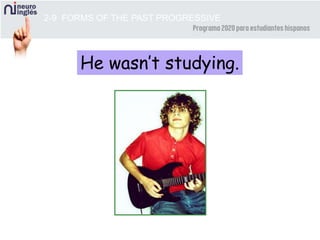
He wasn’t studying.
2-9 FORMS OF THE PAST PROGRESSIVE
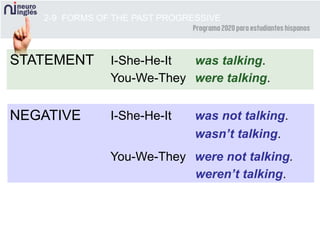
was not talking.
wasn’t talking.
NEGATIVE
STATEMENT I-She-He-It
2-9 FORMS OF THE PAST PROGRESSIVE
was talking.
You-We-They were talking.
I-She-He-It
You-We-They were not talking.
weren’t talking.
QUESTION
SHORT
ANSWER
I-she-he-it talking?Was
Yes,
No,
2-9 FORMS OF THE PAST PROGRESSIVE
you-we-they talking?Were
I-she-he-it was.
I-she-he-it wasn’t.
Yes,
No,
you-we-they were.
you-we-they weren’t.
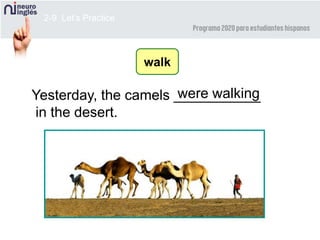
2-9 Let’s Practice
Yesterday, the camels ___________
in the desert.
walk
were walking
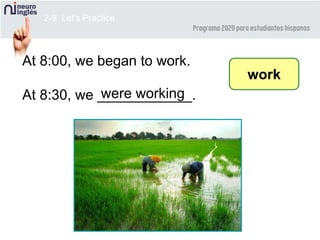
2-9 Let’s Practice
At 8:00, we began to work.
At 8:30, we ____________.
work
were working
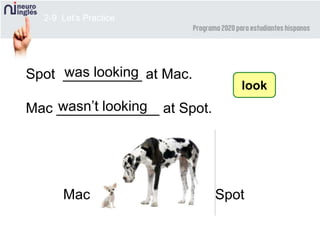
2-9 Let’s Practice
Spot __________ at Mac.
Mac _____________ at Spot.
was looking
look
wasn’t looking
SpotMac
2-10 EXPRESSING PAST TIME: USING TIME CLAUSES
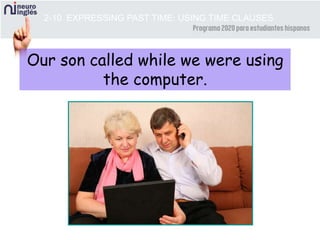
Our son called while we were using
the computer.
2-10 EXPRESSING PAST TIME: USING TIME CLAUSES
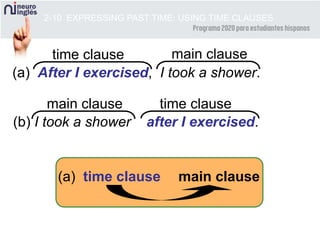
(a) After I exercised, I took a shower.
(b) I took a shower after I exercised.
(a) time clause main clause
time clause main clause
time clausemain clause
2-10 EXPRESSING PAST TIME: USING TIME CLAUSES
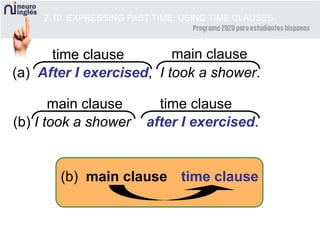
(a) After I exercised, I took a shower.
(b) I took a shower after I exercised.
(b) main clause time clause
time clause main clause
time clausemain clause
2-10 EXPRESSING PAST TIME: USING TIME CLAUSES
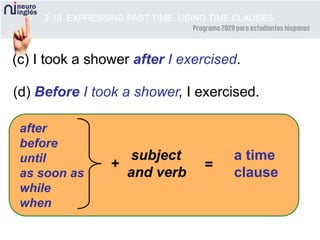
(c) I took a shower after I exercised.
(d) Before I took a shower, I exercised.
after
before
until
as soon as
while
when
subject
and verb
a time
clause
+ =
2-10 EXPRESSING PAST TIME: USING TIME CLAUSES
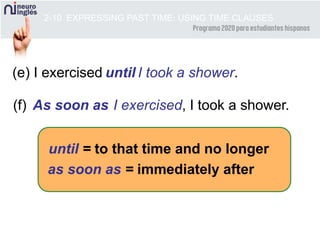
(e) I exercised I took a shower.
(f) I exercised, I took a shower.
until = to that time and no longer
as soon as = immediately after
until
As soon as
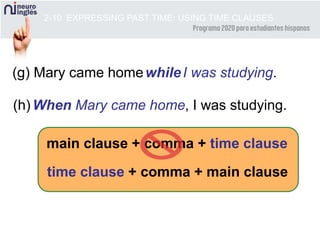
main clause + comma + time clause
When Mary came home, I was studying.
2-10 EXPRESSING PAST TIME: USING TIME CLAUSES
(g) Mary came home I was studying.
(h)
while
time clause + comma + main clause
2-10 EXPRESSING PAST TIME: USING TIME CLAUSES
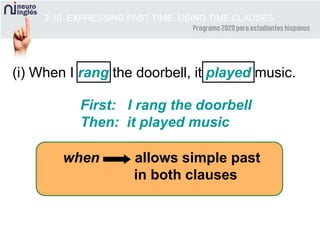
First: I rang the doorbell
Then: it played music
(i) When I rang the doorbell, it played music.
when allows simple past
in both clauses
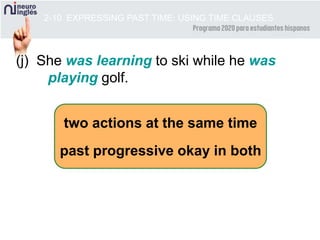
two actions at the same time
past progressive okay in both
2-10 EXPRESSING PAST TIME: USING TIME CLAUSES
(j) She was learning to ski while he was
playing golf.
2-10 Let’s Practice
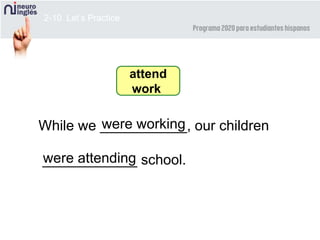
While we ___________, our children
____________ school.
attend
work
were working
were attending
2-10 Let’s Practice
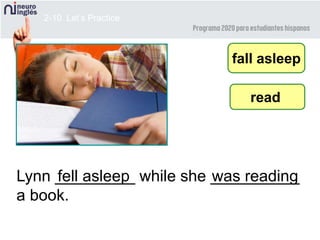
Lynn _________ while she __________
a book.
fall asleep
was reading
read
fell asleep
2-10 Let’s Practice
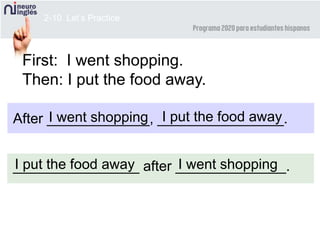
First: I went shopping.
Then: I put the food away.
After _____________, ________________.I went shopping I put the food away
________________ after ______________.I went shoppingI put the food away
2-11 EXPRESSING PAST HABIT: USED TO
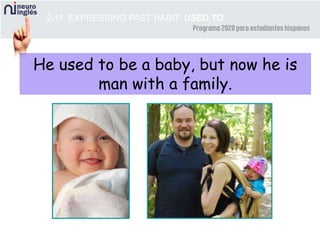
He used to be a baby, but now he is
man with a family.
2-11 EXPRESSING PAST HABIT: USED TO
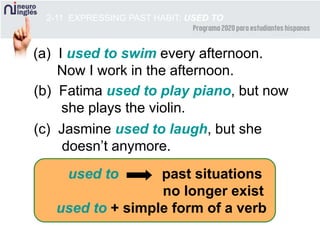
(a) I used to swim every afternoon.
Now I work in the afternoon.
(b) Fatima used to play piano, but now
she plays the violin.
(c) Jasmine used to laugh, but she
doesn’t anymore.
used to past situations
no longer exist
used to + simple form of a verb
2-11 EXPRESSING PAST HABIT: USED TO
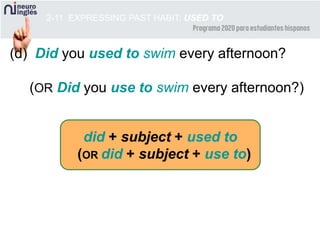
(d) Did you used to swim every afternoon?
(OR Did you use to swim every afternoon?)
did + subject + used to
(OR did + subject + use to)
2-11 EXPRESSING PAST HABIT: USED TO
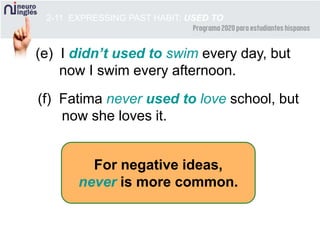
(e) I didn’t used to swim every day, but
now I swim every afternoon.
(f) Fatima never used to love school, but
now she loves it.
For negative ideas,
never is more common.
2-11 Let’s Practice
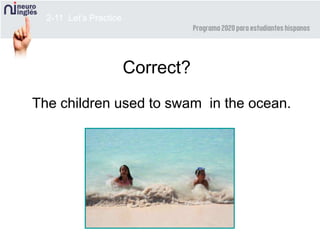
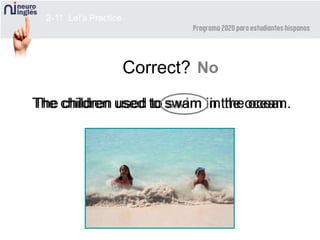
Correct?
The children used to swam in the ocean.
The children used to swim in the ocean.The children used to swam in the ocean.
2-11 Let’s Practice
Correct? No
2-11 Let’s Practice
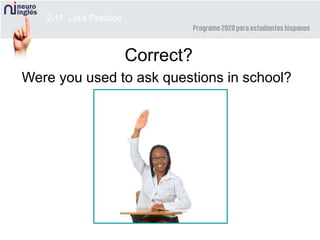
Correct?
Were you used to ask questions in school?
2-11 Let’s Practice
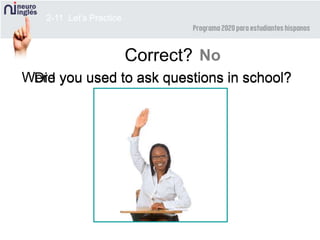
Correct?
Were you used to ask questions in school?
No
Did you used to ask questions in school?
Images used under license from:
• Shutterstock, Inc.
• Clipart, Inc.
PHOTO CREDITS
Copyright © 2008 Pearson Education and
its licensors. All rights reserved.

I2

  • 2.
    Preview 2-1 Expressing pasttime: the simple past 2-2 Forms of the simple past: regular verbs 2-3 Forms of the simple past: be 2-4 Regular verbs: pronunciation of –ed endings 2-5 Spelling of –ing and –ed forms 2-6 The principal parts of a verb 2-7 Irregular verbs: a reference list 2-8 The simple past and the past progressive 2-9 Forms of the past progressive 2-10 Expressing past time: using time clauses 2-11 Expressing past habit: used to CONTENTS
  • 3.
    CHAPTER 2: PREVIEW Aladarides the bus to work. Yesterday it rained and her clothes got wet. Today she is taking extra clothes to work.
  • 4.
    CHAPTER 2: PREVIEW Aladarides the bus to work. Yesterday it rained and her clothes got wet. Today she is taking extra clothes to work. PRESENT TENSE
  • 5.
    CHAPTER 2: PREVIEW Aladarides the bus to work. Yesterday it rained and her clothes got wet. Today she is taking extra clothes to work. PAST TENSE PRESENT TENSE
  • 6.
    2-1 EXPRESSING PASTTIME: THE SIMPLE PAST We graduated from college in 2007.
  • 7.
    2-1 EXPRESSING PASTTIME: THE SIMPLE PAST (a) Our family ate lunch outside yesterday. (b) Adrianna studied English for six hours last Wednesday. THE SIMPLE PAST
  • 8.
    activities or situations SIMPLEPAST began and ended in past (yesterday, last night, in 2007) 2-1 EXPRESSING PAST TIME: THE SIMPLE PAST (a) Our family ate lunch outside yesterday. (b) Adrianna studied English for six hours last Wednesday. THE SIMPLE PAST
  • 9.
    watch 2-1 EXPRESSING PASTTIME: THE SIMPLE PAST (c) They watched the movie last night. (d) Alexandra answered the question yesterday. THE SIMPLE PAST +ed = watched answer +ed = answered
  • 10.
    2-1 EXPRESSING PASTTIME: THE SIMPLE PAST (e) We slept in tents at camp last summer. THE SIMPLE PAST
  • 11.
    2-1 EXPRESSING PASTTIME: THE SIMPLE PAST (e) We slept in tents at camp last summer. (f) I understood most of the directions yesterday. THE SIMPLE PAST Irregular past: sleep slept understand understood eat ate
  • 12.
    Simple past formsof be was and were 2-1 EXPRESSING PAST TIME: THE SIMPLE PAST (g) I was a lifeguard last summer. (h) They were in Belgium last month. THE SIMPLE PAST
  • 13.
    We started schoollast week. 2-2 FORMS OF THE SIMPLE PAST: REGULAR VERBS
  • 14.
    2-2 FORMS OFTHE SIMPLE PAST: REGULAR VERBS STATEMENT I-You-She-He-It-We-They started school last week.
  • 15.
    2-2 FORMS OFTHE SIMPLE PAST: REGULAR VERBS STATEMENT NEGATIVE I-You-She-He-It-We-They started school last week. I-You-She-He-It-We-They did not start school last week.
  • 16.
    2-2 FORMS OFTHE SIMPLE PAST: REGULAR VERBS QUESTION SHORT ANSWER I-you-she-he-it-we-they start school last week? Did I-you-she-he-it-we-they did.Yes, I-you-she-he-it-we-they didn’t.No,
  • 17.
    2-3 FORMS OFTHE SIMPLE PAST: BE She was sick last Monday.
  • 18.
    STATEMENT 2-3 FORMS OFTHE SIMPLE PAST: BE I-She-He-It was home last week. We-You-They were home last week.
  • 19.
    STATEMENT NEGATIVE I-She-He-It wasnot home last week. 2-3 FORMS OF THE SIMPLE PAST: BE I-She-He-It was home last week. We-You-They were home last week. We-You-They were not home last week.
  • 20.
    QUESTION I-she-he-it home lastweek?Was 2-3 FORMS OF THE SIMPLE PAST: BE we-you-they home last week?Were SHORT ANSWER I-she-he-it was. we-you-they were. Yes, Yes, I-she-he-it- wasn’t. we-you-they weren’t. No, No,
  • 21.
    They _______ atthe movies last night at 8:00. 2-1, 2-2, 2-3 Let’s Practice They ____ at the grocery store last night at 8:00. weren’t were is They were at the movies last night at 8:00.? ACCURATE, AFFIRMATIVE STATEMENT: NEGATIVE STATEMENT:
  • 22.
    2-1, 2-2, 2-3Let’s Practice This airplane was made in 1625. This airplane ______ made in 1625. This airplane ___ made in 1943. wasn’t was ? 1943 is ACCURATE, AFFIRMATIVE STATEMENT: NEGATIVE STATEMENT:
  • 23.
    ACCURATE, AFFIRMATIVE STATEMENT: 2-1,2-2, 2-3 Let’s Practice Did Carla get a bad grade on her test? Carla ________ a bad grade on her test. Carla ________ an excellent grade on her test. didn’t get got NEGATIVE STATEMENT: get ?
  • 24.
    2-4 REGULAR VERBS:PRONUNCIATION OF –ED ENDINGS talk/t/ She talked to me for an hour.
  • 25.
    voiceless sound +-ed /t/ (a) talked = talk/t/ stopped = stop/t/ hissed = hiss/t/ watched = watch/t/ washed = wash/t/ examples: k /k/ /p/ pp , 2-4 REGULAR VERBS: PRONUNCIATION OF –ED ENDINGS
  • 26.
    /k/ /s/ /ch//sh/, voiceless sound + -ed /t/ (a) talked = talk/t/ stopped = stop/t/ hissed = hiss/t/ watched = watch/t/ washed = wash/t/ examples: /p/ ss ch sh , , , 2-4 REGULAR VERBS: PRONUNCIATION OF –ED ENDINGS
  • 27.
    voiced sound +-ed /d/ (b) called = call/d/ rained = rain/d/ lived = live/d/ robbed = rob/d/ stayed = stay/d/ examples: ll /l/ /n/ n , 2-4 REGULAR VERBS: PRONUNCIATION OF –ED ENDINGS
  • 28.
    voiced sound +-ed /d/ (b) called = call/d/ rained = rain/d/ lived = live/d/ robbed = rob/d/ stayed = stay/d/ examples: /l/ /n/ /v/ v /b/ bb all vowel sounds y , , , , 2-4 REGULAR VERBS: PRONUNCIATION OF –ED ENDINGS
  • 29.
    “t” or “d”+ -ed / d/ (c) waited = wait / d/ needed = need / d/ t d e e e 2-4 REGULAR VERBS: PRONUNCIATION OF –ED ENDINGS
  • 30.
    2-4 Let’s Practice behave__1. /t/ 2. /d/ 3. / d/ e ?
  • 31.
    2-4 Let’s Practice behave__1. /t/ 2. /d/ 3. / d/ e /d/
  • 32.
    2-4 Let’s Practice plant___?1. /t/ 2. /d/ 3. / d/ e
  • 33.
    plant___ 2-4 Let’s Practice /d/ e 1. /t/ 2. /d/ 3. / d/ e
  • 34.
    We are learningto speak English. 2-5 SPELLING OF –ING AND –ED FORMS
  • 35.
    smiledsmilingsmile hopedhoping 2-5 SPELLING OF–ING AND –ED FORMS -ing form: drop -e, add -ing END OF VERB DOUBLE THE CONSONANT? -e NO -ed form: add -d hope (a)
  • 36.
    learnlearning helpinghelphelped learned 2-5 SPELLING OF–ING AND –ED FORMS add -ing END OF VERB DOUBLE THE CONSONANT? Two Consonants NO add -ed (b) Two consonants
  • 37.
    heatheatingheated rainedrainingrain 2-5 SPELLING OF–ING AND –ED FORMS add -ing END OF VERB DOUBLE THE CONSONANT? Two Vowels + One Consonant NO add -ed (c) Two vowels + one consonant
  • 38.
    planningplanned stopping plan stoppedstop 2-5 SPELLING OF–ING AND –ED FORMS add -ing END OF VERB DOUBLE THE CONSONANT? One Vowel + One Consonant YES add -ed (d) ONE-SYLLABLE VERBS Double the consonant and
  • 39.
    visit offeringoffered visiting offer visited 2-5 SPELLING OF–ING AND –ED FORMS add -ing END OF VERB DOUBLE THE CONSONANT? One Vowel + One Consonant NO add -ed (e) TWO-SYLLABLE VERBS First syllable stressed
  • 40.
    preferredprefer admitting admitted preferring admit 2-5 SPELLINGOF –ING AND –ED FORMS add -ing END OF VERB DOUBLE THE CONSONANT? One Vowel + One Consonant YES add -ed (f) TWO-SYLLABLE VERBS Second syllable stressed, double the consonant
  • 41.
    playedplay enjoying enjoyed playing enjoy 2-5 SPELLINGOF –ING AND –ED FORMS END OF VERB DOUBLE THE CONSONANT? NO keep the -y (g) vowel + -y -y
  • 42.
    worriedworry studying studied worrying study 2-5 SPELLINGOF –ING AND –ED FORMS END OF VERB DOUBLE THE CONSONANT? NO -y + -ing (h) consonant + -y -y -i + -ed-y
  • 43.
    dieddie tying tied dying tie 2-5 SPELLINGOF –ING AND –ED FORMS END OF VERB -y + -ing (i) -ie -ie add -d
  • 44.
    2-5 Let’s Practice -INGform ________ rain -ED form ________ raining rained
  • 45.
    2-5 Let’s Practice -INGform _________ study -ED form _________ studying studied
  • 46.
    2-5 Let’s Practice -INGform _____ lie -ED form _____ lying lied Please don’t lie to me!
  • 47.
    They became friends. 2-6THE PRINCIPAL PARTS OF A VERB
  • 48.
    2-6 THE PRINCIPALPARTS OF A VERB SIMPLE FORM Regular Verbs Irregular Verbs finish hope try Simple Form No final –s, –ed, or –ing see sing go
  • 49.
    2-6 THE PRINCIPALPARTS OF A VERB SIMPLE PAST Regular Verbs Irregular Verbs finished hoped tried Simple Past –ed for regular verbs saw sang went
  • 50.
    2-6 THE PRINCIPALPARTS OF A VERB PAST PARTICIPLE Regular Verbs Irregular Verbs finished hoped tried Past Participle –ed for regular verbs seen sung gone perfect tenses & passive
  • 51.
    2-6 THE PRINCIPALPARTS OF A VERB PRESENT PARTICIPLE Regular Verbs Irregular Verbs finishing hoping trying Present Participle –ing for all verbs seeing singing going used with progressive tenses
  • 52.
    Somebody spent allmy money. 2-7 IRREGULAR VERBS: A REFERENCE LIST
  • 53.
    2-7 IRREGULAR VERBS:A REFERENCE LIST SIMPLE FORM: awake SIMPLE PAST: awoke PAST PARTICIPLE: awoken
  • 54.
    2-7 IRREGULAR VERBS:A REFERENCE LIST SIMPLE FORM: forget SIMPLE PAST: forgot PAST PARTICIPLE: forgotten
  • 55.
    2-7 IRREGULAR VERBS:A REFERENCE LIST SIMPLE FORM: shave SIMPLE PAST: shaved PAST PARTICIPLE: shaved/shaven
  • 56.
    2-7 IRREGULAR VERBS:A REFERENCE LIST SIMPLE FORM: throw SIMPLE PAST: threw PAST PARTICIPLE: thrown
  • 57.
    2-7 Let’s Practice SIMPLEFORM: give SIMPLE PAST: _____gave PAST PARTICIPLE: _____given
  • 58.
    2-7 Let’s Practice SIMPLEFORM: sit SIMPLE PAST: ___sat PAST PARTICIPLE: ___sat
  • 59.
    2-7 Let’s Practice SIMPLEFORM: think SIMPLE PAST: _______thought PAST PARTICIPLE: _______thought
  • 60.
    He ran towork yesterday. He was running when the bus drove by. 2-8 THE SIMPLE PAST AND THE PAST PROGRESSIVE
  • 61.
    2-8 THE SIMPLEPAST AND THE PAST PROGRESSIVE THE SIMPLE PAST X (a) Edgar ran to work yesterday. (b) Pat drove to work this morning. began and ended at particular time in the past
  • 62.
    2-8 THE SIMPLEPAST AND THE PAST PROGRESSIVE THE PAST PROGRESSIVE (c) Edgar was running when the bus drove by. (d) They were eating when I got home. in progress was/were + -ing XX
  • 63.
    2-8 THE SIMPLEPAST AND THE PAST PROGRESSIVE THE PAST PROGRESSIVE (e) When the bus drove by, Edgar was running. (f) The bus drove by while Edgar was running. when = at that time while = during that time XX
  • 64.
    He wasn’t studying. 2-9FORMS OF THE PAST PROGRESSIVE
  • 65.
    was not talking. wasn’ttalking. NEGATIVE STATEMENT I-She-He-It 2-9 FORMS OF THE PAST PROGRESSIVE was talking. You-We-They were talking. I-She-He-It You-We-They were not talking. weren’t talking.
  • 66.
    QUESTION SHORT ANSWER I-she-he-it talking?Was Yes, No, 2-9 FORMSOF THE PAST PROGRESSIVE you-we-they talking?Were I-she-he-it was. I-she-he-it wasn’t. Yes, No, you-we-they were. you-we-they weren’t.
  • 67.
    2-9 Let’s Practice Yesterday,the camels ___________ in the desert. walk were walking
  • 68.
    2-9 Let’s Practice At8:00, we began to work. At 8:30, we ____________. work were working
  • 69.
    2-9 Let’s Practice Spot__________ at Mac. Mac _____________ at Spot. was looking look wasn’t looking SpotMac
  • 70.
    2-10 EXPRESSING PASTTIME: USING TIME CLAUSES Our son called while we were using the computer.
  • 71.
    2-10 EXPRESSING PASTTIME: USING TIME CLAUSES (a) After I exercised, I took a shower. (b) I took a shower after I exercised. (a) time clause main clause time clause main clause time clausemain clause
  • 72.
    2-10 EXPRESSING PASTTIME: USING TIME CLAUSES (a) After I exercised, I took a shower. (b) I took a shower after I exercised. (b) main clause time clause time clause main clause time clausemain clause
  • 73.
    2-10 EXPRESSING PASTTIME: USING TIME CLAUSES (c) I took a shower after I exercised. (d) Before I took a shower, I exercised. after before until as soon as while when subject and verb a time clause + =
  • 74.
    2-10 EXPRESSING PASTTIME: USING TIME CLAUSES (e) I exercised I took a shower. (f) I exercised, I took a shower. until = to that time and no longer as soon as = immediately after until As soon as
  • 75.
    main clause +comma + time clause When Mary came home, I was studying. 2-10 EXPRESSING PAST TIME: USING TIME CLAUSES (g) Mary came home I was studying. (h) while time clause + comma + main clause
  • 76.
    2-10 EXPRESSING PASTTIME: USING TIME CLAUSES First: I rang the doorbell Then: it played music (i) When I rang the doorbell, it played music. when allows simple past in both clauses
  • 77.
    two actions atthe same time past progressive okay in both 2-10 EXPRESSING PAST TIME: USING TIME CLAUSES (j) She was learning to ski while he was playing golf.
  • 78.
    2-10 Let’s Practice Whilewe ___________, our children ____________ school. attend work were working were attending
  • 79.
    2-10 Let’s Practice Lynn_________ while she __________ a book. fall asleep was reading read fell asleep
  • 80.
    2-10 Let’s Practice First:I went shopping. Then: I put the food away. After _____________, ________________.I went shopping I put the food away ________________ after ______________.I went shoppingI put the food away
  • 81.
    2-11 EXPRESSING PASTHABIT: USED TO He used to be a baby, but now he is man with a family.
  • 82.
    2-11 EXPRESSING PASTHABIT: USED TO (a) I used to swim every afternoon. Now I work in the afternoon. (b) Fatima used to play piano, but now she plays the violin. (c) Jasmine used to laugh, but she doesn’t anymore. used to past situations no longer exist used to + simple form of a verb
  • 83.
    2-11 EXPRESSING PASTHABIT: USED TO (d) Did you used to swim every afternoon? (OR Did you use to swim every afternoon?) did + subject + used to (OR did + subject + use to)
  • 84.
    2-11 EXPRESSING PASTHABIT: USED TO (e) I didn’t used to swim every day, but now I swim every afternoon. (f) Fatima never used to love school, but now she loves it. For negative ideas, never is more common.
  • 85.
    2-11 Let’s Practice Correct? Thechildren used to swam in the ocean.
  • 86.
    The children usedto swim in the ocean.The children used to swam in the ocean. 2-11 Let’s Practice Correct? No
  • 87.
    2-11 Let’s Practice Correct? Wereyou used to ask questions in school?
  • 88.
    2-11 Let’s Practice Correct? Wereyou used to ask questions in school? No Did you used to ask questions in school?
  • 89.
    Images used underlicense from: • Shutterstock, Inc. • Clipart, Inc. PHOTO CREDITS Copyright © 2008 Pearson Education and its licensors. All rights reserved.