POSSESSIONS
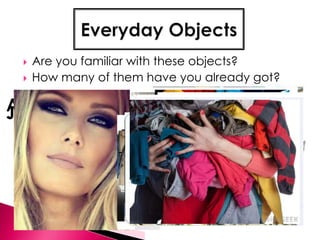
 Are you familiar with these objects? 
 How many of them have you already got? 
AMSK UWOENYNASGELLYLEATS SES 
AN ID CARD 
A BUS PASS 
JAE AA ACNL AWPU NTIC EBRLASLGEER OTHES 
MKEPT3 
Y 
PLAYER 
UMMBARKEEL LUAP A MOBILE 
PHONE
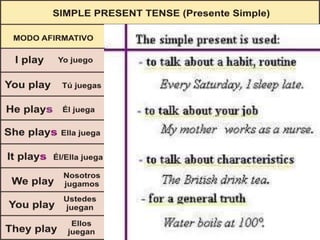
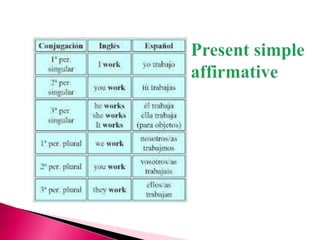
 English is a very easy language. Verbs don’t 
change when you conjugate them. If you 
know the infinitive form you can make the 
present simple without any problem. 
◦ WALK 
◦ I want to explain someone that I go to school on 
foot everyday I just said that… 
◦ WTYehoeuIy 
walk to school everyday 
◦ The only change that we make is when we want to 
talk about something that someone does ( HE/SHE/IT) 
 SHE walkS to school everyday
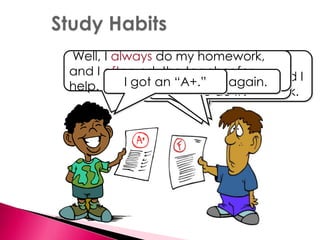
Well, I always do my homework, 
and I often ask the teacher for 
help. I got aI gn o“tA a+n.” “F” again. 
You got an “A+” 
again!?!? How do 
Hmmm… Well, I am 
Maybe I need to try 
your study habits. 
usually late for class, and I 
never you do my do homework. 
it?
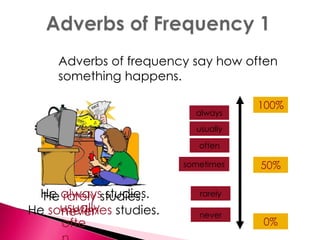
Adverbs of frequency say how often 
something happens. 
He always studies. 
usually 
ofte 
n 
100% 
50% 
0% 
always 
usually 
often 
He sometimes studies. 
sometimes 
He rarely studies. 
rarely 
never never
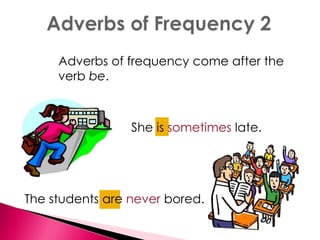
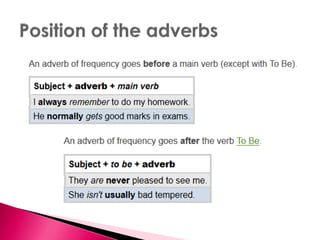
Adverbs of frequency come after the 
verb be. 
She is sometimes late. 
The students are never bored.
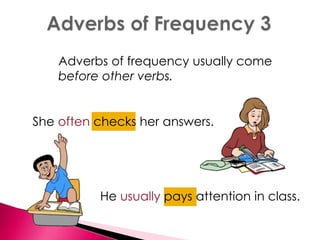
Adverbs of frequency usually come 
before other verbs. 
She often checks her answers. 
He usually pays attention in class.
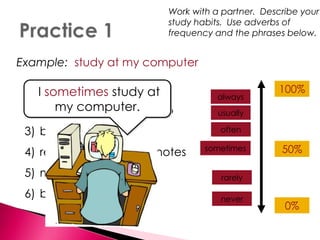
Work with a partner. Describe your 
study habits. Use adverbs of 
frequency and the phrases below. 
Example: study at my computer 
1) study in front of the TV 
2) ask the teacher for help 
3) be early to class 
4) review my grammar notes 
5) make flashcards 
6) be attentive in class 
100% 
50% 
0% 
always 
usually 
often 
sometimes 
rarely 
never 
I sometimes study at 
my computer.
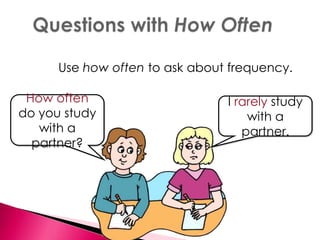
Use how often to ask about frequency. 
How often 
do you study 
with a 
partner? 
I rarely study 
with a 
partner.
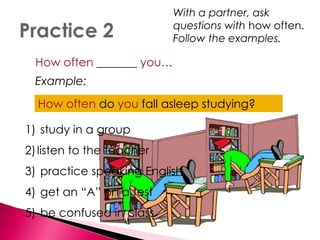
With a partner, ask 
questions with how often. 
Follow the examples. 
How often _______ you… 
Example: 
•Hofawll oafstleeenpd ostuydoyuinfagll asleep studying? 
1) study in a group 
2) listen to the teacher 
3) practice speaking English 
4) get an “A” on a test 
5) be confused in class
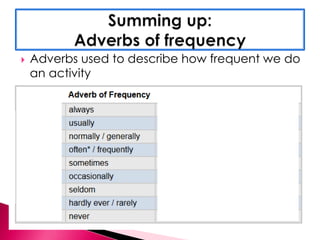
 Adverbs used to describe how frequent we do 
an activity
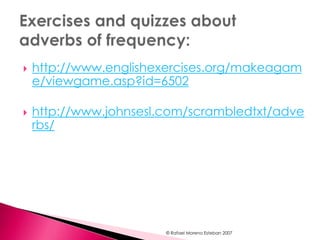
 http://www.englishexercises.org/makeagam 
e/viewgame.asp?id=6502 
 http://www.johnsesl.com/scrambledtxt/adve 
rbs/ 
© Rafael Moreno Esteban 2007
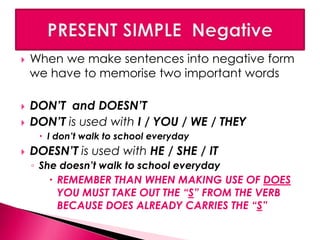
 When we make sentences into negative form 
we have to memorise two important words 
 DON’T and DOESN’T 
 DON’T is used with I / YOU / WE / THEY 
 I don’t walk to school everyday 
 DOESN’T is used with HE / SHE / IT 
◦ She doesn’t walk to school everyday 
 REMEMBER THAN WHEN MAKING USE OF DOES 
YOU MUST TAKE OUT THE “S” FROM THE VERB 
BECAUSE DOES ALREADY CARRIES THE “S”
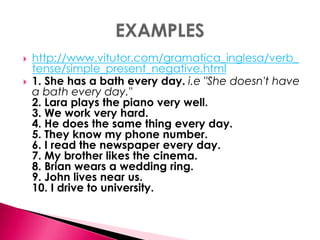
 http://www.vitutor.com/gramatica_inglesa/verb_ 
tense/simple_present_negative.html 
 1. She has a bath every day. i.e "She doesn't have 
a bath every day." 
2. Lara plays the piano very well. 
3. We work very hard. 
4. He does the same thing every day. 
5. They know my phone number. 
6. I read the newspaper every day. 
7. My brother likes the cinema. 
8. Brian wears a wedding ring. 
9. John lives near us. 
10. I drive to university.
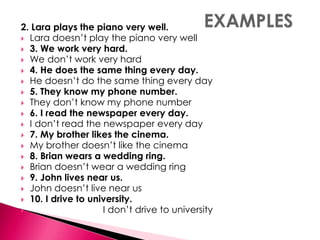
2. Lara plays the piano very well. 
 Lara doesn’t play the piano very well 
 3. We work very hard. 
 We don’t work very hard 
 4. He does the same thing every day. 
 He doesn’t do the same thing every day 
 5. They know my phone number. 
 They don’t know my phone number 
 6. I read the newspaper every day. 
 I don’t read the newspaper every day 
 7. My brother likes the cinema. 
 My brother doesn’t like the cinema 
 8. Brian wears a wedding ring. 
 Brian doesn’t wear a wedding ring 
 9. John lives near us. 
 John doesn’t live near us 
 10. I drive to university. 
 I don’t drive to university
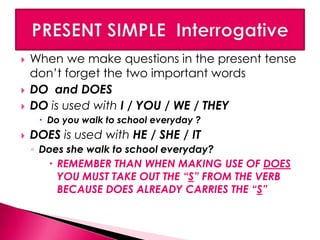
 When we make questions in the present tense 
don’t forget the two important words 
 DO and DOES 
 DO is used with I / YOU / WE / THEY 
 Do you walk to school everyday ? 
 DOES is used with HE / SHE / IT 
◦ Does she walk to school everyday? 
 REMEMBER THAN WHEN MAKING USE OF DOES 
YOU MUST TAKE OUT THE “S” FROM THE VERB 
BECAUSE DOES ALREADY CARRIES THE “S”
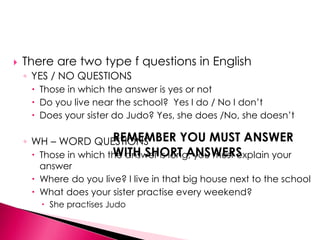
 There are two type f questions in English 
◦ YES / NO QUESTIONS 
 Those in which the answer is yes or not 
 Do you live near the school? Yes I do / No I don’t 
 Does your sister do Judo? Yes, she does /No, she doesn’t 
REMEMBER YOU MUST ANSWER 
WITH SHORT ANSWERS 
◦ WH – WORD QUESTIONS 
 Those in which the answer is long, you must explain your 
answer 
 Where do you live? I live in that big house next to the school 
 What does your sister practise every weekend? 
 She practises Judo
 http://www.agendaweb.org/verbs/present-simple. 
html 
 http://www.englishexercises.org/makeagame/ 
viewgame.asp?id=5702 
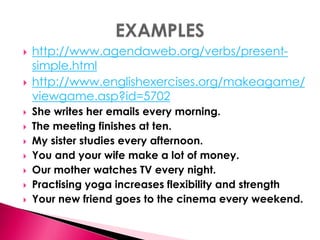
 She writes her emails every morning. 
 The meeting finishes at ten. 
 My sister studies every afternoon. 
 You and your wife make a lot of money. 
 Our mother watches TV every night. 
 Practising yoga increases flexibility and strength 
 Your new friend goes to the cinema every weekend.
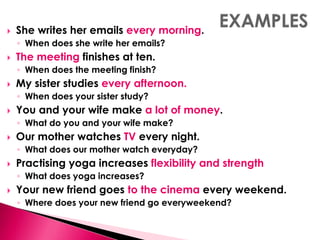
 She writes her emails every morning. 
◦ When does she write her emails? 
 The meeting finishes at ten. 
◦ When does the meeting finish? 
 My sister studies every afternoon. 
◦ When does your sister study? 
 You and your wife make a lot of money. 
◦ What do you and your wife make? 
 Our mother watches TV every night. 
◦ What does our mother watch everyday? 
 Practising yoga increases flexibility and strength 
◦ What does yoga increases? 
 Your new friend goes to the cinema every weekend. 
◦ Where does your new friend go everyweekend?
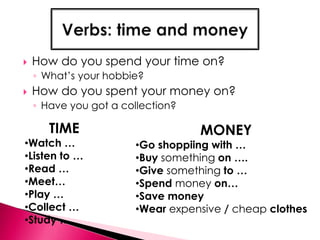
 How do you spend your time on? 
◦ What’s your hobbie? 
 How do you spent your money on? 
◦ Have you got a collection? 
TIME 
•Watch … 
•Listen to … 
•Read … 
•Meet… 
•Play … 
•Collect … 
•Study … 
MONEY 
•Go shoppiing with … 
•Buy something on …. 
•Give something to … 
•Spend money on… 
•Save money 
•Wear expensive / cheap clothes
 Write an internet profile, you have one in 
page 15 to help you 
◦ Think of adjectives to describe you 
◦ Things you like and dislike 
◦ How do you spend your money and your time 
◦ You are going to meet people so you must tell 
which people do you want to meet (boys, girls…) 
◦ Which languages do you want to learn? and which 
nationalities do you want to meet?

2º ESO Unit 1

  • 1.
  • 2.
     Are youfamiliar with these objects?  How many of them have you already got? AMSK UWOENYNASGELLYLEATS SES AN ID CARD A BUS PASS JAE AA ACNL AWPU NTIC EBRLASLGEER OTHES MKEPT3 Y PLAYER UMMBARKEEL LUAP A MOBILE PHONE
  • 3.
     English isa very easy language. Verbs don’t change when you conjugate them. If you know the infinitive form you can make the present simple without any problem. ◦ WALK ◦ I want to explain someone that I go to school on foot everyday I just said that… ◦ WTYehoeuIy walk to school everyday ◦ The only change that we make is when we want to talk about something that someone does ( HE/SHE/IT)  SHE walkS to school everyday
  • 7.
    Well, I alwaysdo my homework, and I often ask the teacher for help. I got aI gn o“tA a+n.” “F” again. You got an “A+” again!?!? How do Hmmm… Well, I am Maybe I need to try your study habits. usually late for class, and I never you do my do homework. it?
  • 8.
    Adverbs of frequencysay how often something happens. He always studies. usually ofte n 100% 50% 0% always usually often He sometimes studies. sometimes He rarely studies. rarely never never
  • 9.
    Adverbs of frequencycome after the verb be. She is sometimes late. The students are never bored.
  • 10.
    Adverbs of frequencyusually come before other verbs. She often checks her answers. He usually pays attention in class.
  • 11.
    Work with apartner. Describe your study habits. Use adverbs of frequency and the phrases below. Example: study at my computer 1) study in front of the TV 2) ask the teacher for help 3) be early to class 4) review my grammar notes 5) make flashcards 6) be attentive in class 100% 50% 0% always usually often sometimes rarely never I sometimes study at my computer.
  • 12.
    Use how oftento ask about frequency. How often do you study with a partner? I rarely study with a partner.
  • 13.
    With a partner,ask questions with how often. Follow the examples. How often _______ you… Example: •Hofawll oafstleeenpd ostuydoyuinfagll asleep studying? 1) study in a group 2) listen to the teacher 3) practice speaking English 4) get an “A” on a test 5) be confused in class
  • 14.
     Adverbs usedto describe how frequent we do an activity
  • 16.
     http://www.englishexercises.org/makeagam e/viewgame.asp?id=6502  http://www.johnsesl.com/scrambledtxt/adve rbs/ © Rafael Moreno Esteban 2007
  • 17.
     When wemake sentences into negative form we have to memorise two important words  DON’T and DOESN’T  DON’T is used with I / YOU / WE / THEY  I don’t walk to school everyday  DOESN’T is used with HE / SHE / IT ◦ She doesn’t walk to school everyday  REMEMBER THAN WHEN MAKING USE OF DOES YOU MUST TAKE OUT THE “S” FROM THE VERB BECAUSE DOES ALREADY CARRIES THE “S”
  • 18.
     http://www.vitutor.com/gramatica_inglesa/verb_ tense/simple_present_negative.html  1. She has a bath every day. i.e "She doesn't have a bath every day." 2. Lara plays the piano very well. 3. We work very hard. 4. He does the same thing every day. 5. They know my phone number. 6. I read the newspaper every day. 7. My brother likes the cinema. 8. Brian wears a wedding ring. 9. John lives near us. 10. I drive to university.
  • 19.
    2. Lara playsthe piano very well.  Lara doesn’t play the piano very well  3. We work very hard.  We don’t work very hard  4. He does the same thing every day.  He doesn’t do the same thing every day  5. They know my phone number.  They don’t know my phone number  6. I read the newspaper every day.  I don’t read the newspaper every day  7. My brother likes the cinema.  My brother doesn’t like the cinema  8. Brian wears a wedding ring.  Brian doesn’t wear a wedding ring  9. John lives near us.  John doesn’t live near us  10. I drive to university.  I don’t drive to university
  • 20.
     When wemake questions in the present tense don’t forget the two important words  DO and DOES  DO is used with I / YOU / WE / THEY  Do you walk to school everyday ?  DOES is used with HE / SHE / IT ◦ Does she walk to school everyday?  REMEMBER THAN WHEN MAKING USE OF DOES YOU MUST TAKE OUT THE “S” FROM THE VERB BECAUSE DOES ALREADY CARRIES THE “S”
  • 21.
     There aretwo type f questions in English ◦ YES / NO QUESTIONS  Those in which the answer is yes or not  Do you live near the school? Yes I do / No I don’t  Does your sister do Judo? Yes, she does /No, she doesn’t REMEMBER YOU MUST ANSWER WITH SHORT ANSWERS ◦ WH – WORD QUESTIONS  Those in which the answer is long, you must explain your answer  Where do you live? I live in that big house next to the school  What does your sister practise every weekend?  She practises Judo
  • 22.
     http://www.agendaweb.org/verbs/present-simple. html  http://www.englishexercises.org/makeagame/ viewgame.asp?id=5702  She writes her emails every morning.  The meeting finishes at ten.  My sister studies every afternoon.  You and your wife make a lot of money.  Our mother watches TV every night.  Practising yoga increases flexibility and strength  Your new friend goes to the cinema every weekend.
  • 23.
     She writesher emails every morning. ◦ When does she write her emails?  The meeting finishes at ten. ◦ When does the meeting finish?  My sister studies every afternoon. ◦ When does your sister study?  You and your wife make a lot of money. ◦ What do you and your wife make?  Our mother watches TV every night. ◦ What does our mother watch everyday?  Practising yoga increases flexibility and strength ◦ What does yoga increases?  Your new friend goes to the cinema every weekend. ◦ Where does your new friend go everyweekend?
  • 24.
     How doyou spend your time on? ◦ What’s your hobbie?  How do you spent your money on? ◦ Have you got a collection? TIME •Watch … •Listen to … •Read … •Meet… •Play … •Collect … •Study … MONEY •Go shoppiing with … •Buy something on …. •Give something to … •Spend money on… •Save money •Wear expensive / cheap clothes
  • 25.
     Write aninternet profile, you have one in page 15 to help you ◦ Think of adjectives to describe you ◦ Things you like and dislike ◦ How do you spend your money and your time ◦ You are going to meet people so you must tell which people do you want to meet (boys, girls…) ◦ Which languages do you want to learn? and which nationalities do you want to meet?