UNIT 1 1st 
ESO
 How many languages do you know? 
 Do you know words to greet people in English? 
 And, in other languages? 
 http://www.youtube.com/watch?v=l9aBWrn39Cs 
 http://www.youtube.com/watch? 
v=LDrBMpMdW0s
 In the activity 2 in your books you have a list of 
languages, could you tell me where are these 
languages spoken? 
 Find these countries working in pairs on the 
text in page 15. Try to pronounce correctly 
these languages
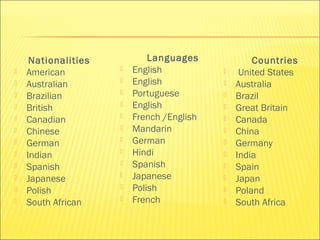
Languages 
 English 
 English 
 Portuguese 
 English 
 French /English 
 Mandarin 
 German 
 Hindi 
 Spanish 
 Japanese 
 Polish 
 French 
Countries 
 United States 
 Australia 
 Brazil 
 Great Britain 
 Canada 
 China 
 Germany 
 India 
 Spain 
 Japan 
 Poland 
 South Africa 
Nationalities 
 American 
 Australian 
 Brazilian 
 British 
 Canadian 
 Chinese 
 German 
 Indian 
 Spanish 
 Japanese 
 Polish 
 South African
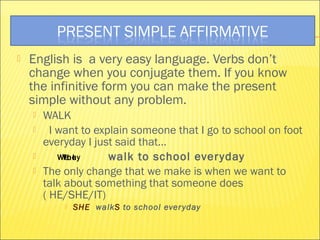
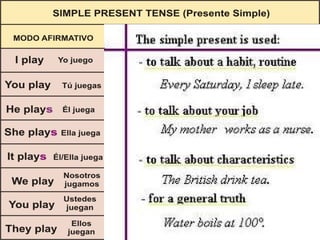
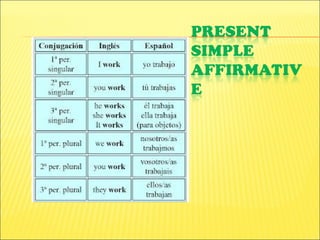
 English is a very easy language. Verbs don’t 
change when you conjugate them. If you know 
the infinitive form you can make the present 
simple without any problem. 
 WALK 
 I want to explain someone that I go to school on foot 
everyday I just said that… 
 WTYehoeuI y 
walk to school ever yday 
 The only change that we make is when we want to 
talk about something that someone does 
( HE/SHE/IT) 
 SHE walkS to school ever yday
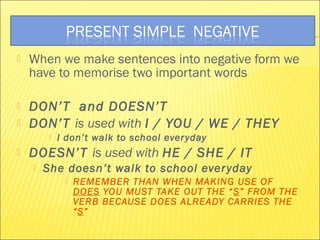
 When we make sentences into negative form we 
have to memorise two important words 
 DON’T and DOESN’T 
 DON’T is used with I / YOU / WE / THEY 
 I don’t walk to school ever yday 
 DOESN’T is used with HE / SHE / IT 
 She doesn’t walk to school ever yday 
 REMEMBER THAN WHEN MAKING USE OF 
DOES YOU MUST TAKE OUT THE “S” FROM THE 
VERB BECAUSE DOES ALREADY CARRIES THE 
“S”
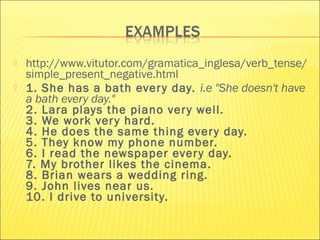
 http://www.vitutor.com/gramatica_inglesa/verb_tense/ 
simple_present_negative.html 
 1. She has a bath ever y day. i.e "She doesn't have 
a bath every day." 
2. Lara plays the piano ver y well. 
3. We work ver y hard. 
4. He does the same thing ever y day. 
5. They know my phone number. 
6. I read the newspaper ever y day. 
7. My brother likes the cinema. 
8. Brian wears a wedding ring. 
9. John lives near us. 
10. I drive to university.
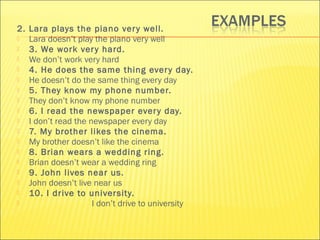
2. Lara plays the piano ver y well. 
 Lara doesn’t play the piano very well 
 3. We work ver y hard. 
 We don’t work very hard 
 4. He does the same thing ever y day. 
 He doesn’t do the same thing every day 
 5. They know my phone number. 
 They don’t know my phone number 
 6. I read the newspaper ever y day. 
 I don’t read the newspaper every day 
 7. My brother likes the cinema. 
 My brother doesn’t like the cinema 
 8. Brian wears a wedding ring. 
 Brian doesn’t wear a wedding ring 
 9. John lives near us. 
 John doesn’t live near us 
 10. I drive to university. 
 I don’t drive to university
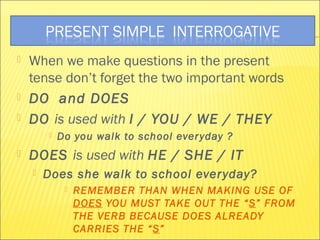
 When we make questions in the present 
tense don’t forget the two important words 
 DO and DOES 
 DO is used with I / YOU / WE / THEY 
 Do you walk to school ever yday ? 
 DOES is used with HE / SHE / IT 
 Does she walk to school everyday? 
 REMEMBER THAN WHEN MAKING USE OF 
DOES YOU MUST TAKE OUT THE “S” FROM 
THE VERB BECAUSE DOES ALREADY 
CARRIES THE “S”
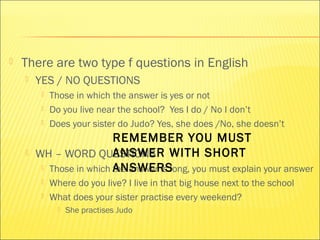
 There are two type f questions in English 
 YES / NO QUESTIONS 
 Those in which the answer is yes or not 
 Do you live near the school? Yes I do / No I don’t 
 Does your sister do Judo? Yes, she does /No, she doesn’t 
REMEMBER YOU MUST 
ANSWER WITH SHORT 
ANSWERS 
 WH – WORD QUESTIONS 
 Those in which the answer is long, you must explain your answer 
 Where do you live? I live in that big house next to the school 
 What does your sister practise every weekend? 
 She practises Judo
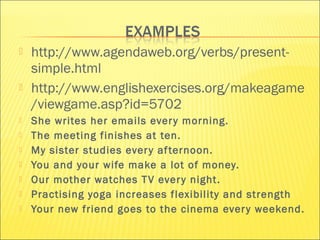
 http://www.agendaweb.org/verbs/present-simple. 
html 
 http://www.englishexercises.org/makeagame 
/viewgame.asp?id=5702 
 She writes her emails ever y morning. 
 The meeting finishes at ten. 
 My sister studies ever y af ternoon. 
 You and your wife make a lot of money. 
 Our mother watches TV ever y night. 
 Practising yoga increases flexibility and strength 
 Your new friend goes to the cinema ever y weekend.
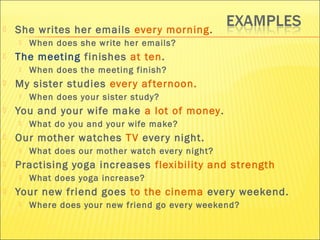
 She writes her emails ever y morning. 
 When does she write her emails? 
 The meeting finishes at ten. 
 When does the meeting finish? 
 My sister studies ever y af ternoon. 
 When does your sister study? 
 You and your wife make a lot of money. 
 What do you and your wife make? 
 Our mother watches TV ever y night. 
 What does our mother watch ever y night? 
 Practising yoga increases flexibility and strength 
 What does yoga increase? 
 Your new friend goes to the cinema ever y weekend. 
 Where does your new friend go ever y weekend?
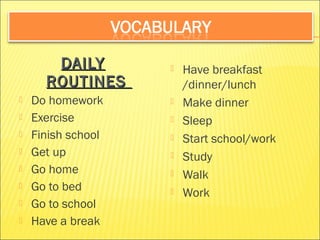
DDAAIILLYY 
RROOUUTTIINNEESS 
 Do homework 
 Exercise 
 Finish school 
 Get up 
 Go home 
 Go to bed 
 Go to school 
 Have a break 
 Have breakfast 
/dinner/lunch 
 Make dinner 
 Sleep 
 Start school/work 
 Study 
 Walk 
 Work
Page 21 in your notebook 
Write a countr y and language fact sheet 
about your countr y 
You have an example about Canada, read it and 
write one about Spain. 
Follow the steps you have learnt in the classroom 
Remember 80-100 words
HALLOWEEN 
 Write a mystery /creepy story to make your 
teacher shivers….. 
 http://www.readwritethink.org/files/resources/ 
lesson_images/lesson407/write-scary2.pdf 
 Use this to help you writing it

Unit 1 1º eso

  • 1.
  • 2.
     How manylanguages do you know?  Do you know words to greet people in English?  And, in other languages?  http://www.youtube.com/watch?v=l9aBWrn39Cs  http://www.youtube.com/watch? v=LDrBMpMdW0s
  • 3.
     In theactivity 2 in your books you have a list of languages, could you tell me where are these languages spoken?  Find these countries working in pairs on the text in page 15. Try to pronounce correctly these languages
  • 4.
    Languages  English  English  Portuguese  English  French /English  Mandarin  German  Hindi  Spanish  Japanese  Polish  French Countries  United States  Australia  Brazil  Great Britain  Canada  China  Germany  India  Spain  Japan  Poland  South Africa Nationalities  American  Australian  Brazilian  British  Canadian  Chinese  German  Indian  Spanish  Japanese  Polish  South African
  • 5.
     English isa very easy language. Verbs don’t change when you conjugate them. If you know the infinitive form you can make the present simple without any problem.  WALK  I want to explain someone that I go to school on foot everyday I just said that…  WTYehoeuI y walk to school ever yday  The only change that we make is when we want to talk about something that someone does ( HE/SHE/IT)  SHE walkS to school ever yday
  • 8.
     When wemake sentences into negative form we have to memorise two important words  DON’T and DOESN’T  DON’T is used with I / YOU / WE / THEY  I don’t walk to school ever yday  DOESN’T is used with HE / SHE / IT  She doesn’t walk to school ever yday  REMEMBER THAN WHEN MAKING USE OF DOES YOU MUST TAKE OUT THE “S” FROM THE VERB BECAUSE DOES ALREADY CARRIES THE “S”
  • 9.
     http://www.vitutor.com/gramatica_inglesa/verb_tense/ simple_present_negative.html  1. She has a bath ever y day. i.e "She doesn't have a bath every day." 2. Lara plays the piano ver y well. 3. We work ver y hard. 4. He does the same thing ever y day. 5. They know my phone number. 6. I read the newspaper ever y day. 7. My brother likes the cinema. 8. Brian wears a wedding ring. 9. John lives near us. 10. I drive to university.
  • 10.
    2. Lara playsthe piano ver y well.  Lara doesn’t play the piano very well  3. We work ver y hard.  We don’t work very hard  4. He does the same thing ever y day.  He doesn’t do the same thing every day  5. They know my phone number.  They don’t know my phone number  6. I read the newspaper ever y day.  I don’t read the newspaper every day  7. My brother likes the cinema.  My brother doesn’t like the cinema  8. Brian wears a wedding ring.  Brian doesn’t wear a wedding ring  9. John lives near us.  John doesn’t live near us  10. I drive to university.  I don’t drive to university
  • 11.
     When wemake questions in the present tense don’t forget the two important words  DO and DOES  DO is used with I / YOU / WE / THEY  Do you walk to school ever yday ?  DOES is used with HE / SHE / IT  Does she walk to school everyday?  REMEMBER THAN WHEN MAKING USE OF DOES YOU MUST TAKE OUT THE “S” FROM THE VERB BECAUSE DOES ALREADY CARRIES THE “S”
  • 12.
     There aretwo type f questions in English  YES / NO QUESTIONS  Those in which the answer is yes or not  Do you live near the school? Yes I do / No I don’t  Does your sister do Judo? Yes, she does /No, she doesn’t REMEMBER YOU MUST ANSWER WITH SHORT ANSWERS  WH – WORD QUESTIONS  Those in which the answer is long, you must explain your answer  Where do you live? I live in that big house next to the school  What does your sister practise every weekend?  She practises Judo
  • 13.
     http://www.agendaweb.org/verbs/present-simple. html  http://www.englishexercises.org/makeagame /viewgame.asp?id=5702  She writes her emails ever y morning.  The meeting finishes at ten.  My sister studies ever y af ternoon.  You and your wife make a lot of money.  Our mother watches TV ever y night.  Practising yoga increases flexibility and strength  Your new friend goes to the cinema ever y weekend.
  • 14.
     She writesher emails ever y morning.  When does she write her emails?  The meeting finishes at ten.  When does the meeting finish?  My sister studies ever y af ternoon.  When does your sister study?  You and your wife make a lot of money.  What do you and your wife make?  Our mother watches TV ever y night.  What does our mother watch ever y night?  Practising yoga increases flexibility and strength  What does yoga increase?  Your new friend goes to the cinema ever y weekend.  Where does your new friend go ever y weekend?
  • 15.
    DDAAIILLYY RROOUUTTIINNEESS Do homework  Exercise  Finish school  Get up  Go home  Go to bed  Go to school  Have a break  Have breakfast /dinner/lunch  Make dinner  Sleep  Start school/work  Study  Walk  Work
  • 16.
    Page 21 inyour notebook Write a countr y and language fact sheet about your countr y You have an example about Canada, read it and write one about Spain. Follow the steps you have learnt in the classroom Remember 80-100 words
  • 17.
    HALLOWEEN  Writea mystery /creepy story to make your teacher shivers…..  http://www.readwritethink.org/files/resources/ lesson_images/lesson407/write-scary2.pdf  Use this to help you writing it