Simple Present vs. Present   Continuous When do we use each tense?
Use the  simple present  for: 1) ROUTINES: action that happens repeatedly   (habitual action) 2) general or permanent situations 3) facts   Use the  present continuous  for: Something that is happening now or close to the time of speaking 2) A temporary situation Examples . . .
PRESENT SIMPLE Routines…
Simple Present (Examples) 1) Routines: Tom  goes  fishing every week. I usually  work  until 2:00 p.m. My family  comes  to visit me every year.
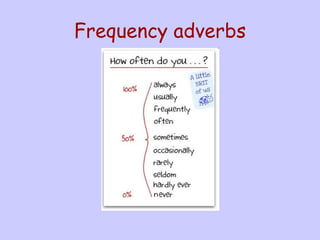
Frequency adverbs
On Mondays, on Saturdays… At weekends Every  day, year, night, morning, weekend, century… Once / twice / three times… a week/a month / a year…
Simple Present (More Examples) 2) General or Permanent Situations: Carmen  lives  in Palma. Jack  doesn’t work  on Saturday. Beth and Toan  work  at ECC. 3) Facts: The Earth  is  round. Water  boils  at 100 degrees Celsius. The Eiffel Tower  is  in Paris.
Present Continuous (Examples) 1) Action happening now or close to time of speaking: Where’s Tom? He ’s playing  soccer. Don’t bother the kids. They  are doing  their homework. 2) Temporary situations: Martha and her husband  are travelling  around Europe for two weeks. Lisa  is living  with friends until she finds an apartment.
Present Continuous . . . Time expressions Now Right now We are reviewing the present continous at the moment  At the moment Today, tonight…
Grammar Structure: Here are some reminders about how to  make  the simple present and present continuous:
Simple Present : The most important thing to remember about this tense is . . . 3 rd  person singular (he, she, it) We say : I You We They work
Simple Present: But for 3 rd  person singular, we say . . . He She It  work s
Simple Present (Negative) For all verbs, use: doesn't don't simple form of VERB + Examples . . .
1) Sara works on Sunday. Sara  doesn’t work  on Sunday. 2) They have a big house. They  don’t have  a big house. 3) Sam takes classes at night. Sam  doesn’t take  classes at night. 4) I have a lot of free time. I  don’t have  a lot of free time.
Simple Present (Interrogative?) For all verbs, use: Do  Subject Does Ex. Do you study English? Yes, I do. simple form of VERB + +
Present Continuous: Don’t forget that VERB BE is part of this structure. I  AM You, We, They   ARE He, She, It   IS verb -ING +
Examples: Everyone  is studying  hard. They  are celebrating  their 40 th  anniversary today. I  am cleaning  my house this week.
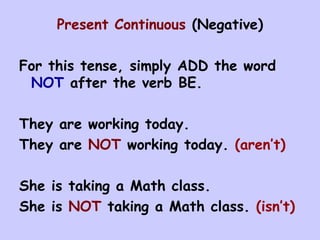
Present Continuous  (Negative) For this tense, simply ADD the word  NOT  after the verb BE. They are working today. They are  NOT  working today.  (aren’t) She is taking a Math class. She is  NOT  taking a Math class.  (isn’t)
Present Continuous  (Interrogative ?) Am  Is  Subject  V. -ing Are Are you playing football right now? No, I’m not. + +
Important Note about Present Continuous! Some verbs are NOT typically used in the present continuous tense.  Instead, we prefer to use these verbs in the simple present.  These verbs are called  STATIVE  (or non-action) verbs. Here are some examples: want like love hate know need see hear believe understand have (possession) forget remember belong
Examples: I  like  Rome. NOT: I am liking Rome. She  has  a big house. NOT: She is having a big house. I  prefer  to have coffee. NOT: I am preferring to have coffee. _____________ _____________ _____________
Practice! Do these exercises with your class. Choose the simple present or present continuous and discuss  why  each is correct. 1. On Tuesdays, I ________ (go) to the gym. 2. Karen ________ (paint) her apartment this week. 3. This room __________ (be) very large. 4. He _________ (have) a headache right now. 5. It ________ (rain) really hard right now.  6. Where is John? He _______ (work).  7. I ________ (meet) my friend in a few minutes. 8. My family ________ (come) to San Diego often.
Answers! 1.  On Tuesdays , I  go  to the gym. 2. Karen  is painting  her apartment  this week . 3. This room  is  very large.  (fact) 4. He  has  a headache right now.  (stative) 5. It  is raining  really hard  right now .  6. Where is John? He  is working .  (right now) 7. I  am meeting  my friend  in a few minutes . 8. My family  comes  to San Diego  often .
PAST SIMPLE TENSE
AFFIRMATIVE FORM Verbs can be: REGULAR  or …
Irregular! (IRREGULAR VERBS LIST AT THE BACK OF YOUR BOOK…)
Affirmative of Regular Verbs All Persons add – ED  to the Base Form: I play ed You laugh ed He listen ed She watch ed We wait ed They rememeber ed
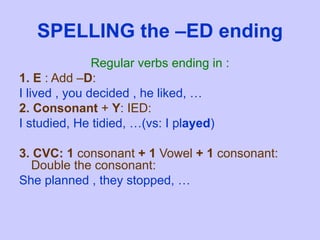
SPELLING the –ED ending Regular verbs ending in : 1. E  : Add – D : I lived , you decided , he liked, … 2. Consonant  +  Y : IED: I studied, He tidied, …(vs: I pl ayed ) 3. CVC: 1  consonant  + 1  Vowel  +   1  consonant: Double the consonant:  She planned , they stopped, …
Pronouncing the –ED: Three possibilities: /d/  as in  cleaned /t/  as in  kicked /id/  as in  decided Plenty of pronunciation practice: http://englishteachermargarita.blogspot.com/2009/10/pronouncing-ed-2009-10.html
Affirmative of Irregular Verbs You must  learn them by heart:   A List:   http://www.mansioningles.com/gram53.htm An  Irregular Verbs in Groups  List: http://safasexto.files.wordpress.com/2009/09/irregularverbsingroups1.pdf I went You read He spoke We heard They came All Persons  are the same  - as in Regular Verbs.

Pres. simple vs. continous; past simple

  • 1.
    Simple Present vs.Present Continuous When do we use each tense?
  • 2.
    Use the simple present for: 1) ROUTINES: action that happens repeatedly (habitual action) 2) general or permanent situations 3) facts Use the present continuous for: Something that is happening now or close to the time of speaking 2) A temporary situation Examples . . .
  • 3.
  • 4.
    Simple Present (Examples)1) Routines: Tom goes fishing every week. I usually work until 2:00 p.m. My family comes to visit me every year.
  • 5.
  • 6.
    On Mondays, onSaturdays… At weekends Every day, year, night, morning, weekend, century… Once / twice / three times… a week/a month / a year…
  • 7.
    Simple Present (MoreExamples) 2) General or Permanent Situations: Carmen lives in Palma. Jack doesn’t work on Saturday. Beth and Toan work at ECC. 3) Facts: The Earth is round. Water boils at 100 degrees Celsius. The Eiffel Tower is in Paris.
  • 8.
    Present Continuous (Examples)1) Action happening now or close to time of speaking: Where’s Tom? He ’s playing soccer. Don’t bother the kids. They are doing their homework. 2) Temporary situations: Martha and her husband are travelling around Europe for two weeks. Lisa is living with friends until she finds an apartment.
  • 9.
    Present Continuous .. . Time expressions Now Right now We are reviewing the present continous at the moment At the moment Today, tonight…
  • 10.
    Grammar Structure: Hereare some reminders about how to make the simple present and present continuous:
  • 11.
    Simple Present :The most important thing to remember about this tense is . . . 3 rd person singular (he, she, it) We say : I You We They work
  • 12.
    Simple Present: Butfor 3 rd person singular, we say . . . He She It work s
  • 13.
    Simple Present (Negative)For all verbs, use: doesn't don't simple form of VERB + Examples . . .
  • 14.
    1) Sara workson Sunday. Sara doesn’t work on Sunday. 2) They have a big house. They don’t have a big house. 3) Sam takes classes at night. Sam doesn’t take classes at night. 4) I have a lot of free time. I don’t have a lot of free time.
  • 15.
    Simple Present (Interrogative?)For all verbs, use: Do Subject Does Ex. Do you study English? Yes, I do. simple form of VERB + +
  • 16.
    Present Continuous: Don’tforget that VERB BE is part of this structure. I AM You, We, They ARE He, She, It IS verb -ING +
  • 17.
    Examples: Everyone is studying hard. They are celebrating their 40 th anniversary today. I am cleaning my house this week.
  • 18.
    Present Continuous (Negative) For this tense, simply ADD the word NOT after the verb BE. They are working today. They are NOT working today. (aren’t) She is taking a Math class. She is NOT taking a Math class. (isn’t)
  • 19.
    Present Continuous (Interrogative ?) Am Is Subject V. -ing Are Are you playing football right now? No, I’m not. + +
  • 20.
    Important Note aboutPresent Continuous! Some verbs are NOT typically used in the present continuous tense. Instead, we prefer to use these verbs in the simple present. These verbs are called STATIVE (or non-action) verbs. Here are some examples: want like love hate know need see hear believe understand have (possession) forget remember belong
  • 21.
    Examples: I like Rome. NOT: I am liking Rome. She has a big house. NOT: She is having a big house. I prefer to have coffee. NOT: I am preferring to have coffee. _____________ _____________ _____________
  • 22.
    Practice! Do theseexercises with your class. Choose the simple present or present continuous and discuss why each is correct. 1. On Tuesdays, I ________ (go) to the gym. 2. Karen ________ (paint) her apartment this week. 3. This room __________ (be) very large. 4. He _________ (have) a headache right now. 5. It ________ (rain) really hard right now. 6. Where is John? He _______ (work). 7. I ________ (meet) my friend in a few minutes. 8. My family ________ (come) to San Diego often.
  • 23.
    Answers! 1. On Tuesdays , I go to the gym. 2. Karen is painting her apartment this week . 3. This room is very large. (fact) 4. He has a headache right now. (stative) 5. It is raining really hard right now . 6. Where is John? He is working . (right now) 7. I am meeting my friend in a few minutes . 8. My family comes to San Diego often .
  • 24.
  • 25.
    AFFIRMATIVE FORM Verbscan be: REGULAR or …
  • 26.
    Irregular! (IRREGULAR VERBSLIST AT THE BACK OF YOUR BOOK…)
  • 27.
    Affirmative of RegularVerbs All Persons add – ED to the Base Form: I play ed You laugh ed He listen ed She watch ed We wait ed They rememeber ed
  • 28.
    SPELLING the –EDending Regular verbs ending in : 1. E : Add – D : I lived , you decided , he liked, … 2. Consonant + Y : IED: I studied, He tidied, …(vs: I pl ayed ) 3. CVC: 1 consonant + 1 Vowel + 1 consonant: Double the consonant: She planned , they stopped, …
  • 29.
    Pronouncing the –ED:Three possibilities: /d/ as in cleaned /t/ as in kicked /id/ as in decided Plenty of pronunciation practice: http://englishteachermargarita.blogspot.com/2009/10/pronouncing-ed-2009-10.html
  • 30.
    Affirmative of IrregularVerbs You must learn them by heart: A List: http://www.mansioningles.com/gram53.htm An Irregular Verbs in Groups List: http://safasexto.files.wordpress.com/2009/09/irregularverbsingroups1.pdf I went You read He spoke We heard They came All Persons are the same - as in Regular Verbs.