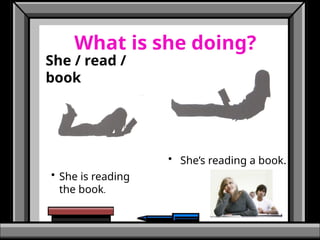
What is she doing?
She / read /
book
• She is reading
the book.
• She’s reading a book.
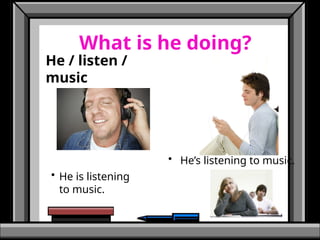
What is he doing?
He / listen /
music
• He is listening
to music.
• He’s listening to music.
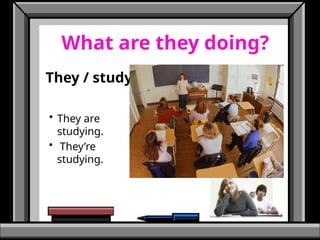
What are they doing?
They / study
• They’re
studying.
• They are
studying.
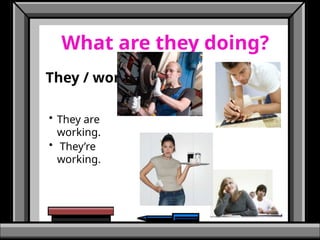
What are they doing?
They / work
• They’re
working.
• They are
working.
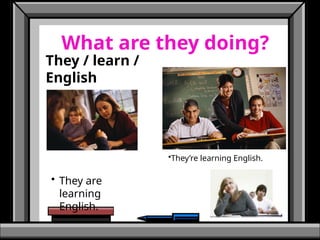
What are they doing?
They / learn /
English
• They are
learning
English.
•They’re learning English.
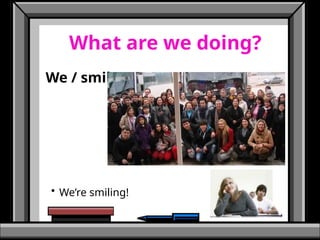
What are we doing?
We / smile
• We’re smiling!
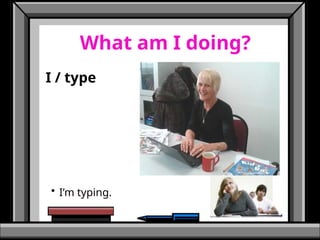
What am I doing?
I / type
• I’m typing.
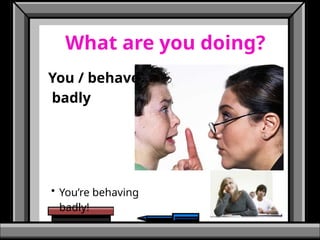
What are you doing?
You / behave /
badly
• You’re behaving
badly!
Form
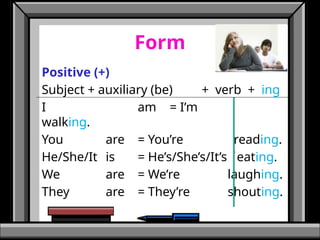
Positive (+)
Subject + auxiliary (be) + verb + ing
I am = I’m
walking.
You are = You’re reading.
He/She/It is = He’s/She’s/It’s eating.
We are = We’re laughing.
They are = They’re shouting.
Form
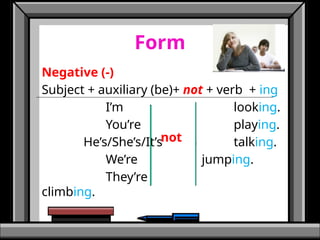
Negative (-)
Subject + auxiliary (be)+ not + verb + ing
I’m looking.
You’re playing.
He’s/She’s/It’s talking.
We’re jumping.
They’re
climbing.
not
Form
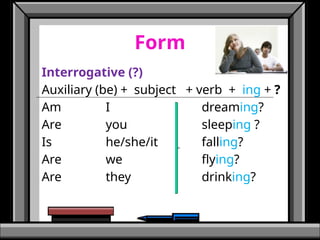
Interrogative (?)
Auxiliary (be) + subject + verb + ing + ?
Am I dreaming?
Are you sleeping ?
Is he/she/it falling?
Are we flying?
Are they drinking?
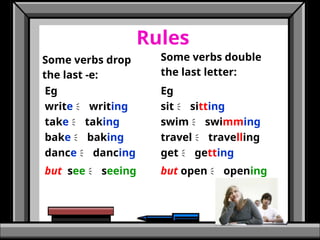
Rules
Some verbs drop
the last -e:
Eg
write  writing
take  taking
bake  baking
dance  dancing
but see  seeing
Some verbs double
the last letter:
Eg
sit  sitting
swim  swimming
travel  travelling
get  getting
but open  opening
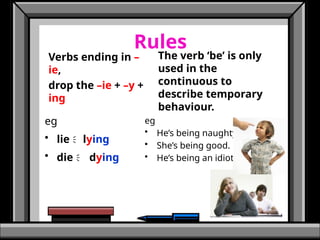
Rules
eg
• lie lying
• die  dying
The verb ‘be’ is only
used in the
continuous to
describe temporary
behaviour.
eg
• He’s being naughty.
• She’s being good.
• He’s being an idiot.
Verbs ending in –
ie,
drop the –ie + –y +
ing
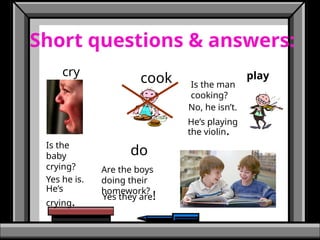
Short questions & answers:
cry
cook play
do
Is the
baby
crying?
Is the man
cooking?
Are the boys
doing their
homework?
No, he isn’t.
He’s playing
the violin.
Yes he is.
He’s
crying. Yes they are!
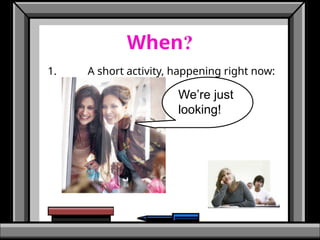
When?
1. A short activity, happening right now:
We’re just
looking!
When?
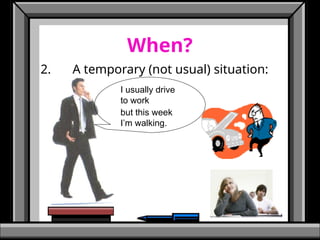
2. A temporary (not usual) situation:
I usually drive
to work
but this week
I’m walking.
When?
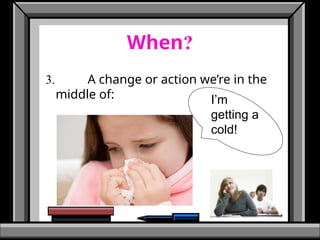
3. A change or action we’re in the
middle of: I’m
getting a
cold!
When?
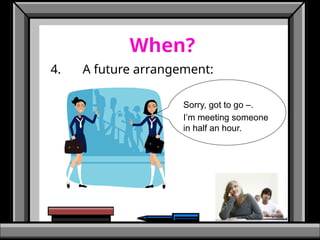
4. A future arrangement:
Sorry, got to go –.
I’m meeting someone
in half an hour.
Making future
arrangements:
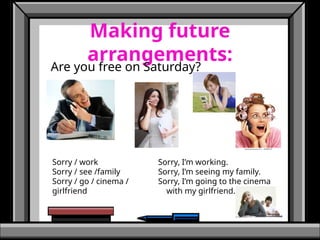
Are you free on Saturday?
Sorry / work
Sorry / see /family
Sorry / go / cinema /
girlfriend
Sorry, I’m working.
Sorry, I’m seeing my family.
Sorry, I’m going to the cinema
with my girlfriend.
Think . . . Have
• The verbs have and think have a
different meaning in the simple
and continuous.
– I think that’s good. (opinion)
– Wait a minute, I’m thinking.
(activity happening now)
– I have a car. (possession)
– I’m having lunch. (activity happening
now)
and now
we’re
saying
‘good-bye’!

Day - 6 present continuous tense 22.pptx

  • 2.
    What is shedoing? She / read / book • She is reading the book. • She’s reading a book.
  • 3.
    What is hedoing? He / listen / music • He is listening to music. • He’s listening to music.
  • 4.
    What are theydoing? They / study • They’re studying. • They are studying.
  • 5.
    What are theydoing? They / work • They’re working. • They are working.
  • 6.
    What are theydoing? They / learn / English • They are learning English. •They’re learning English.
  • 7.
    What are wedoing? We / smile • We’re smiling!
  • 8.
    What am Idoing? I / type • I’m typing.
  • 9.
    What are youdoing? You / behave / badly • You’re behaving badly!
  • 10.
    Form Positive (+) Subject +auxiliary (be) + verb + ing I am = I’m walking. You are = You’re reading. He/She/It is = He’s/She’s/It’s eating. We are = We’re laughing. They are = They’re shouting.
  • 11.
    Form Negative (-) Subject +auxiliary (be)+ not + verb + ing I’m looking. You’re playing. He’s/She’s/It’s talking. We’re jumping. They’re climbing. not
  • 12.
    Form Interrogative (?) Auxiliary (be)+ subject + verb + ing + ? Am I dreaming? Are you sleeping ? Is he/she/it falling? Are we flying? Are they drinking?
  • 13.
    Rules Some verbs drop thelast -e: Eg write  writing take  taking bake  baking dance  dancing but see  seeing Some verbs double the last letter: Eg sit  sitting swim  swimming travel  travelling get  getting but open  opening
  • 14.
    Rules eg • lie lying •die  dying The verb ‘be’ is only used in the continuous to describe temporary behaviour. eg • He’s being naughty. • She’s being good. • He’s being an idiot. Verbs ending in – ie, drop the –ie + –y + ing
  • 15.
    Short questions &answers: cry cook play do Is the baby crying? Is the man cooking? Are the boys doing their homework? No, he isn’t. He’s playing the violin. Yes he is. He’s crying. Yes they are!
  • 16.
    When? 1. A shortactivity, happening right now: We’re just looking!
  • 17.
    When? 2. A temporary(not usual) situation: I usually drive to work but this week I’m walking.
  • 18.
    When? 3. A changeor action we’re in the middle of: I’m getting a cold!
  • 19.
    When? 4. A futurearrangement: Sorry, got to go –. I’m meeting someone in half an hour.
  • 20.
    Making future arrangements: Are youfree on Saturday? Sorry / work Sorry / see /family Sorry / go / cinema / girlfriend Sorry, I’m working. Sorry, I’m seeing my family. Sorry, I’m going to the cinema with my girlfriend.
  • 21.
    Think . .. Have • The verbs have and think have a different meaning in the simple and continuous. – I think that’s good. (opinion) – Wait a minute, I’m thinking. (activity happening now) – I have a car. (possession) – I’m having lunch. (activity happening now)
  • 22.