Depth-first Search
• Depth-first search isa recursive algorithm for traversing a tree or
graph data structure.
• It is called the depth-first search because it starts from the root node
and follows each path to its greatest depth node before moving to the
next path.
• DFS uses a stack data structure for its implementation.
• The process of the DFS algorithm is similar to the BFS algorithm.
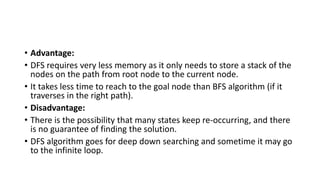
• Advantage:
• DFS requires very less memory as it only needs to store a stack of the
nodes on the path from root node to the current node.
• It takes less time to reach to the goal node than BFS algorithm (if it
traverses in the right path).
• Disadvantage:
• There is the possibility that many states keep re-occurring, and there
is no guarantee of finding the solution.
• DFS algorithm goes for deep down searching and sometime it may go
to the infinite loop.
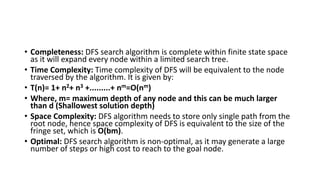
• Completeness: DFS search algorithm is complete within finite state space
as it will expand every node within a limited search tree.
• Time Complexity: Time complexity of DFS will be equivalent to the node
traversed by the algorithm. It is given by:
• T(n)= 1+ n2+ n3 +.........+ nm=O(nm)
• Where, m= maximum depth of any node and this can be much larger
than d (Shallowest solution depth)
• Space Complexity: DFS algorithm needs to store only single path from the
root node, hence space complexity of DFS is equivalent to the size of the
fringe set, which is O(bm).
• Optimal: DFS search algorithm is non-optimal, as it may generate a large
number of steps or high cost to reach to the goal node.
Depth-Limited Search Algorithm:
• A depth-limited search algorithm is similar to depth-first search with a
predetermined limit. Depth-limited search can solve the drawback of
the infinite path in the Depth-first search. In this algorithm, the node
at the depth limit will treat as it has no successor nodes further.
• Depth-limited search can be terminated with two Conditions of
failure:
• Standard failure value: It indicates that problem does not have any
solution.
• Cutoff failure value: It defines no solution for the problem within a
given depth limit.
• Advantages:
• Depth-limited search is Memory efficient.
• Disadvantages:
• Depth-limited search also has a disadvantage of incompleteness.
• It may not be optimal if the problem has more than one solution.
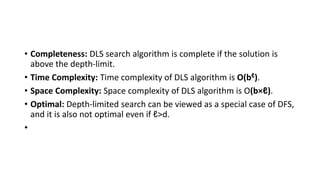
• Completeness: DLS search algorithm is complete if the solution is
above the depth-limit.
• Time Complexity: Time complexity of DLS algorithm is O(bℓ).
• Space Complexity: Space complexity of DLS algorithm is O(b×ℓ).
• Optimal: Depth-limited search can be viewed as a special case of DFS,
and it is also not optimal even if ℓ>d.
•
Uniform-cost Search Algorithm:
• Uniform-cost search is a searching algorithm used for traversing a
weighted tree or graph. This algorithm comes into play when a
different cost is available for each edge. The primary goal of the
uniform-cost search is to find a path to the goal node which has the
lowest cumulative cost. Uniform-cost search expands nodes according
to their path costs form the root node. It can be used to solve any
graph/tree where the optimal cost is in demand. A uniform-cost
search algorithm is implemented by the priority queue. It gives
maximum priority to the lowest cumulative cost. Uniform cost search
is equivalent to BFS algorithm if the path cost of all edges is the same.
• Advantages:
• Uniform cost search is optimal because at every state the path with
the least cost is chosen.
• Disadvantages:
• It does not care about the number of steps involve in searching and
only concerned about path cost. Due to which this algorithm may be
stuck in an infinite loop.
• Completeness:
• Uniform-cost search is complete, such as if there is a solution, UCS will find it.
• Time Complexity:
• Let C* is Cost of the optimal solution, and ε is each step to get closer to the goal node.
Then the number of steps is = C*/ε+1. Here we have taken +1, as we start from state 0
and end to C*/ε.
• Hence, the worst-case time complexity of Uniform-cost search isO(b1 + [C*/ε])/.
• Space Complexity:
• The same logic is for space complexity so, the worst-case space complexity of Uniform-
cost search is O(b1 + [C*/ε]).
• Optimal:
• Uniform-cost search is always optimal as it only selects a path with the lowest path cost.
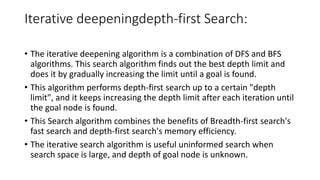
Iterative deepeningdepth-first Search:
• The iterative deepening algorithm is a combination of DFS and BFS
algorithms. This search algorithm finds out the best depth limit and
does it by gradually increasing the limit until a goal is found.
• This algorithm performs depth-first search up to a certain "depth
limit", and it keeps increasing the depth limit after each iteration until
the goal node is found.
• This Search algorithm combines the benefits of Breadth-first search's
fast search and depth-first search's memory efficiency.
• The iterative search algorithm is useful uninformed search when
search space is large, and depth of goal node is unknown.
• Advantages:
• Itcombines the benefits of BFS and DFS search algorithm in terms of
fast search and memory efficiency.
• Disadvantages:
• The main drawback of IDDFS is that it repeats all the work of the
previous phase.
1'st Iteration-----> A
2'nd Iteration----> A, B, C
3'rd Iteration------>A, B, D, E, C, F, G
4'th Iteration------>A, B, D, H, I, E, C, F, K, G
In the fourth iteration, the algorithm will find the goal node.
• Completeness:
• This algorithm is complete is ifthe branching factor is finite.
• Time Complexity:
• Let's suppose b is the branching factor and depth is d then the worst-case
time complexity is O(bd).
• Space Complexity:
• The space complexity of IDDFS will be O(bd).
• Optimal:
• IDDFS algorithm is optimal if path cost is a non- decreasing function of the
depth of the node.
Bidirectional Search Algorithm:
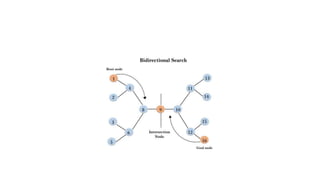
• Bidirectional search algorithm runs two simultaneous searches, one
form initial state called as forward-search and other from goal node
called as backward-search, to find the goal node. Bidirectional
search replaces one single search graph with two small subgraphs in
which one starts the search from an initial vertex and other starts
from goal vertex. The search stops when these two graphs intersect
each other.
• Bidirectional search can use search techniques such as BFS, DFS,
DLS, etc.
• Advantages:
• Bidirectional search is fast.
• Bidirectional search requires less memory
• Disadvantages:
• Implementation of the bidirectional search tree is difficult.
• In bidirectional search, one should know the goal state in advance.
• Completeness: Bidirectional Search is complete if we use BFS in both
searches.
• Time Complexity: Time complexity of bidirectional search using BFS
is O(bd).
• Space Complexity: Space complexity of bidirectional search is O(bd).
• Optimal: Bidirectional search is Optimal.
• ]
Types of Inference rules:
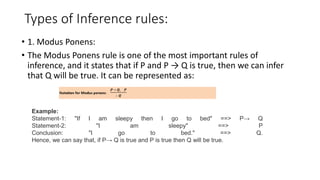
• 1. Modus Ponens:
• The Modus Ponens rule is one of the most important rules of
inference, and it states that if P and P → Q is true, then we can infer
that Q will be true. It can be represented as:
Example:
Statement-1: "If I am sleepy then I go to bed" ==> P→ Q
Statement-2: "I am sleepy" ==> P
Conclusion: "I go to bed." ==> Q.
Hence, we can say that, if P→ Q is true and P is true then Q will be true.
• 2. Modus Tollens:
• The Modus Tollens rule state that if P→ Q is true and ¬ Q is true, then
¬ P will also true. It can be represented as:
• Statement-1: "If I am sleepy then I go to bed" ==> P→ Q
Statement-2: "I do not go to the bed."==> ~Q
Statement-3: Which infers that "I am not sleepy" => ~P

NEW-II.pptx

  • 2.
    Depth-first Search • Depth-firstsearch isa recursive algorithm for traversing a tree or graph data structure. • It is called the depth-first search because it starts from the root node and follows each path to its greatest depth node before moving to the next path. • DFS uses a stack data structure for its implementation. • The process of the DFS algorithm is similar to the BFS algorithm.
  • 3.
    • Advantage: • DFSrequires very less memory as it only needs to store a stack of the nodes on the path from root node to the current node. • It takes less time to reach to the goal node than BFS algorithm (if it traverses in the right path). • Disadvantage: • There is the possibility that many states keep re-occurring, and there is no guarantee of finding the solution. • DFS algorithm goes for deep down searching and sometime it may go to the infinite loop.
  • 5.
    • Completeness: DFSsearch algorithm is complete within finite state space as it will expand every node within a limited search tree. • Time Complexity: Time complexity of DFS will be equivalent to the node traversed by the algorithm. It is given by: • T(n)= 1+ n2+ n3 +.........+ nm=O(nm) • Where, m= maximum depth of any node and this can be much larger than d (Shallowest solution depth) • Space Complexity: DFS algorithm needs to store only single path from the root node, hence space complexity of DFS is equivalent to the size of the fringe set, which is O(bm). • Optimal: DFS search algorithm is non-optimal, as it may generate a large number of steps or high cost to reach to the goal node.
  • 6.
    Depth-Limited Search Algorithm: •A depth-limited search algorithm is similar to depth-first search with a predetermined limit. Depth-limited search can solve the drawback of the infinite path in the Depth-first search. In this algorithm, the node at the depth limit will treat as it has no successor nodes further. • Depth-limited search can be terminated with two Conditions of failure: • Standard failure value: It indicates that problem does not have any solution. • Cutoff failure value: It defines no solution for the problem within a given depth limit.
  • 7.
    • Advantages: • Depth-limitedsearch is Memory efficient. • Disadvantages: • Depth-limited search also has a disadvantage of incompleteness. • It may not be optimal if the problem has more than one solution.
  • 9.
    • Completeness: DLSsearch algorithm is complete if the solution is above the depth-limit. • Time Complexity: Time complexity of DLS algorithm is O(bℓ). • Space Complexity: Space complexity of DLS algorithm is O(b×ℓ). • Optimal: Depth-limited search can be viewed as a special case of DFS, and it is also not optimal even if ℓ>d. •
  • 10.
    Uniform-cost Search Algorithm: •Uniform-cost search is a searching algorithm used for traversing a weighted tree or graph. This algorithm comes into play when a different cost is available for each edge. The primary goal of the uniform-cost search is to find a path to the goal node which has the lowest cumulative cost. Uniform-cost search expands nodes according to their path costs form the root node. It can be used to solve any graph/tree where the optimal cost is in demand. A uniform-cost search algorithm is implemented by the priority queue. It gives maximum priority to the lowest cumulative cost. Uniform cost search is equivalent to BFS algorithm if the path cost of all edges is the same.
  • 11.
    • Advantages: • Uniformcost search is optimal because at every state the path with the least cost is chosen. • Disadvantages: • It does not care about the number of steps involve in searching and only concerned about path cost. Due to which this algorithm may be stuck in an infinite loop.
  • 13.
    • Completeness: • Uniform-costsearch is complete, such as if there is a solution, UCS will find it. • Time Complexity: • Let C* is Cost of the optimal solution, and ε is each step to get closer to the goal node. Then the number of steps is = C*/ε+1. Here we have taken +1, as we start from state 0 and end to C*/ε. • Hence, the worst-case time complexity of Uniform-cost search isO(b1 + [C*/ε])/. • Space Complexity: • The same logic is for space complexity so, the worst-case space complexity of Uniform- cost search is O(b1 + [C*/ε]). • Optimal: • Uniform-cost search is always optimal as it only selects a path with the lowest path cost.
  • 14.
    Iterative deepeningdepth-first Search: •The iterative deepening algorithm is a combination of DFS and BFS algorithms. This search algorithm finds out the best depth limit and does it by gradually increasing the limit until a goal is found. • This algorithm performs depth-first search up to a certain "depth limit", and it keeps increasing the depth limit after each iteration until the goal node is found. • This Search algorithm combines the benefits of Breadth-first search's fast search and depth-first search's memory efficiency. • The iterative search algorithm is useful uninformed search when search space is large, and depth of goal node is unknown.
  • 15.
    • Advantages: • Itcombinesthe benefits of BFS and DFS search algorithm in terms of fast search and memory efficiency. • Disadvantages: • The main drawback of IDDFS is that it repeats all the work of the previous phase.
  • 16.
    1'st Iteration-----> A 2'ndIteration----> A, B, C 3'rd Iteration------>A, B, D, E, C, F, G 4'th Iteration------>A, B, D, H, I, E, C, F, K, G In the fourth iteration, the algorithm will find the goal node.
  • 17.
    • Completeness: • Thisalgorithm is complete is ifthe branching factor is finite. • Time Complexity: • Let's suppose b is the branching factor and depth is d then the worst-case time complexity is O(bd). • Space Complexity: • The space complexity of IDDFS will be O(bd). • Optimal: • IDDFS algorithm is optimal if path cost is a non- decreasing function of the depth of the node.
  • 18.
    Bidirectional Search Algorithm: •Bidirectional search algorithm runs two simultaneous searches, one form initial state called as forward-search and other from goal node called as backward-search, to find the goal node. Bidirectional search replaces one single search graph with two small subgraphs in which one starts the search from an initial vertex and other starts from goal vertex. The search stops when these two graphs intersect each other. • Bidirectional search can use search techniques such as BFS, DFS, DLS, etc.
  • 19.
    • Advantages: • Bidirectionalsearch is fast. • Bidirectional search requires less memory • Disadvantages: • Implementation of the bidirectional search tree is difficult. • In bidirectional search, one should know the goal state in advance.
  • 21.
    • Completeness: BidirectionalSearch is complete if we use BFS in both searches. • Time Complexity: Time complexity of bidirectional search using BFS is O(bd). • Space Complexity: Space complexity of bidirectional search is O(bd). • Optimal: Bidirectional search is Optimal. • ]
  • 22.
    Types of Inferencerules: • 1. Modus Ponens: • The Modus Ponens rule is one of the most important rules of inference, and it states that if P and P → Q is true, then we can infer that Q will be true. It can be represented as: Example: Statement-1: "If I am sleepy then I go to bed" ==> P→ Q Statement-2: "I am sleepy" ==> P Conclusion: "I go to bed." ==> Q. Hence, we can say that, if P→ Q is true and P is true then Q will be true.
  • 23.
    • 2. ModusTollens: • The Modus Tollens rule state that if P→ Q is true and ¬ Q is true, then ¬ P will also true. It can be represented as: • Statement-1: "If I am sleepy then I go to bed" ==> P→ Q Statement-2: "I do not go to the bed."==> ~Q Statement-3: Which infers that "I am not sleepy" => ~P