Solving problems by searching Chapter 3
Outline Problem-solving agents Problem types Problem formulation Example problems Basic search algorithms
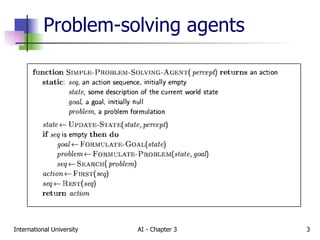
Problem-solving agents
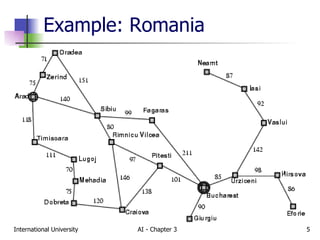
Example: Romania On holiday in Romania; currently in Arad. Flight leaves tomorrow from Bucharest Formulate goal : be in Bucharest Formulate problem : states : various cities actions : drive between cities Find solution : sequence of cities, e.g., Arad, Sibiu, Fagaras, Bucharest
Example: Romania
Problem types Deterministic, fully observable      single-state problem Agent knows exactly which state it will be in; solution is a sequence Non-observable      sensorless problem (conformant problem) Agent may have no idea where it is; solution is a sequence Nondeterministic and/or partially observable      contingency problem percepts provide  new  information about current state often  interleave } search, execution Unknown state space      exploration problem
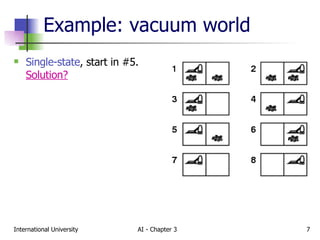
Example: vacuum world Single-state , start in #5.  Solution?
Example: vacuum world Single-state , start in #5.  Solution?   [Right, Suck] Sensorless,  start in  { 1,2,3,4,5,6,7,8 }   e.g.,  Right  goes to { 2,4,6,8 }  Solution?
Example: vacuum world Sensorless,  start in  { 1,2,3,4,5,6,7,8 }   e.g.,  Right  goes to { 2,4,6,8 }  Solution?   [Right,Suck,Left,Suck] Contingency   Nondeterministic:  Suck  may  dirty a clean carpet Partially observable: location, dirt at current location. Percept:  [L, Clean],  i.e., start in #5 or #7 Solution?
Example: vacuum world Sensorless,  start in  { 1,2,3,4,5,6,7,8 }   e.g.,  Right  goes to { 2,4,6,8 }  Solution?   [Right,Suck,Left,Suck] Contingency   Nondeterministic:  Suck  may  dirty a clean carpet Partially observable: location, dirt at current location. Percept:  [L, Clean],  i.e., start in #5 or #7 Solution?   [Right,  if  dirt  then  Suck]
Single-state problem formulation A  problem  is defined by four items: initial state  e.g., &quot;at Arad&quot; actions  or  successor function   S(x)  = set of action–state pairs  e.g.,  S(Arad) =  { <Arad    Zerind, Zerind>, …  } goal test , can be explicit , e.g.,  x  = &quot;at Bucharest&quot; implicit , e.g.,  Checkmate(x) path cost  (additive) e.g., sum of distances, number of actions executed, etc. c(x,a,y)  is the  step cost , assumed to be  ≥  0 A  solution  is a sequence of actions leading from the initial state to a goal state
Selecting a state space Real world is absurdly complex     state space must be  abstracted  for problem solving (Abstract) state = set of real states (Abstract) action = complex combination of real actions e.g., &quot;Arad    Zerind&quot; represents a complex set of possible routes, detours, rest stops, etc.  For guaranteed realizability,  any  real state &quot;in Arad“ must get to  some  real state &quot;in Zerind&quot; (Abstract) solution =  set of real paths that are solutions in the real world Each abstract action should be &quot;easier&quot; than the original problem
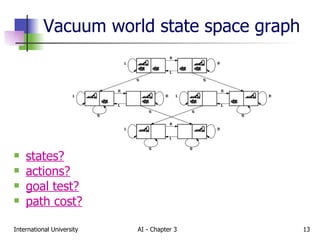
Vacuum world state space graph states? actions? goal test? path cost?
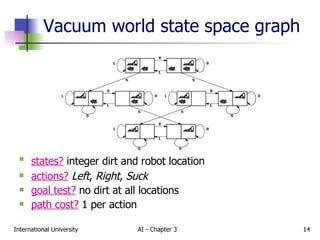
Vacuum world state space graph states?   integer dirt and robot location   actions?   Left ,  Right ,  Suck goal test?   no dirt at all locations path cost?   1 per action
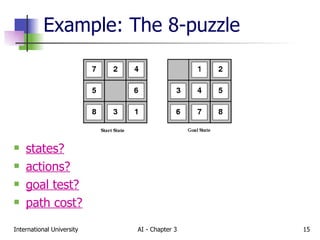
Example: The 8-puzzle states? actions? goal test? path cost?
Example: The 8-puzzle states?   locations of tiles  actions?   move blank left, right, up, down  goal test?   = goal state (given) path cost?  1 per move [Note: optimal solution of  n -Puzzle family is NP-hard]
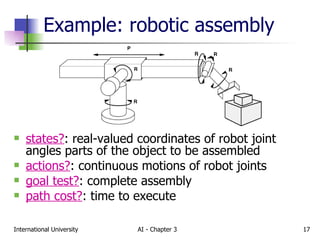
Example: robotic assembly states? : real-valued coordinates of robot joint angles parts of the object to be assembled actions? : continuous motions of robot joints goal test? : complete assembly path cost? : time to execute
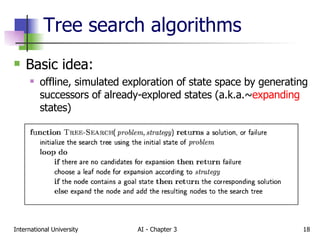
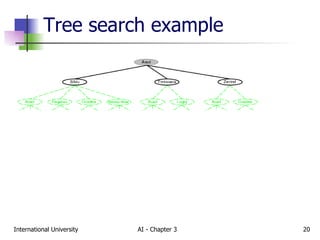
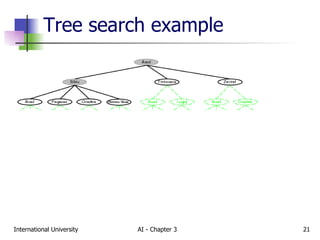
Tree search algorithms Basic idea: offline, simulated exploration of state space by generating successors of already-explored states (a.k.a.~ expanding  states)
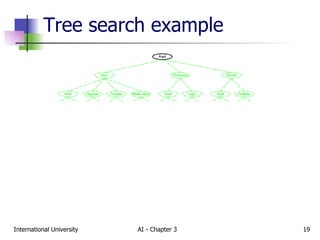
Tree search example
Tree search example
Tree search example
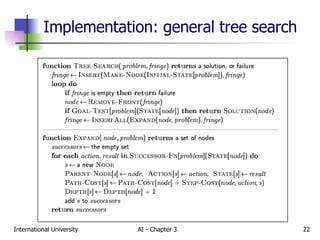
Implementation: general tree search
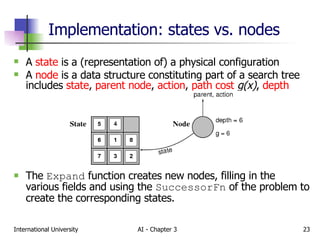
Implementation: states vs. nodes A  state  is a (representation of) a physical configuration A  node  is a data structure constituting part of a search tree includes  state ,  parent node ,  action ,  path cost   g(x) ,  depth The  Expand  function creates new nodes, filling in the various fields and using the  SuccessorFn  of the problem to create the corresponding states.
Search strategies A search strategy is defined by picking the  order of node expansion Strategies are evaluated along the following dimensions: completeness : does it always find a solution if one exists? time complexity : number of nodes generated space complexity : maximum number of nodes in memory optimality : does it always find a least-cost solution? Time and space complexity are measured in terms of  b:  maximum branching factor of the search tree d:  depth of the least-cost solution m : maximum depth of the state space (may be  ∞ )
Uninformed search strategies Uninformed  search strategies use only the information available in the problem definition Breadth-first search Uniform-cost search Depth-first search Depth-limited search Iterative deepening search
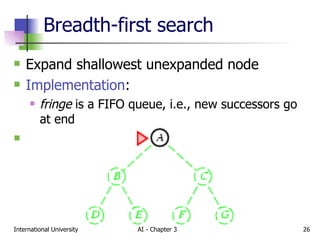
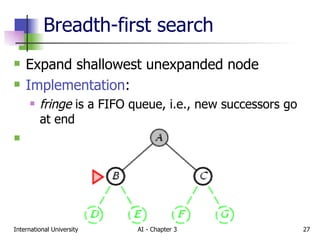
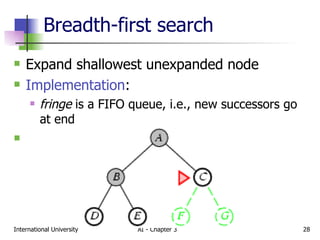
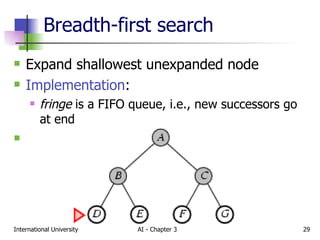
Breadth-first search Expand shallowest unexpanded node Implementation : fringe  is a FIFO queue, i.e., new successors go at end
Properties of breadth-first search Complete?   Yes (if  b  is finite) Time?   1+b+b 2 +b 3 +… + b d  +  b(b d -1 ) = O(b d+1 ) Space?   O(b d+1 )  (keeps every node in memory) Optimal?  Yes (if cost = 1 per step) Space  is the bigger problem (more than time)
Uniform-cost search Expand least-cost unexpanded node Implementation : fringe  = queue ordered by path cost Equivalent to breadth-first if step costs all equal Complete?  Yes, if step cost  ≥  ε Time?  # of nodes with  g  ≤  cost of optimal solution,  O(b ceiling(C*/  ε ) )  where  C *  is the cost of the optimal solution Space?  # of nodes with  g   ≤  cost of optimal solution,  O(b ceiling(C*/  ε ) ) Optimal?  Yes – nodes expanded in increasing order of  g(n)
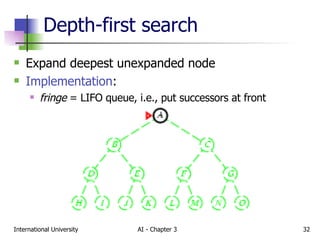
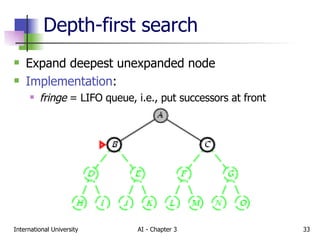
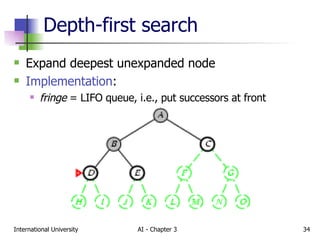
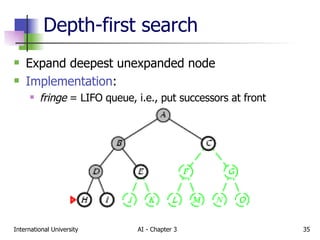
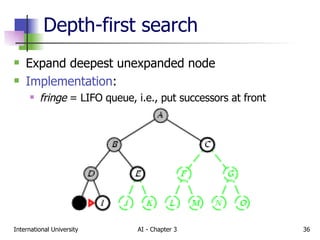
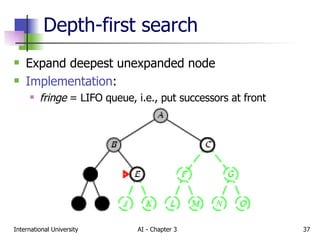
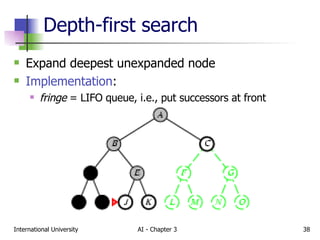
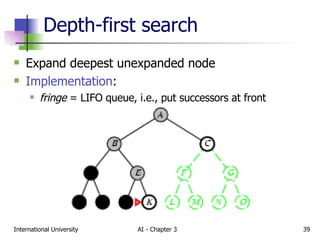
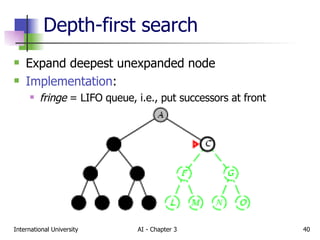
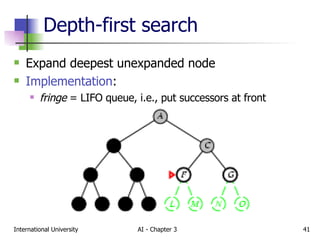
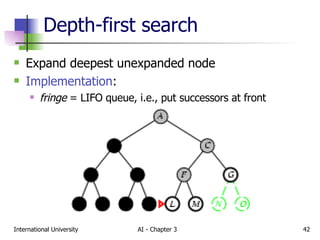
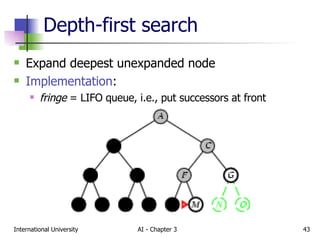
Depth-first search Expand deepest unexpanded node Implementation : fringe  = LIFO queue, i.e., put successors at front
Properties of depth-first search Complete?  No: fails in infinite-depth spaces, spaces with loops Modify to avoid repeated states along path    complete in finite spaces Time?   O(b m ) : terrible if  m  is much larger than  d but if solutions are dense, may be much faster than breadth-first Space?   O(bm),  i.e., linear space! Optimal?  No
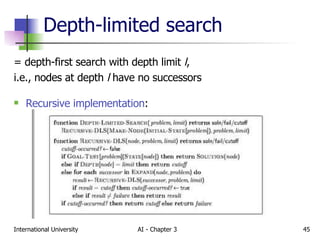
Depth-limited search = depth-first search with depth limit  l , i.e., nodes at depth  l  have no successors Recursive implementation :
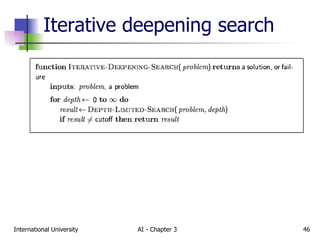
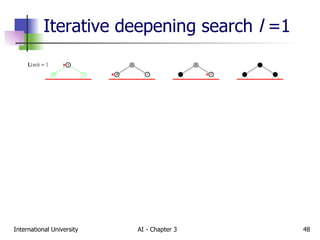
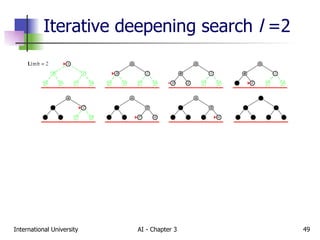
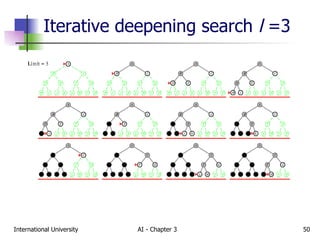
Iterative deepening search
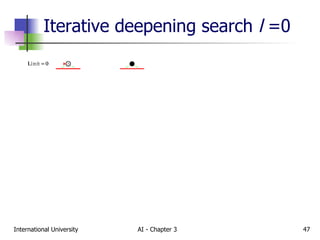
Iterative deepening search  l  =0
Iterative deepening search  l  =1
Iterative deepening search  l  =2
Iterative deepening search  l  =3
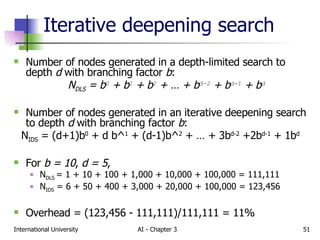
Iterative deepening search Number of nodes generated in a depth-limited search to depth  d  with branching factor  b :  N DLS  = b 0  + b 1  + b 2  + … + b d-2  + b d-1  + b d   Number of nodes generated in an iterative deepening search to depth  d  with branching factor  b :  N IDS  = (d+1)b 0  + d b^ 1  + (d-1)b^ 2  + … + 3b d-2  +2b d-1  + 1b d   For  b = 10 ,  d = 5 , N DLS  = 1 + 10 + 100 + 1,000 + 10,000 + 100,000 = 111,111 N IDS  = 6 + 50 + 400 + 3,000 + 20,000 + 100,000 = 123,456 Overhead = (123,456 - 111,111)/111,111 = 11%
Properties of iterative deepening search Complete?  Yes Time?   (d+1)b 0  + d b 1  + (d-1)b 2  + … + b d  = O(b d ) Space?   O(bd) Optimal?  Yes, if step cost = 1
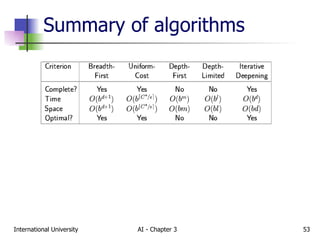
Summary of algorithms
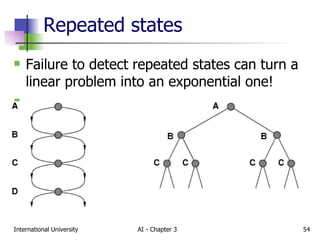
Repeated states Failure to detect repeated states can turn a linear problem into an exponential one!
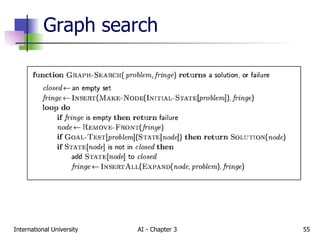
Graph search
Summary Problem formulation usually requires abstracting away real-world details to define a state space that can feasibly be explored Variety of uninformed search strategies Iterative deepening search uses only linear space and not much more time than other uninformed algorithms

Chapter3 Search

  • 1.
    Solving problems bysearching Chapter 3
  • 2.
    Outline Problem-solving agentsProblem types Problem formulation Example problems Basic search algorithms
  • 3.
  • 4.
    Example: Romania Onholiday in Romania; currently in Arad. Flight leaves tomorrow from Bucharest Formulate goal : be in Bucharest Formulate problem : states : various cities actions : drive between cities Find solution : sequence of cities, e.g., Arad, Sibiu, Fagaras, Bucharest
  • 5.
  • 6.
    Problem types Deterministic,fully observable  single-state problem Agent knows exactly which state it will be in; solution is a sequence Non-observable  sensorless problem (conformant problem) Agent may have no idea where it is; solution is a sequence Nondeterministic and/or partially observable  contingency problem percepts provide new information about current state often interleave } search, execution Unknown state space  exploration problem
  • 7.
    Example: vacuum worldSingle-state , start in #5. Solution?
  • 8.
    Example: vacuum worldSingle-state , start in #5. Solution? [Right, Suck] Sensorless, start in { 1,2,3,4,5,6,7,8 } e.g., Right goes to { 2,4,6,8 } Solution?
  • 9.
    Example: vacuum worldSensorless, start in { 1,2,3,4,5,6,7,8 } e.g., Right goes to { 2,4,6,8 } Solution? [Right,Suck,Left,Suck] Contingency Nondeterministic: Suck may dirty a clean carpet Partially observable: location, dirt at current location. Percept: [L, Clean], i.e., start in #5 or #7 Solution?
  • 10.
    Example: vacuum worldSensorless, start in { 1,2,3,4,5,6,7,8 } e.g., Right goes to { 2,4,6,8 } Solution? [Right,Suck,Left,Suck] Contingency Nondeterministic: Suck may dirty a clean carpet Partially observable: location, dirt at current location. Percept: [L, Clean], i.e., start in #5 or #7 Solution? [Right, if dirt then Suck]
  • 11.
    Single-state problem formulationA problem is defined by four items: initial state e.g., &quot;at Arad&quot; actions or successor function S(x) = set of action–state pairs e.g., S(Arad) = { <Arad  Zerind, Zerind>, … } goal test , can be explicit , e.g., x = &quot;at Bucharest&quot; implicit , e.g., Checkmate(x) path cost (additive) e.g., sum of distances, number of actions executed, etc. c(x,a,y) is the step cost , assumed to be ≥ 0 A solution is a sequence of actions leading from the initial state to a goal state
  • 12.
    Selecting a statespace Real world is absurdly complex  state space must be abstracted for problem solving (Abstract) state = set of real states (Abstract) action = complex combination of real actions e.g., &quot;Arad  Zerind&quot; represents a complex set of possible routes, detours, rest stops, etc. For guaranteed realizability, any real state &quot;in Arad“ must get to some real state &quot;in Zerind&quot; (Abstract) solution = set of real paths that are solutions in the real world Each abstract action should be &quot;easier&quot; than the original problem
  • 13.
    Vacuum world statespace graph states? actions? goal test? path cost?
  • 14.
    Vacuum world statespace graph states? integer dirt and robot location actions? Left , Right , Suck goal test? no dirt at all locations path cost? 1 per action
  • 15.
    Example: The 8-puzzlestates? actions? goal test? path cost?
  • 16.
    Example: The 8-puzzlestates? locations of tiles actions? move blank left, right, up, down goal test? = goal state (given) path cost? 1 per move [Note: optimal solution of n -Puzzle family is NP-hard]
  • 17.
    Example: robotic assemblystates? : real-valued coordinates of robot joint angles parts of the object to be assembled actions? : continuous motions of robot joints goal test? : complete assembly path cost? : time to execute
  • 18.
    Tree search algorithmsBasic idea: offline, simulated exploration of state space by generating successors of already-explored states (a.k.a.~ expanding states)
  • 19.
  • 20.
  • 21.
  • 22.
  • 23.
    Implementation: states vs.nodes A state is a (representation of) a physical configuration A node is a data structure constituting part of a search tree includes state , parent node , action , path cost g(x) , depth The Expand function creates new nodes, filling in the various fields and using the SuccessorFn of the problem to create the corresponding states.
  • 24.
    Search strategies Asearch strategy is defined by picking the order of node expansion Strategies are evaluated along the following dimensions: completeness : does it always find a solution if one exists? time complexity : number of nodes generated space complexity : maximum number of nodes in memory optimality : does it always find a least-cost solution? Time and space complexity are measured in terms of b: maximum branching factor of the search tree d: depth of the least-cost solution m : maximum depth of the state space (may be ∞ )
  • 25.
    Uninformed search strategiesUninformed search strategies use only the information available in the problem definition Breadth-first search Uniform-cost search Depth-first search Depth-limited search Iterative deepening search
  • 26.
    Breadth-first search Expandshallowest unexpanded node Implementation : fringe is a FIFO queue, i.e., new successors go at end
  • 27.
    Breadth-first search Expandshallowest unexpanded node Implementation : fringe is a FIFO queue, i.e., new successors go at end
  • 28.
    Breadth-first search Expandshallowest unexpanded node Implementation : fringe is a FIFO queue, i.e., new successors go at end
  • 29.
    Breadth-first search Expandshallowest unexpanded node Implementation : fringe is a FIFO queue, i.e., new successors go at end
  • 30.
    Properties of breadth-firstsearch Complete? Yes (if b is finite) Time? 1+b+b 2 +b 3 +… + b d + b(b d -1 ) = O(b d+1 ) Space? O(b d+1 ) (keeps every node in memory) Optimal? Yes (if cost = 1 per step) Space is the bigger problem (more than time)
  • 31.
    Uniform-cost search Expandleast-cost unexpanded node Implementation : fringe = queue ordered by path cost Equivalent to breadth-first if step costs all equal Complete? Yes, if step cost ≥ ε Time? # of nodes with g ≤ cost of optimal solution, O(b ceiling(C*/ ε ) ) where C * is the cost of the optimal solution Space? # of nodes with g ≤ cost of optimal solution, O(b ceiling(C*/ ε ) ) Optimal? Yes – nodes expanded in increasing order of g(n)
  • 32.
    Depth-first search Expanddeepest unexpanded node Implementation : fringe = LIFO queue, i.e., put successors at front
  • 33.
    Depth-first search Expanddeepest unexpanded node Implementation : fringe = LIFO queue, i.e., put successors at front
  • 34.
    Depth-first search Expanddeepest unexpanded node Implementation : fringe = LIFO queue, i.e., put successors at front
  • 35.
    Depth-first search Expanddeepest unexpanded node Implementation : fringe = LIFO queue, i.e., put successors at front
  • 36.
    Depth-first search Expanddeepest unexpanded node Implementation : fringe = LIFO queue, i.e., put successors at front
  • 37.
    Depth-first search Expanddeepest unexpanded node Implementation : fringe = LIFO queue, i.e., put successors at front
  • 38.
    Depth-first search Expanddeepest unexpanded node Implementation : fringe = LIFO queue, i.e., put successors at front
  • 39.
    Depth-first search Expanddeepest unexpanded node Implementation : fringe = LIFO queue, i.e., put successors at front
  • 40.
    Depth-first search Expanddeepest unexpanded node Implementation : fringe = LIFO queue, i.e., put successors at front
  • 41.
    Depth-first search Expanddeepest unexpanded node Implementation : fringe = LIFO queue, i.e., put successors at front
  • 42.
    Depth-first search Expanddeepest unexpanded node Implementation : fringe = LIFO queue, i.e., put successors at front
  • 43.
    Depth-first search Expanddeepest unexpanded node Implementation : fringe = LIFO queue, i.e., put successors at front
  • 44.
    Properties of depth-firstsearch Complete? No: fails in infinite-depth spaces, spaces with loops Modify to avoid repeated states along path  complete in finite spaces Time? O(b m ) : terrible if m is much larger than d but if solutions are dense, may be much faster than breadth-first Space? O(bm), i.e., linear space! Optimal? No
  • 45.
    Depth-limited search =depth-first search with depth limit l , i.e., nodes at depth l have no successors Recursive implementation :
  • 46.
  • 47.
  • 48.
  • 49.
  • 50.
  • 51.
    Iterative deepening searchNumber of nodes generated in a depth-limited search to depth d with branching factor b : N DLS = b 0 + b 1 + b 2 + … + b d-2 + b d-1 + b d Number of nodes generated in an iterative deepening search to depth d with branching factor b : N IDS = (d+1)b 0 + d b^ 1 + (d-1)b^ 2 + … + 3b d-2 +2b d-1 + 1b d For b = 10 , d = 5 , N DLS = 1 + 10 + 100 + 1,000 + 10,000 + 100,000 = 111,111 N IDS = 6 + 50 + 400 + 3,000 + 20,000 + 100,000 = 123,456 Overhead = (123,456 - 111,111)/111,111 = 11%
  • 52.
    Properties of iterativedeepening search Complete? Yes Time? (d+1)b 0 + d b 1 + (d-1)b 2 + … + b d = O(b d ) Space? O(bd) Optimal? Yes, if step cost = 1
  • 53.
  • 54.
    Repeated states Failureto detect repeated states can turn a linear problem into an exponential one!
  • 55.
  • 56.
    Summary Problem formulationusually requires abstracting away real-world details to define a state space that can feasibly be explored Variety of uninformed search strategies Iterative deepening search uses only linear space and not much more time than other uninformed algorithms