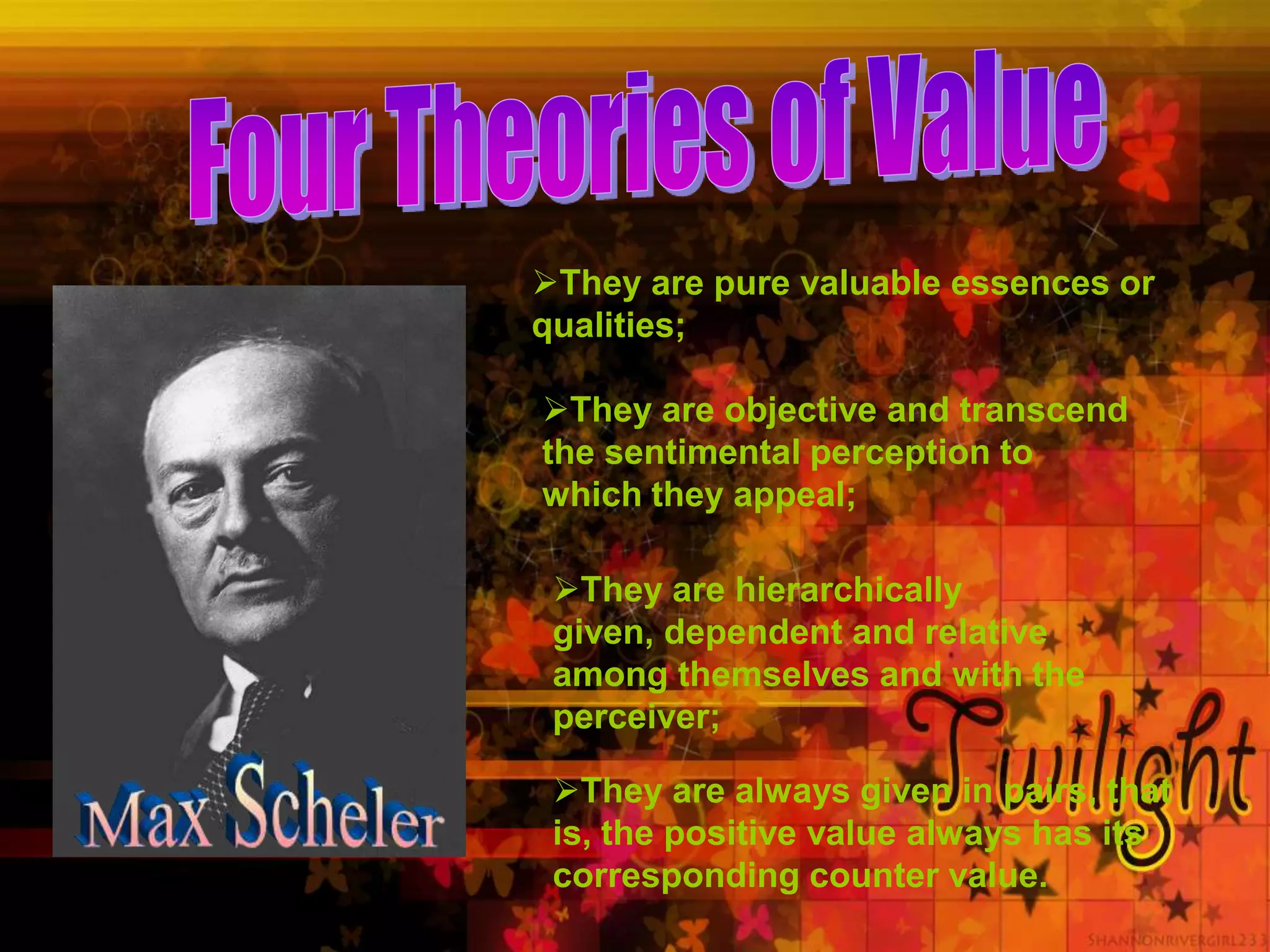
They are pure valuable essences or
qualities;
They are objective and transcend
the sentimental perception to
which they appeal;
They are hierarchically
given, dependent and relative
among themselves and with the
perceiver;
They are always given in pairs, that
is, the positive value always has its
corresponding counter value.
The non- indifference of value
strengthens the transcendence
which traditional philosophy
attributes to supreme values of
Good, Truth and Beauty,
contained in different degrees
in all being.
Good for What?
Good for Whom?
•These two Questions can and must be asked
of anything presented as good or Valuable
demonstrates the fact that all good or value in
this world are relative both to something and to
somebody.
•Values are relative to cultural influences and
historical changes, in the sense that the
appreciation of values is affected by these
factors.
It has just been pointed out that all value or
good are relative. Now, In any relation there
are three things to be considered:
1.That which is related to some other thing.
The Latin technical for this I a quo, literally
from which.
2. That to which the former is related or
referred. The Latin technical term for this is
ad quem, literally to which.
3. The basis of the relationship between the
two terms, i.e. the reason why the term a qou
is related to the term ad quem
Values has an
Absolute character
that is, it has an
objectivity
independent from
human appreciation
or judgment.
Man is not creator
of Value since
value transcends
the subject, nay, it
transcends the
world.
Under this aspect we can say that absolute values exist in
which the perspective of the Absolute appears, for we can
find the realities of these values only in that Absolute and
supra temporal Value. In this Supreme Value and by
relating to it, our ideal values of Good, Beauty, Justice, etc.,
•Value in its
deepest structure
never goes alone
but is accompanied
by a counter value.
•Every positive
value has its
corresponding
negative value.
•When we call something
not good, not beautiful,
not real, we are also
recognizing values, this
time through their
opposites.
•Values, therefo
re, are both
positive and
negative.
That is within the
realm of values and
among the different
classes and groups
there exists a
hierarchy, a scaled
graduation of
values.
Material and non-
personal values are
subordinate to
spiritual and
personal values
respectively.
This hierarchy is
recognized by all and
implies that some values
are preferred or ought
to be preferred to other
values classified as
inferior values.
Personal
values are
preferred or
ought to be
preferred to
non-personal
values.
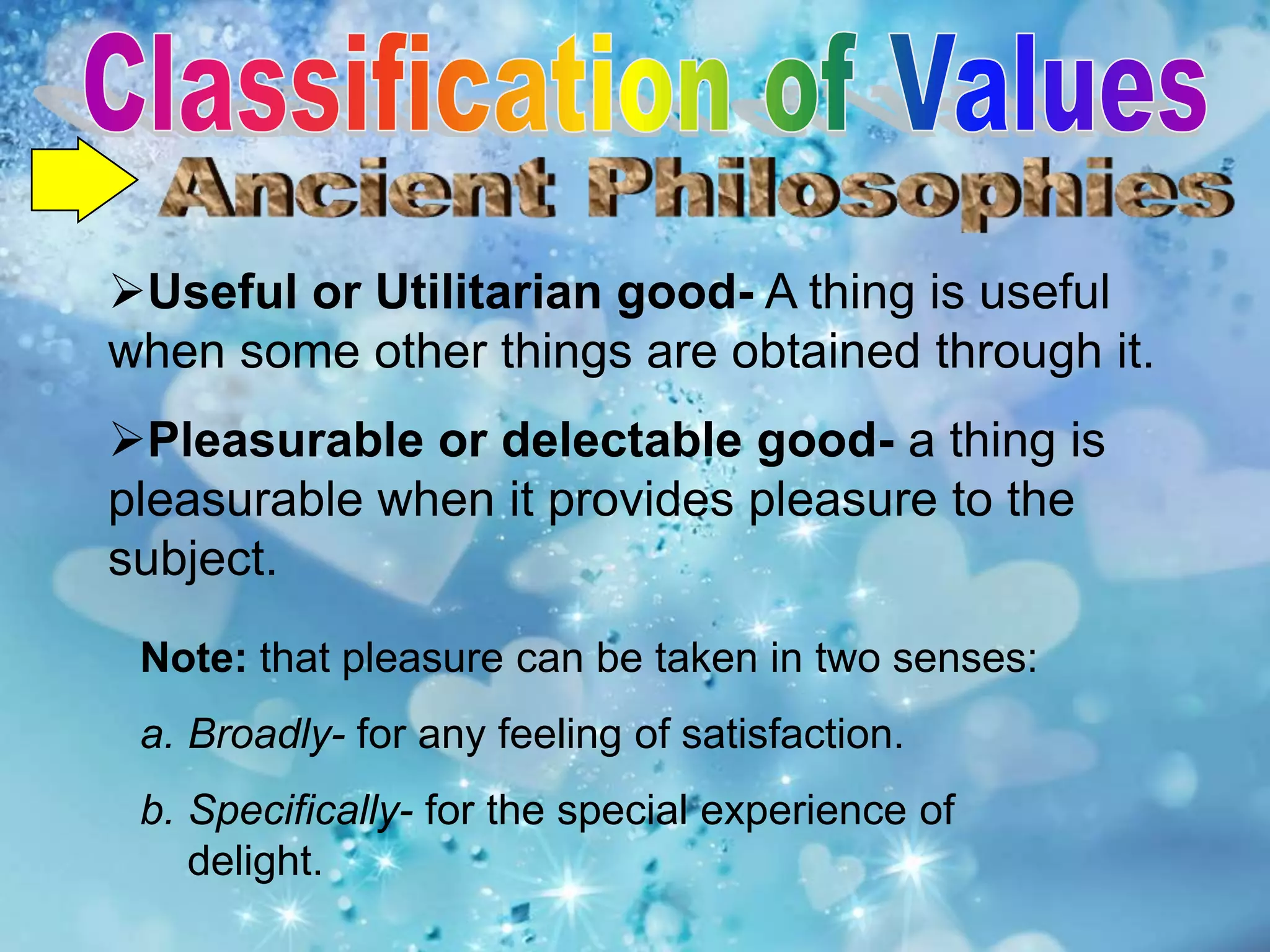
Useful or Utilitarian good- A thing is useful
when some other things are obtained through it.
Pleasurable or delectable good- a thing is
pleasurable when it provides pleasure to the
subject.
Note: that pleasure can be taken in two senses:
a. Broadly- for any feeling of satisfaction.
b. Specifically- for the special experience of
delight.
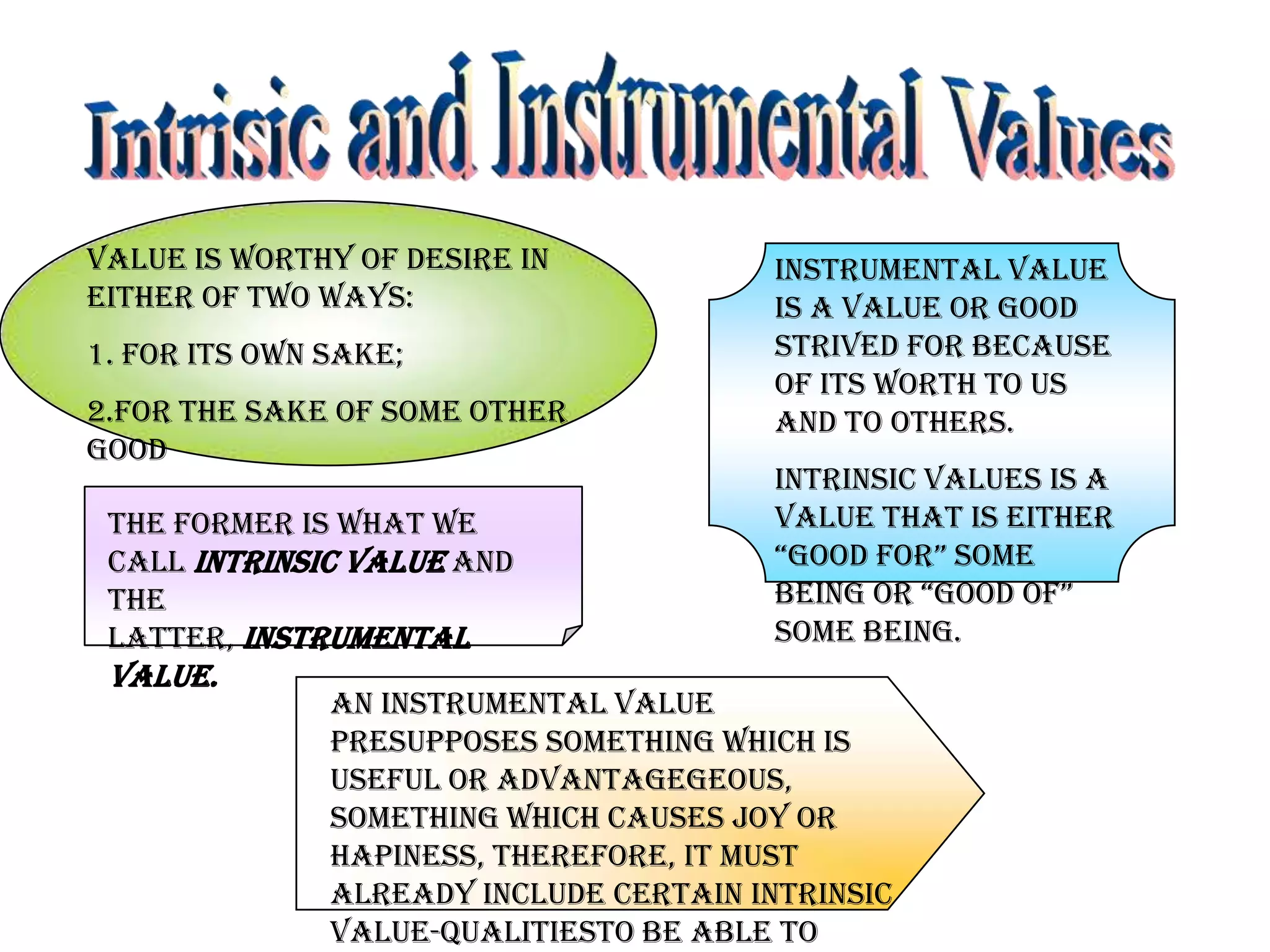
Instrumental Value
is a value or good
strived for because
of its worth to us
and to others.
Intrinsic values is a
value that is either
“good for” some
being or “good of”
some being.
The former is what we
call intrinsic value and
the
latter, instrumental
value.
Value is worthy of desire in
either of two ways:
1. For its own sake;
2.For the sake of some other
good
An instrumental value
presupposes something which is
useful or advantagegeous,
something which causes joy or
hapiness, therefore, it must
already include certain intrinsic
value-qualitiesto be able to
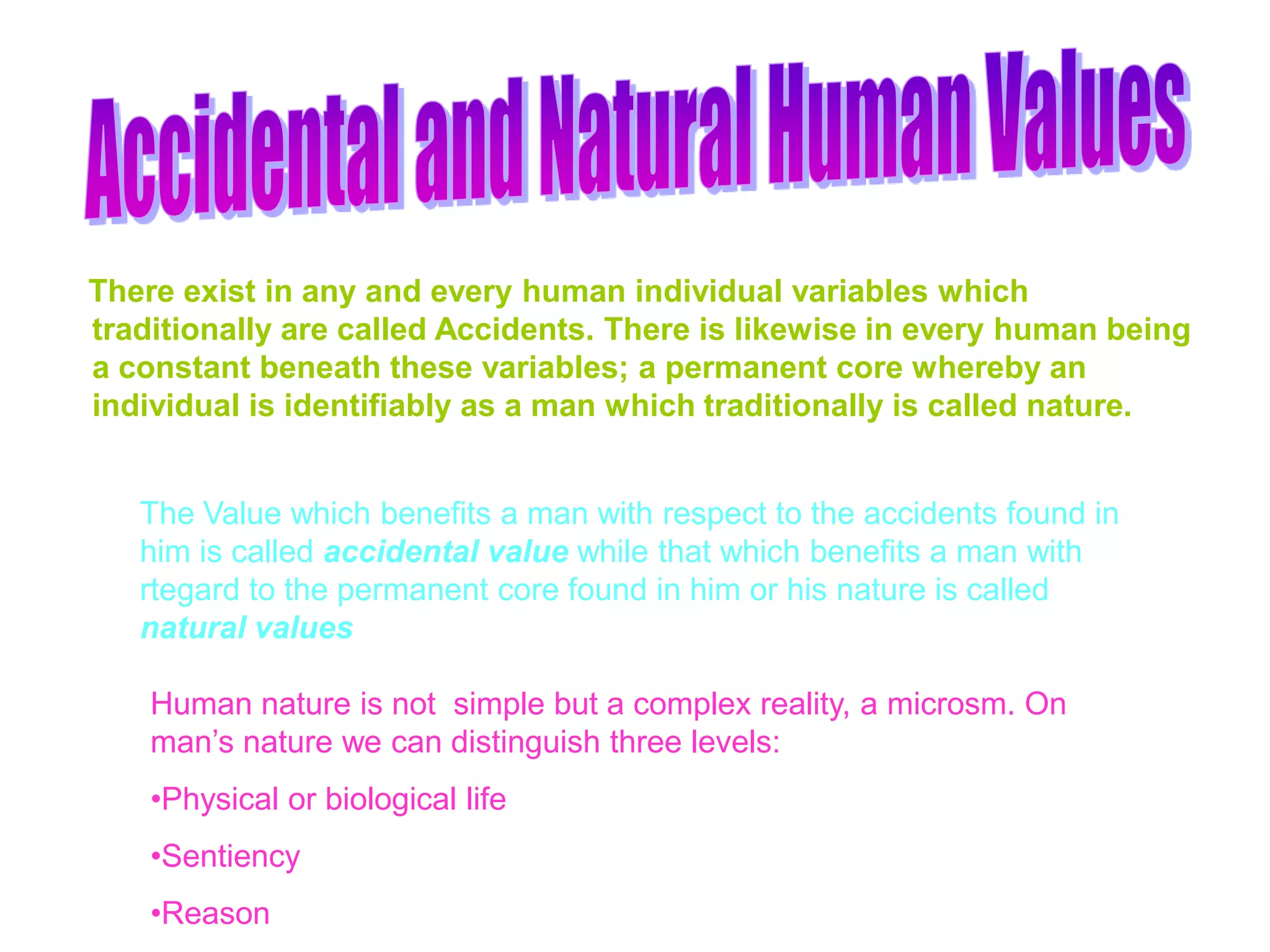
There exist in any and every human individual variables which
traditionally are called Accidents. There is likewise in every human being
a constant beneath these variables; a permanent core whereby an
individual is identifiably as a man which traditionally is called nature.
The Value which benefits a man with respect to the accidents found in
him is called accidental value while that which benefits a man with
rtegard to the permanent core found in him or his nature is called
natural values
Human nature is not simple but a complex reality, a microsm. On
man’s nature we can distinguish three levels:
•Physical or biological life
•Sentiency
•Reason
Primary Values are values that are chosen, acted upon and are
necessary for the authentic development of man.these are values
which help a human being to develop the best to develop the best of
his capacity and, as such, motive him to move him to move beyond
the normal functioning in society.
While it is true that there exists a wide range of values from which
each person may choose for himself, every society holds certain
values which its members must keep. Through long experience and
practice, society has determined values which are connsistently
necessary for the well-being of its members. Many values are
obligatory. These obligatory values are called Secondary Values.
Understanding value from the book of mrs. colon

Understanding value from the book of mrs. colon

  • 2.
    They are purevaluable essences or qualities; They are objective and transcend the sentimental perception to which they appeal; They are hierarchically given, dependent and relative among themselves and with the perceiver; They are always given in pairs, that is, the positive value always has its corresponding counter value.
  • 3.
    The non- indifferenceof value strengthens the transcendence which traditional philosophy attributes to supreme values of Good, Truth and Beauty, contained in different degrees in all being.
  • 4.
    Good for What? Goodfor Whom? •These two Questions can and must be asked of anything presented as good or Valuable demonstrates the fact that all good or value in this world are relative both to something and to somebody. •Values are relative to cultural influences and historical changes, in the sense that the appreciation of values is affected by these factors.
  • 5.
    It has justbeen pointed out that all value or good are relative. Now, In any relation there are three things to be considered: 1.That which is related to some other thing. The Latin technical for this I a quo, literally from which. 2. That to which the former is related or referred. The Latin technical term for this is ad quem, literally to which. 3. The basis of the relationship between the two terms, i.e. the reason why the term a qou is related to the term ad quem
  • 6.
    Values has an Absolutecharacter that is, it has an objectivity independent from human appreciation or judgment. Man is not creator of Value since value transcends the subject, nay, it transcends the world. Under this aspect we can say that absolute values exist in which the perspective of the Absolute appears, for we can find the realities of these values only in that Absolute and supra temporal Value. In this Supreme Value and by relating to it, our ideal values of Good, Beauty, Justice, etc.,
  • 7.
    •Value in its deepeststructure never goes alone but is accompanied by a counter value. •Every positive value has its corresponding negative value. •When we call something not good, not beautiful, not real, we are also recognizing values, this time through their opposites. •Values, therefo re, are both positive and negative.
  • 8.
    That is withinthe realm of values and among the different classes and groups there exists a hierarchy, a scaled graduation of values. Material and non- personal values are subordinate to spiritual and personal values respectively. This hierarchy is recognized by all and implies that some values are preferred or ought to be preferred to other values classified as inferior values. Personal values are preferred or ought to be preferred to non-personal values.
  • 9.
    Useful or Utilitariangood- A thing is useful when some other things are obtained through it. Pleasurable or delectable good- a thing is pleasurable when it provides pleasure to the subject. Note: that pleasure can be taken in two senses: a. Broadly- for any feeling of satisfaction. b. Specifically- for the special experience of delight.
  • 10.
    Instrumental Value is avalue or good strived for because of its worth to us and to others. Intrinsic values is a value that is either “good for” some being or “good of” some being. The former is what we call intrinsic value and the latter, instrumental value. Value is worthy of desire in either of two ways: 1. For its own sake; 2.For the sake of some other good An instrumental value presupposes something which is useful or advantagegeous, something which causes joy or hapiness, therefore, it must already include certain intrinsic value-qualitiesto be able to
  • 11.
    There exist inany and every human individual variables which traditionally are called Accidents. There is likewise in every human being a constant beneath these variables; a permanent core whereby an individual is identifiably as a man which traditionally is called nature. The Value which benefits a man with respect to the accidents found in him is called accidental value while that which benefits a man with rtegard to the permanent core found in him or his nature is called natural values Human nature is not simple but a complex reality, a microsm. On man’s nature we can distinguish three levels: •Physical or biological life •Sentiency •Reason
  • 12.
    Primary Values arevalues that are chosen, acted upon and are necessary for the authentic development of man.these are values which help a human being to develop the best to develop the best of his capacity and, as such, motive him to move him to move beyond the normal functioning in society. While it is true that there exists a wide range of values from which each person may choose for himself, every society holds certain values which its members must keep. Through long experience and practice, society has determined values which are connsistently necessary for the well-being of its members. Many values are obligatory. These obligatory values are called Secondary Values.