UNDERSTANDING THE  CHEMISTRY  OF ATOMS TO IONS www.sciencetutors.zoomshare.com
ATOMS TO IONS Contents of Slide Definitions of Atom Neutral Atom Examples of neutral atoms Electron configuration Ions Atoms to Ions Valence electrons Electron loss or gain  Quick Quiz Ionic compounds Task  Facts about Ionic Compounds www.sciencetutors.zoomshare.com
ATOMS   TO IONS www.sciencetutors.zoomshare.com
What is an ATOM? An ATOM is the smallest component of an element having the chemical properties of the element  www.sciencetutors.zoomshare.com
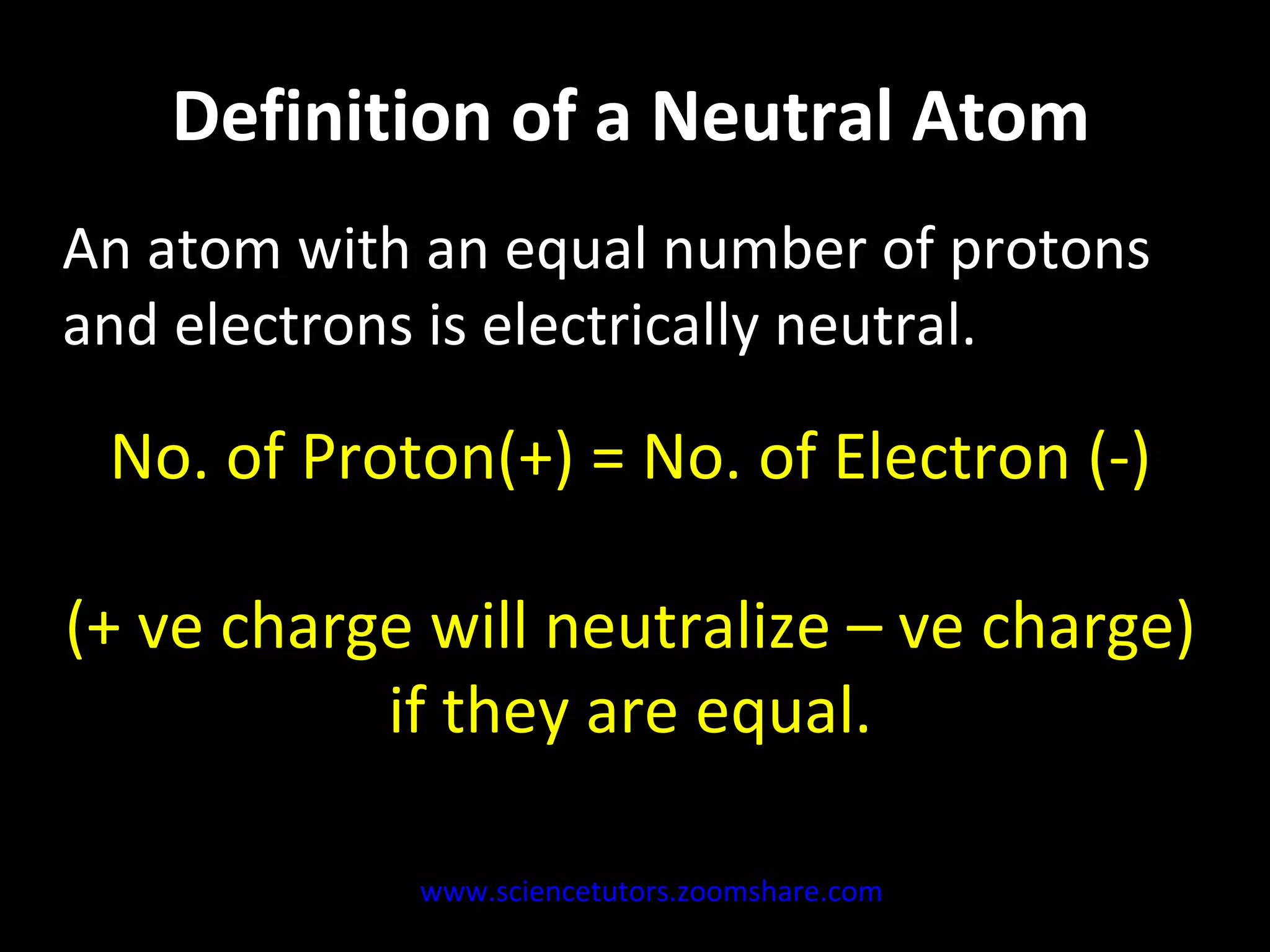
Definition of a Neutral Atom An atom with an equal number of protons and electrons is electrically neutral. No. of Proton(+) = No. of Electron (-) (+ ve charge will neutralize – ve charge) if they are equal. www.sciencetutors.zoomshare.com
Definition of a Neutral Atom No. of Proton(+) = No. of Electron (-) (+ ve charge will neutralize – ve charge) if they are equal . www.sciencetutors.zoomshare.com
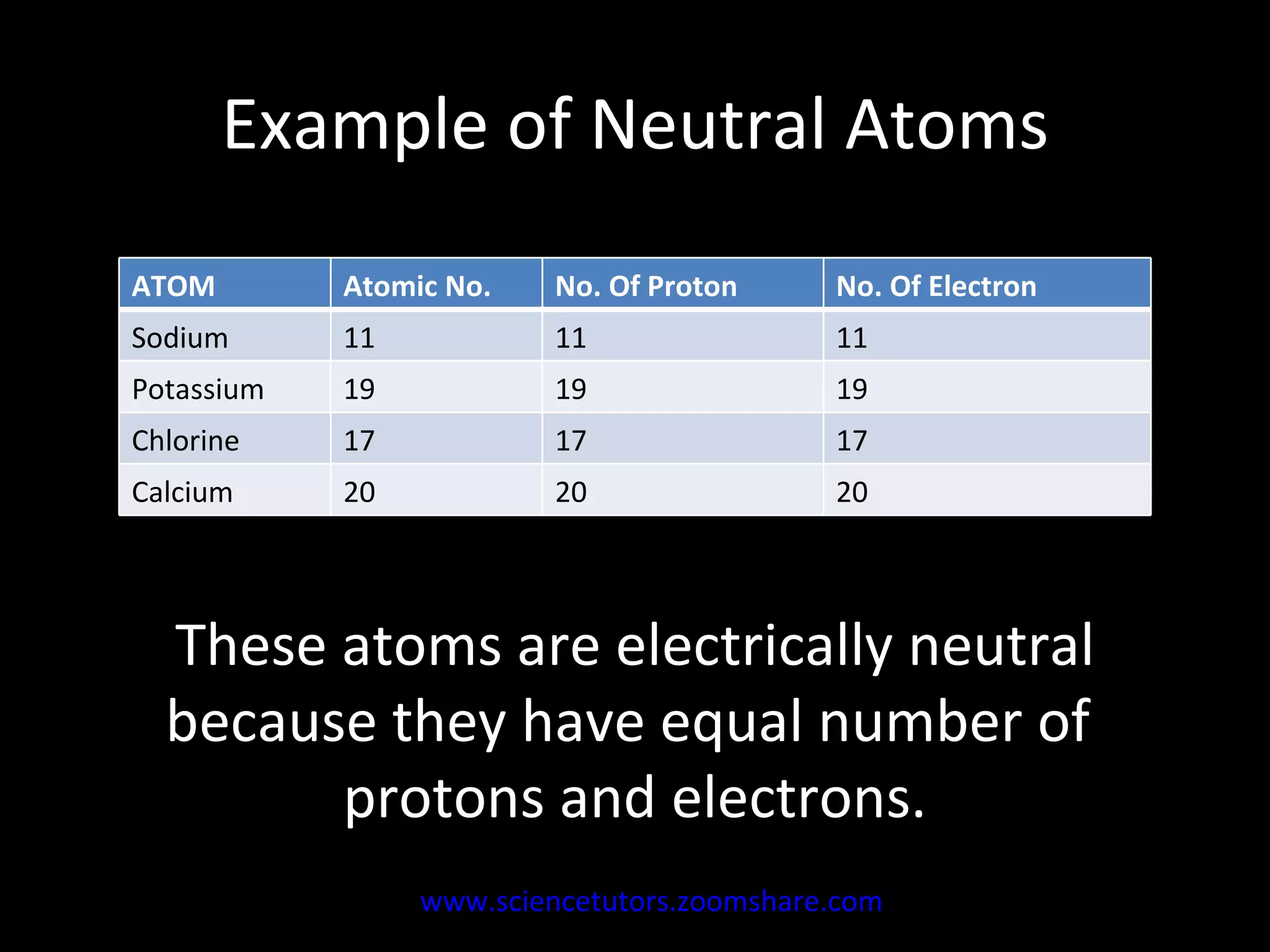
Example of Neutral Atoms These atoms are electrically neutral because they have equal number of  protons and electrons. www.sciencetutors.zoomshare.com   ATOM Atomic No. No. Of Proton No. Of Electron Sodium 11 11 11 Potassium 19 19 19 Chlorine 17 17 17 Calcium 20 20 20
Electron Configuration Electron configuration shows how the electrons are distributed among various atomic orbital of atoms and ions.  OR  The arrangement of electrons in an atom. www.sciencetutors.zoomshare.com
What is an Ion? An ion is an atom or molecule which has lost or gained one or more valence electrons, giving it a positive or negative electrical charge www.sciencetutors.zoomshare.com
Atoms to Ions Ions are formed by the loss or gain of electrons by single atoms or groups of atoms. www.sciencetutors.zoomshare.com
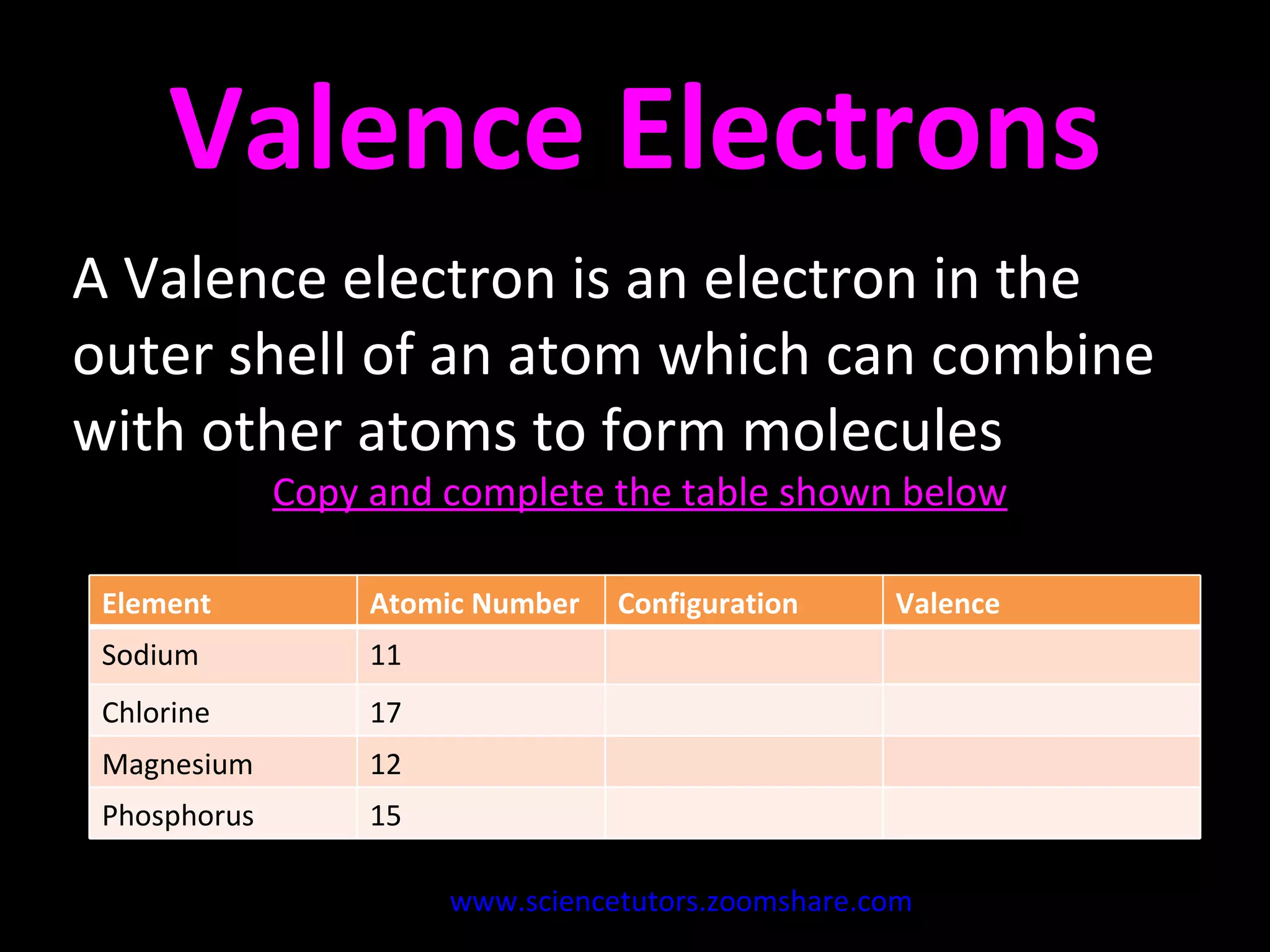
Valence Electrons A Valence electron is an electron in the outer shell of an atom which can combine with other atoms to form molecules  Copy and complete the table shown below www.sciencetutors.zoomshare.com   Element Atomic Number Configuration Valence Sodium 11 Chlorine 17 Magnesium 12 Phosphorus 15
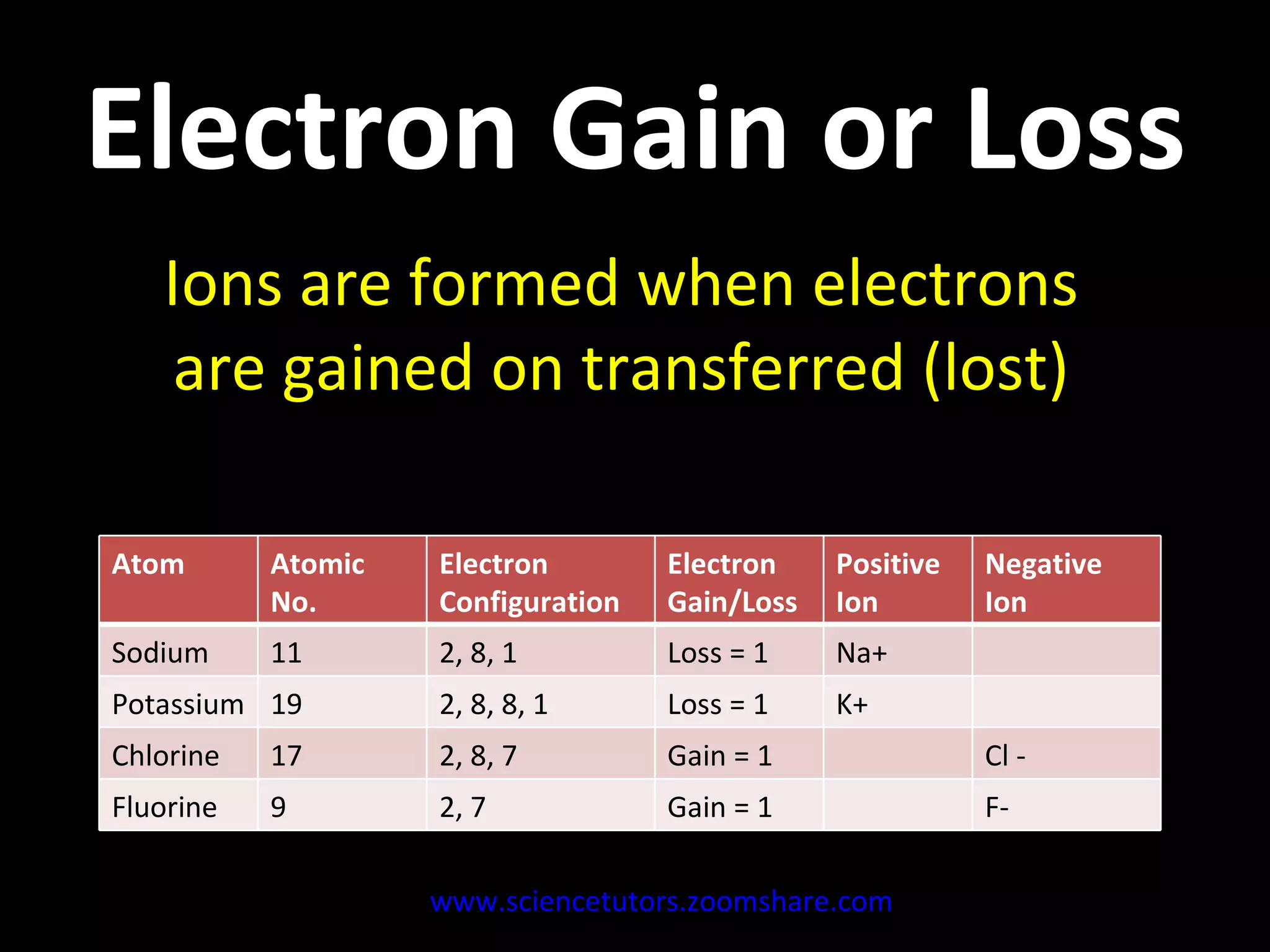
Electron Gain or Loss Ions are formed when electrons are gained on transferred (lost) www.sciencetutors.zoomshare.com   Atom Atomic No. Electron Configuration Electron Gain/Loss Positive Ion Negative Ion Sodium 11 2, 8, 1 Loss = 1 Na+ Potassium 19 2, 8, 8, 1 Loss = 1 K+ Chlorine 17 2, 8, 7 Gain = 1 Cl - Fluorine  9 2, 7 Gain = 1 F-
QUICK QUIZ State whether the following is true (T), False (F) or Not Sure (?) Ionic compounds are formed between metals and non metals.  The metals lose electrons and non metals gain them to get full shells. They are generally solids with high melting points  Not all ionic compounds are conductors ions in ionic compounds are held together in a lattice structure by ionic bonds www.sciencetutors.zoomshare.com
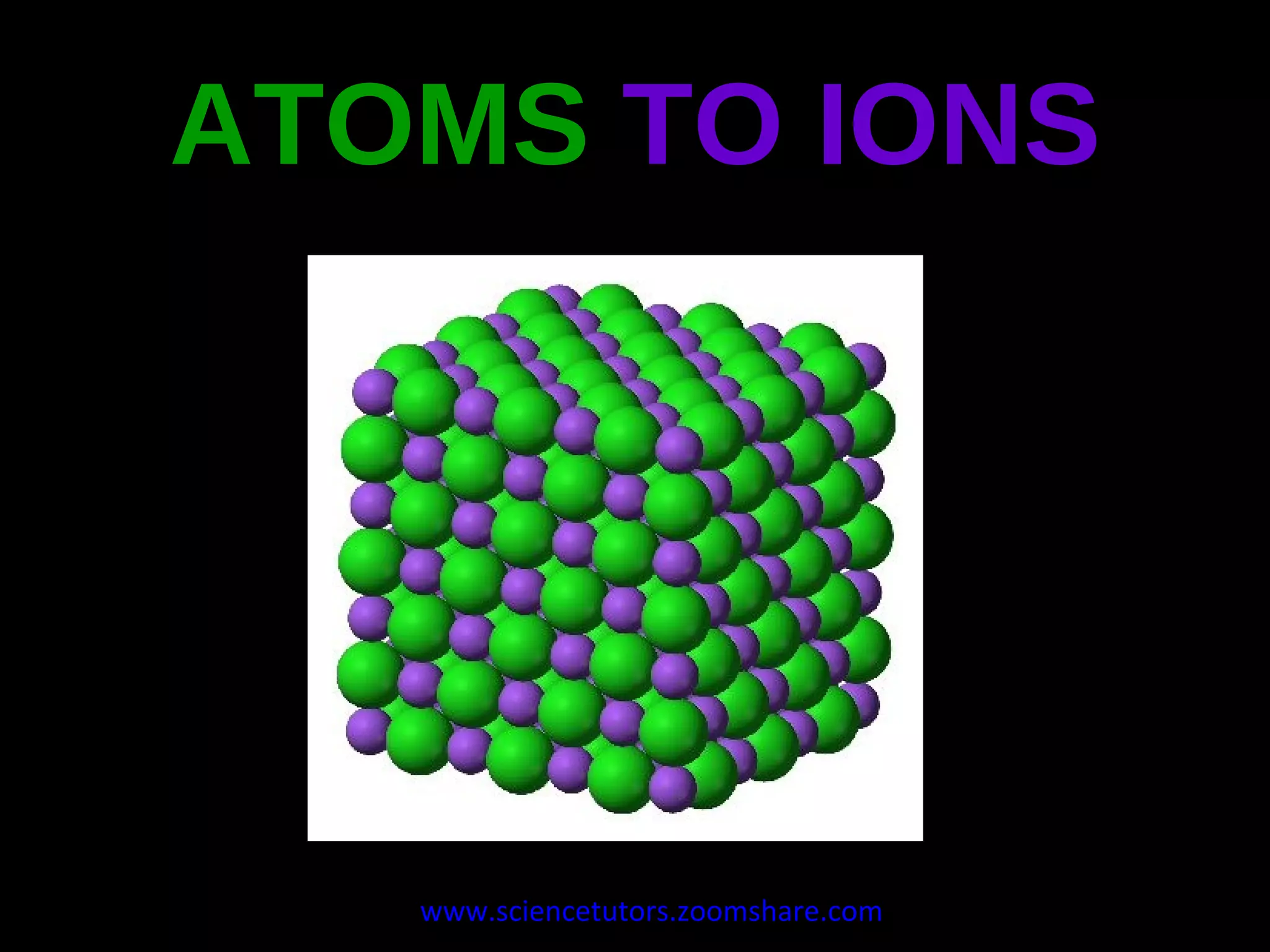
IONIC COMPOUNDS Chemical compounds that consist of charged positive and negative ions (opposite charges +ve and –ve) OR  An ionic compound is a chemical compound in which positive and negative ions are held together in a lattice structure by ionic bonds. www.sciencetutors.zoomshare.com
TASK 2 Make a list of all ionic compounds you have studied.  www.sciencetutors.zoomshare.com
Explain why ionic compounds are generally solids with high melting points and conduct electricity.  www.sciencetutors.zoomshare.com
Facts about Ionic Compounds Ionic compounds conduct electricity when they dissolve in water. Ionic compounds are very hard and very brittle. Ionic compounds tend to have high melting and boiling points.   All ionic compounds form crystals.
UNDERSTANDING THE  CHEMISTRY  OF ATOMS TO IONS www.sciencetutors.zoomshare.com
Visit   www.sciencetutors.zoomshare.com www.slideshare.net/sciencetutors   for more science resources

Understanding The Chemistry Of Atoms To Ions

  • 1.
    UNDERSTANDING THE CHEMISTRY OF ATOMS TO IONS www.sciencetutors.zoomshare.com
  • 2.
    ATOMS TO IONSContents of Slide Definitions of Atom Neutral Atom Examples of neutral atoms Electron configuration Ions Atoms to Ions Valence electrons Electron loss or gain Quick Quiz Ionic compounds Task Facts about Ionic Compounds www.sciencetutors.zoomshare.com
  • 3.
    ATOMS TO IONS www.sciencetutors.zoomshare.com
  • 4.
    What is anATOM? An ATOM is the smallest component of an element having the chemical properties of the element www.sciencetutors.zoomshare.com
  • 5.
    Definition of aNeutral Atom An atom with an equal number of protons and electrons is electrically neutral. No. of Proton(+) = No. of Electron (-) (+ ve charge will neutralize – ve charge) if they are equal. www.sciencetutors.zoomshare.com
  • 6.
    Definition of aNeutral Atom No. of Proton(+) = No. of Electron (-) (+ ve charge will neutralize – ve charge) if they are equal . www.sciencetutors.zoomshare.com
  • 7.
    Example of NeutralAtoms These atoms are electrically neutral because they have equal number of protons and electrons. www.sciencetutors.zoomshare.com ATOM Atomic No. No. Of Proton No. Of Electron Sodium 11 11 11 Potassium 19 19 19 Chlorine 17 17 17 Calcium 20 20 20
  • 8.
    Electron Configuration Electronconfiguration shows how the electrons are distributed among various atomic orbital of atoms and ions. OR The arrangement of electrons in an atom. www.sciencetutors.zoomshare.com
  • 9.
    What is anIon? An ion is an atom or molecule which has lost or gained one or more valence electrons, giving it a positive or negative electrical charge www.sciencetutors.zoomshare.com
  • 10.
    Atoms to IonsIons are formed by the loss or gain of electrons by single atoms or groups of atoms. www.sciencetutors.zoomshare.com
  • 11.
    Valence Electrons AValence electron is an electron in the outer shell of an atom which can combine with other atoms to form molecules Copy and complete the table shown below www.sciencetutors.zoomshare.com Element Atomic Number Configuration Valence Sodium 11 Chlorine 17 Magnesium 12 Phosphorus 15
  • 12.
    Electron Gain orLoss Ions are formed when electrons are gained on transferred (lost) www.sciencetutors.zoomshare.com Atom Atomic No. Electron Configuration Electron Gain/Loss Positive Ion Negative Ion Sodium 11 2, 8, 1 Loss = 1 Na+ Potassium 19 2, 8, 8, 1 Loss = 1 K+ Chlorine 17 2, 8, 7 Gain = 1 Cl - Fluorine 9 2, 7 Gain = 1 F-
  • 13.
    QUICK QUIZ Statewhether the following is true (T), False (F) or Not Sure (?) Ionic compounds are formed between metals and non metals. The metals lose electrons and non metals gain them to get full shells. They are generally solids with high melting points Not all ionic compounds are conductors ions in ionic compounds are held together in a lattice structure by ionic bonds www.sciencetutors.zoomshare.com
  • 14.
    IONIC COMPOUNDS Chemicalcompounds that consist of charged positive and negative ions (opposite charges +ve and –ve) OR An ionic compound is a chemical compound in which positive and negative ions are held together in a lattice structure by ionic bonds. www.sciencetutors.zoomshare.com
  • 15.
    TASK 2 Makea list of all ionic compounds you have studied. www.sciencetutors.zoomshare.com
  • 16.
    Explain why ioniccompounds are generally solids with high melting points and conduct electricity. www.sciencetutors.zoomshare.com
  • 17.
    Facts about IonicCompounds Ionic compounds conduct electricity when they dissolve in water. Ionic compounds are very hard and very brittle. Ionic compounds tend to have high melting and boiling points. All ionic compounds form crystals.
  • 18.
    UNDERSTANDING THE CHEMISTRY OF ATOMS TO IONS www.sciencetutors.zoomshare.com
  • 19.
    Visit www.sciencetutors.zoomshare.com www.slideshare.net/sciencetutors for more science resources