Understanding Technology Stakeholders:
Their Progress and Challenges
John M. Gilligan
Software Assurance Forum
November 4, 2009 1
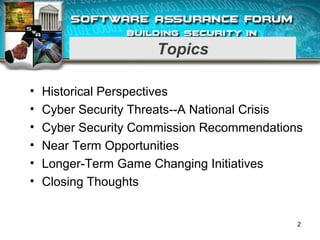
Topics
• Historical Perspectives
• Cyber Security Threats--A National Crisis
• Cyber Security Commission Recommendations
• Near Term Opportunities
• Longer-Term Game Changing Initiatives
• Closing Thoughts
2
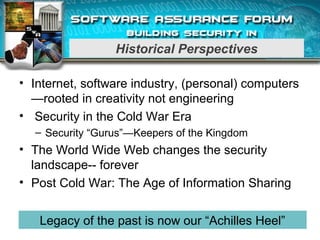
Historical Perspectives
• Internet, software industry, (personal) computers
—rooted in creativity not engineering
• Security in the Cold War Era
– Security “Gurus”—Keepers of the Kingdom
• The World Wide Web changes the security
landscape-- forever
• Post Cold War: The Age of Information Sharing
3Legacy of the past is now our “Achilles Heel”
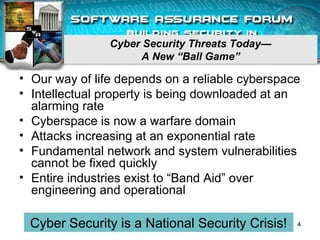
Cyber Security Threats Today—
A New “Ball Game”
• Our way of life depends on a reliable cyberspace
• Intellectual property is being downloaded at an
alarming rate
• Cyberspace is now a warfare domain
• Attacks increasing at an exponential rate
• Fundamental network and system vulnerabilities
cannot be fixed quickly
• Entire industries exist to “Band Aid” over
engineering and operational
Cyber Security is a National Security Crisis! 4
Commission Cyber Security for the 44th
Presidency:
Key Recommendations
• Create a comprehensive national security
strategy for cyberspace
• Lead from the White House
• Reinvent public-private partnerships
• Regulate cyberspace
• Modernize authorities
• Leverage government procurement (Supply
Chain Risk Management)
• Build on recent progress with CNCI
(comprehensive national cyber-security
initiative) 5
Use Government IT Procurement
• Cyber security needs to be reflected in our
contractual requirements
• Many “locked down” configuration defined
• Use government-industry partnership to
accelerate implementation of secure
configurations
• Get started now, improve configuration
guidelines over time and leverage SCAP!
6
Build on FDCC Successes and Lessons Learned
Longer-Term: IT Reliably Enabling Economy
• Change the dialogue: Reliable, resilient IT is
fundamental to future National Security and
Economic Growth
• New business model for software industry
• Redesign the Internet
• Get the “man out of the loop”—use
automated tools (e.g., SCAP)
• Develop professional cyberspace workforce
• Foster new IT services models
Need to Fundamentally “Change the Game” to Make Progress7
Security Content Automation Protocol (SCAP)
• What is it: A set of open standards that
allows for the monitoring, positive control,
and reporting of security posture of every
device in a network.
• How is it implemented: Commercial products
implement SCAP protocols to exchange and
enforce configuration, security policy, and
vulnerability information.
• Where is it going: Extensions in development
to address software design weaknesses,
attack patterns, and malware attributes.
8
SCAP Enables Automated Tools To Implement And Enforce Secure Operations
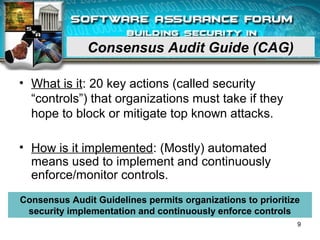
Consensus Audit Guide (CAG)
• What is it: 20 key actions (called security
“controls”) that organizations must take if they
hope to block or mitigate top known attacks.
• How is it implemented: (Mostly) automated
means used to implement and continuously
enforce/monitor controls.
Consensus Audit Guidelines permits organizations to prioritize
security implementation and continuously enforce controls
9
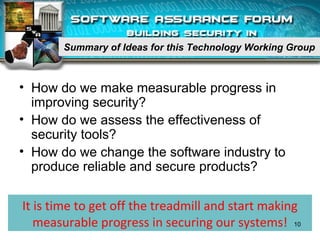
Summary of Ideas for this Technology Working Group
• How do we make measurable progress in
improving security?
• How do we assess the effectiveness of
security tools?
• How do we change the software industry to
produce reliable and secure products?
It is time to get off the treadmill and start making
measurable progress in securing our systems! 10
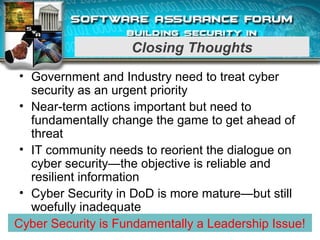
Closing Thoughts
• Government and Industry need to treat cyber
security as an urgent priority
• Near-term actions important but need to
fundamentally change the game to get ahead of
threat
• IT community needs to reorient the dialogue on
cyber security—the objective is reliable and
resilient information
• Cyber Security in DoD is more mature—but still
woefully inadequate
11Cyber Security is Fundamentally a Leadership Issue!
Contact Information
jgilligan@gilligangroupinc.com
www.gilligangroupinc.com
John M. Gilligan
12

Understanding Technology Stakeholders: Their Progress and Challenges

  • 1.
    Understanding Technology Stakeholders: TheirProgress and Challenges John M. Gilligan Software Assurance Forum November 4, 2009 1
  • 2.
    Topics • Historical Perspectives •Cyber Security Threats--A National Crisis • Cyber Security Commission Recommendations • Near Term Opportunities • Longer-Term Game Changing Initiatives • Closing Thoughts 2
  • 3.
    Historical Perspectives • Internet,software industry, (personal) computers —rooted in creativity not engineering • Security in the Cold War Era – Security “Gurus”—Keepers of the Kingdom • The World Wide Web changes the security landscape-- forever • Post Cold War: The Age of Information Sharing 3Legacy of the past is now our “Achilles Heel”
  • 4.
    Cyber Security ThreatsToday— A New “Ball Game” • Our way of life depends on a reliable cyberspace • Intellectual property is being downloaded at an alarming rate • Cyberspace is now a warfare domain • Attacks increasing at an exponential rate • Fundamental network and system vulnerabilities cannot be fixed quickly • Entire industries exist to “Band Aid” over engineering and operational Cyber Security is a National Security Crisis! 4
  • 5.
    Commission Cyber Securityfor the 44th Presidency: Key Recommendations • Create a comprehensive national security strategy for cyberspace • Lead from the White House • Reinvent public-private partnerships • Regulate cyberspace • Modernize authorities • Leverage government procurement (Supply Chain Risk Management) • Build on recent progress with CNCI (comprehensive national cyber-security initiative) 5
  • 6.
    Use Government ITProcurement • Cyber security needs to be reflected in our contractual requirements • Many “locked down” configuration defined • Use government-industry partnership to accelerate implementation of secure configurations • Get started now, improve configuration guidelines over time and leverage SCAP! 6 Build on FDCC Successes and Lessons Learned
  • 7.
    Longer-Term: IT ReliablyEnabling Economy • Change the dialogue: Reliable, resilient IT is fundamental to future National Security and Economic Growth • New business model for software industry • Redesign the Internet • Get the “man out of the loop”—use automated tools (e.g., SCAP) • Develop professional cyberspace workforce • Foster new IT services models Need to Fundamentally “Change the Game” to Make Progress7
  • 8.
    Security Content AutomationProtocol (SCAP) • What is it: A set of open standards that allows for the monitoring, positive control, and reporting of security posture of every device in a network. • How is it implemented: Commercial products implement SCAP protocols to exchange and enforce configuration, security policy, and vulnerability information. • Where is it going: Extensions in development to address software design weaknesses, attack patterns, and malware attributes. 8 SCAP Enables Automated Tools To Implement And Enforce Secure Operations
  • 9.
    Consensus Audit Guide(CAG) • What is it: 20 key actions (called security “controls”) that organizations must take if they hope to block or mitigate top known attacks. • How is it implemented: (Mostly) automated means used to implement and continuously enforce/monitor controls. Consensus Audit Guidelines permits organizations to prioritize security implementation and continuously enforce controls 9
  • 10.
    Summary of Ideasfor this Technology Working Group • How do we make measurable progress in improving security? • How do we assess the effectiveness of security tools? • How do we change the software industry to produce reliable and secure products? It is time to get off the treadmill and start making measurable progress in securing our systems! 10
  • 11.
    Closing Thoughts • Governmentand Industry need to treat cyber security as an urgent priority • Near-term actions important but need to fundamentally change the game to get ahead of threat • IT community needs to reorient the dialogue on cyber security—the objective is reliable and resilient information • Cyber Security in DoD is more mature—but still woefully inadequate 11Cyber Security is Fundamentally a Leadership Issue!
  • 12.