Cyber Security: Past and Future
John M. Gilligan
CERT’s 20th Anniversary Technical Symposium
Pittsburgh, PA
March 10, 2009
Topics
• Historical Perspectives
• Cyber Security Today--A National Crisis
• Cyber Security Commission Recommendations
• Near Term Opportunities
• Longer-Term Game Changing Initiatives
• Closing Thoughts
Historical Perspectives
• Computer Security in the Cold War Era
• Security “Gurus”—Keepers of the Kingdom
• The Internet changes the security landscape--
forever
• The Age of Information Sharing
• Omissions of the past are now our “Achilles
Heel”
Our Approaches To Providing Mission Enabling IT Are Stuck In The Past
Cyber Security Today—A New “Ball Game”
• Our way of life depends on a reliable cyberspace
• Intellectual property is being downloaded at an
alarming rate
• Cyberspace is now a warfare domain
• Attacks increasing at an exponential rate
• Fundamental network and system vulnerabilities
cannot be fixed quickly
• Entire industries exist to “Band Aid” over
engineering and operational weaknesses
Cyber Security is a National Security Crisis!
Commission Cyber Security for the 44th Presidency:
Key Recommendations
• Create a comprehensive national security
strategy for cyberspace
• Lead from the White House
• Reinvent public-private partnerships
• Regulate cyberspace
• Modernize authorities
• Leverage government procurement
• Build on recent progress with CNCI
Near-Term Opportunities
• Use government IT acquisitions to change IT
business model
• Enhance public-private partnerships
• Adopt the Consensus Audit Guidelines (CAG)
• Update FISMA
• Implement more secure Internet protocols
• Implement comprehensive, federated
authentication strategy
• Leverage Stimulus Package to improve cyber
security
Use Government IT Procurement
• Cyber security needs to be reflected in our
contractual requirements
• Many “locked down” configuration defined
• Use government-industry partnership to
accelerate implementation of secure
configurations
• Get started now, improve configuration
guidelines over time and leverage SCAP!
Build on FDCC Successes and Lessons Learned
Security Content Automation Protocol (SCAP)
• What is it: A set of open standards that allows for
the monitoring, positive control, and reporting of
security posture of every device in a network.
• How is it implemented: Commercial products
implement SCAP protocols to exchange and
enforce configuration, security policy, and
vulnerability information.
• Where is it going: Extensions in development to
address software design weaknesses, attack
patterns, and malware attributes.
SCAP Enables Automated Tools To Implement And Enforce Secure Operations
Enhance Public-Private Partnerships
• Most of our nation’s critical infrastructure is
owned by the private sector
• Much of our government-sponsored research
intellectual property is “protected” by industry
• Regulators need to guide/govern private
sector efforts
• Private and public sectors must act in
cooperation
– Defense Industrial Base (DIB): an excellent model
Protecting Government and Military Systems Is Not Sufficient
Implement Consensus Audit Guidelines (CAG)
• Underlying Rationale
– Let “Offense drive Defense”
– Focus on most critical areas
• CAG: Twenty security controls based on
attack patterns
• Emphasis on auditable controls and
automated implementation/enforcement
• Public comment period through March 25th
• Pilots and standards for tools later this year
Update FISMA
• Emphasize evaluating effectiveness of controls
vs. paper reviews
• Enhance authority and accountability of CISO
• Foster government leadership
– Independent, expert reviews
– Procurement standards
– Dynamic sharing of lessons learned
Near-Term Opportunities
• Use government IT acquisitions to change IT
business model
• Enhance public-private partnerships
• Adopt Consensus Audit Guidelines (CAG)
• Update FISMA
• Implement more secure Internet protocols
• Implement comprehensive, federated
authentication strategy
• Leverage Stimulus Package to improve cyber
security
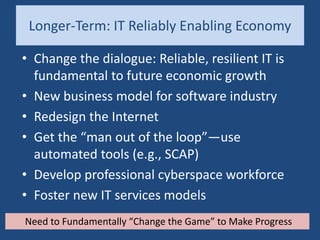
Longer-Term: IT Reliably Enabling Economy
• Change the dialogue: Reliable, resilient IT is
fundamental to future economic growth
• New business model for software industry
• Redesign the Internet
• Get the “man out of the loop”—use
automated tools (e.g., SCAP)
• Develop professional cyberspace workforce
• Foster new IT services models
Need to Fundamentally “Change the Game” to Make Progress
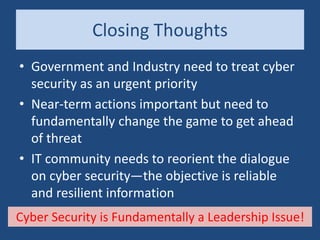
Closing Thoughts
• Government and Industry need to treat cyber
security as an urgent priority
• Near-term actions important but need to
fundamentally change the game to get ahead
of threat
• IT community needs to reorient the dialogue
on cyber security—the objective is reliable
and resilient information
Cyber Security is Fundamentally a Leadership Issue!
Contact Information
jgilligan@gilligangroupinc.com
www.gilligangroupinc.com
John M. Gilligan
16
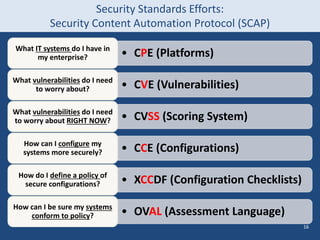
Security Standards Efforts:
Security Content Automation Protocol (SCAP)
• CPE (Platforms)What IT systems do I have in
my enterprise?
• CVE (Vulnerabilities)What vulnerabilities do I need
to worry about?
• CVSS (Scoring System)What vulnerabilities do I need
to worry about RIGHT NOW?
• CCE (Configurations)How can I configure my
systems more securely?
• XCCDF (Configuration Checklists)How do I define a policy of
secure configurations?
• OVAL (Assessment Language)How can I be sure my systems
conform to policy?
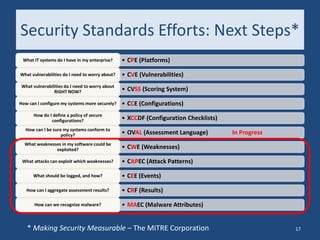
Security Standards Efforts: Next Steps*
17
• CPE (Platforms)What IT systems do I have in my enterprise?
• CVE (Vulnerabilities)What vulnerabilities do I need to worry about?
• CVSS (Scoring System)What vulnerabilities do I need to worry about
RIGHT NOW?
• CCE (Configurations)How can I configure my systems more securely?
• XCCDF (Configuration Checklists)How do I define a policy of secure
configurations?
• OVAL (Assessment Language) In ProgressHow can I be sure my systems conform to
policy?
• CWE (Weaknesses)What weaknesses in my software could be
exploited?
• CAPEC (Attack Patterns)What attacks can exploit which weaknesses?
• CEE (Events)What should be logged, and how?
• CRF (Results)How can I aggregate assessment results?
• MAEC (Malware Attributes)How can we recognize malware?
* Making Security Measurable – The MITRE Corporation

Cyber Security: Past and Future

  • 1.
    Cyber Security: Pastand Future John M. Gilligan CERT’s 20th Anniversary Technical Symposium Pittsburgh, PA March 10, 2009
  • 2.
    Topics • Historical Perspectives •Cyber Security Today--A National Crisis • Cyber Security Commission Recommendations • Near Term Opportunities • Longer-Term Game Changing Initiatives • Closing Thoughts
  • 3.
    Historical Perspectives • ComputerSecurity in the Cold War Era • Security “Gurus”—Keepers of the Kingdom • The Internet changes the security landscape-- forever • The Age of Information Sharing • Omissions of the past are now our “Achilles Heel” Our Approaches To Providing Mission Enabling IT Are Stuck In The Past
  • 4.
    Cyber Security Today—ANew “Ball Game” • Our way of life depends on a reliable cyberspace • Intellectual property is being downloaded at an alarming rate • Cyberspace is now a warfare domain • Attacks increasing at an exponential rate • Fundamental network and system vulnerabilities cannot be fixed quickly • Entire industries exist to “Band Aid” over engineering and operational weaknesses Cyber Security is a National Security Crisis!
  • 5.
    Commission Cyber Securityfor the 44th Presidency: Key Recommendations • Create a comprehensive national security strategy for cyberspace • Lead from the White House • Reinvent public-private partnerships • Regulate cyberspace • Modernize authorities • Leverage government procurement • Build on recent progress with CNCI
  • 6.
    Near-Term Opportunities • Usegovernment IT acquisitions to change IT business model • Enhance public-private partnerships • Adopt the Consensus Audit Guidelines (CAG) • Update FISMA • Implement more secure Internet protocols • Implement comprehensive, federated authentication strategy • Leverage Stimulus Package to improve cyber security
  • 7.
    Use Government ITProcurement • Cyber security needs to be reflected in our contractual requirements • Many “locked down” configuration defined • Use government-industry partnership to accelerate implementation of secure configurations • Get started now, improve configuration guidelines over time and leverage SCAP! Build on FDCC Successes and Lessons Learned
  • 8.
    Security Content AutomationProtocol (SCAP) • What is it: A set of open standards that allows for the monitoring, positive control, and reporting of security posture of every device in a network. • How is it implemented: Commercial products implement SCAP protocols to exchange and enforce configuration, security policy, and vulnerability information. • Where is it going: Extensions in development to address software design weaknesses, attack patterns, and malware attributes. SCAP Enables Automated Tools To Implement And Enforce Secure Operations
  • 9.
    Enhance Public-Private Partnerships •Most of our nation’s critical infrastructure is owned by the private sector • Much of our government-sponsored research intellectual property is “protected” by industry • Regulators need to guide/govern private sector efforts • Private and public sectors must act in cooperation – Defense Industrial Base (DIB): an excellent model Protecting Government and Military Systems Is Not Sufficient
  • 10.
    Implement Consensus AuditGuidelines (CAG) • Underlying Rationale – Let “Offense drive Defense” – Focus on most critical areas • CAG: Twenty security controls based on attack patterns • Emphasis on auditable controls and automated implementation/enforcement • Public comment period through March 25th • Pilots and standards for tools later this year
  • 11.
    Update FISMA • Emphasizeevaluating effectiveness of controls vs. paper reviews • Enhance authority and accountability of CISO • Foster government leadership – Independent, expert reviews – Procurement standards – Dynamic sharing of lessons learned
  • 12.
    Near-Term Opportunities • Usegovernment IT acquisitions to change IT business model • Enhance public-private partnerships • Adopt Consensus Audit Guidelines (CAG) • Update FISMA • Implement more secure Internet protocols • Implement comprehensive, federated authentication strategy • Leverage Stimulus Package to improve cyber security
  • 13.
    Longer-Term: IT ReliablyEnabling Economy • Change the dialogue: Reliable, resilient IT is fundamental to future economic growth • New business model for software industry • Redesign the Internet • Get the “man out of the loop”—use automated tools (e.g., SCAP) • Develop professional cyberspace workforce • Foster new IT services models Need to Fundamentally “Change the Game” to Make Progress
  • 14.
    Closing Thoughts • Governmentand Industry need to treat cyber security as an urgent priority • Near-term actions important but need to fundamentally change the game to get ahead of threat • IT community needs to reorient the dialogue on cyber security—the objective is reliable and resilient information Cyber Security is Fundamentally a Leadership Issue!
  • 15.
  • 16.
    16 Security Standards Efforts: SecurityContent Automation Protocol (SCAP) • CPE (Platforms)What IT systems do I have in my enterprise? • CVE (Vulnerabilities)What vulnerabilities do I need to worry about? • CVSS (Scoring System)What vulnerabilities do I need to worry about RIGHT NOW? • CCE (Configurations)How can I configure my systems more securely? • XCCDF (Configuration Checklists)How do I define a policy of secure configurations? • OVAL (Assessment Language)How can I be sure my systems conform to policy?
  • 17.
    Security Standards Efforts:Next Steps* 17 • CPE (Platforms)What IT systems do I have in my enterprise? • CVE (Vulnerabilities)What vulnerabilities do I need to worry about? • CVSS (Scoring System)What vulnerabilities do I need to worry about RIGHT NOW? • CCE (Configurations)How can I configure my systems more securely? • XCCDF (Configuration Checklists)How do I define a policy of secure configurations? • OVAL (Assessment Language) In ProgressHow can I be sure my systems conform to policy? • CWE (Weaknesses)What weaknesses in my software could be exploited? • CAPEC (Attack Patterns)What attacks can exploit which weaknesses? • CEE (Events)What should be logged, and how? • CRF (Results)How can I aggregate assessment results? • MAEC (Malware Attributes)How can we recognize malware? * Making Security Measurable – The MITRE Corporation